What does a ChatGPT rank tracker actually do? It checks, prompt by prompt, whether ChatGPT and other AI engines name your business when customers ask the questions that matter to you, how early in the answer you are named, and who is named ahead of you. There is no single position number like on Google; rank in an AI answer is an order of mention that gets rebuilt every time, so it only becomes reliable when each prompt is asked more than once.
When a business owner asks "where do I rank in ChatGPT?", they usually want to know three things: Am I mentioned at all, how prominently, and who is getting recommended instead of me? Traditional SEO rank trackers answer none of these directly, because an AI answer is a piece of text, not a results page. This is where AEO (answer engine optimization) comes in: the work of getting your business named in the answers that ChatGPT, Gemini, Perplexity and Google's AI Overviews and AI Mode give to customers. You will also see the same idea called GEO, short for generative engine optimization; here we use AEO. This guide explains what "rank" means inside an AI answer, what a ChatGPT rank tracker should measure, how to set up tracking yourself, and how Welda does it. If you would like a baseline first, a free AI visibility analysis of your website shows how AI systems read your site today and gives you a starting point.
What does "rank" mean in an AI answer?
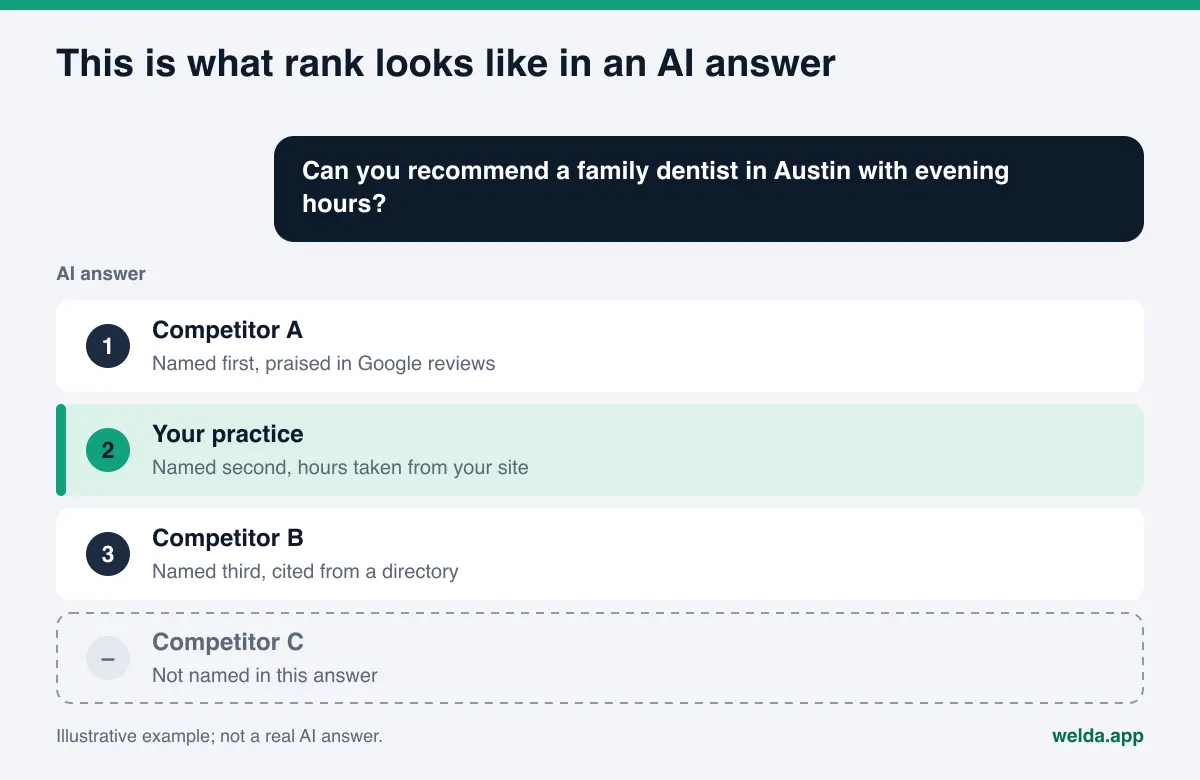
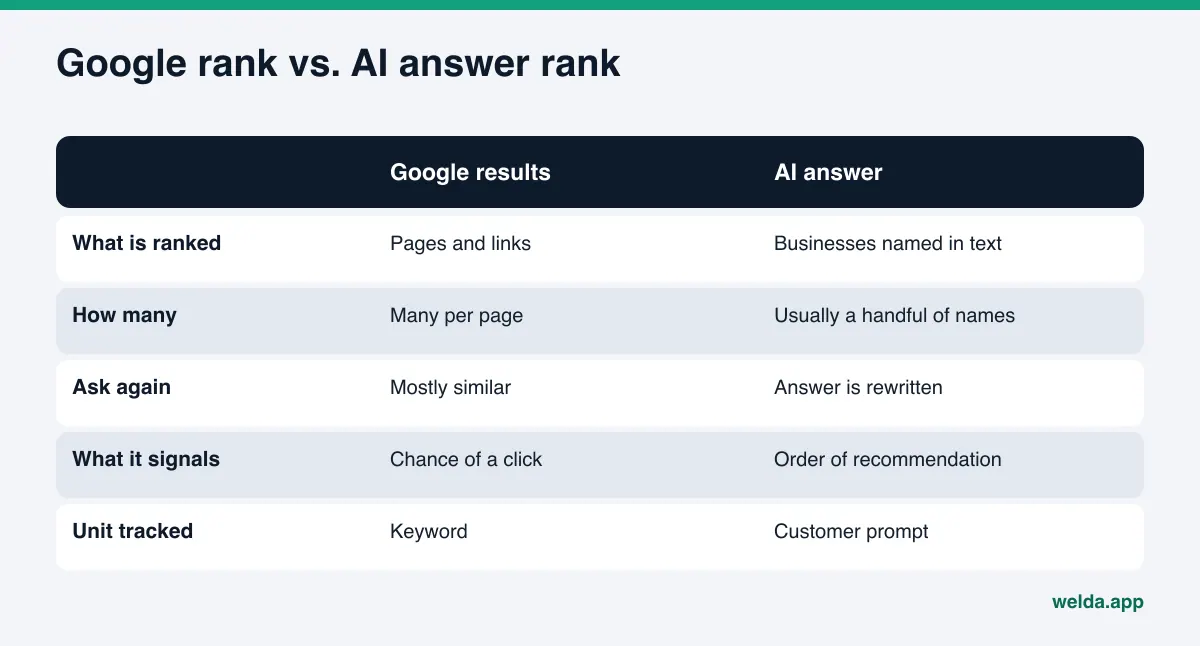
On Google, rank is a page's place in a list of results. The first link sits at the top; the tenth sits at the bottom of the page. AI answers do not work that way. A customer asks "Can you recommend a family dentist in Austin with evening hours?" and the engine writes a paragraph or a short list that names a few practices. Rank is the order in which businesses appear in that text.
That order matters, because the business named first sits in the most visible part of the answer and is often the one described with a reason. AI answers frequently explain a recommendation ("patients mention it is easy to get a same-week appointment"), while other businesses are named only in passing. So rank is not just a number. It is how you are recommended.
To read rank in an AI answer, look at four layers together:
- Mention: Are you named in the answer at all? If not, there is no rank to talk about.
- Position: If you are named, are you the first business, the third, or the last?
- Context: How are you described? With a positive reason, as a bare name, or with a caveat?
- Source: Where did the engine learn about you? Your own website, your Google Business Profile, Yelp, or an industry directory?
A ChatGPT rank tracker that does not show all four layers paints an incomplete picture. A report that simply says "you are #3" does not tell you why you are third or what would change it.
Why does your ChatGPT rank change every time you ask?
Ask ChatGPT the same question twice and you may get two different answers. This is not a bug; it is how these systems work. The answer is generated fresh each time, the sources found during a web search can differ from one moment to the next, and a small change in wording can bring different businesses to the front. That is why a single screenshot is a poor basis for saying "we are number one in ChatGPT" or "we never show up."
The main reasons rank moves around:
- Regenerated answers: The same prompt on the same engine can list names in a different order a few minutes later.
- Prompt wording: Phrases like "best," "affordable," "near me" or "open late" steer the answer toward different sources.
- Engine differences: ChatGPT, Gemini, Perplexity and Google AI lean on different sources. You can be second on one and missing on another. We cover this in more depth in our guide to Gemini visibility tracking.
- Access path: A prompt asked in the consumer app and one sent through an API do not always produce the same answer. We explain how tracking tools handle that in API vs. app answers in AI visibility tracking.
- Source updates: New reviews on a directory or a competitor refreshing their site will shift answers over time.
The practical takeaway is simple: rank only means something when every prompt is asked more than once. If you are second in two of three runs and fourth in the third, your median position is second, and the spread tells you the margin of error. A tracker that runs each prompt once gives you a snapshot, not a trend.
What should a ChatGPT rank tracker measure?
Plenty of products now describe themselves as AI rank trackers, and their marketing copy sounds almost identical. When you compare them, focus on the measurement method rather than the brand. The table below lists what a ChatGPT rank tracker should report and why each item matters for AEO.
| Measurement | What it shows | Why it matters |
|---|---|---|
| Mention per prompt | Whether you are named for each prompt | An overall percentage hides which prompts you are missing |
| Order of mention | Where in the answer you are named | The first business named sits in the most visible spot |
| Repeats and margin | How often each prompt is asked and how much results vary | A single answer can be chance |
| Engine breakdown | ChatGPT, Gemini, Perplexity and Google AI separately | Each engine relies on different sources |
| Competitor position | Who else is named in the same answer, and where | Rank is always relative to a competitor |
| Cited sources | The sites the engine pulled information from | Tells you where a fix needs to happen |
| Trend over time | Change across weeks on the same prompt list | The only way to see whether your work had an effect |
The last two rows are the ones most often overlooked. Rank data on its own tells you what happened. Why it happened, and what to do about it, sits in the source and competitor data. We explain the logic of measuring yourself against competitors in our article on AI share of voice.
How to set up ChatGPT rank tracking, step by step
Whether or not you use a tool, the logic of AI rank tracking is the same. A small business can start with nothing more than a spreadsheet.
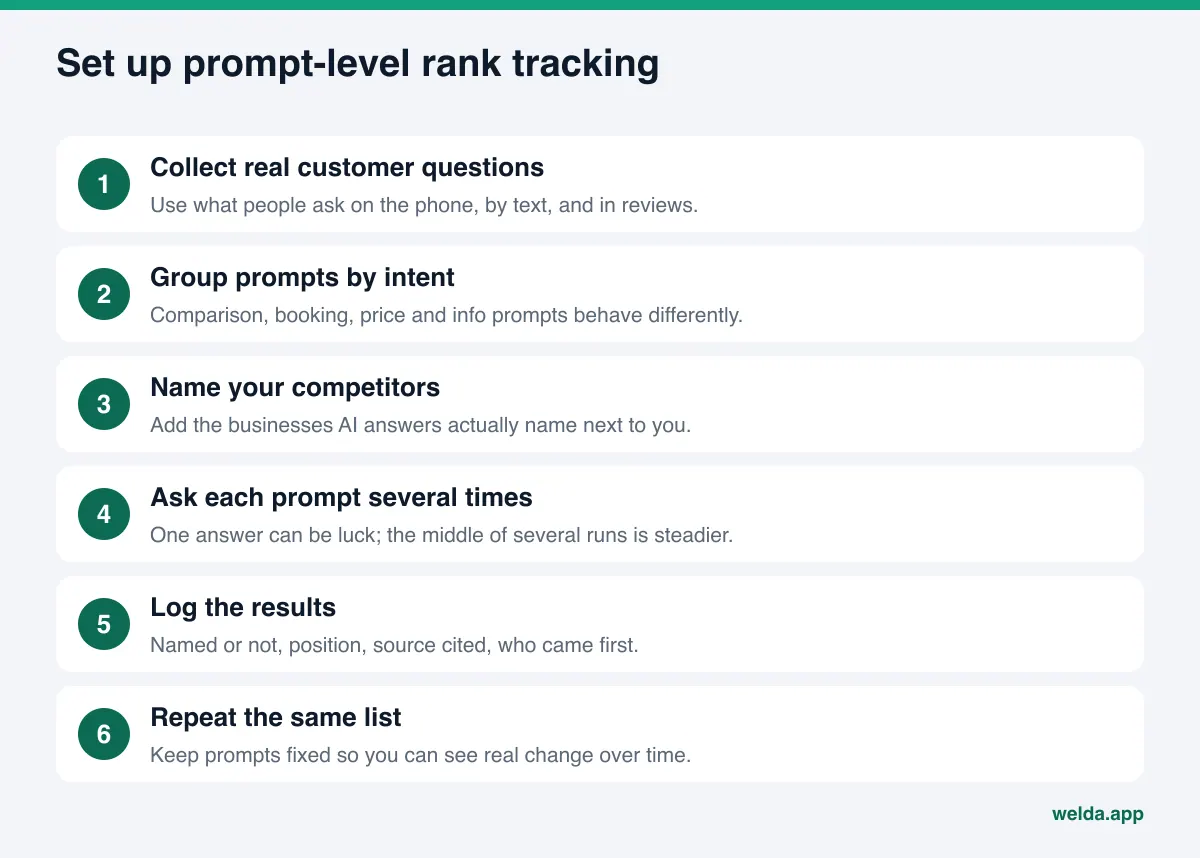
- Collect real customer questions. Write down what people ask on the phone, by text, by email and in reviews. Skip broad prompts like "best dentist in Texas" and use specific ones with a neighborhood and a need, such as "family dentist in South Austin open Saturdays" or "emergency plumber in Brooklyn that takes credit cards." Fifteen to thirty prompts is plenty to start.
- Group prompts by intent. Comparison prompts ("which is better"), booking prompts, price prompts and information prompts behave differently. Tracking them as separate groups shows you where you are weak.
- List your competitors by name. The competitors you have in mind and the businesses AI answers actually name next to you are not always the same. Add any names that show up in your first round.
- Ask each prompt on each engine several times. At least three runs give you a much more reliable median than one. Open a new chat each time so earlier conversation does not color the answer, and stay signed out or use a clean account where you can.
- Log results in a fixed sheet. For every prompt you need: engine, run number, named or not, position, first business named, source cited, date.
- Repeat the same list on a schedule. If you keep changing prompts, you cannot see change. Keep the core list fixed and add new prompts as a separate group.
- Pick one action after every round. Tracking that never produces a task only produces reports. Start with the prompt group where you lose most often, and with the source your competitor is cited from there.
The weak point of doing this by hand is effort. Twenty prompts on four engines, three runs each, is 240 answers per round. Reading each one and logging position, competitors and sources takes hours, which is why most people do the first round and quit before the second. A ChatGPT rank tracker exists to take over exactly this repetitive part.
Manual tracking or a tool?
Tracking by hand is a good teacher. Asking the first few prompts yourself is the fastest way to see how AI engines describe your industry and which sources they trust. For ongoing tracking, though, the limits show up quickly.
| Criterion | Manual tracking | AEO tracking tool |
|---|---|---|
| Getting started | Immediately, in a spreadsheet | Needs a prompt list and competitor setup |
| Runs per prompt | Usually one, because of effort | A fixed number every time |
| Engines covered | Mostly ChatGPT only | Several engines in the same round |
| Personal bias | Your account history may color answers | Asked under the same conditions |
| Records over time | Hand-kept sheet, easy to break | Weekly trend and before-and-after view |
| Source and competitor analysis | Read every answer yourself | Summarized by prompt and competitor |
The decision is usually straightforward. If AEO is new to you, do the first round by hand to learn how answers behave, then move to a tool for regular tracking. For a full list of features worth checking, see our guide to AEO tool features.
How Welda tracks your rank in ChatGPT and other AI engines
Welda is software that measures where a business appears in AI answers and fills in what is missing on the business's behalf. Rank tracking sits at the center of the measurement side of the Welda dashboard. One thing to be clear about up front: the dashboard is in early access and is opening first to businesses in Turkey. Regular measurement across all four engines is being added during early access, and the dashboard views described below are shown with illustrative data. The part anyone can use today, in English, is the free website analysis. Here are the three pieces that matter most for rank tracking.
Prompt-by-prompt view: every prompt, every engine, every run
In Welda, rank is not one blended number. It is shown prompt by prompt. Each row is a customer question, and the columns are ChatGPT, Gemini, Perplexity and Google AI. Each cell shows your position on that engine, and an empty cell means you were not named. You can filter by intent (booking, comparison, information) and by engine. Prompts can be tracked in English or Turkish.
Open a prompt and you see the detail behind the number: your position on each engine, which businesses the answer named and with what reasoning, the result of each of the three runs and their median, and the sources the engine cited. If you were missing once and named twice at different positions, you see that plainly instead of an averaged rank that hides it. The question "is our spot on this prompt solid, or is it luck?" is answered on screen.
The decision you make here is usually this: Which prompts are you missing entirely, and which are you on but low? They call for different work. A prompt where you never appear usually points to a missing fact, such as a service not clearly described on your site or no profile on a source the engine relies on. A prompt where you appear low calls for a look at where the competitor ahead of you draws its strength.
The score formula: how much does rank weigh?
Welda's score is calculated with a published formula, and position is one part of it. Half the score comes from the share of prompts where you are named, 30 percent from the position score, and 20 percent from your share relative to competitors. Because every prompt runs three times on each engine, the spread across runs gives a ± margin of error.
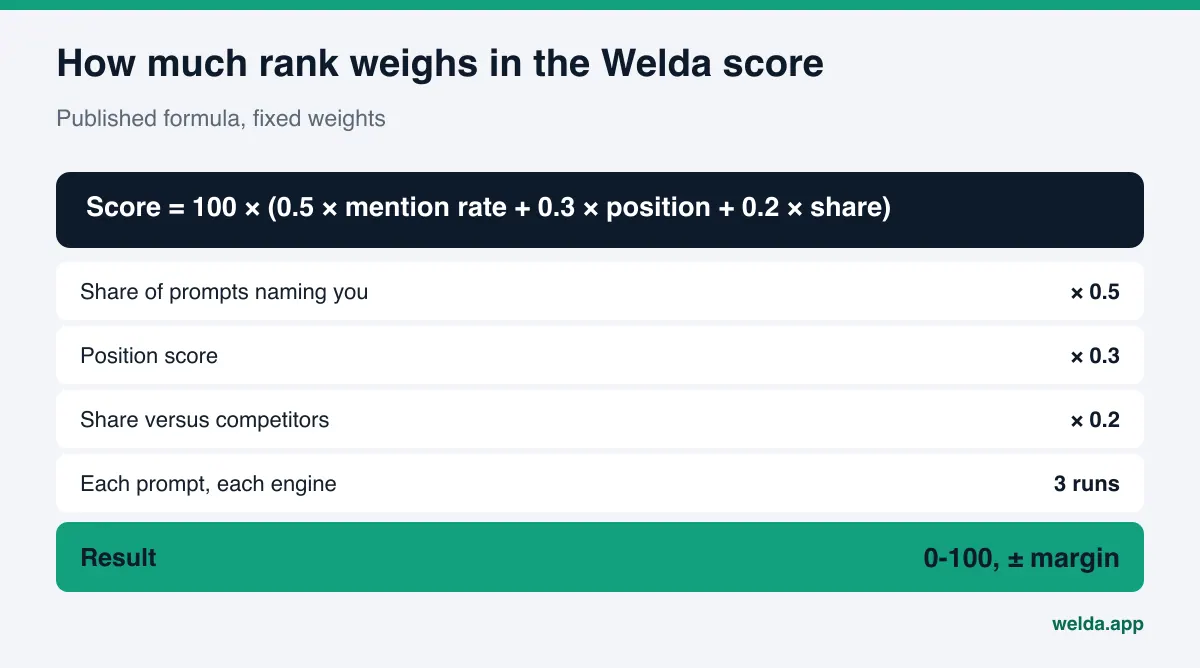
The weighting has a practical meaning: first get named, then move up. For a business that is missing from ten prompts, closing those gaps moves the score more than fighting for first place on prompts where it already appears. If you are wondering what range to aim for, read what is a good AI visibility score.
Competitor view: who is named ahead of you, and why?
Rank only makes sense relative to someone else. The competitor view shows how often each competitor is named across the same prompt list, their share of all mentions, and the engine where they are strongest. More useful still, it shows which topic a competitor wins on and which source it is cited from. If a competitor beats you on a cluster of prompts and is cited from Yelp or a booking site for that topic, your profile and facts on that source are the first place to look.
After measuring, Welda moves on to the second half of the job. It drafts the content, profile copy and review responses needed to close the gaps and puts them on a single to-do list. You approve what gets published, and the content lives on your own website. You can then follow how a prompt's rank changes after that work in a before-and-after view and in a one-page monthly report.
Until the dashboard is open to you, the free website analysis is the piece you can use today. It reads your site the way AI systems do, lists what is missing and how to fix it, and also asks an AI assistant with web search 5 questions your customers might ask, then checks whether your business name appears in the answers. That is a one-time check, not rank tracking, but it gives you a first answer to "are we named at all?"
How to read rank data: an example scenario
Here is an example to make it concrete. An example independent hotel tracks a list of 20 prompts before the summer season. The first round looks like this: it is named in about half of the booking prompts, mostly in second or third place. It does not appear on any honeymoon prompts. On pool and breakfast prompts, it is named first on one engine. These values are illustrative and do not belong to a real business.
Three mistakes are common when reading a table like this. The first is treating first place on one engine as overall success. The second is ignoring a prompt group where you never appear while chasing first place where you already do well. The third is reacting to a small drop in a single round and rewriting pages every week.
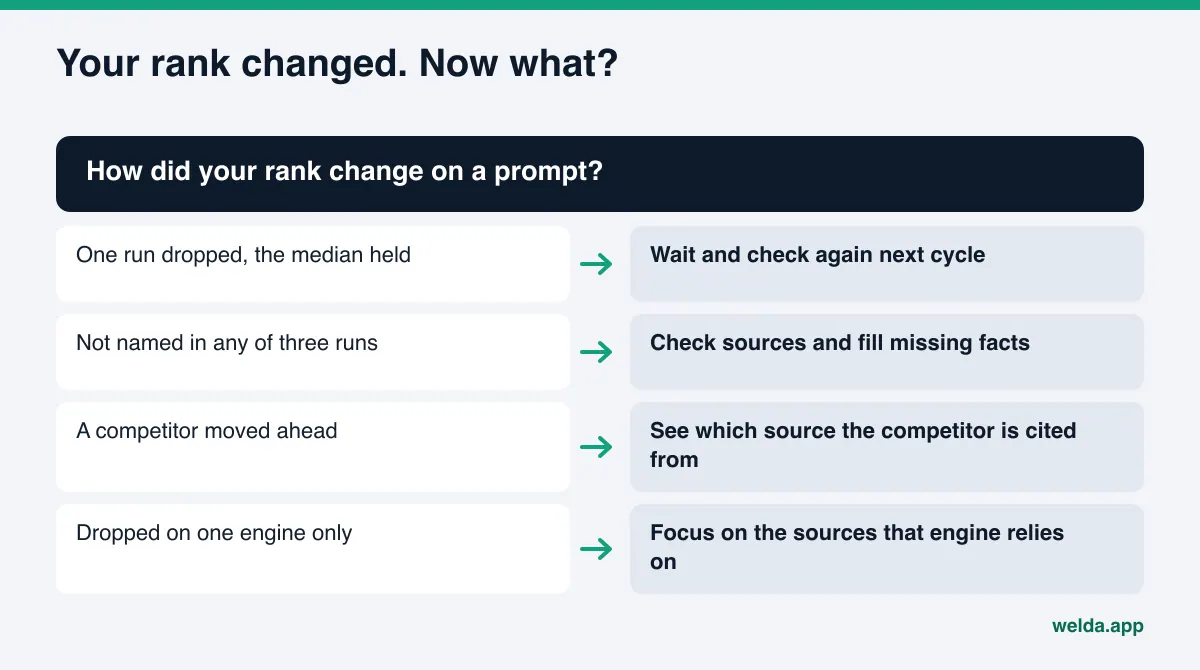
The better reading goes like this. Missing from every honeymoon prompt is the biggest loss, because the heaviest part of the score is mention rate. So look at which sources the competitors named on those prompts are cited from. If the hotel's site has no clear honeymoon page, or its Google Business Profile and Tripadvisor listing never mention that offer, that is the first task. The second- and third-place booking prompts come next. Where one competitor stays ahead, check its review presence and whether it has a clear FAQ page answering the same questions.
The order of work follows from that. In the first month the missing honeymoon facts are filled in, and the new page and profile copy go up for approval. In the following rounds the same 20 prompts are asked again under the same conditions. If the hotel starts getting named on honeymoon prompts, the mention rate rises, and attention shifts to the booking prompts. The result is a plan that focuses on one prompt group a month and can be measured.
When you react to a rank change, remember the margin of error. If the median of three runs did not move, a drop in a single run is noise, not a signal. If the median moves in the same direction over several rounds, then it is worth looking for a cause. If you are also tracking how your brand is described, not only where it is ranked, see our guide to AI brand monitoring tools.
Limits: what rank tracking cannot tell you, and what Welda does not do
Rank tracking is a strong signal, but it does not tell you everything. Knowing the limits up front keeps you from misreading the data.
- Not every customer sees the same answer. Location, chat history and exact wording change the result. A tracker shows answers to prompts asked under controlled conditions, not what each individual customer sees.
- Rank is not clicks or customers. Being named second does not tell you how many calls or bookings it produced. That requires tracking where leads come from separately.
- You only track what you ask. If the prompt list does not match how customers really talk, the rank data will not reflect reality either.
- Change takes time. New content usually takes weeks to show up in AI answers. Expecting a rank change within a week will mislead you.
Welda's limits are just as clear. Welda does not guarantee a rank or a spot in ChatGPT; nobody can honestly promise that, because the engine writes the answer. It does not make up facts it does not know; it asks the business. It does not create fake reviews. It does not publish sensitive content without your approval. Handling negative reviews, managing directory accounts such as Yelp or BBB, and press outreach stay with the business; Welda only helps with drafted replies or lists them as tasks. When you describe your business online, the FTC's rules on endorsements and truthful claims still apply, and that responsibility stays with you. The free website analysis does not measure rank either; it shows how ready your site is and runs a one-time prompt check.
ChatGPT rank tracker checklist
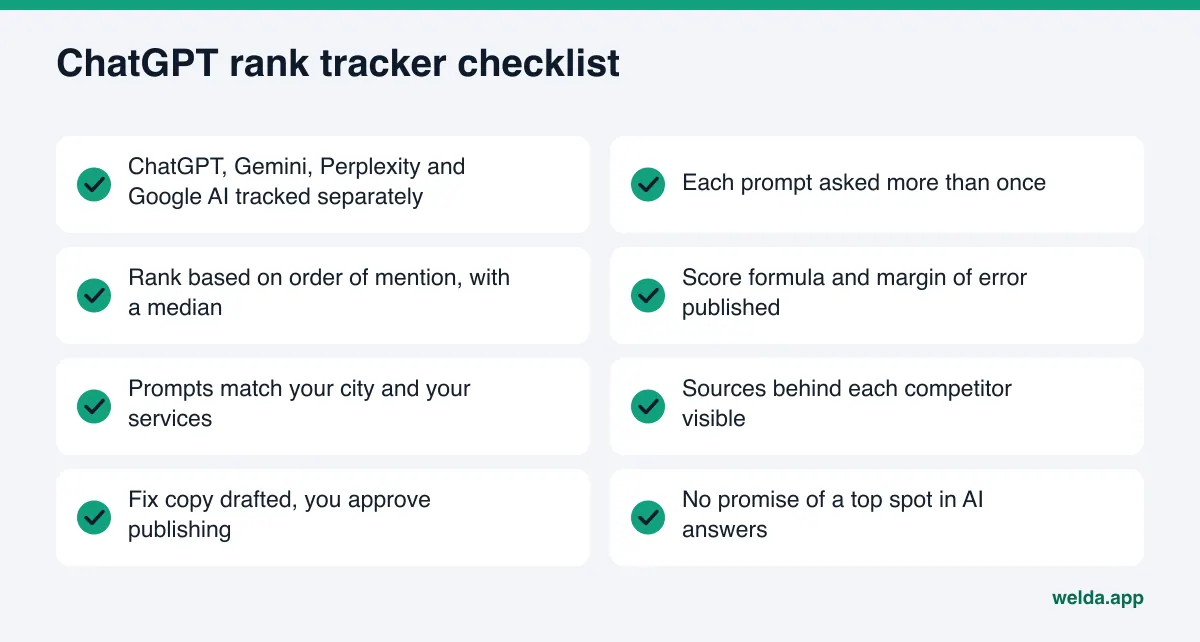
When you sit through a demo or set up your own tracking, ask for a written answer to each of these questions. Any item that stays vague will make the rank data harder to trust later.
| Question | The answer you want |
|---|---|
| Which engines are actually queried? | Gemini, Perplexity and Google AI as well as ChatGPT, each reported separately |
| How many times is each prompt asked? | More than once, with the spread shown |
| How is rank calculated? | Order of mention in the answer, median across runs |
| Is the score formula published? | Weights and margin of error in writing |
| Are prompts specific to your city and industry? | Real customer language, not generic prompts |
| Can you see which source a competitor wins from? | Cited sites by prompt and by competitor |
| Who does the work after measuring? | Drafted copy, published only with your approval |
| Is a top spot guaranteed? | No; a vendor that guarantees it is not explaining its method |
Frequently asked questions
Does ChatGPT have rankings like Google?
No. ChatGPT writes an answer, not a list of results. Rank is the order in which businesses are named in that answer, and it can change when the same prompt is asked again.
Can I check my ChatGPT rank for free?
Yes, by hand. Open a new chat for each prompt, ask it several times, and log the results in a spreadsheet. Welda's free website analysis checks whether you are named for 5 prompts in a one-time test; it does not track rank.
Why do I get a different result every time I ask?
Answers are generated fresh each time, and if the engine searches the web, the sources it finds can change. That is why reliable tracking asks each prompt several times and looks at the median.
How many prompts should I track?
For a small business, 15 to 30 real customer questions is a good start. The number matters less than whether the prompts use your customers' real words and include details like neighborhood, service and price.
Do I need to be ranked first?
No. In Welda's formula, the largest part of the score comes from the share of prompts where you are named at all. Closing prompts where you are missing is usually worth more than moving up one spot on prompts where you already appear.
Can I use the Welda dashboard in the US?
The dashboard is in early access and is opening first to businesses in Turkey. Pricing is discussed in the early access conversation. What you can use today from anywhere is the free website analysis, which works in English.
How long does it take for my rank to change?
There is no fixed timeline. New or corrected content usually takes weeks to show up in AI answers, so measure the same prompt list regularly and do not react to one round's movement.
Where to start with AI rank tracking
ChatGPT rank tracking starts by breaking "where do I rank?" into better questions: Which prompts am I named on, how prominently, who is named ahead of me, and where does that competitor get its strength? Those four answers lead to far more useful work than a single position number. As a first step, run the free AI visibility analysis to see how AI systems read your site and what is missing. You get a score, a fix for each gap, and the result of the 5-prompt check, and you can request early access to the Welda dashboard from there.