What is AI share of voice, and how do you measure it? AI share of voice is the portion of all business mentions in AI answers that go to you, across the questions your customers actually ask ChatGPT, Gemini, Perplexity and Google's AI features. You measure it with a fixed question set, several engines and repeated runs. It tells you more than "do I show up": it tells you where you stand against the competitors sharing the same short list.
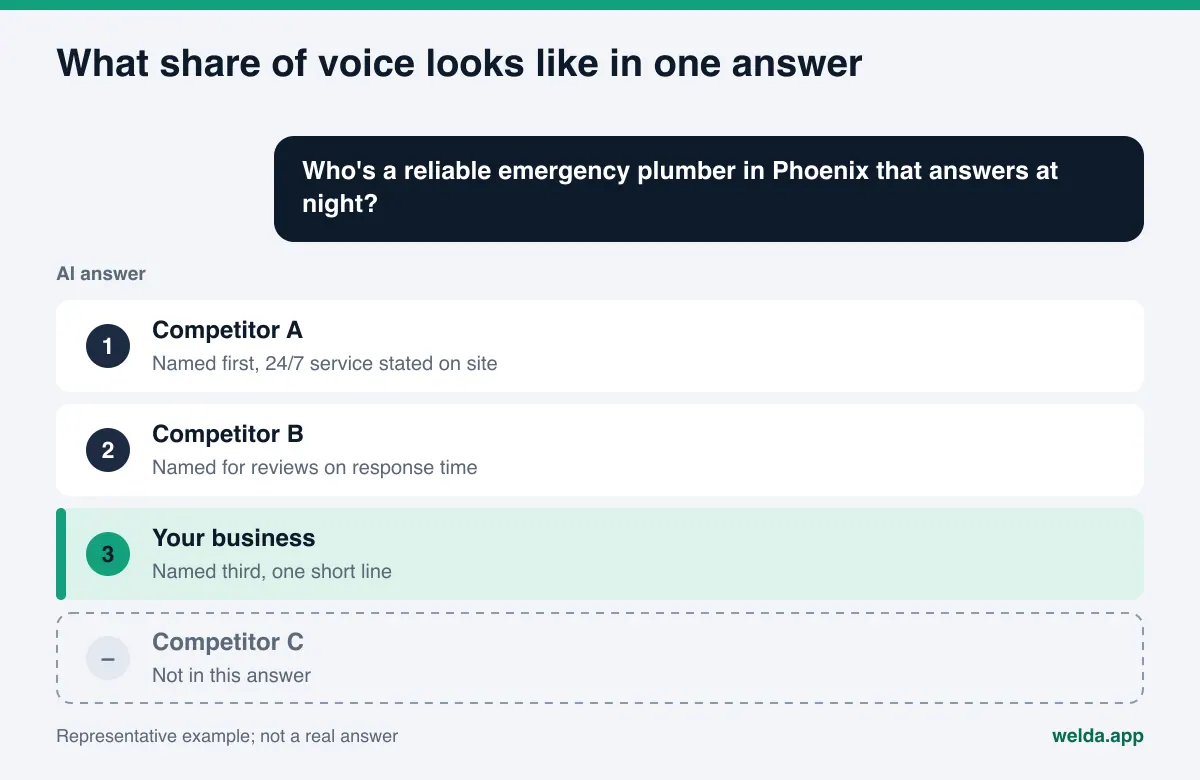
Share of voice is an old marketing metric. Ad teams have long used it to compare how much a brand is seen or talked about relative to its category. In AI search there is only one voice that matters: the assistant writing the answer. When someone asks "Who's a reliable emergency plumber in Phoenix that answers at night?", the answer usually names three to five companies. How often you appear on those lists, in what position and next to whom adds up to your AI share of voice. The broader discipline is called AEO (answer engine optimization) in the US; you will also see it called GEO, generative engine optimization, which means the same thing. Share of voice is one of the most useful numbers on the measurement side of AEO. If you want to see how AI systems read your site today, run the free site analysis. Below we walk through how to calculate share of voice yourself and how Welda measures it.
Why AI share of voice matters for a local or small business
In classic search, a customer scans ten blue links and clicks a few. In an AI answer there is often nothing to click. The customer reads the answer and remembers one or two names. That makes "am I on the list" an important question, but not a sufficient one. If a competitor is named first in nearly every answer and you appear fourth in a handful, both of you are technically "visible." Only one of you is being remembered.
AI share of voice makes that gap measurable. It answers three practical questions at once:
- Of all the businesses AI names for my customers' questions, what fraction of those mentions are mine?
- Who is taking the rest, and on which topics are they ahead of me?
- Over time, is share moving toward me or away from me?
For an owner or a small marketing team, each answer leads to a decision. Low share on one topic tells you which page or profile to work on next. Rising share after a change tells you the change is working. And because it is a single percentage, it is easy to put in front of leadership; we cover how to frame it in AEO reporting for executives.
Share of voice vs. mention rate vs. position
Three AI visibility metrics get mixed up constantly. They come from the same set of answers but answer different questions.
| Metric | The question it answers | How it is calculated | What it misses |
|---|---|---|---|
| Mention rate | In how many questions do I appear? | Questions where your name appears at least once, divided by all questions | How often competitors appear alongside you |
| Position | When I appear, where am I on the list? | Your average place in the list of named businesses | Questions where you are not named at all |
| AI share of voice | What is my slice of all mentions? | Your mentions divided by mentions of every business | Whether a mention is positive or negative |
A 50 percent mention rate sounds healthy. But if two competitors are named in every one of those same answers, your share of voice is below a third. The reverse also happens: a business that appears in few answers, but often as the only option, can have a higher share than its mention rate suggests. Read all three together.
There is a fourth signal worth tracking separately: citations. Some engines link to source pages under the answer. Being cited as a source and being named as a recommendation are different things. For share of voice, count named mentions. Keep citations in their own column, because they show which sources are feeding which competitor.
How to calculate AI share of voice, step by step
You can calculate AI share of voice by hand. The method is simple; the hard part is applying it the same way every time. Here is a setup a small business can build in an afternoon.
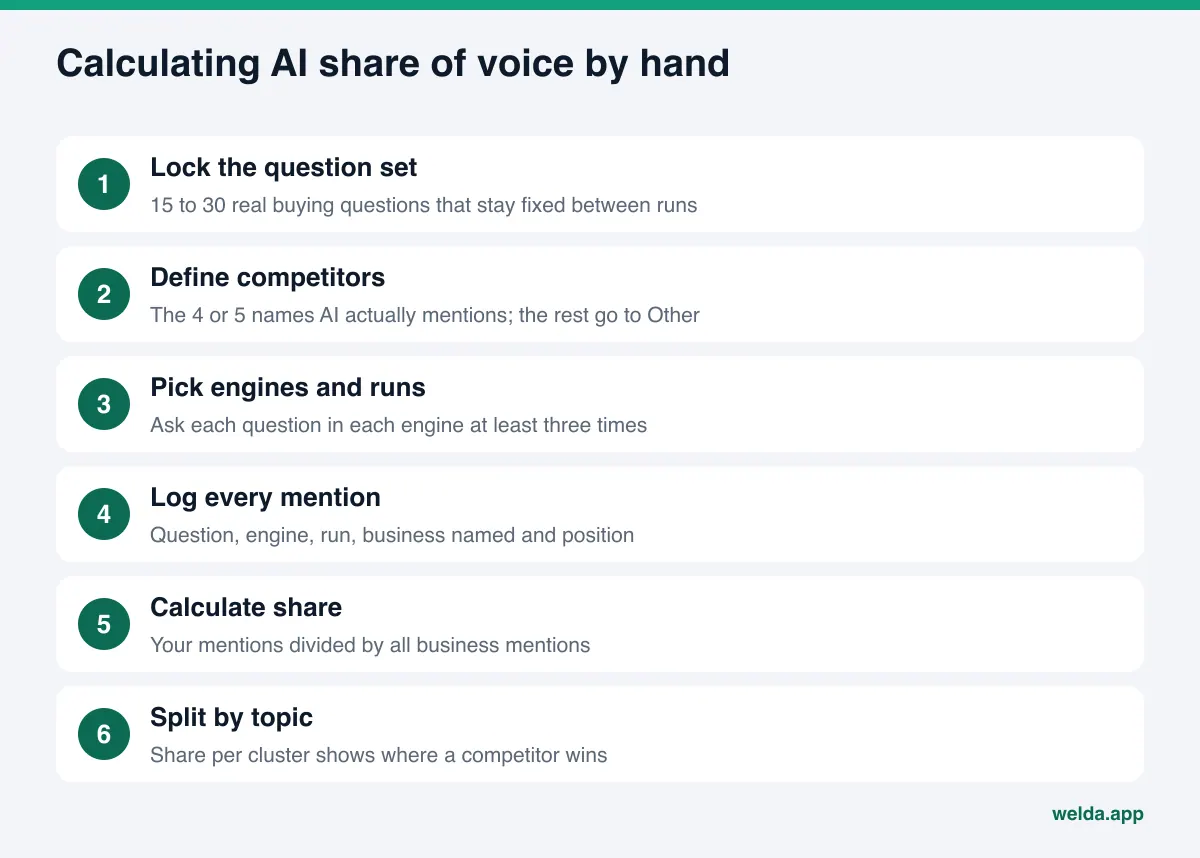
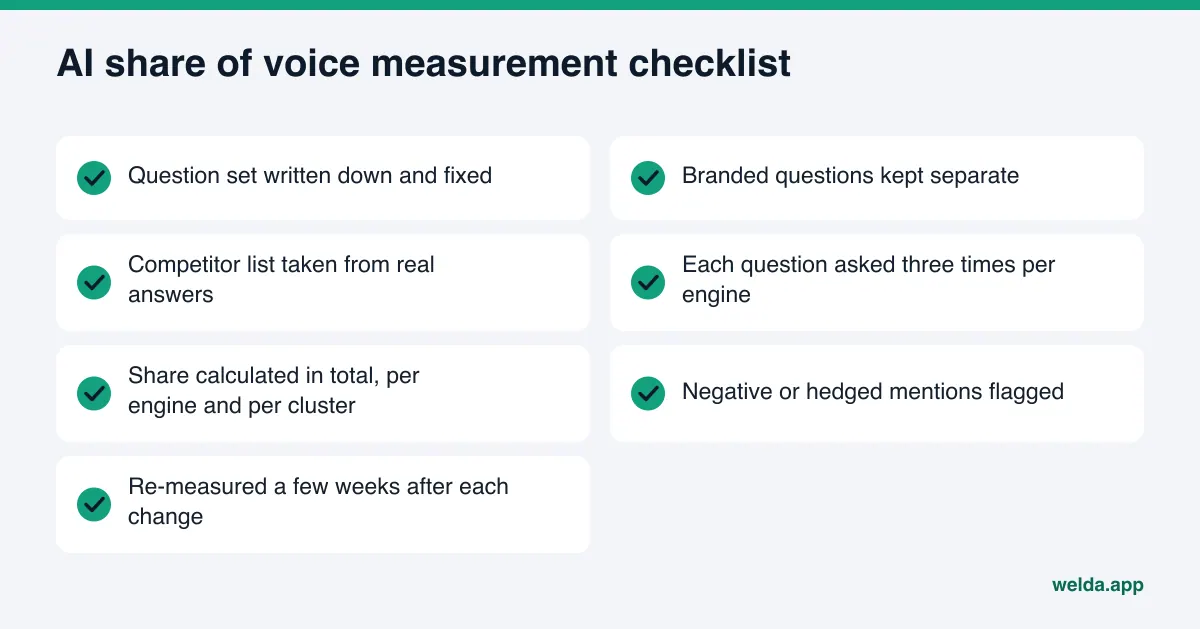
- Lock your question set. Write 15 to 30 questions a real customer would ask when choosing a provider. Mix service, location, budget and comparison questions: "Best-rated water heater repair in Mesa", "Plumber in Scottsdale who gives upfront quotes", "Is it better to repair or replace a 12-year-old water heater, and who can do it this week?" Do not change the list between runs, or you lose the ability to compare.
- Define your competitor list from the answers. Do not start from the competitors you assume you have. Run the questions once, see who AI actually names, and lock the four or five most frequent names. Everyone else goes into an "Other" bucket.
- Choose engines and repetitions. Ask every question in ChatGPT, Gemini, Perplexity and Google's AI features. Ask each one at least three times per engine. AI answers vary even for the same prompt; a single answer can be a lucky or unlucky draw.
- Log every mention. Use a spreadsheet with columns for question, engine, run, business named and position.
- Calculate share. Divide your total mentions by the total mentions of all businesses. Repeat for each competitor.
- Split by topic. Group questions into clusters, such as emergency service, pricing, water heaters or a specific suburb, and calculate share per cluster. This is where you see exactly where a competitor wins.
The weak point of the manual method is labor and consistency. Twenty questions, four engines and three runs is 240 answers per measurement. Logged-in history, location and account settings can also shift results when you ask by hand. We compare when manual checks are enough and when a tool earns its keep in manual ChatGPT checks vs tracking tools.
Reading the numbers: a worked example
The numbers below are entirely illustrative and do not belong to any real business. Picture an example plumbing company in the Phoenix area that ran 20 questions across four engines, three times each, and logged 200 business mentions in total.
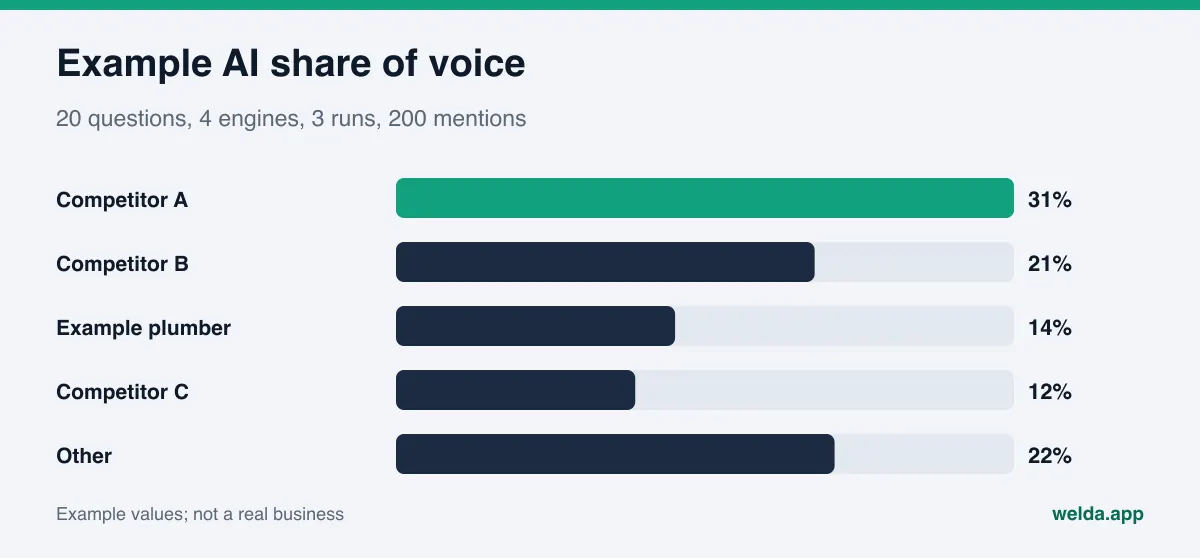
In this example, the company holds 14 percent share of voice. Competitor A leads with 31 percent. The total alone suggests a broad problem. The cluster view tells a sharper story: the company leads on "water heater" questions, but it is never named for "emergency, after-hours" questions, where Competitor A dominates. The fix is not a vague "improve AI visibility." It is concrete: a page that states after-hours availability, service area and response process in plain text, and matching hours on Google Business Profile, Yelp and Angi.
Three reading rules come out of this:
- Do not chase the total. Share by topic cluster tells you which page to write.
- A large "Other" bucket means your competitor list is incomplete. If a new name keeps showing up, add it and note the date, since changing the list breaks comparison with earlier runs.
- Ignore small swings. If your three runs disagree a lot, a one-point move is noise, not a trend.
Common ways AI share of voice gets distorted
Share of voice is easy to compute and easy to misread. These are the patterns that inflate or deflate it.
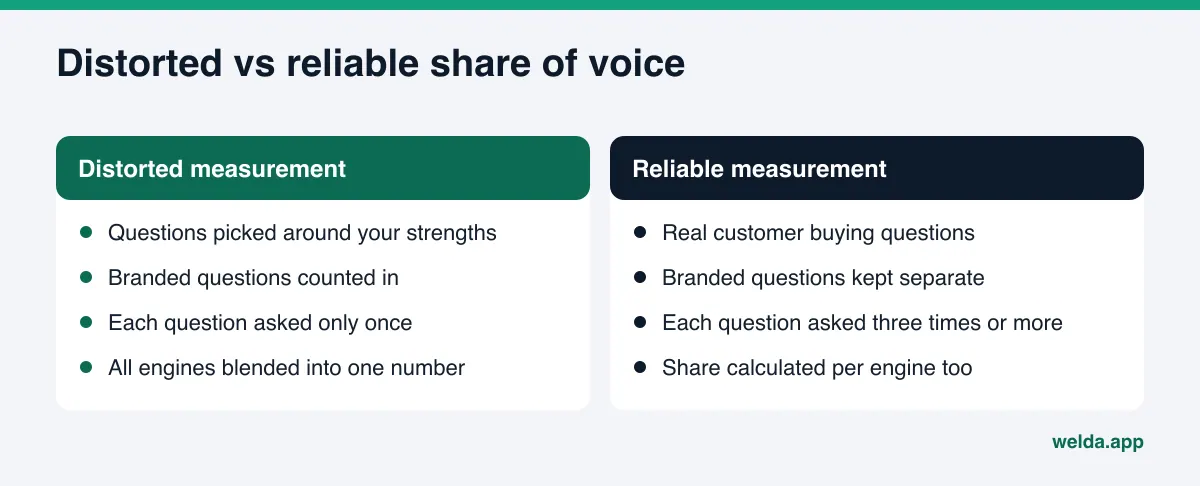
A question set built around your strengths. If every question is about something you already do well, your share looks great and means little. Build the list from real customer calls, emails and form submissions, and include topics where you are weak.
Branded questions mixed in. "Is [your company] any good?" will almost always mention you. Keep branded questions in a separate set. Share of voice should count only the choice questions where a customer has not decided yet.
All engines blended into one number. You might be strong in Perplexity and invisible in Google's AI features. A blended total hides that. Calculate share per engine too; the engine where a competitor is strongest hints at which sources are feeding it.
Tone ignored. An answer might say "some reviewers mention long wait times." That is a mention, but not a good one. Flag negative or hedged mentions next to your share number.
Location ignored. For a local business, "plumber in Phoenix" and "plumber in Tempe" bring different competitors. If you serve several cities or suburbs, measure them separately; we cover the setup in local AI rank tracking.
How to win back AI share of voice from competitors
Share of voice is an outcome. You do not change it directly; you change what AI systems can read about you. When share is low, this order of work tends to pay off:
- Find the cluster you are losing. Splitting share by topic usually exposes one or two clusters where a competitor dominates. Start there.
- Check whether your site answers that topic clearly. If customers ask about after-hours service and your site never says "after-hours," AI has nothing to match. State the service, conditions and who it is for in plain text.
- Look at the sources feeding the competitor. Answers may draw on Google Business Profile, Yelp, Angi, BBB or local "best of" lists. If your profile there is missing or thin, fixing it can matter as much as your own site.
- Make your facts consistent. Name, address, phone, hours and service names should match across your site and every profile. Conflicting details give AI a reason to leave you out.
- Re-measure with the same questions. New content usually takes weeks to show up in AI answers. Measure again a few weeks after the change and compare against your baseline; see before and after AEO measurement for how to set that up cleanly.
How Welda measures AI share of voice
In Welda, share of voice is not a separate report. It is built into the visibility score, and the formula is public: 100 × (0.5 × the share of questions where your name appears + 0.3 × position score + 0.2 × share against competitors). That last term is the share of voice described in this article. It carries the smallest weight on purpose. Being named comes first, position second, relative share third. Your score does not rise just because competitors are weak, but your standing against them still counts.
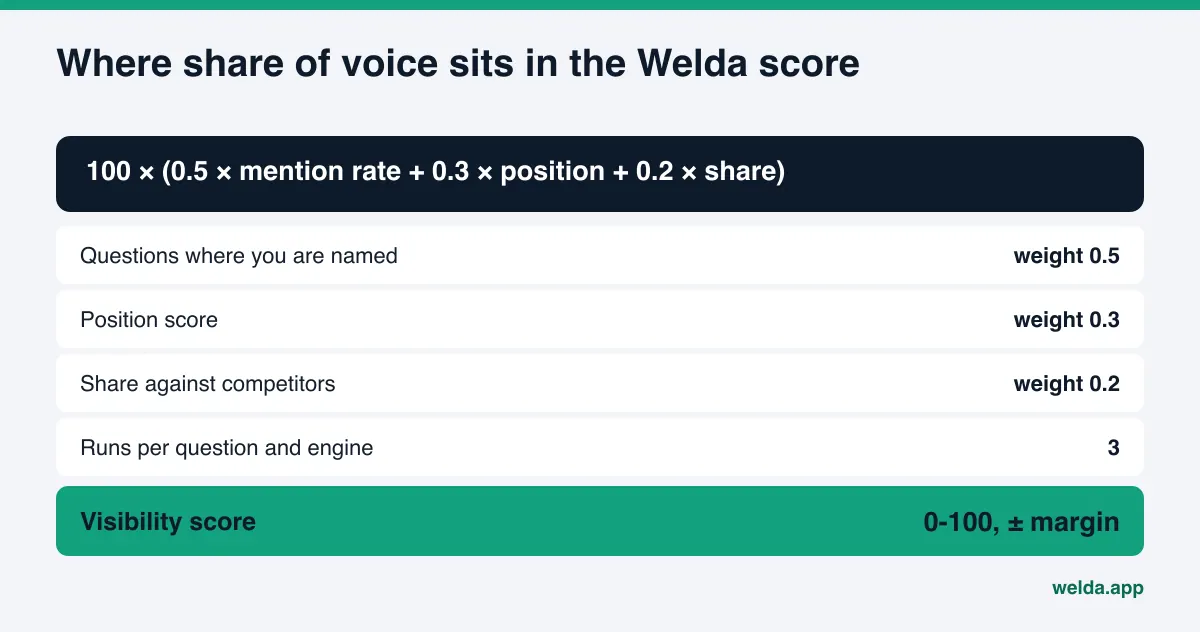
The measurement follows the same logic as the manual method, run consistently. The questions your customers would ask go to ChatGPT, Gemini, Perplexity and Google AI three times each. The spread across those three runs produces a ± margin of error, so you can tell a real change from noise. Questions can be run in English or Turkish.
The Competitors screen is where share of voice lives. At the top, a bar for each business shows its share of all mentions, with your row highlighted and smaller names grouped as "Other." Next to it, a panel explains why share is going to a competitor: which question cluster they win and which sources they are cited from. Below, a table puts each business's score, mention rate, share, trend, strongest engine and winning sources side by side. The decision this screen supports is usually simple: which cluster to work on first.
The Questions screen is where you go when share drops in one cluster. Each question shows which engine named you and in what position. Open a question and you see who else was named in that answer and which sources were cited. It turns a percentage back into an actual answer you can read.
From measurement to work. Once the losing cluster is clear, Welda adds the gap to your to-do list: a missing page, an incomplete profile field or a source where you are absent. Welda drafts the content and profile copy; you approve before anything is published, and the content always lives on your own site. On WordPress, drafts open on your site for review and go live once approved. Where there is no connection, Welda hands you a ready package to apply yourself. A before-and-after comparison and a one-page monthly PDF report help you show the change to leadership.
What is available today. The Welda dashboard is in early access and opening in stages, starting with businesses in Turkey. Regular four-engine tracking is being added during early access, and sample screens in the dashboard use representative data. What anyone can use today, in English, is the free site analysis. It reads your homepage and several inner pages, lists what is missing and how to fix it, runs a competitor comparison, and asks an AI assistant with web search five questions your customers might ask to check whether your business is named. That is a one-time check, not a share of voice calculation, but it usually points to why share might be low. Pricing is discussed in the early access conversation.
Limits: what AI share of voice cannot tell you, and what Welda does not do
- Share of voice is not revenue. Higher share does not by itself show how many calls or bookings it produced. Track AI referral traffic and leads separately.
- It depends on the question set. A different list produces a different share. You cannot directly compare share numbers from two tools or two agencies that used different questions.
- AI answers are variable. The same question can get different answers on the same day. Repeated runs reduce that noise; they do not remove it.
- Welda does not guarantee rankings or that you will "show up in ChatGPT." Nobody can promise a share of voice target.
- Welda does not invent facts. If a competitor wins on a service you do not offer, Welda will not write content implying you do. It asks you instead.
- Welda does not create fake reviews. Responding to negative reviews, managing directory accounts and PR stay with you.
- Change takes time. New content usually takes weeks to be reflected in AI answers. Do not expect share to move within days.
How often you measure is part of reading share correctly. Too often and you chase noise; too rarely and you notice a loss late. We discuss the balance in how often to measure AI visibility.
AI share of voice checklist and decision table
Whether you measure by hand or with software, fix the method before you trust the number.
| What you see | What it likely means | First move |
|---|---|---|
| Low mention rate, low share | AI cannot match you to the questions | State services and service area clearly on your site; remove crawler blocks |
| High mention rate, low share | You are named, but always in a crowd | Bring forward what sets you apart: specialties, guarantees you actually offer, service details |
| Zero share in one cluster | Nothing readable about you on that topic | Write a dedicated page or section |
| Weak in one engine only | You are missing from a source that engine relies on | Review cited sources; complete the missing profile |
| Share rising, leads flat | Visibility is not turning into contact | Check that phone, booking and hours are easy to find |
Use the table as a starting point. The real discipline is picking the cluster with the biggest gap after your first measurement and focusing only on that until the next one.
Frequently asked questions
Is AI share of voice the same as an AI visibility score?
No. Share of voice is your slice of all business mentions. A visibility score is broader; in Welda it combines how often you are named, your position and your share against competitors. Share of voice is one component of the score.
What is a good AI share of voice?
There is no universal benchmark. It depends on your industry, location, question set and how many competitors get named. What matters is the change over time with the same questions, and the gap to the leader.
Is measuring one AI engine enough?
No. Engines draw on different sources and can name different businesses. At minimum, measure the engines your customers use most, separately, so you can see why the total moves.
How many questions do I need?
For a small business, 15 to 30 well-chosen questions are enough to start. More important than volume: the questions should reflect real buying decisions, and the list should stay fixed between measurements.
Does the free site analysis show my share of voice?
Not directly. The free analysis reads your site, lists gaps and fixes, runs a competitor comparison and checks once whether you are named in five customer questions. Ongoing share of voice tracking is part of the Welda dashboard, which is in early access.
Why does a competitor have more share than I do?
Usually one of two reasons: their site answers the topic more clearly, or they are stronger in a source AI relies on, such as Google Business Profile, Yelp or a local list. Look at the cluster they win and the sources cited in those answers.
Where to start measuring your AI share of voice
AI share of voice is one of the clearest ways to see where you stand against competitors in AI answers. But the number is only useful once AI can actually read you: crawlers allowed in, services and location stated plainly, business details consistent everywhere. If that foundation is missing, measuring share just confirms a low number. Start with the free site analysis to see how AI reads your site, which fix would move your score most and whether you are named in five customer questions. If you want ongoing share of voice tracking, we are happy to talk about early access.