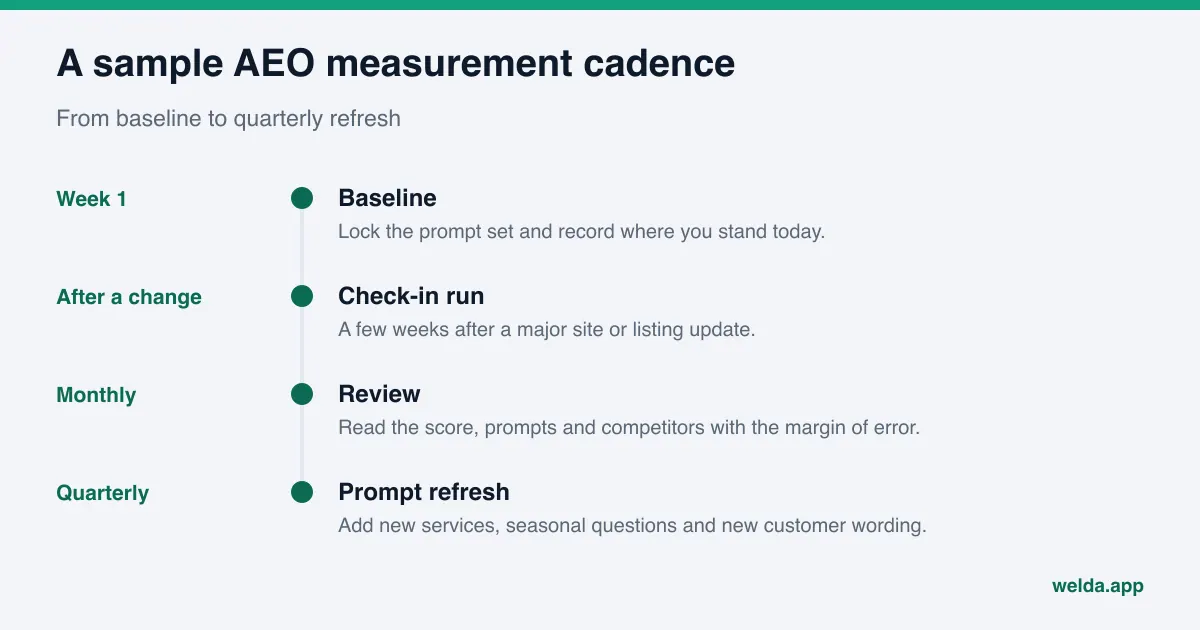
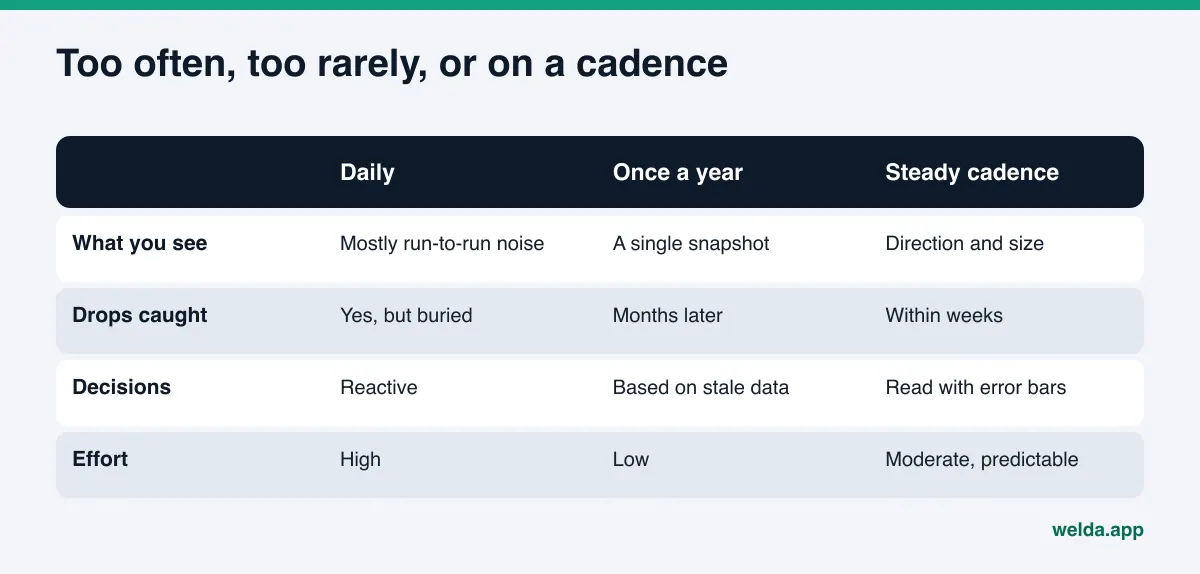
How often should you measure AI visibility? For most businesses, a sound default is one baseline run, a check-in a few weeks after every significant change, and a calm review once a month. Checking daily makes you mistake the natural wobble of AI answers for real movement; checking once a year means you find out about a drop months too late.
This guide covers what should set your cadence for how often to measure AI visibility, how to build a tracking routine step by step, which events justify an extra run before the scheduled one, and which part of the work Welda takes on. If you do not yet know where you stand, start by running a free AI visibility analysis of your site so your routine has a baseline to compare against.
Why measurement frequency is its own question in AEO
In classic search, a page's ranking moves slowly within a day. Answer engines behave differently. Ask ChatGPT, Gemini, Perplexity or Google's AI Overviews and AI Mode the same question twice and you can get two different lists of businesses. The engine builds the answer fresh each time; which sources it reads and which businesses it names, in what order, shift a little from run to run.
That wobble has two consequences for answer engine optimization (AEO, sometimes called GEO, generative engine optimization). First, one screenshot or one test is not a measurement. Second, the more often you measure, the more movement you see, and most of it has nothing to do with anything you did. So "how often" is always paired with "how confident do I need to be." We cover the statistics behind this in our guide to margin of error in AI visibility tracking.
Measuring too rarely has a cost too. A site migration can accidentally block AI crawlers. Your phone number can go stale on Yelp or the BBB. A new competitor down the street can build a strong review profile on Google Business Profile and start showing up in answers you used to own. You only see these things by measuring. A once-a-year check means that, in the worst case, a problem sits unnoticed for months.
The goal, then, is to measure often enough to catch real change in time, but not so often that every wobble triggers a new plan.
How often to measure AI visibility: four factors that decide it
There is no single right frequency. These four factors set the right cadence for your business.
- How much you are changing. If you are regularly adding service pages, FAQ content or structured business information, more frequent runs help you see whether that work lands. If nothing is changing on your side, frequent runs mostly show the outside world moving.
- How volatile your market is. An HVAC contractor heading into summer, a hotel in a beach town, or a restaurant in a busy neighborhood competes in a field that shifts with seasons and openings. A CPA firm or an industrial supplier with the same competitors for years sees slower change.
- How often you make decisions. Budgets, content plans and agency or staff assignments are reviewed monthly at most small businesses. Tying your measurement cadence to that decision cycle makes sure the numbers actually get used.
- How large your margin of error is. A measurement with few prompts and a single run per prompt swings a lot; repeating it often will mislead you. As the number of prompts and repeats grows, the measurement calms down and shorter intervals become readable.
Put those together and most local and regional businesses land somewhere in this table:
| Situation | Suggested cadence | Why |
|---|---|---|
| Nothing has been done yet | One baseline, then a work plan | You need to know what is missing first |
| Fixes just started | Monthly review, check-ins after big changes | Changes usually take weeks to show in answers |
| Seasonal, competitive market | Monthly, plus a run at the start of each season | Competitors and questions shift with the season |
| Stable market, few changes | Monthly or every other month | Frequent runs only show noise |
| Site migration or redesign | Immediate technical check, full run weeks later | Access problems must be caught early |
"Monthly" in this table is a review frequency. The measuring itself can happen more often, but the decision is made once a month, looking at the average of several runs and the margin of error. That distinction is the difference between having frequent data and making jumpy decisions.
Building your AEO tracking routine step by step
You do not need an expensive tool to build a routine. You need discipline first. These steps are the same whether you measure by hand or with software.
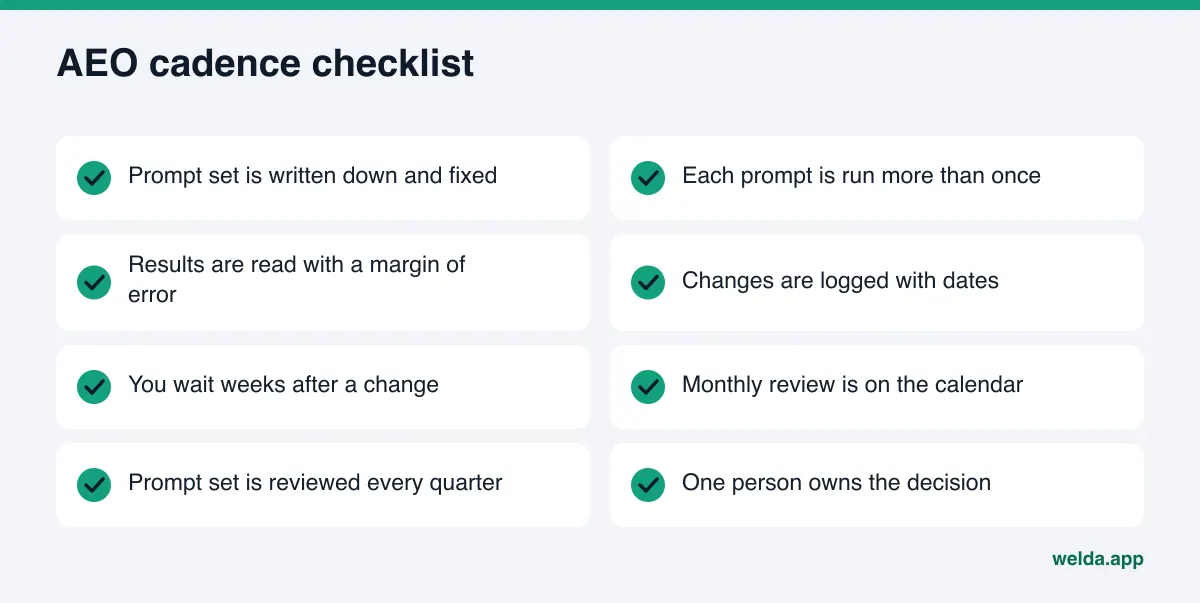
- Write the prompt set down. List the questions your customers would actually ask an AI assistant, in their own words: "best emergency plumber in Plano open on weekends," "family-friendly brunch near Wicker Park," "AC repair company with upfront pricing in Mesa." Mix service, location, price and comparison questions.
- Keep the set fixed between runs. If you ask different questions every month, you cannot compare two months. Make changes during your quarterly review and log them.
- Run each prompt more than once. A single run can be lucky or unlucky. Asking the same prompt of the same engine several times and reading the results together smooths out the noise.
- Record the baseline. Which prompts mention you, in what position, and which competitor shows up instead. Every later run is compared to this.
- Keep a change log. New pages, corrected business details, updated Google Business Profile, review responses on Yelp: each with a date. When the score moves, this log is the first place you look for the reason.
- Wait after a change. New content usually takes weeks to show up in AI answers. Measuring the week you publish and concluding "it didn't work" is premature.
- Review monthly. Read the score, the prompt-by-prompt results and the competitor view together with the margin of error. Log differences inside the margin as "no change."
- Refresh the prompt set quarterly. If you added a service, the season turned, or customers started asking something new, update the set and compare old and new prompts separately.
What ties these steps together is comparability. Frequency only means something when each run happens under the same conditions as the last. For which metrics to track along the way, see our breakdown of AEO KPIs.
Reading a change in your AI visibility score
Once you have a cadence, the next question is when a difference between two runs is meaningful. This is where an open formula helps. The Welda score has three parts: the share of prompts that mention you, your position when you are named, and your share compared with competitors.
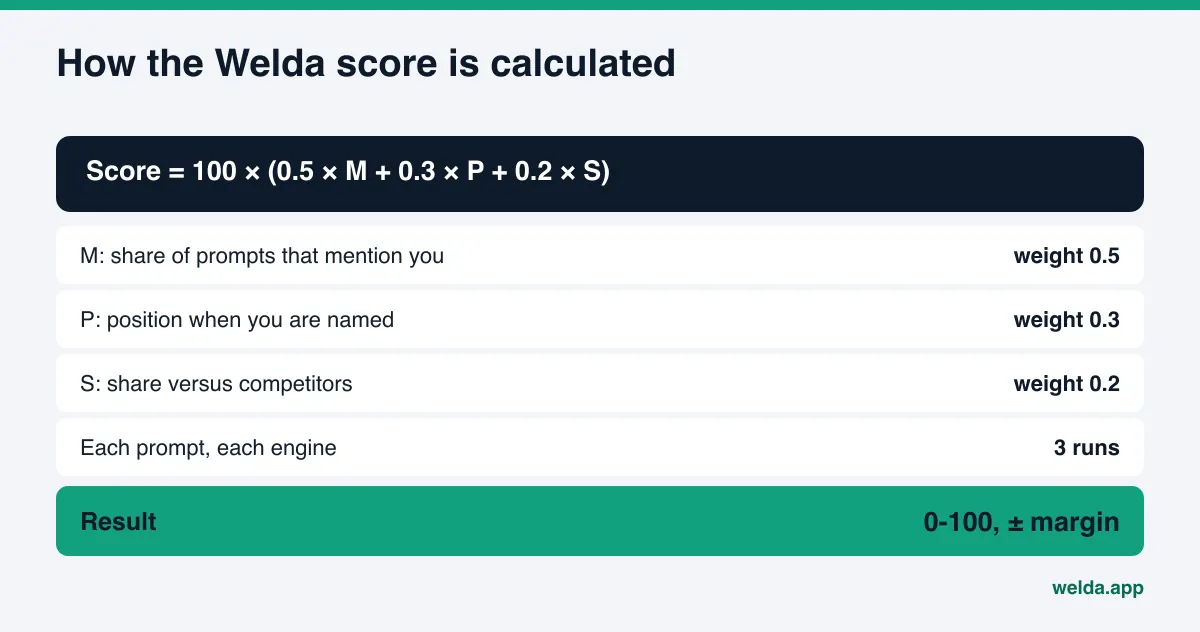
Say an example landscaping company sees its score rise a few points over a month. First question: is that outside the margin of error? If the margin is a few points and the rise is about the same, it is too early to say anything. Second question: which part moved? If the mention rate went up, the engines are starting to recognize the business on new prompts. If only the position score went up, the business is ranking a bit higher on prompts where it was already named. If the competitor share went up, sometimes that is a competitor losing ground rather than you gaining it.
This way of reading results also shapes frequency. If you can see the parts separately, a monthly run tells you a lot. If all you see is one number, no amount of measuring will tell you what changed. For context on what level to aim for, read what is a good AI visibility score.
When not to wait for the scheduled run
A monthly rhythm is for normal periods. Some events call for a look before the scheduled date. What they have in common is that they can change how AI engines read your business overnight.
- Site migration, domain change or redesign. These projects can quietly break robots.txt, redirects or page titles. Run a technical check within days of launch, then a full measurement a few weeks later.
- A change in address, phone number or hours. Fix the details on your site, Google Business Profile, Apple Maps, Yelp and industry directories such as Angi or Healthgrades first. Then measure to see whether the correction has propagated.
- A new location or service. Add prompts for the new area or service and take a separate baseline for them.
- A strong competitor opening nearby. A focused run on the prompts where they show up reveals which sources they are winning from.
- A wave of reviews or complaints. If there is a burst of activity about you on Yelp, Tripadvisor or the BBB, check whether AI answers reflect it. Responding and managing the situation stays with you.
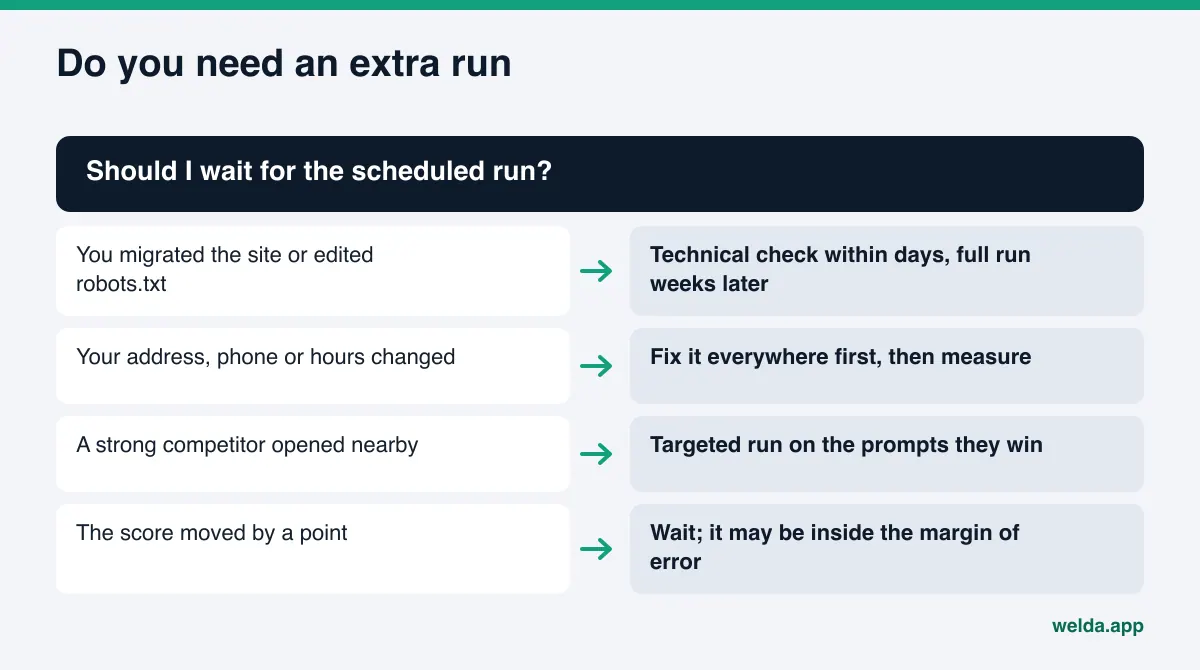
The case where you should not run an extra check matters too: if the score moved a point or two and nothing happened, waiting is the right call. Measuring daily out of curiosity pushes you toward planning around noise.
What to watch between full runs
A monthly full run does not mean ignoring everything in between. You just watch lighter signals.
The first is AI referral traffic and leads. Tracking visits from ChatGPT or Perplexity to your site, and whether they turn into calls, form fills or bookings, shows what visibility actually brings in. We explain the setup in our guide to attribution for AI referrals.
The second is technical health: AI crawlers can still reach your site, page titles and business markup are intact, and the site has not slowed down. These checks are quick and can run more than once a month.
The third is your information on outside sources: your Google Business Profile, your listings on Yelp and the BBB, and your most recent reviews. These are sources AI engines draw on, and a wrong detail in one place can find its way into answers over time.
None of these replace a full run. They warn you early if something has broken between runs.
Example: a home services company's first quarter
To make the cadence concrete, consider an example scenario. A sample HVAC company in a mid-size Sun Belt city wants to know why AI assistants rarely mention it and starts tracking for the first time. The calendar below is not real data from a real business; it is a constructed example to show how the rhythm works.
| When | Work done | Measurement |
|---|---|---|
| Week 1 | Prompt set written: AC repair, emergency service, maintenance plans, neighborhood and price questions | Baseline, each prompt run several times |
| Weeks 2 and 3 | Service pages clarified, FAQ added, Google Business Profile hours and categories updated | No run, entries in the change log |
| Week 4 | Review responses posted, an old phone number corrected on Angi and Yelp | Quick technical check |
| End of month 2 | No new work | Full run and first monthly review |
| End of month 3 | New page for prompts still missing | Full run, seasonal prompt refresh before summer |
Two things stand out. First, there are no runs during the weeks when fixes are being made. If there were, it would be easy to see a picture where changes have not landed yet and draw the wrong conclusion. Second, the first review comes weeks after the fixes. At the end of month two, the company sees which prompts now mention it and where competitors still lead, and picks month three's work accordingly. Just before peak season, it adds summer questions to the set so the next quarter is measured on what customers will actually ask.
How Welda handles AI visibility measurement
Welda is software that measures where a business appears in AI answers and fills the gaps on the business's behalf. For measurement cadence, three parts of Welda matter most.
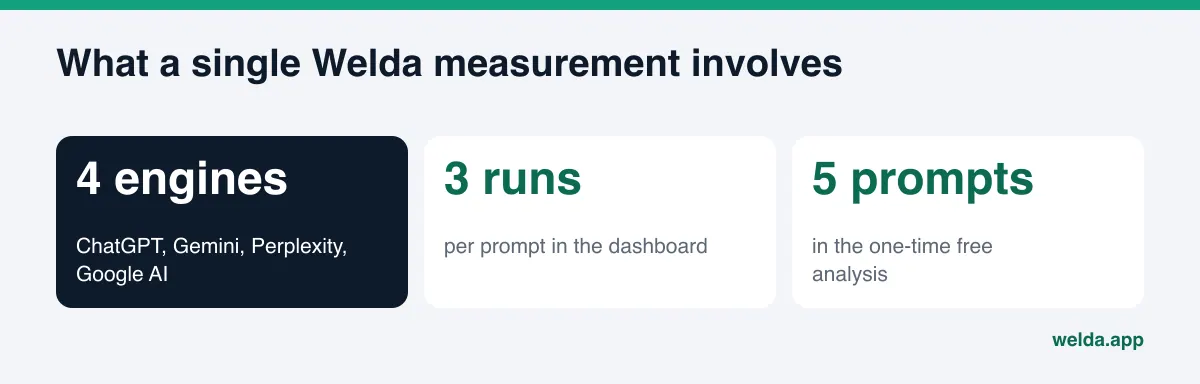
A free analysis as your baseline. The part anyone can use today is the free site analysis, which works in English. It reads your homepage and a few inner pages such as services, pricing, about and contact, and checks whether AI crawlers can get in, how your title and description read, whether your business markup, address and phone details are present, whether you have an FAQ section, and how clearly your services are described. You get a score out of 100, split into technical and content, plus what to fix for each gap. It also asks 5 questions a customer might ask to an AI assistant with web search and checks whether your business name appears in the answers. That is a one-time measurement, free once per site. In a cadence, its role is clear: it gives you the starting snapshot. It is not an ongoing tracker.
Trend and margin of error in the dashboard. In the Welda dashboard, the prompts your customers would ask are run three times each on ChatGPT, Gemini, Perplexity and Google AI. The spread across those three runs produces a ± margin, and the score is always shown with it. The visibility view puts the score's trend over the weeks, the gap to the strongest competitor, and the breakdown by engine side by side, along with a list of what changed this week: which prompt mentions you for the first time, which one dropped, and which piece of work done through Welda lines up with the change. Your decision on that screen is simple: did the score move outside the margin, and if so, on which prompt and which engine. A wobble inside the margin does not justify new work. A drop on a specific prompt sends you to the competitors and sources views to see where the competitor is winning from.
A one-page monthly report. The easiest way to review monthly is a report that arrives in the same shape every time. The Welda monthly report gathers the score, the prompts that mention you, competitor share, the month's wins and losses, and next month's work on one page, downloadable as a PDF. We go deeper on what belongs in it in our monthly AEO report guide.
Beyond measurement, Welda drafts missing content, profile copy and review responses; you keep publishing approval, and the content always lives on your own site.
To be clear about where things stand: the Welda dashboard is in early access, and the full dashboard is opening first in Turkey. Regular four-engine measurement is being added during early access, and the example screens use representative data. What anyone can use today, in English, is the free site analysis. Pricing is discussed in the early access conversation.
Limits, and what Welda does not do
Whatever your cadence, there are things a measurement cannot tell you. Knowing them up front sets the right expectations.
- A measurement is a sample. No tool can see every answer an engine gives every user. It shows what happened on chosen prompts, on chosen engines, at a given time.
- Personalization and location matter. A real customer's answer can differ from the measured one depending on location, chat history and exact wording.
- Measuring more often does not speed results up. Frequent runs do not make engines read new content any faster. It usually takes weeks for new content to show up in answers.
- Welda does not promise rankings or placement in ChatGPT. The free analysis does not measure rankings, and the dashboard measures visibility and closes gaps without guaranteeing an outcome.
- Welda does not make things up. If hours, price ranges or service details are missing, it asks you.
- Some work stays with you. Responding to negative reviews, owning directory accounts and doing PR are yours. Welda does not create fake reviews, which the FTC's final rule on fake reviews also prohibits.
These limits do not make measurement useless. They frame how to read it. A good cadence does not promise certainty; it shows direction.
Checklist: is your measurement routine ready
Before you think about measuring more often, answer these. If any answer is "no," fixing that gap is worth more than a higher frequency.
| Question | If the answer is "no" |
|---|---|
| Do you have a baseline? | Get one, from the free analysis or by hand |
| Is your prompt set written down? | List 20 to 30 prompts in customers' own words |
| Is each prompt run more than once? | Do not decide on a single run |
| Do you keep a change log? | Start a dated log today |
| Who reads the results and decides? | Make one person responsible for the monthly review |
If nothing on this list is missing, adjust your frequency to how fast your market moves. If something is missing, measuring more often just repeats a flawed method faster.
Frequently asked questions
Is it worth measuring AI visibility every day?
For most businesses, no. AI answers shift a little on every run, so daily measurement shows that wobble rather than real change. Daily technical checks can be useful, but visibility decisions should rest on the average of several runs, reviewed monthly.
How long after a change should I measure again?
For technical changes, check crawler access within a few days. Content and business detail changes usually take weeks to show up in AI answers, so run the full measurement after that.
Can I rerun the free analysis every month?
No. The free analysis is free once per site and is a one-time measurement. It is the right tool for a baseline. Ongoing tracking is the job of the Welda dashboard, which is in early access.
My score dropped a point two months in a row. Should I worry?
Check the margin of error first. If the change is inside the ± margin, it does not count as a drop. If it is outside, look at which prompt and which engine fell and what changed for competitors in the same period.
Should every engine be measured on the same schedule?
For comparability, yes. ChatGPT, Gemini, Perplexity and Google AI lean on different sources and can change at different speeds. Asking the same prompt set at the same interval lets you see the differences between them.
When should I change my prompt set?
Review it every quarter and update it when you add a service or location, or when the season changes. Log what you changed and take a separate baseline for new prompts.
Get your baseline today
The answer to how often to measure AI visibility only makes sense once you know where you are starting from. You cannot build a cadence without a baseline. To see how your site reads to AI engines today, what is missing, and whether your business name appears for 5 customer questions, start your free site analysis. The results link arrives by email and stays open for 14 days, and you can build your measurement routine on top of it.