What is a good AI visibility score? There is no single number that counts as good for every business. A score only means something next to the scores of competitors measured on the same questions, next to your own earlier measurements, and next to its margin of error. This guide explains what is a good AI visibility score in practice, starting from the formula, and shows how Welda calculates and displays it.
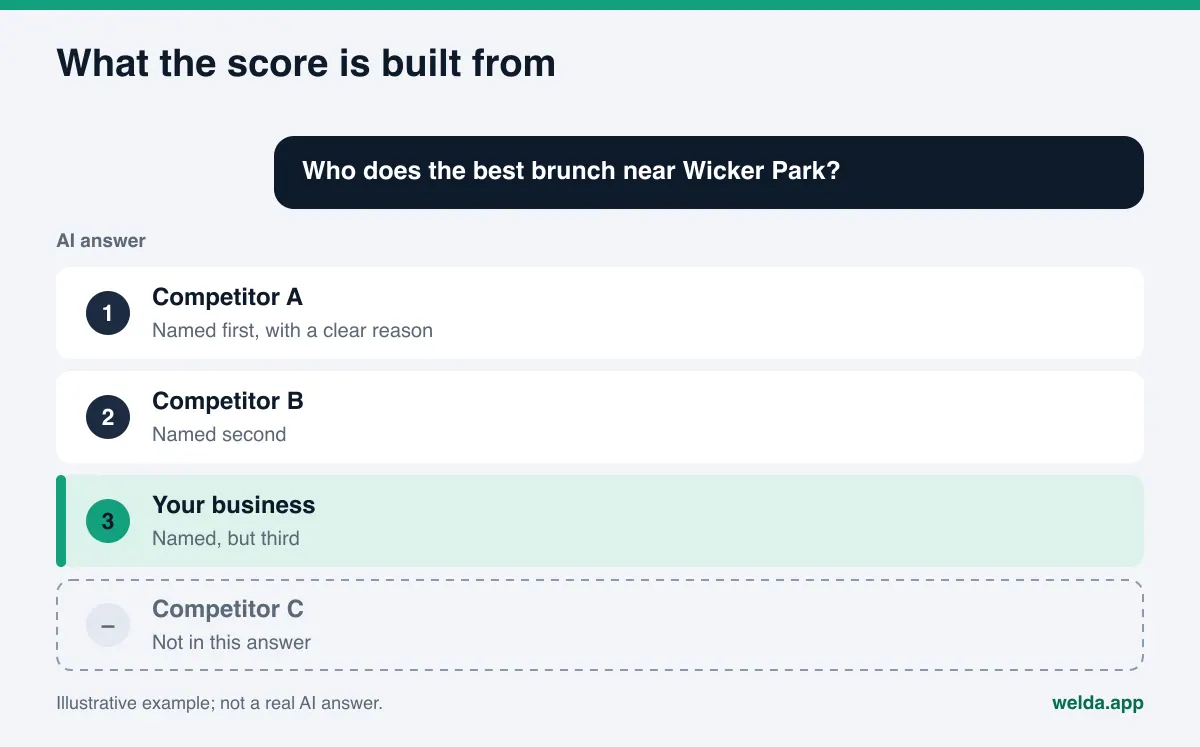
What an AI visibility score measures
An AI visibility score compresses one question into a number: when customers ask ChatGPT, Gemini, Perplexity or Google's AI Overviews and AI Mode about the kind of business you run, how often does your name come up? Because it looks like a grade, the first thing most owners ask is what grade they should be aiming for. That is a fair question with an unsatisfying answer. The score does not describe absolute quality. It describes where you stand on a specific list of questions against a specific set of competitors.
Picture two businesses. One is a coffee shop in a dense Chicago neighborhood with dozens of cafes within walking distance. The other is a garage door repair company in a small town with three competitors in the county. They could post the exact same score and be in very different positions. In the coffee shop's market, an AI answer has room for three or four names and there are fifty candidates. In the garage door company's market, the odds of being named are naturally higher. The same number is strong in one place and mediocre in the other.
This is the heart of AEO (answer engine optimization), which some people also call GEO, generative engine optimization. It is not about a magic threshold. It is about understanding the inputs behind the number. Three of them decide what a good score looks like for you:
- The question set. Which questions are being asked? Questions that already contain your brand name inflate the score. Category and neighborhood questions, like "best brunch spot in Wicker Park," show real competition.
- The competitor set. Who are you compared with? The businesses customers actually weigh you against, or a national chain ten times your size?
- Your industry and location. In crowded categories with short answers, the same effort produces a lower score.
So the honest answer to "what is a good AI visibility score" is a way of reading the number, not a number. If you have no measurement yet, a sensible first step is the free site analysis, which shows whether your website is ready to be understood by AI systems in the first place.
The formula behind the score
Before you judge a score, you need to know how it is built. A score with a hidden formula is a grade from a teacher who will not show you the rubric. In the Welda panel, the visibility score is calculated like this:
Score = 100 × (0.5 × share of questions where you are named + 0.3 × position score + 0.2 × share against competitors)
Each part answers a different question:
- Share of questions where you are named (50% weight). Out of all tracked questions, in how many does your business appear in the answer? Half the score comes from here because not being mentioned at all is the most basic problem.
- Position score (30% weight). When you are named, how early? Being the first recommendation carries more weight than being the fifth name in a list.
- Share against competitors (20% weight). Looking at you and the competitors you track together, how much of the answer space is yours? If competitors show up in nearly every answer and you appear occasionally, this part drags the score down.
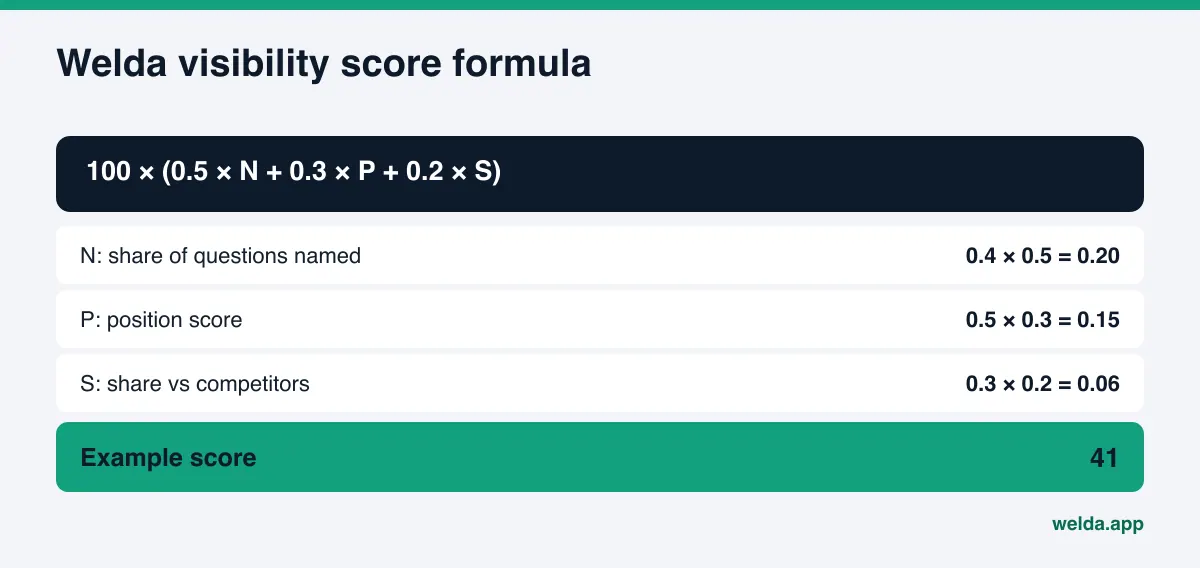
Here is a worked example with illustrative values, not data from a real business. Say a business is named in 40% of tracked questions, has a position score of 0.5 and a competitor share of 0.3. The math: 0.5 × 0.4 = 0.20; 0.3 × 0.5 = 0.15; 0.2 × 0.3 = 0.06. The total is 0.41, so the score is 41.
The example also shows why a single number is not enough. A business that is named often but always last can land on 41. So can a business that is named rarely but always first. The first one needs to work on why it sits at the bottom of lists. The second one needs to work on why it is missing from so many questions. Without the three parts, you do not know which job is yours.
What is a good AI visibility score against your competitors?
The first comparison that gives your score meaning is your competitors. Without three to five competitor scores measured on the same questions, on the same AI engines, at the same time, your number floats in the air. Below is a practical reading frame. It is not an industry standard. It is a starting point that turns a score into something you can act on.
| Where you stand | What it usually means | Where to look first |
|---|---|---|
| Below every tracked competitor | AI systems do not yet recognize you for these questions, or do not trust your information | Share of questions where you are named; basic facts and sources |
| In the middle of the pack | You appear for some topics and are missing from others | Which topic and which source each competitor wins with |
| Close to the leader, within the margin | The gap may not be distinguishable from measurement noise | Position score; questions where you are named but not first |
| You are the leader | You are ahead on this question set; watch for competitor moves | New question clusters and questions you have lost |
One consequence matters a lot: a "good score" is usually a shrinking gap to the leader. If the leader in your set sits at 45, moving from 35 to 42 can be more meaningful than a score of 60 in a different industry. These numbers are only examples.
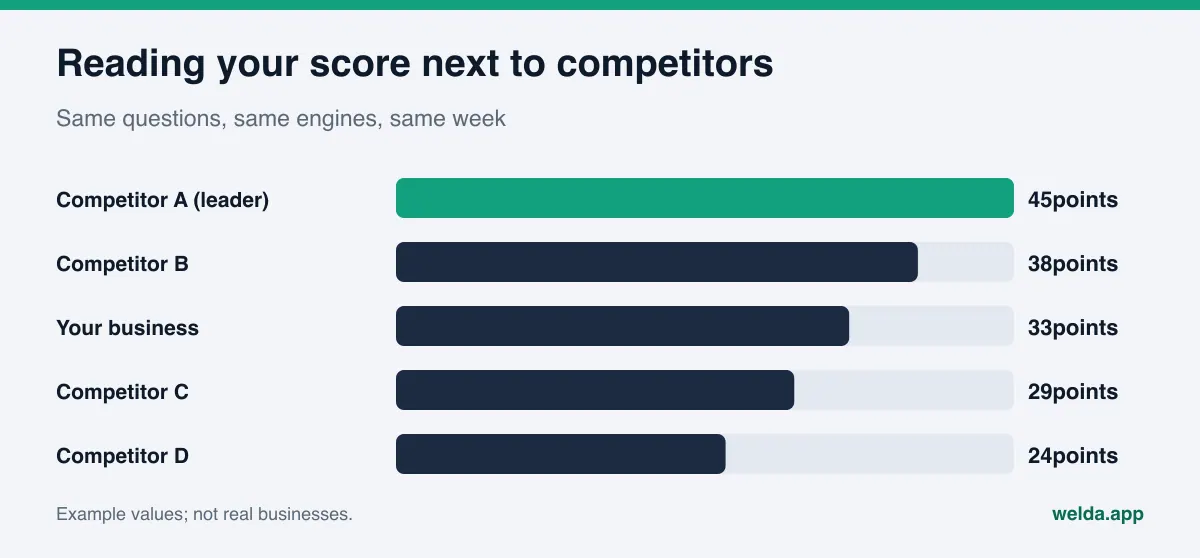
Be honest when you choose the competitor set. If you compare yourself with much smaller businesses, your score looks great and tells you nothing. Pick the three to five businesses that show up for the same customer questions and that customers actually consider. If you already rank well in classic search and still do not appear in AI answers, our piece on ranking first on Google but not in ChatGPT covers why that happens.
Margin of error: is that small change real?
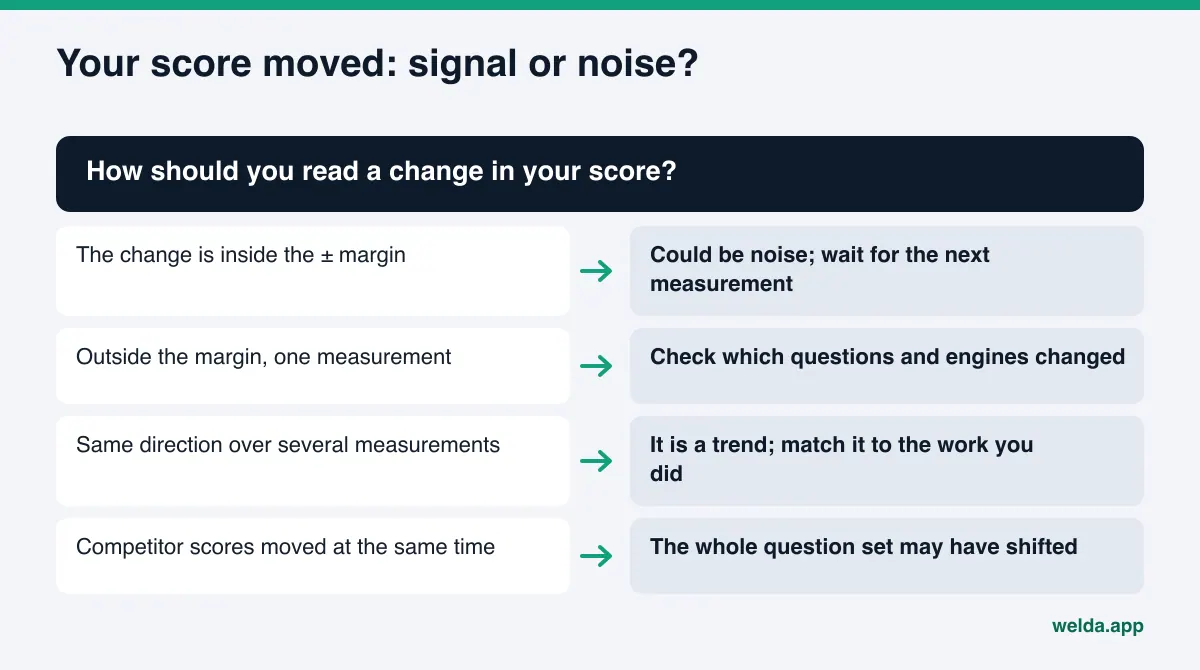
AI answers are not fixed. Ask the same question to the same engine twice in a row and you may be named the first time and missing the second. Because of this natural variation, a single measurement can mislead you in either direction.
In the Welda panel, every question is asked to every engine three times. The spread between those three runs produces a ± margin of error shown next to the score. That margin keeps you from celebrating a two-point bump or panicking over a three-point dip.
The practical rule: if the change sits inside the margin, do not treat it as real yet. If your score is 30 ± 2 and the next measurement shows 31, that can be noise. If the change moves outside the margin and keeps going in the same direction over several measurements, you are looking at a trend.
How often you measure affects this reading too. Look too often and you are watching noise. Look too rarely and you notice a competitor's move late. We cover that balance in our guide on how often to measure AI visibility.
Two different scores: site readiness and AI visibility
When someone asks "what's my score," two different numbers get mixed up. Knowing the difference is the shortest way to avoid answering "what is a good AI visibility score" with the wrong figure.
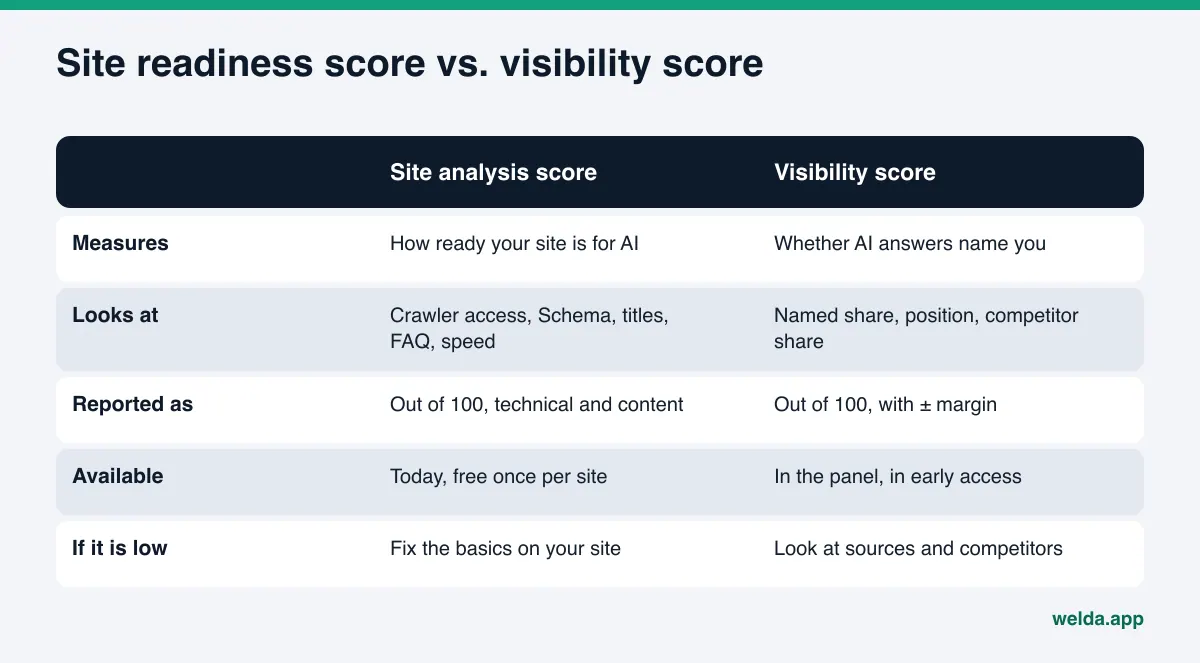
The site analysis score measures how ready your website is to be read by Google and AI systems. It checks whether AI crawlers can access the site through robots.txt, the page title and description, the main heading, structured business data (Schema), address, phone and location details, whether your social and map profiles are linked from the site, a FAQ section, reviews and trust signals, how clearly your services are described, and page speed. It is scored out of 100, with technical and content results shown separately. It is a readiness score: how much of what AI systems need to understand you is already in place.
The visibility score measures the outcome: whether your name actually appears in AI answers to real questions, in what position, and with what share against competitors. The formula above belongs to this score.
They are related but not the same. A business with a high readiness score can still trail in visibility because competitors are much stronger on Yelp, Tripadvisor or industry directories. A business with a weak site but years of reputation can still be named. A high readiness score means the basics are done. A low visibility score on top of that means the remaining work is off your site: profiles, reviews, directories and the other sources AI systems learn from.
Example: same score, two different to-do lists
Here is how reading the parts changes the work. Both businesses below are fictional examples.
An example boutique hotel is named in more than half of its tracked questions, but usually as the fourth or fifth option. Competitor A is named in fewer questions but always first. Their scores are close. The hotel's job is not to appear in more questions; it is to move up in the ones where it already appears. AI answers attach a short reason to each name, such as "rooftop bar with skyline views" or "guests praise the breakfast." If the hotel's site and its Google Business Profile do not state clear, distinctive facts like these, the system includes it but does not lead with it.
An example HVAC contractor is named in only a few questions, but first whenever it is named. That suggests AI systems know the business but do not know what it does. If the website says "full-service heating and cooling," there is little for an AI system to work with when someone asks "who installs heat pumps near me." The job is to list services one by one, add a FAQ, and make sure the services on Google Business Profile, Angi and the BBB listing match the site.
| Weak part | Likely cause | First move |
|---|---|---|
| Low share of questions named | Services, location or basic facts unclear; missing from key sources | Service pages, structured business data, complete profiles |
| Low position score | No clear reason written down that sets you apart | State distinctive facts plainly; respond to reviews |
| Low share against competitors | A competitor is stronger in specific topics and sources | Address each topic and source the competitor wins with |
| Far behind on one engine | Missing from the sources that engine relies on | Check your presence on the sites that engine cites |
Steps to improve your score
Once you can read the score, the work is to find the weak part and act on it. The sequence below starts from the score itself instead of producing content at random.
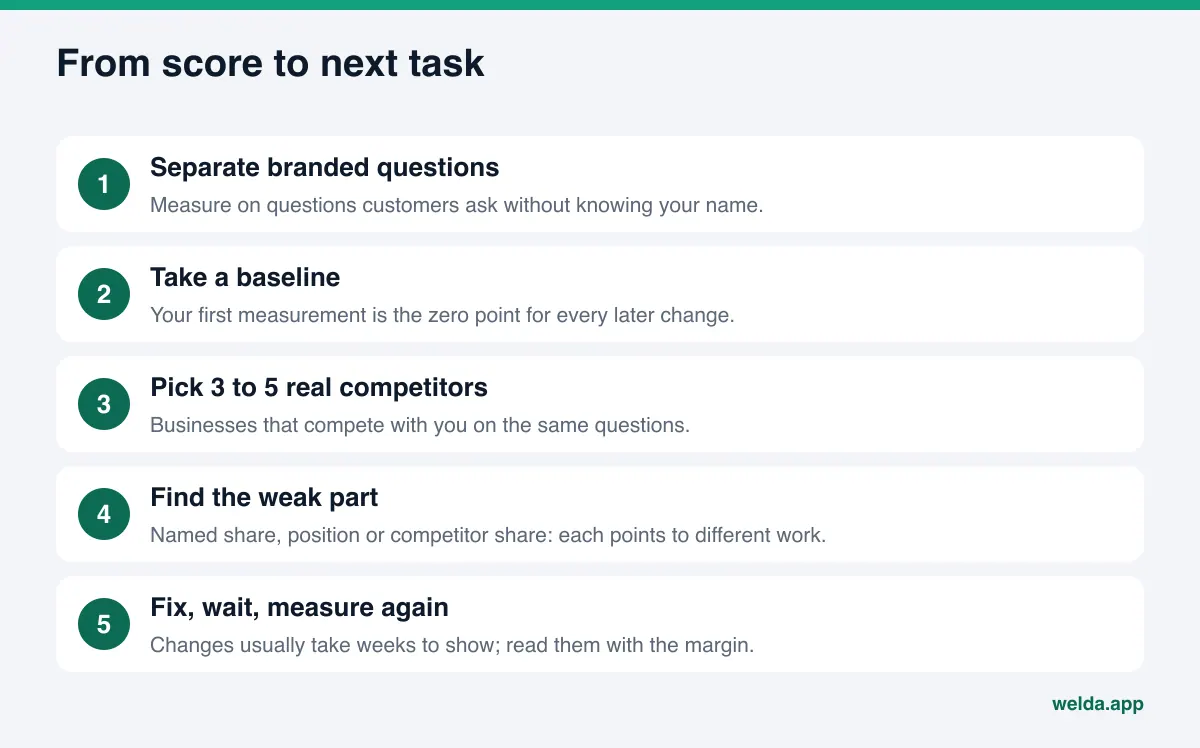
- Fix the question list. Keep branded questions separate. The real measurement happens on questions customers ask without knowing you: services, neighborhoods, needs and comparisons.
- Take a baseline. Your first measurement is your zero point. Every later change is read against it.
- Pick three to five real competitors. Choose businesses that compete with you on the same questions and read your score next to theirs.
- Find the weak part. Use the table above to match the weak component to its likely cause.
- Look at the sources competitors win with. Are they cited from Google Business Profile, Yelp, Tripadvisor, the BBB, Healthgrades or an industry directory? Do you have a profile there, and is it accurate?
- Close the gaps on your site. Describe each service clearly, add a FAQ, set up structured business data correctly, and keep your name, address and phone identical everywhere.
- Wait, then measure again. New content usually takes weeks to show up in AI answers. Read the change together with its margin of error.
For a broader framework around these steps, see our AEO audit guide.
How Welda handles it: score, margin and competitors on one screen
In Welda, the question of what is a good AI visibility score is answered as a reading across a few screens rather than a target number. These are the parts that matter for this topic.
The visibility screen: score, margin and trend. Your score appears out of 100 with its ± margin next to it. Below it, a 12-week trend line runs alongside the line of the strongest competitor you track, so you judge progress by direction instead of a single week. The same screen splits the result by engine: the share of questions where you are named on ChatGPT, Gemini, Perplexity and Google AI, each on its own bar. If one engine lags clearly behind the others, you know to look at the sources that engine relies on. A "what changed this week" list shows which questions you were named in for the first time and which piece of work came before it.
The competitors screen: where "good" begins. This is where the score gets its meaning. For each tracked competitor you see the score, the share of questions where they are named, and their share of answers, side by side. More useful still, the screen tells you which topic cluster each competitor wins and which sources they are cited from. If a competitor leads on, say, "family-friendly" questions with citations from a travel review site, that topic and that source become your work. The decision on this screen is simple: on which topic do I close the gap to the leader first?
From score to work. Welda turns the weak part into tasks. Missing information, drafts waiting for approval and manual tasks land in one to-do list, each with ready-to-use copy next to it. Welda drafts content, profile text and review replies; publishing approval stays with you, and content always lives on your own website. A monthly one-page report summarizes how the score moved, with its margin.
A note on availability: the panel is in early access and is opening first in Turkey, one group of businesses at a time. Regular four-engine measurement is being added during early access, and the panel screens you see are shown with representative data. What anyone in the US can use today is the free site analysis, which works in English. It gives your site a readiness score out of 100, splits technical and content results, explains each gap and how to fix it, and includes a simulation of how much each fix would raise the score. It also asks an AI assistant with web search 5 questions a customer might ask and checks whether your business is named. That is a one-time check, not ongoing tracking. Pricing is discussed in the early access conversation.
Limits: what a score does not tell you, and what Welda does not do
Using a score well means knowing what it leaves out.
- A score is not a ranking. It does not measure your position in Google search. The free site analysis does not measure rankings either, and it does not promise any.
- A score depends on its question set. Change the questions and the score changes. Putting two tools' scores, or two question sets' scores, side by side is misleading.
- A score is not revenue. Being named can bring customers, but the score alone does not prove it did. We look at that link in our piece on AEO ROI.
- Nobody can guarantee a score or a spot in ChatGPT. Welda does not either. Our article on guaranteed ChatGPT rankings explains why such promises do not hold up.
What Welda does not do is just as clear. It does not invent information it does not have; it asks you. It does not publish sensitive content without approval. It does not create fake reviews. Handling negative reviews, managing directory accounts and PR outreach stay with your business. And because new content usually takes weeks to reach AI answers, the effect on the score is not immediate.
Checklist: questions to ask before you trust a score
Whenever you see an AI visibility score, from Welda or anywhere else, run through these questions:
- Is the formula published? How much weight does each part carry?
- Are branded questions kept separate from category questions?
- Which engines were measured, and how many times was each question asked?
- Is there a margin of error next to the score?
- Do you have competitor scores measured on the same question set?
- Is it a single snapshot or a trend over several weeks?
- Do you know your site readiness score and your visibility score separately?
- Which part of the score is weak, and what is the next task for it?
If you answer "I don't know" to several of these, the number alone is not yet enough to make a decision.
Frequently asked questions
What is a good AI visibility score, is 50 good?
It depends entirely on context. A 50 is strong on a question set where competitors score 30 and weak where they score 70. Read it next to competitors measured on the same questions and next to your own history.
Can a score reach 100?
By the formula, 100 means you are named in every question, always first, and hold the entire answer share against competitors. On a realistic, competitive question set, that is not something to expect. The goal is closing the gap to the leader, not 100.
My score dropped this week. What should I do?
First check whether the drop is outside the margin of error. If it is inside, it may be noise. If it is outside and continues in the next measurement, look at which questions and engines you lost and which sources the competitor wins with there.
Is the free site analysis score the same as the panel score?
No. The site analysis score measures how ready your site is for AI systems. The panel score measures whether you are actually named in AI answers. One looks at inputs, the other at outcomes.
Can I compare scores from different AEO tools?
Only if the formula, question set and engines are the same, which is rare. A 40 in one tool and a 40 in another can measure different things. Compare within one tool, on one question set.
How long does it take for a score to go up?
There is no fixed timeline. New content and profile fixes usually take weeks to show up in AI answers. Judge change over several measurements, not a single week.
Start with your site's readiness
What counts as a good AI visibility score for you only becomes clear on your own question set, next to your own competitors. The first step is knowing whether your site gives AI systems enough to work with. The free site analysis scores your site out of 100, lists each gap, estimates how much each fix would add, and checks whether your business is named in answers to 5 customer questions. It is free once per site; the results link arrives by email and stays open for 14 days.