Can anyone deliver guaranteed ChatGPT rankings? No. AI answers from ChatGPT, Gemini, Perplexity and Google's AI Overviews do not have a fixed ranking list; the same question can return a different answer for a different person, at a different time, in a different engine. An offer of guaranteed ChatGPT rankings is either promising something nobody can measure reliably, or it has narrowed the guarantee so far that what you buy is not what you actually need.
Why are guaranteed ChatGPT rankings being sold at all?
AEO, short for answer engine optimization, is still a young discipline. You may also see it called GEO (generative engine optimization); in the US the two terms describe the same work, and AEO is the one most buyers search for. The idea is simple: your customers now ask ChatGPT things like "best HVAC company in Naperville that does same-day repairs" or "dog-friendly brunch spot in Austin," and they get back a short paragraph with two or three names instead of ten blue links. Business owners want to be one of those names, and they are right to.
Demand is high and buyer knowledge is thin. That gap is where the easiest pitch lives: "We'll get you to #1 in ChatGPT, or your money back." It sounds concrete. It turns a fuzzy, ongoing project into a single deliverable you can point at.
Small business owners have heard this pitch before. For years, agencies sold "guaranteed page one on Google." Google's own guidance has been blunt about it: "No one can guarantee a #1 ranking on Google," and if someone guarantees that their changes will put you in first place, "find someone else" (Google Search Central, Do you need an SEO?). Classic search at least had a results page and a numbered position. AI answers do not even have that. The ground under a ranking guarantee is weaker in AI search than it ever was in traditional search.
This is a buyer's guide. It covers what "first place" means inside an AI answer, the red flags to look for in a guarantee-based proposal, what to put in a contract instead, and what Welda does and does not do here. If you want a baseline before you talk to any vendor, the free site analysis reads your site the way Google and AI assistants do and checks whether your business name appears in answers to five customer questions. It does not measure rankings or promise any, which is a good place to start the conversation.
What does "#1 in ChatGPT" actually mean?
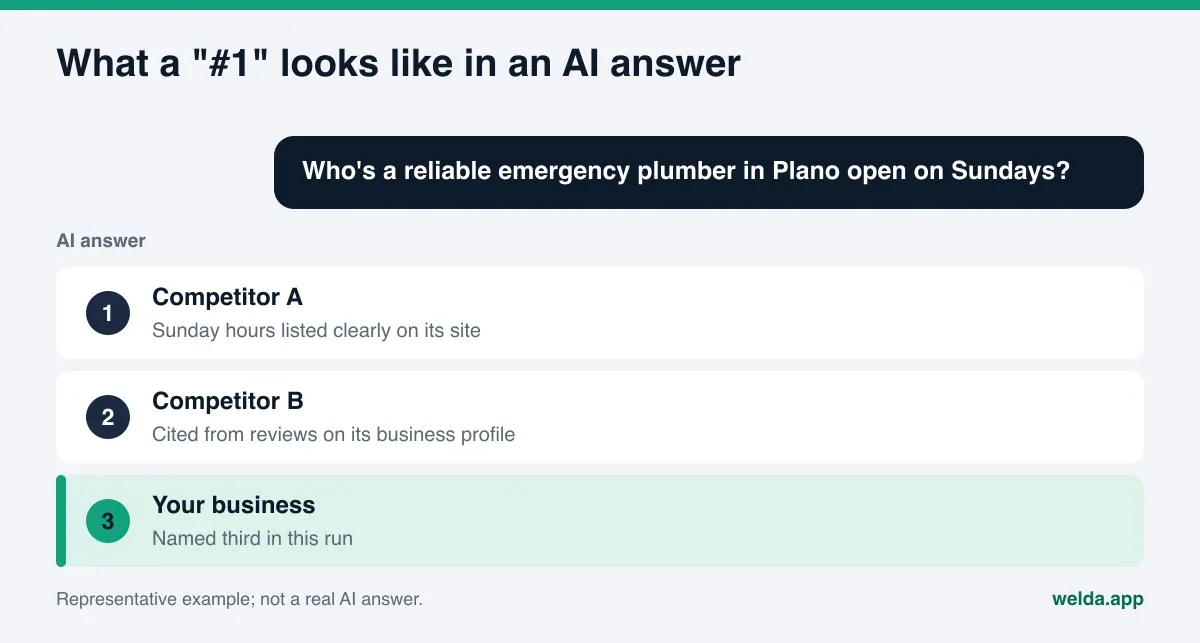
Before you can judge a guarantee, you need to pin down what is being guaranteed. An AI answer is usually a few sentences or a short list. "Number one" presumably means the first business named. Even that is not stable, for reasons no vendor controls.
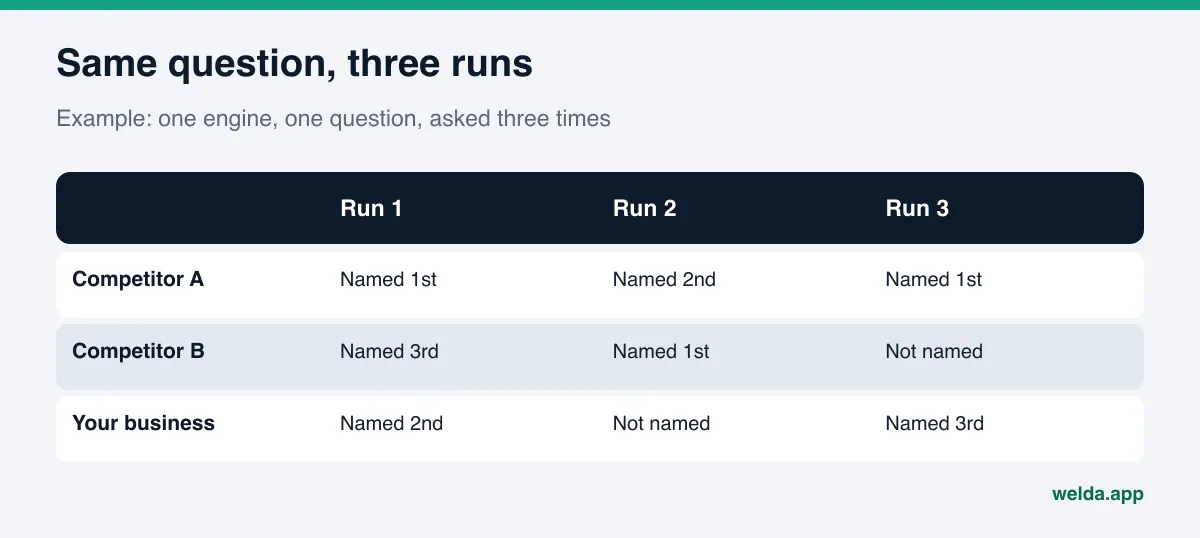
- Every answer is generated fresh. Ask the same engine the same question twice in a row and the order of names, or the names themselves, can change. We explain the mechanics in why AI answers change every time.
- Wording matters. "Plumber in Plano" and "emergency plumber in Plano open on Sunday" are different questions. Being named first in one and missing from the other is normal.
- Engines use different sources. The pages ChatGPT finds through web search are not the same ones Gemini or Perplexity rely on. One engine might lean on your Google Business Profile, another on Yelp, Angi or a local news roundup.
- The person asking matters. Location, language, chat history and account settings can shape the answer. A test run from your office does not represent what a customer sees on their phone across town.
- Answers drift over time. Models update, source sites change, competitors publish. A result today says little about the result in three months.
None of these five factors can be controlled by an agency or a software tool. What can be controlled is whether the information an AI system can find about you is accurate, consistent and accessible. That influences the outcome. It does not decide it.
Can you pay to be placed in the organic answer?
According to the engines themselves, no. When OpenAI announced its test of ads in ChatGPT, it stated that ads do not influence the answers ChatGPT gives, and that ads are labeled as sponsored and shown separately from the organic answer (OpenAI, Testing ads in ChatGPT). Buying a sponsored slot and being named in the answer itself are two different things. If a proposal claims a "partnership with OpenAI" or a "priority channel" into the organic answer, that claim contradicts what the engine says publicly. Ask for proof in writing.
Red flags in a guaranteed ChatGPT rankings offer
Here are the signals to check one by one. A single flag does not sink a proposal, but if you see two or three together, slow down.
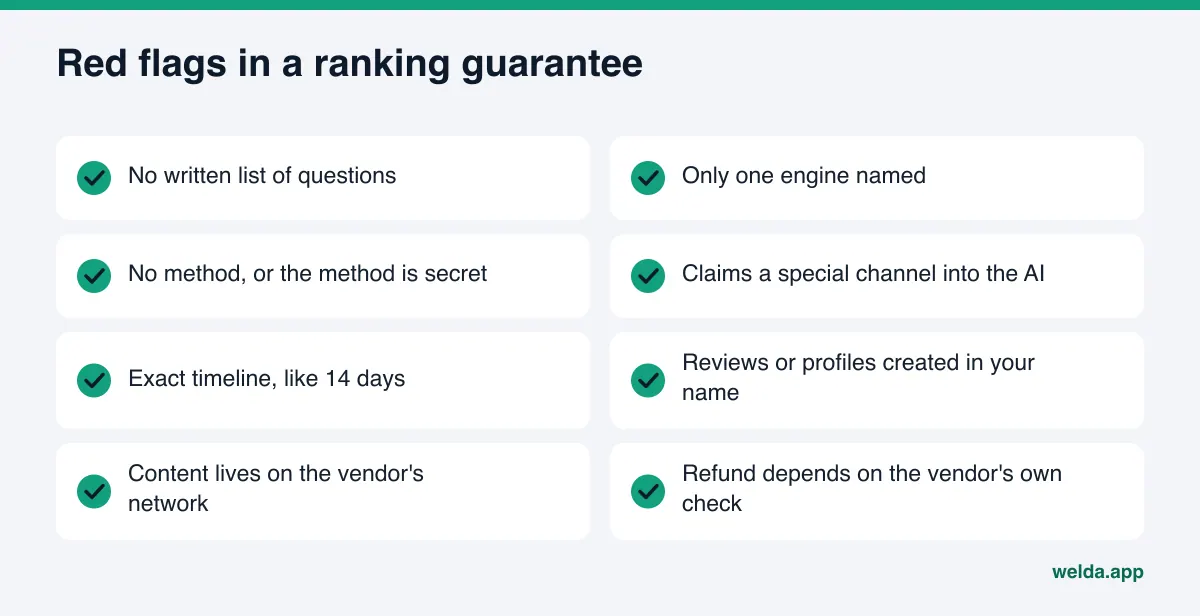
- No list of questions. It says "#1" but never says for which questions, which city or neighborhood, or which language. Without a written question list, the guarantee is empty.
- Only one engine named. "ChatGPT" only. Gemini, Perplexity, Google AI Overviews and AI Mode are separate systems. Showing up in one and not the others is common.
- Hidden or missing methodology. How many times is each question asked, on which days, from which account and location? A single screenshot of a single run is not evidence.
- "Special relationship" claims. Any suggestion that organic answer placement can be bought or arranged deserves extra scrutiny.
- Speed promises. "Top spot in 14 days." New content usually takes weeks to show up in AI answers, and nobody controls that timeline.
- Reviews or profiles created on your behalf. Fake reviews, fabricated listings, or posts placed elsewhere in your name. The FTC's final rule on fake reviews bans buying or selling fake reviews and testimonials, explicitly including AI-generated ones (FTC, final rule on fake reviews).
- Content lives on the vendor's network. If what they publish sits on sites they control rather than your own, the work disappears when the contract ends.
- The refund depends on their own measurement. "Money back if you don't rank," but only the vendor decides whether you ranked. Read who measures and how.
If you are heading into a sales call, pair this list with our questions to ask an AEO agency. It was written for exactly that conversation.
How to evaluate an AEO proposal step by step
Seeing a guarantee does not mean you should walk away immediately. Sometimes the vendor does solid work and the sales copy is simply overcooked. These steps help you find out whether there is measurable work behind the headline.
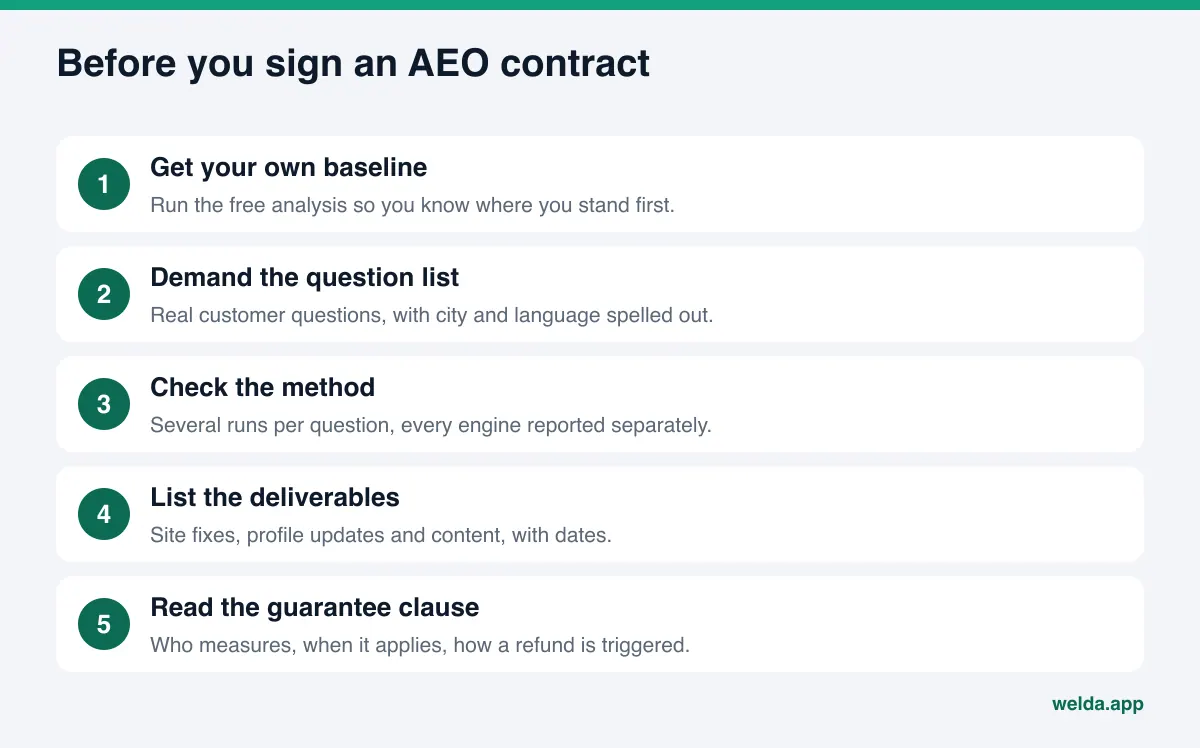
- Ask for the question list. Get the exact questions the guarantee covers, in writing. Check whether these are questions real customers would ask. Ranking first for a narrow question that includes your own brand name is easy and worthless.
- Ask for the method. How often is each question run, in which engines, and how is variation between runs reported? A report built on one run per question dresses up luck as results.
- Ask for a baseline. Before any work starts, have your current visibility measured and handed to you. Without a baseline, "we improved it" cannot be checked.
- List the actual work. Shift the conversation from outcome to tasks: what gets fixed on your site, which profiles get updated, what content gets written. Those are things you can verify were delivered.
- Ask where content will live. Will everything sit on your site and your profiles? Will you approve it before it goes live?
- Read the guarantee clause itself. When does it apply, who measures, how is a refund triggered? Reading that one paragraph often shows how narrow the guarantee really is.
Pricing deserves the same scrutiny. Our AEO budget guide walks through what you should expect to pay for work and measurement versus a promise.
What to put in the contract instead of a guarantee
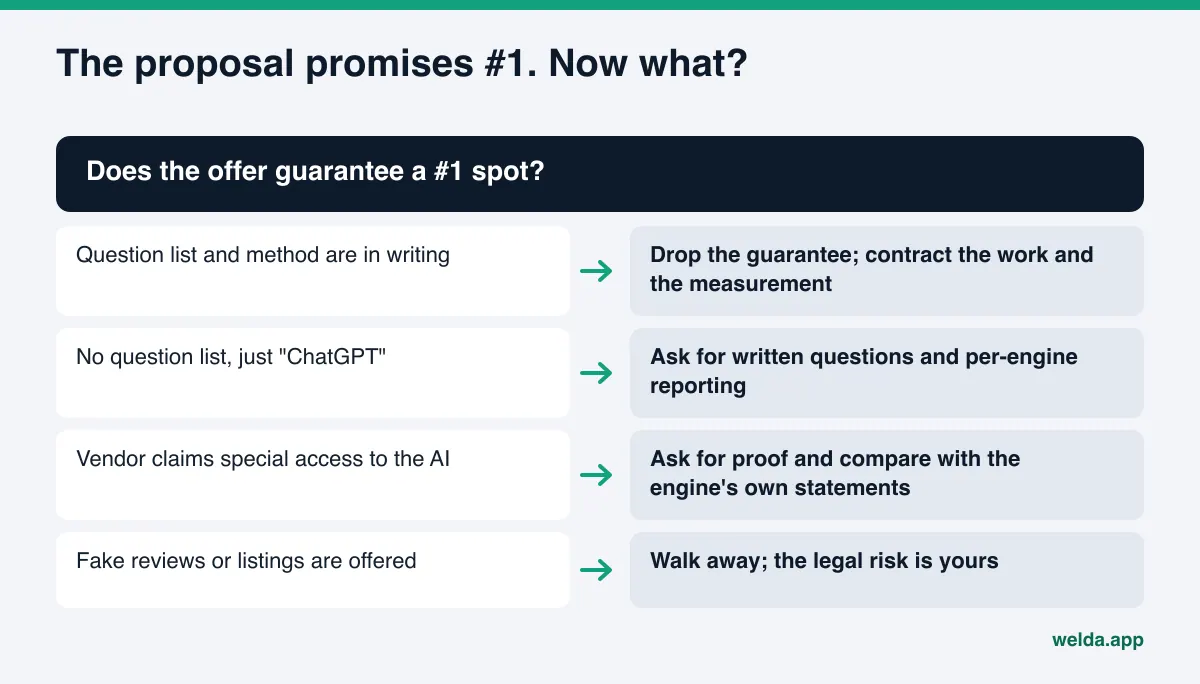
Wanting a guarantee is a reasonable instinct. You are paying, and you want something back. The problem is not the guarantee itself. It is that the thing being guaranteed is outside anyone's control. You can ask for commitments that are controllable and measurable instead.
| What the pitch says | The problem | What to ask for instead |
|---|---|---|
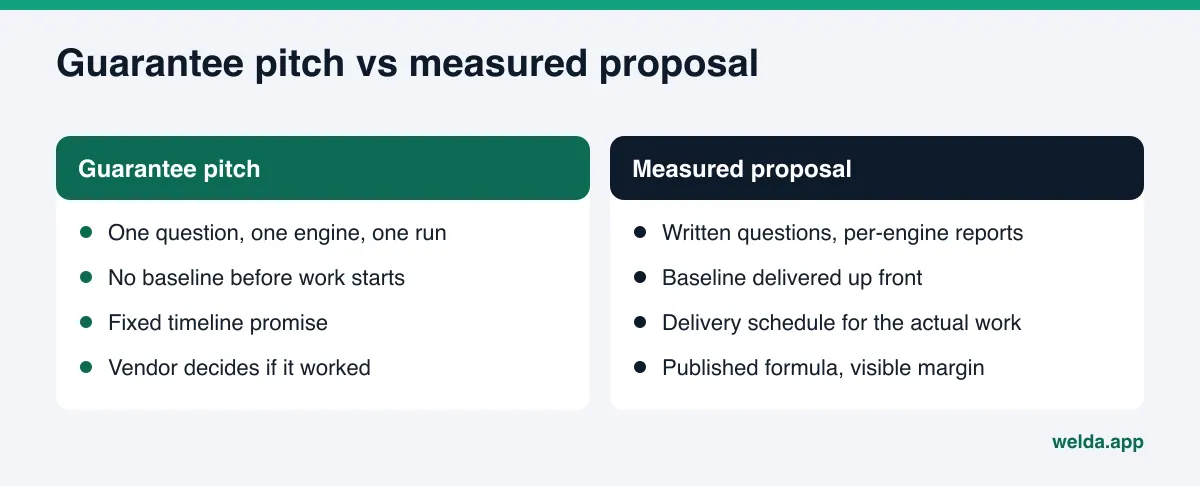
| "Guaranteed #1 in ChatGPT" | No defined questions, engines or method | A written question list and a baseline for each question |
| "Results in two weeks" | Nobody controls how fast AI answers update | A delivery schedule for the work and a monthly report |
| "You'll show up in every AI" | Each engine uses different sources | Results reported separately for each engine |
| "Money back if you don't rank" | The vendor decides whether you ranked | A score with a published formula you can check yourself |
| "We have a direct line to OpenAI" | Contradicts the engine's public statements | A list of which sources get which fixes |
| "We'll handle your reviews" | Fake review risk under FTC rules | Reply drafts for real reviews, approved by you |
Measurable commitments are also how you track progress. Our post on AEO KPIs lists the numbers worth watching: the share of questions where you are named, your position when named, your share against competitors, and how all three move over time.
How Welda handles this: open measurement, not a guarantee
Welda is software that measures where a business shows up in AI answers and fills the gaps on the business's behalf. Three parts of it matter for this topic: how measurement is run, how the score is calculated, and where "why am I not showing up" gets answered. First, the facts about availability. The free site analysis works in English today, for anyone. The full Welda dashboard is in early access and is opening first in Turkey; regular measurement across all four engines is being added during early access, and the sample screens use representative data. Pricing is discussed in the early access conversation.
Each question is asked three times, and the spread stays visible
AI answers are regenerated every time, so Welda builds that into the measurement instead of ignoring it. In the dashboard, the questions your customers would ask are sent to ChatGPT, Gemini, Perplexity and Google AI three times each. If your business is named second on the first run, fourth on the second, and not at all on the third, Welda does not flatten that into "you're #1" or "you're missing." It shows all three. That is the opposite of a guarantee pitch: instead of hiding the variation, it puts it on screen.
On the questions screen, each row is one question with a column per engine. Open a question and you see a summary of the answer, the sources it cited, and the three runs side by side. The decision you make there is practical: where are you already named, where are you absent, and in the questions you miss, who is winning and from which source.
The score formula is published
Guarantee offers share one habit: the vendor answers "did it work?" with its own number. In Welda, the score is calculated in the open: 100 × (0.5 × share of questions where you are named + 0.3 × position score + 0.2 × share against competitors). The spread across the three runs produces a ± margin of error shown next to the score. So when your score moves from 31 one week to 33 the next, you can see whether that is a real change or noise inside the margin.
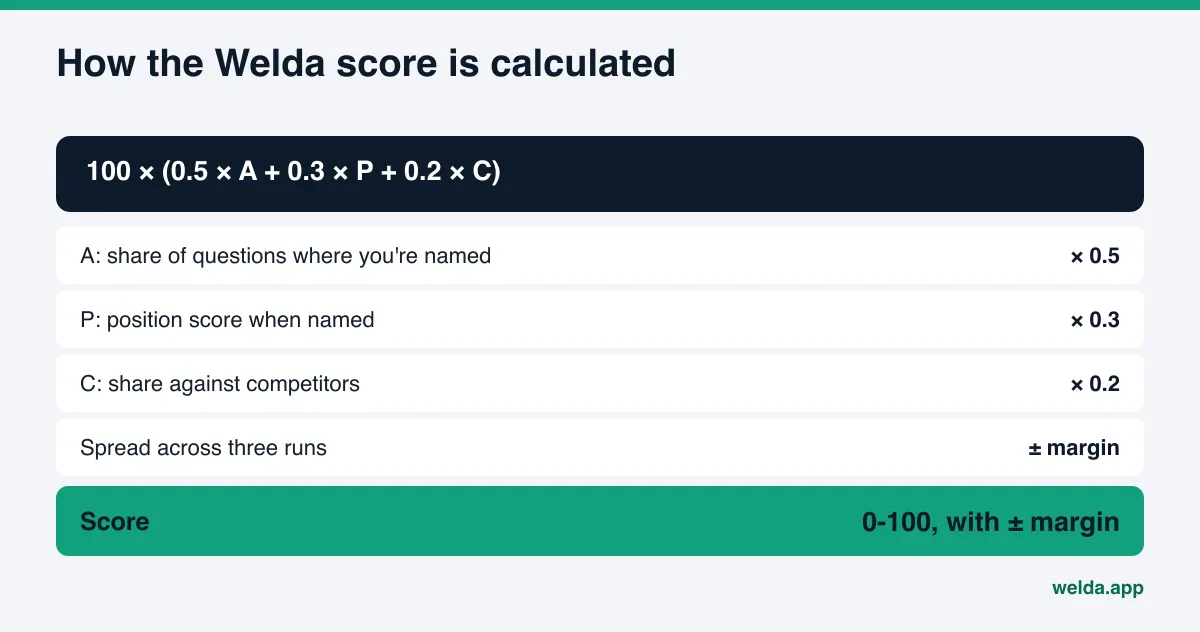
Notice that position only carries a weight of 0.3. That is deliberate. Being named first has value, but being named at all in most of the questions customers actually ask matters more. Ranking first on one question does not make up for being absent from twenty. Guarantee offers usually sell one question's top spot. Measurement shows the whole picture.
"Why am I not showing up" becomes a task list
Measurement by itself changes nothing. The competitor and source screens show which topics a competitor wins and which sites the AI drew from, and the to-do list turns that into work. Welda drafts content, profile copy and review replies; you approve what gets published, and content always lives on your own site. If Welda does not know something, like your Saturday hours, it asks rather than guessing. The monthly one-page report and the before-and-after comparison track the same measurement over time.
Limits: what Welda does not do
If we are going to criticize guarantee pitches, our own limits should be just as clear.
- No ranking guarantee. Not #1, not top five, not "you'll definitely be mentioned in ChatGPT."
- No invented facts. Missing information is requested from the business, never filled in by guesswork.
- No fake reviews. Welda's review work is drafting replies to real reviews.
- No unapproved sensitive content. In healthcare there is no automatic publishing at all; everything goes to an approval queue.
- Some work stays with you. Handling negative reviews, managing directory accounts such as Yelp or BBB listings, and PR outreach are not things Welda does.
- No shortcut on timing. New content usually takes weeks to show up in AI answers. Welda measures that lag; it does not claim to shorten it.
The free analysis has a limit too. It reads your site and asks five questions once. That is a snapshot. We compare snapshots and ongoing tracking in one-time AEO audit vs ongoing tracking.
The legal angle on guarantee claims
This section is not legal advice; it only points to where the rules are published. In the US, the FTC treats deceptive marketing claims as unlawful whether or not AI is involved. When it announced its Operation AI Comply sweep in September 2024, the agency put it plainly: "there is no AI exemption from the laws on the books" (FTC, Operation AI Comply).
That matters to you in two ways. First, it is fair to ask a vendor how they would substantiate a guarantee. Second, the same standard applies to your own marketing. If your site or Google Business Profile says "best in Dallas" or "guaranteed results," you carry that claim too. Welda's compliance check flags patterns like pricing, guarantees and superiority claims before anything is published, but it is not legal advice and has not been reviewed by legal counsel. When in doubt, talk to an attorney.
Decision checklist before you sign
If you can answer "yes" to most of these, the proposal rests on measurable work. The more "no" answers you collect, the more likely the guarantee is covering a gap.
| Question | Good sign | Warning sign |
|---|---|---|
| Is there a written question list? | Real customer questions, with city and language | Vague "key searches" |
| Which engines are measured? | Each engine reported separately | "ChatGPT" only |
| How often is each question run? | Multiple runs, variation reported | One run, one screenshot |
| Is there a baseline? | Delivered to you before work starts | Missing or produced afterward |
| Where does content live? | On your site, with your approval | On the vendor's sites or network |
| How are reviews handled? | Replies to real reviews | "Review support" that generates reviews |
| Is there a timing promise? | Honest that it can take weeks | Days, or "two weeks guaranteed" |
What you want is not a sentence but a process: where you stand today, what is missing, who does what, and what changed a month later. A proposal that answers those four questions clearly is more trustworthy than one with a guarantee on top.
Frequently asked questions
Are guaranteed ChatGPT rankings legal to advertise?
A guarantee is not automatically illegal, but US advertising law expects claims to be truthful and substantiated, and the FTC has said there is no AI exemption. A promise nobody can verify is a risk for the seller. This is general information, not legal advice.
Can I pay ChatGPT to rank my business first?
OpenAI says ads do not influence ChatGPT's answers and are labeled as sponsored, separate from the organic response. The work you can do for the organic answer is making the information AI can find about you accurate and consistent.
I saw my business named first once. Will it stay there?
Not necessarily. The same question can return a different answer on the next run, for a different person, or in a different engine. Look at the average of repeated runs, not a single result.
If Welda doesn't guarantee rankings, what does it offer?
A measurement with a published formula, a question-by-question view of where you are and are not named, ready-to-use copy to close the gaps, and a single to-do list. The dashboard is in early access and opening first in Turkey; the free site analysis is available today in English.
How long until results show up?
New content usually takes weeks to appear in AI answers. Any offer that names an exact timeline is promising something it cannot control.
Does the free analysis show my ranking?
No. It does not measure rankings. It reads your site through Google's and AI assistants' eyes, lists what is missing and how to fix it, and checks once whether your name appears in answers to five customer questions.
Start with your own baseline
The best defense against a guarantee pitch is knowing your starting point before the sales call. Are AI crawlers blocked in your robots.txt? Do you have business schema markup? Is your FAQ section missing? Where are competitors ahead? Once you know those answers, nobody can sell you a "#1" headline; the conversation moves to the actual work. Run the free site analysis, download the report, and read every proposal next to it.