How much should an AEO budget be, and what should it pay for? An AEO budget is not one number. It is a plan made of line items: a baseline measurement, one-time site fixes, a small but steady flow of content, profile and review work, and your own team's review time. The way to find the right number is to measure where you stand first, then split the gaps into one-time and monthly work. A budget set before measuring tends to either leak or stall.
Why an AEO budget deserves its own line
Customers now type full questions into ChatGPT, Gemini, Perplexity and Google's AI Overviews and AI Mode: "emergency plumber in Plano open on Sunday", "family-friendly dentist near me that takes walk-ins", "boutique hotel in Savannah with parking". The answer is not a page of ten blue links. It is a short list of businesses, each with a one-line reason. To write that reason, the AI leans on what it can read about you: the text on your website, your structured data (schema), your Google Business Profile, what people write on Yelp, Tripadvisor or the BBB, and how you appear in industry directories such as Angi or Healthgrades.
This is answer engine optimization, or AEO. You may also see it called GEO (generative engine optimization); in the US the two terms describe the same work, and AEO is the one most buyers search for. Most of it looks nothing like an ad budget. There is no cost per click and no rate card that says "spend this much, appear in that slot". The money goes into making your facts readable, writing the content that is missing, keeping profiles consistent and measuring the result on a regular schedule.
That is why leaving AI search visibility as "a corner of the marketing budget" often goes wrong. Someone buys a tool, someone else talks to an agency, someone edits a few page titles, and nobody knows whether those three spends serve the same customer questions. A separate AEO budget forces one plan with one way of measuring progress.
The second reason is time. New content usually takes weeks to show up in AI answers. An owner who sees nothing in month one is tempted to cut the spend in month two. Writing down up front what will be measured, and when you will look, prevents that early exit. In short, an AEO budget is less an invoice than a work plan.
What goes into an AEO budget?
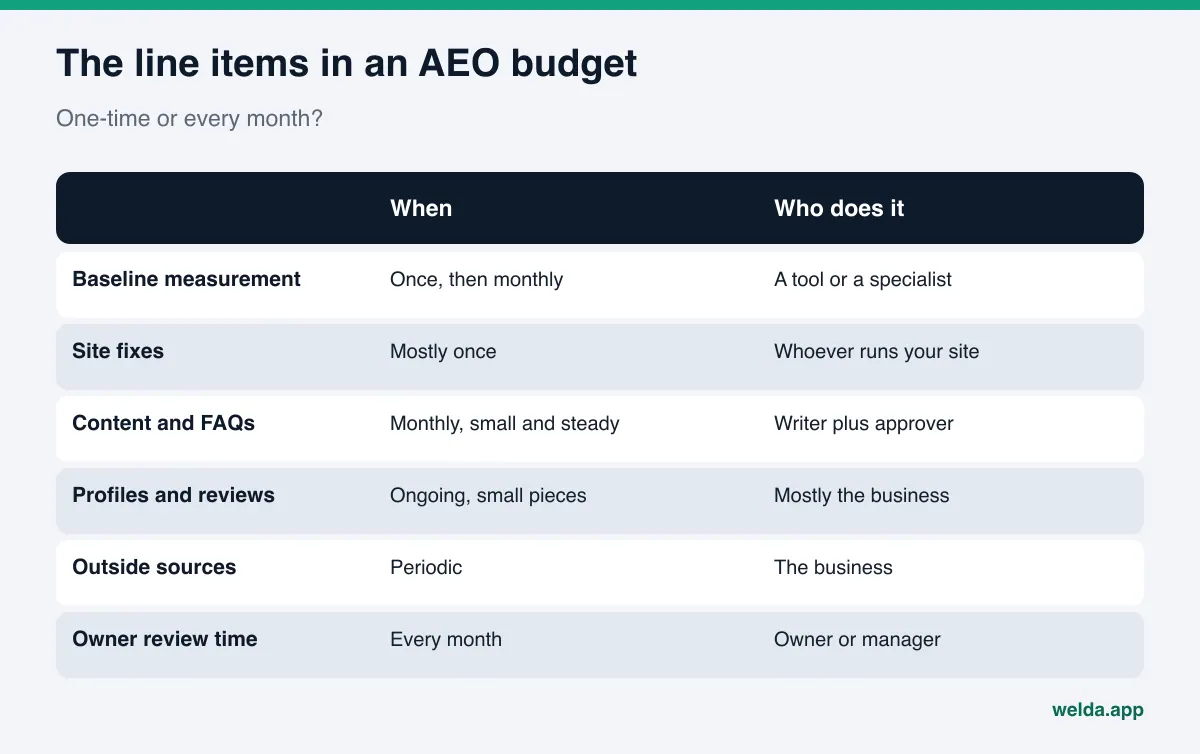
The first step is to see, line by line, where money and hours will go. The table below breaks everything a local or small business spends on AI visibility into six rows. There are no dollar amounts here, because the right figure depends on your site, your category and your team. What matters is knowing each line exists and what kind of cost it is.
| Line item | What it covers | Type | Do you get an invoice? |
|---|---|---|---|
| Measurement | Which questions name you, where competitors lead, your site's technical and content state | Once at the start, then recurring | Yes, if you use a tool or a consultant |
| Site fixes | robots.txt, page title and description, main heading, business schema, contact details, page speed | Mostly one-time | Yes, if a developer does it |
| Content | Clear service pages, FAQ sections, pages that answer specific customer questions | Monthly, small and steady | Yes, if the writer is external |
| Profiles and reviews | Google Business Profile, Yelp, social profiles, review replies, directory listings | Ongoing, small pieces | Usually not, it is staff time |
| Outside sources | Local press, industry associations, best-of lists | Periodic | Sometimes |
| Review and fact supply | Reading drafts, supplying missing facts, approving publication | Monthly | No, it is the owner's time |
The last column is there on purpose. The items most often missing from an AEO budget are the ones that never send an invoice. If nobody owns review replies, nobody updates holiday hours on your Google Business Profile, and nobody reads and approves a drafted service page, then whatever you bought will end up waiting on you. Work that waits does not show up as progress in any measurement.
How to build an AEO budget step by step
The order below makes the dollar figure the last thing you set. That is deliberate. Picking a vendor and a price before you know what you are buying either inflates the budget or points it at the wrong work.
- Measure where you stand. Check whether AI crawlers can reach your site, whether your business details are machine-readable and whether your services are described clearly. A free site analysis is a good first step: it gives you a score out of 100 and a fix for each gap.
- Write the questions you will track. Use the words customers use, with your city or neighborhood. Not "best dentist" but "dentist in Round Rock open Saturday for a cracked tooth". These questions are how you will judge whether the budget worked.
- Separate the one-time work. Fixing robots.txt, adding business schema, rewriting the title and description and making your name, address and phone match everywhere are usually done once. They belong in the startup budget.
- Separate the monthly work. New FAQ answers, a detailed page for one service, profile copy updates and review replies continue in small pieces every month. They belong in the monthly budget.
- Write down internal hours. Who approves drafts, who supplies missing facts, who handles the manual profile updates. Estimate those hours and put them on paper.
- Choose a delivery model. Only now ask whether this is your own team, a freelancer, an agency or software. Because you have a work list, you can compare every proposal against the same list.
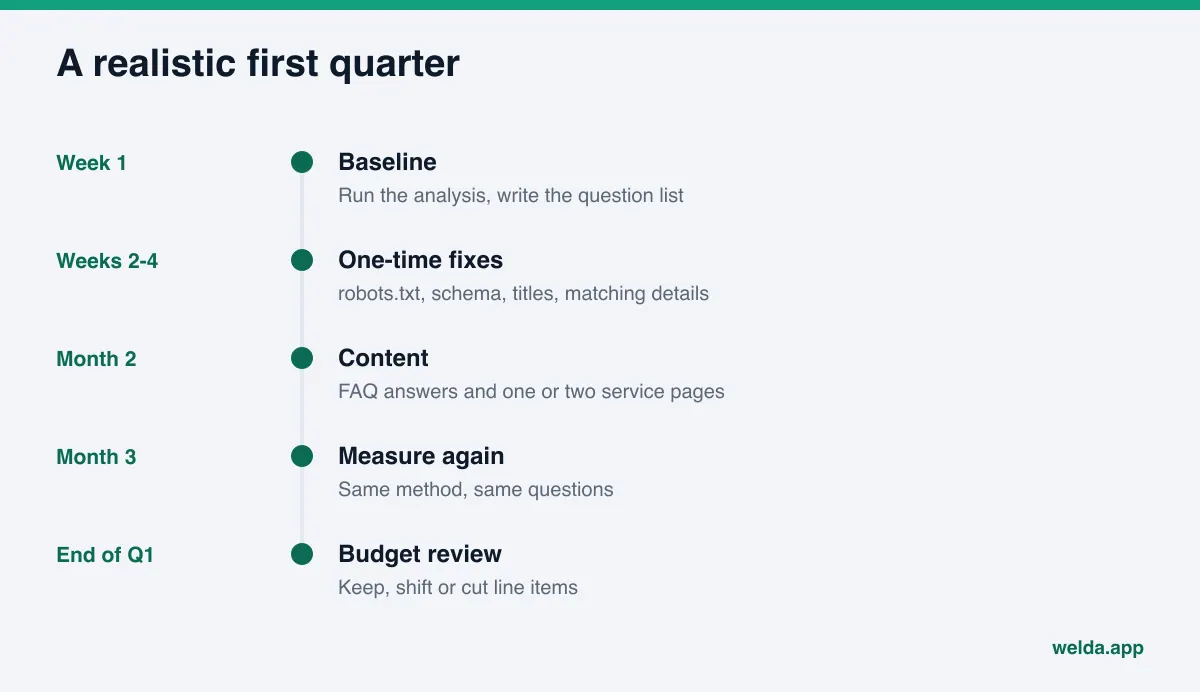
- Set a review date. Book the first budget decision about three months out. Looking earlier means judging before new content has had the weeks it typically needs to appear in answers.
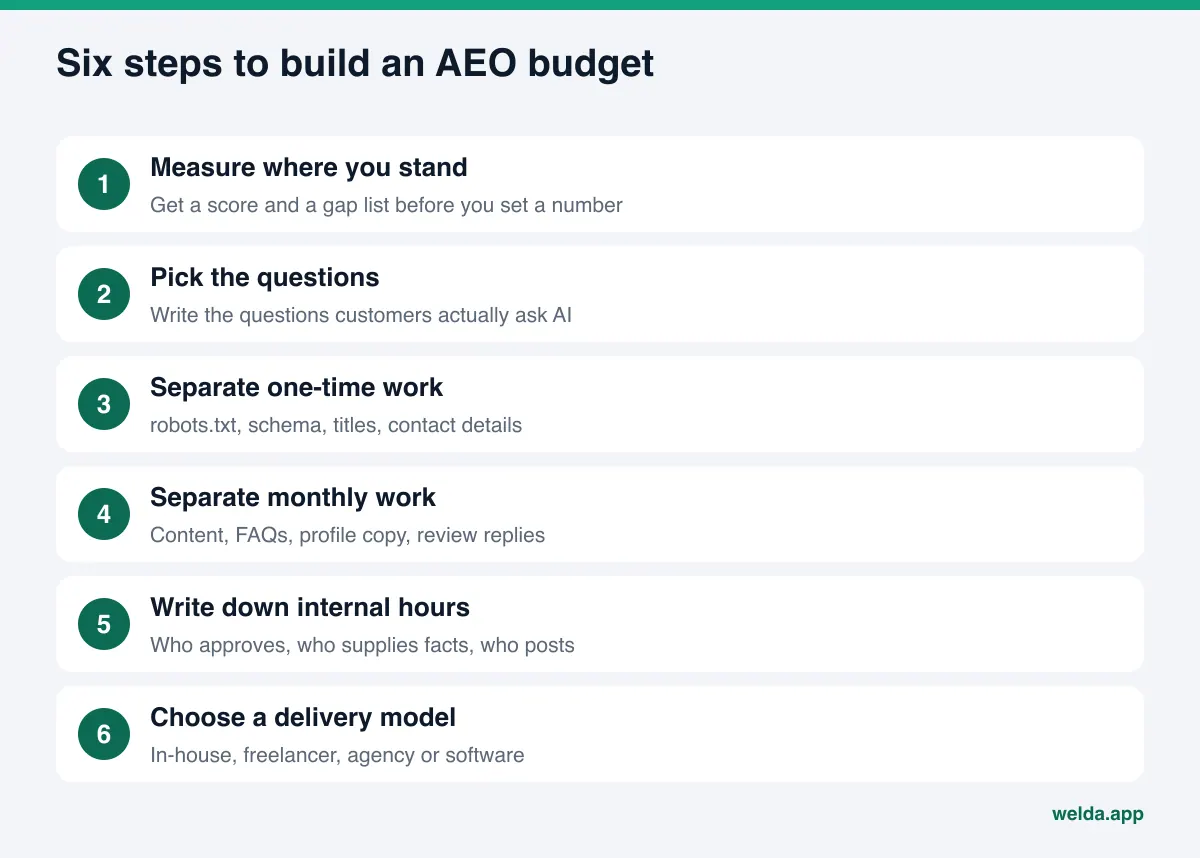
After these steps you have more than a number. You know what gets done when, by whom, and which customer questions should move. Hand that list to anyone who quotes you and ask, "Which of these do you do, and which stay with us?" Our guide on questions to ask an AEO agency pairs well with this list.
One-time vs monthly spend: drawing the line
The most common AEO budget mistake is paying monthly for work that only needs doing once. Once robots.txt is set correctly, it does not need resetting every month. Once your LocalBusiness schema is right, it only changes when your address or phone does. If you are paying for these every month, what you are actually paying for is probably measurement or reporting. That can be worth it, but you should know it.
The reverse is also true. Content and profile work never really finishes. The questions customers ask shift, competitors publish new pages, new reviews arrive. Buying this as a one-off project and walking away lets early gains erode over a few months. So open three separate lines:
- Startup budget: baseline measurement, technical fixes, rewriting the homepage and core service pages, business schema, matching details across your site, Google Business Profile, Yelp and the BBB.
- Monthly budget: recurring measurement, a few new answers or pages each month, profile copy, review replies, a monthly report and a short review meeting.
- Periodic budget: local press, association and directory listings, and a batch update whenever you open a new location or add a service.
With that split in place, proposals get easier to read. If a vendor has spread startup work across a monthly fee, you can ask what you are paying for after month three. If a tool only measures, you can work out who will make the fixes and how many of your hours that adds. We cover the difference in more depth in AI visibility monitoring vs done-for-you AEO.
An example AEO budget for a small business
The scenario below is an example. It does not describe a real company, and nothing in it is a measured result. The point is to show how the line items fit together. Picture an example home services company: one location, a heating and cooling business with a website on a common page builder. The owner can edit the site but has no one on staff whose job is writing.
Assume the first measurement shows this: AI crawlers can reach the site, but there is no business schema; the main heading is just the company name; there is no FAQ section; the phone number on the Google Business Profile does not match the site; and competitors show up for "same-day AC repair" and "furnace tune-up cost" questions. The budget could then be split like this:
| Task | Line | Who does it | What stays with the business |
|---|---|---|---|
| Business schema and titles | Startup | Site manager or a ready-made fix pack | One check |
| Matching the phone everywhere | Startup | The business | Profile updates on GBP, Yelp, Angi |
| FAQ section | Startup | A writer or software | Confirming every answer is accurate |
| "Same-day repair" and pricing-approach pages | Monthly | A writer or software | Supplying facts and approving |
| Review replies | Monthly | Whoever drafts them, or software | Posting and handling negative reviews |
| Measurement and monthly report | Monthly | A tool or specialist | Reading it and making the call |
Watch the last column. Whatever model you pick, the work that stays with the business does not disappear. Only the owner knows the actual service area, whether there is an after-hours fee, which brands the technicians are certified on, and what the warranty on labor really is. A good plan collects those facts once and reuses them in every piece of copy. A weak plan asks the same question every month, or never asks and writes something generic. The second option looks cheaper on paper but never produces the specific facts an AI can repeat with confidence.
Where AEO money gets wasted
Money and hours tend to leak in the same few places. Knowing them protects the first quarter of spend.
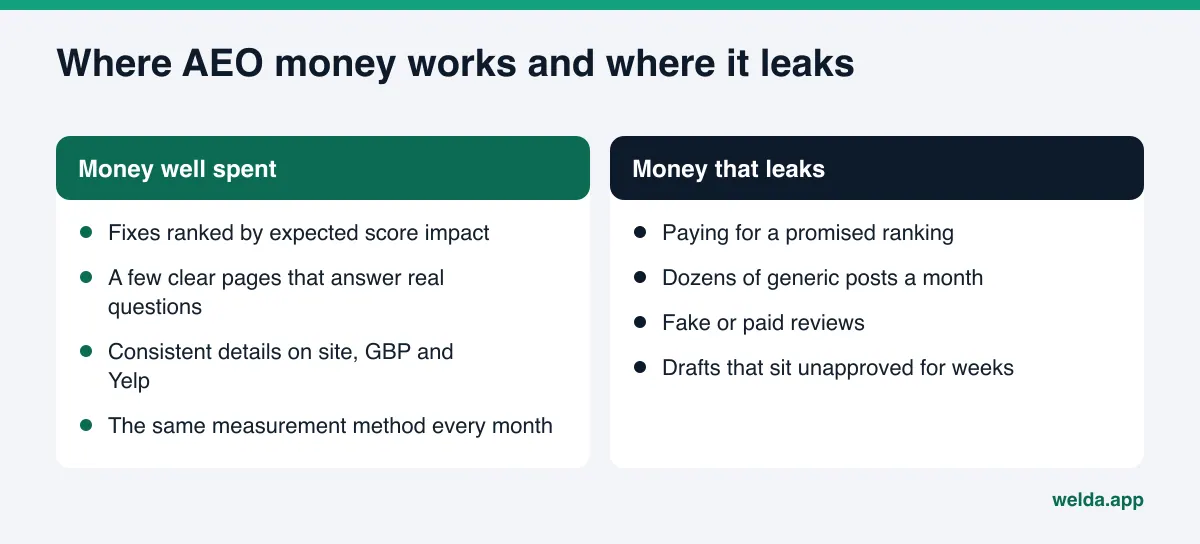
- Starting without measuring. Content written without knowing which questions you miss often re-explains topics where you already do fine.
- Paying for a promise. A proposal that says "we will get you to the top of ChatGPT" is promising something nobody controls. AI answers vary by person, time and wording, and no one can guarantee them.
- Volume over clarity. Dozens of generic posts a month can do less than a few clear pages that answer what customers actually ask.
- Fake or paid reviews. They mislead customers and violate platform rules, and in August 2024 the FTC announced a final rule banning fake reviews and testimonials. This is not legal advice, but there should be no line for this in your budget.
- Drafts that sit unapproved. A finished draft waiting for sign-off contributes nothing. Leaving review hours out of the budget is the quietest loss of all.
Every item on this list says the same thing: an AEO budget is measured in work completed, not money spent. When you compare offers, "How many of these tasks get done for this fee, and what is left for me?" is a more useful question than "What does this fee promise?" If you want to see the tool landscape side by side, start with our list of the best AEO tools for small businesses.
How Welda fits into an AEO budget
Welda is software that measures where a business shows up in AI answers and prepares the missing pieces on its behalf. From a budgeting point of view, three parts of Welda touch this topic directly: the free analysis that measures before you spend, the to-do list that shows what is left for your team, and the monthly report that shows what the spend returned.
Before you set a number: the free analysis and its simulation
Welda's free site analysis reads your homepage and a few inner pages (services, pricing, about, contact) the way Google and AI systems do. You get a score out of 100, split into technical and content. The most useful part for budgeting is the simulation: it shows how much each fix is expected to raise the score. That turns "where should the startup budget go first?" from a guess into a ranked list. The analysis also includes a competitor comparison, a ready-made fix pack to add to your site (including business schema code) and suggested copy for the homepage title, description, main heading, intro paragraph and FAQs. If you can edit your own site, your team can close part of the startup work with that pack alone.
The analysis also asks five questions a customer might ask to an AI assistant that can search the web, and checks whether your business name appears in the answers. It is a one-time check and does not measure rankings, but it lets you walk into a budget meeting with a concrete starting point: "Today we are named in this many of five questions." The free analysis works in English and is free once per site.
Where internal hours become visible: the to-do list
In the Welda panel, the to-do list is the "what stays with the business" column in practice. At the top are facts Welda could not read from your site and asks you for instead of inventing them; you enter each once and it flows into every related draft. Below that are manual tasks, such as a profile with no publishing connection, each with ready-to-use copy next to it. Your job is not to write the copy but to paste it in place and mark it done. Looking at this list is the most direct way to estimate how many internal hours a month needs.
Welda drafts content, profile copy and review replies; publishing approval always stays with the business. On WordPress sites, Welda connects through a separate Editor user and an application password, with no code to install. Content opens on your site as a draft and goes live once you approve it. For other systems Welda provides a ready package and the changes are applied by hand. That difference shows up in the budget: a WordPress business spends less time on implementation, while others should count their web person's hours too.
The return on spend: the score and the monthly report
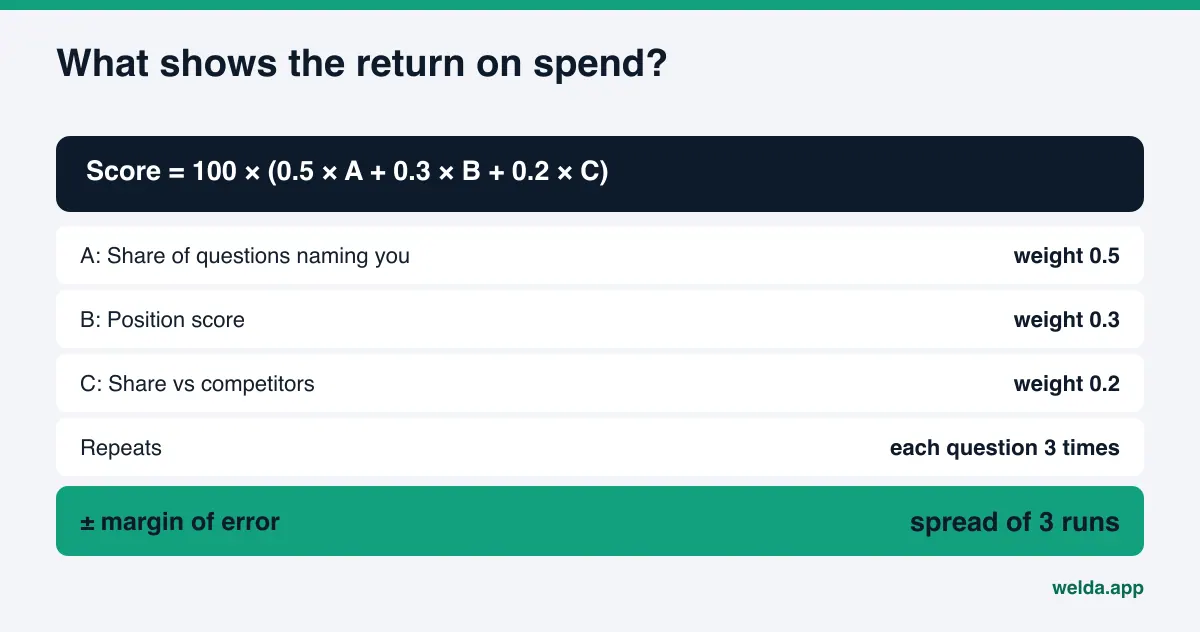
In the panel, the questions your customers would ask are run three times each on ChatGPT, Gemini, Perplexity and Google AI. The score formula is open: the share of questions that name you carries 50 percent of the weight, your position 30 percent and your share against competitors 20 percent, with a margin of error from the spread of the three runs. A one-page monthly report, downloadable as a PDF, puts the month's gains, losses and next steps on a single page. Lay three of those side by side at the quarterly review and you can see which monthly spend moved which questions.
One important note on where things stand. The Welda panel is in early access and is opening gradually, starting with businesses in Turkey. Regular four-engine measurement is being added during early access, and the sample panel screens use representative data. The part anyone can use today is the free site analysis, which runs in English and German. Welda does not publish pricing; pricing is discussed in an early access conversation, so you will not find a Welda dollar figure in this article.
Limits, and what Welda does not do
A good AEO budget also knows what money cannot buy. No spend guarantees a position in AI answers or a mention in ChatGPT, and Welda makes no such guarantee. These limits keep the plan realistic:
- Welda does not write facts it does not know. It asks the business, so fact-supply hours stay in your budget.
- It does not publish sensitive content without approval. In healthcare there is no automatic publishing, every piece comes to you for approval, and patient data is never sent to AI.
- It does not create fake reviews. How to handle negative reviews, directory accounts and press outreach stays with the business.
- It does not host content. Everything lives on your own site, so if you stop using Welda, the content stays yours.
- The compliance check flags patterns such as pricing claims, guarantees and superiority claims before publishing, but it is not legal advice and has not been reviewed by legal counsel.
- New content usually takes weeks to appear in AI answers. Judging the budget on one month of results is misleading.
None of this shrinks the budget; it puts it in the right place. You need fewer writer hours for the work Welda drafts, while review, fact-supply and outreach hours stay where they are. If you want to see what can be done at no cost first, our roundup of free AEO tools is a reasonable next read, and AI SEO tools covers where classic SEO software overlaps.
An AEO budget decision checklist
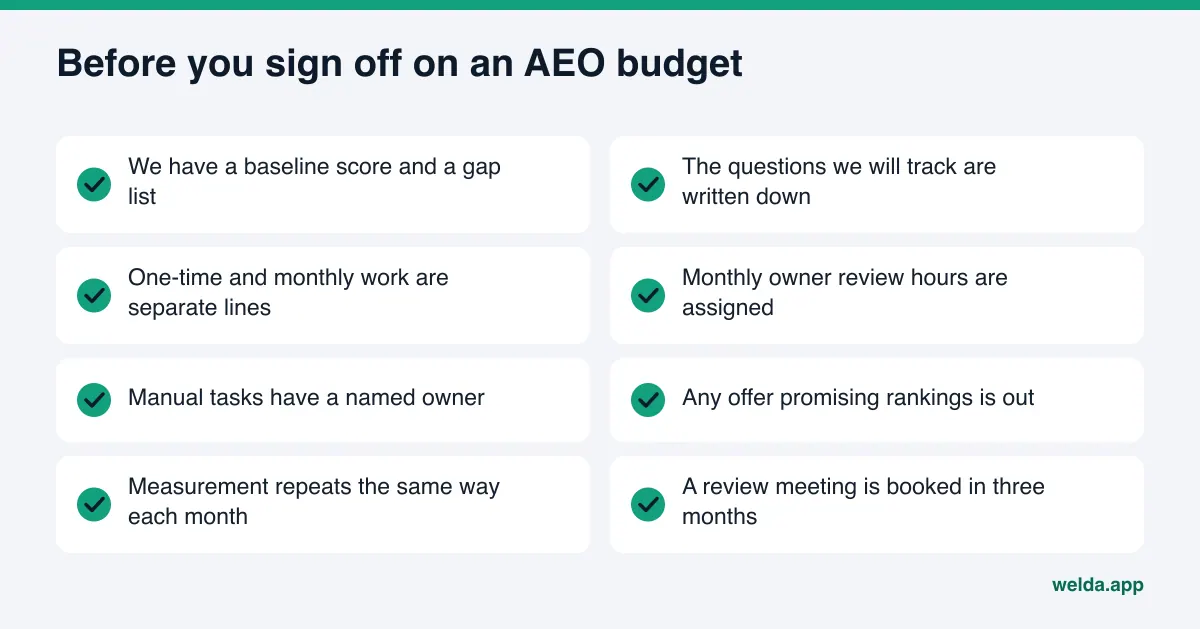
Before you approve the budget, you should be able to answer "yes" to every question below. If even one answer is "not sure", what is missing is not the dollar amount. It is the plan.
| Question | Why it matters |
|---|---|
| Do we have a baseline score and a gap list? | Without them, spend has no direction |
| Are the questions we will track written down? | Progress is judged against those questions |
| Are one-time and monthly work on separate lines? | You should not pay monthly for one-time fixes |
| Who owns approvals and fact supply? | Unapproved drafts do nothing for visibility |
| Does any offer promise rankings? | If so, the offer is not realistic |
| Whose site does the content live on? | When a contract ends, the content should stay with you |
| Is a three-month review on the calendar? | It prevents both quitting early and spending forever |
Filling this table in separately for each agency, freelancer or software proposal gives a clearer answer than comparing their prices. Price only means something once you know what each one actually delivers.
Frequently asked questions
How much should a small business spend on AEO each month?
There is no single right figure. It depends on how many gaps the first measurement finds, who manages your site and how much time your team can give. Measure first, split the work into one-time and monthly, and let the number come from that list.
Should the AEO budget be separate from the SEO budget?
Some work is shared: titles, descriptions, schema and page speed help both. Measuring AI visibility and writing question-based content are separate jobs, though. Do the shared work once and keep AI measurement on its own line to avoid paying twice.
When should I expect results?
Technical fixes can happen right away, but new content usually takes weeks to show up in AI answers. Booking the first decision about three months out and measuring the same way every month is the sensible approach.
Where should I start if my budget is very tight?
Start with the free site analysis and order the fixes by the score impact the simulation shows. One-time work such as robots.txt, business schema and consistent contact details can often be done by your own team.
What does Welda cost?
The Welda panel is in early access and pricing is not published; it is discussed in an early access conversation. The free site analysis, available to anyone today, is free once per site.
Should the budget go to an agency or to software?
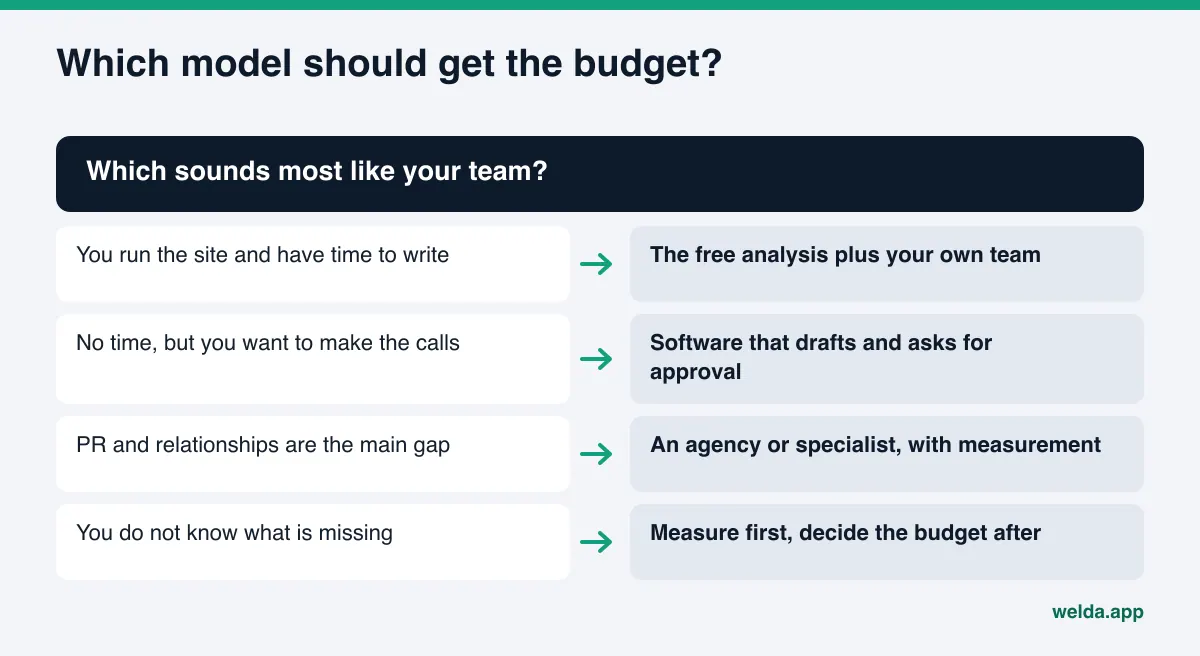
Look at what your team is missing. If you lack time but want to make the decisions, software that drafts and brings work to you for approval may fit. If press and relationships are the main gap, an agency or specialist may be needed. Either way, measurement and internal review hours stay in the budget.
Start the budget with a measurement
The cheapest and most important step in any AEO budget is seeing where you stand before you set a number. Once you know which gaps exist, which fix moves the score most and where competitors lead, the budget stops being a guess and becomes a plan. Run the free site analysis; the results link arrives by email and stays open for 14 days. Bring that report to your budget meeting.