Which AI SEO tools actually help a local or small business? It depends on the job. Some tools sold under that label write content for you. Others measure whether ChatGPT, Gemini, Perplexity, and Google's AI answers mention your business when customers ask. If your customers are asking AI for recommendations, the second job comes first; new content only pays off once you know where the gap is.
Search for "AI SEO tools" and you will find two very different products under the same name. One person typing that phrase wants to draft blog posts faster. Another wants to know why ChatGPT recommends the shop down the street instead of theirs. The first need is served by AI writing tools. The second is the territory of AEO, short for answer engine optimization, which some vendors also call GEO (generative engine optimization). In both cases the goal is AI search visibility: being named in the answer, not just ranked below it. Because the two tool types are marketed with the same language, many businesses buy one and expect it to do the other's work. This guide separates them, explains what an AEO tool should measure, walks you through choosing one, and shows how Welda approaches the problem. If you want a baseline first, run the free AI visibility analysis; it shows in a few minutes how Google and AI systems read your website.
What are AI SEO tools? Two categories under one label
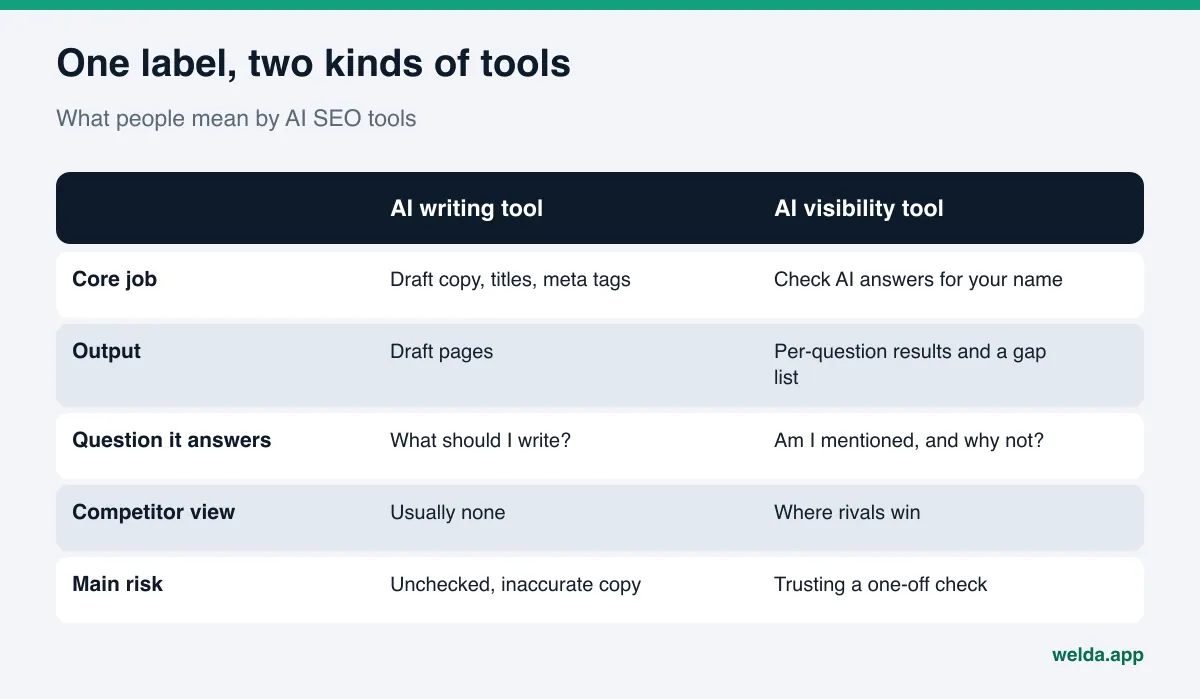
Most products marketed as AI SEO tools fall into one of two groups. The difference is not a technicality. It decides which question your money is buying an answer to.
Group one: AI writing tools. You give them a keyword or topic, and they return a draft article, a title tag, a meta description, or a set of FAQs. Some compare your page with the pages that rank and suggest missing headings. The question they answer is "What should I write, and how do I write it faster?" They do not tell you whether that copy helps you show up in an AI answer, because they never look at the answer.
Group two: AI visibility tools. These ask AI engines the questions your customers would ask and record whether your business name appears, where it appears, which competitors are ahead, and which sources the answer is built on. The question they answer is "Am I being recommended, and if not, why?" Welda belongs to this second group.
There is also a middle ground: classic SEO suites that have added AI modules next to their keyword and rank data. They can be useful if you already live inside one of those platforms, but check whether the AI module measures answers question by question or simply relabels search data.
| Question | AI writing tool | AI visibility (AEO) tool |
|---|---|---|
| What do you get? | Draft copy, title and description ideas | Per-question results, competitor and source data, a gap list |
| What does it look at? | Keywords and ranking pages | The answers AI engines actually give |
| When is it useful? | When you already know what to write | When you do not know what is missing |
| Who checks the work? | You review every piece | The tool measures; who fixes depends on the tool |
| Common mistake | Publishing lots of unchecked pages | Treating a single screenshot as a measurement |
Why buying the wrong AI SEO tool gets expensive
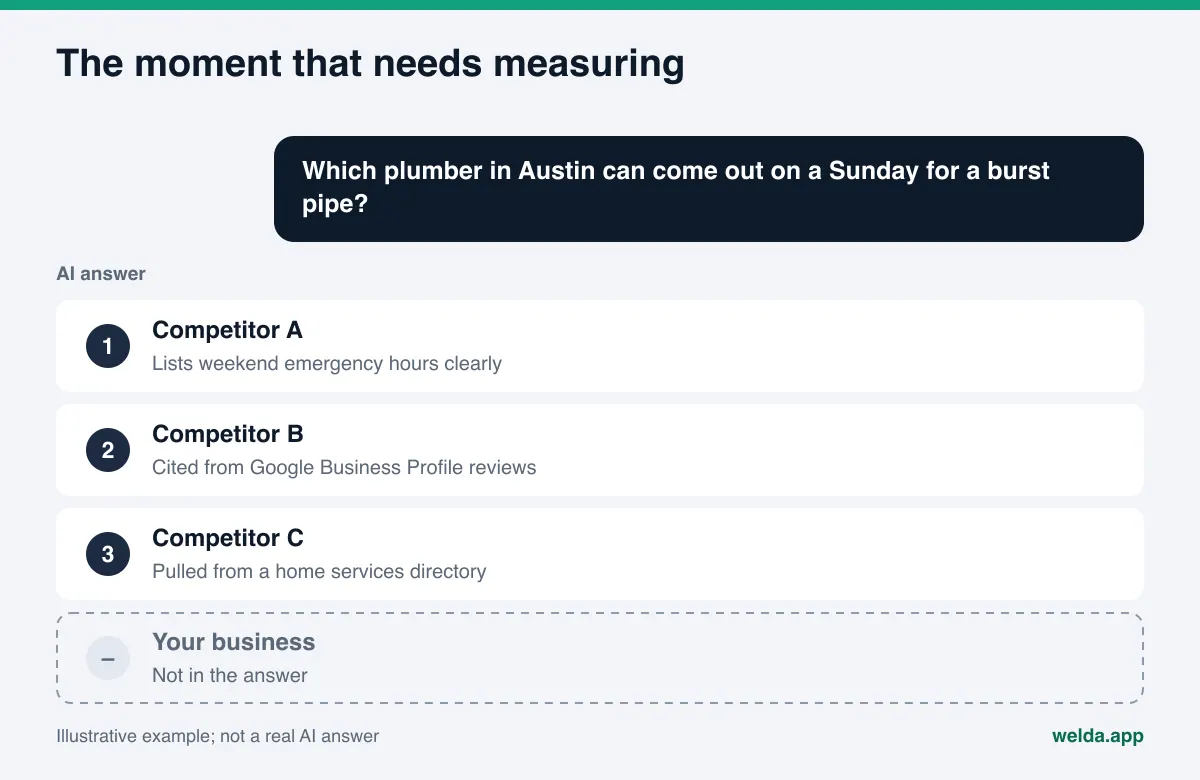
The problem usually starts with a remark from a customer: "I asked ChatGPT for a dentist near me and it suggested someone else." Or you type your own category into Perplexity and see a competitor's name. The easy reaction is to assume you need more content and sign up for a writing tool. But the cause is rarely the amount of content.
Common reasons a business is missing from AI answers include: AI crawlers blocked in robots.txt, services and service areas that are vague on the site, no structured business data (schema), a Google Business Profile that does not match the website, missing or thin listings on the sources the answer relies on, such as Yelp, Tripadvisor, BBB, Healthgrades, or Angi, and competitors who simply state the key facts more clearly. Most of these are not solved by another blog post. Publishing ten AI-written articles a month and discovering months later that none of them changed the answers is a cost in both time and budget.
Google is direct about this. Its page on AI features and your website says there are no additional requirements and no special optimizations needed to appear in AI Overviews or AI Mode; a page has to be indexed and eligible to show in Search with a snippet. In other words, if the basics are broken, more copy on top will not fix them. You need to know what is missing first.
Where AI writing tools hit their limits
AI writing tools are not bad. Used well, they save drafting time. The trouble starts when people expect them to do more than write. Keep three limits in mind.
Accuracy is on you. Google's guidance on using generative AI content points out that generative models do not retrieve facts; they predict a likely sequence of words. It asks site owners to fact-check and review all AI-generated content, including title elements, meta descriptions, structured data, and image alt text. For a local business, that matters in a specific way: if the tool invents opening hours, prices, or service areas, AI engines may read that wrong information from your own site and pass it on to customers.
More pages are not more value. The same guidance warns that generating many pages without adding value for users may violate Google's policy on scaled content abuse. Spinning up near-identical "plumber in [suburb]" pages for every zip code adds risk, not AI visibility.
Reviews are off limits. Some tools offer to write reviews or testimonials. Do not. The FTC's rule on consumer reviews and testimonials, published in August 2024, prohibits fake reviews, including reviews that misrepresent the reviewer's experience with the business. Writing replies to genuine reviews is a different matter. This is not legal advice; check with your own counsel for your situation.
The tool never looks at the answer. A writing tool does not tell you whether its copy is used in any AI answer. "I published this; does ChatGPT mention me now?" remains unanswered. Measurement is a separate job.
What should an AI visibility tool measure?
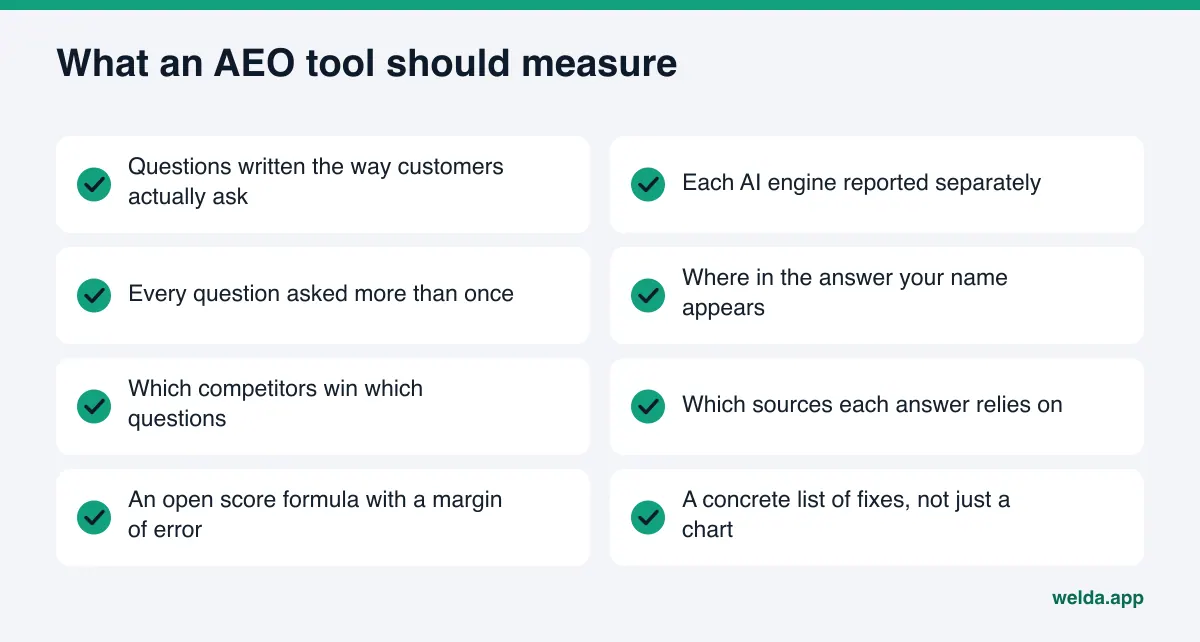
When you evaluate an AEO tool, look past the dashboard design and ask how the measurement is done. These points help you tell a real measurement from a single snapshot.
- The question list: Do the questions sound like your customers? You need full sentences with location, service, and intent, such as "Which pediatric dentist in Plano takes new patients on Saturdays?", not just "dentist." Can you add your own?
- The engines: Is only one AI measured, or do ChatGPT, Gemini, Perplexity, and Google's AI answers each get their own column? Engines draw on different sources, and being named in one but not another is common. Our guide to Gemini visibility tracking shows how much one engine can differ from the rest.
- Repetition: AI answers are generated fresh every time. A question asked once can mislead. Each question should be asked several times, with the spread shown as a margin of error.
- Position: Being the fourth name in a list is not the same as being the first. The tool should record where you appear.
- Competitors: Which competitor wins which question, and on what topic? Without that, you do not know what to fix. Ongoing AI brand monitoring builds on exactly this view.
- Sources: Which sites does the answer rely on? It might be your Google Business Profile, Yelp, a trade directory, a local news story, or a competitor's own site. The source you are missing from is often the task itself.
- An open formula: How is the score calculated? If the vendor will not say, you cannot tell what changed when the number moves.
How to choose an AI SEO tool, step by step
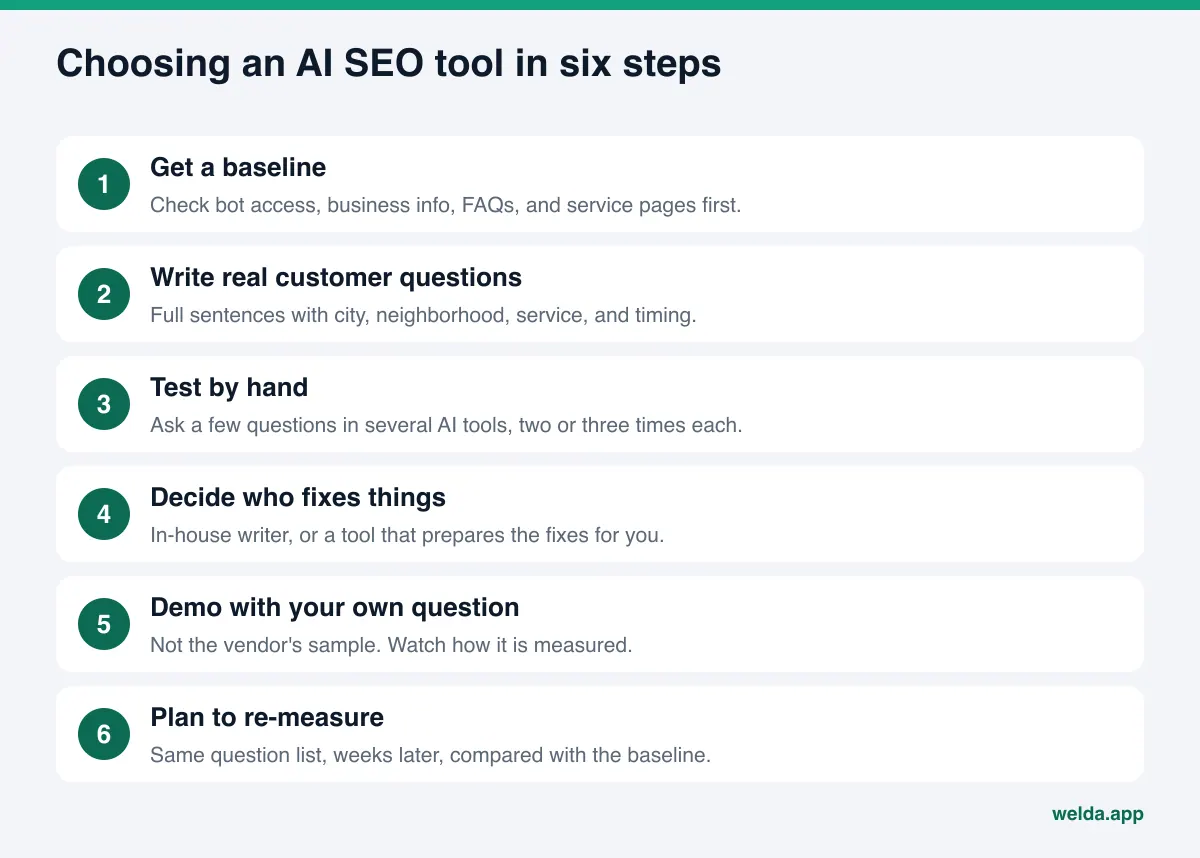
Work through these steps before any sales call. Each one produces the input for the next.
- Get a baseline. Find out whether AI crawlers can reach your site and whether your business info, FAQs, and service descriptions are in place. A free site analysis is enough for this, and it shows how much work any tool will leave you.
- Write down real customer questions. List the fifteen to twenty questions you hear most on the phone, by text, and at the counter. Include the place, the service, and the timing: "HVAC repair in Tempe open on weekends," "family-friendly brunch in Midtown Atlanta."
- Test by hand. Ask a few of these in ChatGPT, Gemini, and Perplexity, and read Google's AI Overview if one appears. Ask the same question two or three times. Seeing the answers shift is the quickest way to understand why repeated measurement matters.
- Decide who does the fixing. Do you have someone who can write copy and update profiles? Then a measurement-only tool may be enough. If not, you need a tool that also prepares the fixes. Comparing prices before this decision is pointless.
- Demo with your own question. Skip the vendor's canned example. Give them a question from your category and your city and watch how the measurement runs. Our AI visibility tool demo checklist lists what to watch for.
- Weigh the promises. If you hear "number one in ChatGPT" or "guaranteed results," walk away. Nobody who understands how AI answers are generated can promise that. We explain why in our piece on guaranteed ChatGPT rankings.
- Plan the re-measurement. Changes usually take weeks to show up in AI answers. The tool should re-run the same question list and compare it with the earlier state.
Example scenario: the same problem, two different tools
To make the difference concrete, take a fictional example. A sample HVAC company notices it is missing when customers ask AI tools for "AC repair open on Sunday" in its city.
With a writing tool: The company generates four blog posts about summer AC maintenance and publishes them. The posts read well, but the tool used outdated hours, and the fact that the company does Sunday calls is still missing from the contact page and the Google Business Profile. Nobody checks the AI answers again, so nobody knows whether anything changed.
With a visibility tool: The measurement shows which sources the answers lean on: competitors list weekend hours clearly on their profiles and on a home services directory. The to-do list comes out in this order: fix hours on the business profile, add Sunday service and service area to the contact page, update the business schema, complete the directory listing. A new blog post may not make the list at all. The same questions are measured again a few weeks later and compared.
This is an illustration, not a result claim. It shows the difference between the two paths: one produces work, the other finds the right work.
How Welda handles AI visibility
Welda is software that measures where your business appears in AI answers and prepares the fixes on your behalf. It does not start by asking what you want to write. It looks at the answers first and builds work from the gaps. Here are the parts most relevant to choosing an AI SEO tool.
The free site analysis: your starting point. This is the part anyone can use today, in English. It reads your homepage and a few inner pages such as services, pricing, about, and contact. It checks whether AI crawlers can get in, your title and description, business schema, address and phone details, FAQs, review and trust signals, how clearly your services are described, and page speed. You get a score out of 100, split into technical and content, and for every gap what was found, why it matters, and how to fix it. It also gives ready-to-use homepage copy suggestions, a simulation of how much each fix could move the score, a competitor comparison, and a fix package to add to your site. On top of that, it asks 5 likely customer questions to an AI assistant that can search the web and checks whether your name appears. That is a one-time check, not ongoing tracking, but it is enough to answer "Is my problem content, or the basics?" before you pay for any writing tool.
The questions view: where you are named. In the Welda dashboard, the questions your customers would ask are put to ChatGPT, Gemini, Perplexity, and Google AI three times each. Every row is one question, with each engine showing whether you were named and in what position. Open a row and you see a summary of the answer, the result of the three runs, and the sources the answer cited. That is the information a writing tool cannot give you: "On booking questions, Gemini names you and ChatGPT does not, and ChatGPT's answer leans on these three sources." The decision this screen drives is where to work before what to write. The gap may not be a blog post at all. It may be a directory listing or an unclear service page.
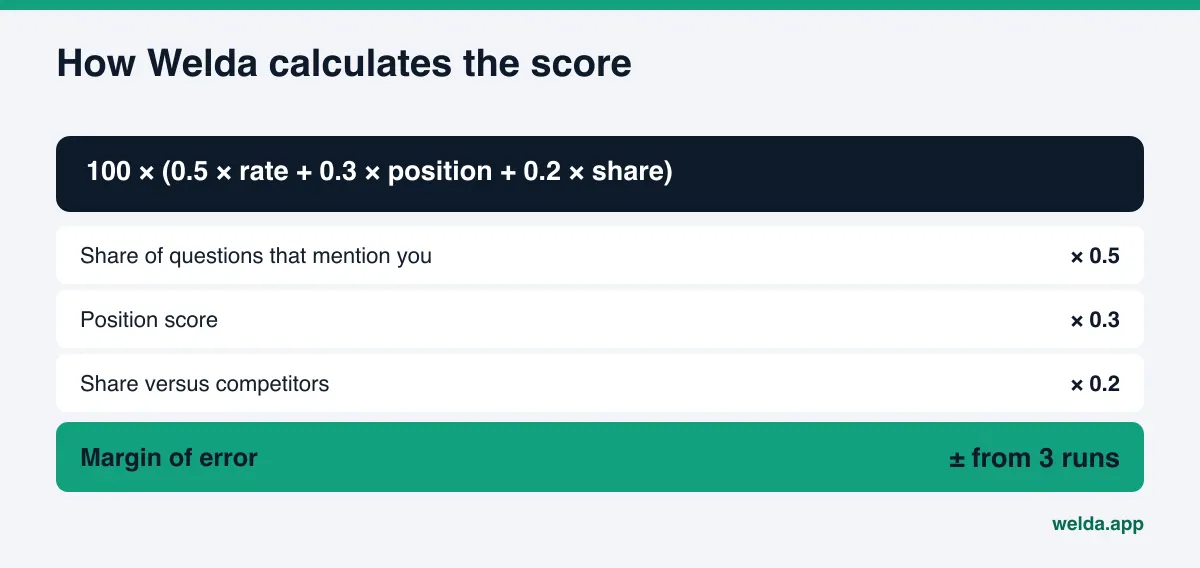
The score is transparent. Mention rate, position, and share against competitors are combined with fixed weights, and the spread across three runs produces a margin of error.
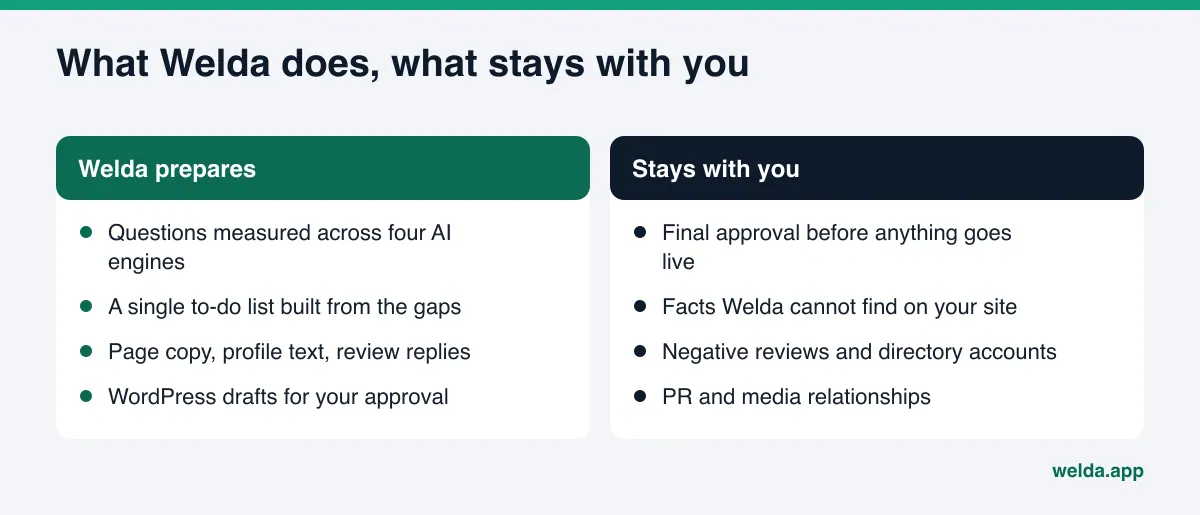
The to-do list: closing the gaps. Measurement alone does not change anything. Welda turns what it finds into one to-do list with three kinds of items. First, facts it could not find on your site: it does not guess them, it asks you, and once you answer, it applies them everywhere. Second, content waiting for your approval: page copy, profile text, review replies. Welda prepares them; you decide what goes live. Third, manual tasks: for a profile without a connection, the text is ready, but copying and verifying it is the account owner's job.
On WordPress, Welda connects without installing code, using a separate Editor user and an application password you create for it. Content opens on your site as a draft and goes live when you approve it. Where no connection is possible, Welda hands you a ready package to apply by hand. Content always lives on your own site; Welda does not host it.
To be clear about status: the Welda dashboard is in early access, and the full dashboard is opening first in Turkey. Regular four-engine measurement is being added during early access, and the dashboard screens shown in examples use representative data. The part that works today in English is the free site analysis. Pricing is discussed in the early access conversation.
Limits: what Welda does not do
Knowing what not to expect from an AI SEO tool matters as much as knowing what to expect. For Welda, the limits are:
- No ranking guarantee. Welda does not promise a spot in ChatGPT or any position. No tool controls AI answers; a tool can only help you fix the information those answers draw on.
- No made-up facts. If your hours, prices, or owner's name are not on your site, Welda asks instead of guessing.
- No unapproved sensitive content. In healthcare there is no automatic publishing; every piece waits for approval, and patient data is not sent to AI. A compliance check flags pricing, guarantee, superiority, and diagnosis-style claims before publishing. It is not legal advice.
- No fake reviews. Welda can draft replies; the reviews themselves must come from real customers.
- Some work stays with you. Handling negative reviews, opening directory accounts, and media outreach remain the business's job.
- Results take time. New content and corrected facts usually take weeks to show up in AI answers.
Apply these limits to any vendor you evaluate. If you want to see how far you can get on your own first, our guide to DIY AEO for small business owners gives you a starting list.
Decision checklist: which AI SEO tool fits you?
Before you buy, write down your own answer to each row. Your answers point to the type of tool you need.
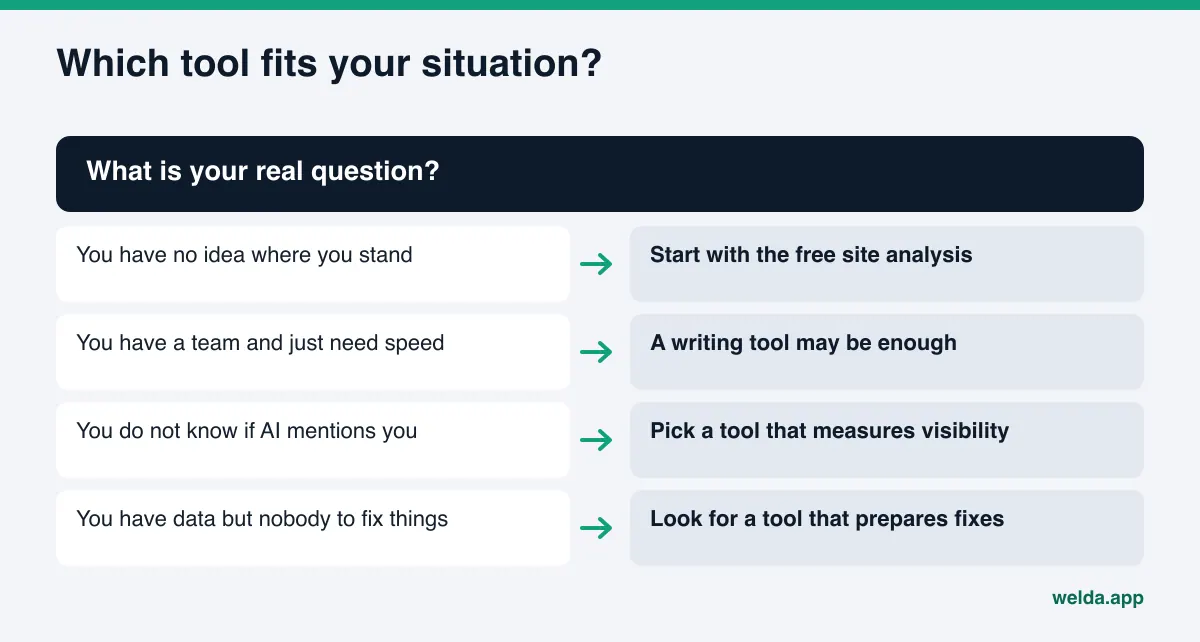
| Your situation | Best fit | Watch out for |
|---|---|---|
| You have no idea where you stand in AI answers | Start with a free site analysis | It is a one-time check, not tracking |
| You have a team and just need faster drafts | An AI writing tool | Fact-check everything; avoid mass pages |
| Competitors are named and you are not | An AI visibility tool | Make sure it shows competitors and sources |
| You have data but nobody to act on it | A tool that prepares fixes | Who approves, and where content lives |
| You are in healthcare or another sensitive field | A tool with an approval workflow | Auto-publishing off; patient data stays out |
One quick test: if a tool cannot clearly answer these three questions, hold off. Which questions are asked, in which engines, and how many times? How is the score calculated? Who fixes the gaps it finds, and who approves publishing?
Frequently asked questions
Are AI SEO tools and AEO tools the same thing?
Not always. "AI SEO tools" is used both for AI writing tools and for tools that measure AI search visibility. An AEO tool usually means the second kind: one that checks whether ChatGPT, Gemini, Perplexity, and Google's AI answers mention your business.
Is an AI writing tool enough on its own?
It can be, if you already know what to write and where you are missing. If you do not, measure first. For many local businesses the gap is not content volume but crawler access, business data, clear service descriptions, or absence from the sources AI answers rely on.
Will Google penalize AI-written content?
Google's guidance does not ban AI content by itself, but expects it to follow Search Essentials and spam policies and to be fact-checked. Mass-producing pages without adding value can violate the scaled content abuse policy.
Does Welda write content too?
Welda prepares page copy, profile text, and review replies for the gaps the measurement finds. It is not a general-purpose writing tool; it decides what to write based on the answers. You approve publishing, and content stays on your own site.
Does Welda work for businesses in the US?
The free site analysis works in English today. The full dashboard is in early access and is opening first in Turkey; question language can be set to English, but it is not yet open to every market.
How long until changes show up in AI answers?
Usually weeks. That is why the same question list should be re-measured and compared over time. Be careful with any tool that promises a fixed timeline or position.
See where you stand, then pick the tool
The right AI SEO tool is the one that answers your actual question. If the question is "What should I write?", a writing tool will do. If it is "Why doesn't AI recommend my business?", you need measurement first, and content only works once it goes where the measurement points. The first step costs nothing: run the free AI visibility analysis and see how AI reads your site, where the gaps are, and which fix could make the biggest difference. Choosing a tool is much easier with that in hand.