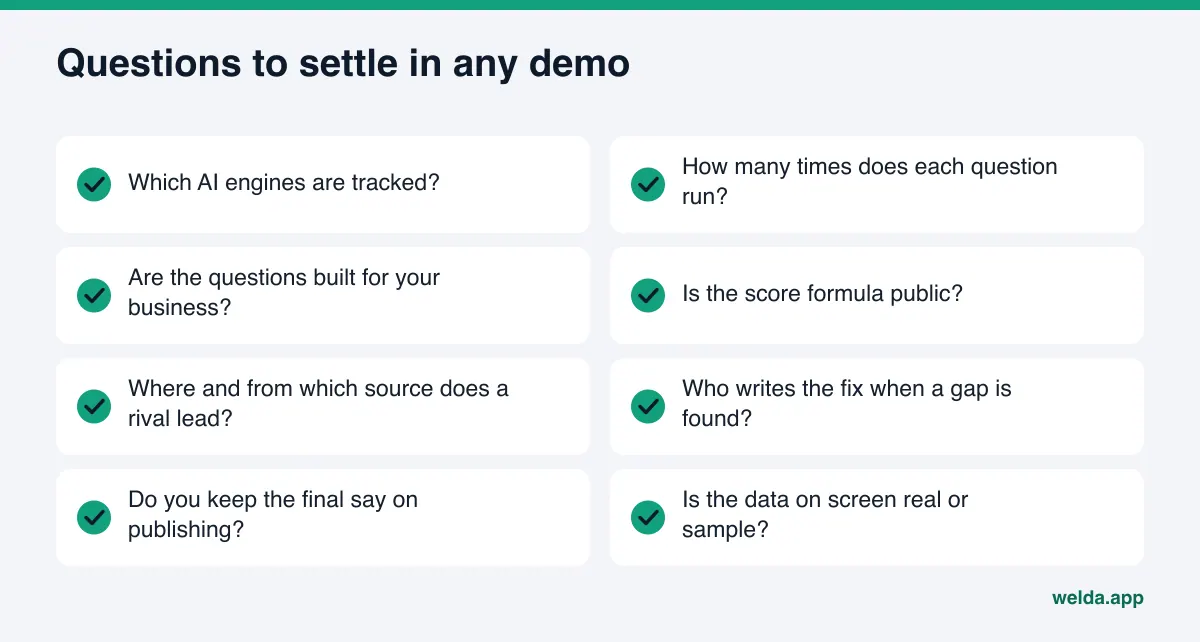
What should you check in an AI visibility tool demo? Look past the dashboard design and test the method: which AI engines are queried, how many times each question runs, how the score is calculated, and who actually fixes a gap once it is found. Bring this AI visibility tool demo checklist, your own customer questions and three real competitors, and you can get clear answers in a 30-minute call.
Why AI visibility tool demos are easy to misread
In most software demos, what you see is what you buy. An invoicing app creates an invoice on screen, and that is the product. AEO (answer engine optimization) tools are different. Their job is to measure whether your business shows up when customers ask ChatGPT, Gemini, Perplexity or Google's AI Overviews and AI Mode for a recommendation, and then to help close the gaps. You may also hear this called GEO, or generative engine optimization; in practice it means the same work. What these tools measure is a live answer that shifts from one run to the next.
That creates three common blind spots in a demo:
- Sample data presented as proof. Most demos run on a sample company with simulated data. That is normal and fine, as long as the vendor says so. The problem starts when a sample result is presented as what you should expect in your market.
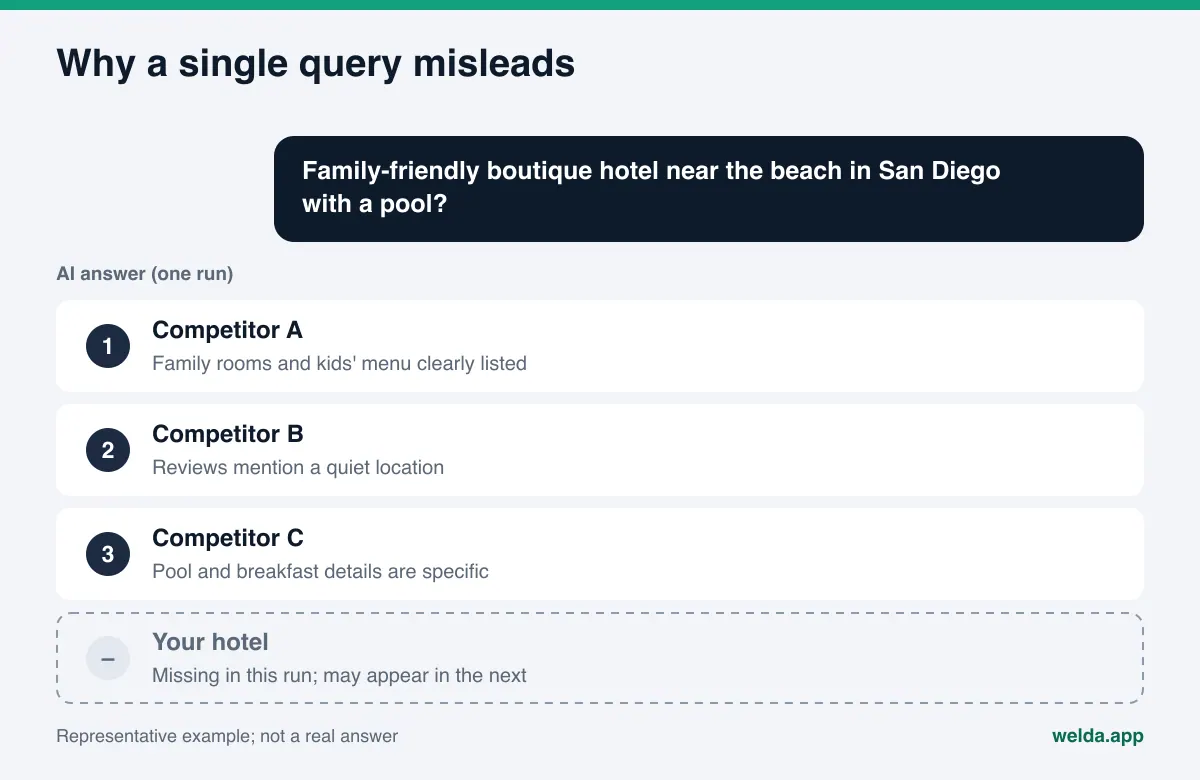
- One-off answers. AI assistants do not give the same answer every time. Asking a question once and saying "look, you are not mentioned" is an observation, not a measurement.
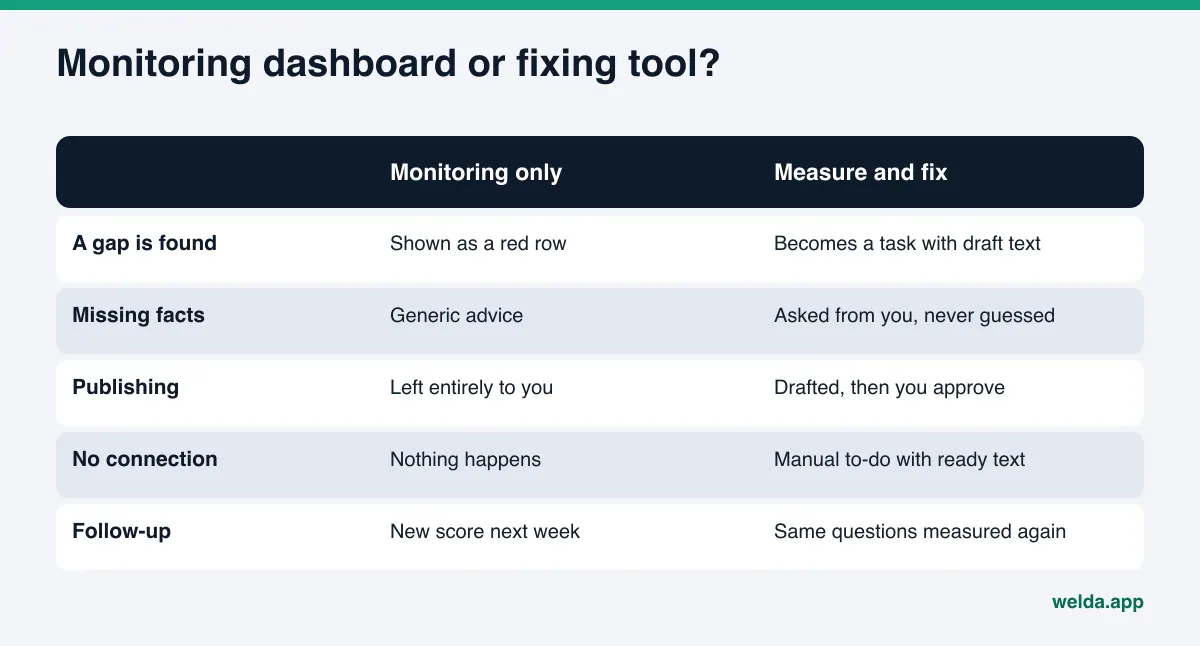
- Measurement without a fix. Some tools only report. You see red rows on a dashboard, but nobody explains who turns them green or how.
For a small or mid-sized business, these differences matter more than any feature list. Marketing time is limited. A useful AI search visibility tool should tell you which task gets done this week and by whom, not just that you have a problem. The demo is the best place to find out. If you are still deciding between software and a service, our guide to AEO software lays out the broader options. This article focuses on the demo itself.
Before the demo: show up with your own data
If you walk into a demo unprepared, you watch the vendor's example. If you come prepared, you test the tool against your own business. Preparation takes an hour or two and changes what you learn.
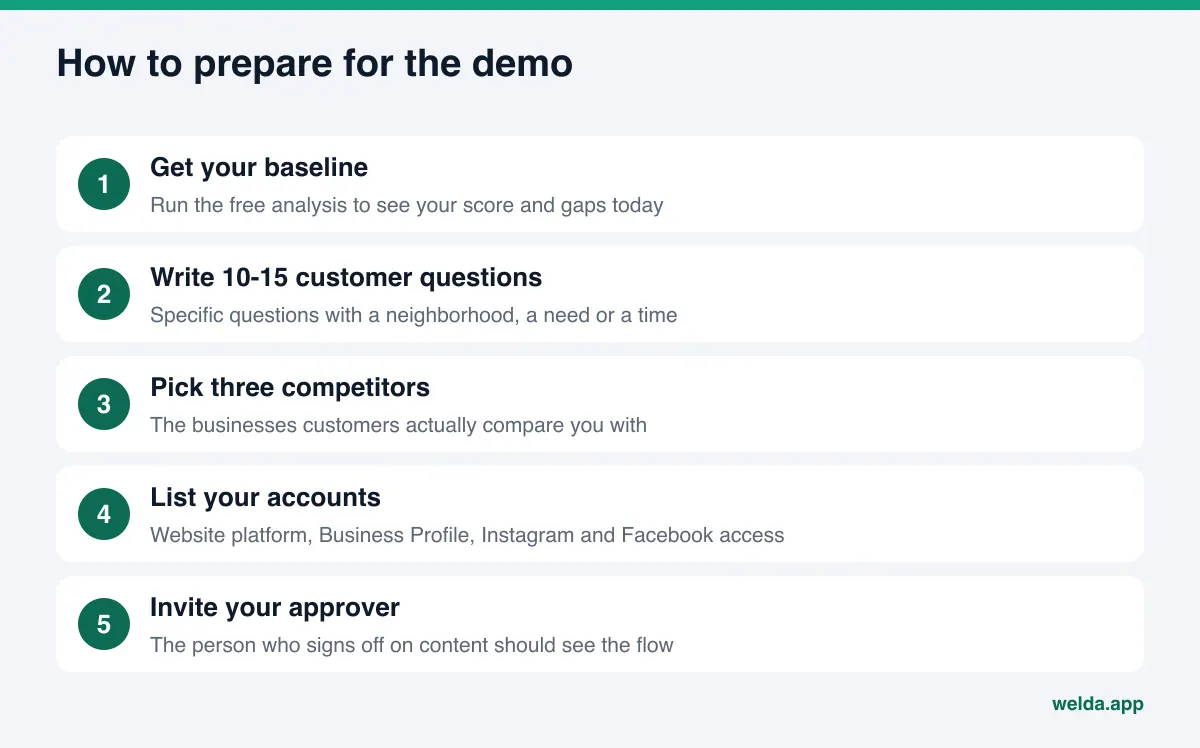
- Get your own baseline. Before the call, see how AI reads your website today. Welda's free site analysis works for this: it reads your homepage and a few inner pages, gives you a technical and a content score out of 100, and explains each gap and why it matters. With that report in hand, you can ask the vendor how their tool sees the same issues.
- Write 10 to 15 customer questions. Write them the way your customers talk: "Which dentist in Austin is open on Saturday mornings?" or "Family-friendly hotel near the beach in San Diego with a pool?" Mix broad questions with specific ones that include a neighborhood, a need or a time.
- Pick three competitors. Choose the businesses customers actually compare you with, in your area or your service line. Tell the vendor up front that you want to see a comparison against them.
- List your accounts. Note what your website runs on (WordPress or another platform) and who has access to your Google Business Profile, Instagram and Facebook. You will need this when the conversation turns to fixes.
- Invite the person who approves content. Someone will have to sign off on anything published. If that person sits in on the demo, they see the approval flow firsthand.
It also helps to send this list to the vendor a day ahead. A prepared vendor can run a few of your questions in advance. If they cannot, you know the demo will follow a fixed script.
Testing measurement: 8 questions for the AI visibility tool demo checklist
The first half of any AI visibility tool is measurement. If measurement is weak, every recommendation built on it is weak too. Ask these questions in order and write down the answers.
| Ask in the demo | Sign of a solid answer | Watch out for |
|---|---|---|
| Which AI engines do you track? | Engines are named one by one, with when each was added | "All the AI platforms," with no list |
| How many times does each question run? | A clear repeat count and a shown margin of error | A single query, no spread or margin |
| Where do the questions come from? | Built for your business; you can add and remove them | One fixed list for every customer |
| How is the score calculated? | Formula and weights explained, available in writing | "It's our proprietary algorithm" |
| How do you compare me with competitors? | Shows which question and which source a rival wins on | One competitor score with no detail |
| Which sources does the AI rely on? | Cited sites listed, with your status on each | No source data, only generic advice |
| Is this real data on screen? | Clearly labeled as sample or simulated | Sample screens shown as real results |
| Do you guarantee rankings? | No; they explain what is measured and what gets done | "You'll show up in ChatGPT in 90 days" |
The repeat count deserves the most attention. AI answers vary. Ask the same question to the same engine three times and you might be named first once, fourth once and not at all the third time. A score built on one query will swing from week to week for no real reason. A good tool does not hide that swing; it shows it as a margin of error.
Where the questions come from matters just as much. For a hotel, "best hotel" returns something very different from "boutique hotel with a courtyard breakfast near the old town." Your customers mostly ask the second kind: specific, local, with a clear need. Ask the vendor to add one of your prepared questions during the call and watch how it shows up on screen. You will also see how close their suggested questions are to your real business.
The second key row is the score formula. A score of 42 out of 100 means nothing on its own. You need to know what is being scored: the share of questions that name you, the position you are named in, or your share compared with competitors. We cover what a realistic target looks like in what is a good AI visibility score.
Testing the fix: who does the work?
Measurement tells you where you stand. The value is in what moves you forward. Spend the second half of the demo here. When you see a gap on screen, ask one question: "Who does what to turn this row green?"
As you listen, look for these distinctions:
- A suggestion or finished work? "Add an FAQ section" is a suggestion. Five questions and answers written for your business is finished work. Ask to see an example of the second.
- What happens when the tool lacks information? If the tool does not know your hours, price range or service area, does it guess or ask you? A guess feeds AI the wrong facts.
- Who approves publishing? Can text go live on your site without your sign-off? In healthcare, legal and financial services, this is the first question to settle.
- Where does the content live? Is the page published on your own site, or hosted by the vendor? If you cancel, the content should stay with you.
- What if there is no connection? If the tool cannot connect to your site or profiles, does the task come to you as a manual to-do with ready-made text?
If you cannot get clear answers here, what you are looking at is a monitoring dashboard, not a fixing tool. That may be enough for some businesses, but then you need a separate plan for who does the fixing.
What to check by industry in an AI visibility tool demo
The questions above apply to every business. Your industry adds a few more. If the vendor's sample company is not in your field, raise these yourself.
- Dental offices, medical practices and med spas: See exactly how approval works for health content. Ask whether anything is ever published automatically, and whether risky claims about price, guarantees or outcomes are flagged before publishing. Agree up front that patient information never goes into the tool. We look at wording rules in more depth in compliant AEO content for healthcare practices.
- Hotels, restaurants and cafes: AI answers in these fields lean heavily on outside sources such as Google Business Profile, Google Maps, Yelp and Tripadvisor. Check how much detail the tool gives on sources. A tool that only reads your website sees half the picture.
- Home and local services: For plumbers, cleaners or contractors, questions usually include a city or neighborhood, and sites like Angi, Yelp and the BBB often shape answers. Ask how local questions are built and how your service area is defined.
- Ecommerce: Customer questions are often about a product type or a comparison. Check whether category and product questions are tracked and how brand comparisons are handled.
A sample demo agenda: how to split 40 minutes
If you leave the agenda to the vendor, most of the time goes to a product tour. Suggest this flow in advance and the topics that matter to you get enough time. The timings are an example; adjust them to your situation.
| Time | Topic | What you should leave with |
|---|---|---|
| First 5 min | Your business, questions and competitors | Confidence the vendor understands your case |
| 10 min | Measurement: engines, repeats, score formula | Written notes on how the score works |
| 10 min | One gap turned into a task: text, approval, publishing | An example of your first task this week |
| 5 min | Sources and competitors | One topic and source where a rival leads |
| 5 min | Limits and what stays with you | A list of what the tool does not do |
| Last 5 min | Scope, access and next step | A written proposal or a follow-up date |
The part most often skipped is limits. Vendors naturally talk about what their tool does. You have to ask what it does not do.
How Welda handles this in an early access call
Welda's dashboard is in early access and opening in stages, starting with businesses in Turkey. Regular tracking across four AI engines is being added during early access, and the dashboard screens you see in a call use sample data. The part anyone can use today, in English, is the free site analysis. Pricing is discussed in the early access conversation. So we suggest treating a Welda call like a demo that starts from your own data: run your free analysis first, then use the call to see on sample screens how the dashboard would track it.
Here are the three parts most relevant to a demo.
The free analysis: your real data before the call
The free analysis reads your site the way Google and AI assistants do. It checks whether AI crawlers can access your site through robots.txt, your title and meta description, your main heading, business details in Schema markup, name, address and phone consistency, linked map and social profiles, FAQs, reviews and trust signals, how clearly your services are described, and page speed. It also asks an AI assistant with web search 5 questions your customers might ask and checks whether your business is named. That is a one-time check, not ongoing tracking. But it means you walk into any demo with a concrete result: a simulation showing which fix would move your score by how much, a competitor comparison, and a ready-to-add fix package. Each site gets one free analysis, email and phone are verified, and your results link stays open for 14 days.
The questions view: seeing how measurement works
The first four questions in the table above are answered in Welda's questions view. Each row is a customer question, each column an engine, and each cell shows where you were named or that you were not named. Click a question and you see the answer detail, the result of each of the three runs, and the sources the answer cited. The decision here is simple: which questions matter most to you, and where are you missing entirely.
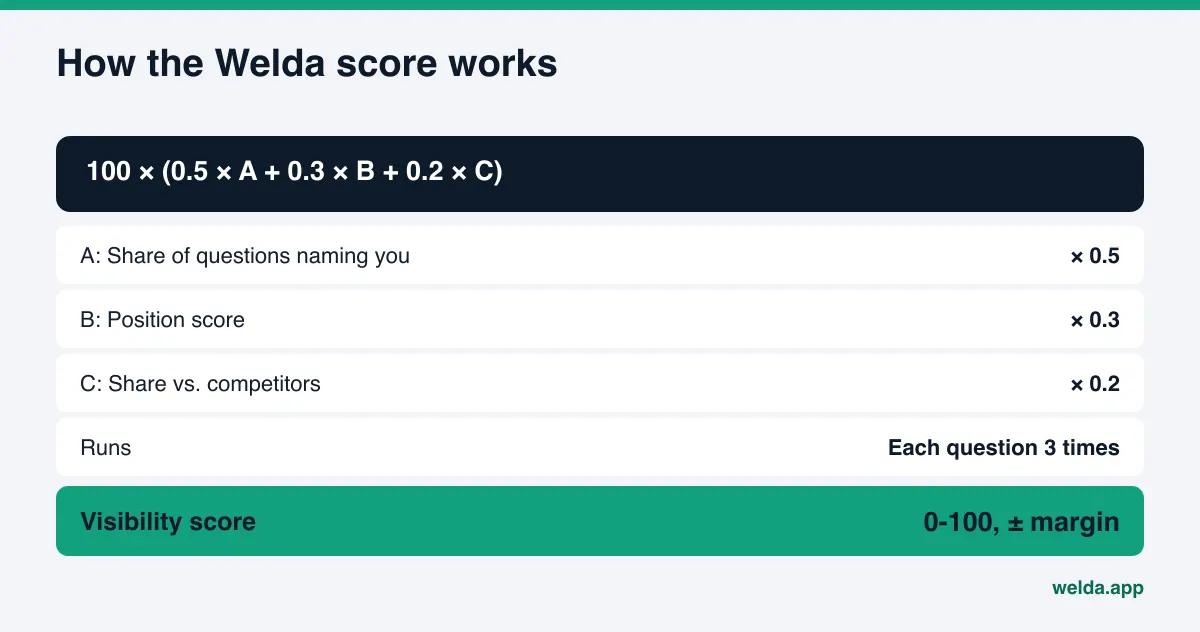
The score formula is public: 100 × (0.5 × share of questions that name you + 0.3 × position score + 0.2 × share against competitors). Every question runs three times on each engine, and the spread across those runs is shown next to the score as a ± margin. When you see a score in a call, you can recalculate it yourself.
Sources and to-dos: what happens when a gap is found
The sources view lists the sites AI cites when it builds an answer and your status on each: complete, incomplete or missing. Each gap becomes a task on your to-do list. Welda drafts the content, profile text and review replies; you keep the final say on publishing. On WordPress sites, Welda connects through a separate Editor user and an application password, with no code to install, and drafts open on your site for review. Where no connection is possible, Welda gives you a ready package and the change is made by hand. Google Business Profile, Instagram and Facebook can be connected; if they are not, the task is listed as a manual to-do with the text ready. Content always lives on your own site.
The dashboard also has views for competitors, the compliance check, a monthly one-page report and before-and-after comparisons. Rather than touring every screen, we suggest spending the time on your own questions and competitors. If a monthly summary matters to your team, our AI visibility report template shows what a useful one includes.
Limits: what Welda will not promise in a demo
What a vendor does not say in a demo matters as much as what they do say. In a Welda call, you will not hear these, because they are not true:
- Ranking guarantees. Welda does not guarantee that you will appear in ChatGPT or rank first anywhere. No tool controls AI answers.
- Instant results. New content usually takes weeks to show up in AI answers. The first week's measurement is a baseline.
- Guessed facts. Welda does not write what it does not know; it asks you. Missing hours, price range or service area show up as information requested from you.
- Fake reviews. Welda never creates reviews. It drafts replies to real ones.
- Sensitive content without approval. Sensitive content is not published without your sign-off. In healthcare, nothing is published automatically, every item comes to you for approval, and no patient data is sent to AI.
- Work that stays with you. Handling negative reviews, opening directory listings and press outreach remain your job. Welda can draft text, but it does not run these for you.
- Legal sign-off. The compliance check flags patterns like price claims, guarantees, superiority claims and diagnostic suggestions before publishing. It is not legal advice and has not been reviewed by a lawyer.
If a vendor raises these limits on their own, that is a good sign. If they do not, ask.
After the demo: your decision checklist
What counts after a demo is what you wrote down, not the impression you left with. Fill in this list the same day. If you are talking to several vendors, score each one separately.
- I saw how at least a few of my own questions are measured.
- I know which engines are tracked and how often each question runs.
- I have the score formula in writing or in my notes.
- I saw which topic and which source my competitors win on.
- I saw how a gap turns into a task with ready-made text.
- I confirmed that I approve publishing and that content stays on my site.
- I understand how tasks reach me when there is no connection.
- I was told clearly whether the data on screen was real or sample data.
- The vendor made no ranking guarantee and said results take weeks.
- I asked in writing what the price covers and what stays with me.
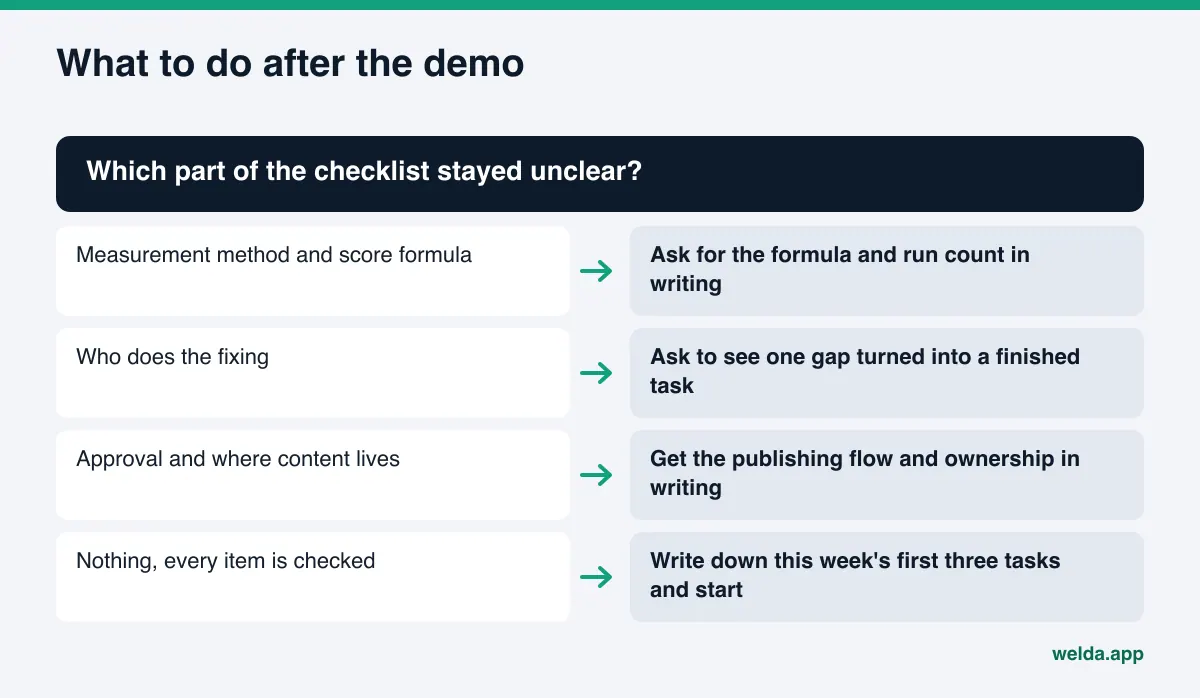
Any item you cannot check off is something to settle in a second call or in a written proposal. Our AEO RFP template gives you headings for that. Having scope in writing means that, three months in, you already know who was supposed to do what.
One last test: when the call ends, can you name the first three tasks for this week? If you can, the tool gave you work. If you cannot, you only saw a screen.
Frequently asked questions
Should I run a free analysis before the demo?
It is not required, but it makes the demo far more useful. With your own score, your gaps and a one-time 5-question AI check in hand, you can compare the vendor's example against your real situation.
Is the data in AI visibility tool demos real?
Most demos run on a sample company with simulated data. Welda's dashboard screens use sample data too, and we say so in the call. What matters is that it is not hidden from you.
How long should the demo be?
If you bring your own questions and competitors, 30 to 45 minutes is usually enough. Split the time between how measurement works and how gaps become tasks.
Who should attend?
The person who makes the buying decision and the person who approves content. If someone else manages your website, have them join for the connection part.
How do I compare several tools fairly?
Use the same questions, the same three competitors and the same checklist in every demo, and keep notes in one table. You then compare method, fixing work and limits instead of screen design. The tool that gives you the clearest work for this week is usually the best bet.
Will pricing come up in a Welda call?
Welda does not publish prices. Pricing is discussed in the early access conversation, based on your situation.
Can I ask for a ranking guarantee?
You can ask, but an honest vendor cannot give one. No tool controls AI answers. Ask instead for a written description of what is measured and what work gets done.
Bring your own data to the demo
The strongest position in any AI visibility tool demo is knowing your own starting point. To see how AI reads your site, which fixes would move your score most, and whether your business is named in 5 customer questions, start your free site analysis. Results arrive by email, and you will walk into your next demo with a real benchmark.