What is AEO software, and what should it actually do for a business? AEO software measures whether your business is named when customers ask ChatGPT, Gemini, Perplexity or Google's AI features about the kind of service you sell, and helps you close the gaps where you are missing. Good AEO software does more than draw a chart: it shows why you lost a given question and what needs to be written or fixed to change that.
AEO stands for answer engine optimization. You will also see the same work called GEO, generative engine optimization; the two terms describe one goal, and this guide uses AEO. It is written for owners and marketing leads at small and mid-sized businesses who are shopping for a tool. We cover the three different jobs that get sold under the "AEO software" label, what good measurement looks like, a step-by-step way to work with any tool, how Welda handles the work, where its limits are, and the questions to ask a vendor. If you want to know how your own site reads to AI before you compare tools, start with a free AI visibility analysis; it lists each gap it finds and how to fix it.
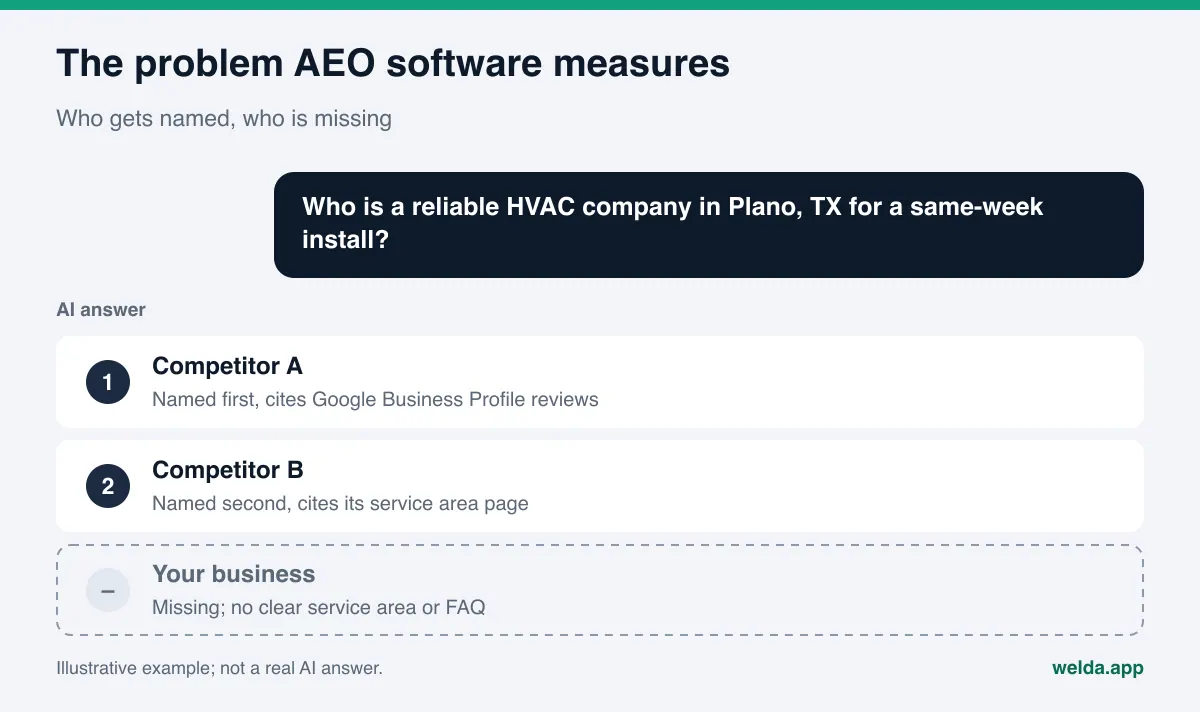
What problem does AEO software solve?
Customers no longer look for a contractor, a clinic or a restaurant only in a list of blue links. They type a full question into an AI assistant: "Who is a reliable HVAC company in Plano for a same-week install?" or "Which pediatric dentist near Wicker Park takes new patients?" The assistant names two or three businesses with a short reason for each. If you are not in that paragraph, the customer can make a decision without ever visiting your website.
The hard part is that this is invisible. You can check a classic search ranking yourself. An AI answer changes with the person, the wording and the day. You may be named this morning and missing this afternoon. Typing questions into ChatGPT by hand tells you very little, and it tells you nothing about why a competitor keeps getting picked. AEO software exists to turn that uncertainty into something you can measure and act on.
The second hard part is that the cause often sits outside your website. AI answers draw on your site, but also on Google Business Profile, Yelp, Tripadvisor, BBB, Healthgrades, Angi, local news and comparison sites. If a competitor's profiles are more complete and their reviews more recent, your site alone may not be enough. That is why useful AEO software shows not only whether you were named but which sources the answer relied on.
The third part is technical and easy to miss. OpenAI states in its crawler documentation that sites which opt out of OAI-SearchBot will not be shown in ChatGPT search answers. A security plugin or a CDN setting can block that bot without anyone noticing. Google, for its part, says on its AI features page that there are no additional requirements to appear in AI Overviews or AI Mode: the page has to be indexed and eligible to show with a snippet. In other words, the basics have to be right before any content work pays off.
The three kinds of AEO software
Products sold as "AEO software", "AI visibility tools" or "AI search monitoring" do quite different things. Knowing which kind you are looking at keeps you from paying for the wrong expectations. For a broader roundup of tools aimed at smaller companies, see our guide to the best AEO tools for small businesses; here we describe the categories rather than individual products.
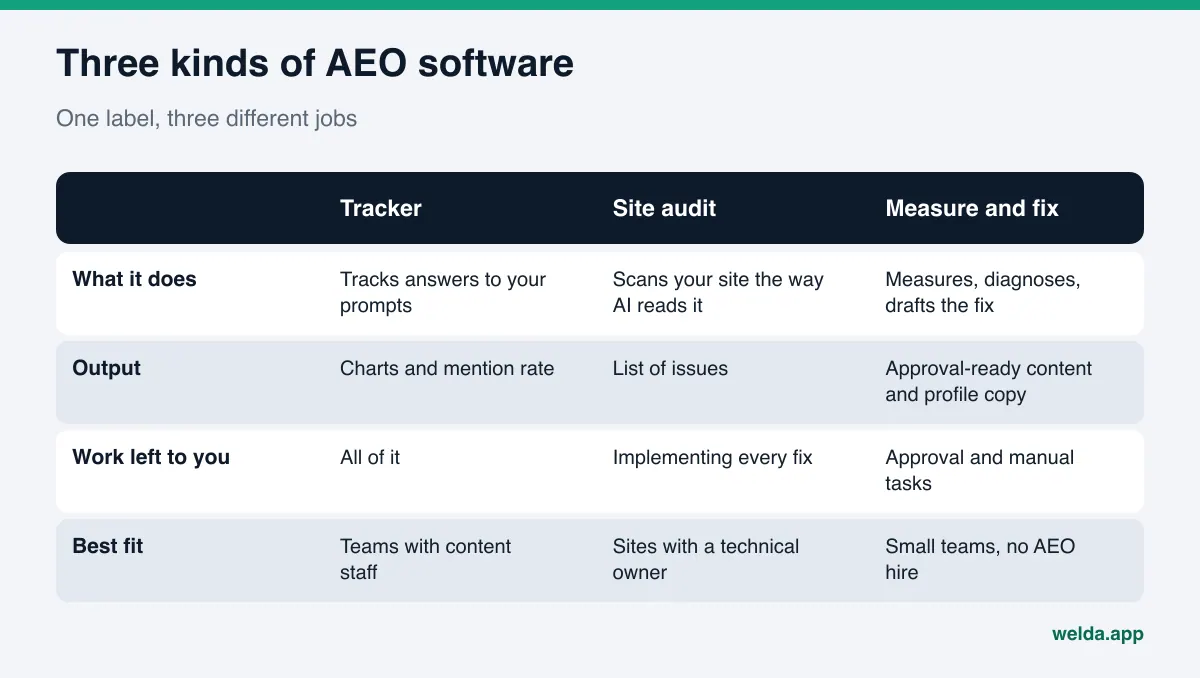
A tracker is a thermometer. You give it a list of prompts, it asks AI engines on a schedule and shows how often you are mentioned. It tells you there is a fever; it does not prescribe anything. A site audit tool is a lab report. It reads your site the way AI crawlers do and flags blocked bots, missing structured data, thin service pages and missing FAQs. It does not tell you what actually happens in the answers. Software that measures and fixes combines both and carries the work to a draft you can approve. Which one fits depends mostly on who will do the work after the numbers arrive. If you are weighing a person against a tool, our piece on whether to hire an AEO specialist or use software goes into that choice.
What good AEO software should measure, and how
Measurement is the part of AEO software buyers question least, and it matters most. AI answers vary from run to run, so a score built on a single query is close to a coin flip. Before you trust any tool's numbers, check four things.
- Whose words are the questions in? A measurement is only as good as its question list. Generic prompts like "best dentist" tell you little. You want the questions your customers actually type: neighborhood names, service names, price ranges, comparisons. Grouping them by intent (booking, comparing, learning) shows where you are weakest.
- How many engines are measured? ChatGPT, Gemini, Perplexity and Google's AI features lean on different sources. Being named in one and missing in another is common. Our post on Perplexity rank tracking shows how much a single engine can differ.
- How often is each question asked? Asking the same question several times and showing the spread tells you how stable a result is. A score without a margin of error can make a small wobble look like a trend.
- Is the scoring formula published? Is the score based on mention rate, position in the answer, share against competitors, or something else? If you do not know the formula, you will not know why the score dropped.
On top of that, measurement should come with sources. When a competitor is named, the sites behind that answer tell you where to start. A measurement without sources says "you lost" but never "where".
A step-by-step plan for working with AEO software
Whatever tool you choose, the order of work is roughly the same. You can also use these steps to judge a vendor: at each step, ask "does the software do this, or do I?"
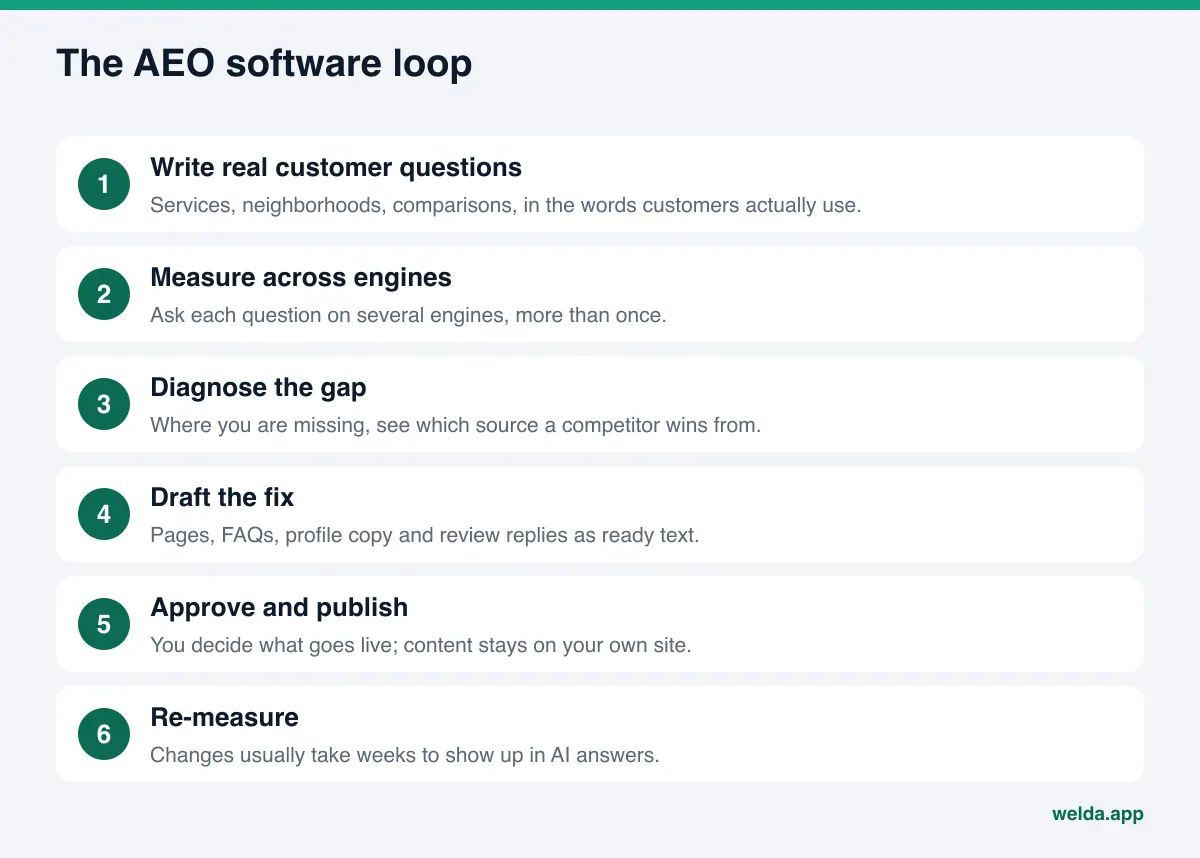
1. Fix the foundation
Can AI crawlers reach your site? Does your page title and description say in one sentence what you do and where? Are your address, phone and service area written out in plain text? Do you have LocalBusiness structured data, and does it match what the page says? Are your Google Business Profile and social accounts linked from the site? You do these once, but if you skip them, everything after is wasted.
2. Build the question list
Write the questions a customer asks before they contact you. For a dental practice: "how many visits does an implant take", "dentist open Saturdays in Ballard". For a boutique hotel: "quiet adults-only hotel near the beach in Santa Barbara". Group them by service, area and intent. Good AEO software drafts this list for you; you correct it.
3. Take a baseline
Measure the questions across engines and record where you start. That baseline is the only honest way to say later whether the work did anything.
4. Prioritize the gaps
Not every gap costs the same. Missing a booking or appointment question costs more than missing a general information question. If a competitor wins mainly through one directory, completing your profile there may move faster than writing new pages.
5. Draft, review and approve fixes
Missing service pages, an FAQ section, profile descriptions, review replies. They get written, checked by the business and published. In regulated fields, this step needs extra care. The FTC's final rule on fake reviews and testimonials, announced in August 2024, prohibits buying or selling fake reviews, including AI-generated ones, so any tool that offers to "generate reviews" is a red flag. This is general information, not legal advice.
6. Re-measure and report
New content usually takes weeks to show up in AI answers. Measurement repeats on a schedule, and progress is judged with a before-and-after comparison. For what a clear report can look like, see our AI visibility report template.
How Welda handles the work
Welda is AEO software of the measure-and-fix kind. Rather than list every feature, here are the three parts most relevant to choosing software: question-by-question measurement, the single to-do list, and the WordPress connection.
First, the status, stated plainly. The Welda dashboard is in early access and is opening in stages, starting with businesses in Turkey. Regular four-engine measurement is being added during early access, and the dashboard screens shown in demos use representative data. What anyone can use today, in English, is the free site analysis. Pricing is not published; it is discussed in an early access call.
Question-by-question measurement
In the questions view, each row is a customer question and each column is an engine. A cell shows whether your business was named in that answer and at what position. Open a row and you see a representative version of the answer and the sources it leaned on. The decision you make here is simple: questions with booking or appointment intent where you are not named at all come first.
Every question is asked three times on each engine. The spread between the three runs is shown next to the score as a margin of error. When the score moves two points in a week, you can tell whether that is a real change or the normal variation of AI answers. Questions can be measured in English or Turkish.
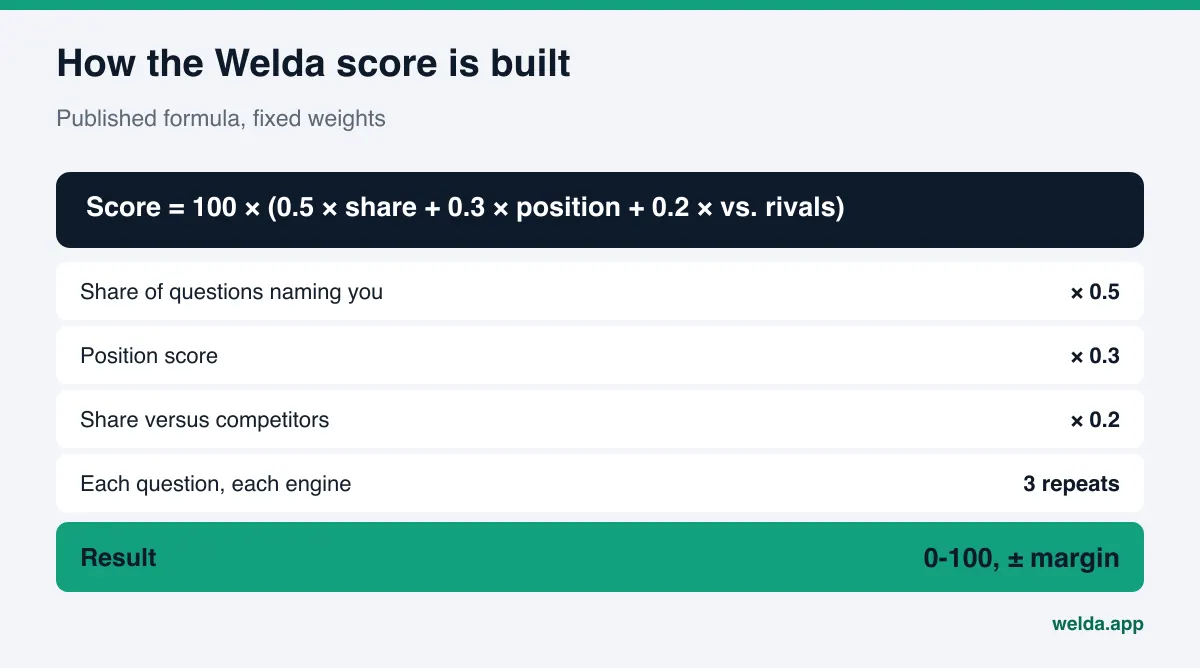
The score formula is not hidden. Share of questions naming you carries half the weight, your position in the answer 30 percent, and your share against competitors 20 percent. When the score drops, you can see which part dropped. If the share holds steady but the position score falls, you are still being named but further down the list; the competitors view then shows which topic and which source put a rival ahead.
One to-do list instead of a report
The real difference between AEO tools is how they turn a measured gap into work. In Welda, all work lands in one to-do list with three groups. The first is information Welda needs from you. When it cannot find a fact on your site, such as a service duration or the name of the lead clinician, it leaves a blank and asks rather than inventing one. Once you fill it in, the fact flows into every draft that needs it.
The second group is items waiting for approval: a page, an FAQ section, a profile description or a review reply that Welda drafted. You read it, edit it if needed and approve it. Nothing goes live without your approval. In healthcare there is no automatic publishing at all; every piece comes to the approval queue, and patient data is never sent to the AI.
The third group is manual tasks. For a profile or directory Welda cannot connect to, the text is ready, but you paste it in. Before anything is published, a compliance check flags risky patterns such as price claims, guarantees, superiority claims and anything that reads like a diagnosis. That check is not legal advice and has not been reviewed by legal counsel; the final call on a flagged sentence is yours.
WordPress: content stays on your site
If your site runs on WordPress, you create a separate Editor user and an application password for Welda. No code or plugin install is needed. Welda opens its drafts in your site as drafts, and they go live when you approve them. Content always lives on your own site; Welda does not host it. If your site runs on another system, Welda gives you a ready package and you apply it by hand. Google Business Profile, Instagram and Facebook can also be connected; when they are not, the task appears as manual work.
The dashboard also includes competitor and source views, ready-to-preview pages, incoming leads, a before-and-after comparison and a one-page monthly PDF report. How much of that you need depends on how much of the work you keep in house.
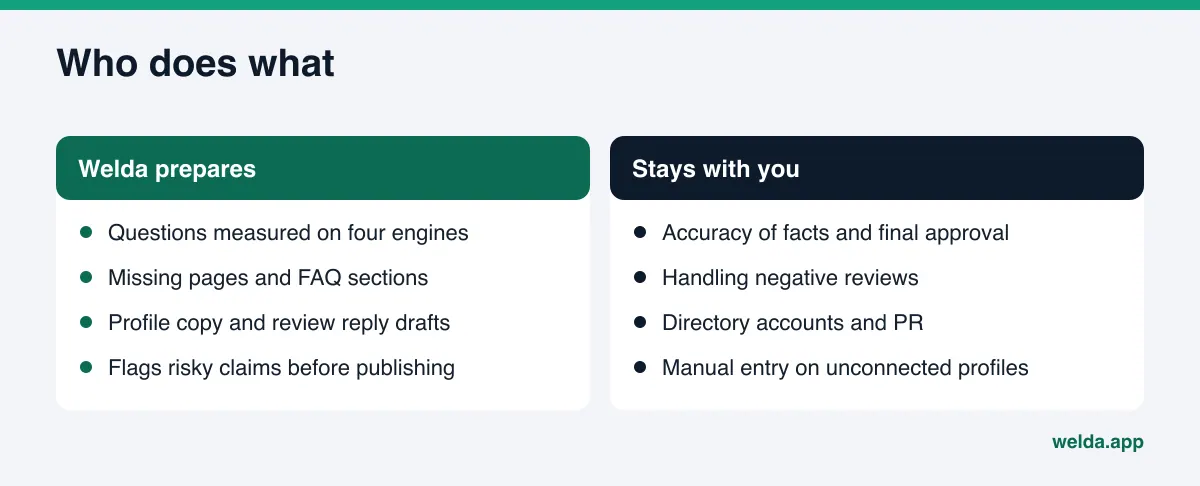
The limits of AEO software, and what Welda does not do
No AEO software controls how AI engines answer. When you compare vendors, look at what is not promised as closely as what is. Here is what Welda does not do:
- It does not guarantee rankings or "getting into ChatGPT." It measures, shows the gap and drafts the fix; the engines decide the outcome.
- It does not write facts it does not know. A service, price or award that is not on your site or in your answers to its questions does not go into the text.
- It does not publish sensitive content without your approval.
- It does not create fake reviews or suggest review gating tricks.
- Responding to negative reviews, opening directory accounts and PR stay with you. Welda prepares text and lists; it does not send them.
- It cannot speed up how fast AI answers pick up new content. That usually takes weeks.
The free analysis has limits too. It reads your homepage and a few inner pages, lists gaps with ready text, and asks five likely customer questions to an AI assistant with web search to see whether your business is named. That is a one-time check, not ranking measurement and not a guarantee. Ongoing tracking is the dashboard's job, and the full dashboard is in early access and opening first in Turkey.
| Topic | Free site analysis | Welda dashboard (early access) |
|---|---|---|
| Who can use it | Anyone today, once per site, in English | Opening in stages, Turkey first |
| What it reads | Homepage plus a few inner pages | Customer questions, answers and sources |
| AI check | Five questions, one time | Four engines, three runs per question, ongoing |
| Output | Scores, gap list, ready text, fix package, PDF | To-do list, approval-ready content, monthly report |
| Who applies fixes | You or your web person | Drafts in WordPress, live on your approval |
A buyer's checklist for AEO software
Before a vendor call, write these questions down and compare the answers side by side. If a tool answers most of them with "it depends", it is unclear what its measurement or fixes rest on.
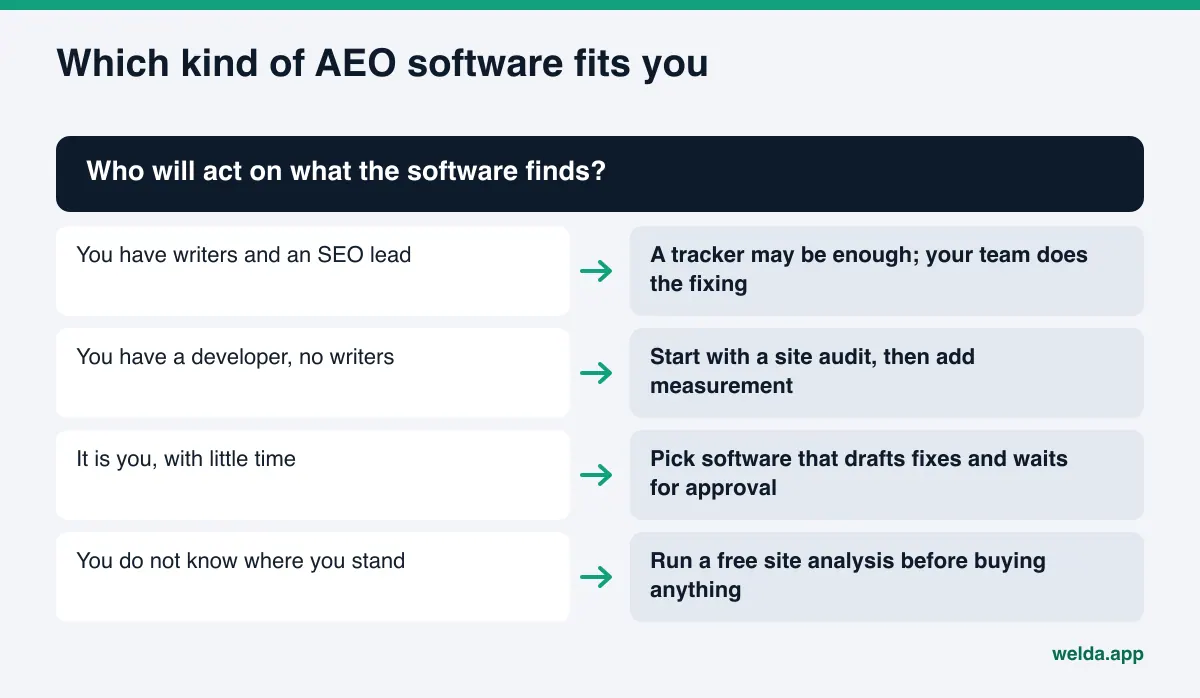
| Question | Why it matters | Red flag |
|---|---|---|
| Which engines are measured? | Engines rely on different sources. | One engine, or a vague list. |
| How many runs per question? | Answers vary; repeats show stability. | Single query, no margin of error. |
| How is the score calculated? | You need it to explain a drop. | "Proprietary algorithm." |
| Are sources shown? | Tells you where to start fixing. | Only mentioned or not mentioned. |
| Who writes the fixes? | Sets how much work lands on your team. | Generic tips only. |
| Where does content live? | If you cancel, the content should stay yours. | Content hosted on the vendor's servers. |
| Who approves publishing? | Accuracy and advertising rules. | Automatic publishing with no review. |
| What is promised? | Nobody controls AI answers. | Ranking or timeline guarantees. |
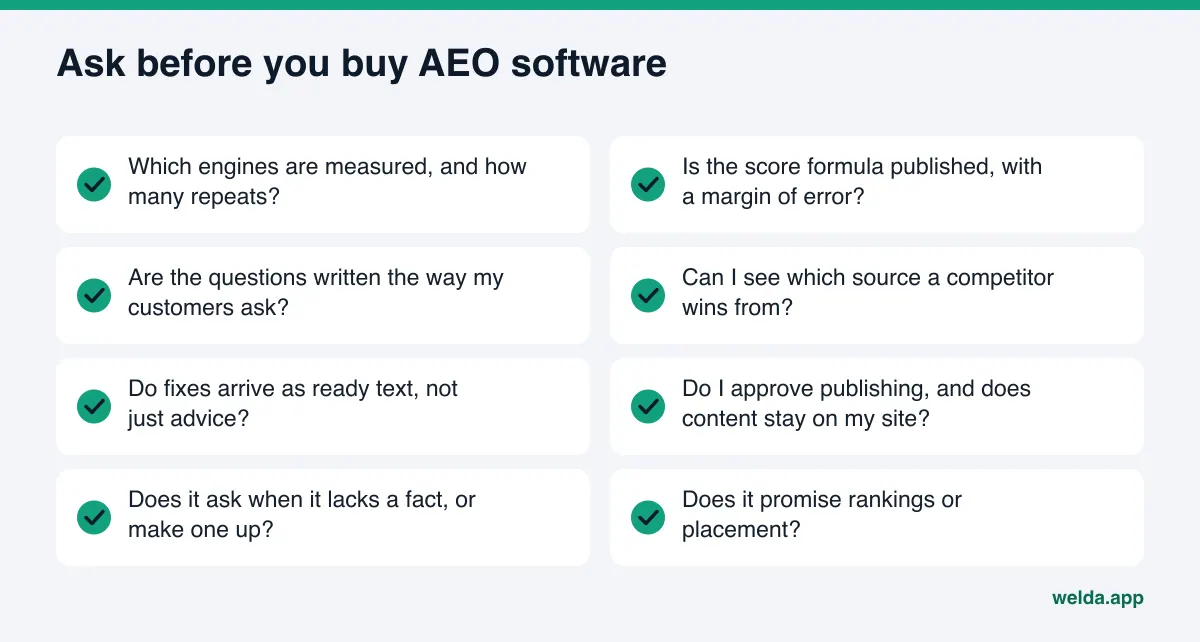
Example scenario: the first month with AEO software
The following is an example, not a real business. An example boutique hotel suspects it is missing from questions like "quiet hotel near the beach" and "adults-only hotel". In week one, the owner runs the free site analysis. It finds no LocalBusiness structured data, rooms and amenities crammed into one long page, and no FAQ section. The analysis returns ready text and a fix package for each issue, and the owner forwards it to the person who manages the site.
With a measure-and-fix tool, the next step is a question list built around the hotel's services and area. The first measurement shows competitors named on most booking-intent questions, with answers leaning on a travel review site and map profiles. Three tasks land on the list: a separate page for adults-only stays, a refreshed Google Business Profile description, and a completed Tripadvisor profile. Text for the first two arrives ready. The owner fills in one fact the tool could not find (breakfast hours), approves the drafts, and updates the Tripadvisor listing by hand.
What the first month shows in this scenario is not "the score went up by X". It is that the work got done and the measurement was repeated. Changes take weeks to reach AI answers; the comparison means something after that.
Frequently asked questions
How is AEO software different from an SEO tool?
An SEO tool tracks your positions in search results and your keywords. AEO software measures whether you are named in AI answers, at what position, and which sources those answers rely on. The two are connected, since Google's AI features draw on indexed pages, but they measure different things.
Does a small business need AEO software?
If customers find you through questions about services and neighborhoods, you need at least a measurement. Not every business needs ongoing tracking right away. Fixing the basic gaps from a free site analysis is often the more sensible first step.
Can AEO software guarantee I show up in ChatGPT?
No. No software controls how AI engines answer. What AEO software can do is measure where you fall behind, show why and draft the fix. Treat any offer that guarantees placement with caution.
How long until results show?
Technical fixes are quick, but new content usually takes weeks to show up in AI answers. That is why measurement repeats and progress is judged before and after.
How much does Welda cost?
The Welda dashboard is in early access and pricing is not published; it is discussed in an early access call. The free site analysis is free once per site.
Is the Welda dashboard available in the US?
The free site analysis works in English today. The full dashboard is in early access and is opening first in Turkey.
Start with where you stand today
Before you pick AEO software, knowing your starting point makes every vendor conversation sharper. If you know which gaps sit on your own site and which sit in outside sources, you can judge what a tool would actually add. The free AI visibility analysis reads your homepage and a few inner pages the way AI does, gives you separate technical and content scores out of 100, explains how to fix each gap, and shows which fixes would raise the score most. The results link arrives by email and stays open for 14 days.