Should you hire an AEO specialist or use software? For most small and midsize businesses, the honest answer is to split the work rather than pick one side. Repeated measurement, gap scanning and first drafts suit software. Choosing which questions matter, describing your business accurately, answering negative reviews and anything built on relationships stays with a person. The real decision is who that person is: you, someone on your team, or an outside AEO specialist.
AEO, short for answer engine optimization, is the work of getting your business named when people ask ChatGPT, Gemini, Perplexity or Google's AI Overviews for a recommendation. You may also see it called GEO (generative engine optimization); in the US the two terms describe the same job, and AEO is the one most buyers search for. When a customer types "family dentist open Saturdays near me" or "quiet boutique hotel in Savannah for a weekend," the answer is often a short list. Being on that list has become a business question, and owners who notice it usually see two paths: hire someone who knows the field, or subscribe to software built for it.
This guide works through the hire an AEO specialist or use software decision task by task. It covers what an AEO specialist actually does all week, which parts are mechanical repetition and which need judgment, how to vet a specialist and a tool, and which part of the job Welda takes on. If you want a baseline before you talk to anyone, the free site analysis reads your site the way search engines and AI assistants do, lists what is missing and checks whether your business name comes up for five questions a customer might ask. That gives you something concrete to bring to an interview or a software demo.
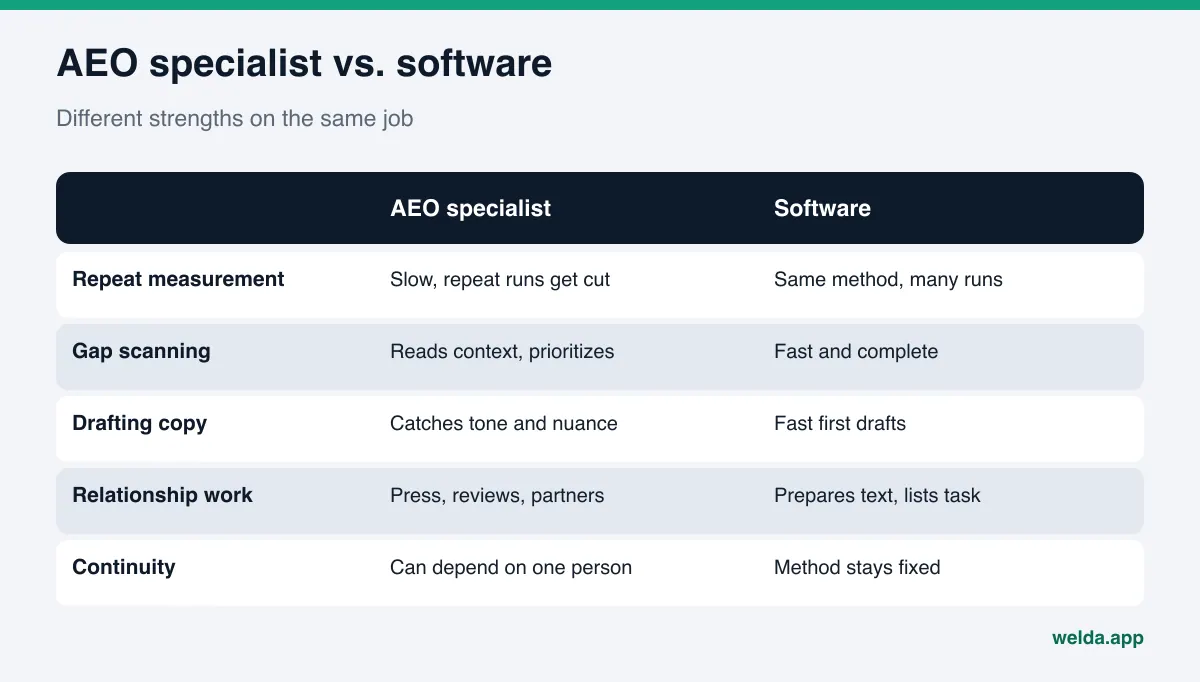
What does an AEO specialist do, and what does software do?
The title "AEO specialist" is still new. Some people come to it from SEO, some from content writing, some from digital PR. Whatever the background, AI search visibility work breaks down into roughly six parts. You cannot make a sound hiring or buying decision until you separate them.
- Measurement: deciding which questions customers ask, asking those questions in each AI assistant, and recording whether your name appears and in what position.
- Diagnosis: figuring out why you are missing. Your site may lack structured business information, your services may be vague, your Google Business Profile may be thin, or you may be absent from the review and directory sites the assistants cite, such as Yelp, BBB, Angi or Healthgrades.
- Content and copy: writing service pages, FAQ sections, profile descriptions and review replies.
- Implementation: putting that copy on your website, your profiles and the directories.
- Off-site work: directory listings, press and partnerships, responding to negative reviews, keeping profiles consistent.
- Reporting: showing on the same question set, month after month, whether the work moved anything.
Software is faster than a person at some of these and useless at others. A specialist can do all six, but spends a large share of paid hours on repetition in a few of them. The decision comes down to which part sits best with whom.
Why this decision matters for a small business
At a large company this is a line item. At a small business it lands directly on the owner's calendar and cash flow. A wrong choice shows up in three ways.
Work you cannot measure. AI answers are not stable. Ask the same question twice today and you may get two different lists. Someone who checks by hand, once, can easily mistake noise for progress. Whether you hire or buy, measurement has to be repeatable.
Knowledge that lives in one head. When one person runs the work, the question list, the copy history and the profile logins tend to live with that person. If they leave, you start over.
Work that never ends. AI search visibility is not a one-time project. Competitors update their sites, assistants shift which sources they lean on, and your own services, hours and prices change. So the useful question is not "who should do this" but "who keeps doing this every month." For a fuller picture of what a service engagement usually covers, see what AEO services include.
Task by task: where a specialist wins and where software wins
The table below takes the six parts one at a time. Read it as a proposed split, not a ranking. For each row, ask yourself who in your business owns that job today.
| Task | Specialist strength | Software strength | Sensible split |
|---|---|---|---|
| Choosing the question list | Knows your customers and their language | Suggests candidate questions from your site and category | Software suggests, a person decides |
| Running questions in each assistant | Slow and tedious; repeat runs get skipped | Asks the same question the same way, many times | Software |
| Finding gaps | Reads context, sets priorities | Scans technical gaps quickly and completely | Software scans, a person prioritizes |
| Drafting copy | Catches tone and nuance | Produces drafts fast, asks for missing facts | Software drafts, a person edits and approves |
| Relationship work | Press, partners, negative reviews | Prepares the text, adds the task to a list | A person |
| Reporting | Explains results, adds context | Measures on a fixed method every cycle | Software measures, a person interprets |
The pattern is plain: mechanical, repeated tasks go to software, and tasks that need judgment or relationships go to a person. Paying a specialist to do the mechanical part is expensive. Running software with nobody behind it means approvals pile up and nothing gets published.
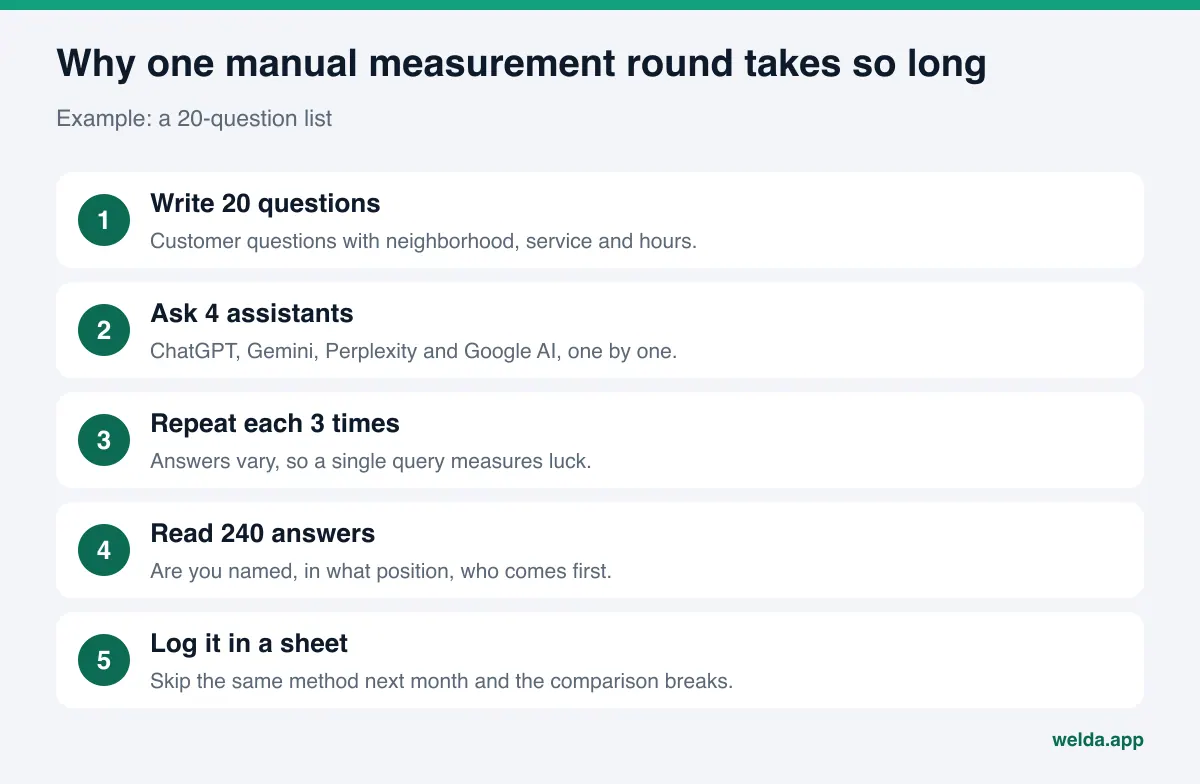
Why manual measurement eats a specialist's week
Measurement is the most underestimated part of this decision. Run the numbers on a modest setup. Say you want to track 20 questions customers might ask. You ask each one in four assistants: ChatGPT, Gemini, Perplexity and Google AI. Because answers vary, you ask each question three times. That is 20 × 4 × 3 = 240 queries for a single round. After each one, someone has to read the answer, note whether your name appears, note its position and record which competitors came first.
A specialist doing this by hand every month spends a real share of billable time on copy and paste. Worse, under time pressure the repeat runs get dropped or an assistant gets skipped, and then nobody can tell whether the month-end report shows a real change or random variation. If you are weighing tools for this part of the job, the AI visibility tool demo checklist walks through what to test during a trial.
That is why a good AEO specialist will usually want the measurement handled by software too. Their expensive hours should go to interpreting results and deciding what to do next.
Three common setups, and which one fits you
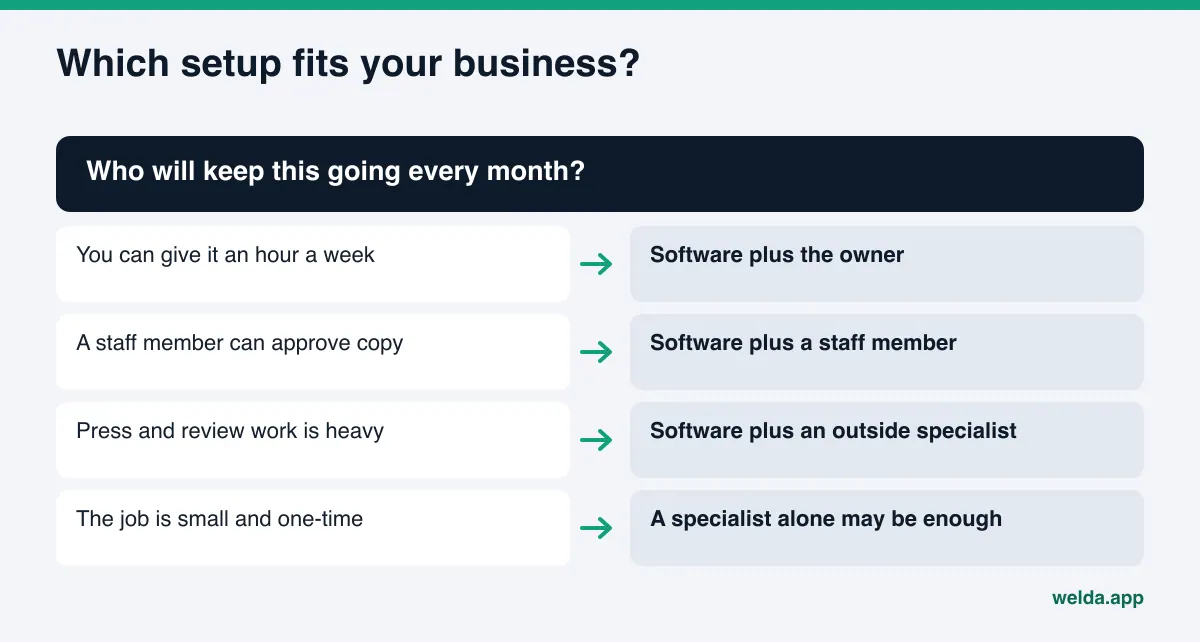
In practice, businesses settle into one of three setups. The examples below are illustrations, not real companies; they show how the choice gets made.
Setup 1: Software plus the owner. Picture an example boutique hotel where the owner already updates the website and writes the Google Business Profile and Tripadvisor review replies. Software measures, finds the gaps and drafts the copy; once a week the owner reviews, approves and completes the manual tasks, such as updating listings that have no publishing connection. There is no specialist cost, but the owner's time has to be real and protected.
Setup 2: Software plus a staff member. An example home services company assigns the work to its office manager. That person does not need to be an AEO specialist. They need to know the business, read carefully and have authority to approve. The task list the software produces becomes their weekly job description, including keeping Angi, Yelp and BBB profiles in line with the website.
Setup 3: Software plus an outside specialist. An example multi-location dental group in a crowded metro market. Healthcare advertising needs care, claims need review, and there is plenty of press and directory work, including Healthgrades and similar sites. A specialist or consultant adds real value here, but the measurement still runs in software so the specialist's work can be judged on independent numbers.
There is a fourth option: a specialist alone, no software. That can make sense for a very short question list and a one-time cleanup project. Once the work has to continue month after month, the measurement load lands on someone's desk again.
Step by step: how to decide whether to hire an AEO specialist or use software
To make the call on evidence instead of instinct, work through these steps in order. Each one ends with a note, a list or a number you can act on.
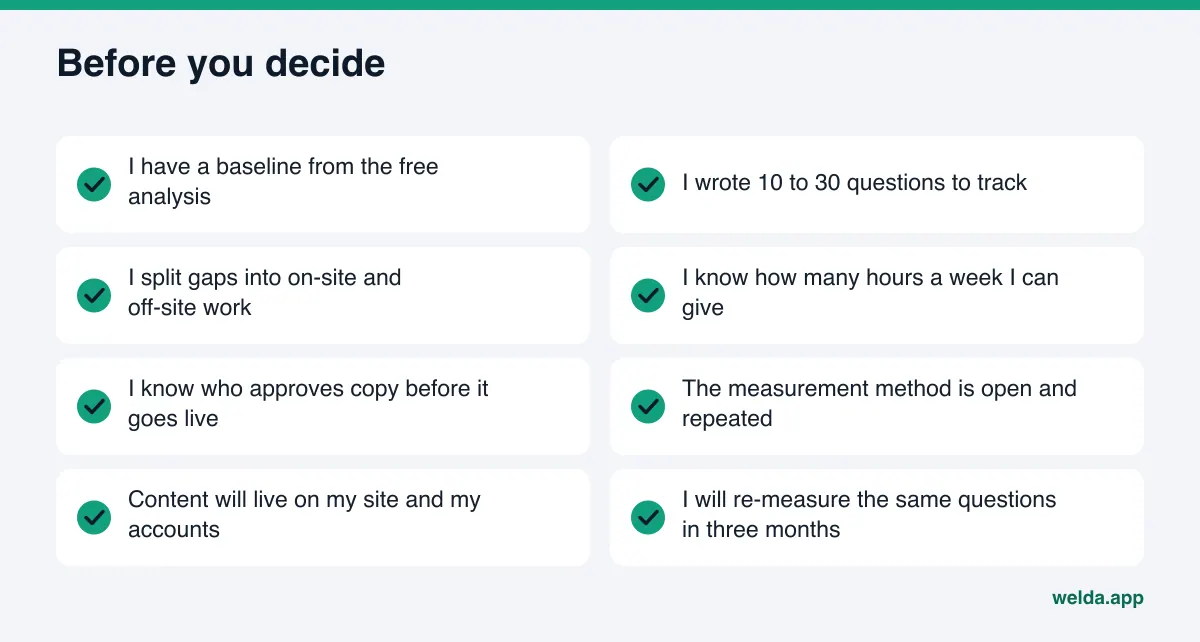
- Get a baseline. Find out how your site reads to AI assistants and what the basic gaps are. The free analysis is enough for this step.
- Write the questions you want to track. What would a customer ask to find you? Write 10 to 30 questions with real detail: neighborhood, service, price range, hours, insurance accepted.
- Sort the gaps into two piles. Fixes that live on your site and in your copy go in one pile. Fixes that need relationships or off-site work go in the other.
- Be honest about your own time. Write down how many hours a week you can actually give this. If the answer is zero, Setup 1 is not for you.
- Name the approver. Who signs off on every piece of copy before it goes live on your site or profiles? Without that person, neither a specialist nor software can publish anything.
- Pick a setup and re-measure in three months. Compare before and after on the same question set. If nothing changed, first check which tasks were actually completed.
Step four often decides the whole thing. If the owner cannot spare even one hour a week, a good tool will fill up with tasks waiting for approval. In that case you need a staff member or an outside specialist.
A simple worksheet helps with that time estimate. Fill in the hours column yourself; the point is to give every recurring task a named owner.
| Task | How often | Who owns it | Hours you set aside |
|---|---|---|---|
| Reviewing and approving drafted copy | Weekly | You or a staff member | Your estimate |
| Filling in missing business facts | As needed | You | Your estimate |
| Updating directory and review profiles | Monthly | Staff member or specialist | Your estimate |
| Replying to negative reviews | Weekly | You | Your estimate |
| Press and partnership outreach | Occasionally | Specialist or you | Your estimate |
| Reading the monthly report and deciding next steps | Monthly | You | Your estimate |
Questions to ask before you hire an AEO specialist
If you decide to bring in a specialist, whether full time, part time or on contract, ask these questions in the interview. How clearly they answer matters as much as what they say.
- How do you measure? Which assistants, how many repeat runs, which question list? "I checked and you show up" is not a method.
- Can I see the raw measurements? You should have access to the results and the method, not only a summary deck.
- Where will the content live? Copy should sit on your website and in accounts you own. If the specialist leaves, the work should stay.
- What do you do when you don't know a fact? Prices, specialties, credentials and awards should be confirmed with you, never invented.
- What do you promise? Be cautious with anyone who promises a top spot in ChatGPT. Nobody can guarantee what an AI assistant will say.
- How do you handle advertising rules? Superlatives, pricing claims and health claims can create real exposure. Ask how they check copy before it goes live.
- Do you ever use fake reviews or fake profiles? The only acceptable answer is no.
What to check before you buy AEO software
Software needs the same scrutiny. However polished the dashboard looks, check these points:
- Is the score formula published? If you cannot see how the score is calculated, you cannot tell what a change in it means.
- Is each question asked more than once? A single query measures luck. Look for repeated runs and a stated margin of error.
- Do you keep publishing approval? Nothing should go live on your site or profiles without your sign-off.
- Does the content live on your site? If a tool hosts content on its own servers, you lose that work when you cancel.
- Does it list the manual work honestly? A tool that claims to automate everything should explain what it does on platforms it cannot connect to.
For a longer list of what to probe during a trial, the demo checklist linked above goes further.
How Welda handles this work
Welda takes the software side of this split and makes the human side visible. Three parts matter most for the specialist-or-software question, so this section focuses on them. A note on availability first: the Welda dashboard is in early access, opening in stages and launching first with businesses in Turkey. Regular measurement across all four assistants is being added during early access, and the sample dashboard screens use representative data. The part anyone can use today, in English, is the free site analysis. Pricing is discussed during the early access conversation.
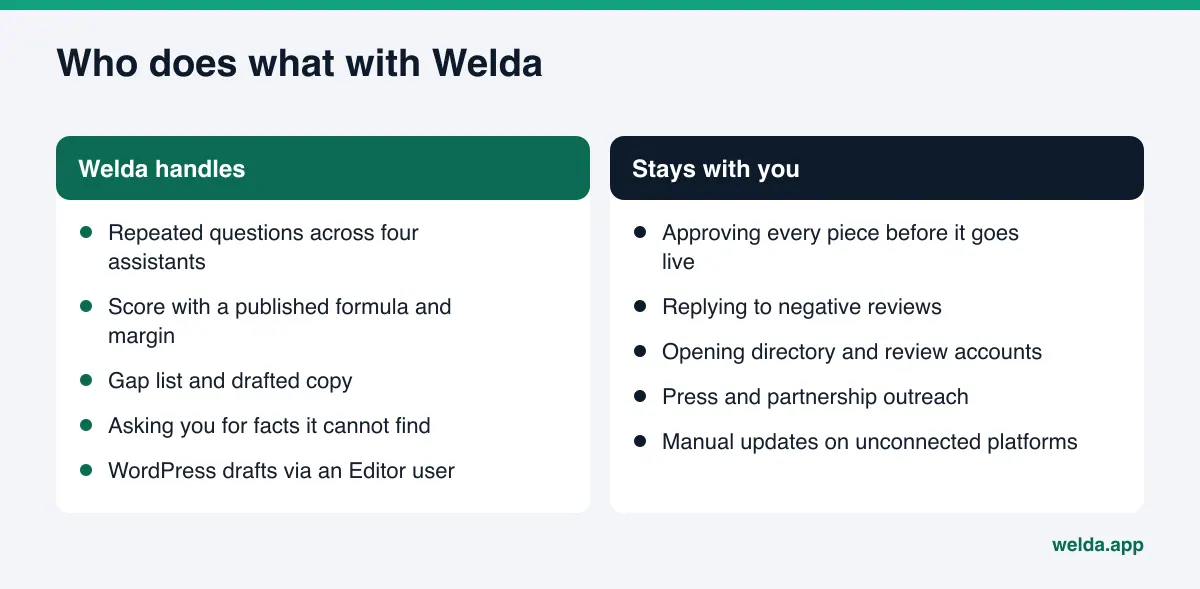
The task list works like a job description. Welda groups the work into three kinds of tasks. First, facts it needs from you: when Welda cannot read something from your site, such as who the responsible contact is, it leaves the field blank and asks instead of guessing. Once you fill it in, the fact flows into every draft. Second, drafts awaiting approval: copy Welda has prepared sits here until you read it. Third, tasks you complete yourself: profiles without a publishing connection, press outreach and similar work. Each comes with ready-to-use text, and you mark it done when it is finished. In Setup 2, this list can serve as the staff member's weekly assignment. In Setup 3, the specialist's desk is already defined: relationship work goes to the person, drafting stays in the software.
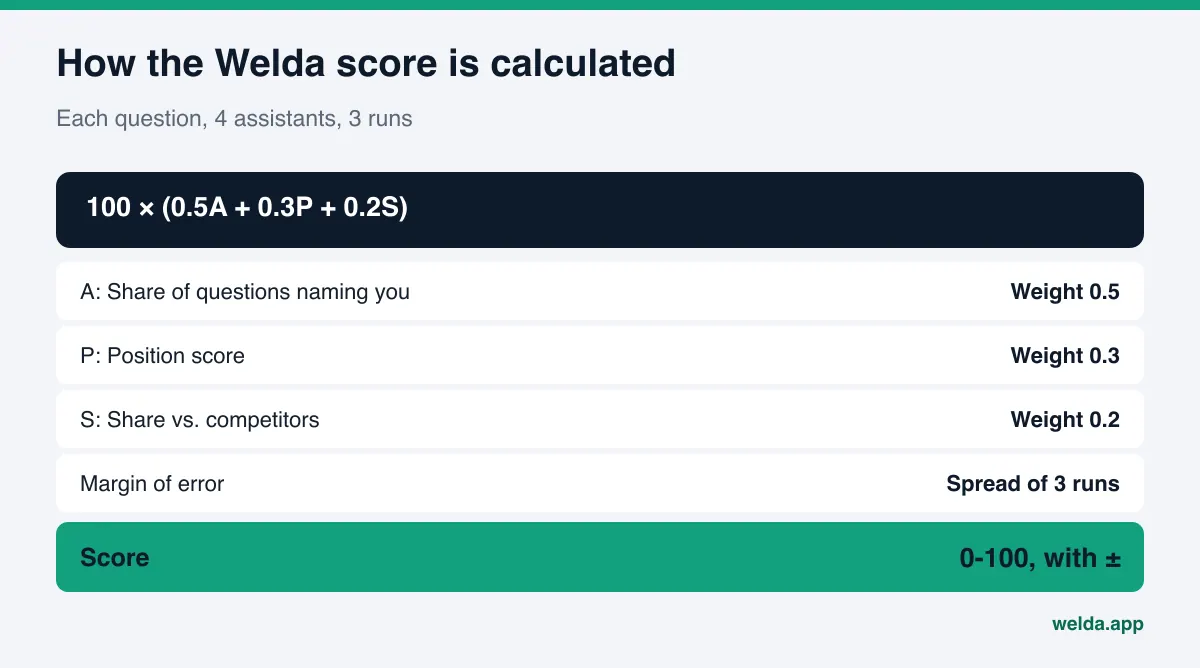
Measurement that is independent of who does the work. In Welda, each customer question is asked three times in ChatGPT, Gemini, Perplexity and Google AI. The score uses a published formula: the share of questions where your name appears carries half the weight, your position in the answer carries 30 percent, and your share against competitors carries 20 percent. The spread across the three runs produces a ± margin. This is useful even if you hire a specialist: you see the effect of their work on a score measured by a fixed method, not on a spreadsheet they maintain themselves. A questions view shows which questions name you, and a competitors view shows which topic and which source puts a competitor ahead. Questions can be tracked in English or Turkish.
Implementation without code, and only with approval. On WordPress sites, Welda connects through a separate Editor user and an application password that you create. Drafted content opens on your site as a draft and goes live only when you approve it. Content always lives on your own site; Welda does not host it. On other platforms, Welda provides a ready package and the changes are applied by hand, by you or whoever works with you. Google Business Profile, Instagram and Facebook can be connected; when one is not connected, the related task shows up as manual.
Beyond those three, a compliance check flags patterns such as pricing claims, guarantees, superiority claims and diagnostic suggestions before anything is published. It is not legal advice and has not been reviewed by counsel. A one-page monthly PDF report gives you a summary you can forward to a partner or specialist. In healthcare, nothing publishes automatically, every item comes to you for approval, and patient data is never sent to the AI.
Limits: what Welda does not do
Choosing software does not make a person unnecessary. The things Welda deliberately does not do are also the reasons a human still has a role.
- Welda does not promise rankings or a spot in ChatGPT. No software and no specialist can guarantee what an AI assistant will say.
- It does not write facts it does not know. It asks the business, so there will be moments when it waits on you or your staff.
- It does not publish sensitive content without approval. If nobody approves, the work does not move.
- It does not create fake reviews.
- Handling negative reviews, opening directory accounts and press work stay with the business. Welda prepares the text, but a person has to carry the task.
- New content usually takes weeks to show up in AI answers. Expecting a big change in month one leads to disappointment whether you hire or buy.
The free analysis has limits too: it does not measure rankings, it is a one-time check and it is free once per site. To make sense of the results, read how to read your AI visibility report.
Decision checklist: hire an AEO specialist or use software?
Go through the statements below. The ones you can answer "yes" to point toward a setup.
| Situation | If yes, lean toward |
|---|---|
| I can give this at least one hour a week | Software plus you |
| Someone on my team knows the business and can approve copy | Software plus a staff member |
| Press, partnerships and review work are heavy | Software plus a specialist |
| I work in a regulated field such as healthcare | Strong approval process and expert review |
| My question list is tiny and the job is one-time | A specialist alone may be enough |
| I want independent proof of a specialist's impact | Measurement in software, even with a specialist |
Frequently asked questions
Is an AEO specialist the same as an SEO specialist?
Sometimes it is the same person, but the job differs. SEO looks at positions in search results. AEO looks at whether AI answers name you, which sources they cite and why competitors come first. The two overlap on things like site readability and structured business information. The LLM SEO guide covers where they meet and where they split.
If I use software, do I still need a specialist?
Possibly. Software measures, finds gaps and drafts copy. Approving it, describing the business accurately, answering negative reviews and building press relationships are human work. That human can be you or someone on your team.
If I hire a specialist, why would I also need software?
For measurement. An independent, repeatable measurement is the most reliable way to see the effect of a specialist's work. It also frees their hours from mechanical querying so they can spend them on decisions and relationships.
Can Welda replace an AEO specialist?
For the mechanical part of the job, largely yes. For relationships and judgment, no. Welda measures, lists gaps, drafts copy and, with your approval, places it on your site. Press, negative reviews and directory accounts stay with the business.
How long until I see results?
There is no fixed timeline. New content usually takes weeks to show up in AI answers, so the first fair comparison comes a few months in, on the same question set.
How much does Welda cost?
The Welda dashboard is in early access and pricing is not published; it is discussed during the early access conversation. The free site analysis is available to anyone today, once per site.
See where you stand, then decide
The honest answer to whether you should hire an AEO specialist or use software is a split: which part of the work sits best with you, which with a specialist and which with a tool. To draw that line you first need to know where you stand. Run the free site analysis to see your technical and content scores, why each gap matters and how to fix it, suggested homepage copy and how you fare on five customer questions. Bring that report to a specialist interview or a software demo, and the conversation starts from facts.