What is LLM SEO, and how does a local business actually do it? LLM SEO is the work of getting your business named, accurately, in answers from ChatGPT, Gemini, Perplexity and Google's AI features, all of which run on large language models. In practice it has three parts: AI crawlers can reach your site, the site explains your business clearly enough to be summarized in one sentence, and you measure, question by question, whether answers mention you. This guide walks through each part, shows what to look for in an LLM SEO tool, and explains how Welda handles the work.
What is LLM SEO, and how is it different from traditional SEO?
LLM stands for large language model. ChatGPT, Gemini and Perplexity are answer engines built on these models, and Google now shows similar generated answers in AI Overviews and AI Mode. In the US, most marketers call this discipline AEO, short for answer engine optimization. You will also see "AI search visibility," "AI visibility," and occasionally GEO (generative engine optimization), a term that is more common in Europe. LLM SEO is the name SEO practitioners tend to use. The labels differ; the goal is the same: when a customer asks a question, your business shows up inside the answer with the right address and the right services.
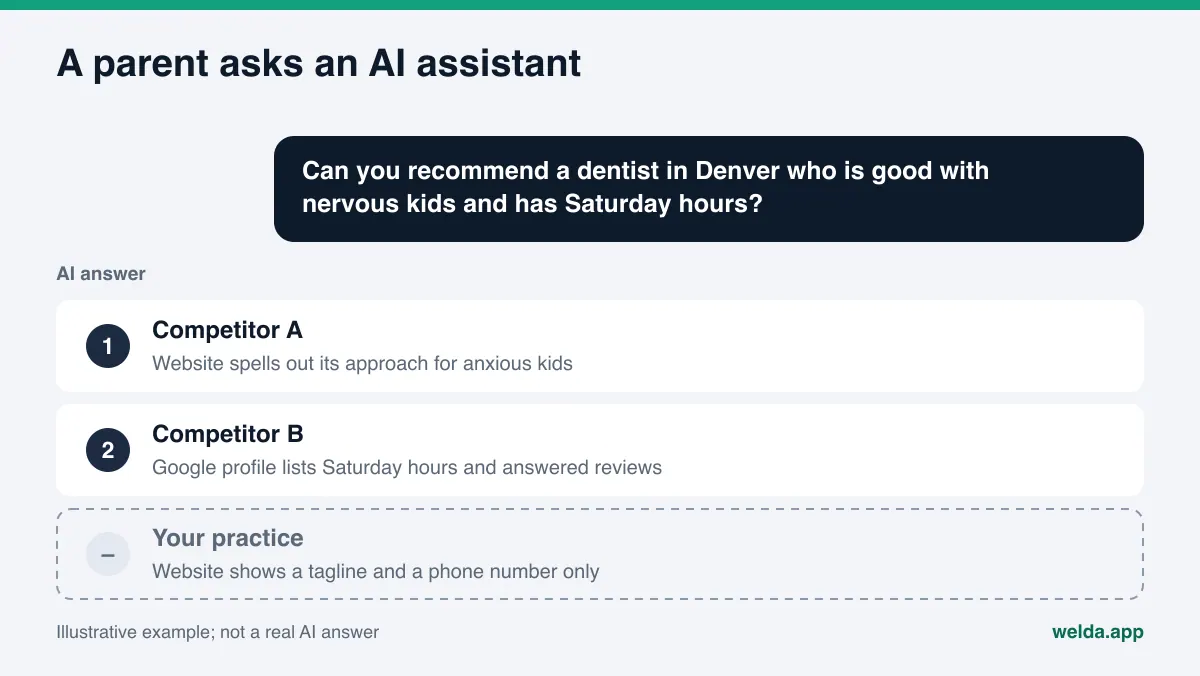
Traditional SEO is a ranking game. Someone types "dentist Denver," Google returns ten links, and you try to be near the top. In AI search there is no list of ten, or the list is very short. A customer types a full sentence, "Can you recommend a dentist in Denver who is good with nervous kids and has Saturday hours?", and gets two or three practice names, a sentence of reasoning for each, and a handful of cited sources. Getting into that short list takes more than keywords. The model needs to be able to describe you.
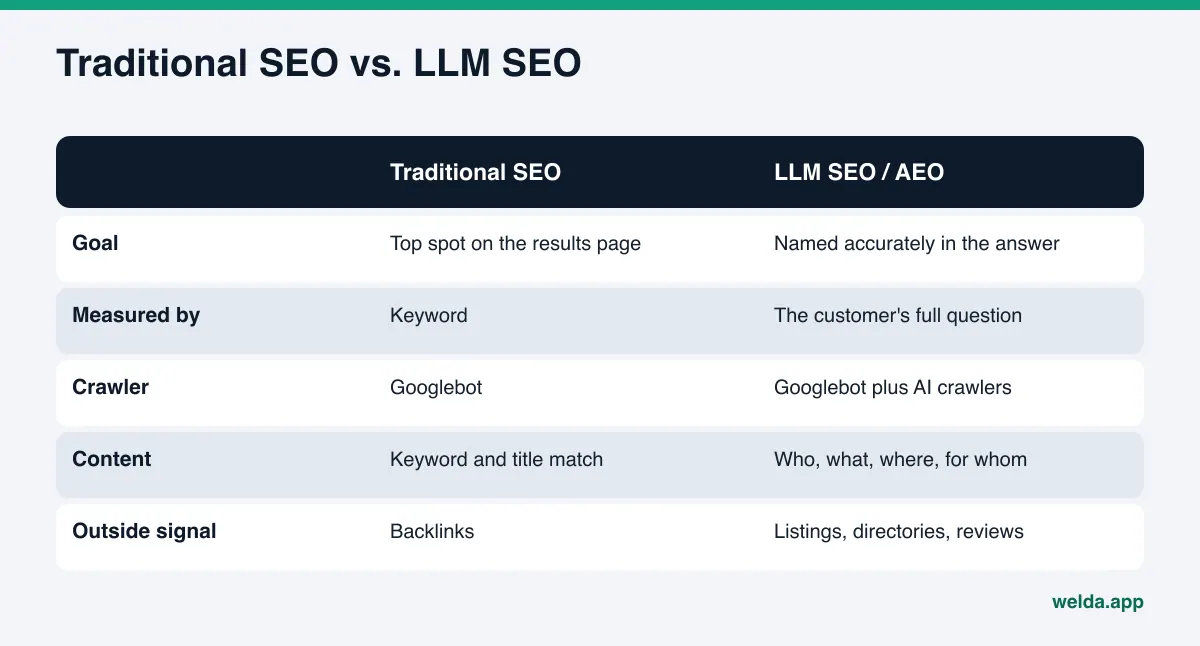
| Area | Traditional SEO | LLM SEO / AEO |
|---|---|---|
| Goal | A top position on the results page | Being named, accurately, inside the answer |
| Unit of measurement | Keyword | The full question a customer asks |
| Who reads your site | Googlebot | Googlebot plus AI search crawlers |
| Content focus | Keyword and title match | Who you are, what you do, where, for whom |
| Outside signals | Backlinks | Profiles, directories and review sites the AI cites |
| Outcome | A click | A mention, then a call, a booking or a visit |
The two are not rivals. Google states in its documentation on AI features that there are no additional requirements or special optimizations needed to appear in AI Overviews or AI Mode: a page has to be indexed and eligible to show in Search with a snippet. A solid SEO foundation is the entry ticket. What changes is what you measure and how you write.
Why LLM SEO matters for a small business
AI answers tend to arrive at the moment of decision. When someone asks which plumber, which hotel or which clinic, they are usually already comparing options. If your name is not in the answer, you are not in the running, and a competitor has just been recommended by name. That loss never shows up in your analytics, because the customer never reached your site.
The second risk is wrong information. If an answer mentions you but lists an old address, a location you closed, or a service you no longer offer, the customer arrives annoyed or not at all. This usually traces back to scattered or conflicting details across your website, Google Business Profile, Yelp and other listings.
The good news is that LLM SEO is within reach for small businesses. National chains get mentioned everywhere by default. A neighborhood practice, a boutique hotel or a local contractor can win the specific questions, the ones with "near downtown," "open Sundays" or "pet friendly" in them, as long as those details are written down plainly. A clear service page on your own site can be more useful to a model than a generic page from a large brand.
If you would rather start from measurement than guesswork, the free site analysis reads your site the way Google and AI systems do and lists what is missing in one report. It is a useful companion to the steps below.
LLM SEO step by step: what to fix first
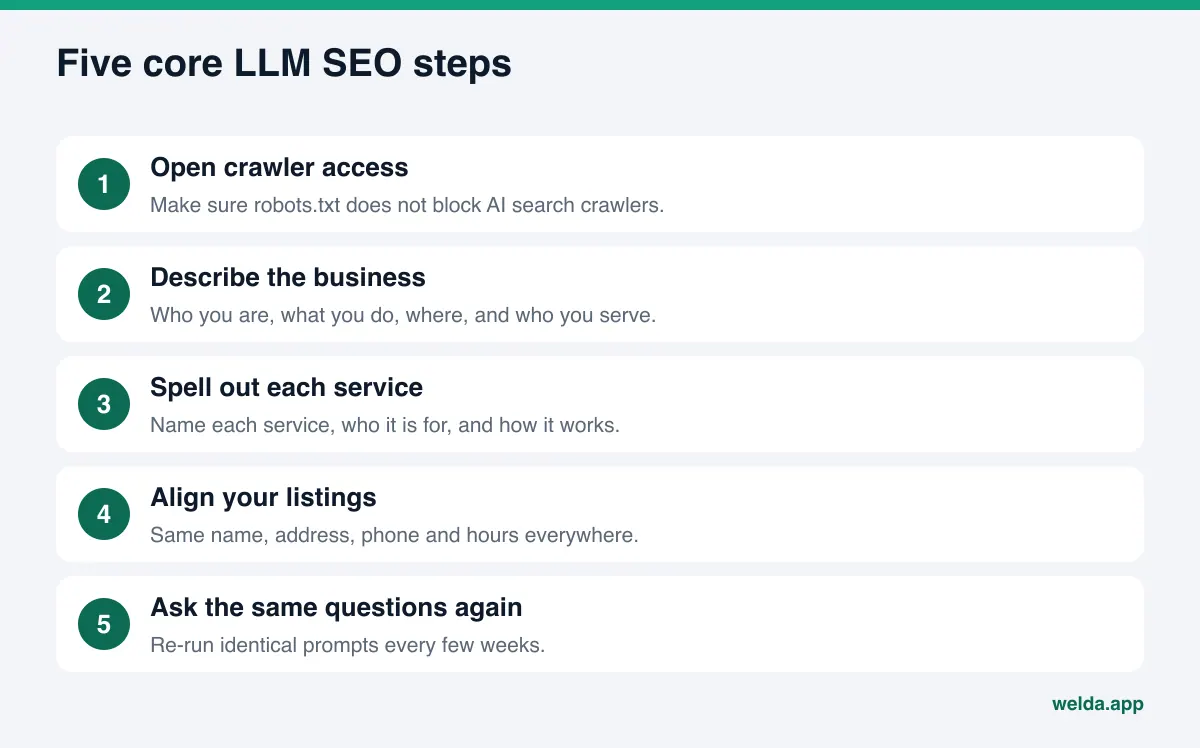
The order matters. Each step depends on the one before it: if AI crawlers cannot reach your site, the best-written service page will never be read.
- Check crawler access. Your robots.txt may be blocking AI search crawlers without anyone noticing. OpenAI's crawler documentation says OAI-SearchBot is used to surface websites in ChatGPT search and that sites opted out of it will not be shown in ChatGPT search answers. Perplexity's bot documentation describes PerplexityBot as the crawler that surfaces and links sites in its results. Our guide to robots.txt for AI crawlers covers the details.
- Describe the business in one paragraph. The opening of your homepage should answer four questions: who you are, what you do, where you are, and who you serve. "Committed to excellence" tells a model nothing.
- Fix the title, description and main heading. The page title should name the type of business and the city or neighborhood. The H1 should describe, not sloganeer.
- Give each service its own section. If customers ask about "emergency drain cleaning," "clear aligners" or "rooms with a kitchenette," those exact words should appear on your site with a short explanation of who each service is for.
- Add LocalBusiness schema. Put your name, address, phone, hours and social profiles in structured data. Google says no special schema is required for AI features, but consistent machine-readable facts still help, and they support classic search too.
- Write an FAQ from real questions. Pull the ten questions your front desk hears most and answer each in two or three sentences. AI answers often look a lot like a good FAQ.
- Align your listings. Name, address, phone and hours should match across your site, Google Business Profile, Yelp, Apple Maps, and the directories that matter in your industry: Healthgrades for medical practices, Tripadvisor for hospitality, Angi or BBB for home services. Link to those profiles from your site.
- Make trust visible. Reply to reviews calmly and specifically. State verifiable facts such as licenses, memberships and years in business.
- Measure, fix, measure again. Ask the same questions in the same words at regular intervals. New content usually takes weeks to show up in AI answers, so do not judge a change after one try.
People also ask about llms.txt and similar new files. In the same documentation, Google says you do not need to create new machine-readable files or AI text files to appear in its AI features. Do the basics above first.
A worked example: building a question set for LLM SEO
To make the steps concrete, take a hypothetical example: a small pediatric dental practice in a suburban area. The website has friendly photos and a "Smiles for life" tagline, but it never says which insurance plans it accepts, whether it sees kids with special needs, or what happens in an emergency. Before any LLM SEO work, the first job is to write down the questions parents would actually ask an AI assistant and group them by intent. The table below is an illustrative starting set.
| Intent | Example question | Which page should answer it |
|---|---|---|
| Find a provider | Who is a good pediatric dentist near me for anxious kids? | Homepage intro and "our approach" section |
| Practical detail | Which kids' dentists nearby are open on Saturdays? | Hours, repeated in schema and on Google |
| Comparison | Is a pediatric dentist better than a family dentist for a toddler? | An FAQ or short explainer page |
| Cost and coverage | Do local pediatric dentists take my insurance plan? | Insurance and payment page |
| Urgent need | My child chipped a tooth, where can I go today? | Emergency visits section |
This exercise does two jobs. It defines what you will measure, and it exposes gaps on your site: wherever the third column says "we don't have that page," your odds of being named for that question are low. A model can only guess at what you have not written down, and the sources it guesses from may be thin or out of date.
The same logic works in any category. For a roofer the intents might be "storm damage," "free inspection," "service area"; for a restaurant, "private dining," "gluten free," "late night." The questions should be in the customer's own words. Call notes, contact form messages and your reviews are the best raw material.
What should an LLM SEO tool measure?
In classic SEO it is easy to say "we rank third." In AI search it is harder, because the same engine can give a slightly different answer to the same question each time. A single screenshot is not evidence. Sound measurement has four traits:
- Real questions: full customer sentences, not two-word keywords.
- Several engines: ChatGPT, Gemini, Perplexity and Google AI lean on different sources. Showing up in one and never in another is common.
- Repetition: each question asked more than once, so a lucky mention is not mistaken for a stable one.
- Competitor context: if you are not named, who is, and based on which source? That tells you what to fix.
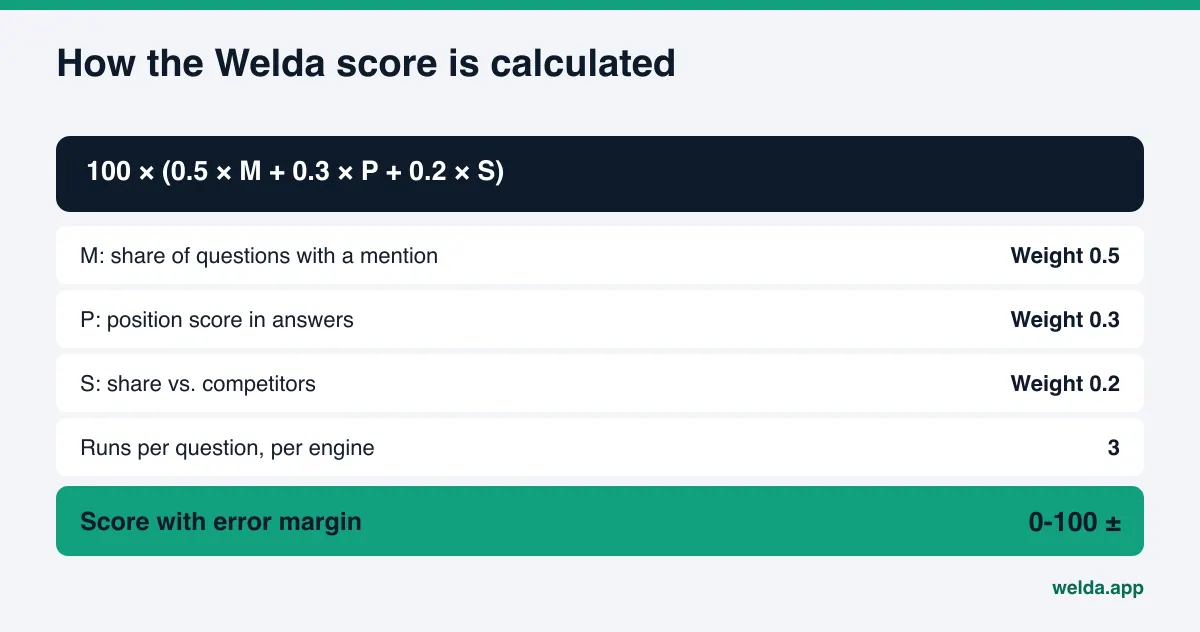
Welda's score is built on those four traits, and the formula is published. It weights the share of questions where you are named, your position within the answer, and your share relative to competitors. Each question runs three times on each engine, which produces an error margin alongside the score.
How Welda handles LLM SEO
Welda is software that measures where a business appears in AI answers and fills the gaps on the business's behalf. Three parts of it map directly onto the work described above.
The free site analysis
The part anyone can use today is the free site analysis, which works in English. It reads your homepage plus a few inner pages such as services, pricing, about and contact, and checks most of the steps in this guide: crawler access in robots.txt, title and description, main heading, LocalBusiness schema, address and phone, whether social and map profiles are linked, FAQ, reviews and trust signals, how clearly services are described, and page speed. You get a score out of 100, with technical and content scores reported separately, and for each gap a note on what was found, why it matters and how to fix it.
For LLM SEO, the most practical output is the ready-to-use copy. The report suggests a page title, meta description, H1, intro paragraph and FAQ for your homepage, and a simulation shows how much each fix would move the score. It also includes a competitor comparison and a fix pack you can add to your site, schema markup included. On top of that, it asks five questions your customers might ask to an AI assistant that can search the web, and checks whether your business name appears in the answers. That is a one-time snapshot, not ongoing tracking. The analysis is free once per site; your email and phone number are verified, and the results link arrives by email and stays open for 14 days. It does not measure rankings and does not promise any.
Question tracking across four engines
Inside the Welda dashboard, the questions your customers would ask go to ChatGPT, Gemini, Perplexity and Google AI three times each. The questions view shows, row by row, which engine named you and in what position, and opening a row reveals the answer text, the cited sources and the result of each run. The decision this screen supports is simple: which group of questions has the gap? If a practice is named for "kids' dentist" but never for "emergency dental visit," the next task is a clear emergency section and a matching FAQ entry. Questions can be tracked in English or Turkish.
Sources and the fix list
LLM SEO is not only about your own site. Answers lean on directories, map listings, review platforms and forums. Welda's sources view lists the sites the engines cite, your status on each (missing, incomplete, unverified) and the next action. Gaps flow into a single to-do list with draft text beside each item. On WordPress sites, Welda connects through a dedicated Editor user and an application password, without installing code; content opens as a draft and goes live only when you approve it. On other platforms, Welda hands you a ready-made package to apply by hand. Your content always stays on your own site. The topic of earning citations is covered in more depth in how to get cited by AI.
Where Welda stands today: the dashboard is in early access and is opening first in Turkey. Regular four-engine tracking is being added during early access, and the sample screens shown for the dashboard use representative data. The free site analysis is the part available to everyone today, in English and German as well as Turkish. Pricing is discussed in an early access call.
How to choose an LLM SEO tool
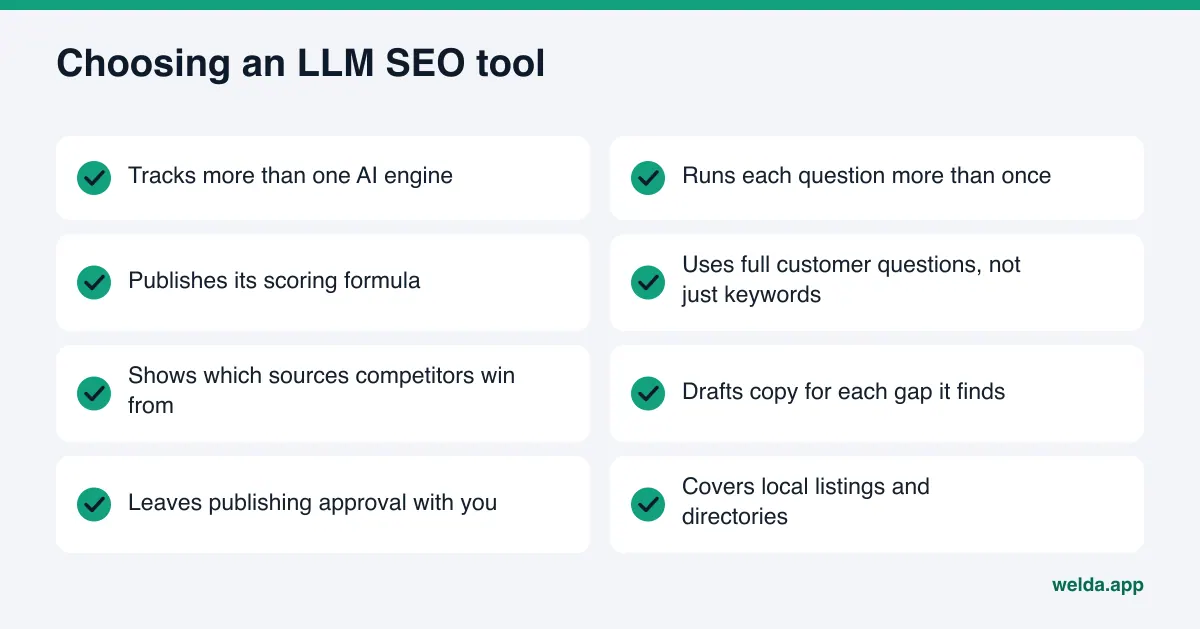
A growing number of products call themselves LLM SEO, AEO or AI visibility tools. Rather than comparing brand names that change every quarter, it is more durable to know which questions to ask. Use this table when you evaluate any option:
| Question to ask | Why it matters | Weak answer |
|---|---|---|
| Which engines does it track? | Engines rely on different sources | A single engine |
| How many times is each question run? | Answers vary from run to run | One run, no error margin |
| Is the scoring formula published? | You need to know what moved | "Proprietary algorithm" |
| Who writes the questions? | They should match how customers talk | Short keywords only |
| Does it fix gaps or only chart them? | Measurement alone changes nothing | Dashboards only |
| Who approves what goes live? | Wrong content can hurt the brand | Auto-publishing without review |
| Does it see local sources? | Local answers cite local listings | National sites only |
For a broader comparison, see our roundup of AEO tools for small businesses, and if you are weighing a person against a platform, read whether to hire an AEO specialist or use software.
Limits: what no one can promise, and what Welda does not do
The most common pitch in this space is "we will get you to the top of ChatGPT." Nobody can keep that promise. Answer engines run on models and sources outside your control, and answers vary by user, location and time. What you can do is make your business easy to understand and measure the results honestly.
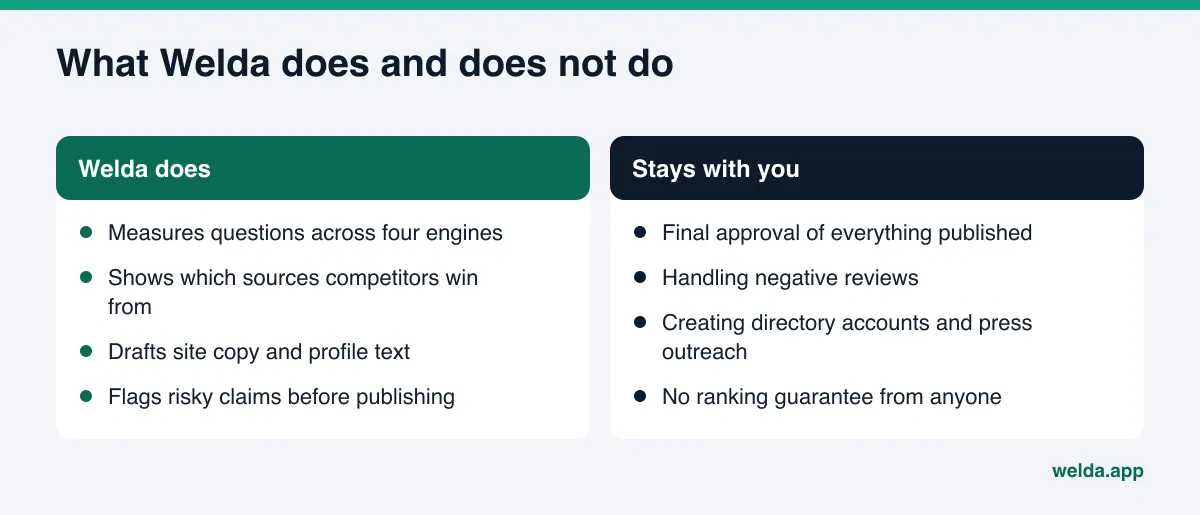
Welda is explicit about its limits:
- It does not guarantee rankings or placement in ChatGPT or any other engine.
- It does not invent facts. When information is missing, it asks the business.
- It does not publish sensitive content without approval. In healthcare there is no auto-publishing; every item goes to review, and patient data is never sent to an AI model.
- It does not write fake reviews.
- Handling negative reviews, creating directory accounts and press outreach stay with the business.
- It does not host content. Everything lives on your own site.
A compliance check flags patterns such as pricing claims, guarantees, superiority claims and diagnostic suggestions before anything is published. It is a warning layer, not legal advice, and it has not been reviewed by legal counsel. And there is the time factor: new content usually takes weeks to be reflected in AI answers, so a quiet first month is normal.
LLM SEO checklist for this week
With or without a tool, you can audit yourself with this list. Answer yes or no to each item; every "no" is a task.
- robots.txt does not block OAI-SearchBot, PerplexityBot or Googlebot.
- The first paragraph of the homepage states business type, location and main service.
- The page title names the business type and city, not a slogan.
- Each main service is named on the site with a short description.
- Address, phone and hours match on the site, Google Business Profile, Yelp and key directories.
- LocalBusiness schema is on the page and up to date.
- The FAQ is built from real customer questions.
- Google Business Profile and social accounts are linked from the site.
- Reviews get replies, and no copy makes promises you cannot back up.
- You have written five customer questions and asked them on at least two engines.
If you do the last item by hand, phrase the questions identically every time and log the results in a spreadsheet. Ask again a few weeks later and you will see what changed. As the list grows, keeping this up by hand gets hard, and that is the point where an LLM SEO tool earns its place.
Frequently asked questions
Is LLM SEO the same as AEO?
In practice, yes. Both aim to get a business mentioned in AI-generated answers. "LLM SEO" points at the technology, "AEO" at the type of engine. GEO, generative engine optimization, is a third name for the same work.
Should I stop doing traditional SEO?
No. Google requires pages to be indexed and eligible for a snippet in regular Search before they can appear in AI Overviews or AI Mode. Technical SEO remains the foundation. What changes is writing clear, answer-style sentences.
How long does LLM SEO take to show results?
There is no fixed timeline. Removing a technical block, such as a robots.txt rule that shuts out AI crawlers, can show up sooner. New content usually takes weeks to be reflected in answers, which is why repeated measurement matters.
Does Welda guarantee I will show up in ChatGPT?
No. Welda measures, shows the gaps and drafts content and profile copy; you keep the final say on what is published. No one can control exactly what an answer engine says.
What is the difference between the free analysis and the dashboard?
The free analysis reads your site once, returns a score and ready-to-use copy, and runs a one-time five-question AI check. The dashboard asks questions on four engines repeatedly, tracks competitors and sources, and queues fixes for your approval. The dashboard is in early access and opening first in Turkey.
My site is not on WordPress. Can Welda still help?
Yes. Where there is no direct connection, Welda provides a ready-made fix package that you or your web person apply by hand. Measurement and the to-do list work regardless of platform.
Start your LLM SEO work with a free analysis
The first step in LLM SEO is knowing where you stand. Run the free site analysis to see how AI systems read your site, which gaps are holding your score down, and what ready-to-use copy would fix your homepage. The results link lands in your inbox; from there you can apply the fixes yourself or join the early access list for the Welda dashboard.