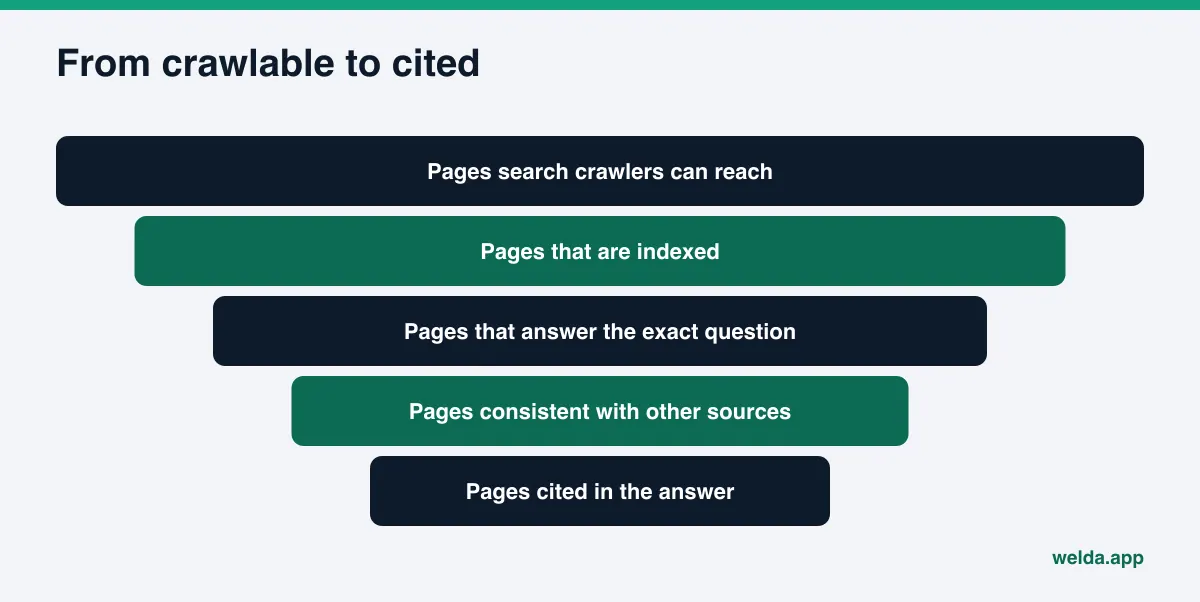
How do you get cited by AI? When ChatGPT, Gemini, Perplexity or Google's AI Overviews answer a question, they usually link a few sources. To get your own website into that list, AI search crawlers first have to be able to reach it, and then a page has to answer one specific question clearly, up front, with facts that match what other sites say about you.
This guide is for small and local business owners who want to know how to get cited by AI, not just mentioned. In the US this work is usually called AEO, short for answer engine optimization; you will also see GEO (generative engine optimization) used for the same goal. Below we cover the difference between a mention and a citation, which pages tend to get cited, why your site might be skipped, and a step-by-step plan. If you want to see how your own website reads to AI today, start with a free AI visibility analysis. It lists each gap it finds and how to fix it.
Mentioned vs. cited: why the difference matters
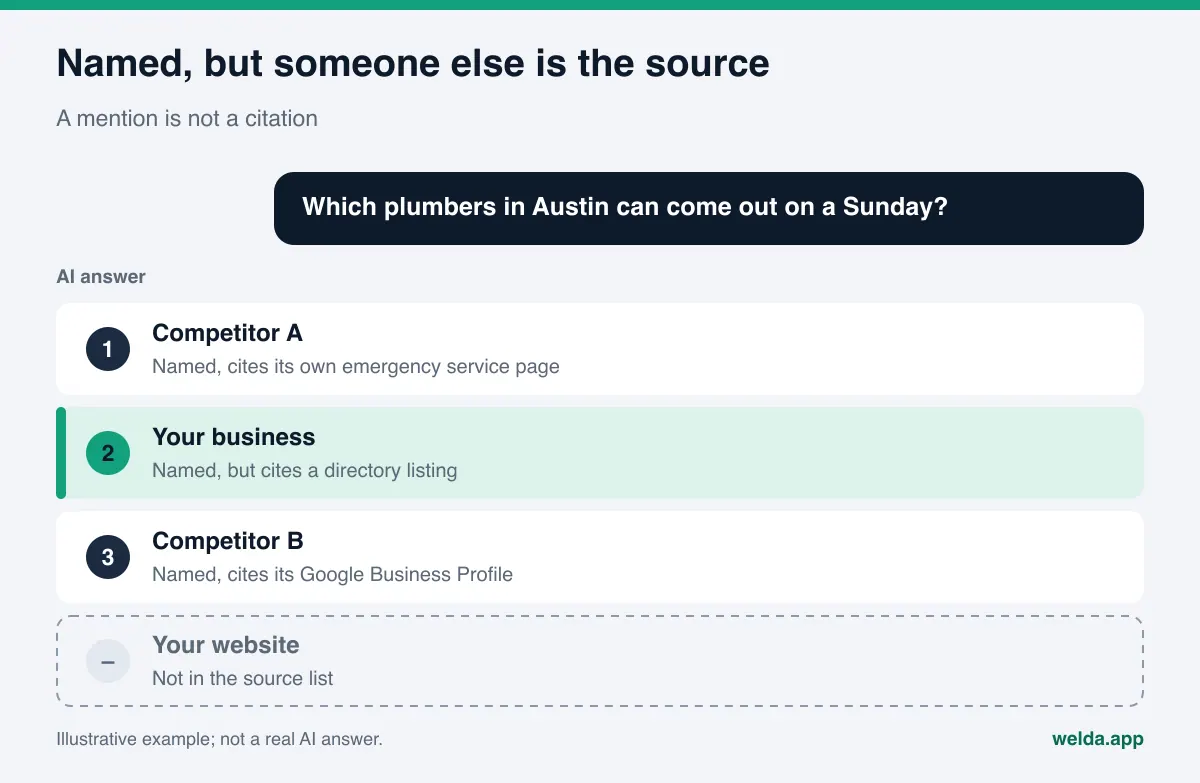
Two different things can happen to your business inside an AI answer. Your name can appear in the text: "Good options in this area include X, Y and Z." Or there can be a link next to a sentence or under the answer that points to your website. The first is a mention. The second is a citation.
The two often come apart. Your name may appear in the answer, but the assistant may have taken that information from a Yelp listing, a Reddit thread or a competitor's comparison page. In that case, the customer reads about you on a page you do not control. If the hours there are out of date or a location has closed, the customer reads that too. A common result is an assistant repeating old hours or a closed location; we cover that in detail in what to do when AI says your business is closed.
Being cited gives you three practical advantages:
- You are the source of the facts. What drives your price, which neighborhoods you serve, how booking works: the assistant takes it from your own words.
- The click comes to you. When someone wants more than the summary, they click the link. If that link goes to a directory, they see your competitors on the same page.
- You become a candidate for related questions. A page that keeps getting cited on one topic tends to show up as a candidate for similar questions. Treat that as an observed pattern, not a rule.
Why learning how to get cited by AI matters now
In a classic search, people see ten results, click a few, and compare on their own. In an AI answer, the engine does the comparing and hands back a paragraph. Many people stop there. Google's AI Overviews and AI Mode, ChatGPT search and Perplexity all place source links next to that paragraph, and those links are the shortest path from the answer to your website. If you have noticed fewer clicks from Google since AI Overviews appeared, becoming one of the cited sources is one way to win part of that traffic back.
There is also a trust side. When someone asks for the "best," "most reliable" or "honest" provider, the assistant looks for evidence. If the evidence is not clearly stated on your site, it looks elsewhere and cites what it finds. For US local businesses, that is often Google Business Profile, Yelp, the BBB, Angi, Tripadvisor for travel and dining, Healthgrades for medical practices, and Reddit threads. None of these are bad sources. The question is whether the facts there are current and whether your own site gives the assistant something better to quote.
Which pages AI tends to cite
The engines do not publish a detailed recipe for choosing sources. But their own documentation and the answers themselves make a few things clear.
Google says there are no additional requirements and no special optimization needed to appear in AI Overviews or AI Mode: a page needs to be indexed and eligible to be shown in Search with a snippet, and even that is not a guarantee. Source: Google Search Central, AI features and your website. In other words, on Google the first condition for being cited is being properly indexed in regular search.
For ChatGPT, OpenAI says its search crawler is called OAI-SearchBot and that sites opted out of it will not be shown in ChatGPT search answers. The same page notes that OAI-SearchBot and GPTBot, the crawler used for model training, are controlled separately. Source: OpenAI documentation on its crawlers. Perplexity likewise recommends allowing PerplexityBot in robots.txt if you want your site to appear in its search results: Perplexity crawler guide. For more on that engine, see how to rank in Perplexity.
Among pages that get through those gates, the ones that earn citations usually share these traits:
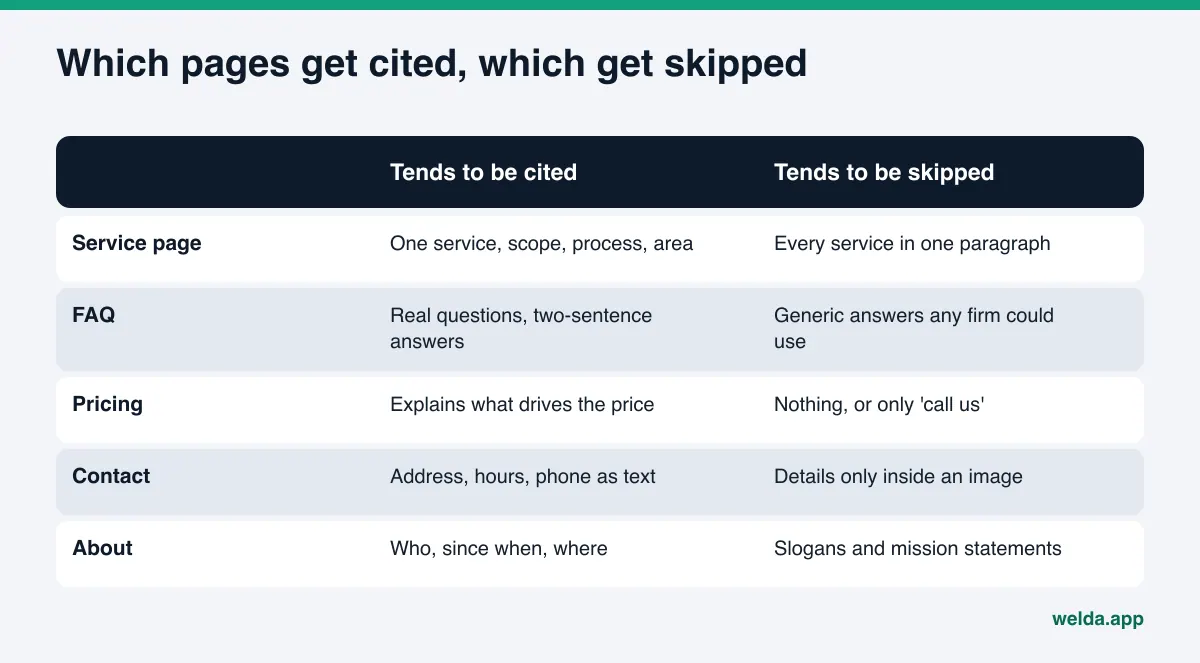
- They answer one question. A "Services" page that lists ten services in one paragraph struggles to be the source for "how long does a water heater install take." A page or section built for that question is an easier pick.
- They answer first. The short answer is in the first paragraph, details follow. Quoting a clean paragraph is easier than digging an answer out of a long introduction.
- They contain checkable facts. Address, hours, service area, process steps, what drives the price. Concrete details that do not contradict other sources.
- They are readable as text. A price list baked into an image or a menu that only exists as a PDF is hard for a crawler to use.
- They say who you are. Business name, address, contact details and LocalBusiness structured data make clear who owns the page.
Why your website is not getting cited
If your site never shows up as a source in AI answers, the cause is usually one of the following. Read the table against your own site, one row at a time.
| Cause | How to spot it | What to do |
|---|---|---|
| Crawlers are blocked | robots.txt has a Disallow rule for AI search crawlers, or a security plugin blocks unknown bots | Allow search crawlers; manage training crawlers separately if you wish |
| Page is not indexed | The page does not appear in a Google "site:" search | Remove noindex tags, check your sitemap |
| No answer to the question | The answer to the customer's question is not written anywhere on your site | Write a section or page dedicated to that question |
| Facts live in images | Prices, hours or menus exist only as images or PDFs | Add the same information to the page as text |
| Conflicting details | Your site's phone or hours differ from Google Business Profile or Yelp | Pick one correct version and use it everywhere |
| A competitor is clearer | A competitor's service page is cited for the same question | See what their page states plainly that yours does not, and fill the gap |
| Site is slow or erroring | Pages load slowly or some URLs return errors | Fix speed and access problems |
The competitor row is the most frustrating one, because a competitor's page can show up even when someone asks about you by name. We cover that case in competitors showing up when AI is asked about your brand.
Step by step: how to get cited by AI
1. Write down the questions customers actually ask
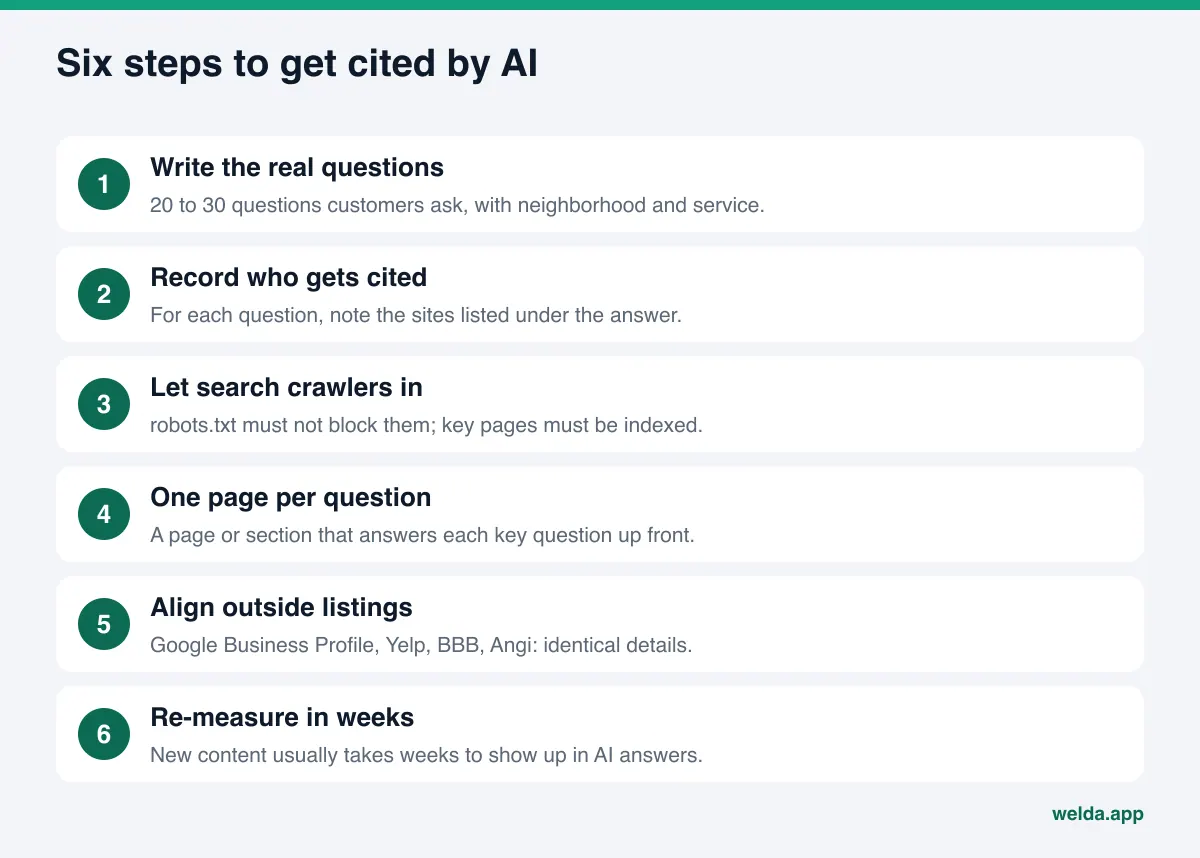
Citations happen question by question. Instead of a vague goal like "show up in AI," write 20 to 30 questions your customers would really ask. Build them from neighborhood, service and need: "emergency plumber in South Austin open Sunday," "how long does a tankless water heater install take," "do I need a permit to replace a water heater in Travis County." Make some of them branded ("is [your business] reliable") and some unbranded. Unbranded questions represent new customers; branded ones represent people who already heard of you.
2. Record who gets cited for each question
Ask the questions on a few engines and note the sources under each answer. A simple sheet with three columns is enough: question, are you named, which sites are cited. After a dozen questions a pattern appears. Maybe the same directory is cited every time, or one competitor's blog post. Answers to the same question vary from run to run, so do not decide based on a single try.
3. Let AI search crawlers in
Open your robots.txt and check whether any rules apply to search crawlers. Some themes, hosting setups and security plugins block unfamiliar bots wholesale. The key distinction: blocking training crawlers can be a reasonable choice, but if you block a search crawler you close the door on being cited in that engine's search answers yourself. Check this setting with whoever manages your website.
4. Give each important question a page or section
Take the questions from step two and look at your site. Is there a place that answers each one plainly? If not, write it. Give every service its own page. Open each page with a two or three sentence summary, then cover process, scope, timing and what drives the price. End the page with real questions about that service and short answers. Even if you do not want to publish prices, explaining what determines the price gives the assistant a sentence it can quote.
5. State your business details in code too
Add LocalBusiness structured data (Schema.org markup) to your site: business type, name, address, phone, hours, and links to your Google Business Profile and social profiles. The markup alone will not earn citations, but it makes clear who owns the page and which details are official. If you have an FAQ section, you can mark it up as well, as long as the markup matches the questions and answers visible on the page.
6. Complete and align your outside listings
For some questions, the assistant will prefer to cite your Google Business Profile, Yelp page, BBB profile or an Angi listing instead of your website. That is normal and not a problem, as long as the details there are right. Name, address, phone, hours and service list should read the same everywhere, and each profile should link to your site. Replying to reviews with a signed, specific response means your voice is present when that page is cited. One firm line: never buy or write fake reviews. The FTC's rule on consumer reviews and testimonials bans fake reviews, including AI-generated ones, and allows civil penalties; see the FTC announcement of the final rule. This is general information, not legal advice.
Example: turning a service page into a citable source
Take an example HVAC company. Its site has one "Services" page where AC repair, furnace installation, duct cleaning and emergency service each get a single sentence. Hours appear only in an image in the footer. A homeowner asks an assistant: "Is there an HVAC company in Round Rock that does emergency repairs on weekends?"
The assistant needs two facts: does the company serve Round Rock, and does it work weekends. On the example site, neither is written as text. So the engine takes them from a directory listing or Google Business Profile and cites that instead. If the listing has old hours, the answer is wrong too.
The fix: the contact page states the address, service area towns and weekend hours as plain text. A separate emergency service page opens with two sentences that answer "when are you available on weekends and what should I do in an emergency." The page ends with three or four real questions: is there an after-hours fee, how fast can a technician arrive, which brands do you service. The structured data lists the same hours and service area. Finally, the Google Business Profile hours are matched to the site. Now the engine has a short, accurate sentence it can quote from your own page. Whether it picks that page is still the engine's call, but there is no longer a reason to skip it.
7. Measure again in a few weeks
When you publish a new page, engines need time to find it, read it and start using it in answers. That usually takes weeks. Seeing no change in the first week does not mean it failed. Run the same question list again four to six weeks later and compare the source lists.
How Welda helps you get cited
Welda is software that measures where a business appears in AI answers and fills in the gaps on the business's behalf. Three parts of it are directly useful for citations.
The free site analysis: is the door open? This is the part anyone can use today, and it works in English. The analysis reads your homepage and a few inner pages (services, pricing, about, contact) and checks the first rows of the table above for your own site: are AI crawlers blocked by robots.txt, are the page title and description in place, is LocalBusiness structured data present, can your address and phone be read, is there an FAQ section, are services described clearly, does the page load quickly. For each gap it shows what it found, why it matters and how to fix it. It also drafts a homepage title, description, main heading, intro paragraph and FAQ, and gives you a ready-made fix package that includes the structured data code. On top of that, it asks five customer-style questions to an AI assistant that can search the web and checks whether your business name appears in the answers. That is a one-time check, and it does not measure rankings.
The Sources view in the Welda dashboard: where does AI get its facts? In the dashboard, the questions your customers would ask are put to ChatGPT, Gemini, Perplexity and Google AI three times each. The Sources view brings together the sites cited in those answers. Each row is a site, its type (directory, review site, map, social, your own site) and your status there: incomplete profile, unverified details, or not present at all. Your own website is one row in that list. If it cannot be read because of an access problem, you see it there. The decision on this screen is simple: which source deserves your effort first? If your own site's row is weak, the work is on the site. If a directory gets cited often and your profile there is incomplete, the work is finishing that profile.
The Questions view: who gets cited for which question. The Questions view shows each question on its own row: are you named, on which engine, in what position. Open a question and you see the answer detail and the sources cited in it. That is where the "named, but someone else is the source" case becomes visible question by question.
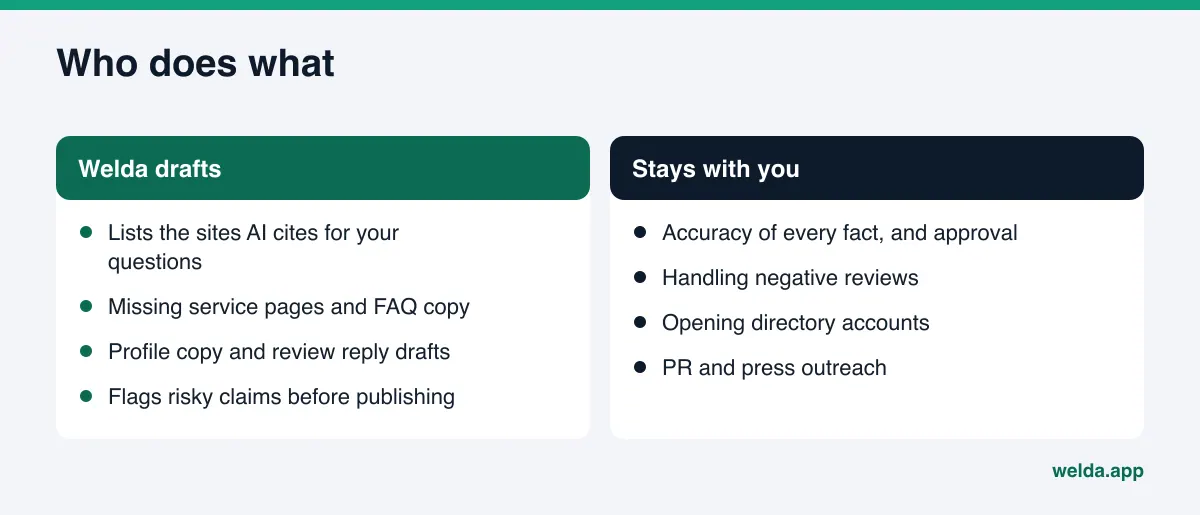
After measuring, Welda drafts the content to close the gaps: a missing service page, FAQ copy, profile text and review reply drafts. These land in a single to-do list, and the decision to publish stays with you. On WordPress sites, Welda connects through its own Editor user and an application password, with no code to install, and opens content on your site as a draft; it goes live when you approve it. On other systems, Welda hands you a ready package and you apply it. Content always lives on your own site; Welda does not host content. So when that content is cited, it is cited at your address.
A clear note on availability: the Welda dashboard is in early access and is opening first in Turkey. Regular measurement across all four engines is being added during early access, and the sample dashboard screens use illustrative data. Pricing is discussed in the early access conversation. What anyone can use today, in English, is the free site analysis.
Limits: what Welda does not do
- Nobody can guarantee a citation. The engine decides which page to cite. Welda does not promise rankings or "getting into ChatGPT." What it does is make the information an engine needs complete and readable, and measure the result.
- It does not make things up. Service area, process, what drives your price: Welda does not invent these. It asks you, and missing facts sit in the to-do list as questions.
- It does not write fake reviews. That is against platform rules and federal rules alike.
- Some work stays with you. Handling negative reviews, opening directory accounts and press outreach remain the business's job. Welda can draft text for these, but you are the one who sends it.
- It flags risky wording before publishing. Price claims, guarantees, superiority claims and diagnostic suggestions are flagged for review. That is a warning, not legal advice. In healthcare there is no automatic publishing; every piece comes to you for approval.
- Results take time. New content usually takes weeks to show up in AI answers.
Checklist: is your site ready to be cited by AI?
Compare the list below with your own site once. Every item you cannot check is information AI looks for and cannot find.
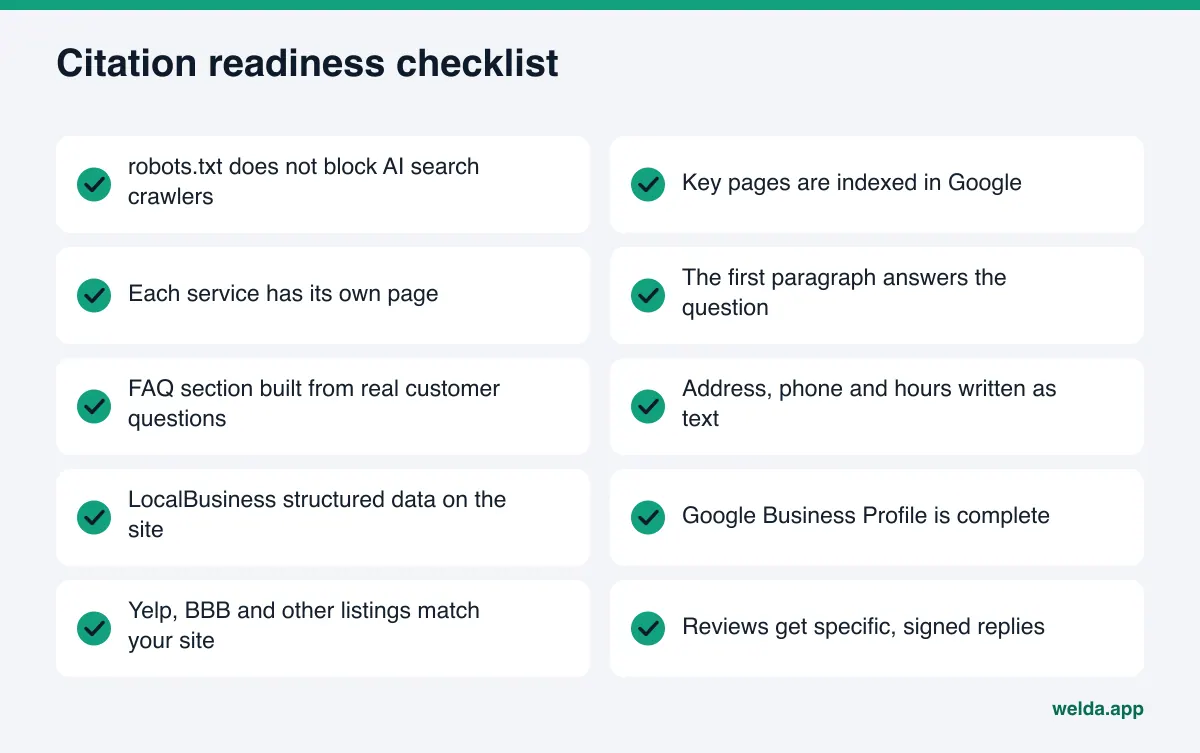
Then decide how you want to handle it. If your site has a few technical gaps and two or three missing pages, the fix package from the free analysis covers much of the work, and you can do it yourself. If you have many questions to track, active competitors, and want to see which sources rise and fall over time, regular measurement makes more sense. To read your results in context, see what a good AI visibility score looks like.
| Your situation | Suggested first move |
|---|---|
| You are not named for any question | Check crawler access and indexing first, then write service pages |
| You are named, but a directory is always the source | State the answer plainly on your own page and align the directory listing |
| A competitor's page is the source | Add what their page states plainly and yours does not |
| A Reddit thread or complaint is the source | Reply openly with your name, and explain the issue on your own site too |
| Your site is cited often | Keep pages current and add new questions regularly |
Frequently asked questions
Can I pay to be cited in AI answers?
Citations are the engine's own choice, and there is no known way to pay for a place in the source list. Even where ad placements exist, they are not the same thing as a source link.
If AI names my business, isn't that enough?
A mention has value, but if the facts come from another page, their accuracy is out of your hands and the click goes there. The goal is to be named and to have your own site be the source.
Does an llms.txt file help me get cited?
No engine has made a clear commitment to using it. Crawler access, indexing and pages that answer real questions come first.
If I block training crawlers, can I still be cited?
OpenAI says it manages its training crawler and its search crawler separately, so you can block one and allow the other. Check each engine's own documentation.
How do I know if I am starting to get cited?
Ask the same question list regularly and look at the links under each answer. Rely on the pattern across several runs, not a single try, because answers to the same question vary.
How long does it take?
Removing a technical block can show up faster. New content usually takes weeks to be reflected in AI answers. No one can give you an exact timeline.
See where your site stands today
Getting cited by AI starts with a site that AI can read. To see in a few minutes whether crawlers can get in, whether your business details can be read and which pages are missing, run the free AI visibility analysis. You get a fix for each gap and a ready-made package you can add to your site.