Competitors show up when AI is asked about my brand. What should I do? Start by sorting the answer. If the AI describes you accurately and then lists a few alternatives, that usually comes from the question itself. If it says little about you and a lot about a competitor, or mixes up your details with someone else's, that points to missing or inconsistent information on your side, and that is something you can fix.
A customer types your business name into ChatGPT, Gemini, Perplexity or Google's AI Overviews and AI Mode. They ask whether you are any good, whether you are legit, what you charge. Your name appears, but most of the answer is about another business, or it closes with "you may also want to consider..." If competitors show up when AI is asked about your brand, you are losing people at the moment they were closest to choosing you. This guide breaks the problem into its parts: when it is normal, when it needs fixing, how to find the source, and what to change on your end. This work is usually called AEO (answer engine optimization); you may also see GEO, generative engine optimization, used for the same goal. To see what your own site tells AI right now, run a free AI visibility analysis. It checks whether your business information, services and FAQ are written clearly enough for an AI system to use.
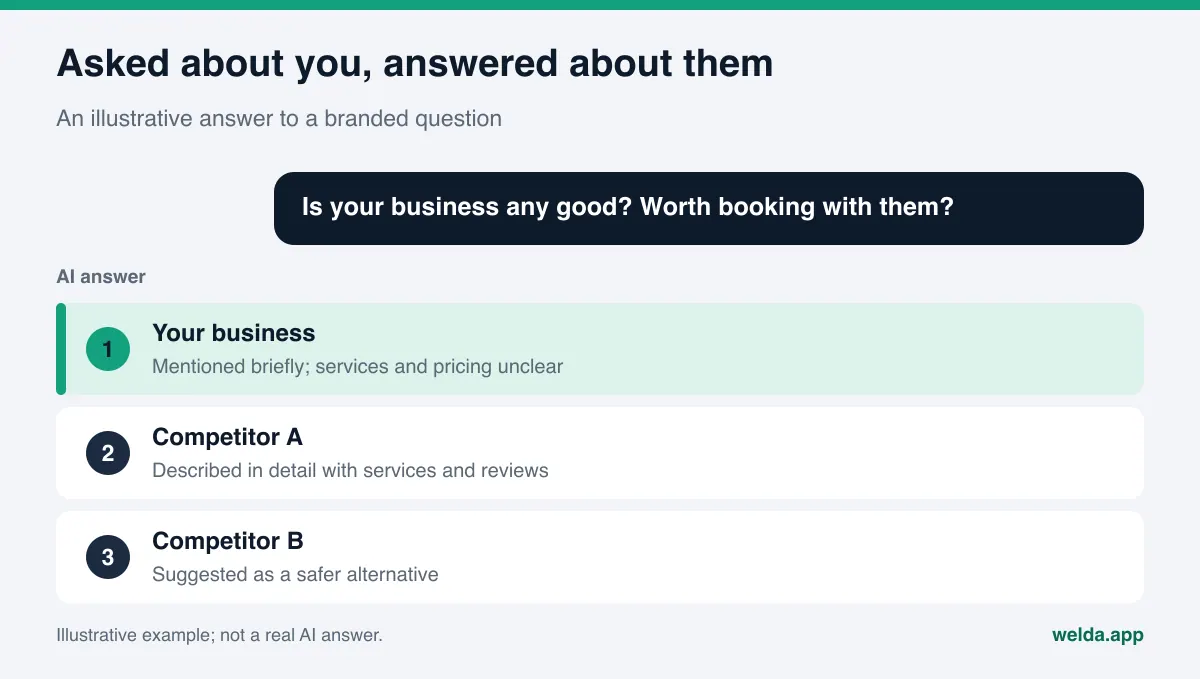
Competitors show up when AI is asked about my brand: what does that actually mean?
A branded question is asked by someone who already knows you. They heard about you from a friend, drove past your sign or saw your ad. They are no longer asking "who is best"; they are asking "is this the right place for me." That makes it one of the questions closest to a purchase.
This is different from a general question like "best roofer in Denver," where a competitor appears and you do not. Here the customer has your name in hand and the answer still sends them somewhere else. In practice you will see one of three patterns:
- An added suggestion. The answer describes you correctly, then adds one or two similar businesses at the end.
- A shift in weight. Your name appears in a sentence, while services, reviews and pricing are given for a competitor. For you, the answer says details are "limited" or "unclear."
- A mix-up. The answer gives your name with a competitor's address, phone number or services. This is common with similar names, shared buildings and recent moves.
These are not the same problem and they do not share a fix. You cannot remove the first one entirely. The second and third are mostly about the information available on your side.
Why does AI bring up competitors in answers about your brand?
Assistants that search the web do not consult one official record. They split your question into several searches, read the pages they find and merge them into one paragraph. When they cannot find clear, consistent pages about you, they fill the gap with nearby businesses that are better documented. The common causes:
- Your site does not answer the question. If what the customer asks (price range, a specific service, who you serve) is not written on your site, the AI looks for it elsewhere, and those pages often describe a competitor in more detail.
- The question is a comparison by nature. "X vs Y," "alternatives to X" and "places like X" are supposed to name other businesses. The goal there is not to erase the competitor but to make sure your side is accurate and complete.
- Best-of lists and roundups. If a local guide, a Reddit thread or a "top 10" article mentions you alongside competitors, the AI may treat that page as a source about you and carry the other names into the answer.
- Look-alike names. A common word in your name, a business with the same name in another city, or a recent rebrand can lead AI to merge two businesses' details.
- Old or negative information. An unresolved BBB complaint, old Yelp reviews or unanswered Google reviews can push an answer toward "you may want to look at these instead."
- Stronger sources on the competitor's side. If a competitor has a complete Google Business Profile, solid directory listings and a detailed site, it becomes the natural point of comparison even in questions about you.
Most of these come down to an information gap. When the AI cannot find enough about you, it reaches for the nearest well-described example. So the first job is to find where the gap is.
Which branded questions open the door to competitors?
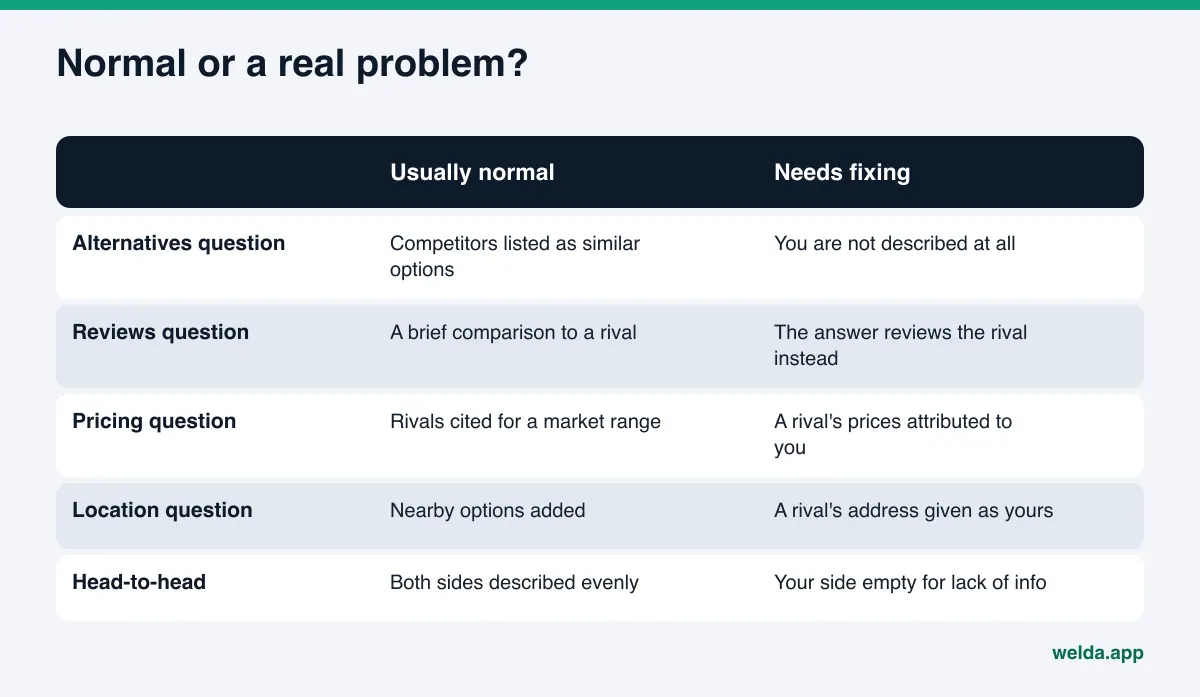
Branded questions come in several types, and each lets competitors in differently. Use this table as a frame when you build your own list.
| Question type | Example phrasing | How competitors get in | Where to look first |
|---|---|---|---|
| Evaluation | "Is [your name] any good?" | Thin info about you, so a rival is described for contrast | About and service pages, reviews |
| Trust | "Is [your name] legit?" | Complaint pages and unanswered reviews dominate | Review responses, BBB profile, contact details |
| Pricing | "How much does [your name] charge?" | No pricing info, so a rival's prices are used as a guide | A page that states your pricing approach |
| Service | "Does [your name] offer X?" | Vague service list, so "this other place does X" | A clear description for each service |
| Head-to-head | "[Your name] vs [rival]" | Expected comparison; your side may be empty | A page that states your differences, FAQ |
| Alternatives | "Places like [your name]" | Rivals are listed; this is normal | Clear category and location on your site |
| Location and contact | "Where is [your name]? Phone?" | A look-alike business's details are given | Consistent NAP and business schema |
The best source for your list is the questions customers already ask your front desk, your sales team or your inbox. Those are the branded questions people also type into AI.
How to fix it, step by step
The order below starts with evidence and moves from your own site outward. The reason is simple: you can change your site today, while third-party sources are outside your control and change more slowly.
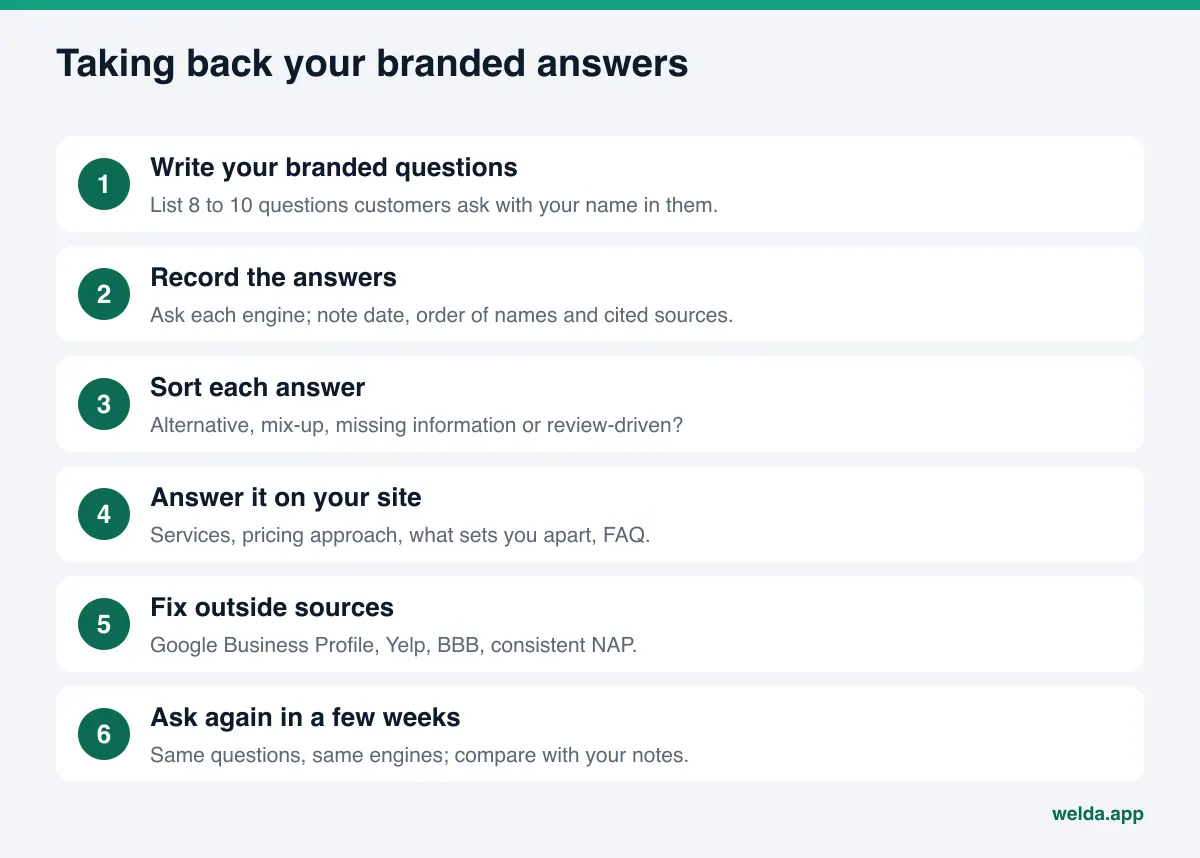
1. Write down your branded questions
List 8 to 10 questions that include your name, with at least one from each type in the table. Write them the way customers talk: "do they take walk-ins," not "service availability." Include common misspellings and short forms of your name, because customers do not always type it correctly.
2. Record the answers
Ask each question in ChatGPT, Gemini, Perplexity and Google's AI Mode. Save a screenshot, and note the date, which businesses are named in what order, and which sites are cited. Answers vary between runs, so ask the same question a few times at different moments before drawing conclusions.
3. Sort each answer
Mark each one as an added suggestion, a shift in weight or a mix-up. Added suggestions usually come from the question's intent and are not the first priority. Shifts in weight and mix-ups are the ones you can fix directly. This sorting keeps you from doing a lot of work that will not change anything.
4. Open the cited pages
Perplexity and Google's AI answers often show sources. Open each one. Which page brings the competitor into an answer about you? A local roundup, a Reddit thread, the competitor's own comparison page, an old news story about you? Without knowing the source, fixes tend to land in the wrong place. We cover how citations work in how to get cited by AI.
5. Answer the question on your site
For each answer where the weight shifted to a competitor, ask: is the answer to this question clearly written on my site? If it is not, the AI has no way to learn it from you. The next section covers which pages do this job.
6. Separate your identity
If you saw a mix-up, write your name, address and phone number (NAP) the same way everywhere. Put your full name, address and phone in your site's business schema, and link your Google Business Profile and social profiles from your site. If a business with a similar name exists, state plainly on your site which city you serve and what you do. If you moved or rebranded, follow the order in update AI answers after a rebrand or move.
7. Update outside sources
Complete your Google Business Profile: category, services, hours and description. Claim and update your Yelp page and the directories that matter in your field, such as Healthgrades for medical practices, Angi for home services or Tripadvisor for hospitality. If you have an open BBB complaint, post a calm, factual response. Reply to your Google reviews. None of this changes an answer on its own, but each step adds information from your side to what the AI reads.
8. Ask the same questions again in a few weeks
New content usually takes weeks to show up in AI answers. Keep your first notes and repeat the same questions in the same engines. Change tends to be gradual: one engine may start describing you more fully while another repeats the old answer for a while.
Pages on your site that answer branded questions
For a branded question, your own site is one of the first places an AI system looks. If a sentence on your site answers the question directly, the answer is more likely to rest on your words. There is no guarantee, but if the sentence does not exist, there is no chance at all. These pages cover most branded questions.
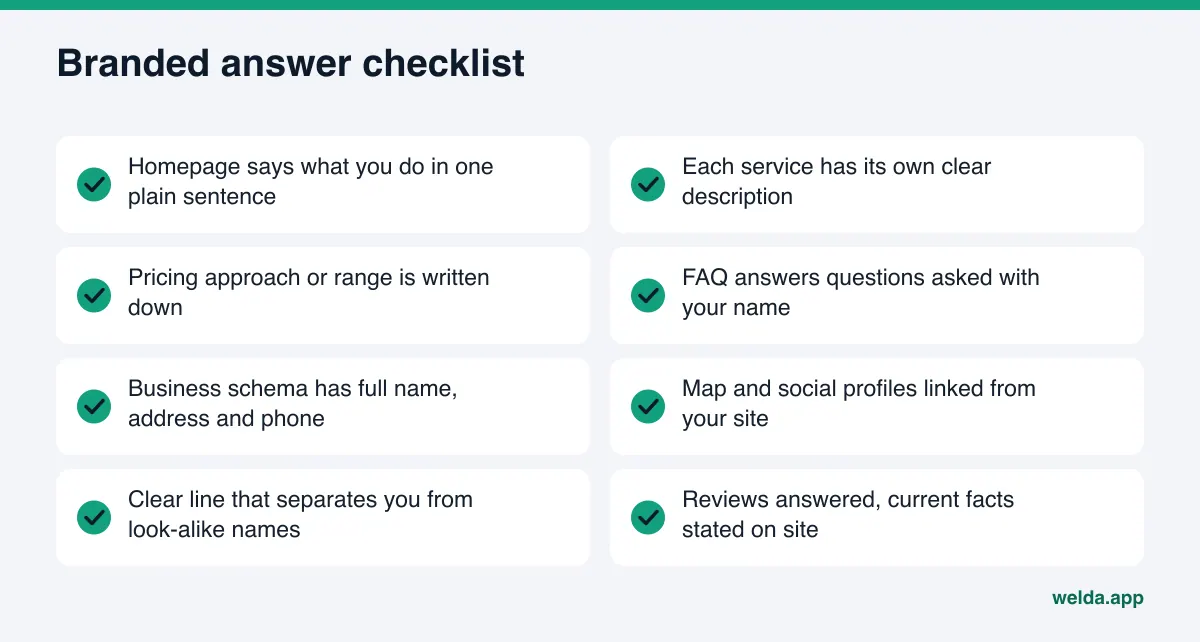
- The first paragraph of your homepage. Say what you do, where and for whom in one sentence. Phrases like "committed to excellence" tell an AI nothing.
- Service pages. Give each service its own description. The answer to "do you offer this" should be a sentence, not just a menu label.
- Pricing approach. Even if you do not publish prices, explain what pricing depends on and how to get a quote. With no pricing information at all, AI may quote a competitor's prices as a reference.
- What sets you apart. A concrete description of why customers choose you. You do not have to name competitors; state what you do differently in a way that can be checked.
- FAQ. Answer the questions people ask with your name attached: parking, weekend hours, payment options, how to book.
- About and contact. When you opened, who runs the business, your address and phone. These are the strongest signals against mix-ups.
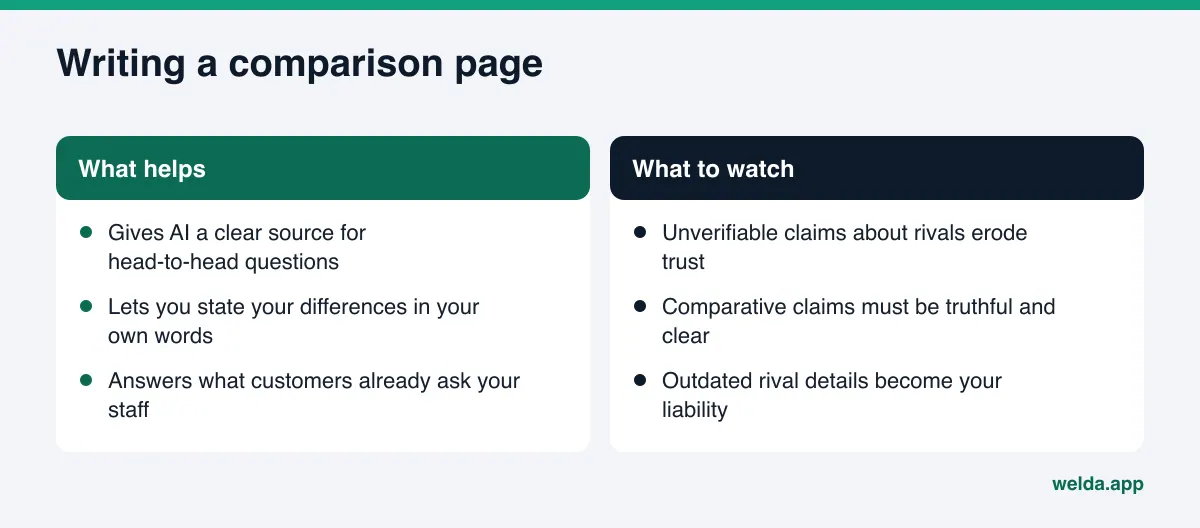
Some businesses consider a dedicated comparison page. The FTC's policy statement on comparative advertising encourages naming competitors but requires clarity and, where needed, disclosure, and the claims must be truthful. This is not legal advice; talk to your attorney before publishing claims about a named competitor. For most small businesses, the safer path is to describe your own differences in concrete terms without naming anyone.
If old pages on your site carry outdated facts, AI may keep reading them. See update old content for AI search for how to handle that.
How Welda handles this
Welda is software that measures where a business shows up in AI answers and fills in the gaps on the business's behalf. For branded questions, three parts matter most.
The free analysis: is your site ready for branded questions?
The free analysis reads your homepage and a few inner pages (services, pricing, about, contact) the way Google and AI systems would. For branded questions, the most useful findings are whether your business schema includes your name, address and phone; whether your services are clearly described; whether you have an FAQ section; and whether your map and social profiles are linked from your site. For each gap you see what was found, why it matters and how to fix it. You also get ready-to-use homepage text: title, description, main heading, intro paragraph and FAQ suggestions. The fix pack you can add to your site includes the business schema code, which is the first concrete step for businesses that get mixed up with others.
The analysis also asks a web-searching AI assistant five questions a customer might ask and checks whether your name appears in the answers. It is a one-time snapshot, not a ranking measurement. The free analysis works in English and German.
The Competitors view in the dashboard: where and from which source a rival wins
In the Welda dashboard, the Competitors view shows each competitor's share relative to you and, more importantly, which group of questions it wins and which source it wins from. For branded questions, that tells you whether a competitor enters answers about you through a directory, a comparison article or its map listing. The decision it leads to is usually simple: is your information missing at that source, or is the answer missing from your site? A separate Sources view lists the sites AI draws on and where you are absent.
The Questions view: what position you are named in
For branded questions, the real measure is not whether your name appears but where and with how much weight. In the dashboard, each question is asked three times in ChatGPT, Gemini, Perplexity and Google AI, so you see what position you are named in for each engine and which sources the answer cites. Three runs per question keep a single lucky or unlucky answer from driving your decisions. Gaps land in one to-do list, where Welda drafts page copy, profile text or review replies; publishing stays with you, and content always lives on your own site.
An honest note on availability: the Welda dashboard is in early access and is opening first in Turkey. Regular four-engine measurement is being added during early access, and dashboard screens are shown with sample data. The part anyone can use today, in English, is the free site analysis. Pricing is discussed in the early access conversation.
Limits: what you cannot change and what Welda does not do
Aiming for competitors never to appear in branded answers is not realistic. When a customer asks for alternatives, AI will list alternatives. The goal is for the answer to describe you accurately, fully and with current facts.
- No guarantees. Welda does not guarantee rankings or "showing up in ChatGPT." AI engines produce answers by their own rules.
- Nothing written about competitors. Welda does not write content that disparages a competitor or makes claims about it. It focuses on completing your own information.
- No made-up facts. If Welda does not know your pricing approach, a service detail or what sets you apart, it asks you rather than inventing it.
- No fake reviews. Welda drafts review replies for your approval. It does not write reviews.
- Outside work stays with you. Resolving negative reviews, managing directory accounts and press work remain with the business. Welda lists these as manual tasks.
- It takes time. New content usually takes weeks to show up in answers, and not at the same pace in every engine.
Before anything is published, Welda's compliance check flags patterns such as price, guarantee and superiority claims, which is useful before a sentence like "better than the competition" goes live. It is not legal advice and has not been reviewed by legal counsel.
Decision checklist: what to fix first
Once you have your notes, use the chart below to decide where to start. The general rule: if there is a mix-up, fix identity first, because a wrong address or phone number loses customers directly. The information gap comes next. Added suggestions come last.
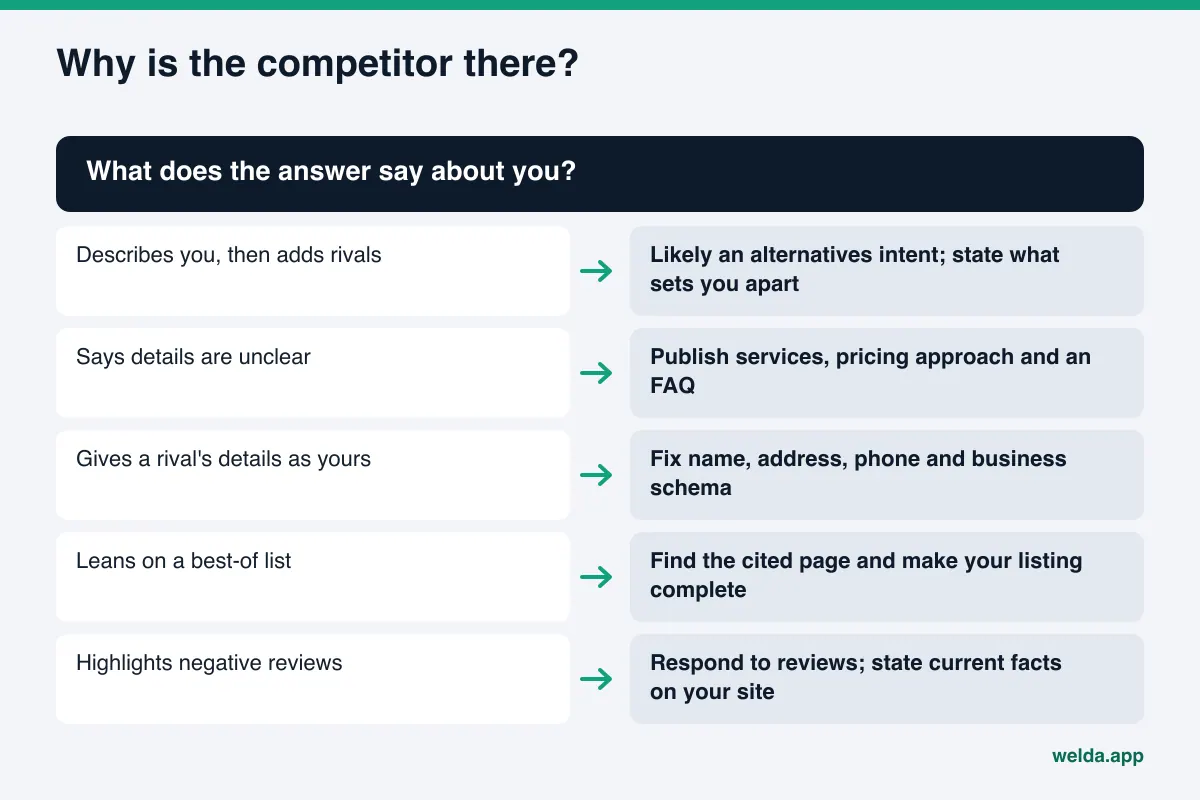
- Does the answer give a competitor's address, phone or services as yours? Fix name, address, phone and business schema first.
- Does it say your details are unclear? Write your services, pricing approach and FAQ.
- Does it rely on a best-of list? Check your entry on that page and state the same facts more clearly on your site.
- Does it highlight negative reviews? Respond to them and state what has changed on your site.
- Does it describe you correctly and then add alternatives? If your differences are clearly written, wait and keep watching.
If you run several locations, treat each one's branded questions separately, since customers often ask "[your name] in Plano" rather than the brand alone. We cover that in AEO for franchises. If your name appears but the facts are wrong, the correction order in ChatGPT giving wrong information about your business also applies.
Frequently asked questions
Can I stop competitors from appearing in answers about my brand?
No. For alternatives and comparison questions, AI will name other businesses. What you can influence is whether the answer describes you with accurate and sufficient information.
What if a competitor uses my name on its own site?
A comparison page can become a source for AI. First check whether what it says about you is accurate. If it is false, discuss the legal side with an attorney; this article is not legal advice. On your side, the work is to answer the same questions clearly on your own site.
AI confuses me with a business that has a similar name. What do I do?
Write your name, address and phone the same way everywhere. Add full details to your business schema, link your map and social profiles from your site, and state clearly on your site which city you serve and what you do.
If I do not publish prices, will AI quote a competitor's?
It can. You do not have to publish numbers, but explaining what your pricing depends on and how to get a quote gives AI something to say about you.
How long until I see a change?
New content usually takes weeks to show up in AI answers. Engines re-read sources on their own schedules, so repeat the same questions a few weeks apart.
Can Welda track these questions for me?
In the early access dashboard, questions are asked three times in four engines and you see your position and which source a competitor wins from. The dashboard is opening first in Turkey; the free analysis is available in English today.
Bottom line: write your own answer first
When competitors show up as AI answers questions about your brand, the instinct is to look at the competitor. In most cases the problem is not them but how little the AI can find about you. Write the answers to the questions customers ask with your name in clear sentences on your site, keep your identity consistent everywhere, and ask the same questions again in a few weeks. To see which information your site is missing today, run the free AI visibility analysis; you get a fix for each gap and ready-to-use text for your homepage.