What is AEO for franchises, and why is it harder than for a single business? AEO for franchises means getting named correctly in AI answers at two levels: when customers ask about the brand, and when they ask for a location near them. A single business has one website, one listing and one address. A franchise system has dozens of locations, many operators and listings scattered across platforms, and AI assistants read all of it, contradictions included. This guide covers how franchisors and franchisees should split the work, the steps in order, and what Welda takes on.
AEO (answer engine optimization) is the work of getting your business named, with accurate details, in answers from ChatGPT, Gemini, Perplexity and Google's AI Overviews and AI Mode. You may also see it called GEO (generative engine optimization); the idea is the same. For franchise brands, the hard part is that customers rarely ask about the brand in the abstract. They ask about the location closest to them. To see how your brand's website looks to AI today, start with the free AI visibility analysis. It reads your homepage and several inner pages and lists every gap it finds.
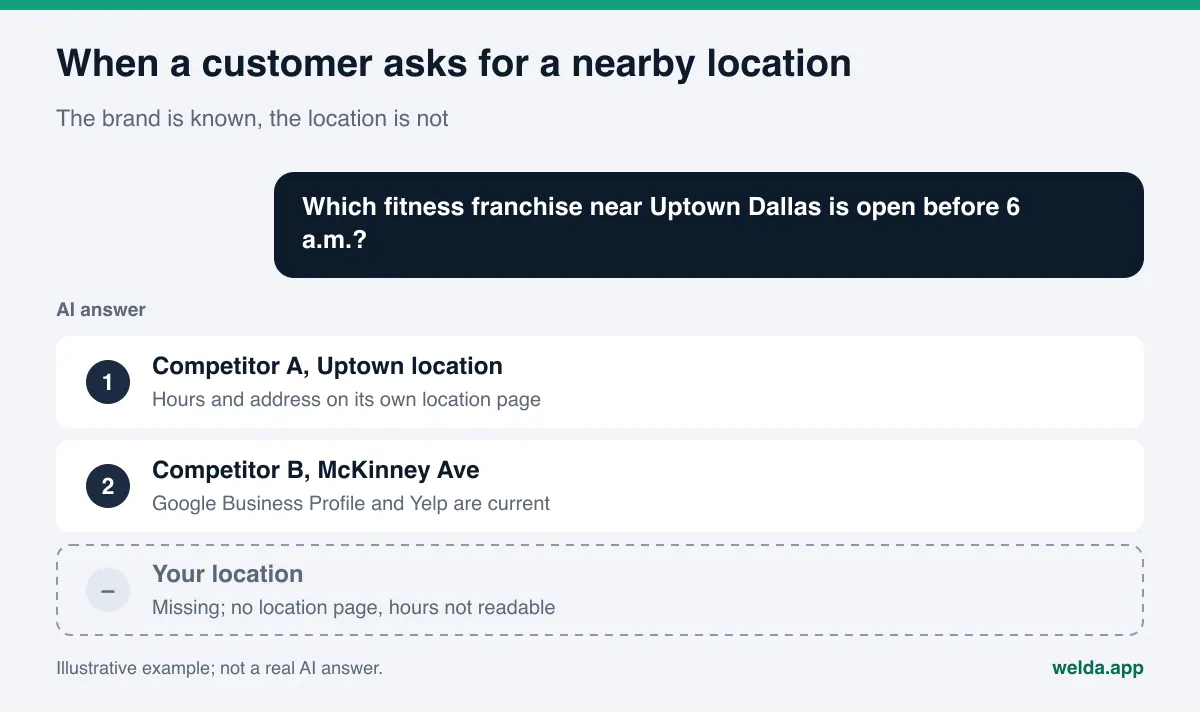
Why franchise brands struggle with AI search visibility
When an AI assistant answers a question, it pulls from websites, map listings, directories and review platforms. For a single-location business, most of those sources come from one place and agree with each other. In a franchise system, the same brand appears in dozens of sources, managed by different people at different times.
Three problems show up again and again:
- Location data is scattered. The franchisor's site has a store locator that loads through a script, or a single page with a long list of addresses. Some franchisees run their own Facebook page or a separate microsite. AI cannot reliably tell which unit is where and when it is open.
- Closed locations live on. A closed or relocated unit leaves behind its Google Business Profile, old Yelp and Yellow Pages entries and sometimes an old landing page. When a customer asks, the old address and old phone number can end up in the answer.
- Names and categories drift. One unit is listed as "Brand Uptown", another as "Brand Fitness McKinney", a third under the operator's LLC name. AI does not always connect them to the same brand.
Each of these lands on the customer. Someone who drives to a closed location or calls a disconnected number blames the brand, and that complaint often ends up on Yelp, Google or the BBB, which are sources AI reads too. We cover why wrong details stick in AI answers in wrong address or phone number in AI answers.
How AI reads a franchise brand and its locations
A franchise faces two kinds of questions, and different sources drive each. If you skip this distinction, effort goes to the wrong place.
Brand questions are about the brand itself: "Is this chain any good?", "Does it have gluten-free options?", "How do I cancel a membership?", "Which states does it operate in?" Answers usually draw on the franchisor's website, news coverage, BBB profiles, Reddit threads and review sites.
Location questions are about a place: "Which gym near Uptown Dallas opens before 6 a.m.?", "Does the Plano location have parking?", "What is the closest location to me?" These answers lean on Google Business Profile, Google Maps, Apple Maps, Yelp, local directories and, when it exists, the location page.
| Question type | Sources that usually drive the answer | Who owns it |
|---|---|---|
| Is the brand trustworthy, what is it like? | Franchisor site, BBB, Reddit, review sites, news | Franchisor |
| Where does the brand operate? | Location list and location pages on the franchisor site | Franchisor |
| Is there a location in this neighborhood, when does it close? | Google Business Profile, Apple Maps, Yelp, location page | Franchisor and franchisee together |
| How good is that particular location? | That location's reviews and replies | Franchisee, under brand rules |
| Details about the product or service | Service pages and FAQ on the franchisor site | Franchisor |
The takeaway is simple. Brand questions depend on the franchisor's site and the brand's overall reputation. Location questions depend on local listings. A franchisor that only works on the corporate site will lose location questions. Franchisees who only look after their own listings leave brand questions unattended. When a competitor shows up for a question that names your brand, it usually comes from this gap; we cover it in competitors showing up when AI is asked about your brand.
Franchisor vs. franchisee: who owns AEO for franchises?
Franchise agreements usually cover trademark use, signage and marketing fund contributions. AI visibility is rarely spelled out. So the first job is to write a short rule for who manages what.
The franchisor's part is a standard: one brand name, one primary category, a location page template, schema markup, a review reply style and one master list of locations. The franchisee's part is local, current information: hours, holiday closures, phone changes, services specific to that unit, photos and replies to its own reviews.
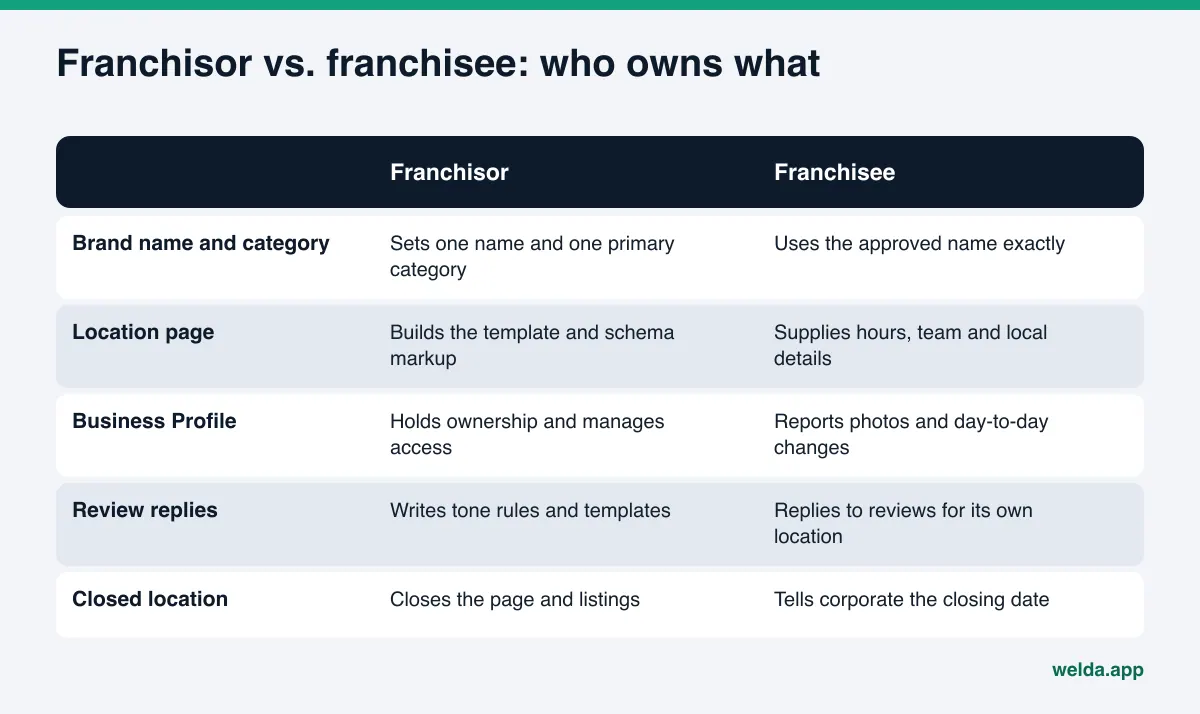
For this split to work, information has to flow one way. The franchisee reports a change; the franchisor applies it the same way everywhere. If a franchisee renames their listing on their own, or corporate updates hours without asking the unit, the data AI reads splits in two again.
Google's rules point the same way. Under Google's guidelines for representing your business, all locations within the same country must have the same name, locations offering the same service should share one primary category, and each location should have only one profile. For a franchise, that rule is both a limit and an advantage: consistent names and categories make it easier for AI to tie every unit back to one brand.
AEO for franchises, step by step
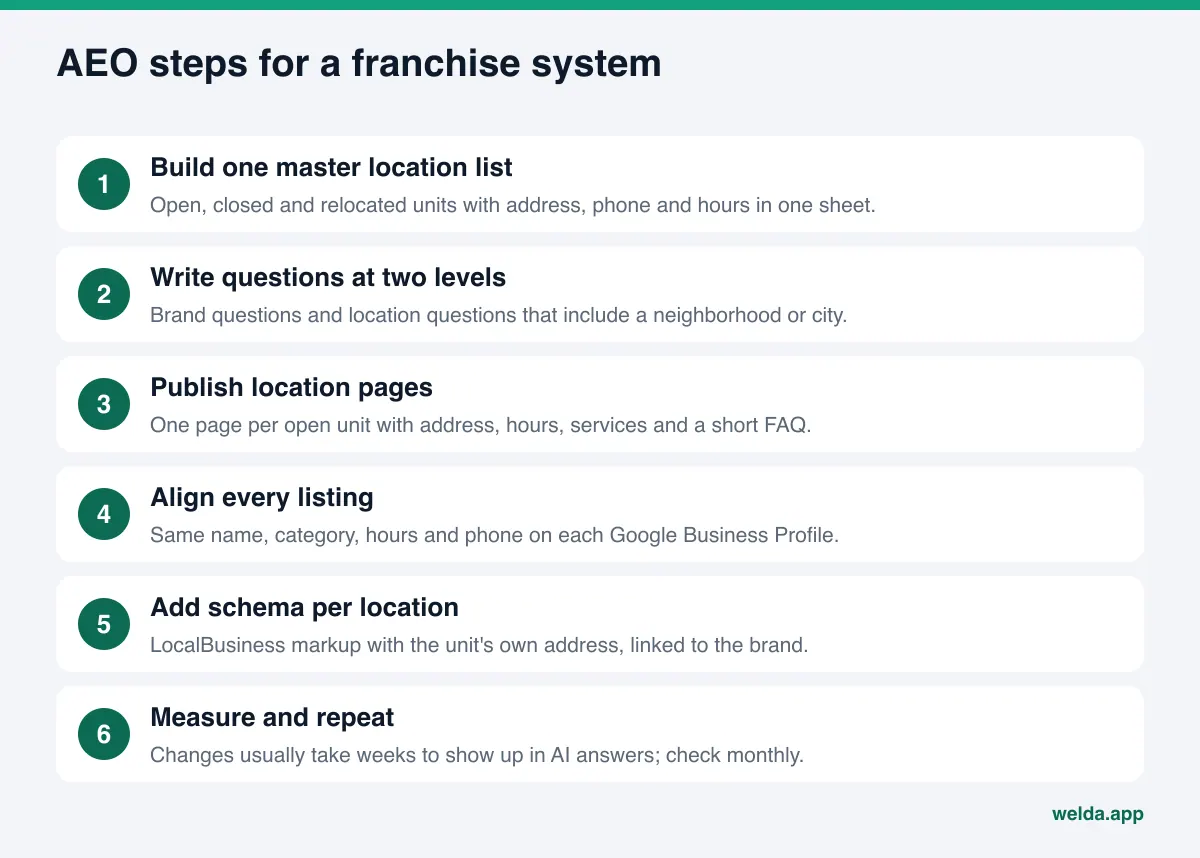
The order below starts with the mistakes that do the most damage and moves toward content. Stopping wrong information first, then adding new information, is the more efficient path.
- Build one master location list. Put every open, closed, relocated and planned unit in one sheet: location name, street address, phone, hours, operator and who controls each listing. This sheet becomes the single source of truth for everything that follows.
- Write questions at two levels. List the questions customers ask about the brand, and separately the questions that name a neighborhood or city. Rather than writing questions for every unit at once, pick a few representative markets and start there.
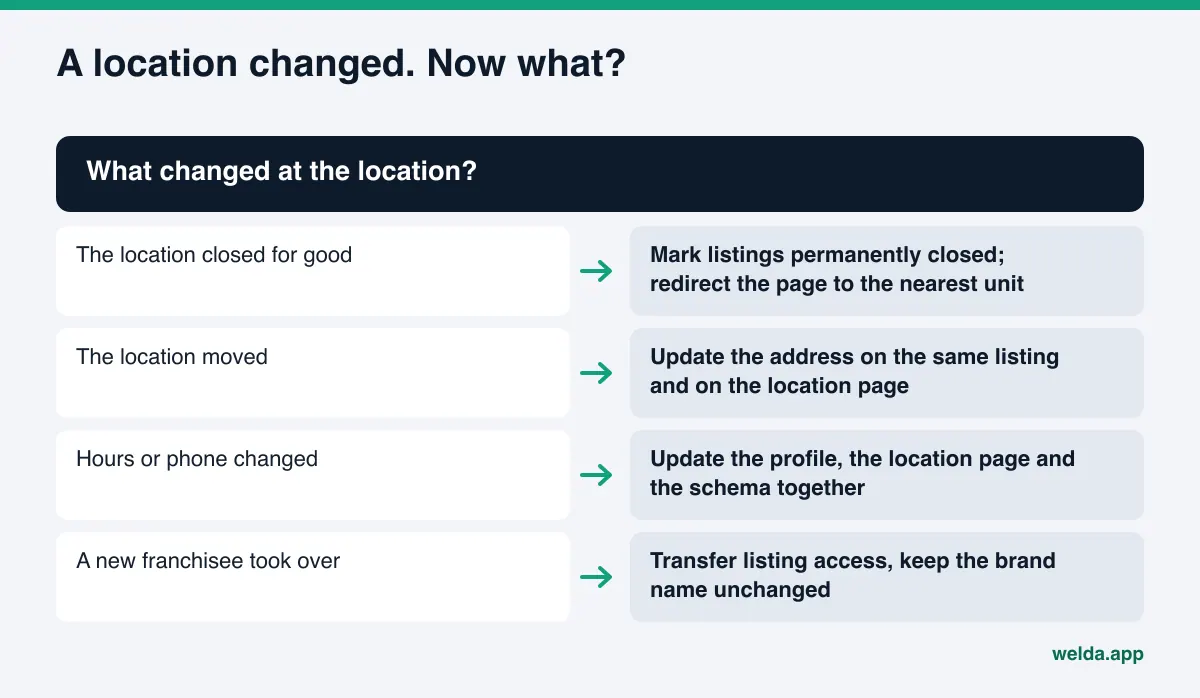
- Clean up closed locations. Mark closed units as permanently closed on Google Business Profile, Apple Maps and Yelp, redirect old location pages to the nearest unit or the locator, and update old directory entries.
- Publish a page for every open location. A locator widget alone is not enough. Each unit needs its own crawlable page with address, phone, hours, directions, services specific to that unit and a short FAQ.
- Align every listing. On each Google Business Profile, the name, primary category, phone, hours and website link should match the master list. The website link should point to that location's page, not the corporate homepage. Apple Maps matters too; see Apple Business Connect for AI assistants.
- Add schema markup per location. Give each location page LocalBusiness markup with that unit's address and hours, and link it to the brand.
- Close the brand-level gaps. Describe services clearly on the corporate site, answer common brand questions in an FAQ, and reply consistently to brand complaints on the BBB and similar platforms.
- Write a review reply policy. Let franchisees reply to their own reviews, but with a shared tone and a list of phrases to avoid. One harsh reply from one unit becomes text AI reads about the whole brand.
- Measure and repeat. Ask the same questions every month. New content usually takes weeks to show up in AI answers, so do not judge by a single week.
If you want to spread this over a quarter, the sequence in our 90-day AEO plan fits a franchise system as well. The difference is that most of the first month goes to the location list and listing cleanup.
What a good franchise location page includes
For location questions, the location page is the clearest source AI can read that you fully control. Google decides the format of a Business Profile; you decide the format of your location page. Getting the template right once pays off for every unit that opens later.
| Field | What to write | Why it matters |
|---|---|---|
| Page title | Brand name plus neighborhood: "Brand Uptown Dallas" | Matches questions that name a place |
| Address and phone | Written exactly as on the Business Profile | Conflicting details get dropped from answers |
| Hours | Day by day, with holiday notes | Answers "is it open now" questions |
| Location-specific services | Real differences: parking, drive-thru, kids' area, early hours | Separates this unit from the others |
| Directions | Nearby landmark, transit stop, cross streets | Gives context for local questions |
| Short FAQ | Three to five questions about this unit | Provides answers that can be quoted directly |
| Schema markup | The unit's own address, hours and link to the brand | States identity in a machine-readable way |
The most common mistake is cloning one page and swapping the city name. Pages like that give AI nothing new. Each location page needs a few real details specific to that unit. And never publish what you do not know: if a location has no parking, writing "free parking" turns into a complaint fast.
In schema markup, each unit is described as its own local business with its own address. The schema.org LocalBusiness type includes a parentOrganization property to tie a unit to the organization it belongs to, and openingHoursSpecification for hours. Together they tell machines which brand the location belongs to and when it is open.
How Welda handles AEO for a franchise brand
Welda measures where a brand stands in AI answers and prepares the missing pieces on the business's behalf. For a franchise system, three parts matter most.
Start with the free site analysis. The analysis reads the franchisor's site through the homepage and several inner pages, and it works in English. For a franchise brand, typical gaps it can surface include: no schema markup at all, or markup that only shows the corporate address; address and phone written inconsistently across the site; map and social profiles not linked from the site; and no FAQ section. Each gap comes with what was seen, why it matters and how to fix it, plus a simulation of how much each fix would move the score. The analysis also asks five customer-style questions to an AI assistant that can search the web and checks whether your brand name appears in the answers. It is free once per site; if franchisees run their own websites, each one counts as a separate site.
Question-by-question measurement in the panel. In the Welda panel, the questions customers would ask are put to ChatGPT, Gemini, Perplexity and Google AI three times each. The questions screen shows one row per question and where your name appears on each engine. For a franchise, that screen holds two groups: brand questions and location questions that name a neighborhood. What a franchisor learns there is where the gap sits. Strong on brand questions but absent in certain neighborhoods points to location pages and listings. Present for locations but losing brand questions to competitors points to the corporate site and reputation sources. The score formula is published, so you can see which part moved.
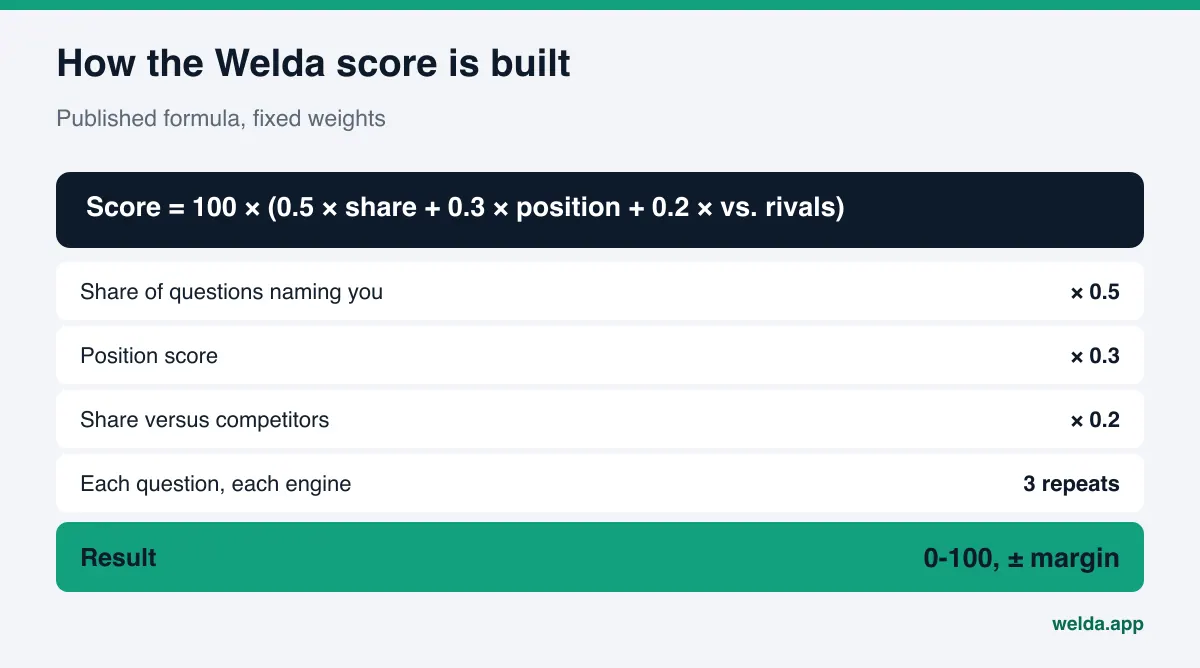
Sources and the to-do list. The sources screen shows which sites AI cites and your status on each: a listing missing, a profile unverified, a complaint thread unanswered. The to-do list collects it all in one place: missing information (such as a unit's hours), drafts waiting for approval (such as a location page or a review reply) and manual tasks. Welda drafts location page copy, profile text and review replies. It does not invent details it does not know; it asks you. Approval stays with you, and content always lives on your own site. On WordPress sites, Welda connects through a separate Editor user and an application password, with no code to install; the page opens as a draft and goes live once approved. On other systems, Welda provides a ready package and the work is applied by hand. Google Business Profile, Instagram and Facebook can be connected; for listings that are not connected, the task is marked as manual. A compliance check flags patterns such as price, guarantee and superiority claims before publishing; it is not legal advice.
A clear note on availability: the free analysis works in English and German today. The full Welda panel is in early access and is opening first in Turkey, so US franchise brands can use the free analysis now and join the early access list for the panel. Regular measurement across all four engines is being added during early access, and the sample screens in the panel use representative data. Pricing is discussed in an early access call.
Limits: what Welda does not do, and what stays with the brand
Setting the right expectations matters in a franchise system, because part of the work is something no software can do alone.
- No guarantees. Welda does not guarantee rankings or "getting into ChatGPT". AI answers vary, which is why each question is asked three times and shown with a margin of error.
- No guessing. If a unit's hours, parking or services are unknown, Welda does not fill them in; it lists them as missing information. Collecting location data is the franchisor's and franchisee's job.
- No unapproved publishing. Sensitive content does not go live without approval. In a franchise system you decide the approval chain: the franchisee, corporate or both.
- No fake reviews. Welda does not write reviews; it drafts replies to real ones. The FTC's final rule on consumer reviews, announced in August 2024, prohibits fake reviews and also addresses undisclosed reviews by company insiders, which matters when franchisees and staff are tempted to review their own units.
- Some work stays with you. Resolving negative reviews, setting up directory accounts, PR work and any agreements with franchisees remain with the brand.
- It takes time. A new location page or a corrected listing usually takes weeks to show up in AI answers.
There is also a liability side. If a location page or review reply publishes something wrong, the responsibility stays with the brand and the operator. We cover what to watch in liability for errors in AI-written content; that article is not legal advice either.
Example scenario: where a 20-unit franchise would start
The scenario below is an example and does not describe a real business. Picture a fitness franchise with 20 units across three Texas metros: 14 run by franchisees, 6 by corporate. The corporate site has a store locator that loads addresses through a map widget. Last year two units closed and one moved.
In week one, corporate builds the master list and finds that both closed units still show as open on Google and Yelp. They are marked permanently closed. The relocated unit's old address still sits on a directory site, and that gets corrected. In week two, the question list is written: about ten brand questions and a set of location questions drawn from neighborhoods where the brand operates. The free analysis shows no schema markup on the corporate site and no FAQ section.
Over the next weeks, a location page template goes live. Each franchisee is asked for hours, unit-specific services and directions. Pages for units that have not sent their details stay on hold rather than going live with blank fields. Business Profile website links are switched from the homepage to each unit's page. A review reply policy is written and shared with every franchisee.
We are not attaching a number to the outcome, because results depend on the brand, the market and the competition. The order is what matters: listing cleanup comes before content. One AI answer that sends a customer to a closed unit does more harm than ten new pages do good.
Franchise AEO checklist: is your system ready?
Check the list once at brand level and once for every location. Each unchecked item is a piece of information AI is missing or reading wrong when it decides whether to name you.
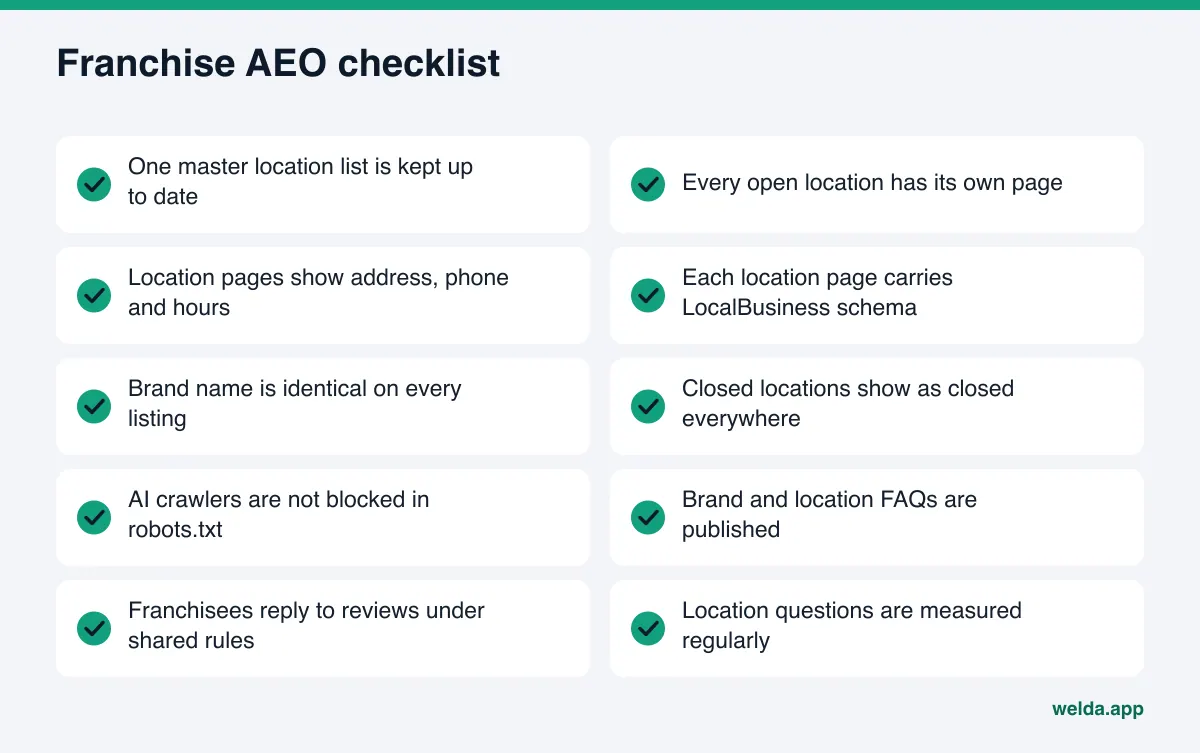
If fewer than half the items are checked, start with listing cleanup and location pages. If most are checked, the next step is measurement: adding content without knowing which question, engine and neighborhood you are missing can mean spending effort on the wrong unit. To see which sources competitors draw on, the method in our citation gap analysis guide works well for franchise brands.
Frequently asked questions
Does each franchise location need its own website?
No. For most franchise brands, a dedicated page for each location on the franchisor's site is enough and easier to manage. What matters is that every unit has its own crawlable page with its own address, hours and specific details.
Can franchisees manage their own Google Business Profile?
Yes, but the name and primary category should follow the brand standard. Google's guidelines require all locations in the same country to use the same name. Corporate should keep access as well, so a listing is not lost when a unit changes hands.
How long until a closed location drops out of AI answers?
There is no fixed timeline. Marking listings closed, redirecting the old page and updating directories speeds things up; it usually takes weeks to show in answers.
We do well on brand questions but not on location questions. Why?
Brand questions depend on the corporate site and overall reputation; location questions depend on local listings and location pages. That pattern usually means location pages are missing or listings are inconsistent.
Does the free analysis cover every franchise location?
No. It reads one site: the homepage and several inner pages. It shows gaps on the franchisor's site and the state of its schema markup, and it runs a one-time five-question AI test. Regular location-level measurement happens in the panel, which is in early access.
Does Welda publish location pages itself?
Welda drafts the copy. With a WordPress connection, the page opens as a draft on your site and goes live when you approve it. Without one, you get a ready package to apply by hand. Approval always stays with you.
See where your franchise brand stands today
AEO for franchises starts with a clear split between franchisor and franchisees: one master location list, one name, one page per location and regular measurement. As a first step, run the free AI visibility analysis on your corporate site. The results link arrives by email and includes the gaps, suggested copy and a ready-to-apply fix package.