What is a citation gap analysis, and why should a local business care? A citation gap analysis maps the websites AI answer engines rely on when they answer questions in your category, then shows where you are missing, incomplete or wrong on those sites. When a competitor gets named in ChatGPT and you do not, the reason is often sitting in that list. This guide walks through the method, how to prioritize what you find, and how Welda handles the work.
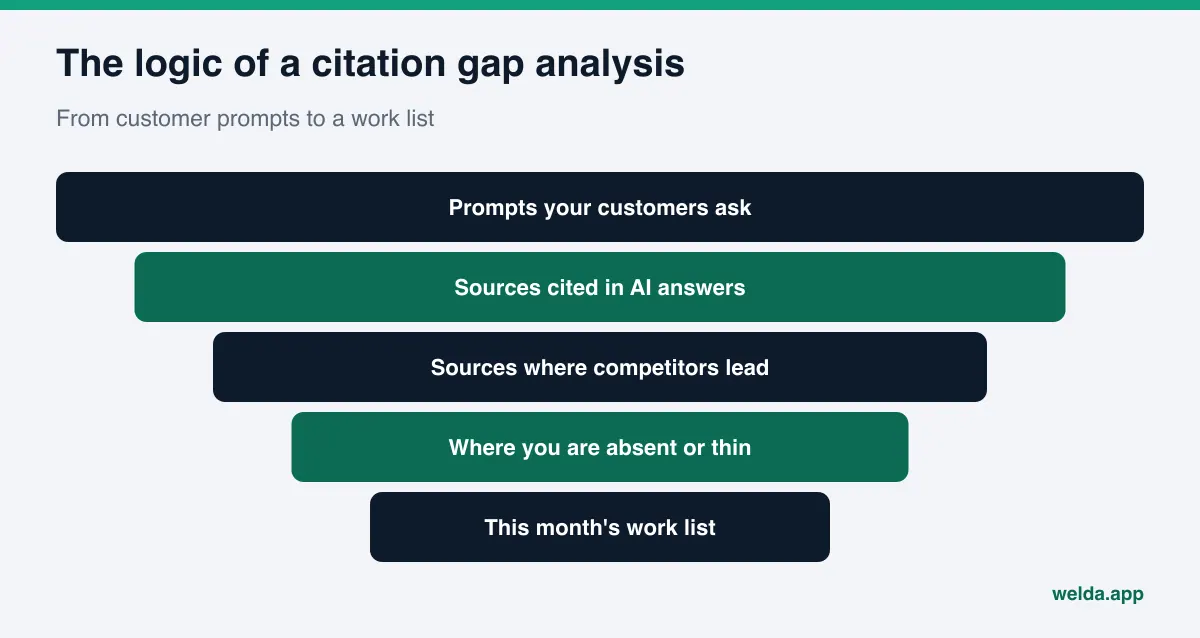
What a citation gap analysis actually measures
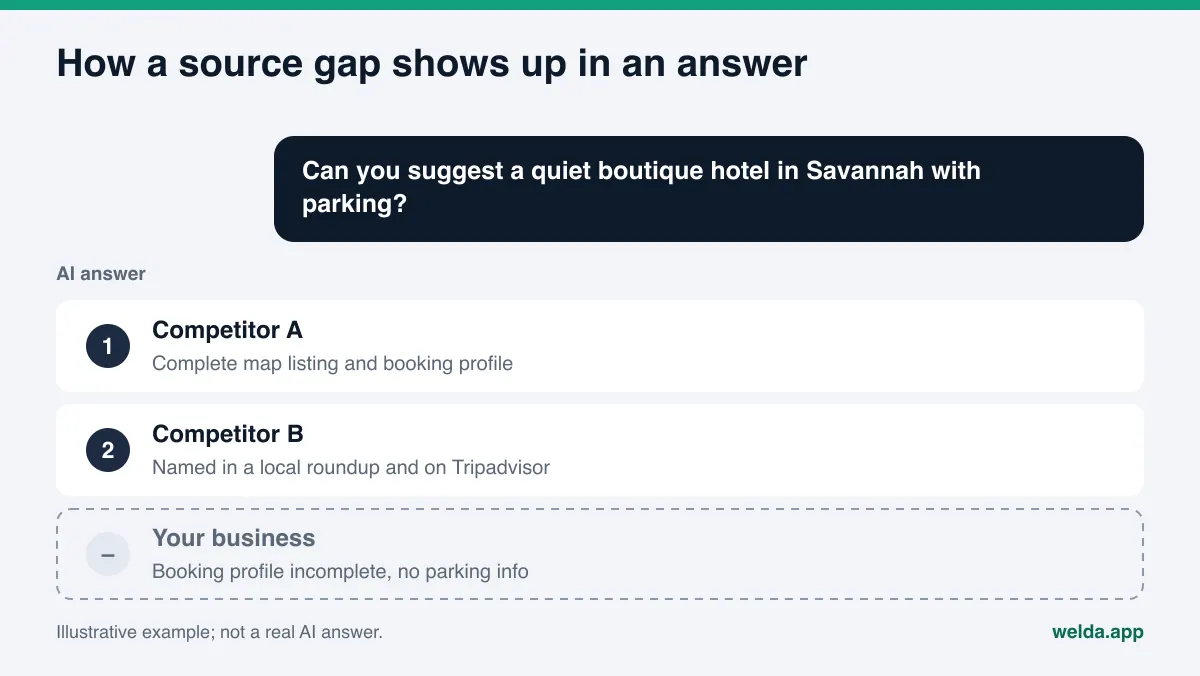
When a customer asks ChatGPT, Gemini, Perplexity or Google's AI Overviews and AI Mode for "a pediatric dentist in Austin who takes new patients" or "a quiet boutique hotel near the Savannah historic district," the answer is not invented from nothing. Engines that search the web read a set of pages and build the answer from them. Those pages can be your own website, your Google Business Profile, Yelp, Tripadvisor, Healthgrades, Angi, the BBB, a Reddit thread, or a "best of" roundup on a local news site.
A citation gap analysis asks three questions about those pages. First, which sources do AI engines lean on most when they answer the questions your customers ask? Second, are you present on those sources, and if so, is your information complete and correct? Third, where do your competitors show up strongly while you fall behind? Put the three answers side by side and you get a work list. A "citation gap" is any source the AI trusts where you are absent, thin or misdescribed.
In AEO (answer engine optimization), this is one of the most practical diagnostics you can run. Some people call the broader discipline GEO, generative engine optimization; the work is the same. What makes citation gap analysis different from a classic backlink audit is the question it asks. A backlink audit asks who links to you. A citation gap analysis asks which pages feed the AI's answer and what those pages say about you. A source does not need to link to you to matter. It needs to describe you accurately. And a site that links to you may never appear in an AI answer at all.
Why AI answers depend so heavily on sources
Answer engines that search the web show where their answers come from. Perplexity says in its help center that each answer includes numbered citations linking to the original sources. Google's documentation for AI Overviews and AI Mode says these features surface links to supporting pages, and that there are no extra technical requirements beyond being indexed and eligible to show in Search. In practice, what the AI says about your category is shaped by what it reads.
That has two consequences for a business owner. The first is that a great website is not always enough. If the engine builds most of an answer from third-party sites, your own pages carry only part of the weight. For a hotel, booking sites and map listings may carry much of it. For a dental practice, Healthgrades, Google reviews and local health directories might. For a contractor, Angi, the BBB and neighborhood threads can matter. The second is that errors on those sources travel straight into answers. An old phone number, a closed second location, outdated hours or a years-old unresolved complaint can become part of the story the AI tells until someone fixes it.
That is why a citation gap analysis is one of the most concrete answers to "why aren't we showing up?" Before you look outward, check your own site. The free site analysis reads your pages the way Google and AI systems do, checks whether your map and social profiles are linked from your site, and explains how to fix each gap it finds. The citation work picks up where that leaves off: it looks at everything outside your site.
Which source types AI engines cite for local businesses
Sources change by industry and by question. Still, most local businesses in the US see similar groups. The table below lists them and what to check on each. It is not a ranking. Only measurement tells you which group carries the most weight in your category.
| Source type | US examples | What to check |
|---|---|---|
| Your own website | Services, pricing, about and contact pages | Can AI crawlers get in, are services spelled out, is business schema present |
| Maps and business profiles | Google Business Profile, Apple Maps, Bing Places | Category, hours, address, phone, service list, review replies |
| Review and vertical directories | Yelp, Tripadvisor, Healthgrades, Angi | Listing exists, description current, photos and attributes complete |
| Trust and complaint sources | BBB, Reddit threads | Threads about you, unanswered complaints, resolved issues still showing |
| Roundups and local media | "Best of" lists, local news, city blogs | Articles naming competitors but not you |
| Social profiles | Instagram, Facebook | Bio, address and contact info, link back to your site |
How to run a citation gap analysis, step by step
You can do this by hand. It takes time, but the logic is simple. The steps below hold whether you use a tool or a spreadsheet.
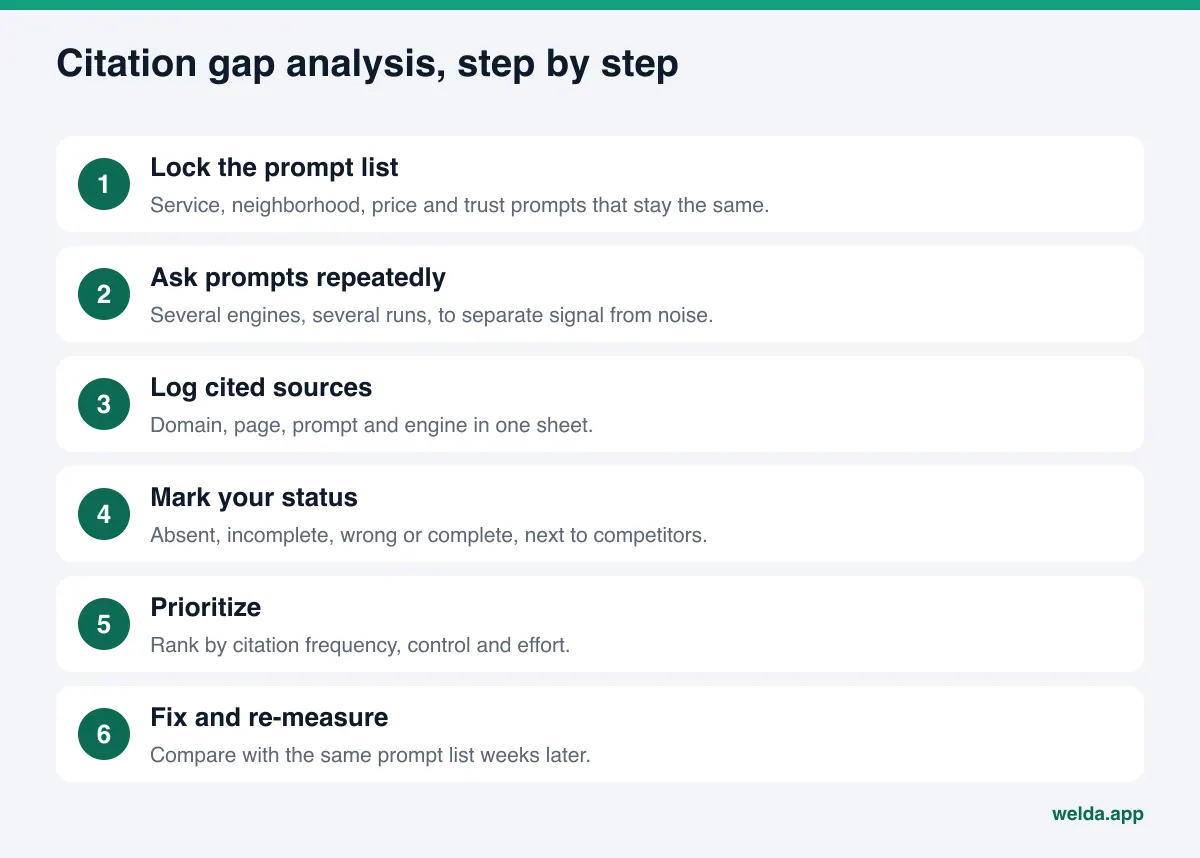
- Lock your prompt list. Write 20 to 50 questions your customers would really ask: service, neighborhood, price range, comparisons and trust questions. We cover how to build the list in prompts to track for AI visibility. If the prompt list changes between runs, the source list changes too, so lock it first.
- Ask each prompt on several engines, several times. AI answers vary even for the same question. A source that shows up once may vanish on the next try. Repetition separates sources that keep coming back from noise.
- Log every cited source. For each answer, record the domain, the page URL, the prompt and the engine. Some answers show no sources at all. Note that too.
- Group sources by type. Your site, maps, directories, complaint and forum sources, roundups, social. Grouping shows at a glance where you are weak.
- Mark your status on each source. Four states cover most cases: absent, present but incomplete, present but wrong, present and complete. If AI crawlers cannot reach your own site, that is its own state.
- Compare the same sources for competitors. Pick the two or three businesses named ahead of you. How do they look on each source? More reviews, a clearer description, fresher photos?
- Prioritize. For each gap, weigh three things: how often the source is cited, how much control you have over it, and how much effort the fix takes. There is a decision chart for this below.
- Fix, wait, and measure again. Changes on sources take time to show up in answers. Wait a few weeks before re-running the same prompt list.
The first round by hand is doable. The second and third get heavy, because you are repeating dozens of prompts across engines and tracking changes. We discuss where manual checking stops scaling in manual ChatGPT checks vs tracking tools.
Four kinds of citation gaps and what closes each one
Not every gap is the same, and they do not close the same way. Sorting what you find into four groups makes it clear who owns each fix and how long it should take.
Absence. A directory or booking site that engines cite often has no listing for you, while your competitors are there. This is the most visible gap, and it usually starts with claiming or creating a listing. Creating it is not the finish line, though. The description, services and contact details need to match your website.
Incomplete listing. You have a listing, but it is half done. The wrong primary category, an empty services section, missing hours, photos from five years ago. When an AI answers a question like "open late" or "has parking" and cannot find that fact for you, it names someone else. Incomplete listings are often the cheapest gaps to close because you already control the account.
Wrong information. An old address, a closed location, a changed phone number or a service you no longer offer is still sitting on a source. Here the risk is not only missing out. The wrong fact can end up in the answer. That is why consistent name, address and phone details across every source matter so much.
Access problems. The source is your own website, but AI crawlers cannot get to the page or cannot read it. Blocking crawlers in robots.txt, very slow pages, and services listed only inside images are common causes. This gap is entirely yours to fix.
There is a fifth case: you are on the source, but the story is negative. An unresolved BBB complaint or a one-sided Reddit thread. That is less a data gap than a reputation issue, and we cover it in AI reputation management. One rule applies across all of it: do not try to close gaps with fake reviews. The FTC's final rule on fake reviews and testimonials, announced in August 2024, bans fake reviews, including AI-generated ones, and buying them. This is general information, not legal advice.
How to prioritize citation gaps
When the analysis is done, most businesses face a long list. Rather than attacking everything at once, set an order. A practical rule rests on three questions. How often does this source get cited for your prompts? Is the information there under your control? How much work is the fix?
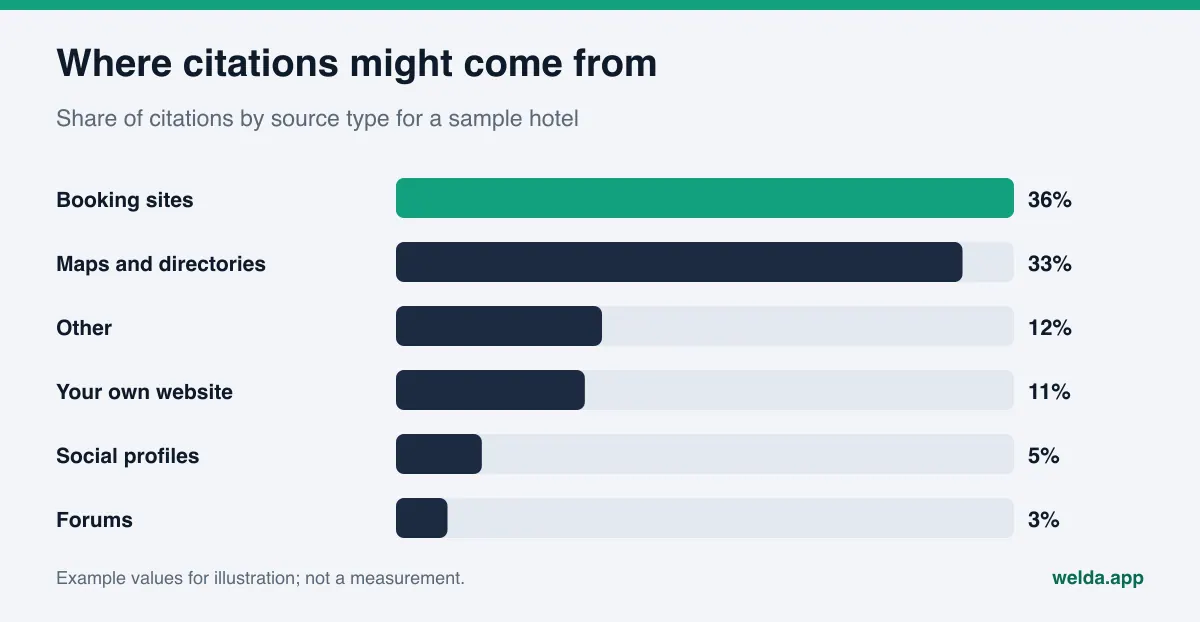
Take an example: a boutique hotel. Say the analysis shows that booking sites and map listings take most of the citations, while the hotel's own site is rarely cited. One booking profile is incomplete, the map listing has outdated amenities, and AI crawlers cannot reach one page on the hotel's site. A sensible order would be: fix the crawler access first (fully in the hotel's hands, low effort), then the map listing (frequently cited, owned by the hotel), then the booking profile (frequently cited, editable, takes longer). The fact that the hotel never comes up in Reddit threads goes to the bottom. Little can be done there, and it should never be filled with planted posts.
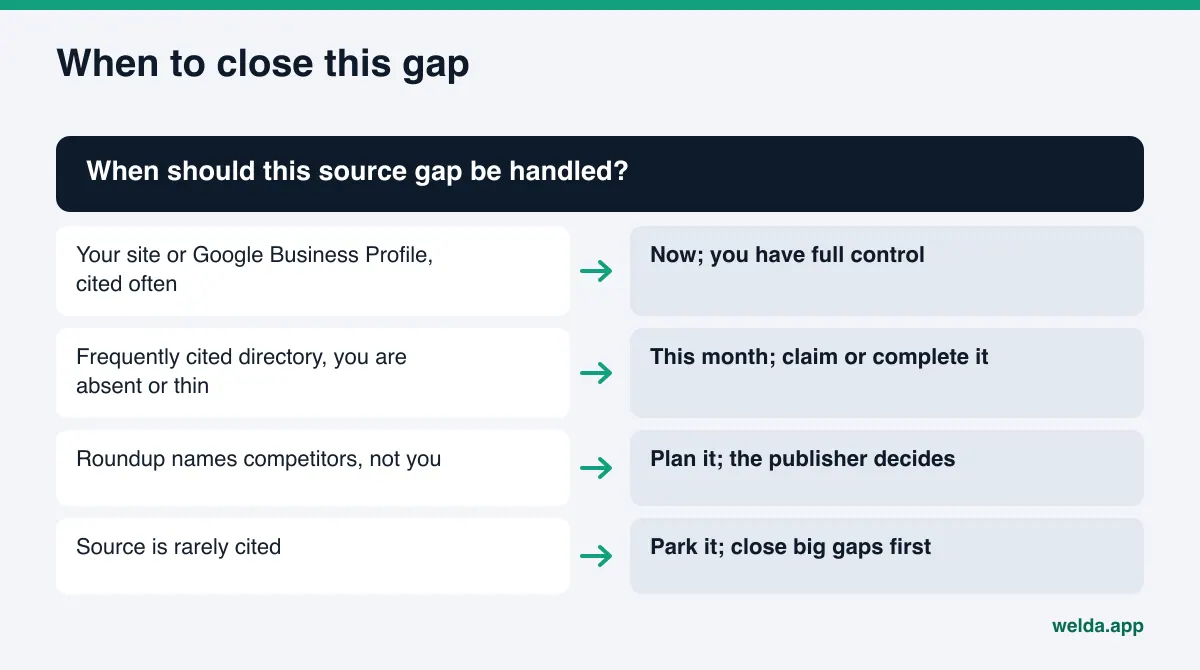
| Gap | Your control | Typical effort | Priority |
|---|---|---|---|
| AI crawlers blocked on your site | Full | Low | Now |
| Missing details on Google Business Profile | Full | Low | Now |
| No listing on a frequently cited directory | Mostly | Medium | High |
| Wrong address or phone on a directory | Mostly | Low to medium | High |
| Roundup names competitors, not you | Partial | High | Medium |
| Unanswered negative thread or complaint | Partial | Medium | Case by case |
With roundups and local media, you do not control the outcome. You can reach out to an editor, but the publisher decides. Put those items on the plan, and spend the first weeks after the analysis on the sources you do control.
How Welda runs citation gap analysis
In Welda, this work comes together on two screens and one list. A quick note on status first. The Welda dashboard is in early access, opening first to businesses in Turkey. Regular four-engine tracking is being added during early access, and the dashboard screens are shown with sample data. The part anyone can use today is the free site analysis, which runs in English. Pricing is discussed in the early access conversation.
The Sources screen. When your customers' questions are asked three times each on ChatGPT, Gemini, Perplexity and Google AI, the sites cited in the answers are collected here. Each row shows a source, how many citations it received, its share of the total, and your status there: unverified, incomplete profile, site unreachable, absent, or completed. A one-line next step sits beside it. On the right, citations are summarized by source type, so you can see how much of the total your own site earns. The decision this screen supports is usually simple: pick the two or three most-cited sources where you are weakest and make them this month's work.
The Competitors screen. A citation gap only means something next to a competitor. This screen shows your share relative to competitors, which topic cluster each competitor wins, and which sources it gets cited from. Seeing that a competitor beats you on one group of questions, and does it with citations from two specific sites, turns a vague goal like "publish more content" into a concrete one like "complete our listings on those two sites." The share calculation is explained in AI share of voice.
The to-do list. Every gap on the Sources screen becomes a task. Welda drafts what it can: a profile description, a service blurb, a review reply, or content for your site. If Google Business Profile, Instagram or Facebook is connected, the draft comes to you for approval. If not, the task is listed as "do manually," with the ready text next to it. The same goes for directories and booking sites Welda does not connect to: the text is ready, and you or your team enter it. Welda does not make up facts it does not know. If it does not know whether you have parking, it asks. Publishing approval stays with you.
The effect of those changes shows in later runs with the same prompt list. How to set up that comparison is covered in before and after AEO measurement.
The free site analysis does not include the Sources screen, but it covers your side of the citation work. It checks whether AI crawlers can reach your site, whether business schema is present, whether your address and phone are clearly stated, and whether your map and social profiles are linked from your site. It also asks five questions a customer might ask to an AI assistant that can search the web, and shows whether your business name appears in the answers. That is a one-time check, not ongoing tracking, but it is a useful baseline.
Limits: what citation analysis cannot do, and what Welda does not do
A citation gap analysis is a strong diagnostic, but it cannot promise certain things. Knowing that up front keeps expectations honest.
- Engines do not publish their selection rules. The analysis shows which sources were cited, not why. Being on a cited source does not guarantee you will be named.
- Not every answer cites sources. Answers given without a web search show no citations. The analysis works from answers that do.
- Results fluctuate. The same prompt can be answered from different sources at different times. That is why Welda asks every prompt three times and reports its score with a margin of error.
- Effects take time. Completing a listing today does not mean answers change tomorrow. New content usually takes weeks to show up in AI answers.
- Welda does not guarantee rankings or that you will "show up in ChatGPT."
- Welda does not create fake reviews and does not post anonymous content on forums or complaint sites on your behalf.
- Some work stays with you. Handling negative reviews, managing directory accounts and press outreach are yours. Welda supplies drafts and an order of work.
- Content lives on your site. Welda does not host content. On WordPress sites, content opens as a draft and goes live when you approve it.
Citation gap analysis checklist
Whether you run the analysis yourself or read it from a tool, confirm these before you turn the results into work.
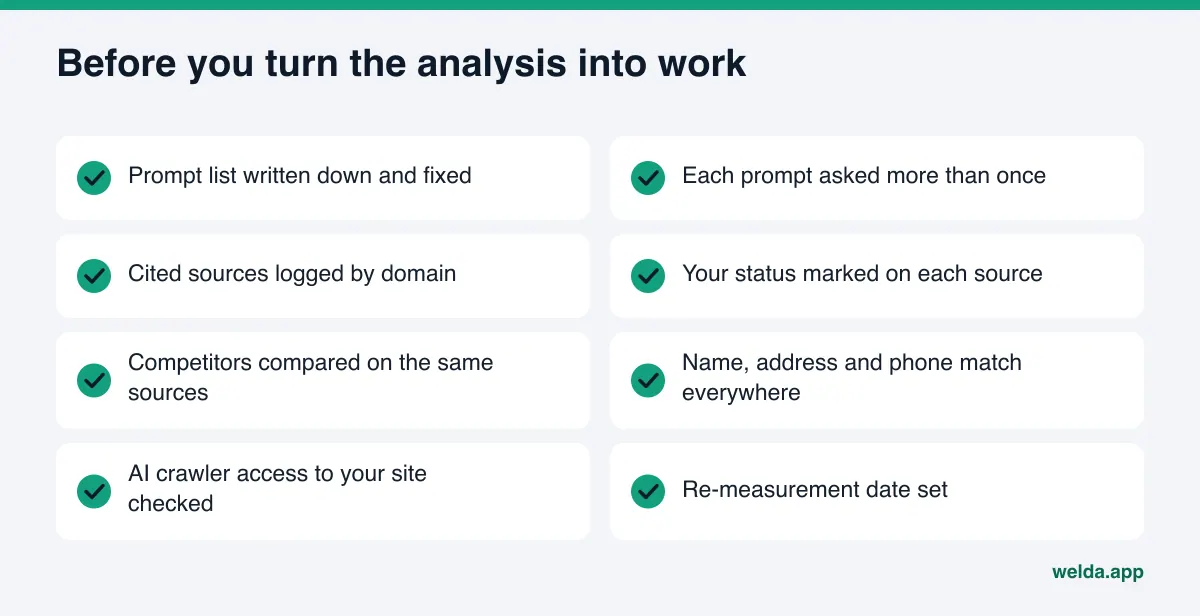
- The prompt list is written down and stays the same between runs.
- Each prompt was asked on more than one engine, more than once.
- Cited sources were logged with their domains.
- Sources are grouped by type, with your status marked on each.
- At least two competitors were compared on the same sources.
- Name, address and phone match across every source.
- AI crawler access to your own site was checked.
- The first month's work comes from sources you control.
- Changes are logged with dates, and a re-measurement date is set.
Frequently asked questions
Is citation gap analysis the same as competitor analysis?
No, but they work together. Competitor analysis shows who leads in AI answers. Citation gap analysis shows why: which sites the competitor gets cited from, and where you are missing.
If my website is in good shape, do I still need this?
Usually, yes. A large part of an AI answer can come from sources outside your site. Even with a strong site, an incomplete Google Business Profile or a missing listing on a frequently cited directory can keep you out of the answer.
Can I do a citation gap analysis manually?
Yes. Ask the prompts, log the sources in a spreadsheet, mark your status. The hard part is repetition: asking each prompt several times and redoing it every month takes real time.
How do I know which directories I should be on?
Measure, do not guess. Look at which sites get cited again and again for prompts in your category. The sources where your competitors stand out are usually the first list.
Will Welda create directory listings for me?
No. Directory and listing accounts stay with you. Welda drafts the descriptions and service text for those sources and lists the task as "do manually." You enter it.
Does Welda work for businesses in the US today?
The free site analysis works in English today. The full dashboard is in early access and is opening first in Turkey.
Start with your own site, then look at your sources
A citation gap analysis turns AI visibility from a vague goal into a work list. Once you can see which sites feed the answers, how you look on them, and where a competitor pulls ahead, the order of work becomes clear. The starting point is your own site: can crawlers get in, are your facts clear, are your profiles linked? Run the free site analysis to see that in a few minutes. The results link arrives by email and lists what to fix for every gap.