What is AI reputation management? It is the work of making sure that when a customer asks ChatGPT, Gemini, Perplexity or Google's AI Overviews about your business, the answer is accurate, current and fair. AI engines do not form opinions about you. They summarize what they read, so your reputation in AI answers is managed by fixing and filling in the sources they read.
For years, online reputation meant page one of Google. A customer typed your name, saw your Yelp rating, a BBB listing, maybe a news story and a Reddit thread, and made up their own mind. In an AI answer, the customer sees none of that directly. They read two or three sentences: "Customers like their work, but several reviews mention surprise fees." "They used to be located on Main Street." "Some people report it is hard to get an appointment." The answer rarely shows where each claim came from, and most people read it as the settled truth about your business. To see your starting point, you can run a free AI visibility analysis; it reads your site the way search engines and AI do and lists every gap, including reviews and trust signals.
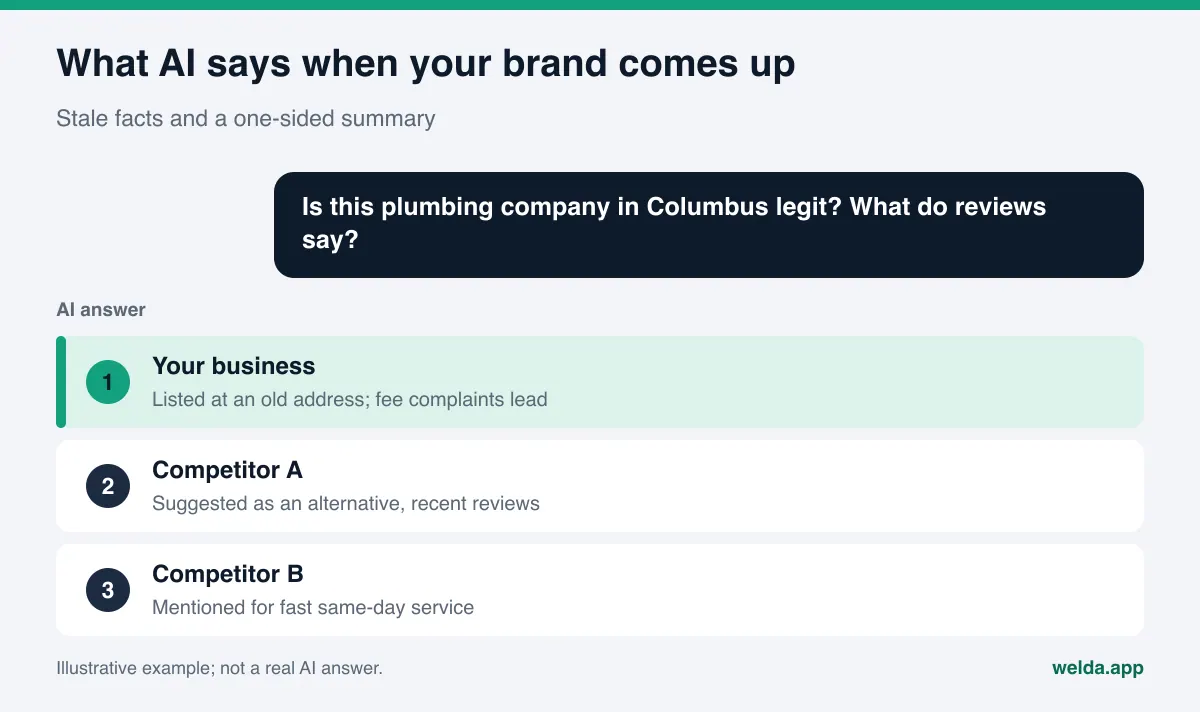
What does an AI reputation problem look like?
In practice, reputation problems in AI answers show up in four forms. Each has a different cause and a different fix, so the first job is to name which one you are dealing with.
- Stale facts. An old address, a closed location, outdated hours or a service you dropped years ago keeps appearing. The usual source is an old directory listing or an abandoned profile.
- A one-sided summary. A handful of complaints becomes the headline of the answer, even though most customers were happy. The engine simply did not find enough balanced information.
- Mistaken identity. Your business gets mixed up with a similarly named company in another town, and its reviews or problems get attached to you.
- Silence. When someone asks about your brand, you are barely mentioned, or the answer steers them to a competitor. That is a reputation problem too: the customer learns nothing about you.
The fourth one is the easiest to miss. Owners tend to fixate on a single negative sentence, but hearing a competitor's name in response to a question about your own brand is more common than most people expect. We cover that case separately in why competitors show up when AI is asked about your brand.
How is AI reputation management different from classic online reputation management?
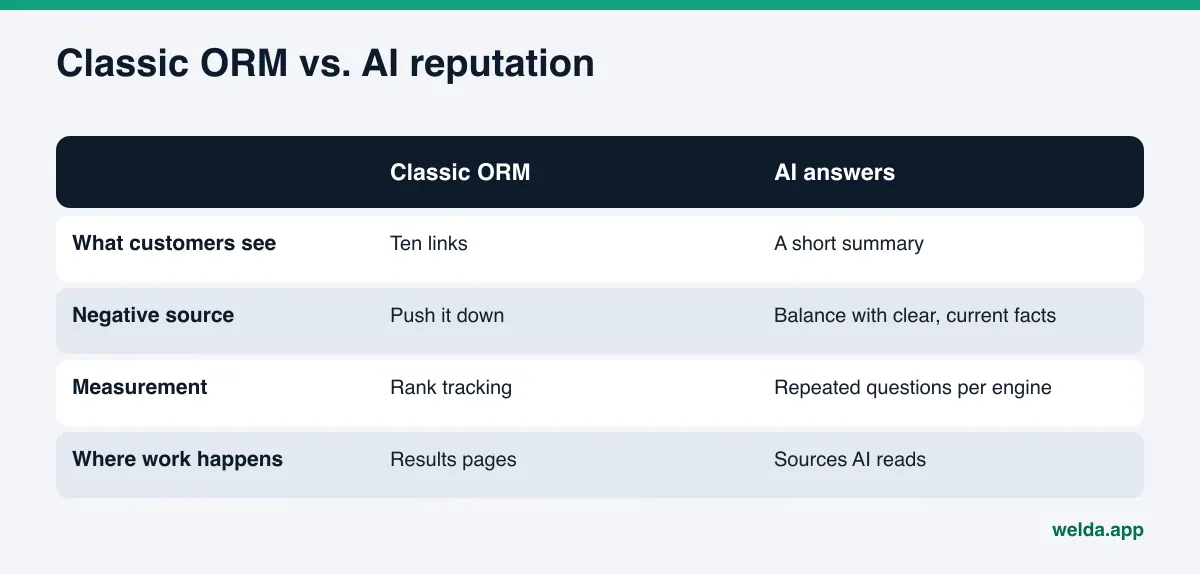
Classic online reputation management was about search results. If a negative link ranked on page one, you published or promoted positive pages until it slid down. AI answers do not work that way. Instead of a ranked list, there is a summary. The engine reads several sources, pulls out what they have in common and writes a paragraph. That creates three practical differences.
First, pushing a negative source down does not help. If the engine read it and nothing else contradicts it, the claim lands in the answer. What balances it is newer, clearer and more trustworthy information on the same topic. If the complaint is that pricing is confusing, the fix is a page on your own site that explains how your pricing works. Our guide on pricing questions in AI answers walks through that in detail.
Second, answers vary. The same question asked on different days, or on different engines, gives different answers. A negative sentence you saw once may not show up every time; a problem you never saw may appear regularly on another engine. A single screenshot is not evidence. Checking has to be repeated.
Third, the source pool is wide. For local and service businesses in the US, AI answers commonly draw on Google Business Profile and its reviews, Yelp, the Better Business Bureau, Reddit threads, industry directories such as Angi, Tripadvisor or Healthgrades depending on the field, local news and your own website. Nobody outside the engines knows exactly how each one is weighted for each question. What you can see is which sources are cited, and that is where the work starts.
| Topic | Classic reputation management | AI reputation management |
|---|---|---|
| What the customer sees | A page of ten links | A short written summary |
| Response to a negative source | Push it down the results | Balance it with clearer, current facts |
| How you measure | Rank tracking | Repeated questions, engine by engine |
| Where the work happens | Search results pages | The sources AI reads, plus your site |
| How fast it moves | Tied to ranking changes | New content usually takes weeks to show up |
A note on terms. In the US, the most common name for this broader field is AEO, answer engine optimization. You will also see GEO, generative engine optimization, which means essentially the same thing. AI reputation management is the part of AEO that deals with what the answer says about you, not only whether you appear.
How to audit what AI says about your business
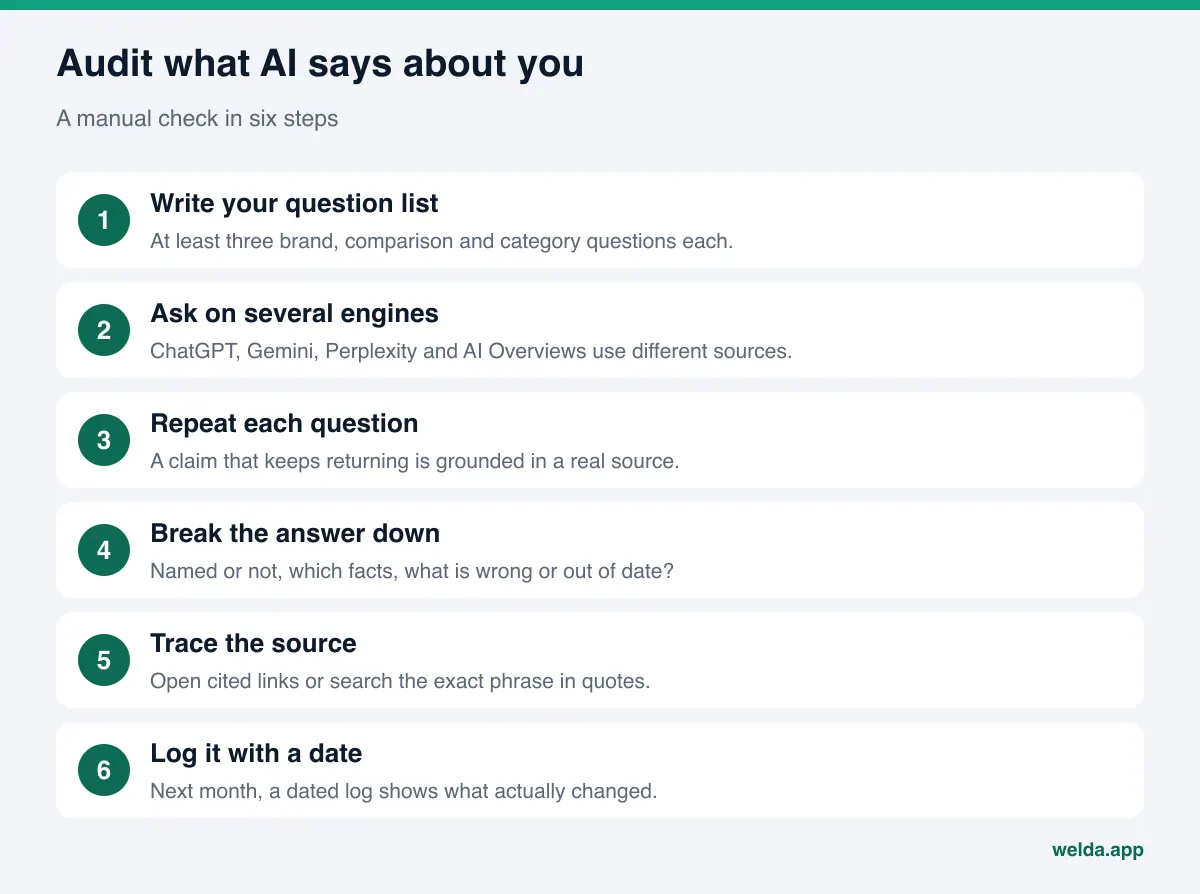
You can start without any tool. The only requirement is discipline. Work through the steps below in order.
- Write your question list. Split it into three groups: brand questions ("Is [business name] legit?", "What are reviews like for [business name]?"), comparison questions ("[business name] vs [competitor]") and category questions ("Best [service] near [neighborhood]"). Aim for at least three per group.
- Ask on several engines. ChatGPT, Gemini, Perplexity and AI Overviews in Google Search rely on different sources. A clean answer on one can be a problem on another.
- Repeat each question. One answer can be a fluke. A negative claim that keeps coming back is grounded in a real source.
- Break each answer into parts. Were you named? In what position? With which facts? What is wrong or out of date? Which sources are shown?
- Trace the source. Perplexity and AI Overviews often show links; open them. When no source is shown, search the exact phrase in quotes to find where it came from.
- Log it with a date. When you ask the same questions next month, a dated log is the only way to know what actually changed.
This manual audit is a fine starting point, but it does not scale well. Ten questions across four engines with three repeats each is 120 separate queries. Doing that every month, consistently, is not realistic for most small businesses.
How to fix a negative or inaccurate AI answer
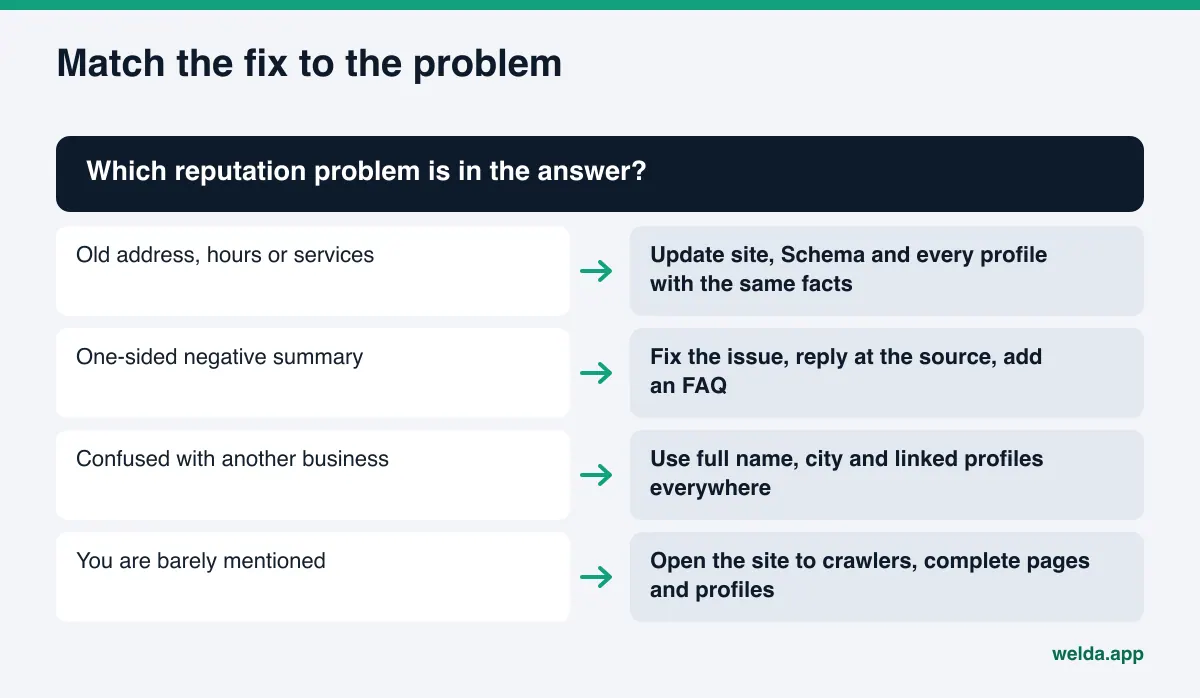
You cannot tell an engine to stop saying something. Every fix goes through a source. What you do depends on the kind of problem.
Stale or wrong facts
Start with your own website. Address, phone, hours and the list of services must be current and consistent everywhere on the site. Add your business details as structured data (Schema) so engines can match each fact to the right field. Then update your Google Business Profile, Yelp, BBB and any industry directory with exactly the same details. When the same information appears consistently in many places, an old listing carries less weight.
A one-sided or negative summary
There are two jobs here. The first is to look at the complaint itself. If it is fair, fix the underlying problem, then post a clear, signed reply on the platform where it appeared. A resolved, answered complaint on Yelp or BBB reads very differently from one that was ignored. The second job is to add balancing information: answer the questions customers keep asking in a plain FAQ section on your site, explain your process, describe each service clearly. We go deeper on replies in review responses for AI visibility.
Mistaken identity
If you are being confused with another business, make your distinguishing details unmistakable everywhere: full legal and trade name, city and neighborhood, year founded, service area. Linking your social accounts and your map listing from the business details on your site helps engines understand which records belong to you.
Silence
If nothing is said about you, the problem is missing information, not reputation. The job is to give engines more to read: make sure AI crawlers can access your site, describe each service on its own page, and complete your map and directory profiles.
An AI answer is a mirror. If the reflection looks bad, you fix the lighting, which means the sources. Trying to fool the mirror with fake reviews is not durable, and in the US it carries real legal risk.
The Federal Trade Commission's final rule on fake reviews and testimonials bans buying or creating fake reviews, including AI-generated ones, paying for reviews based on whether they are positive, and suppressing negative reviews through threats or intimidation. That last point matters here: AI reputation management is never about silencing critics. This is not legal advice. We summarize what that means for AEO in fake reviews rules and AI visibility. In short, reputation management means making real customer experience visible, not manufacturing experience that never happened.
Example scenario: a plumbing company with a stale reputation
The scenario below is an example. It does not describe a real business; it shows how the steps above fit together.
An example plumbing company moved its shop across town two years ago and changed its name slightly when a new owner took over. The owner hears from a customer that ChatGPT described the company as "possibly closed." A manual audit turns up the rest. On brand questions, two engines give the old address and one mixes up the old and new names. On a category question ("emergency plumber near me" for their area) the company is not mentioned. On a comparison question, one engine summarizes two old Yelp complaints about surprise after-hours fees.
Tracing the sources shows three things. Two directory listings still carry the old name and address. The Google Business Profile has the right address but an empty services list. On Yelp, both complaints about fees went unanswered. The company's own site has no pricing explanation and no FAQ.
The work then falls into a natural order. Fix the address, hours and services on the website and add the business details as structured data. Update or close the old directory listings. Fill in services on the Google Business Profile. Write signed replies to the Yelp complaints explaining how after-hours pricing works. Add an FAQ section on the site that answers the same question. None of these changes the answer by itself. Together, they make every source the engine reads say the same, current thing.
The owner in this scenario should not expect results in a week. Changes usually take weeks to show up in AI answers. Asking the same questions a month later, on the same engines, with the same number of repeats, is the only honest way to see what worked.
Which sources should you fix first?
Time is limited. Rather than fixing everything at once, set priorities. Two questions do most of the work: how often is this source cited in answers, and what is your status there?
| Situation | Priority | What to do |
|---|---|---|
| Frequently cited source, no profile or an incomplete one | High | Claim or complete the profile |
| Frequently cited source, unanswered complaints | High | Fix the issue, post a signed, clear reply |
| Your own site is blocked or unreachable for crawlers | High | Fix access first |
| Rarely cited source, outdated facts | Medium | Update the listing |
| Rarely cited source, status fine | Low | Check once a month |
Filling in the first column means knowing which sources actually appear in answers. In a manual audit you log them one by one. In the Welda panel, they are collected on a dedicated screen.
How Welda handles AI reputation management
Welda is software that measures where your business appears in AI answers and prepares the missing work on your behalf. Three parts of it matter most for reputation.
The sources view: where answers get their facts
The sources screen lists the sites that engines cite when they answer your customers' questions. Each row shows the source, its type (directory, review site, forum, social, your own site), how often it is cited and your status there: missing, incomplete, unverified or complete. Next to it is the recommended action. That is the priority table above, built for you. If a forum-type source shows you as absent, for example, the suggested action is a signed, transparent reply in the relevant thread. Welda drafts the text; whether to post it is your call.
The to-do list: ready-made text, your approval
Most reputation work happens on platforms only the account owner can access. Welda gathers it into one to-do list. For connected accounts (Google Business Profile, Instagram, Facebook), drafted text comes to you for approval. For platforms without a connection, the task is listed as manual with the text ready beside it: a profile description, corrected business details, a draft reply to a review. You copy, paste and mark it done.
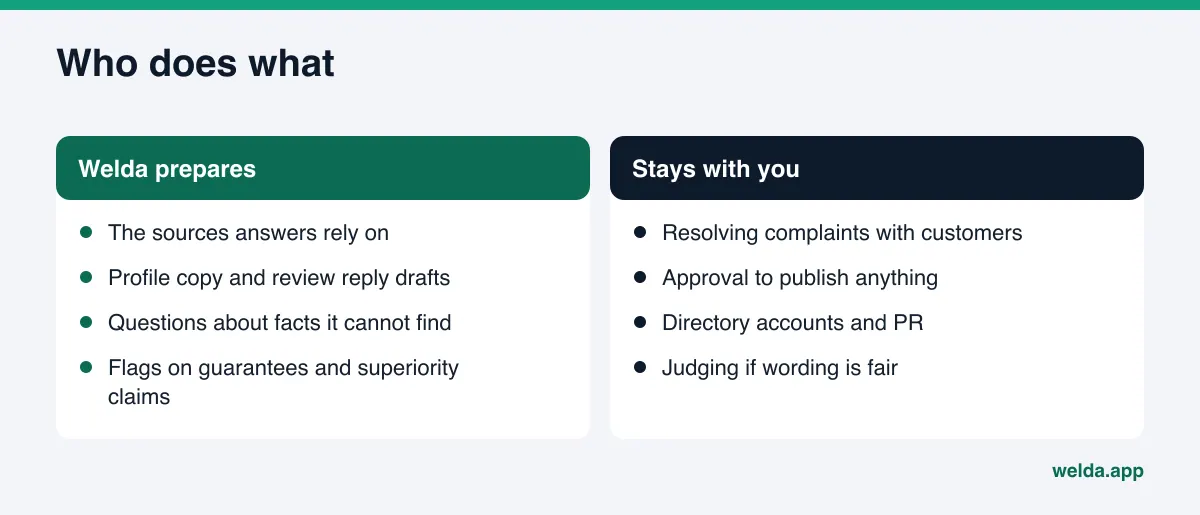
At the top of that list is a section for facts Welda could not read from your site. Welda does not invent what it does not know. It leaves the field blank and asks you. If a review reply needs the manager's name or a detail about a service, that field stays flagged until you fill it in. In reputation work, a made-up fact does more harm than a missing one.
Questions and compliance checks
The questions screen shows, for each brand, comparison and category question, which engines name you. Each question is asked three times on each of four engines, so you are not making decisions from a single answer, and a before and after view shows how the same questions shift once you make changes. A compliance check flags patterns such as price claims, guarantees and superiority claims in drafted text before anything is published, which helps keep a reply to an angry customer from turning into a promise you cannot keep. It is not legal advice.
About availability. The Welda panel is in early access, opening in stages and starting with businesses in Turkey. Regular four-engine measurement is being added during early access, and sample panel screens use representative data. The part anyone can use today is the free site analysis, which works in English. It reads your homepage and key inner pages, checks reviews and trust signals, whether your map and social profiles are linked from your site and whether you have an FAQ section, and it asks an AI assistant with web search five questions your customers might ask to see whether your name comes up. That is a one-time snapshot. Pricing is discussed in the early access conversation.
What Welda does not do
AI reputation management attracts a lot of big promises. Here is what Welda does not do.
- It does not delete negative answers. No tool can remove a sentence from an engine's answer. What can be done is fixing sources and adding balancing information.
- It does not guarantee results. There is no guarantee of a positive mention or a specific position in ChatGPT or anywhere else. The engines decide.
- It does not write fake reviews. It will not post reviews on anyone's behalf or suggest buying them.
- It does not manage negative reviews for you. It drafts replies, but resolving the complaint, talking to the customer and posting the reply stay with you.
- It does not run directory accounts or PR. Account access and press relationships are yours; Welda prepares text and lists.
- It does not publish without approval. Sensitive content, especially in healthcare, always goes to you first.
Timing matters too. New information on your site or a profile usually takes weeks to be reflected in AI answers, and the lag varies by engine and source. If the answer has not changed after a week, that does not mean the work failed. If your visibility dropped suddenly, our guide to why AI visibility drops lists the usual causes.
AI reputation management checklist
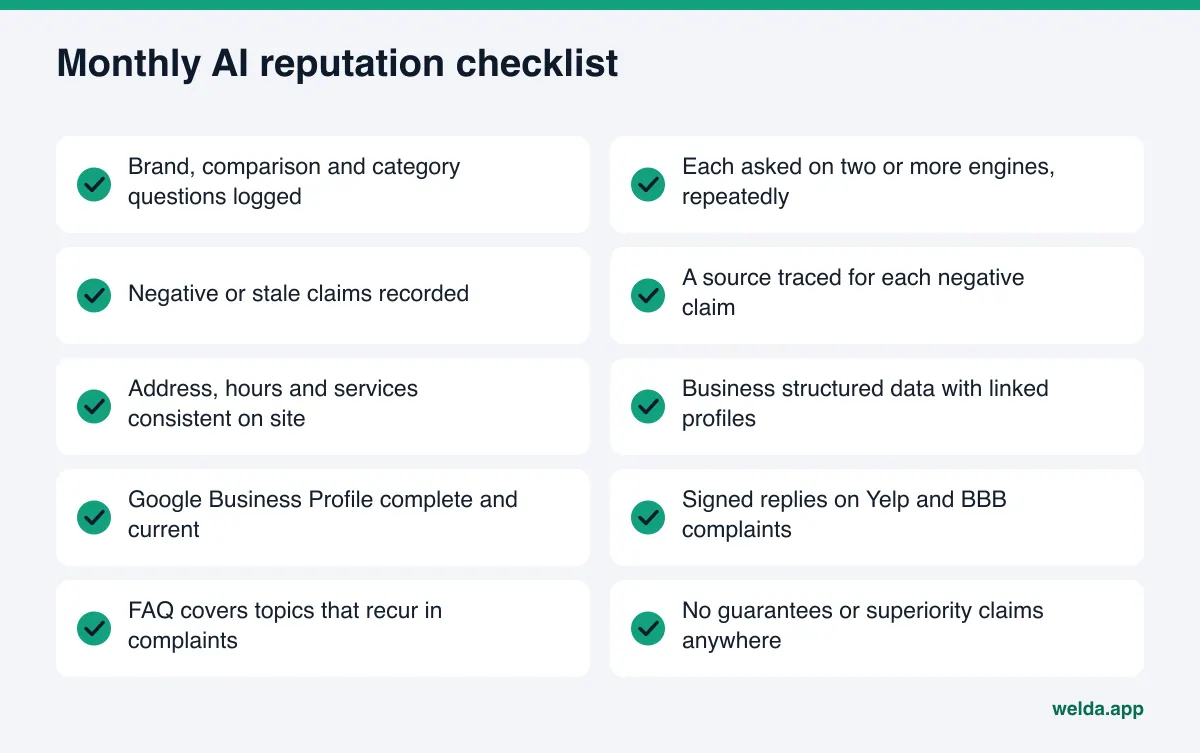
Run through this list once a month. Every unchecked item leaves room for an engine to say something wrong or incomplete about you.
- Brand, comparison and category questions are written down and dated.
- Each question was asked on at least two engines, more than once.
- Negative or stale claims about you are logged.
- A likely source has been traced for each negative claim.
- Address, phone, hours and services are current and consistent on your site.
- Business structured data is on the site, with social and map profiles linked.
- Google Business Profile is complete and current.
- Open complaints on Yelp, BBB and similar sites have signed, clear replies.
- Your FAQ answers the topics that keep showing up in complaints.
- No reply or page makes guarantees or superiority claims.
For the decision itself: if a negative claim shows up rarely and on one engine, manual tracking and a reply at the source are often enough. If it appears regularly across several engines, you need to fix many sources together and measure the result with repeats. That is the point where a tool earns its place, by keeping the measurement and the ready-made text in one place.
Frequently asked questions
Can I report a wrong AI answer to the engine?
Some engines let you leave feedback on an answer, but that does not mean the answer will change. The lasting fix is to correct the source of the wrong information and state the right facts clearly on your site and your profiles.
A negative Yelp review keeps appearing in AI answers. What should I do?
First decide whether the complaint is fair, and fix the problem if it is. Then post a calm, signed reply on Yelp. A resolved, answered complaint reads differently from an ignored one. If your site explains the same topic clearly, the engine has what it needs to write a more balanced summary.
How long does AI reputation management take to work?
There is no fixed timeline. New content usually takes weeks to show up in AI answers, and it varies by engine. That is why regular, repeated measurement matters.
Does Welda reply to reviews automatically?
Welda drafts replies. Approval to publish stays with you, and so do resolving the complaint and talking to the customer.
Does Welda measure whether answers are positive or negative?
The Welda panel shows which questions name you, in what position, where competitors lead and which sources the answers rely on. Judging whether the wording is accurate and fair to you stays with your business.
Does the free analysis measure my reputation?
It reads your site and checks reputation-related signals: reviews and trust signals, whether your map and social profiles are linked, whether you have an FAQ section. It also asks an AI assistant with web search five customer questions and shows whether your name appears. It is a one-time check and does not measure rankings.
Start by seeing what is being said
AI reputation management is the work of fixing and completing the sources AI engines read. There is no shortcut: you cannot delete an answer, and fake reviews will not balance it. But a clear website, current profiles and honest replies to complaints make answers more accurate and fair over time. As a first step, run the free AI visibility analysis and see in a few minutes how AI reads your site and which gaps affect how you are described.