Why did my AI visibility drop? Usually for one of three reasons: normal variation in how AI answers are generated, a change on your site that cut off AI crawlers, or a competitor that gained ground in the sources AI assistants rely on. Confirm the drop is real before you change anything, then look for the cause in a fixed order. Publishing more content at random rarely fixes it.
This guide is for business owners and marketers who noticed that ChatGPT, Gemini, Perplexity or Google's AI Overviews and AI Mode mention them less than they used to. In answer engine optimization (AEO), which some people also call GEO, a drop in AI visibility is a diagnostic problem before it is a content problem. Below you'll find a diagnostic sequence, a table that matches causes to symptoms, the on-site and off-site checks worth running, and what Welda shows you along the way. If you want a quick read on your own site today, the free site analysis checks whether AI crawlers can reach your pages and flags missing business details in one report.
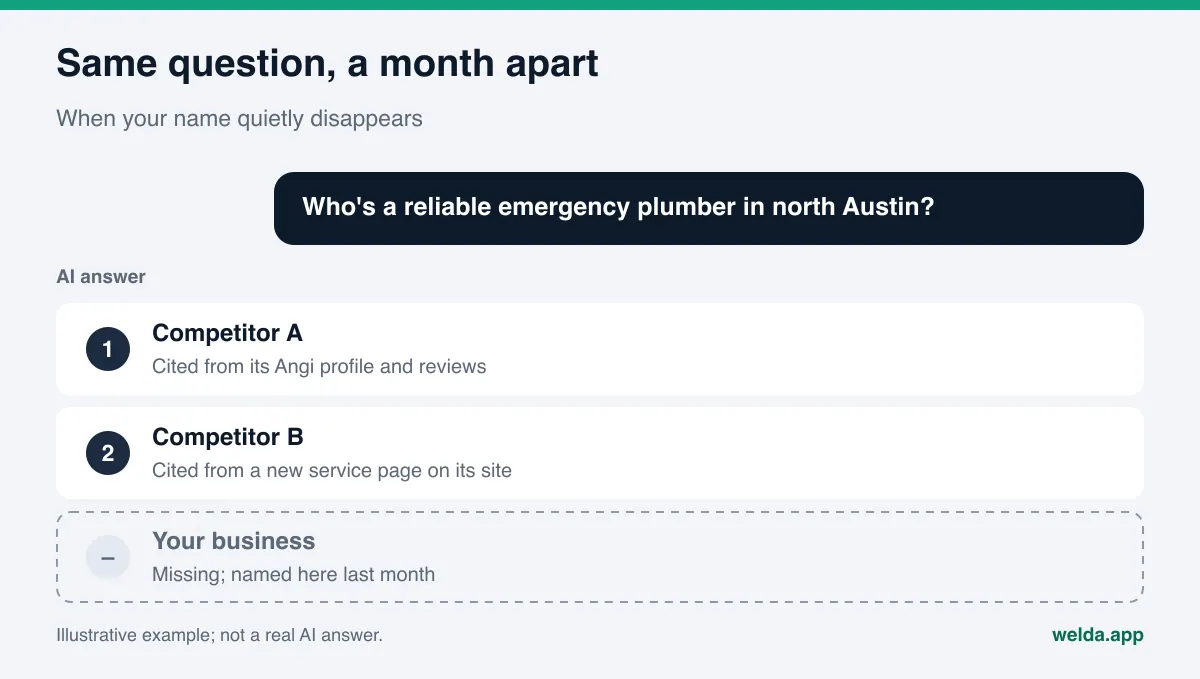
Did your AI visibility actually drop, or is it noise?
AI answers are not fixed. Ask the same assistant the same question twice and you can get two different lists. One run names three businesses, the next names four. Positions shuffle. So a question that named you last week and doesn't name you today is not, by itself, proof of a decline.
To separate a real drop from ordinary variation, check three things:
- Were the same questions asked? If new questions were added to the list, or old ones removed, the two measurements are not comparable. New questions are often about topics you haven't prepared for, so they pull the average down.
- Was each question asked more than once? A single try can't capture how much answers vary. When each question is repeated, you get an average and a spread. If the change sits inside that spread, it's noise, not a drop.
- How long has it lasted? One low reading can bounce back next time. A line that moves the same way across two or three measurements points to something real.
We cover cadence in detail in how often to measure AI visibility. The short version: catching a drop takes regular measurement against the same question list. Typing a few questions into ChatGPT now and then gives you an impression, not a measurement.
A worked example
Picture an example dental practice in a mid-sized US city. Its score was 44 a month ago and reads 38 this week, with a margin of error of ± 4. A 6-point change, a bit larger than the margin, looks like a decline. But last week someone added seven new questions about Invisalign and sedation dentistry. Remove those seven and the score is 43. The practice's standing on the original questions hasn't moved; the scope of the measurement has. The job here is not to "fix the drop" but to prepare content for the new topics. These numbers are illustrative and don't belong to any real business.
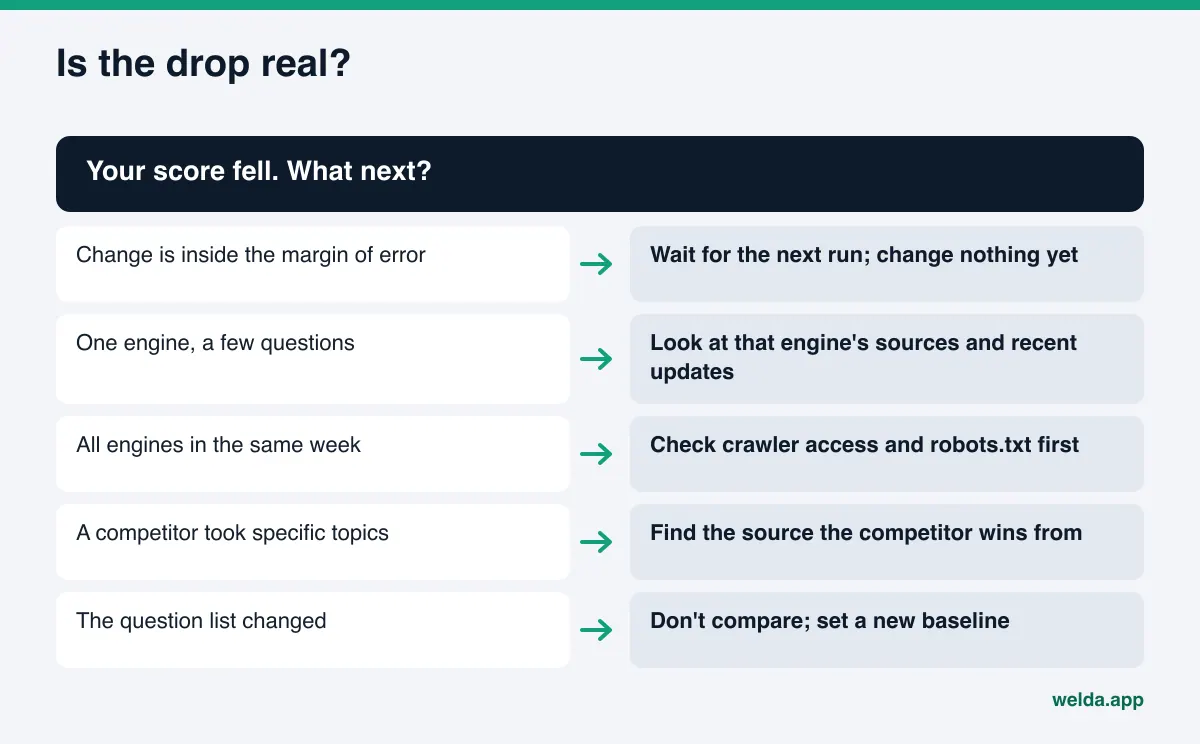
Why AI visibility dropped: the seven usual causes
If the measurement shows a real decline, the cause almost always falls into one of the groups below. The table pairs each cause with its typical symptom and the first place to look.
| Cause | Typical symptom | Where to look first |
|---|---|---|
| AI crawlers can't reach the site | Every engine drops the same week; citations to your own site disappear | robots.txt, CDN and firewall bot settings |
| Redesign or new URLs | Citations to old pages vanish; service questions stop naming you | Redirects, removed pages, missing Schema |
| Pages dropped out of the index | Decline concentrated in Google AI Overviews and AI Mode | noindex and nosnippet tags, Search Console |
| Inconsistent business details | Named with an old address, old phone or old name | Google Business Profile, Yelp, BBB, site footer |
| A competitor moved ahead | Competitor named on specific topics where you used to be | The source and page the competitor is cited from |
| Reviews and reputation shifted | You're still named, but with a caveat or complaint | Google reviews, Yelp, BBB complaints, Reddit threads |
| The engine itself changed | One engine moves, and competitors move with you | Which source types that engine now cites |
The first three live on your site and usually come from a change someone made without thinking about AI crawlers. The last four live off your site and tend to develop more slowly. We'll take them in that order.
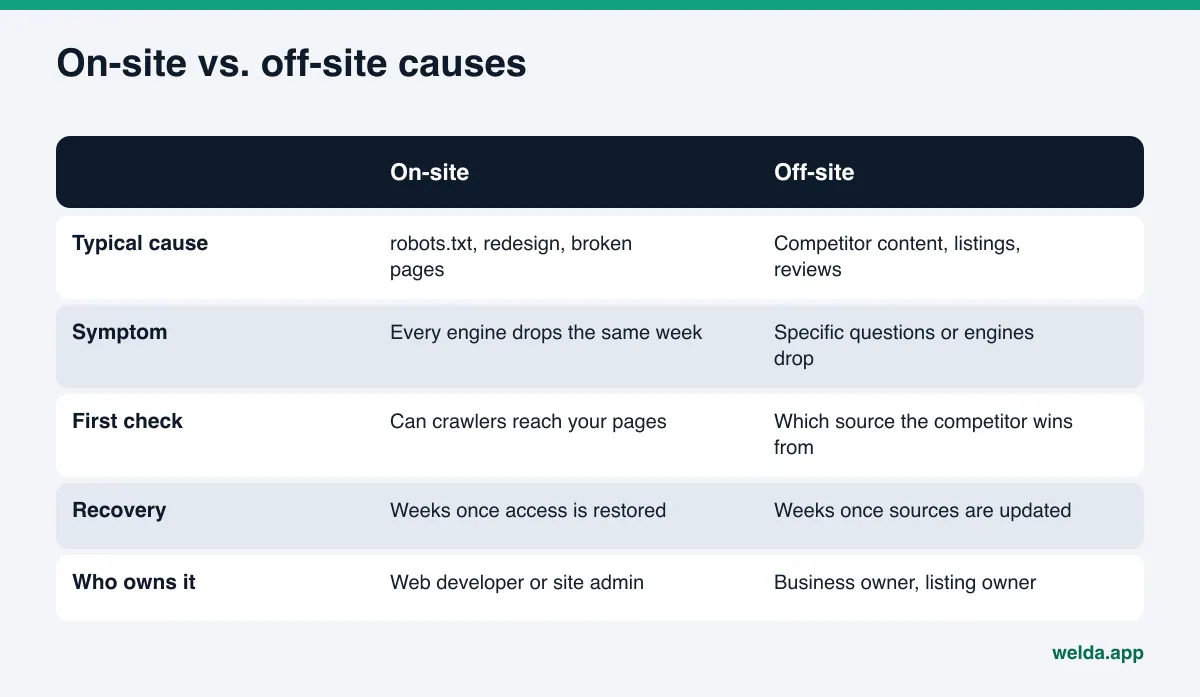
On-site causes: what breaks when nobody is looking
A sharp decline that starts in the same week across every engine points to your site first. AI assistants that search the web need to read your pages before they can cite them.
robots.txt and crawler blocks
The robots.txt file at the root of your domain tells crawlers which pages they may visit. A redesign, a plugin update or a security change can add lines that block AI crawlers, and those lines aren't always written on purpose.
Two distinctions matter here. According to OpenAI's crawler documentation, OAI-SearchBot is what surfaces sites in ChatGPT's search features, and sites that opt out of it won't appear in ChatGPT search answers. GPTBot is for training OpenAI's models, and blocking it is a separate decision from search visibility. The same page notes that robots.txt changes can take about 24 hours to take effect for search. On the Google side, Google's crawler documentation says the Google-Extended token does not affect a site's inclusion in Google Search; it controls use for Gemini model training and grounding in some Gemini products.
In practice, one "block all AI bots" rule can cut off search as well as training. Opening your robots.txt and reading which user agents are disallowed takes minutes and rules out one of the most common causes on the spot.
CDN and firewall settings
A clean robots.txt doesn't guarantee access. Your CDN or web application firewall can stop crawlers at another layer. Cloudflare, for example, announced on July 1, 2025 that it would block AI crawlers accessing content without permission by default. If you moved your site behind a CDN after that, or rebuilt your security settings, check which bot option you ended up with. Which crawlers you allow is your call. The point is to make that call deliberately rather than inherit it from a default.
Redesigns, new domains and missing pages
A new website often loses things nobody listed in the project brief: redirects from old URLs, separate pages for each service, the FAQ section, and the Schema markup that describes the business in machine-readable form. If AI answers used to cite those pages, the citations go when the pages go. Pull a list of your old URLs from your analytics or Search Console and check that each one either loads or redirects to the right new page.
Slow pages produce a similar effect when crawlers time out before reading the content. We look at that separately in site speed and AI crawlers.
noindex and nosnippet
Google's guidance on AI features and your website says a page must be indexed and eligible to be shown in Google Search with a snippet to appear as a supporting link in AI Overviews and AI Mode. A noindex tag left over from a staging site, or a nosnippet directive added by mistake, can cause a sudden drop that shows up mostly on the Google side.
Off-site causes: sources, competitors and reviews
When the decline is limited to certain questions or one or two engines, the cause usually sits off your site. AI assistants don't recommend a business based on its website alone. They read Google Business Profile, Yelp, Angi, Healthgrades, Tripadvisor, BBB, local news sites and forums together.
A competitor showed up in a new source
If a competitor got listed on an industry directory, earned a mention in local news, or added a page that answers your customers' questions better, you can slip down simply because an AI answer only has room for a few names. The useful question isn't "what did the competitor do" in general. It's which question they moved ahead on, and which source the answer cites. We explain how citations work in how to get cited by AI.
Your business details went out of sync
If you moved, rebranded or changed your phone number and the update didn't reach every listing at once, AI assistants struggle to reconcile two versions of your business. Sometimes you're named with the old address; sometimes not at all. There's a full checklist for that situation in updating AI answers after a rebrand or move.
A new complaint or thread changed the tone
Sometimes your name keeps appearing but the answer changes: a line like "some customers mention long wait times" gets added, and the assistant puts you last or recommends someone else first. Unanswered complaints on Google, Yelp or BBB, or a critical Reddit thread, can do this. We cover the response in negative reviews in AI answers.
The engine changed
AI companies update their models and search infrastructure from time to time, and an engine may start favoring different source types afterward. The tell: the decline shows up in one engine only, and your competitors' numbers move in the same week. Rewriting your site in a hurry won't help much. Looking at which sources that engine now cites will.
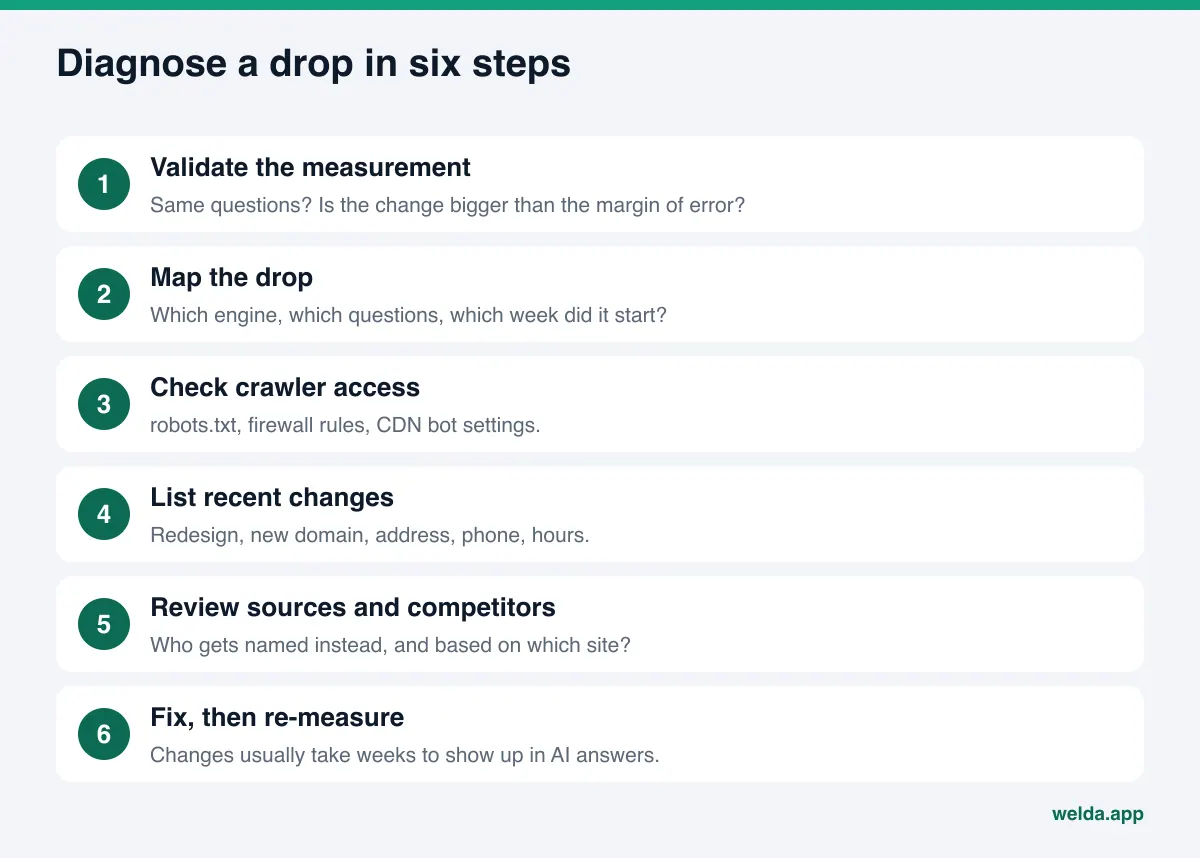
What to do when AI visibility dropped: step by step
This order rules out the cheapest and most common causes first. Each step ends with a decision. Once you've found a cause that fits, you don't need to run the rest.
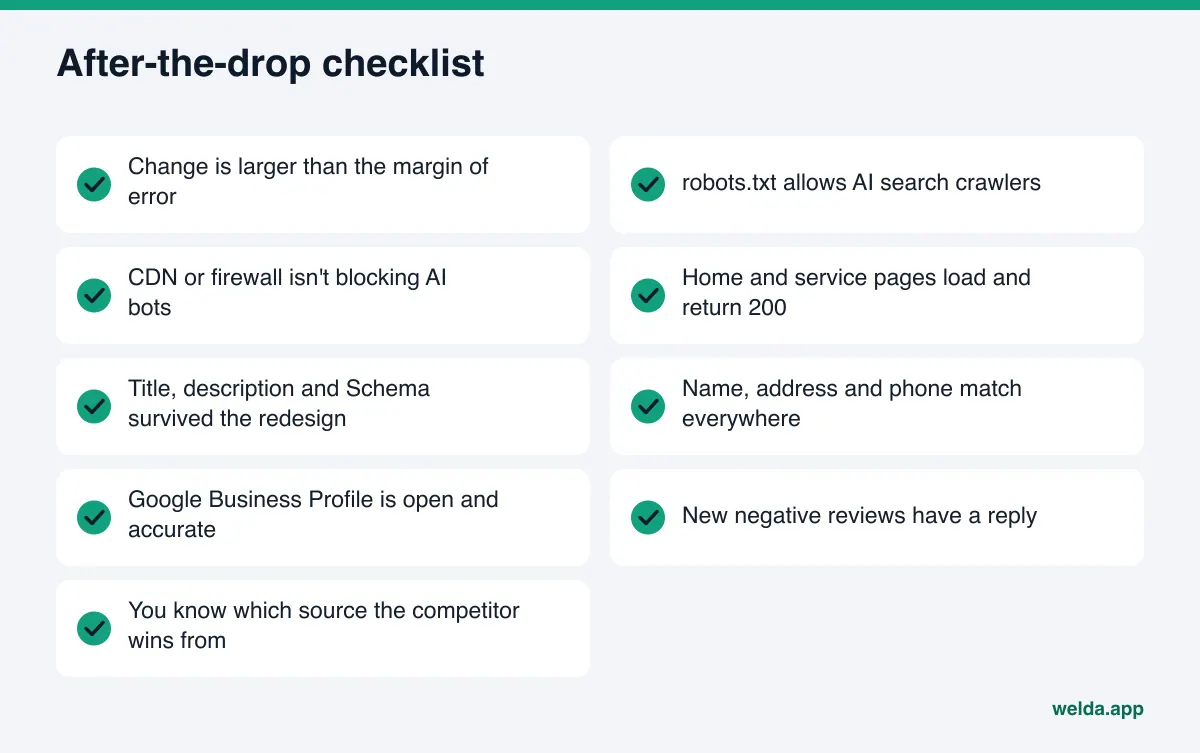
- Validate the measurement. Were the same questions asked in both runs? Is the change bigger than the margin of error? If not, wait for another run.
- Map the drop. Which engine, which questions, which week? All engines or one? Every question or a specific topic?
- Check crawler access. Open robots.txt and see whether search crawlers like OAI-SearchBot or PerplexityBot are disallowed. Then check CDN and firewall bot settings.
- List recent changes. What changed in the two or three weeks before the drop: site, domain, address, name, phone, hours? Ask whoever manages your website too.
- Open the key pages yourself. Home, services, pricing, about and contact. Do they load? Are the title, description, main heading and Schema still there?
- Review sources and competitors. On the questions you lost, who gets named instead, and based on which site? Do you have a current profile on that site?
- Fix, then re-measure. Access fixes can show up sooner. New content and updated listings usually take weeks to be reflected in AI answers.
How Welda helps when AI visibility dropped
Diagnosing a drop takes two things: a measurement you can trust and enough detail to see where the drop began. Welda puts both in one place. Here are the three parts that matter most for this job.
The visibility view: is the drop real?
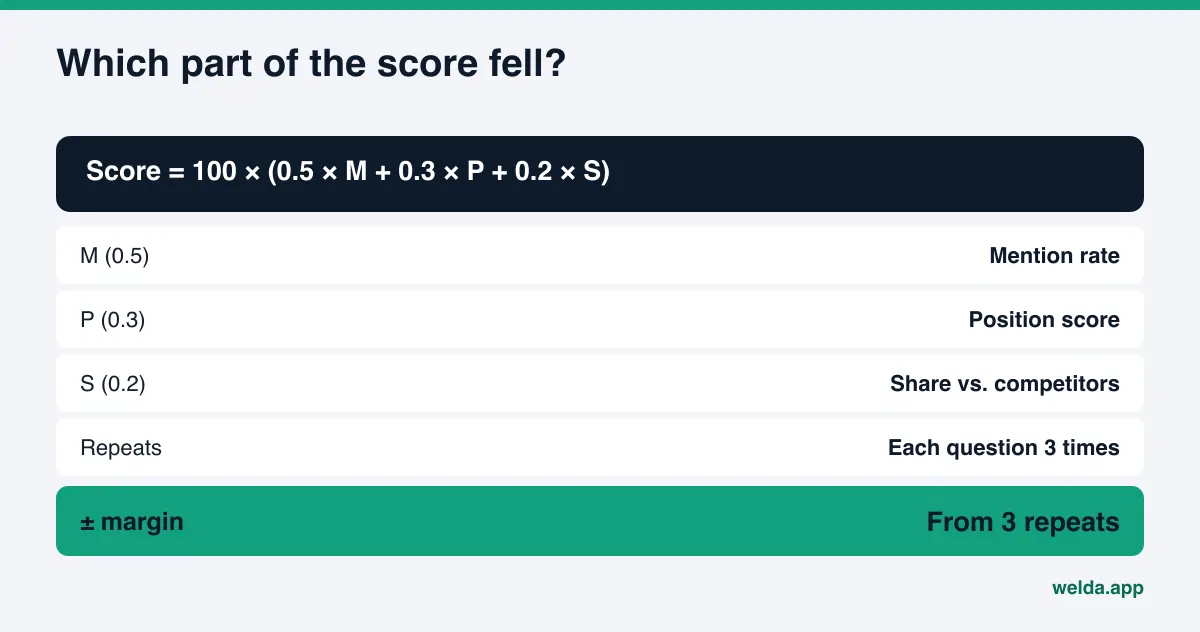
In the Welda panel, the questions your customers are likely to ask are sent to ChatGPT, Gemini, Perplexity and Google AI three times each per measurement. Next to the score sits a ± margin of error calculated from how much those three runs differ. If the score fell 3 points and the margin is ± 4, the panel says so plainly: this is within the noise. That keeps you from rebuilding pages every time the number wiggles.
The same view shows the score over time and broken down by engine, so a break that hits every engine in the same week looks very different from a dip in one. A list of what changed this week shows, question by question and engine by engine, where your name newly appears or no longer does.
Because the formula is public, you can also read which part of the score moved. If the share of questions naming you fell, you've become less visible. If that share held but the position score fell, you're still named, just further down. If share versus competitors fell, someone moved ahead. Each case calls for a different fix.
Sources and competitors: why did it drop?
The sources view lists the sites AI assistants cite when they build answers and shows your status on each. During a drop, the most important row is often your own site. If it can't be reached, that row turns red and the to-do is to fix access. A robots.txt or firewall problem usually becomes visible here first.
The competitors view helps when the drop is topic-specific. It shows which questions a competitor wins and which source the answer leans on. Instead of a vague "a competitor is ahead," you get something you can act on, for example: on family-friendly questions the competitor is cited from a directory profile, and yours there is incomplete.
To-dos and before/after: what changed after the fix?
Fixes land in a single to-do list. Welda drafts corrected copy, listing descriptions and review replies; publishing stays your decision. On WordPress sites it connects through a separate Editor user and an application password, so drafts appear on your site for approval. Where there's no connection, you get a ready-made package and apply it yourself. Changes like editing robots.txt or a CDN setting fall into that second group: Welda tells you what to change, and whoever runs your site makes the change. A before/after comparison then shows which questions responded, and a one-page monthly PDF report makes it easy to share with a partner or manager.
A clear note on availability: the Welda panel is in early access and is opening first in Turkey. Regular four-engine measurement is being added during early access, and sample panel screens use representative data. What anyone can use today is the free site analysis, which works in English. It reads your home page and a few inner pages, checks whether AI crawlers are allowed in robots.txt, and reviews your title, description, Schema, contact details and FAQ. It also asks an AI assistant with web search five questions your customers might ask and shows whether your business is named. It's a one-time check, free once per site, so it won't replace ongoing tracking, but it surfaces on-site breakage fast. Pricing is discussed in an early access conversation.
Limits: what Welda won't do
The sentence a business wants to hear after a drop is "you'll get your spot back." Nobody can say that honestly. Here is where Welda draws the line:
- No guarantees. No promised score, position or "showing up in ChatGPT." No tool controls AI answers.
- No guessing. If a fix needs information Welda doesn't have, such as a new address, new hours or a changed service, it asks you instead of making it up.
- No publishing without approval. Every draft goes through you. In healthcare there is no automatic publishing at all.
- No fake reviews. For a reputation-driven drop, Welda drafts replies. It doesn't write reviews.
- Some work stays with you. Fixing the issue behind negative reviews, logging into directory accounts, press outreach, and changing robots.txt or CDN settings belong to the business or its web team.
- Recovery takes time. After access is restored or new content goes live, it usually takes weeks to show up in AI answers. After an engine update, the timing is even less predictable.
Decision table and checklist after a drop
Not every drop deserves the same urgency. Use this table to decide how fast to move.
| Situation | Urgency | Decision |
|---|---|---|
| Change within the margin of error | Low | Change nothing; wait for the next measurement |
| Sudden drop on every engine | High | Same day: check crawler access and that pages load |
| Drop right after a redesign | High | Restore removed pages, redirects and Schema |
| Competitor ahead on specific topics | Medium | Claim the source profile; build a page for that topic |
| Tone of answers turned negative | Medium | Reply to complaints; fix the underlying issue |
| One engine, competitors moving too | Low | Watch two or three runs; review that engine's sources |
Frequently asked questions
Why did my AI visibility drop so much in one week?
A sharp one-week drop is usually either measurement noise or a site change that blocked crawlers. Check whether the change exceeds the margin of error, then check robots.txt and your CDN or firewall. Competitor and source-driven declines tend to build more slowly.
Will blocking GPTBot hurt my visibility in ChatGPT?
Per OpenAI's documentation, GPTBot is for model training, while OAI-SearchBot determines whether you appear in ChatGPT search answers. You can block one and allow the other. Problems usually come from a single rule that blocks every AI crawler.
My Google rankings held, but AI answers dropped me. Is that possible?
Yes. AI answers combine many sources and behave differently from a list of ranked links. We dig into that gap in ranking first on Google but not in ChatGPT.
How long until I recover after a fix?
There's no fixed timeline. Access fixes can show up sooner; new content and updated listings usually take weeks. Plan to track several measurements after the change before judging it.
Will the free analysis tell me why my visibility dropped?
It covers most on-site causes: whether crawlers can get in, and whether your title, description, Schema and contact details are in place. Competitor and source-driven causes need regular measurement and source tracking, which is what the Welda panel is for.
The drop is only in one engine. Should I worry?
If your competitors moved the same week, the engine itself probably changed. Watch two or three measurements and look at which sources it now cites. If only you dropped, check your standing on the sources that engine relies on.
Your next step
When AI visibility dropped, the first job is confirming that AI crawlers can reach your site and that your core business details are intact. Run the free site analysis: it checks robots.txt, title, description, Schema, contact details and FAQ in one report, explains how to fix each gap, and shows whether five customer questions name your business. For ongoing measurement and source tracking, you can also ask to join the Welda panel's early access.