Why do negative reviews show up in AI answers, and what can you do about it? ChatGPT, Gemini, Perplexity and Google's AI Overviews describe a business by summarizing what they read on review sites, maps and complaint platforms. Complaints that repeat and go unanswered make it into that summary. You cannot delete reviews, but you can fix the underlying problem, reply in public, state the facts clearly on your own site, and make recent customer experience visible.
When a customer asks an AI assistant "Is there a trustworthy dentist in South Austin?" or "Does this hotel have a lot of complaints?", the answer is usually a single paragraph. If that paragraph names you next to "some patients mention long wait times," that sentence shapes the decision. This guide explains how negative reviews in AI answers come about, which parts are in your hands, and what Welda does in the process. In the US the work of improving how AI assistants describe and recommend you is usually called AEO, or answer engine optimization; you may also see it called GEO (generative engine optimization), which describes the same goal. To see how your own site reads to AI today, start with a free AI visibility analysis. Reviews and trust signals on your site are among the things it checks.
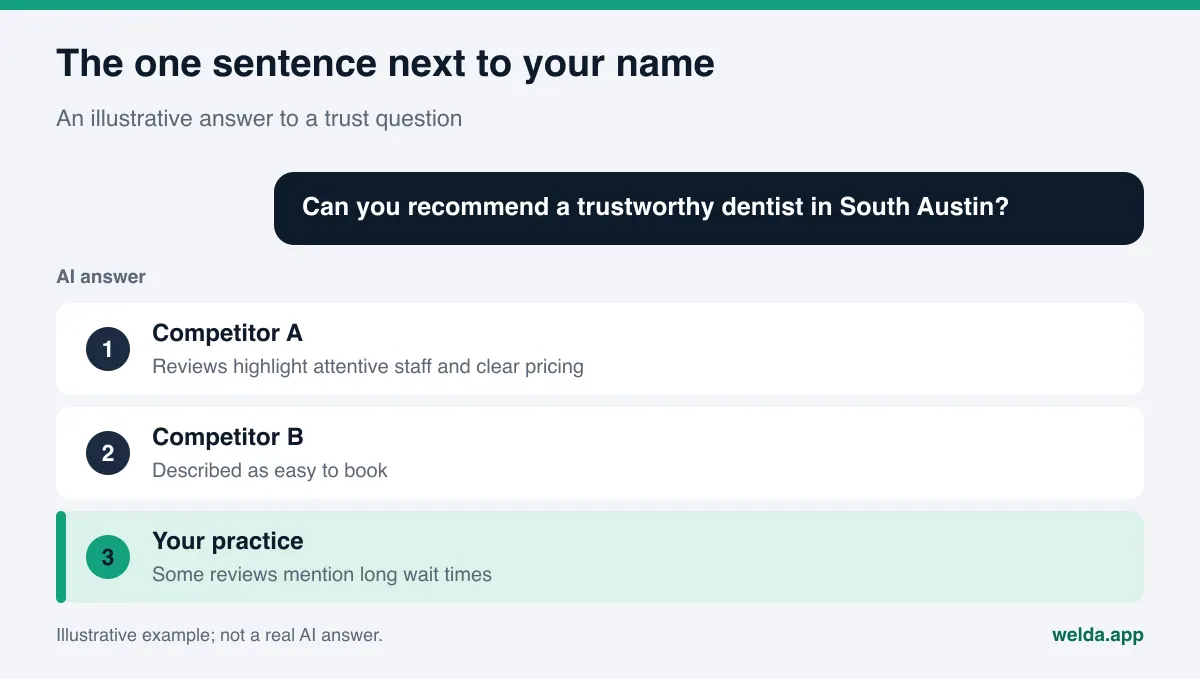
How negative reviews end up in AI answers
When a question is about a specific business, AI engines draw on two kinds of information. The first is what the model learned earlier from the open web. The second, for engines that can search, is what they find at the moment of the question: your Google Business Profile and its reviews, Yelp, Tripadvisor, the Better Business Bureau, Healthgrades, Angi, Reddit threads and local news. The engine reads those sources, condenses them and writes one answer.
Condensing is the part that matters. The assistant does not quote a hundred reviews. It pulls out recurring themes: "friendly staff," "pricey," "hard to get an appointment," "slow to call back." A complaint that appears once rarely makes the cut. The same complaint from different people, on different sites, within the last few months, is far more likely to become a sentence in the answer.
So the issue is not only your star rating. A business with a 4.6 average can still be described as "though some customers mention surprise fees on the final bill" if that one theme keeps coming back. The reverse also holds: a business with a few harsh reviews that it answered, resolved, and explained on its own site tends to be described in a more balanced way.
Why this matters for your business
In a classic search, a customer opens a review page, checks the rating, reads a handful of reviews and forms an opinion. In an AI answer, the engine does that reading and hands the customer a verdict. Many people never click through to the sources. A two-sentence summary in response to "any complaints about this clinic?" becomes the first, and sometimes the only, impression of your business.
Negative themes also affect answers that are not about you specifically. For comparison questions like "best boutique hotel in Savannah," an assistant may favor a competitor with fewer visible complaints, or leave you off the list entirely. Negative reviews shape both how you are described and whether you are mentioned at all.
Which review sources AI engines read in the US
Which sources carry weight changes by engine and by question, and the same question can produce a different answer on another day. We explain why in why AI answers change every time. Still, for US businesses the places where complaints tend to live are predictable.
| Source | What AI sees there | What you can do |
|---|---|---|
| Google Business Profile and Maps | Rating, review text, owner replies, review dates | Reply to every review, keep details current, flag reviews that break policy |
| Yelp | Rating, review text, recency | Claim the page, keep details accurate, reply where appropriate |
| Better Business Bureau | Complaints, business responses, resolution status | Respond to complaints and document how they were resolved |
| Industry sites (Tripadvisor, Healthgrades, Angi) | Category-specific ratings and reviews | Complete the profile and respond to reviews |
| Reddit and local forums | Long first-hand stories, older threads | Where it fits, a calm, signed, factual comment |
| Your own website | Services, pricing clarity, cancellation and refund terms, FAQ | State clearly the facts that complaints are about |
The last row is the one owners forget. Many complaints come from mismatched expectations: "no parking," "charged a cancellation fee," "price was different from the phone quote." If your site says nothing on those topics, AI learns about them only from complaint sites. If your site has a clear answer, the engine at least sees both sides. We cover how to turn those questions into a page in FAQ pages for AEO.
Google's help center on managing customer reviews explains that a business must be verified before it can reply, that replies are checked against content policies and appear publicly under the review, and that the reviewer is notified and can still update the review. That last point matters: a good reply sometimes leads to an updated review.
Four reasons a complaint makes it into the answer
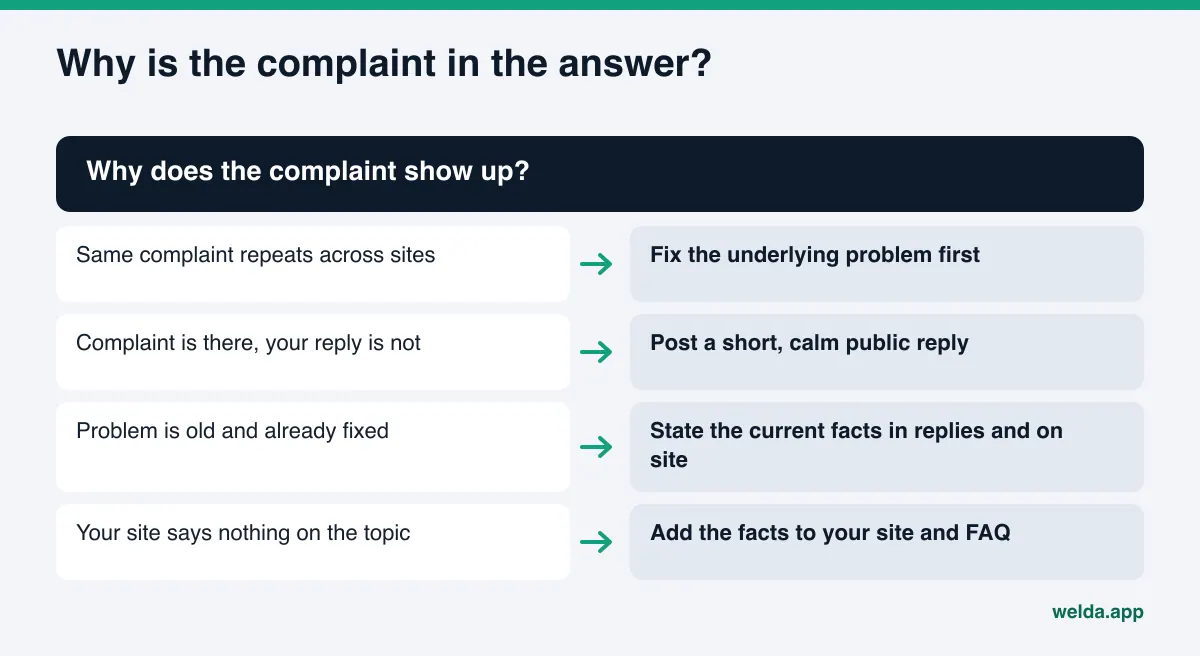
To fix your situation you first need to know why the complaint is there. In practice, four patterns account for most cases.
- A recurring theme. The same complaint comes from different people on different sites. AI summarizes it as a trait of the business. The real fix here is the problem itself, not the reply.
- An unanswered complaint. The complaint is there and your side is not. The engine sees one perspective. A complaint that was answered and resolved reads differently to people and to AI.
- Outdated information. A problem from years ago (an old location, a discontinued service, a previous owner) still sits on the most visible source. When current information is thin, the old story wins.
- Missing counter-information. Your site and profiles say nothing about the subject of the complaint. Where pricing, timelines, cancellations or warranty terms are vague, complaints fill the gap.
Each of these calls for different work. A common mistake is to address one and ignore another, for example writing careful replies to every review while the problem those reviews point to stays in place.
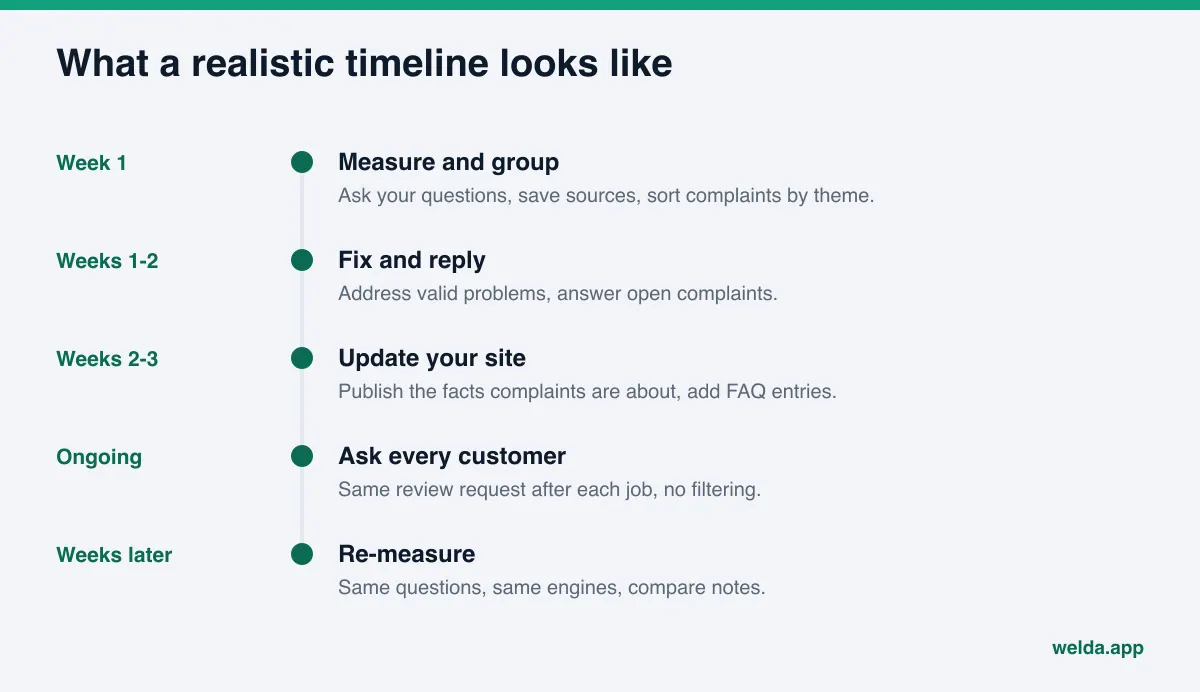
Step by step: reducing the impact of negative reviews in AI answers
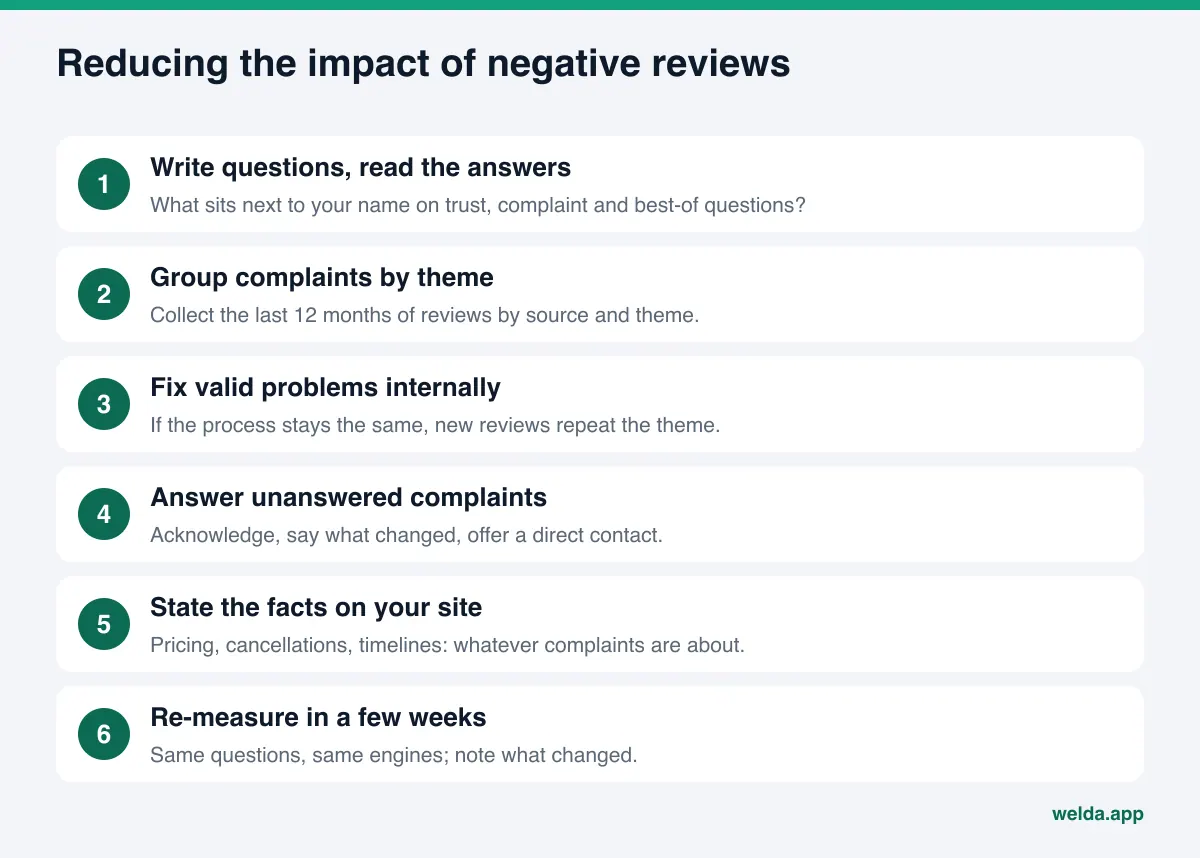
The sequence below is something a small or mid-size business can run on its own. The goal is not to hide reviews. It is to bring the picture AI sees closer to how your business actually operates today.
- Write down the questions customers ask. "Trustworthy [service] in [neighborhood]," "[your name] complaints," "[your name] reviews," "best [service] near [city]." Ten to twenty questions is enough. Include some with your name and some without.
- Read the answers and take notes. Ask each question on a few engines. Note whether you are named, and which positive and negative phrases appear next to your name. Save the source links the engine shows.
- Group complaints by theme. Collect the last twelve months of reviews from each source and count them by theme: wait time, pricing clarity, staff, cleanliness, communication. The themes in AI answers usually match the themes in your reviews.
- Sort each theme into three groups. Valid and ongoing, valid but already fixed, and reviews that break platform policy or do not reflect a real experience. Each group needs different handling.
- Fix the valid problems internally. This is the shortest step to describe and the most important. If the process, the pricing information or the way you communicate stays the same, new reviews will keep carrying the same theme.
- Reply in public. Start with unanswered complaints on Google Business Profile, Yelp and the BBB. Keep replies short: acknowledge the issue, say what changed, and offer a direct way to reach you.
- Put the matching facts on your site. If complaints are about price, explain what drives the price. If they are about cancellations, publish the policy. If they are about wait times, describe how scheduling works. An FAQ section is a natural home for this.
- Flag reviews that break policy. Only real violations, with a short, specific reason.
- Ask real customers for reviews. Ask everyone after service in the same way, without filtering for happy customers. Incentives tied to positive reviews can break both platform rules and federal rules.
- Measure again after a few weeks. Ask the same questions on the same engines. Changes usually take weeks to show up, not days.
How to write a review reply that AI will also read
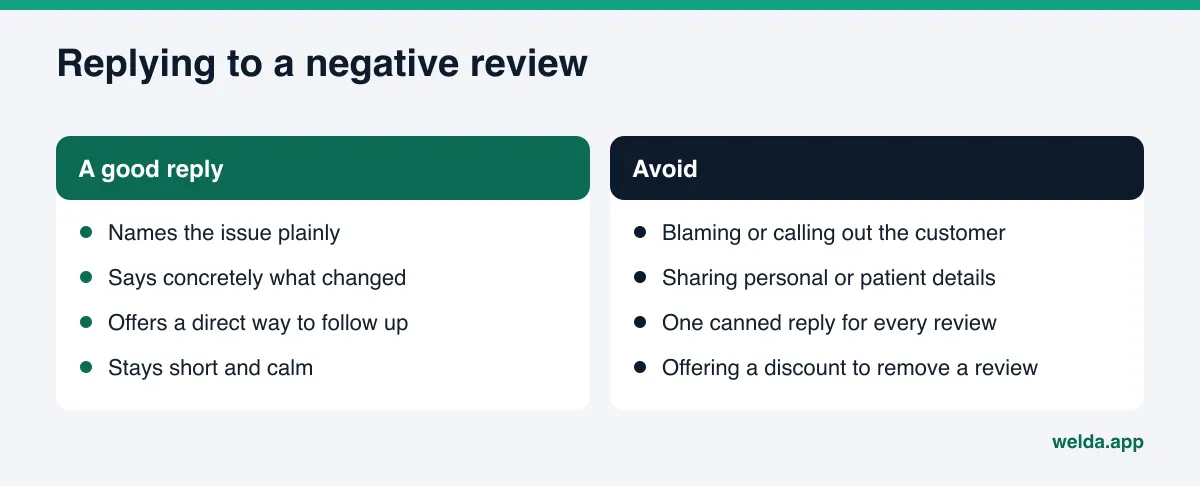
Your reply now has two readers: the customer scanning reviews and the AI engine that crawls and summarizes the page. Content matters as much as tone. We cover the general approach in review responses for AI visibility; here are the points specific to negative reviews.
A good reply does four things. It names the issue plainly, it does not argue, it says concretely what changed, and it offers a private channel to continue the conversation. It shares no personal details and never blames the customer. In healthcare, a reply never discusses anything about a patient's care.
Example scenario, an example boutique hotel: "Thank you for telling us about the street noise. We heard the same from other guests on that side of the building and installed double-pane windows this spring. We now also note courtyard-facing rooms at booking. If you'd like to talk it through, our front desk would be glad to hear from you."
For the person reading, this reply shows the issue was taken seriously. For the AI engine, the page now holds two facts: a past noise complaint and a specific fix. A poor reply, something like "Guests should have known the location before booking," confirms the complaint and adds an argument. That argument can become part of the summary too.
Common complaint themes by industry, and the fact that answers them
Complaint themes differ by industry, but most of them have something you can state on your site. The table below is not a measurement. It is an example mapping of theme types that commonly show up in reviews. Once you group your own reviews by theme, you can build a version for your business.
| Industry | Example complaint theme | What your site can say |
|---|---|---|
| Restaurants | Long waits, reservations not honored | Reservation policy, peak hours, large-party rules |
| Hotels | Noise, rooms not matching photos | Room types and locations, current photos, check-in and check-out times |
| Dental and medical practices | Long waits for appointments, bills higher than expected | How scheduling works, how treatment costs are estimated, insurance basics |
| Home services | Late arrivals, jobs running long | Service area, arrival windows, how jobs are scoped |
| Online stores | Slow shipping, hard returns | Shipping times, step-by-step return and exchange process |
Stating the facts does not erase a complaint. It does two things: it sets expectations correctly for new customers, so the same complaint comes up less often, and it gives AI your own clear account of the subject. In health and wellness, make sure this copy makes no outcome promises.
What not to do: fake reviews and review suppression
Shortcuts are tempting when negative reviews pile up. Each one carries risk for your AI visibility and, in the US, legal risk as well.
- Fake positive reviews. In August 2024 the FTC announced a final rule banning fake reviews and testimonials, which allows civil penalties against knowing violators. We go deeper in fake reviews rules and AI visibility.
- Review suppression. The same rule covers using unfounded legal threats, physical threats, intimidation or certain false public accusations to prevent or remove a negative review. It also bars presenting the reviews on your site as all or most of what was submitted when negative ones were held back.
- Asking only happy customers. Filtering who gets a review request skews the picture, and incentives conditioned on positive sentiment are also covered by the FTC rule.
- Combative replies. Publicly calling a customer a liar or mentioning personal details. In healthcare, privacy rules apply to anything that could identify a patient.
Rules on reviews and endorsements can change. This is general information as of November 2026, not legal advice; talk to an attorney about your specific situation.
How Welda handles negative reviews in AI answers
Welda does not delete reviews, contact reviewers or change your rating. What it does is show how much negative reviews are costing you in AI answers and get the fixes that are in your hands ready to use. Three parts matter most for this topic.
The Sources view: where complaints live and where you stand
The Sources view lists the sites AI engines cite when they answer your customers' questions. For each source you see its type (directory, forum, booking site, your own site), its share of citations in the answers, and your status there: incomplete profile, unverified, or missing. A suggested action sits next to each one.
For negative reviews, this view gives you a priority order. A site full of complaints that AI rarely cites is not where you start. A directory that is cited often and still has unanswered complaints on your profile is a better first move.
The Questions view: which questions complaints are costing you
In the panel, the questions your customers would ask are put to ChatGPT, Gemini, Perplexity and Google AI three times each. The Questions view shows, question by question, whether you are named and in what position. If you appear for general service questions but disappear on trust-heavy ones ("trustworthy," "no complaints," "best"), that is a strong sign your reviews are part of the problem. You still read the tone of the answers yourself; Welda measures whether and where you are named.
The score formula is published: 100 × (0.5 × share of questions that name you + 0.3 × position score + 0.2 × share versus competitors). Because each question runs three times, the spread gives a margin of error, so you do not mistake normal fluctuation for real change.
Reply drafts and the to-do list
Welda drafts review replies, profile copy and the explanatory content your site is missing. If a fact that complaints are about (a cancellation policy, how scheduling works, what drives the price) is missing from your site, it shows up as a content suggestion. Welda does not invent facts it does not know; it asks you and keeps the item on your to-do list as information it needs from you.
You decide what gets published. With Google Business Profile connected, approved replies go out from there; otherwise the task is listed as manual, with the text ready to paste. A compliance check flags patterns like pricing, guarantee or superiority claims before anything is published. It is not legal advice.
Today, the part anyone can use is the free site analysis, and it runs in English. It looks at reviews and trust signals on your site, your FAQ section, how clearly your services are described, and whether your social and map profiles link to your site, and it explains how to fix each gap. It also asks 5 customer questions to an AI assistant that can search the web and checks whether your business is named; that is a one-time check.
Limits: what Welda does not do
Negative reviews are an area where promises get inflated easily, so here are the limits in plain terms.
- Welda does not remove reviews, get them removed, or dispute them with platforms on your behalf. Contact with reviewers, disputes and resolution stay with your business.
- It does not write fake reviews, buy reviews or set up incentives for positive reviews.
- It does not guarantee that negative comments will disappear from AI answers or that you will be described positively. The engines decide what they write.
- It does not publish sensitive content without your approval. In healthcare nothing is published automatically; every item comes to you for approval, and patient data is never sent to AI.
- Managing directory accounts and press outreach also stays with you; Welda prepares the copy and lists.
- Changes typically take weeks to show up in AI answers.
The full Welda panel is in early access and is opening first in Turkey. Regular measurement across all four engines is being added during early access, and sample screens in the panel use representative data. Pricing is discussed in an early access conversation.
Decision guide and checklist
Before tackling a negative theme, pick the row that fits it.
| Situation | First move | Second move |
|---|---|---|
| Complaint is valid and the problem continues | Fix it internally | Say what changed in replies and on your site |
| Complaint was valid but is resolved | Reply to older complaints explaining the change | Update your site, ask recent customers for reviews |
| Complaint comes from a mismatched expectation | Clarify the fact on your site and profile | Add it to your FAQ |
| Review breaks platform policy | Flag it with a clear reason | Short, calm public reply |
| Old, single complaint on a forum | Low priority | A factual comment only if AI cites the thread |
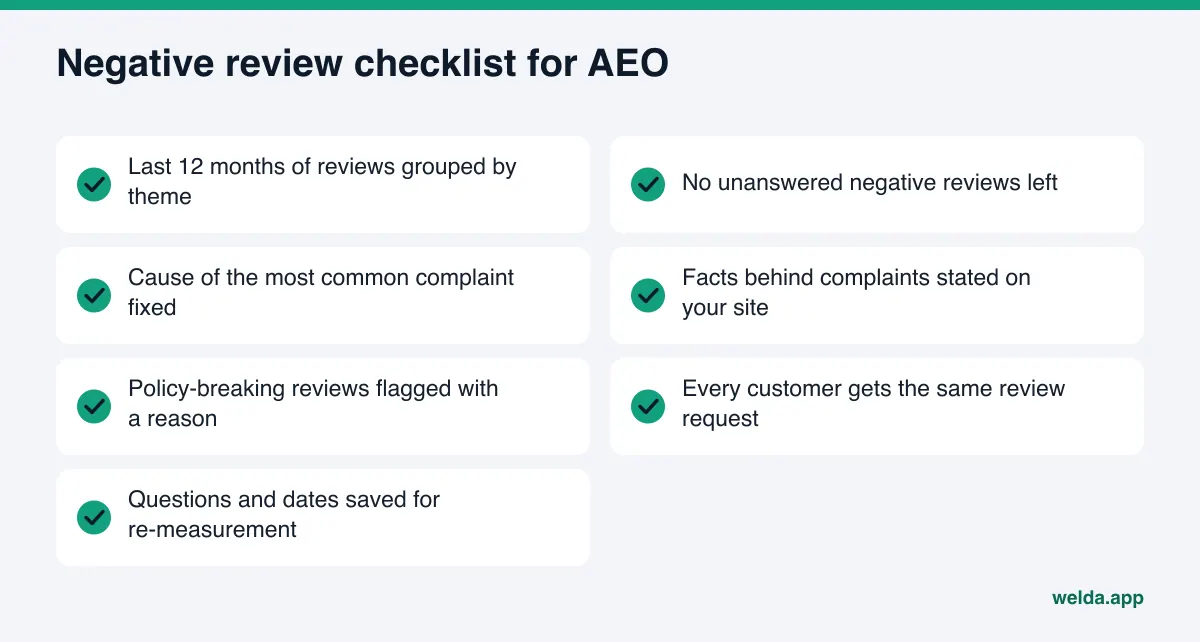
A short checklist:
- Have you grouped the last year of reviews by source and theme?
- Are there unanswered negative reviews left?
- Has the cause behind your most common complaint been fixed?
- Are the facts behind complaints stated clearly on your site?
- Does every customer get the same review request?
- Have you saved your questions so you can measure again in a few weeks?
If you want to run this as part of a broader review, follow the order in our AEO audit guide.
Frequently asked questions
Can I get a negative sentence in an AI answer corrected directly?
No. The engines write the answer, and there is no way to edit a single sentence. What you can do is make the sources they read current and balanced: fix the problem, reply, and state the facts on your site.
Will one harsh review show up in AI answers?
Usually it takes a recurring theme. A single review can stand out if it sits on a highly visible source or if there is little else to go on. That is one more reason businesses with few reviews should ask every customer for one.
Does replying to negative reviews actually help?
A reply changes what AI sees on the page: next to the complaint there is now your explanation and the fix. How much it helps varies by engine and question, and there is no guarantee. An unanswered complaint, though, always reads worse.
What about old BBB complaints or Reddit threads?
For resolved BBB complaints, a short response on what was done is worth posting. Old forum threads are low priority unless AI engines cite them in answers about you; then a calm, signed, factual comment can add the current picture.
Will Welda remove reviews or raise my rating?
No. Welda does not remove reviews, write fake ones or promise a rating. It measures sources and questions and drafts replies and content; publishing decisions and contact with reviewers stay with you.
How long until I see a change?
New replies and content usually take weeks to show up in AI answers. Re-measuring the same questions a few weeks apart gives a far more reliable picture than any single day's answer.
Start with the page you control
The fastest part of reducing the impact of negative reviews in AI answers is the one page you fully control: your own website. Are the facts behind complaints stated clearly? Are reviews and trust signals visible? Do your profiles link to your site? A free AI visibility analysis answers those questions with a score out of 100, plus the reason and the fix for each gap. It is free once per site, and the results link is sent to your email.