How do you build FAQ pages for AEO? Collect the questions customers actually ask, answer each one with a first sentence that stands on its own, put those answers in the visible text of your site, and keep the facts identical across your site and your listings. Done this way, FAQ pages for AEO give ChatGPT, Gemini, Perplexity and Google's AI Overviews quotable sentences about your business. This guide covers where to find the questions, how to write the answers, what FAQ markup still does now that Google has retired FAQ rich results, and how Welda handles this work.
Why FAQ pages for AEO matter for a local business
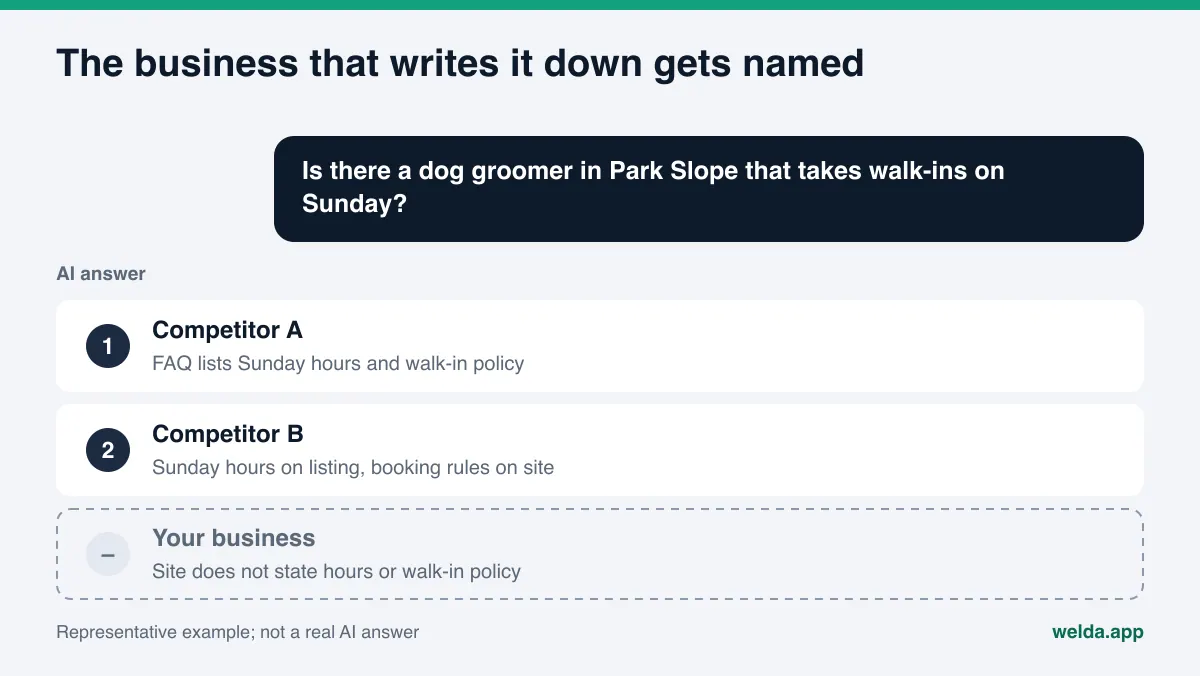
People no longer type two words into a search box. They type full sentences: "Is there a dog groomer in Park Slope that takes walk-ins on Sunday?", "Which HVAC company near me charges a flat fee for a diagnostic visit?", "Do any dentists in Plano see patients after 6 pm?" They ask ChatGPT, Gemini, Perplexity or Google's AI Mode, and they expect a short answer with two or three business names and a reason for each.
The AI has to read that reason somewhere. Usually it reads your website, your Google Business Profile, your reviews on Yelp or Google, and whatever else has been written about you. If your site never says whether you take walk-ins on Sunday, the model either guesses from another source or leaves you out. Neither outcome helps you.
That is the job of answer engine optimization, or AEO: making sure an answer engine can find, trust and repeat accurate information about your business. (You will also see the term GEO, generative engine optimization, used for the same work; the difference is mostly vocabulary, which we cover in GEO vs AEO.) Of all the formats on a website, the FAQ is the one closest to how answer engines work. A question sits next to its answer. The answer is short and ready to quote. That is exactly what a model looks for when it assembles a reply: a sentence that matches a question and stays true even when lifted out of context.
Most small business sites fall short here. The FAQ section is missing, or it was written years ago and filled with marketing questions like "Why choose us?" Meanwhile the real customer questions live in phone calls, text messages and review replies. Building FAQ pages for AEO means moving those real questions onto the readable part of your site. If you want to see whether your site has an FAQ section and how an AI reads your pages today, run the free site analysis. The FAQ section is one of the items it checks on its own line.
Google retired FAQ rich results. Do FAQ pages still matter?
Fair question, because for years the best-known benefit of an FAQ page was the expandable question boxes in Google results. Google first limited those boxes in 2023 to well-known, authoritative government and health sites (Google Search Central, August 2023). In 2026 it retired the FAQ rich result entirely: according to Google's documentation updates log, the feature was deprecated in May 2026 and its documentation was removed in June 2026.
That changes why you write an FAQ, not whether you should. You are no longer writing it to win a visual box in search results. Its value is now entirely in the content. Google's own guidance for its AI features points the same way: there are no extra requirements and no special schema.org markup needed to appear in AI Overviews or AI Mode, and structured data should match the visible text on the page (Google, AI features and your website).
In practice, an FAQ page built for AEO is a writing job, not a code job. The answer has to be visible on the page, written for a person, and it has to answer the question directly. An FAQ that meets those conditions helps the customer reading it, and it gives an answer engine the material to say something accurate about you.
| Topic | The old FAQ playbook | FAQ pages for AEO today |
|---|---|---|
| Goal | Expandable boxes in search results | Readable, quotable answers |
| What mattered most | Getting the markup right | Real questions, clear answers |
| Choosing questions | Keyword lists | The full sentence a customer types |
| Answer length | Short enough to fit the box | First sentence stands alone, detail follows |
| Maintenance | Written once and forgotten | Updated when hours, prices or policies change |
Which questions belong on an FAQ page for AEO?
The most common mistake is inventing questions at a desk. "Do you offer quality service?" is not something anyone types into ChatGPT. An FAQ page for AEO should be full of the things customers genuinely want to know before they decide. You rarely need outside research to find them; most are already in your inbox.
- Phone calls and texts: Write down the five questions you heard most in the last month. Hours, parking, how long a job takes, payment options and cancellation rules top the list for most businesses.
- Reviews: Read your Google, Yelp and BBB reviews for the points where customers got stuck. A review that says "they wouldn't give me a straight answer on price" is a question your FAQ should answer.
- Front desk and sales staff: The people who talk to customers every day know which questions repeat.
- Where competitors win: If an answer engine recommends a competitor as "the one with evening hours" or "same-day service," your site needs a clear answer on those topics too.
- Reddit threads and local forums: Threads about your category in your city show the real worries people have before they book.
Once you have the questions, sort them into groups. Most businesses end up with four or five: location and hours, pricing and payment, process and timing, scope (what you do and what you do not do), and trust (licensing, warranties, refunds, privacy). Those groups become the subheadings of your FAQ page, which makes it easier for both readers and answer engines to find what they need.
Do not skip the questions whose answer is "no." "Do you offer weekend service calls?" deserves an answer even if it is "No, we schedule Monday through Saturday." An answer engine will not recommend you for a need you do not serve, and the customer will not waste a call. A clear no beats silence.
How to build FAQ pages for AEO, step by step
This sequence is a realistic plan a small business can finish in a week or two. It does not require an agency or special software. It requires a few hours of careful writing by someone who knows the business.
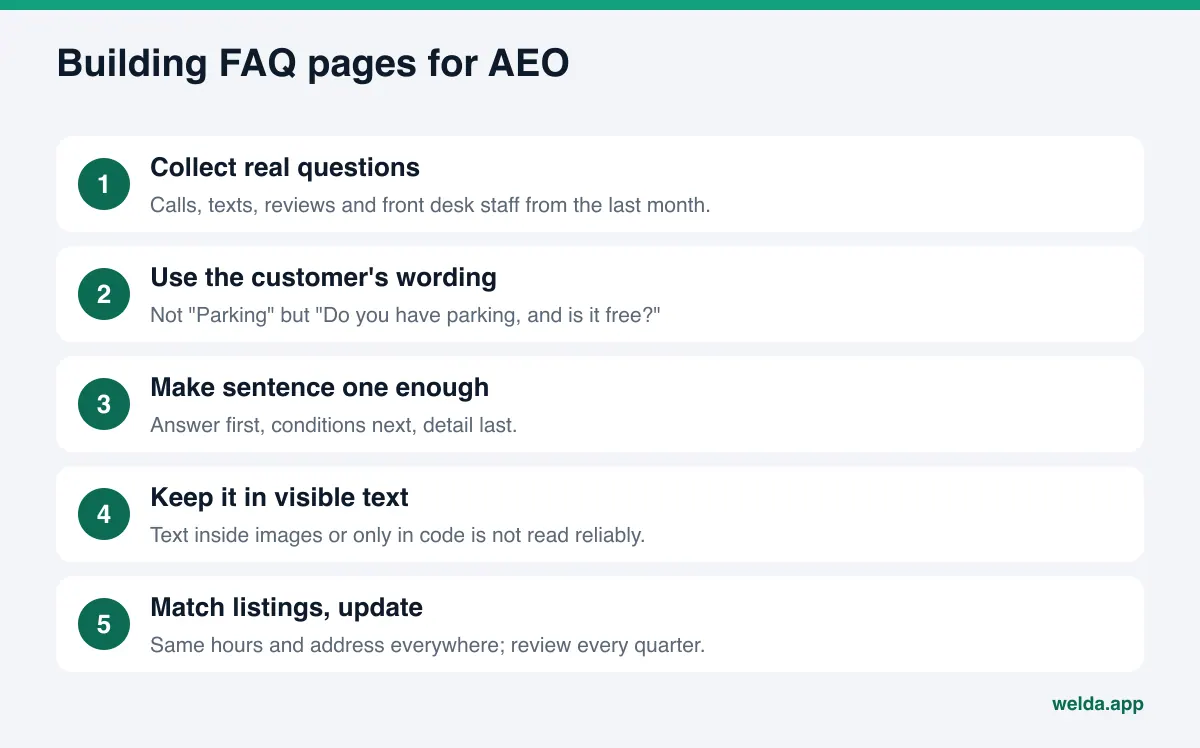
- Build the question list. Pull 20 to 40 real questions from the sources above. Merge duplicates.
- Write each question the way a customer says it. Not "Parking," but "Do you have parking, and is it free?" That is how the question is phrased when someone asks an AI.
- Make the first sentence of every answer self-sufficient. "Yes, we have a free lot behind the building with room for about a dozen cars." Detail goes in the second sentence.
- Be concrete. Hours, timeframes, scope, conditions. Do not state uncertain or changing facts as fixed; "Pricing depends on the scope of the job, and we quote after an on-site visit" is honest and useful.
- Group the questions. Four or five subheadings, not one long scroll.
- Put the answers in visible page text. Answers hidden in images, collapsed widgets that never render, or only in code are not read reliably.
- Add short FAQs to related pages. Three to five key questions on the homepage, service-specific questions on each service page.
- Match your listings. The hours, address and phone number in your FAQ should match your Google Business Profile, Yelp page and social accounts.
- Schedule updates. When hours, price ranges or policies change, the FAQ changes too. Review it every quarter.
Most of this is writing, and the quality of the writing drives the result. You can use AI to draft, but someone who knows the business should check every sentence; we cover the trade-offs in AI-generated content and AEO. The page title and meta description matter as much as the FAQ itself; see our guide to title tags and meta descriptions for AI search.
How to write an FAQ answer an AI can quote
When an answer engine quotes a source, it usually uses the first sentence or two, not the whole paragraph. So the most important part of the answer belongs at the top. Think of the inverted pyramid from news writing: answer first, conditions next, detail last.
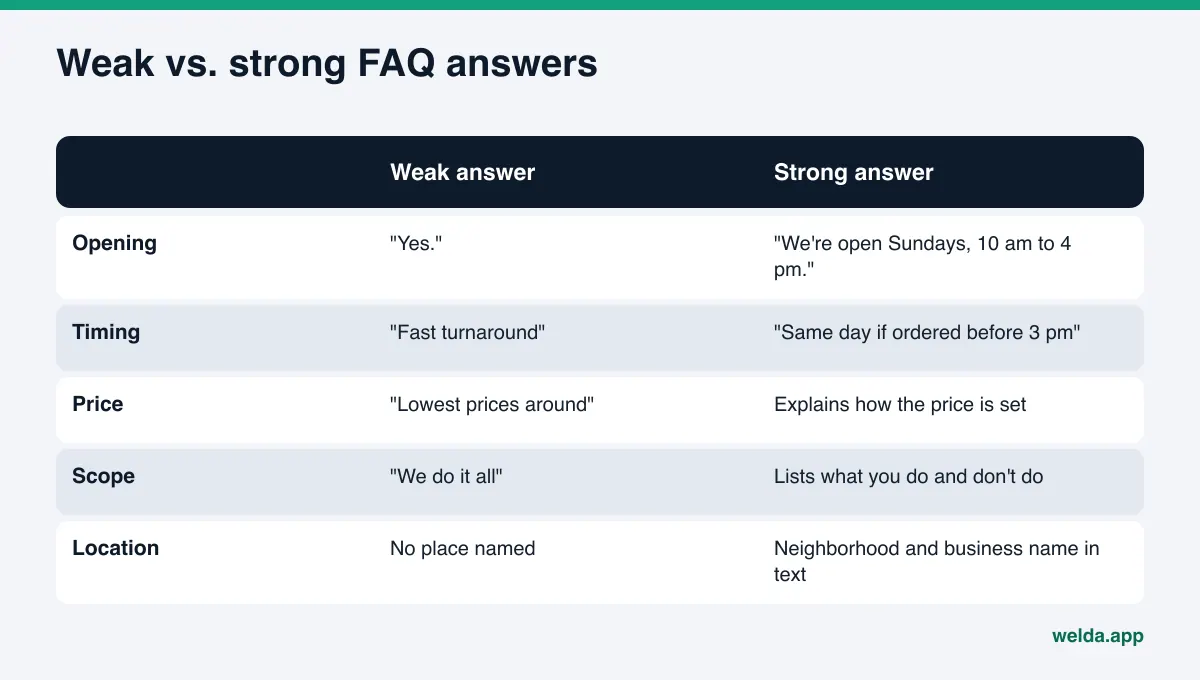
Three rules cover most cases. First, start with a sentence that carries the subject of the question: "We're open Sundays from 10 am to 4 pm" quotes better than an answer that starts with "Yes," because it still makes sense out of context. Second, include your business name or location where it reads naturally, such as "at our Park Slope shop," so the model can tell who is speaking. Third, replace vague marketing language with something checkable: not "fast turnaround," but "most orders ship the same day if placed before 3 pm."
There is no strict length rule. Two to four sentences answer most questions. If a question truly needs a long explanation, such as the stages of a remodel, give the short answer in the FAQ and link to the service page for the rest. The FAQ is not where you explain everything. It is where you give the fastest answer to the most common questions.
Watch out for certain kinds of claims. "Best in town," "guaranteed results" and "lowest prices anywhere" cost you credibility with readers and can raise problems with advertising rules, since the FTC states that under federal law an ad must be truthful, not misleading and, when appropriate, backed by evidence (FTC, Truth in Advertising). In health, legal and financial fields, an FAQ answer should never read like a diagnosis, a promised outcome or personal advice. "Treatment length varies from patient to patient; your dentist will walk you through a plan at the first visit" is accurate and safe. This is general information, not legal advice.
Do you still need FAQPage schema markup?
Schema.org defines a type for FAQ pages called FAQPage (schema.org/FAQPage). Each question is marked up as a Question and each answer as an acceptedAnswer. For years the main reason to add it was the Google question box, and that box is gone.
Should you strip existing markup? No need. In its 2023 announcement Google noted that unused structured data does no harm in Search and does not have to be removed. But when you build a new FAQ, markup should not be your first priority. Get the visible text right first. If you do add markup, there is one rule: the questions and answers in the markup must match the questions and answers people see on the page, word for word. An answer that lives only in code is pointless and erodes trust.
The structured data that matters more is your business information: name, business type, address, phone and hours. When that information is also in code on your site, search engines and answer engines identify your business with fewer mistakes. Keeping your name, address and phone identical everywhere is its own topic, covered in NAP consistency for AI search.
How Welda handles FAQ pages for AEO
Welda is software that measures where a business shows up in AI answers and fills the gaps on the business's behalf. FAQ work shows up in three places: the free analysis, the questions view in the dashboard, and the to-do list.
The FAQ check in the free analysis. The free site analysis, which runs in English, reads your homepage and a few inner pages such as services, pricing, about and contact. One of the items it checks is the FAQ section: is there one, and is it built as real questions and answers? If it is missing or weak, the report says what it found, why it matters for AI search visibility and how to fix it. The ready-to-use homepage copy it suggests includes FAQs, so you get a starting draft based on what it read on your site, not just a note that says "add an FAQ." The simulation shows roughly how much that fix would add to your score next to the other gaps, which helps you decide whether the FAQ comes first or something else does.
Question-by-question measurement in the dashboard. The Welda dashboard is in early access and is opening first to businesses in Turkey. In the dashboard, the questions your customers would ask are put to ChatGPT, Gemini, Perplexity and Google AI three times each, and question language can be set to English. The questions view shows, for every question, which engine named you and in what position. For FAQ work, that view is a question map: the questions where your name never appears point to topics your site does not answer, or answers poorly. You pick the first FAQ entries from that list instead of guessing.
Ready copy, and a question back to you when facts are missing. Welda drafts the FAQ answers, but it does not write facts it does not know. If your parking fee, cancellation window or Sunday hours cannot be read from your site, it lists that as missing information on the to-do list and asks you. You answer once, and the answer flows into the related copy. That blocks the most common FAQ failure at the source: a confident answer that is simply made up.
Before anything goes live, the draft passes a compliance check that flags patterns like price claims, guarantees, superiority claims and diagnostic suggestions. It is a pre-check that makes risky wording visible, not legal advice. On WordPress sites, Welda connects through a separate Editor user and an application password, with no code to install; the FAQ content opens on your site as a draft and goes live once you approve it. The details are in WordPress AEO. On sites without a connection, Welda provides a ready package and the change is made by hand.
What stays with you is clear: supply the facts Welda cannot know, read and approve the copy, and update things when your business changes. The content always lives on your own site; Welda does not host it.
What goes in the FAQ, and what belongs on another page?
An FAQ page is not a storage closet for every fact. Some information belongs on a service page, some on the contact page, some on your listings. Information in the wrong place ends up contradicting itself or going stale.
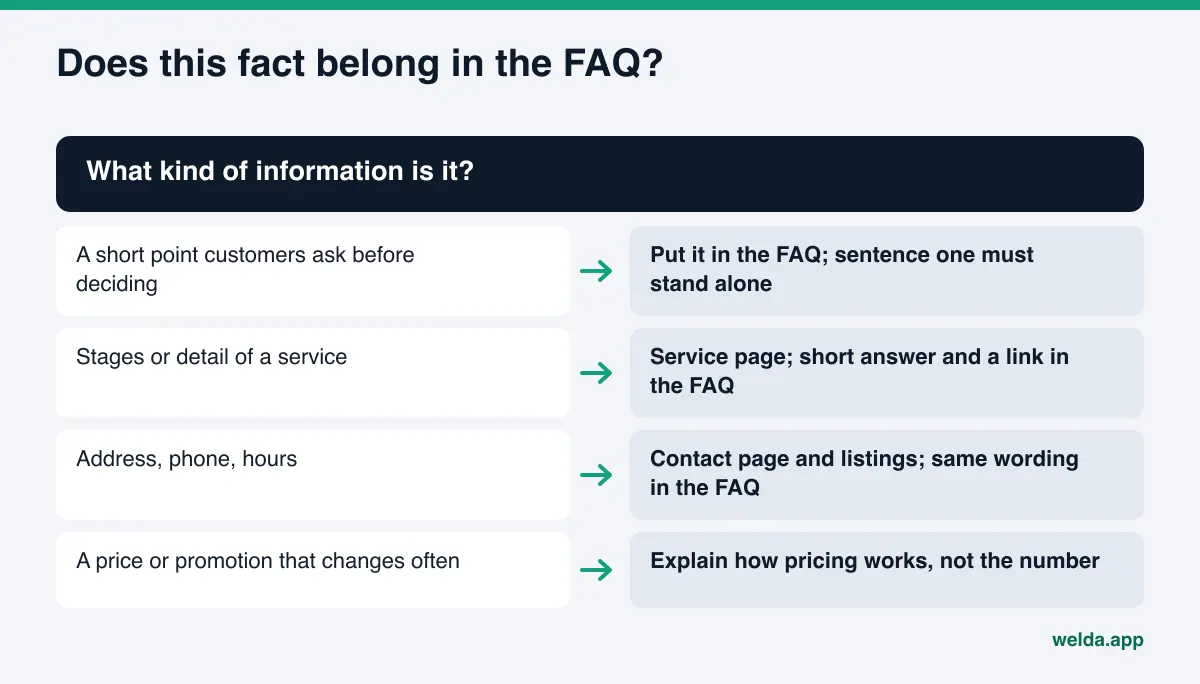
A practical rule: if the same fact appears in several places on your site, pick one home for it, then repeat it briefly elsewhere and link back. Hours, for example, can be detailed on the contact page and stated in one sentence in the FAQ. Keep a short list of where each fact appears so nothing is missed when it changes. The same applies to your Google Business Profile and Yelp listing: if your listing says you close at 6 and your FAQ says 7, the model has no way to know which one to trust.
Reviews are a source of FAQ questions, but they do not replace an FAQ. If a complaint keeps coming up, fix the problem first, then explain the process clearly in the FAQ. How reviews influence AI recommendations is its own subject, covered in reviews and AI recommendations.
Example: an FAQ page for an HVAC company
To make this concrete, picture a sample HVAC company in suburban Denver. It is not a real business; it is an example built to show the steps.
Today the company's site has a list of services and a phone number. The questions customers ask most on the phone are: "Do you charge for a diagnostic visit?", "Can you come the same day?", "Do you service all brands?", "Do I need to be home during the visit?", "Do you offer maintenance plans?" None of these answers appear on the site. When someone asks an AI for "an HVAC company near Denver that does same-day repair and services every brand," the model cannot tell whether this company qualifies.
The owner writes those five questions in the customer's words and gives each a two or three sentence answer. "We often have same-day openings on weekdays; call before noon and we'll tell you the earliest window." "We service most major furnace and AC brands; if we can't work on yours, we'll say so on the phone." The pricing question does not get a made-up number; it explains how the price is determined. The top three questions go on the homepage, and the repair page gets its own repair-specific questions. Hours are matched with the Google Business Profile.
Nobody can promise the result. New content usually takes weeks to show up in AI answers, and no work guarantees a mention for any specific question. What has changed is that the information an answer engine needs to name this company for "same-day repair" is now written down on its site. Before, it was not.
Limits: what an FAQ cannot fix, and what Welda does not do
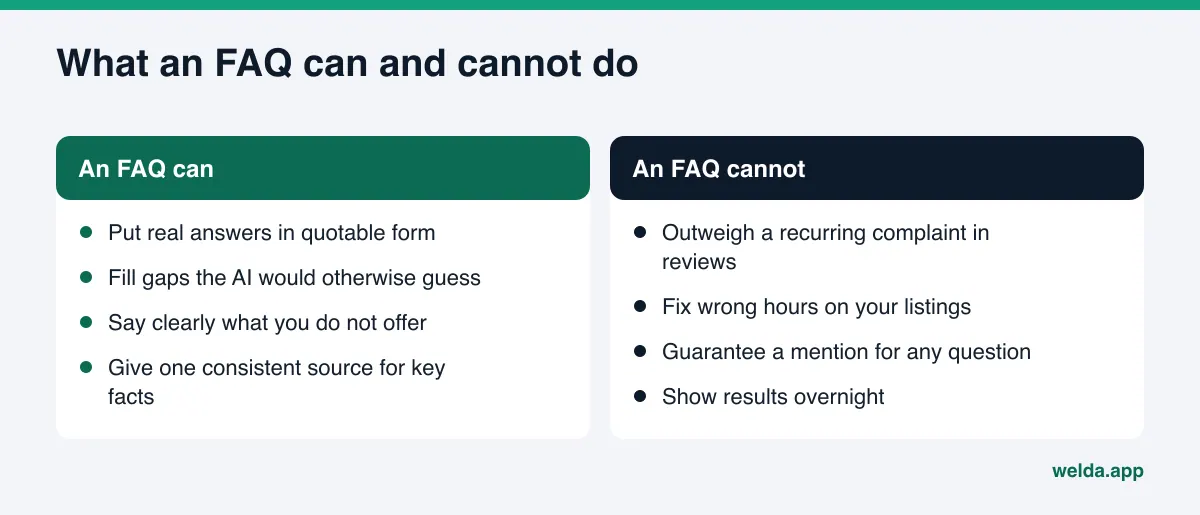
An FAQ is a strong tool, but it is not enough on its own. When an answer engine recommends a business, it also looks at map listings, reviews, directories like Angi or Healthgrades, and forums. A perfect FAQ will not outweigh a recurring complaint in your reviews or wrong hours on your listing.
What Welda does not do in this work:
- It does not guarantee rankings or a mention in ChatGPT. No software or agency can honestly promise that.
- It does not write facts it does not know into your FAQ; it asks you.
- It does not publish sensitive content without your approval. In healthcare, nothing is published automatically; every piece comes to you for approval.
- It does not create fake reviews or fake questions.
- Handling negative reviews, setting up directory accounts and press outreach stay with the business.
And the early access facts, stated plainly: the free analysis works in English today and anyone can use it. The full Welda dashboard is in early access and is opening first in Turkey. Regular four-engine measurement is being added during early access, and sample dashboard screens use representative data. Pricing is discussed in the early access conversation.
FAQ pages for AEO: pre-launch checklist
Before you publish, run your FAQ against this list. Every item you cannot check is a fact an answer engine cannot use about you.
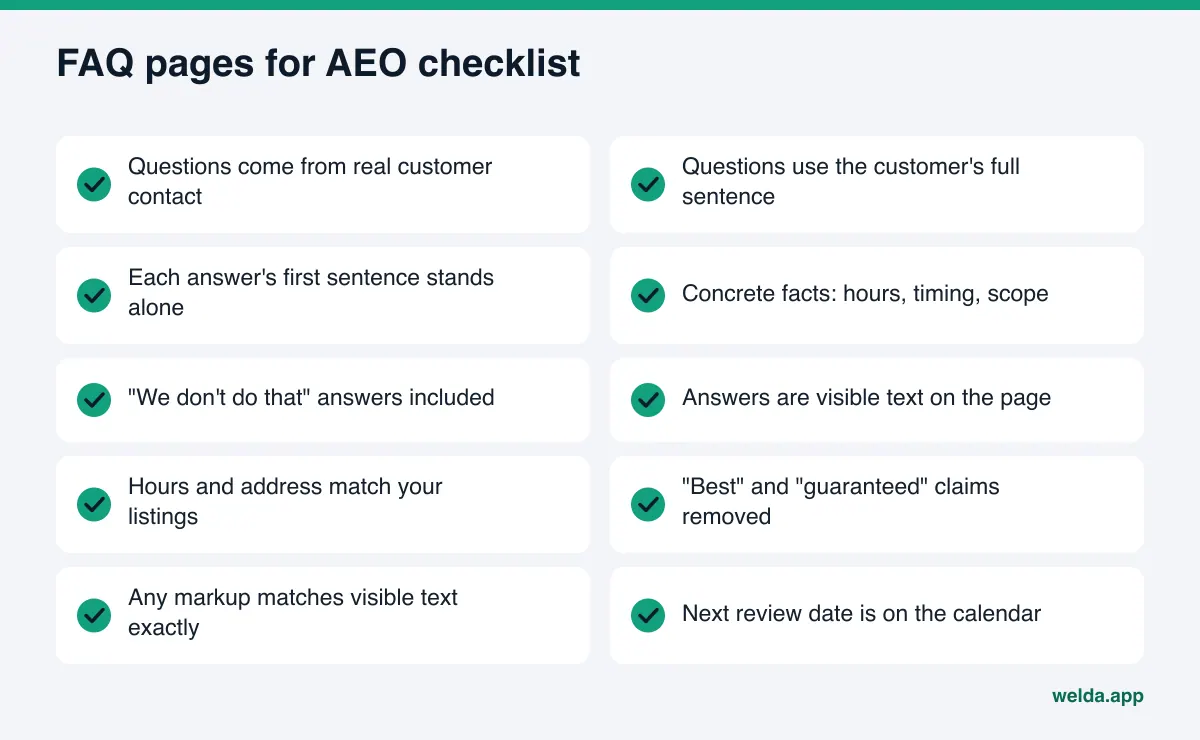
The list looks long, but your first version does not have to be perfect. Ten real questions with honest answers are worth more than forty invented ones. Then add the new questions you hear on the phone each month.
Frequently asked questions
How many questions should an FAQ page have?
There is no fixed number. For a small business, 10 to 25 real questions is usually enough. What matters is that the questions are ones customers really ask and the answers are clear.
Should the FAQ live on its own page or on the homepage?
Both work well together. Put the three to five most important questions on the homepage, the full list on a dedicated FAQ page, and service-specific questions on each service page. The answer to a given question should be the same everywhere.
Google retired FAQ rich results. Should I delete my FAQPage markup?
No need. Google has said unused structured data does no harm. For a new page, though, focus on the quality of the visible answers. If you use markup, it should match the visible text word for word.
Can I have AI write my FAQ answers?
For a draft, yes, but someone who knows the business should check every answer. A model can invent hours or services your site never mentions. That is why Welda asks you for any fact it cannot read.
Will an FAQ page get my business into ChatGPT answers?
It cannot guarantee that. An FAQ gives answer engines the material to describe you accurately. The outcome also depends on your listings, reviews and other sources. Effects usually show up over weeks and should be measured, not assumed.
How do I know whether my site has a usable FAQ section?
The free site analysis checks for an FAQ section as one of its items. If it is missing or weak, the report explains what it saw and how to fix it, and suggests ready-to-use FAQ copy for your homepage.
Check your FAQ today
FAQ pages for AEO are the shortest path between a customer's question and your answer. Collect real questions, write answers whose first sentence stands alone, keep your facts identical everywhere, and measure the result. To see where to start, run the free site analysis: you get your FAQ status, your business information and your other gaps in one report, plus suggested FAQ copy for your homepage. It is free once per site, and the results link arrives by email.