GEO vs AEO: is there a real difference? AEO (answer engine optimization) and GEO (generative engine optimization) both describe the work of getting your business named, and described correctly, when people ask ChatGPT, Gemini, Perplexity or Google's AI Overviews a question. The terms come from different places, and in the US you will hear AEO far more often. For a business owner, though, the work behind both labels is largely the same: make your site and profiles easy to read, answer real customer questions plainly, and measure the results on a schedule.
What AEO means, and where the term came from
An answer engine is any system that responds to a question with an answer instead of a list of ten blue links. AEO took hold in the US when marketers started optimizing for Google's featured snippets and for voice assistants. Back then the goal was simple: when someone asked "what time does the hardware store on Main Street close," the single answer read aloud or shown at the top of the page should come from your page.
The answer engines people use have changed. ChatGPT, Gemini, Perplexity, Google AI Overviews and Google AI Mode now read several sources and write their own response, usually naming a handful of businesses with a short reason for each. AEO stretched to cover that. Today, when an American marketer says AEO, they usually mean showing up in AI-written answers, not only in a snippet box.
Most US business owners searching for help will type "AEO" or "AI search visibility." That is why this article, like the rest of our English content, uses AEO as the main term and treats GEO as a synonym.
What GEO means, and why it is less common in the US
GEO stands for generative engine optimization. The term entered the conversation through research: the paper "GEO: Generative Engine Optimization", first posted in November 2023 and accepted to the KDD 2024 conference, studied how content creators can become more visible in the answers of search systems built on large language models.
So the two names have different origins. AEO grew out of marketing practice in the snippet and voice-search era. GEO was named in an academic study written after generative AI search arrived. In the US, AEO had a head start and stayed the more familiar label for agencies and in-house teams. GEO shows up more in research, in some software marketing, and in markets outside the US, where the topic arrived later and the generative framing came first.
If you see "GEO" in a proposal from an agency or a software vendor, do not assume it means a different service. Read what the proposal actually includes.
GEO vs AEO vs SEO: a side-by-side comparison
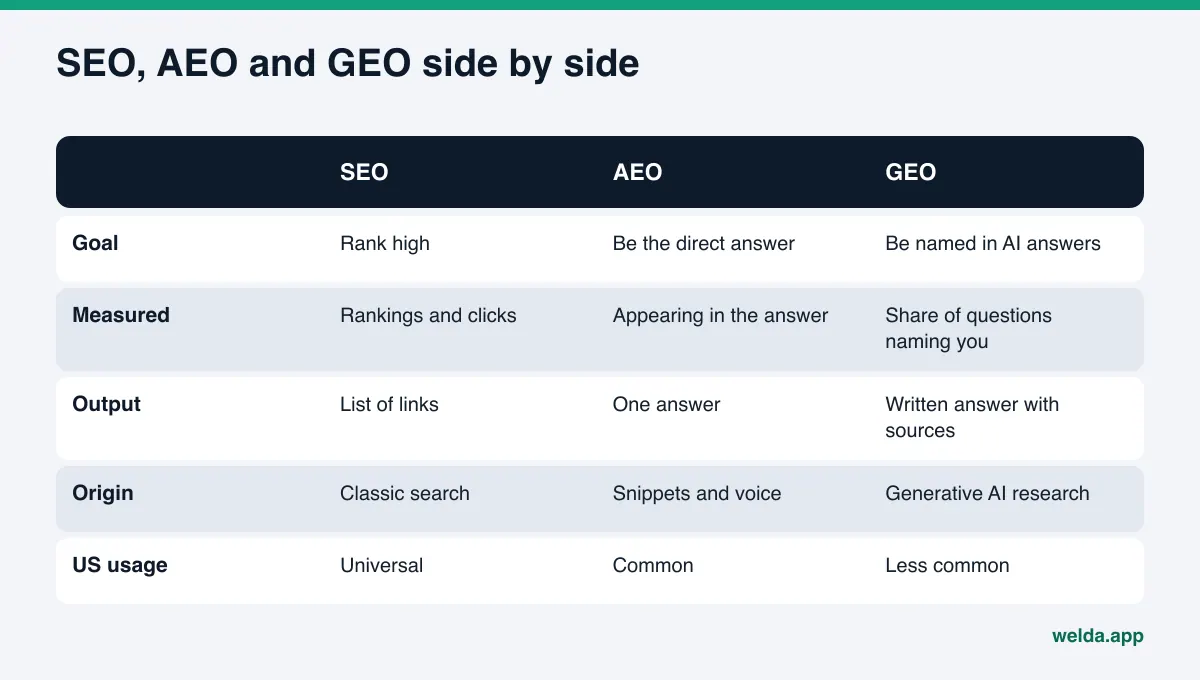
The confusion is understandable because all three sit on the same foundation. Your site has to be crawlable, your titles and descriptions have to make sense, and your business details have to be consistent everywhere. The differences show up in what each one measures and what result it aims for.
| Topic | SEO | AEO | GEO |
|---|---|---|---|
| Goal | Rank high in search results | Be the direct answer to a question | Be named in an AI-written answer |
| What gets measured | Rankings, clicks, impressions | Whether you appear in the answer | Share of questions naming you, position |
| Output format | List of links | One answer or a short list | Written answer with cited sources |
| Origin | Classic web search | Snippets and voice assistants | Generative AI research |
| US usage | Universal | Common | Less common |
| Your control | Partial | Partial | Partial |
The last row matters most. In every case, someone else makes the final call. Google decides rankings; the AI engine decides what goes in the answer. What you control is whether the information the engine reads about you is complete, consistent and current.
A strong Google ranking does not guarantee a mention in AI answers either. We explain why in ranking first on Google but not showing up in ChatGPT. The short version: the engine does not just read your top page. It weighs everything it can find about you.
What AEO looks like for a real business question
Take an example. An example HVAC company serves a suburb outside Phoenix. A homeowner asks ChatGPT, "Who can repair my AC this weekend in Chandler, and do they offer upfront pricing?" The answer names three companies, each with a short reason. Our example company does weekend emergency calls, but its website only says "full-service heating and cooling" and lists a phone number. It does not make the list.
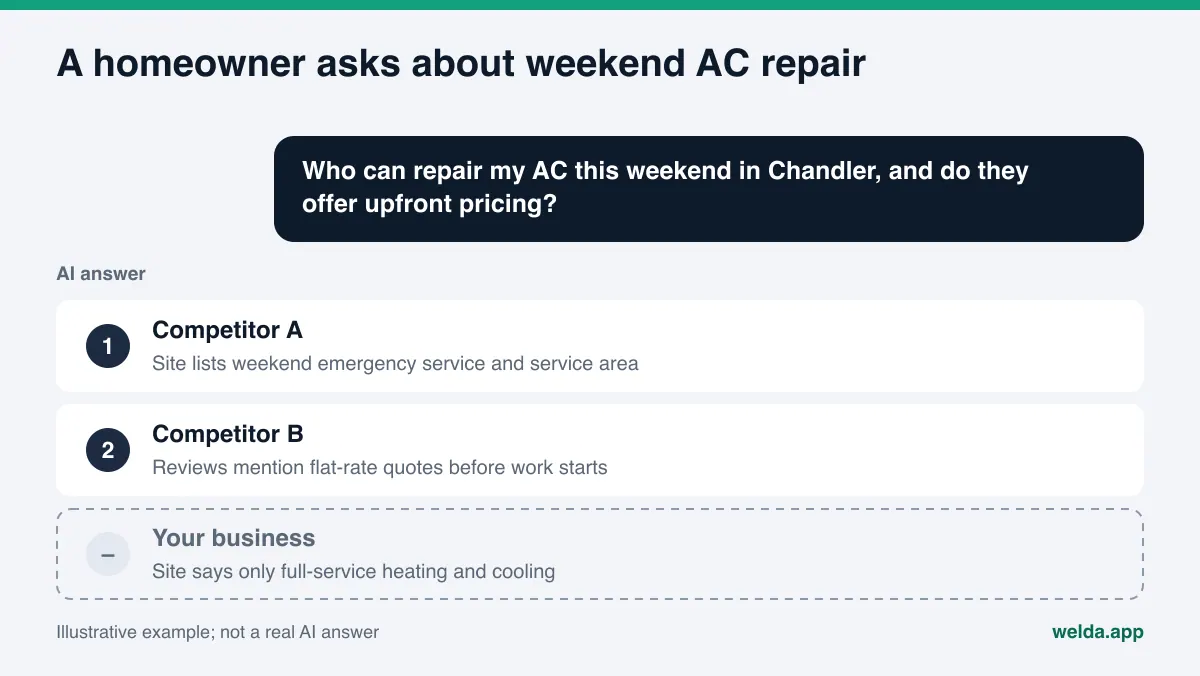
In this example, AEO and GEO are just two names for the work of getting into that answer. The company's to-do list is concrete: a service page that spells out weekend and emergency availability, the cities it actually covers, a plain explanation of how quotes work, an FAQ that answers "do you work weekends," the same hours on Google Business Profile, Yelp and Angi, and calm, specific replies to reviews.
The logic is the same for a dental practice, a restaurant or an online store. Think about the question a customer will ask, then write down on your site and profiles the facts an AI engine needs to answer it. Engines pull from your website, Google Business Profile, Yelp, the BBB, Tripadvisor for hospitality, Healthgrades for medical practices, and industry directories. That is why the work never stops at your homepage.
Which questions matter most?
Questions with buying intent come first. "Best family dentist near me," "gluten-free brunch in Midtown," "emergency vet open Sunday": the person asking is close to a decision. General information questions ("how does a heat pump work") also build visibility, but they turn into customers more slowly. When you choose which questions to track, start with the buying ones.
Skip the label debate: a step-by-step AEO plan
Whether your agency calls it AEO or GEO, the work follows the same order. You can run through these steps for your own site.
- Write down the questions. List 10 to 20 questions a customer might ask an AI assistant. Include your city or neighborhood, the service and the need: "pediatric dentist in Plano that takes walk-ins," "same-day garage door repair in Tacoma."
- See where you stand today. Ask those questions in ChatGPT, Gemini and Perplexity. Note whether you are named, which competitors appear and which sources get cited. Answers vary from run to run, so do not judge from a single try.
- Check access. Make sure your robots.txt file does not block AI crawlers by accident. A blocked site cannot be read, no matter how good the content is.
- Fix the basics. Your page title, meta description, main heading and opening paragraph should say what you do, where, and for whom, in one read.
- Mark up your business details. Add schema markup for address, phone, hours and business type, and keep it identical to the visible text. More in schema markup for AI search.
- Answer the questions on your site. Use the questions from step one to build service sections and an FAQ. Keep answers short, specific and accurate.
- Line up your profiles. Name, address and phone should match on Google Business Profile, Yelp, the BBB and any industry directory, and each profile should link to your site.
- Measure again. Ask the same questions, worded the same way, a few weeks later. New content usually takes weeks to show up in AI answers.
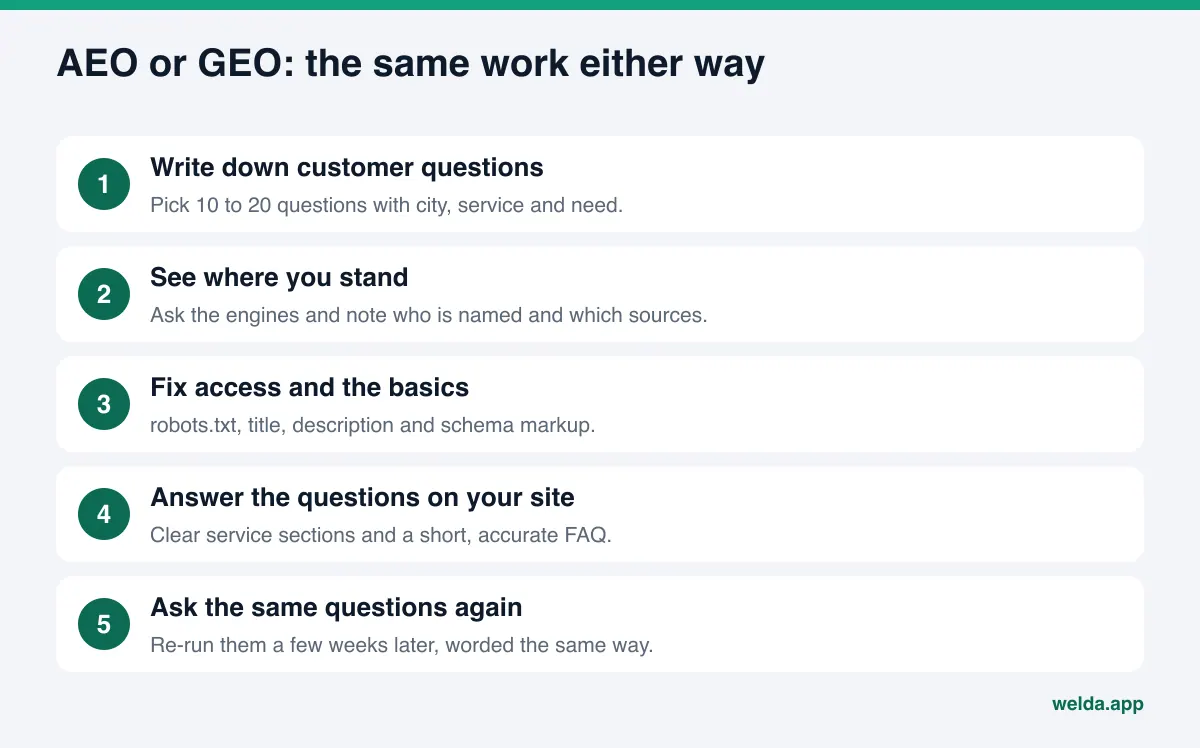
Notice that none of these steps is "AEO only" or "GEO only." Google says the same in its own documentation: there are no additional requirements or special optimizations needed to appear in AI Overviews or AI Mode, and no special schema you have to add. A page needs to be indexed and eligible to show with a snippet. The work is to make your core information complete and consistent, then measure. A new label does not change that.
Hiring for AEO or GEO: what to ask
Because the terms are new, proposals look very different from one another. One vendor's "AEO package" may be a few blog posts. Another's "GEO program" may be a one-time technical audit. A third may run real, repeated measurement. Before you sign anything, get clear answers to these questions:
- What exactly gets measured? Which questions, on which engines, and how many times each? A single screenshot is not measurement.
- How is the score calculated? Is the formula published, or is it a black box? Without a visible formula you cannot tell why the number moved.
- Who writes, who approves? Who drafts the content, and does anything go live without your sign-off?
- Where does the content live? On your own website, or on a subdomain the vendor controls? What happens if you cancel?
- What is being promised? "Guaranteed placement in ChatGPT" is a red flag. No one controls what an engine writes.
- How are reviews handled? The FTC's final rule announced in August 2024 bans fake reviews and testimonials, including AI-generated ones. Any plan that "builds reviews" for you deserves close questions.
If you are weighing a one-off report against continuous tracking, our comparison of a one-time AEO audit vs ongoing tracking walks through it. In short, an audit shows where to start; repeat measurement shows whether the work paid off.
How Welda handles AEO and GEO work
Welda is software that measures where a business shows up in AI answers and fills the gaps on the business's behalf. Call it AEO, GEO or AI visibility; the job is the same. Since this article is about the terms themselves, here are the three parts of Welda that turn the label debate into something you can actually look at.
1. The free site analysis: your baseline
The part anyone can use today is the free site analysis, which runs in English. It reads your homepage and a few inner pages (services, pricing, about, contact) the way Google and an AI engine would. It checks the items from the plan above: whether AI crawlers can get in, whether your title and description describe the business, whether schema markup is present, whether address and phone are clear, whether there is an FAQ, and whether services are spelled out.
It also asks 5 likely customer questions to an AI assistant that can search the web, and shows whether your business name comes up in the answers. That is a one-time check, but it gives you a first concrete answer to "how is our AEO doing?" Results show separate technical and content scores, what was found for each gap and how to fix it, ready-to-use copy for your homepage, and a fix package you can add to your site. It is free once per site; your email and phone are verified, and the results link arrives by email and stays open for 14 days.
2. Question tracking: where the label becomes a measurement
In the Welda dashboard, the Questions view is where AEO stops being a buzzword. Each row is a customer question; each column is an engine. Each cell shows whether your business was named in that engine's answer and in what position. Click a question and you see the answer in detail, along with the sources the engine cited.
The decision this view supports is practical: which questions am I missing entirely, and where is my competitor getting its information? If our example HVAC company shows up for "AC tune-up" on two engines but never for "weekend AC repair," the next piece of content is obvious. The view produces a priority list, not a definition.
In the dashboard, each question goes to ChatGPT, Gemini, Perplexity and Google AI three times. Three runs exist because AI answers vary; one query can mislead.
3. A published score formula
A visibility score is meaningless if you do not know how it is built. Welda publishes its formula: the share of questions that name you carries 50 percent of the weight, your position in those answers 30 percent, and your share against competitors 20 percent. The spread across the three runs produces a margin of error, which is shown next to the score.
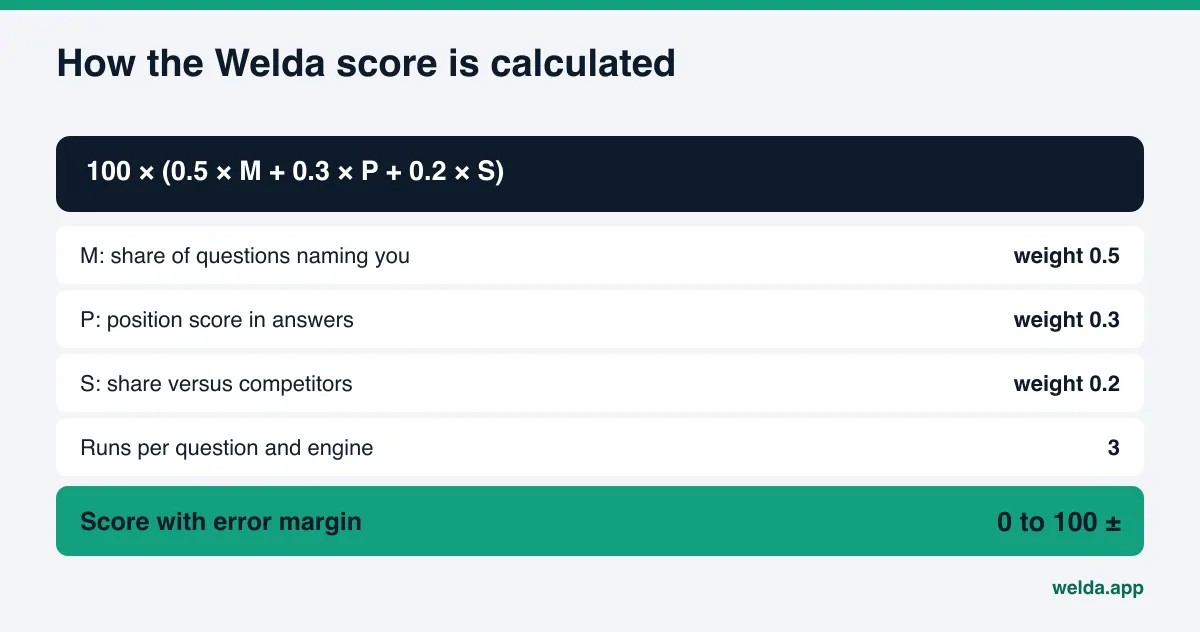
A visible formula lets you see which part moved when the score changes. Are you named in more questions, or higher up in the same ones? That is the kind of answer a vendor should be able to give you, whatever they call the service. For how often to re-check, see how often to measure AI visibility.
Beyond these, Welda builds a single to-do list of missing information, drafts content and profile copy, and on WordPress sites opens content as a draft for review. Publishing approval always stays with the business, and content always lives on the business's own website.
Early access note: the free site analysis works in English and German today. The full Welda dashboard is in early access and is opening first in Turkey. Regular four-engine measurement is being added during early access, and sample dashboard screens use representative data. Pricing is discussed in an early access conversation.
Limits: what AEO, and Welda, will not do
AEO or GEO, the work has limits. Knowing them up front prevents the wrong expectations.
- No guarantees. Welda does not guarantee rankings or a spot in ChatGPT answers. The engine writes the answer.
- No made-up facts. If Welda does not know something, such as your weekend hours or warranty terms, it asks you instead of guessing.
- No unapproved sensitive content. In healthcare, nothing is published automatically; every piece waits for approval.
- No fake reviews. Welda does not create reviews. It drafts replies to real ones.
- Some work stays with you. Handling negative reviews, setting up directory accounts and press outreach remain your job.
- It takes time. New content usually takes weeks to show up in AI answers.
The free analysis does not measure rankings either. It looks at how readable your site is and runs a one-time, five-question test. Ongoing measurement is what the dashboard is for.
GEO vs AEO decision guide: where to start
Whatever term your team settles on, the next step depends on where you are today.
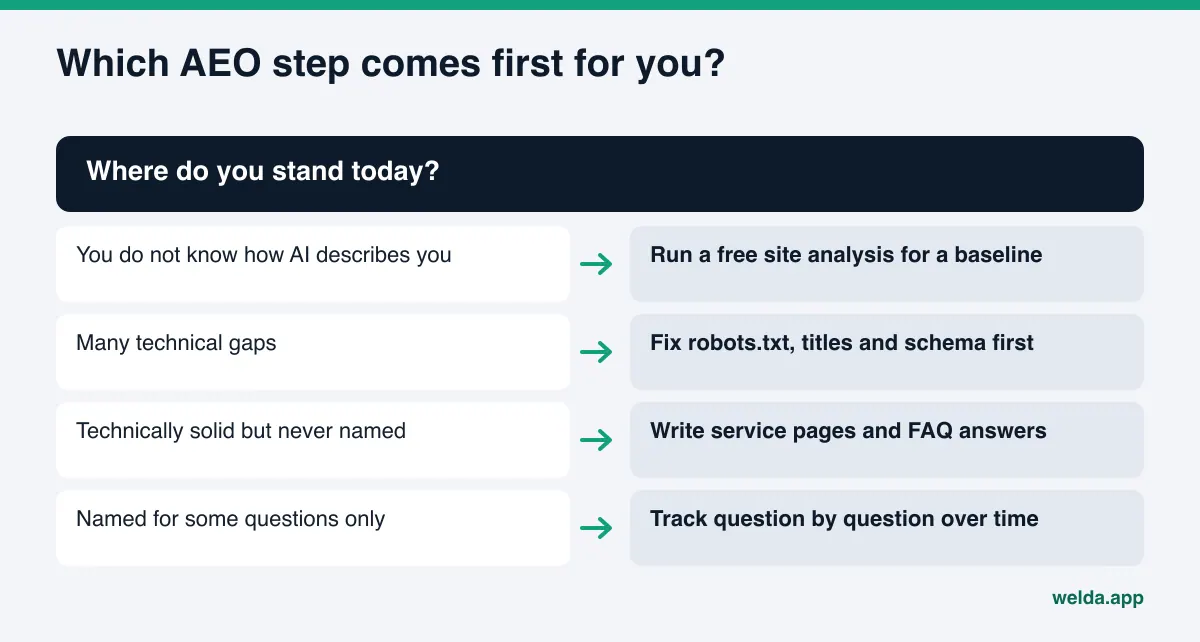
| Where you are | Suggested first step |
|---|---|
| You have no idea how AI describes you | Run the free site analysis |
| The analysis shows many technical gaps | Fix robots.txt, titles and schema first |
| Technically solid, still not named | Write service and FAQ content |
| Named for some questions, not others | Track question by question over time |
| A competitor is always ahead | Check which sources the engine cites for them |
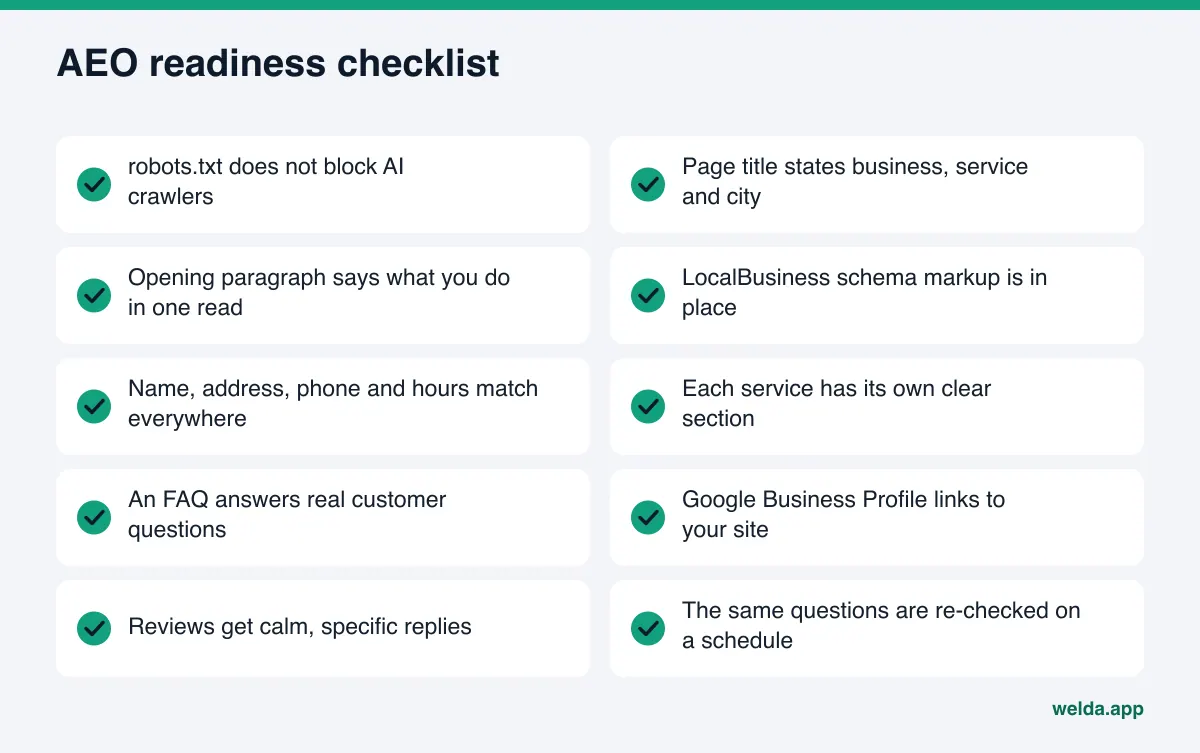
And before you hire anyone, run through the checklist below. Every unchecked item is a fact an engine cannot use when it decides whether to name you.
Frequently asked questions
What is the difference between GEO and AEO?
Mostly origin. AEO grew out of the featured snippet and voice assistant era; GEO was named in a 2023 research paper about generative search. Today both describe getting named in AI-written answers, and in the US AEO is the more common term.
Is AEO replacing SEO?
No. AI visibility sits on top of SEO basics: a crawlable site, clear titles, consistent business details. AEO adds a different goal and a different measurement: being named in the answer.
Do I need special code or files for AEO?
Google says AI Overviews and AI Mode have no extra requirements and need no special schema. Schema markup helps clarify your business details, but on its own it does not get you named.
How long does AEO take to work?
New content usually takes weeks to show up in AI answers. That is why you need to re-ask the same questions, the same way, on a regular schedule.
Should I hire an AEO agency or a GEO agency?
The label tells you little. Ask what gets measured, how the score is calculated, who approves content and where it lives. Compare the work, not the name.
Does Welda do AEO or GEO?
Welda measures visibility in AI answers and helps fill the gaps. You can call that AEO, GEO or AI search visibility. What matters is the questions measured and the fixes made.
Bottom line: track the answer, not the acronym
GEO vs AEO is mostly a naming question. The work underneath is the same: help AI engines describe your business accurately when customers ask. The first step is the same too, which is finding out where you stand. Run the free AI visibility analysis to see how your site reads to an AI engine, what is missing, and what a five-question test turns up.