Why am I ranking first on Google but not in ChatGPT? Because the two systems answer different questions. Google ranks a page against a search phrase; ChatGPT and other answer engines decide whether your business belongs in a short recommendation of two to five names. Your SEO work still counts, but it does not automatically tell an AI system who you are, where you operate and why someone should pick you.
This guide is for owners and marketers who are ranking first on Google but not in ChatGPT and want to know why. We cover where the gap comes from, the seven most common causes, a step-by-step plan to close it, how Welda measures and fills the gap, and what Welda does not do. If you want a baseline before you read on, run a free AI visibility analysis of your site; it takes a few minutes and works in English.
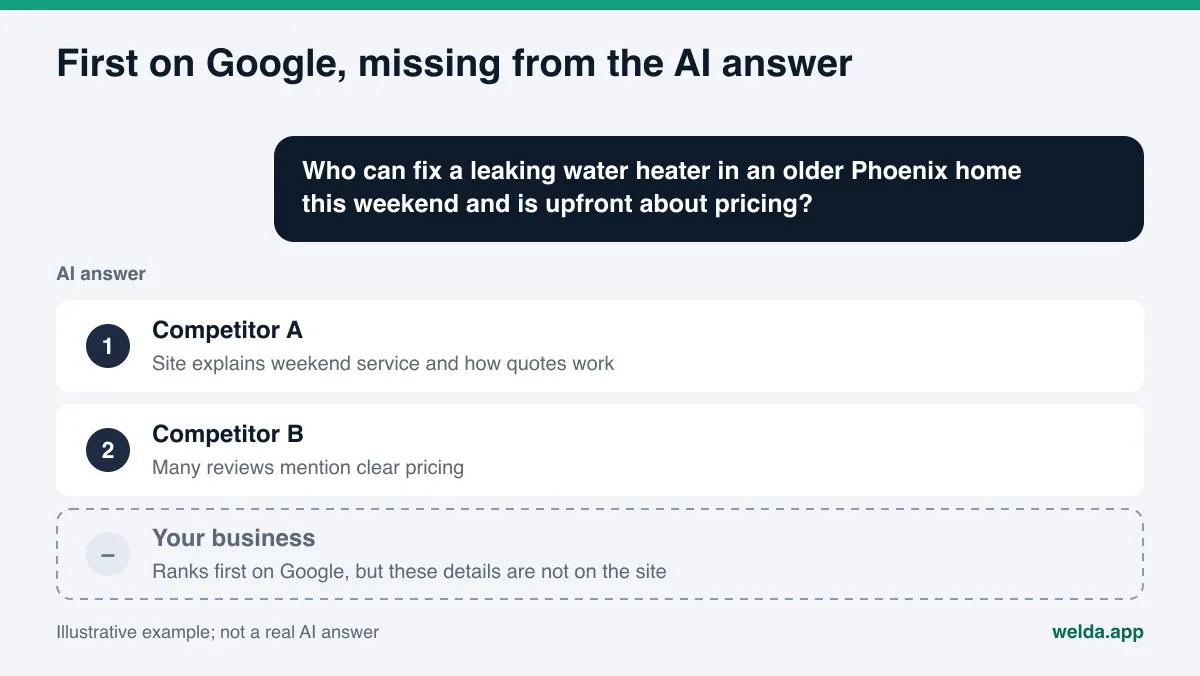
Ranking first on Google but not in ChatGPT: what is actually going on?
A Google search returns a ranked list. The customer scans it, opens a few tabs, compares, and decides. Ranking is mostly about how well one page matches one query. If your page is number one for "emergency plumber Phoenix," you have done that job well.
An answer engine works differently. Someone asks ChatGPT, Gemini, Perplexity or Google's AI Mode a question, and they get a paragraph back. That paragraph usually names a handful of businesses. There is no page two and often no comparison shopping. The AI reads several sources, blends them, and says "these are good options." If your name is not in that paragraph, your Google ranking is invisible at that moment.
The question itself also changes. People type short phrases into Google. They talk to AI assistants in full sentences: "I have a leaking water heater in a 1970s house in Phoenix, who can come out this weekend and is upfront about pricing?" That question carries details your top-ranking keyword never covered: the problem, the age of the house, the timing, the trust signal. If your site does not state those details plainly, the AI has nothing to connect you to the question.
Finally, an AI answer rarely relies on your website alone. It pulls from Google Business Profile, Yelp, the BBB, Angi, Nextdoor threads, local news, and "best of" lists. Your homepage can be strong on its own; the AI is also asking what the rest of the web says about you.
This is the core of AEO (answer engine optimization): making your business easy for answer engines to understand, verify and recommend. You may also see it called GEO, generative engine optimization; in the US the two terms describe essentially the same work, and AEO is the one people search for.
Does Google ranking measure the same thing as AI search visibility?
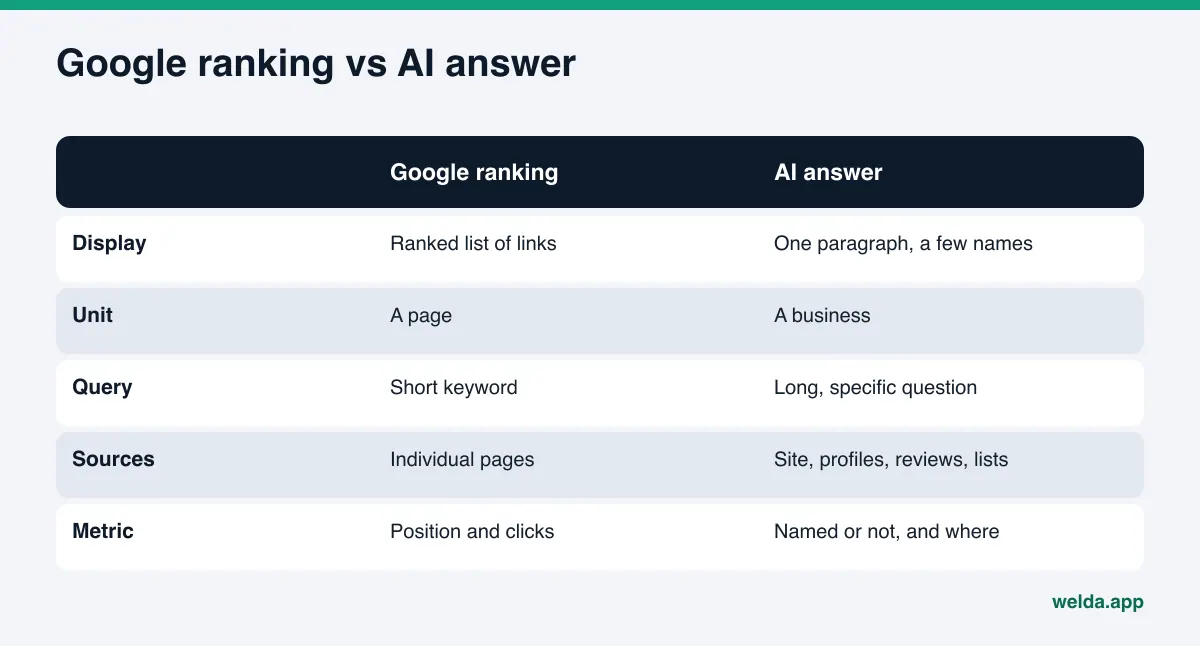
No. They overlap, but they answer different questions. The table below shows the differences that matter most to a business owner.
| Aspect | Google ranking | AI answer |
|---|---|---|
| What the user sees | A ranked list of links | One paragraph naming a few businesses |
| Unit being judged | A page | A business or brand |
| Query style | Short keyword | Long, specific, conversational question |
| Sources | Mostly individual pages | Your site, profiles, reviews and lists combined |
| Visible slots | Many results on page one | Usually a handful of names |
| How you measure it | Rank tracking, clicks | Whether you are named, and in what position |
| Stability | Fairly stable day to day | The same question can return different answers |
The row that matters most is "unit being judged." Google ranks pages. Answer engines recommend businesses. Your page can win a keyword while the AI still lacks clear, consistent, verifiable facts about the business behind it. If you want the measurement side in more depth, our comparison of a rank tracker vs an AI visibility tracker walks through what each tool can and cannot see.
Google's own AI features add another layer. According to Google's documentation on AI features, there are no additional requirements to appear in AI Overviews or AI Mode beyond being indexed and eligible to show with a snippet. The same page explains that these features may run multiple related searches across subtopics to build a response. So even inside Google, ranking first for one phrase does not decide the whole AI answer.
Why this matters for your business
Ranking first on Google is still valuable, and nothing here says otherwise. What is changing is where some customers make up their minds. Some people now ask an assistant a long question and then look up one of the names it gives them. Those people never see your blue link.
There are two risks. The first is the lost customer: if a competitor is named and you are not, the person asking will probably call the competitor first. The second is the wrong impression: if the AI does mention you but with an old address, a service you dropped, or details mixed up with another business, that can hurt as much as being absent.
The third issue is measurement. Search Console and rank trackers tell you where you stand on Google. They tell you nothing about AI answers. The feeling of "we are not in ChatGPT" usually comes from one or two test prompts. Without knowing which questions you miss, on which engines, and which sources your competitors win on, every fix is a guess.
Ranking first on Google but not in ChatGPT: seven common reasons
These are the causes we see most often when a business is strong in classic search but missing from AI answers. Usually more than one applies.
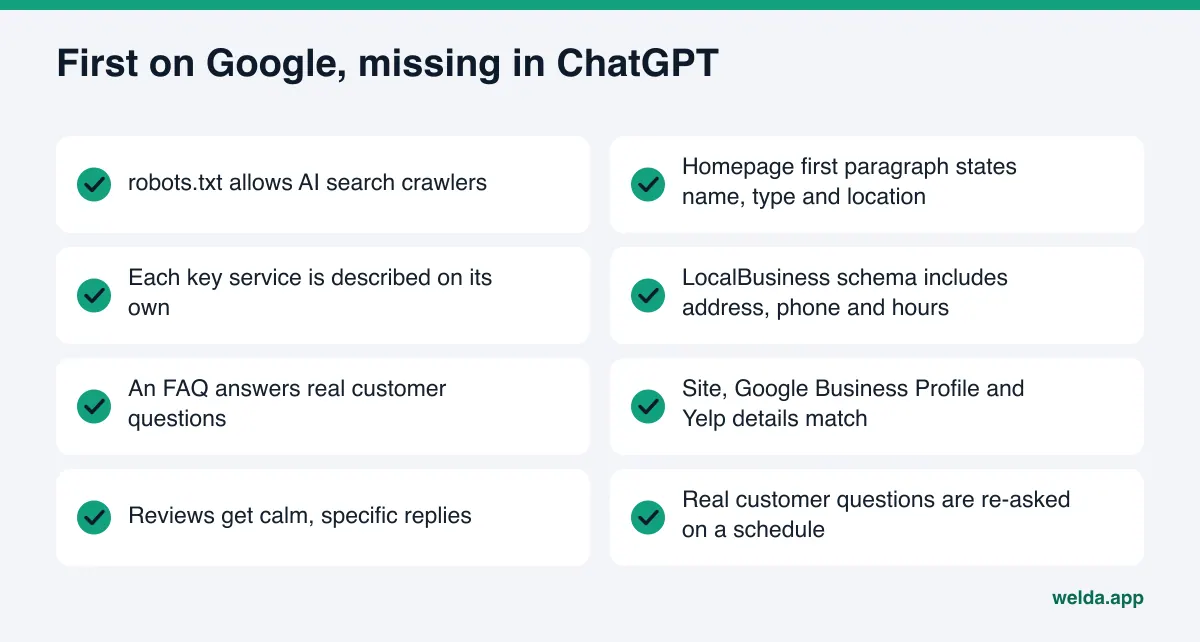
- AI search crawlers are blocked. Your robots.txt file, CDN or security plugin may block AI crawlers without anyone noticing. OpenAI's crawler documentation says OAI-SearchBot is used to surface websites in ChatGPT's search features, and that sites which opt out of it will not be shown in ChatGPT search answers. Being open to Googlebot does not mean you are open to these crawlers.
- Your top keyword is not the question people ask the AI. You may rank for "Denver dentist," but if a patient asks for "a gentle dentist near Wash Park who sees kids and is open Saturdays," your site needs the neighborhood, the hours and the services in plain text.
- Your site says what you sell, not who you are. A hero image, a tagline and a "Book now" button do not tell an AI the business name, location, specialty and audience in one sentence. We cover this in detail in our guide to homepage copy for AI search.
- Structured data is missing or wrong. Without LocalBusiness schema for your name, address, phone, hours and profile links, the AI has to infer basic facts from prose.
- Third-party sources are thin. An incomplete Google Business Profile, few or unanswered Yelp reviews, no listing on the directories your industry uses. The AI cannot answer "what do others say about this business."
- Your details do not match across the web. One address on the site, another on Google Maps, an old phone number on a directory. Inconsistency gives the AI a reason to skip you.
- No FAQ that matches real questions. If your site does not answer what customers actually ask (how pricing works, whether you take insurance, whether there is parking), the AI finds those answers elsewhere and tends to name the businesses on those pages.
Many of these overlap with local SEO, but a standard local SEO checklist does not cover all of them. We break down where the two disciplines meet and split in local SEO vs AEO.
How to turn Google rankings into AI search visibility, step by step
The good news: a site that ranks first on Google usually has a solid foundation. It is indexed, reasonably fast and organized. You do not need to rebuild it. You need to fill the gaps the AI cares about.
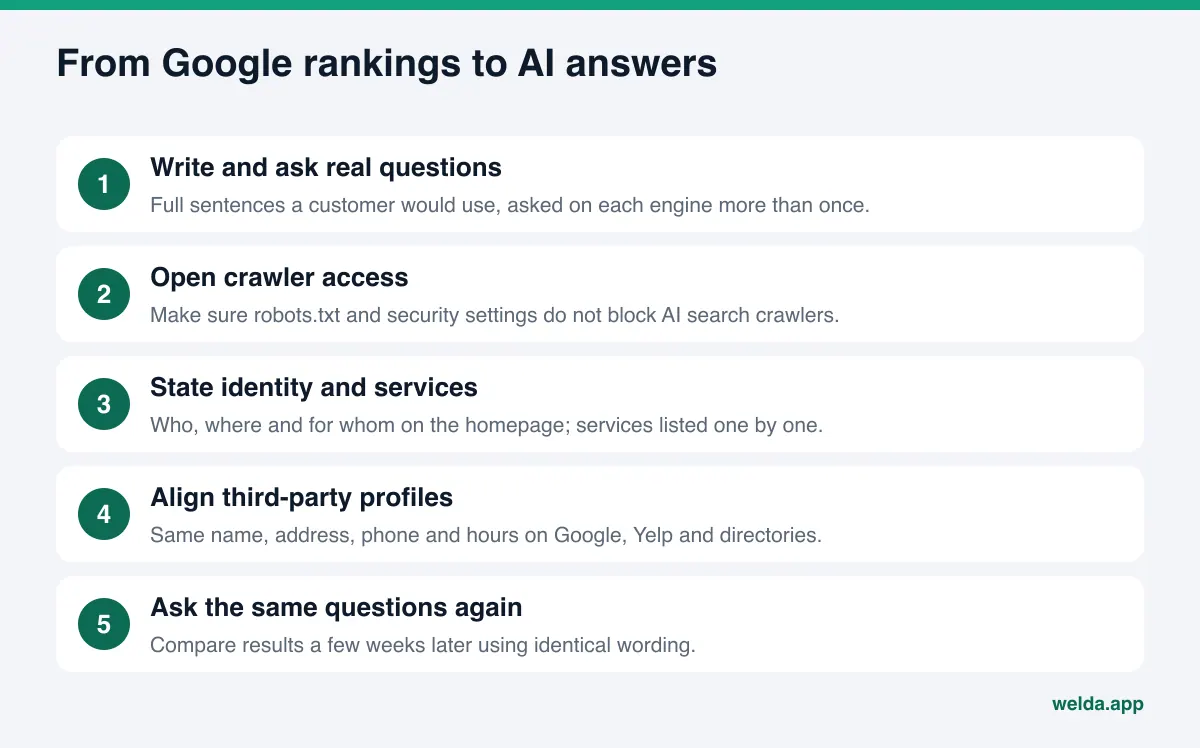
- Measure before you change anything. Write 15 to 20 questions a real customer would ask, in full sentences. Ask them in ChatGPT, Gemini, Perplexity and Google AI Mode. Note whether you are named, in what position, and who shows up instead. Ask each question more than once, since answers vary.
- Check crawler access. Open your robots.txt. Make sure OAI-SearchBot, PerplexityBot and similar search crawlers are not blocked. Ask your host or security provider whether they block AI crawlers by default.
- Add an identity sentence to your homepage. In the first paragraph, say who you are, what you do, where, and for whom. For example: "A family dental practice in Denver's Washington Park neighborhood, treating children and adults." Only state facts that are true and current.
- List services one by one. Replace "full-service" with the actual services. A short paragraph per important service is enough.
- Complete your structured data. Name, address, phone, hours, map link and sameAs links to your profiles, in LocalBusiness or a more specific type.
- Add an FAQ section. Use the questions your front desk hears every week and answer them directly.
- Align your third-party profiles. Make name, address, phone and hours identical on Google Business Profile, Yelp, the BBB and your industry directories. Reply to reviews calmly and specifically.
- Re-ask the same questions in a few weeks. New content usually takes weeks to show up in AI answers. If you do not ask the same questions the same way, you cannot compare.
The first round of this can be done by hand. The hard part is repeating it consistently and comparing results over time. Our AEO audit guide goes into what a thorough one-time check should include.
An example: a top-ranking dental practice that AI does not name
Here is a made-up example to show how this plays out. It does not describe any real business.
An example family dental practice has ranked first for "Denver family dentist" for a long time. The office manager asks ChatGPT for "a gentle family dentist in Denver who is good with anxious kids and open on Saturdays" and sees two competitors named. Their own practice is missing. The first reaction is to blame the SEO agency. The real problem is elsewhere.
A closer look shows the homepage is a large photo, the line "Smiles that last," and a booking button. Nowhere does the site say in a plain sentence that the practice treats children, offers Saturday hours or uses any particular approach with nervous patients. Hours sit inside an image. The Google Business Profile still lists old weekend hours. One competitor has a page that explains its approach for anxious children; the other has many Google and Yelp reviews that mention Saturday appointments.
The fix in this example is clear: an identity sentence on the homepage, a short section on pediatric care and Saturday hours in real text, an FAQ answering "Do you see kids?", "Are you open weekends?" and "Do you take my insurance?", and corrected hours on Google Business Profile. None of this hurts the Google ranking; the same pages simply answer more questions. Any effect on AI answers shows up weeks later, when the same questions are asked again. What matters is being able to compare before and after with identical questions.
How Welda does this work
Welda is software that measures where a business shows up in AI answers and fills the gaps on the business's behalf. For the "ranking on Google, missing in ChatGPT" problem, three pieces matter most.
Start with the free site analysis. This is the part anyone can use today, in English. It reads your homepage and a few inner pages (services, pricing, about, contact) the way Google and an AI system would. It covers most of the seven causes above in one report: whether AI crawlers can reach the site, title and description, main heading, LocalBusiness schema, consistency of name, address and phone, linked social and map profiles, FAQ, how clearly your services are described, and page speed. For each gap it shows what was found, why it matters and how to fix it, and it drafts homepage text you can use. It also asks five customer-style questions to an AI assistant that can search the web and checks whether your business name appears in the answers. That is a one-time snapshot, but it turns a hunch into data. The analysis is free once per site, does not measure rankings and does not promise any.
The Questions screen: where exactly are you missing? In the Welda panel, the questions your customers are likely to ask are put to ChatGPT, Gemini, Perplexity and Google AI three times each. The Questions screen shows one row per question and one column per engine, with your position or a blank where you were not named. Open a question and you see the answer itself, the sources it cited and the result of all three runs. This is where the gap between your short keyword and the long AI question becomes concrete. You may be named for "best family dentist" style questions and missing from every question that mentions kids or weekends. That tells you which content to write next.
The Sources screen: who is the AI reading? This screen lists the sites the AI cited and your status on each one: profile present, incomplete, unverified or unreachable. For a top-ranking business, it often shows that your own site is only one of many sources; much of the answer comes from directories, maps and review platforms. Each row carries the next action. Welda prepares some of that work; some stays with you.
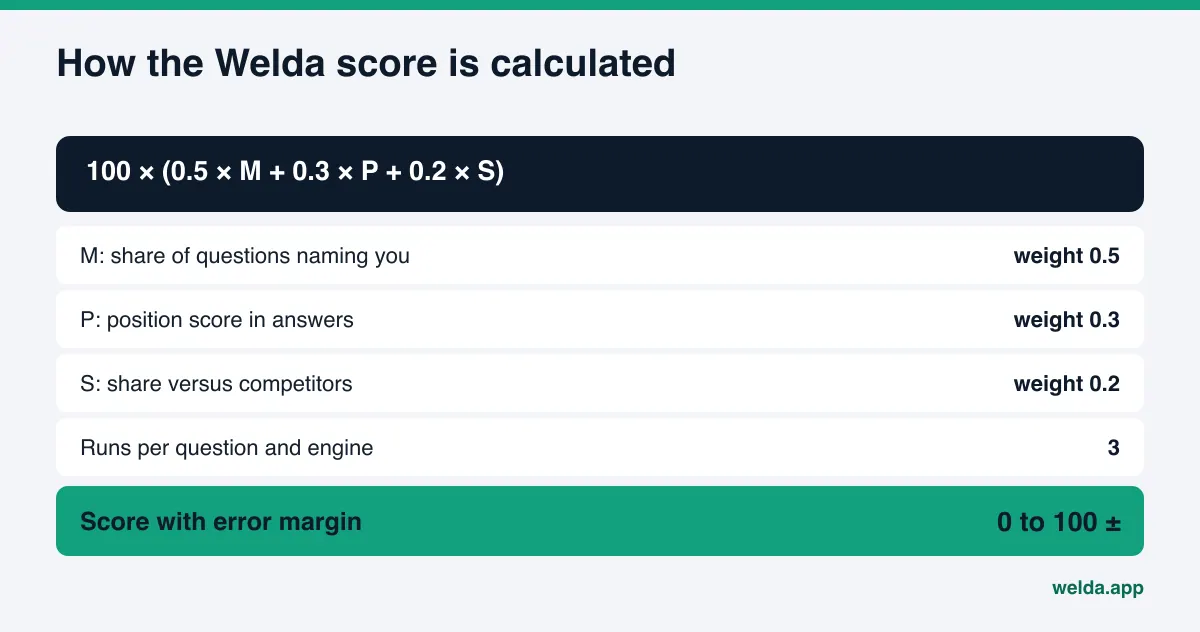
The rest of the panel supports these two screens. A single to-do list collects missing information, drafts waiting for approval and manual tasks. Welda drafts content, profile text and review replies, and you approve what gets published. On WordPress, Welda connects through a separate Editor user and an application password without installing code, and content opens on your site as a draft. The score formula is public: 100 × (0.5 × share of questions naming you + 0.3 × position score + 0.2 × share versus competitors), with an error margin from the spread across three runs. Question language can be set to English or Turkish.
Where Welda stands today: the Welda panel is in early access and is opening first to businesses in Turkey. Regular four-engine measurement is being added during early access, and panel screens are shown with sample data. What anyone can use today, in English and German, is the free site analysis. Pricing is discussed in an early-access conversation.
Limits: what Welda does not do
Wanting to be first in ChatGPT because you are first on Google is understandable. Nobody has a switch for AI answers, so here are the limits up front.
- No guarantees. Welda does not guarantee rankings or placement in ChatGPT or any other engine.
- No invented facts. If information is missing (service area, insurance accepted, weekend hours), Welda asks you rather than guessing.
- No unapproved sensitive content. Sensitive content is not published without your approval. In healthcare nothing is published automatically; every item comes to you for review, and patient data is never sent to AI.
- No fake reviews. Welda does not create reviews. The FTC's final rule on fake reviews bans them, and they would not help anyway. Welda can draft replies to real reviews.
- Some work stays with you. Resolving negative reviews, creating directory accounts and press outreach are the business's job. Welda lists them; it does not run them for you.
- It takes time. New content usually takes weeks to appear in AI answers.
- Your content stays yours. Welda does not host content; everything lives on your own site and profiles.
Whoever handles your SEO can keep doing it. Welda's job is to show how much of that work reaches AI answers and to fill in what does not. If you are wondering whether your current agency can take this on, see can your SEO agency do AEO for the questions to ask.
Decision checklist: where to start
For a business ranking first on Google but not in ChatGPT, the usual order is: remove blockers, then fix identity, then work on third-party sources.
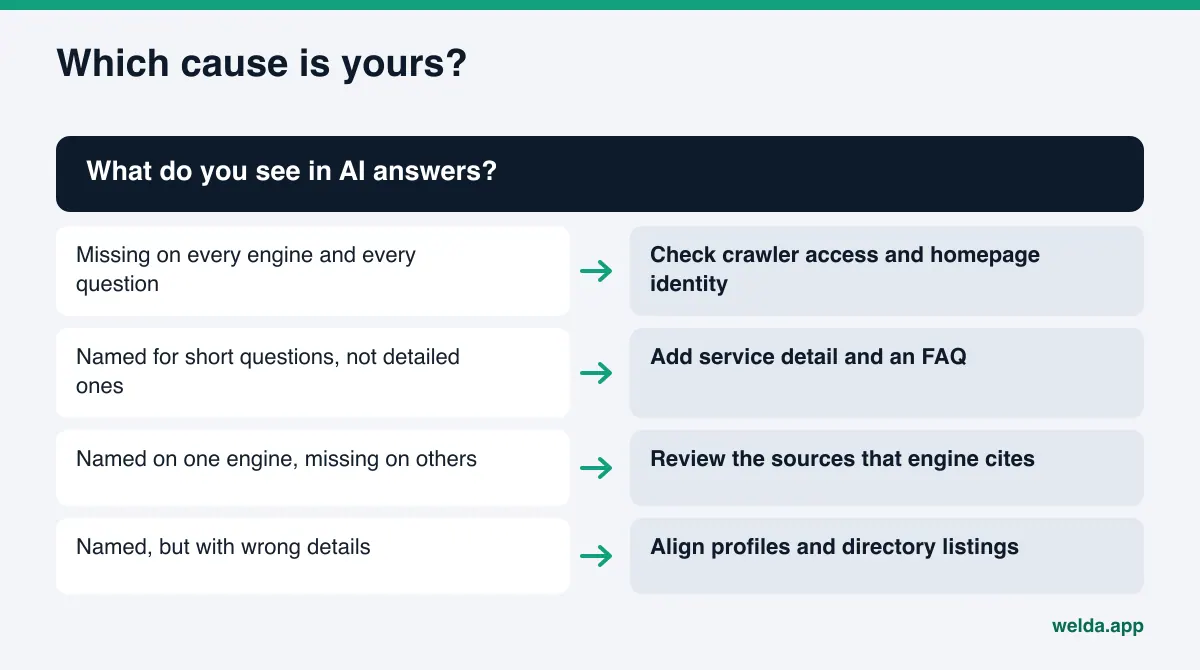
| What you see | Likely cause | First move |
|---|---|---|
| Missing everywhere, on every engine | Crawler access or weak identity | robots.txt and homepage first paragraph |
| Named for short questions, missing for detailed ones | Missing service detail | Service pages and FAQ |
| Named on one engine, missing on others | Different sources per engine | Check which sources that engine cites |
| Named, but with wrong details | Inconsistent listings | Align profiles and directories |
| A competitor is always named first | Stronger third-party coverage | Find the source they win on |
Frequently asked questions
If I rank first on Google, why doesn't ChatGPT recommend me?
Google ranks a page for a keyword; ChatGPT recommends a business for a question. The question is longer, the sources are broader, and there is room for only a few names. Your site and your profiles need to describe the business clearly and consistently.
Should I stop investing in SEO?
No. An indexed, fast, well-organized site is the foundation for AI search visibility too, and Google's AI features only link to indexed pages. AEO builds on top of SEO rather than replacing it.
Which crawlers should I check in robots.txt?
At minimum OpenAI's OAI-SearchBot and Perplexity's PerplexityBot. Blocking training crawlers such as GPTBot is a separate decision; blocking search crawlers can directly affect whether you appear in answers.
I asked ChatGPT myself and it named us. Are we fine?
One test is not enough. The same question can return different answers at different times, and your own chat history can influence the result. That is why Welda asks each question three times per engine and reports an error margin.
How long until changes show up?
Usually weeks. Removing a technical blocker can show results sooner; new content and third-party work take longer. No one can promise a specific timeline.
Does Welda track my Google rankings too?
No. Welda does not measure rankings. It checks whether your business is named in AI answers, in what position, and where competitors are ahead. Keep your existing rank tracker for Google.
Next step: see where you stand
Do not leave "ranking first on Google but not in ChatGPT" as a hunch. The fastest way to see which cause applies to you is to have your site read the way an AI reads it. Run the free AI visibility analysis to get your score, the gaps with fixes, ready-to-use homepage text and the result of the five-question AI test in one report. The results link arrives by email and stays open for 14 days.