What is an AEO audit, and where do you start? An AEO audit checks why your business does or does not show up when customers ask ChatGPT, Gemini, Perplexity, or Google's AI features for a recommendation. It works on two layers: whether AI systems can read and understand your website, and whether their answers to real customer questions actually name you. Start with the site, then measure the answers. This guide walks through both layers step by step and shows how Welda runs the audit.
What an AEO audit covers that a classic SEO audit does not
AEO stands for answer engine optimization: making sure that AI tools which answer questions directly can find, trust, and cite your business. You may also see the term GEO, short for generative engine optimization; it describes the same work and is more common outside the US. A classic SEO audit asks how your pages rank in a list of ten blue links. An AEO audit asks a narrower and, for many local businesses, more urgent question: when someone types a full question into a chat window, are you one of the two or three names in the answer?
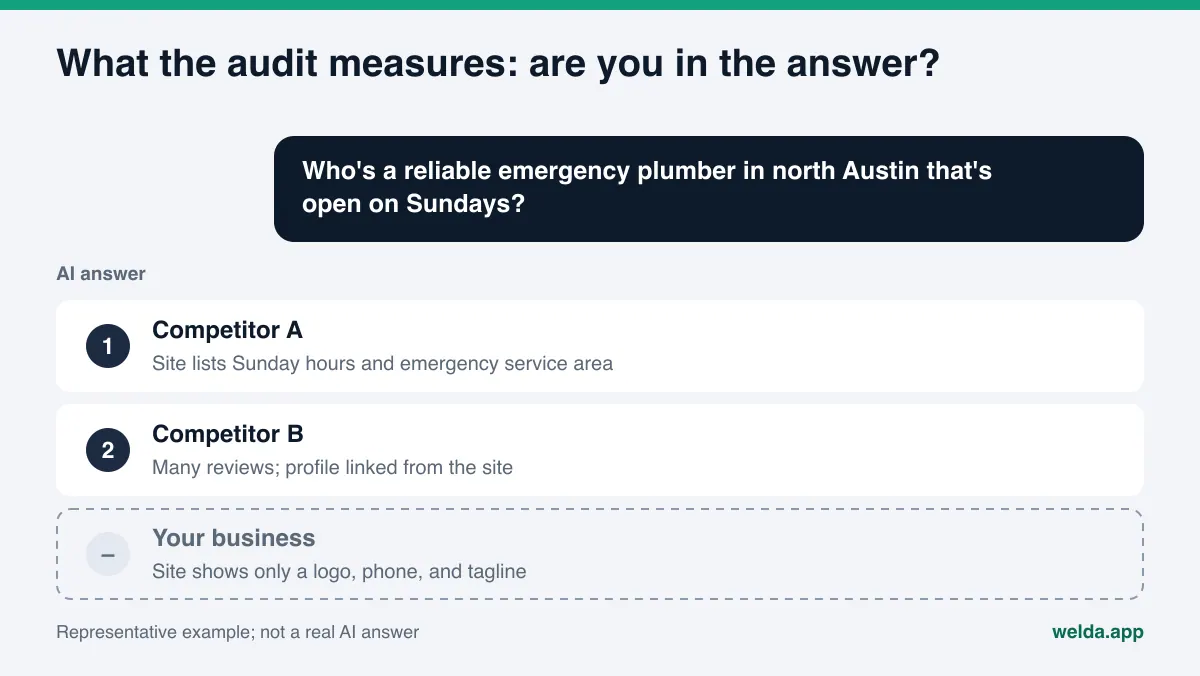
That difference changes what you check. A customer who asks "Who's a reliable emergency plumber in north Austin that's open on Sundays?" does not see a results page. They see a short paragraph with a few company names and a reason for each. Whether you make that short list depends on how clearly your own site states who you are, what you do, and where, and on what other sources such as Google Business Profile, Yelp, Angi, or the BBB say about you.
| Area | Classic SEO audit | AEO audit |
|---|---|---|
| Goal | Position on the results page | Being named, and described correctly, in the answer |
| Unit of measurement | Keyword | A full customer question |
| Crawler check | Googlebot | Googlebot plus AI search crawlers |
| Content review | Keyword and title match | Plain statements of who, what, where, for whom |
| Off-site signals | Backlinks | Profiles, directories, and review sites the AI cites |
| Competitor view | Who outranks you on a keyword | Who gets named for a question, and why |
One does not replace the other. A site in good SEO shape is a strong starting point for AEO. But ranking on page one of Google does not mean ChatGPT will recommend you. If you have been spot-checking answers by hand, the article on manual ChatGPT checks vs tracking tools explains where that approach stops being reliable.
Who needs an AEO audit?
Any business whose customers ask a question before they buy. Restaurants, hotels, home service companies, law and accounting firms, clinics, retailers, and B2B suppliers all fit. What they share is a change in behavior: questions like "best," "near me," and "which one should I pick" are increasingly typed into an assistant instead of a search box. If your name is missing from the answer, a customer can make a decision without ever seeing you.
The real value of an audit is that it replaces guesswork with a list. Instead of "our website is probably outdated," you end up with something like: an AI crawler is blocked in robots.txt, the homepage title has no city, the services page never explains how pricing works, and the Google Business Profile is not linked from the site. That list is a work order for your own team or for an agency. If you plan to hire outside help, the AEO RFP template shows how to turn audit findings into a clear scope.
How to run an AEO audit step by step
The order below is designed to give you the most information for the least effort. Access comes first, because if crawlers cannot reach your site, nothing else you fix will be seen. Doing it by hand takes an afternoon. For a fast first pass, Welda's free site analysis covers the first seven steps in one report.
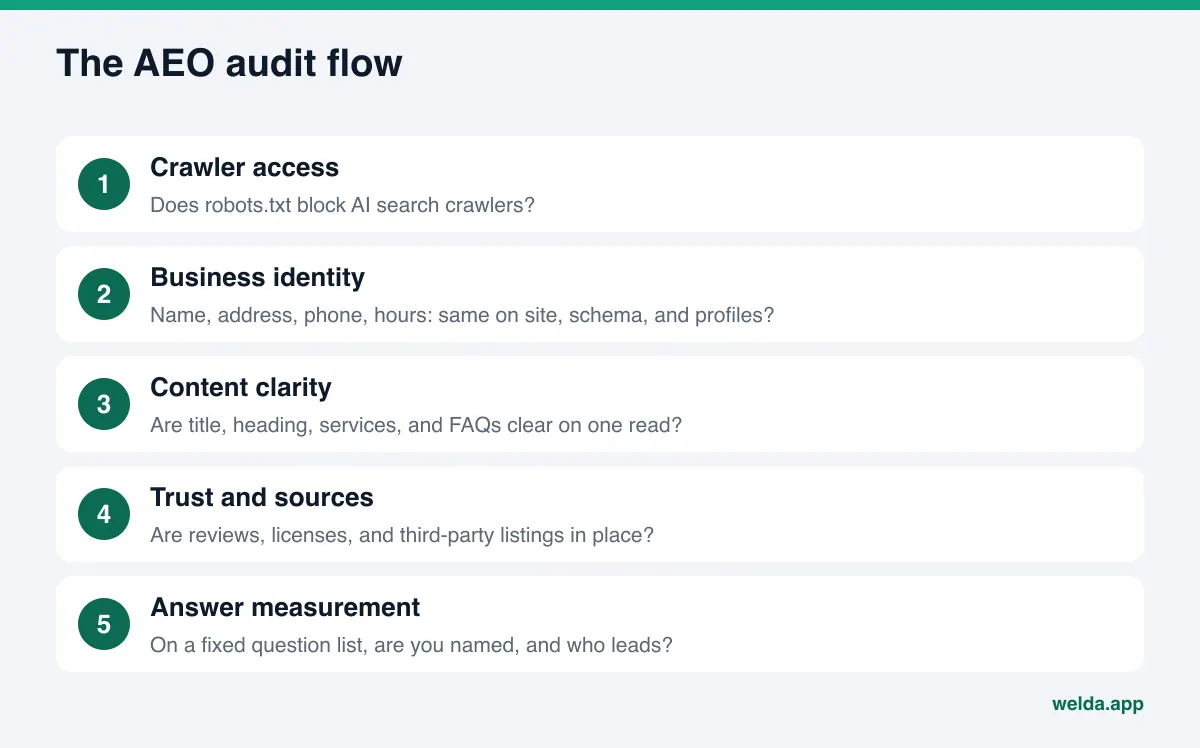
- Check crawler access. Open
yourdomain.com/robots.txt. OpenAI's crawler documentation separatesOAI-SearchBot, which surfaces sites in ChatGPT search, fromGPTBot, which collects content for model training. Perplexity's documentation describesPerplexityBotas its search crawler and says it is not used to train foundation models. On Google's side, Google states that theGoogle-Extendedtoken does not affect inclusion in Google Search. A security plugin or an old template can block search crawlers without anyone noticing. The article on whether AI bots are crawling your website goes deeper. - Read your title tag and meta description. Does the homepage title include your business name, what you do, and where you do it? A title that says "Home" or only your brand name tells an AI system nothing.
- Check the main heading and opening paragraph. Can a first-time visitor answer "who is this, what do they do, where, and for whom" within ten seconds? A tagline can be memorable and still fail to answer that.
- Review your structured data. Is LocalBusiness or Organization schema on the page with your name, address, phone, hours, service area, and social profiles? Does it match the visible text exactly?
- Match your name, address, and phone across the web. Compare the site with Google Business Profile, Apple Maps, Yelp, and any industry directory. Small differences, such as "Suite 200" on one and "#200" on another, are worth cleaning up. Are profiles linked from the site and back?
- Look at services and FAQs. Is each service described in its own plain sentence, with who it is for and how the process works? Are the five questions your staff hears most on the phone answered on the site?
- Count your trust signals. Reviews, licenses, certifications, years in business, team information, warranty and cancellation terms. When an AI tool recommends a business it looks for a reason. If the reason is not on your site, it either finds one elsewhere or skips you.
- Measure the answers. Write down the questions your customers actually ask and try them in several AI tools. Are you named? In what position? Who is named instead, and which site does the answer rely on? This is the second layer of the audit, and it should be repeated over time rather than done once.
Building the question list for your AEO audit
Step eight is only as good as the questions you use. A single broad prompt like "best plumber in Austin" is not enough. Customers rarely phrase it that way, and broad prompts tend to favor large, long-established companies with thousands of reviews. Your list should sound like your customers. Pull it from phone calls, contact form messages, and reviews from the past few months, then sort the questions into the types below.
| Question type | Example (for an example plumbing company) | What it reveals |
|---|---|---|
| Category and location | Who are good plumbers in north Austin? | Whether you make the basic list |
| Specific need | Plumber who replaces tankless water heaters near Round Rock? | Whether service detail on your site gets used |
| Timing and situation | Emergency plumber open Sunday morning in Austin? | Whether hours and availability are read correctly |
| Comparison | Which Austin plumbers give upfront flat-rate quotes? | How you are described against competitors |
| Brand | What do people say about this plumbing company? | Whether the facts about you are accurate |
These questions are examples; write yours in your customers' words. Lock the list once and use the exact same wording each time you re-measure. Change the wording and the answers change too, which makes comparison impossible. Pay special attention to the brand question. If an assistant knows your name but gives an old address, a closed location, or a wrong phone number, that is more urgent than not being mentioned at all, because it sends customers to the wrong place.
When you log results, a few columns are enough: question, AI tool, whether you were named and in what position, the other businesses named, and any sources shown. Asking the same question several times in the same tool can produce different answers. That is normal, and it is why one try is not a measurement.
How to prioritize AEO audit findings
Audits produce long lists, and trying to fix everything at once usually means finishing nothing. Ask three questions of each finding. Does it stop AI systems from reading the site at all? Does it hide information that directly answers a customer's question? How many hours will it take?
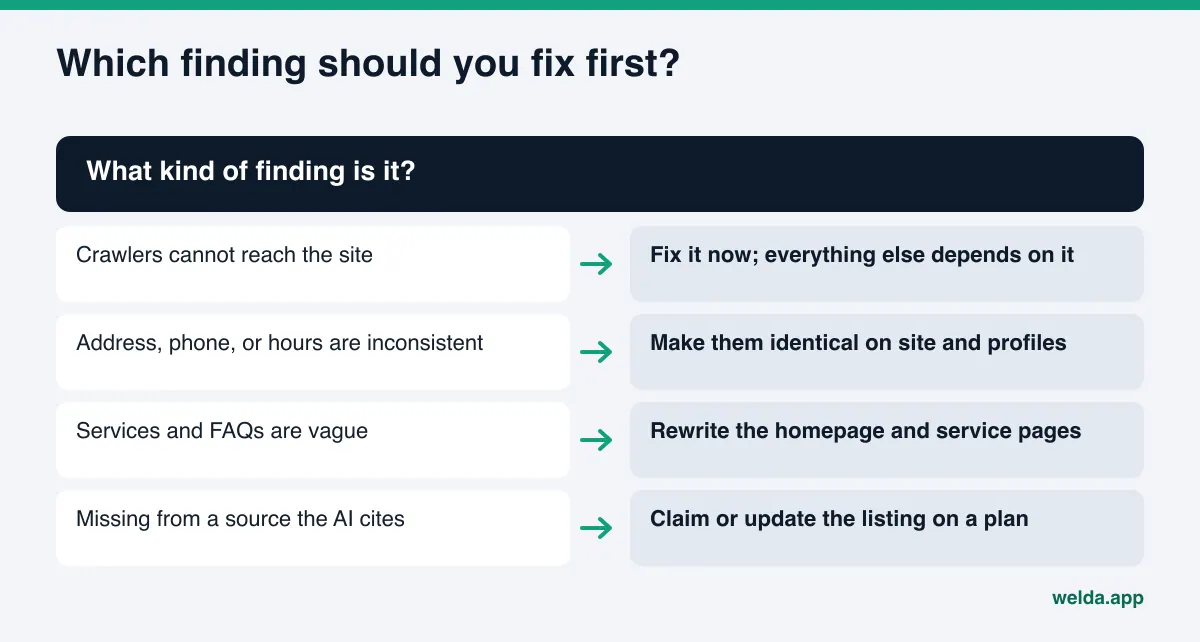
In practice the order looks like this. Access problems come first. Identity comes next: name, address, phone, and service area, written the same way on the site and on every profile. Content clarity follows: the main heading, the opening paragraph, one clear block per service, and FAQs. Off-site sources take the longest. Completing a Google Business Profile takes a few hours, but responding to an old complaint on the BBB or getting listed on Angi can depend on someone else's process.
| Finding | Impact | Typical effort | Owner |
|---|---|---|---|
| Search crawler blocked in robots.txt | Site may not be read at all | Minutes | Site admin |
| No location or service in title and description | Business gets misclassified | About an hour | Content owner |
| Schema missing or contradicting visible text | Identity stays unclear | One to two hours | Site admin |
| Address or phone differs across profiles | Trust weakens, wrong facts spread | Half a day | Owner |
| No service descriptions or FAQs | No sentence that answers the question | One to two days | Content owner |
| Absent from a source the AI cites | Competitor gets named from that source | Weeks | Owner |
The effort estimates are a rough guide and depend on your platform. For a structured way to work through off-site sources, see the article on citation gap analysis.
How Welda runs an AEO audit
Welda handles both audit layers in one flow. The site layer is covered by the free analysis; the answer layer is measured in the Welda dashboard. To be clear about where things stand: the free site analysis works in English and German and is open to anyone today. The full dashboard is in early access and is opening first in Turkey. Regular measurement across four AI engines is being added during early access, and the dashboard examples you may see use representative data. Pricing is discussed in an early access conversation.
Layer one: the free analysis audits your site
The analysis reads your homepage and a few internal pages, such as services, pricing, about, and contact, the way Google and an AI system would. It covers the first seven steps above in a single report: crawler access in robots.txt, title and description, main heading, business schema, address and phone, linked social and map profiles, FAQs, reviews and trust signals, how clearly services are described, and page speed. You get a score out of 100, split into technical and content.
An audit report is only useful if it turns findings into tasks. For each gap, the report shows what was found, why it matters, and how to fix it. You get ready-to-use copy suggestions for the homepage title, meta description, main heading, intro paragraph, and FAQs. A simulation shows how much each fix would move your score, which turns the prioritization table above into numbers for your own site. A competitor comparison runs the same checks on a competitor's site. A ready-made fix pack includes the business schema code to add to your site. The report can be downloaded as a PDF, and there is a shareable score card.
The analysis also runs a small version of step eight. It asks five questions your customers might ask to an AI assistant that can search the web and checks whether your business name appears in the answers. This is a one-time snapshot, not ongoing tracking. Each site gets one free analysis. Your email and phone number are verified, and the results link arrives by email and stays open for 14 days.
Layer two: the dashboard measures answers and competitors
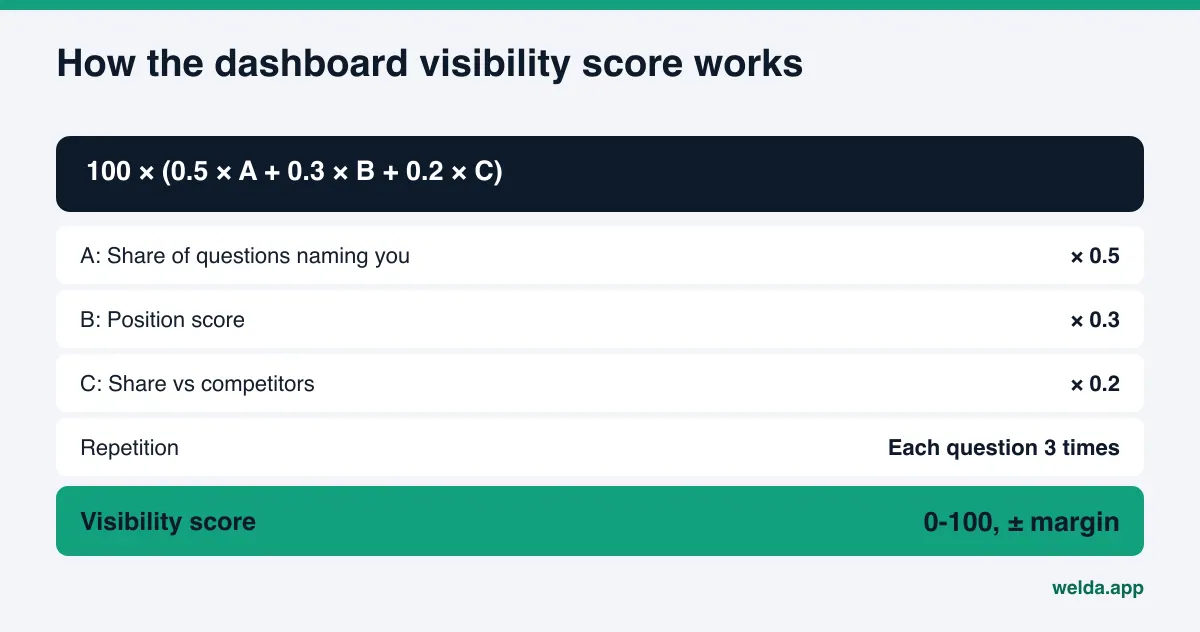
In the dashboard, customer questions are asked to ChatGPT, Gemini, Perplexity, and Google AI three times each. The repetition exists because AI answers vary even for the same prompt; the spread across the three runs produces a ± margin shown next to the score. The scoring formula is public, so when you re-audit you can see exactly which part moved.
For an audit, the competitor view is usually where the work becomes concrete. It shows your share relative to competitors, which group of questions each competitor leads, and which source the AI cites when it names them. "A competitor is doing better" is not a task. "Competitor A leads on emergency-service questions and gets cited from its Yelp and Google Business Profile listings" is.
The questions view shows the same data one question at a time: which engine names you and in what position. The sources view lists the sites the AI draws from and where you are missing. If you want to know how to read the score itself, the article on what a good AI visibility score looks like covers it.
From findings to work: the to-do list
Findings land in a single to-do list with three parts: information Welda could not find on your site and needs to ask you about, drafted content waiting for your approval, and tasks you need to do yourself, each with ready-made copy next to it. Welda does not invent facts. If something like a license number or founding year is missing, it asks rather than guessing, and once you enter it, it is applied everywhere.
On WordPress, Welda connects through a separate Editor user and an application password you create, with no code to install. Content opens as a draft on your site and goes live when you approve it. On other platforms, Welda gives you a ready package to apply by hand. Google Business Profile, Instagram, and Facebook can be connected; if they are not, the task is listed as manual. Your content always lives on your own site. Before anything is published, a compliance check flags patterns such as price claims, guarantees, and superiority claims. That check is not legal advice. A before-and-after comparison and a one-page monthly PDF report give you the baseline for the next audit.
How often should you repeat an AEO audit?
Re-audit the site layer whenever something significant changes: a new theme, a new services page, a move, a new phone number, a new security plugin. Basic items like robots.txt and titles can break on their own after an update.
Measure the answer layer on a regular schedule, because AI answers change even if you do nothing. A competitor publishes a new page, a directory updates, the model itself changes. New content usually takes weeks to show up in AI answers. So you judge whether a fix worked not the next day but a few weeks later, by asking the same questions in the same words.
Limits of an AEO audit, and what Welda does not do
An audit shows what is missing. It does not guarantee that an AI tool will recommend you, and it helps to set expectations accordingly.
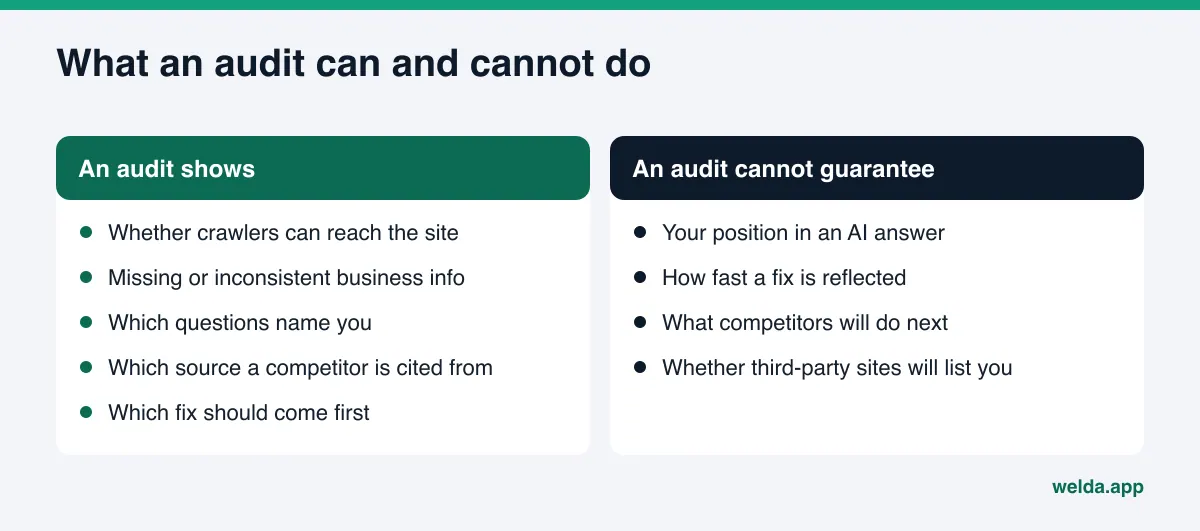
- Welda does not guarantee rankings or that you will "show up in ChatGPT." The free analysis does not measure rankings.
- Welda does not write information it does not know; it asks the business.
- Nothing sensitive is published without approval. The business always has the final say.
- Welda does not create fake reviews. Responding to negative reviews, setting up directory accounts, and press outreach stay with the business; Welda can draft the text, but you own the accounts and the decisions.
- The compliance check flags risky wording, but it is not legal advice and has not been reviewed by legal counsel. For rules on endorsements and reviews, the FTC is the authority to check.
- Fixes take time to appear in answers. A one-time check is a snapshot, not a verdict.
Ask any AEO audit tool or agency about these limits too. If someone promises the top spot in ChatGPT, either they are not measuring AI answers or the promise is not realistic.
AEO audit checklist: is your audit complete?
You can call an audit finished when you can answer yes or no to every item below. Each "I don't know" marks a gap in the audit.
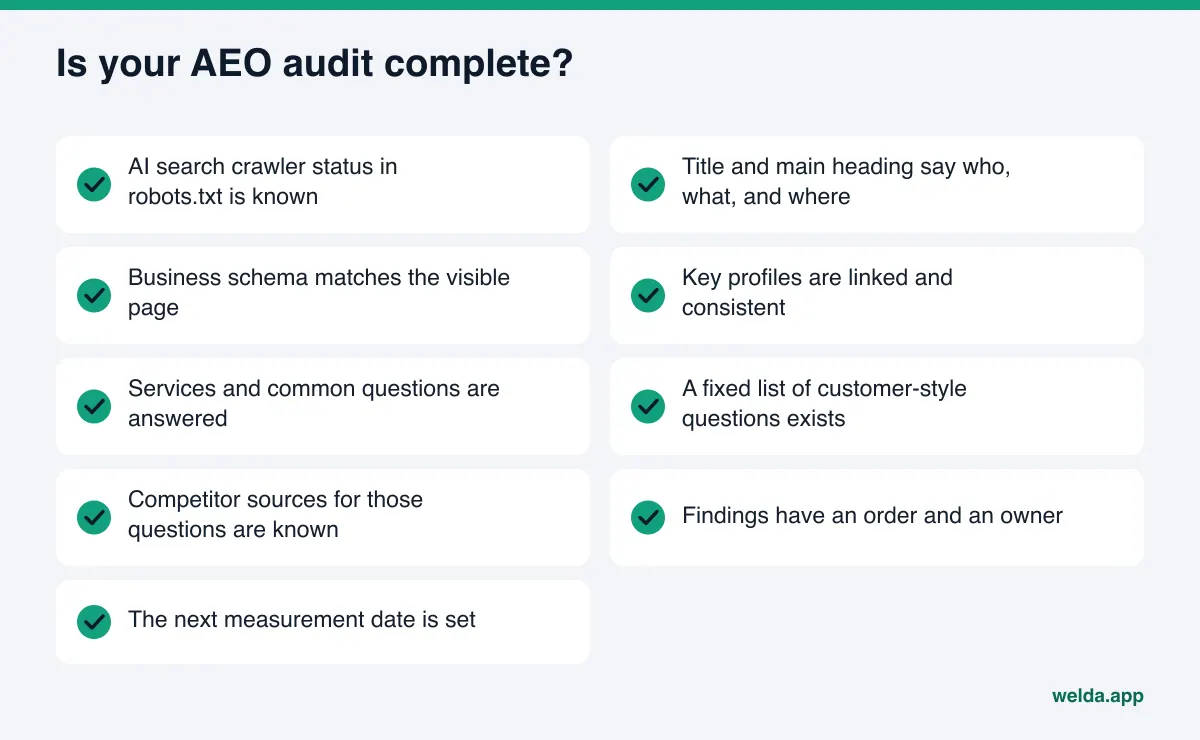
- robots.txt has been read, and the status of AI search crawlers is known.
- Homepage title, description, and main heading state who you are, what you do, and where.
- Business schema exists and matches the address, phone, and hours on the page.
- Google Business Profile, Yelp, and other key profiles are linked and consistent.
- Each service is described clearly, and common customer questions are answered.
- Reviews and trust signals are visible on the site.
- A fixed list of customer-style questions exists.
- You know whether you are named for those questions and which sources competitors are cited from.
- Findings are prioritized and each task has an owner.
- The next measurement date is set.
The free analysis answers the first six items in one report. The last four need continuity, which you can handle by hand or with a dashboard.
Frequently asked questions
Is an AEO audit the same as an SEO audit?
No. They overlap on titles, structured data, and page speed, but an AEO audit also checks AI crawler access, whether your information is clear on a single read, and whether answers to real customer questions name you.
Can I do an AEO audit myself?
Yes. All eight steps can be done by hand. The answer layer is the hard part: asking the same questions in several AI tools, several times, at intervals, and logging the results in a comparable way takes time.
Is the free analysis a full AEO audit?
It audits the site layer and includes a one-time, five-question answer check. Regular measurement across four engines with competitor tracking is the dashboard's job. The free analysis is the first step of the audit.
Is AEO different from GEO?
The two terms describe the same work. AEO is the more common term in the US; GEO is used more in Europe and elsewhere.
How soon will I see results after an audit?
Technical fixes can go live right away, but new content usually takes weeks to show up in AI answers. No one can honestly promise a timeline or an outcome.
Does Welda make the changes on my site?
On WordPress, content opens as a draft and goes live when you approve it. On other platforms, Welda provides a ready package and you or your web person apply it.
The quickest way to start your AEO audit is to have your site read. Run the free site analysis: the report shows each gap, why it matters, and how to fix it, which completes the first step of the audit.