What belongs in an AEO RFP template? An AEO RFP template is a short request-for-proposal document you send to every agency, consultant or software vendor you are considering for AI search visibility work. It covers your business and goals, the questions to track, how measurement works, who does which tasks, approvals, reporting, limits and pricing. Every vendor answers the same sections, so you compare methods instead of promises.
Why you need an AEO RFP template before talking to vendors
A typical small business owner who decides to "get into ChatGPT" emails two or three vendors and lines up whatever comes back. That is where the trouble starts. One proposal offers "20 optimized articles a month." Another offers "AI visibility monitoring." A third promises "answer engine optimization" with a one-page summary and a price. One has no measurement at all, one has measurement but never explains it, and one has a results promise. Three documents written in three different languages are almost impossible to compare.
Answer engine optimization (AEO) is not a typical web project. You may also see it called GEO, short for generative engine optimization; the work is the same. There is no single deliverable you can point to at the end. There is a measurement side: the questions your customers ask are put to AI assistants such as ChatGPT, Gemini, Perplexity and Google's AI Overviews and AI Mode, and someone checks whether your business is named. And there is a fix side: missing facts get filled in, pages get clearer, profiles on Google Business Profile, Yelp or industry directories get aligned, and reviews get thoughtful replies. If a proposal does not explain how both sides are done, you cannot check later what you paid for.
A written RFP template gives you three things:
- Comparability. Every vendor answers the same sections. A section left blank is information in itself.
- Expectations. What gets measured, when it gets reported and what cannot be promised are written down from day one. You avoid the "we never said that" conversation three months in.
- Ownership. Where content lives, who approves publishing and what stays with you if the engagement ends are settled before you sign.
Below you will find a copy-ready AEO RFP template, what a clear answer and a vague answer look like for each section, a scoring table and the red flags worth stopping for. If you are still deciding what kind of help you need, it helps to read up on what AEO consulting usually covers first.
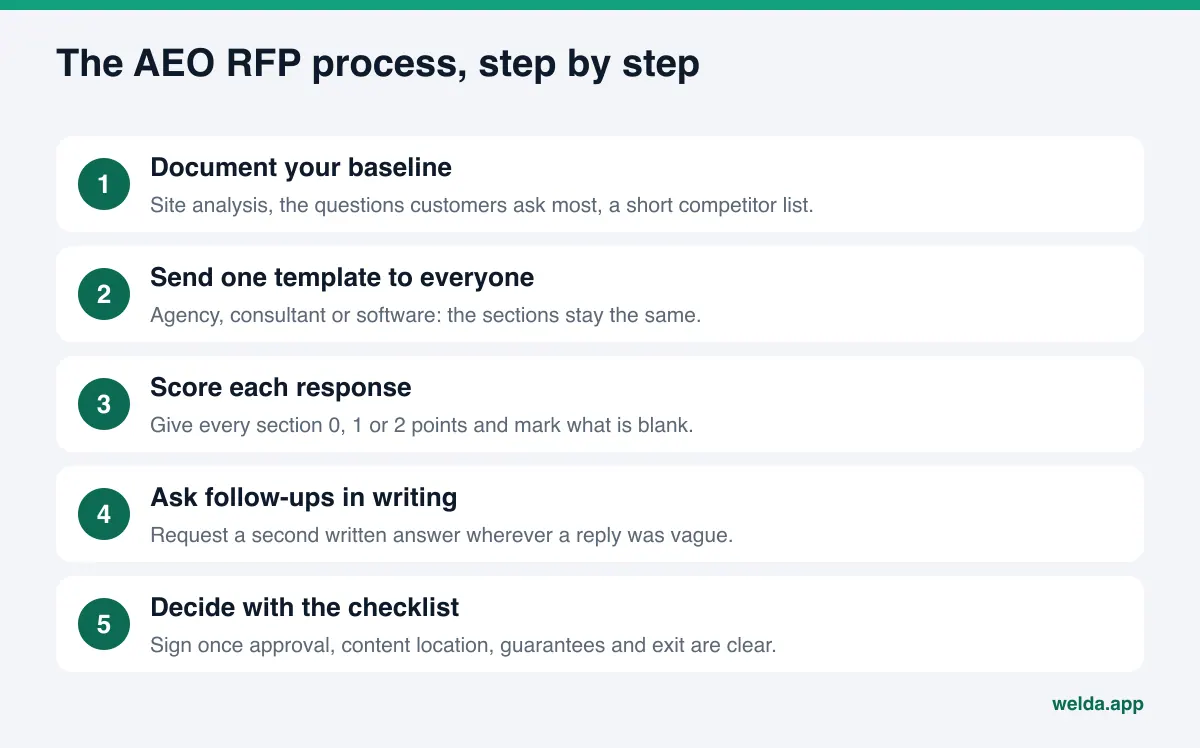
Before you send the RFP: document your starting point
Vendors write better proposals when they can see where you are today. Without a baseline, the response tends to be a generic package that would look the same for a dental office in Phoenix and a law firm in Boston.
The fastest way to build a baseline is to see how your website reads to AI systems right now. Welda's free site analysis works in English. It reads your homepage and a few inner pages such as services, pricing, about and contact. It checks whether AI crawlers are allowed in robots.txt, your page title and description, your main heading, structured business data (schema markup), name, address and phone details, whether your map and social profiles are linked from the site, whether there is an FAQ section, review and trust signals, how clearly your services are described, and page speed. You get a score out of 100, with technical and content parts shown separately, an explanation for each gap and how to fix it, and a PDF.
Attach that PDF to your RFP. Vendors no longer need to pad their proposal with a paid "discovery audit" for problems you already know about; they can write to your actual gaps. The analysis also asks a web-enabled AI assistant 5 questions a customer might ask and checks whether your business name appears in the answers. That is a one-time snapshot, not ongoing tracking, but it gives a rough answer to "where do we stand today."
Your baseline packet should include:
- The site analysis PDF or your own audit notes.
- The 10 to 20 questions customers ask you most often, in their own words: on the phone, in emails, at the front desk.
- Two or three competitors you lose business to.
- What your website runs on (WordPress, a hosted site builder, custom code) and who has admin access.
- Who controls your Google Business Profile, Yelp, Facebook and Instagram accounts.
- Any regulated topics in your field: health claims, legal advertising rules, financial disclosures.
The AEO RFP template: sections you can copy
Paste the outline below into an email or a shared document and send it to every vendor the same way. Trim the questions under each section to fit your business, but keep all the section headings. A heading a vendor skips shows up as an empty cell when you score responses.
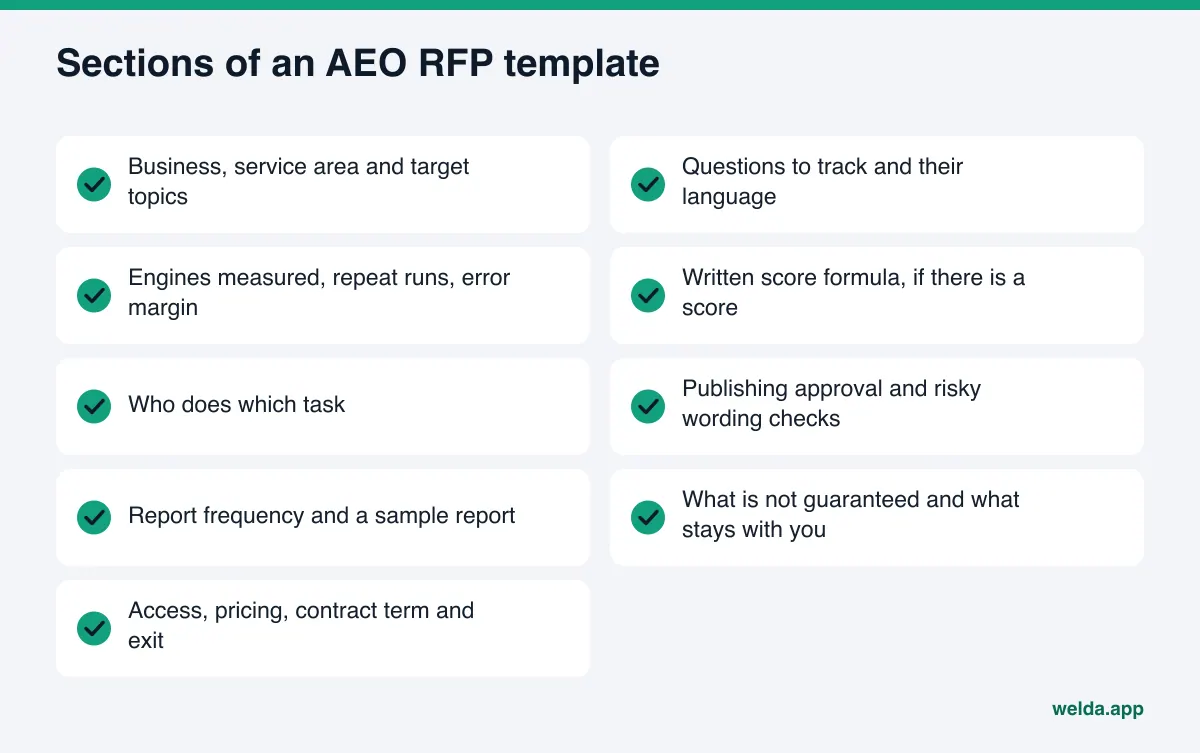
- Business and goals
- We are a [type of business] serving [city and neighborhoods]. We want customers who ask AI assistants about [topics] to see our name in the answer.
- Attached: our baseline analysis and the questions customers ask us most.
- Questions to track
- How many questions will you track? Who writes the list, and can we edit it?
- In which languages are questions asked?
- Measurement method
- Which AI engines do you measure, by name (ChatGPT, Gemini, Perplexity, Google AI Overviews and AI Mode)?
- How many times is each question asked per engine? Since AI answers vary, how do you calculate the margin of error?
- If you report a score, what is the formula? Can you share it in writing?
- Scope of work
- Which tasks on our website, profiles and review replies do you handle, and which stay with us?
- Where is content published, and under whose name?
- Approval and publishing
- Will anything go live without our written approval?
- How do you flag risky wording such as price claims, guarantees or superiority claims before publishing?
- Reporting
- How often do we get a report, and what is in it? Can you share a sample?
- How do you show before-and-after results for a specific change?
- Limits
- What do you not guarantee? What work stays with us?
- How long does it usually take for changes to show up in AI answers?
- Data and access
- How do you connect to our site and accounts? Can we revoke access at any time?
- Is any customer data sent to AI models?
- Pricing and term
- What is included and what is extra? What are the contract length and exit terms?
- If we part ways, do we keep the content, reports and measurement history?
Before you fill in the pricing section with a range, read how to plan an AEO budget so the number you put down matches the scope you are asking for.
How to read the measurement section of an AEO proposal
Measurement is where proposals differ most. AI answers are not fixed: ask the same engine the same question twice and you may get a different list of businesses. A single screenshot showing "you are in the answer now" is not measurement. A solid proposal says how many times each question is asked, how the results are combined and how variation is reported.
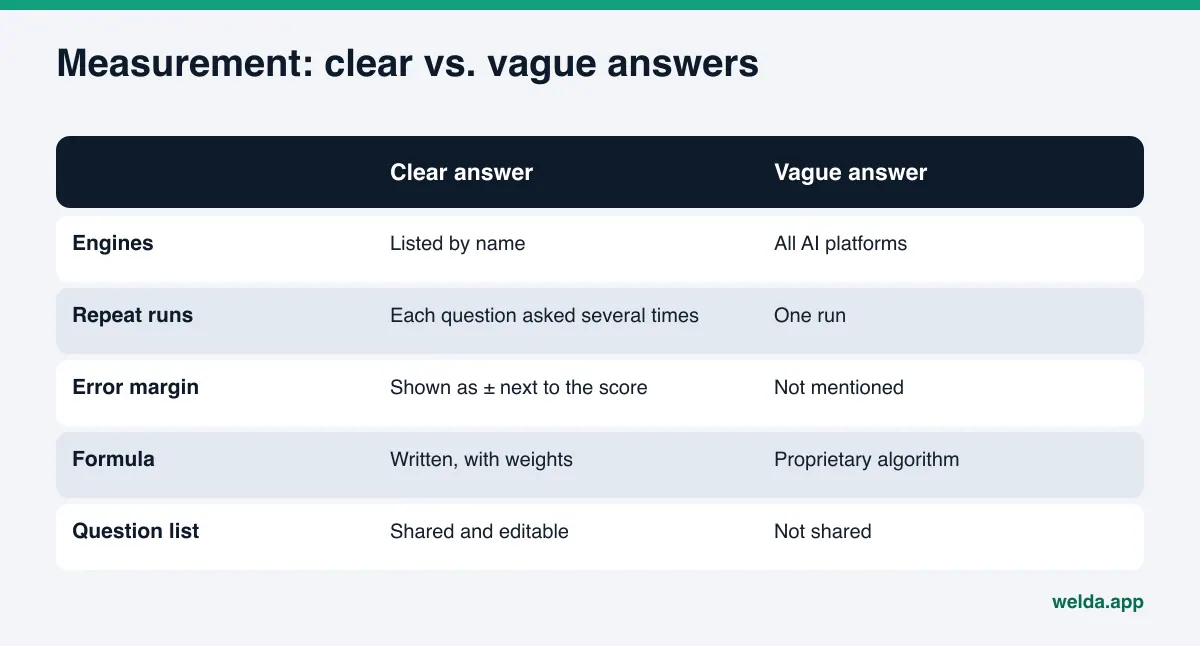
Look for four things:
- Named engines. "All major AI platforms" cannot be checked. You want a list.
- Repeat runs. Without repeats, you cannot tell whether a week-over-week change is real or noise.
- A written formula. If there is a score, you should be able to see how it is calculated. A hidden formula cannot explain why the number went up or down.
- Your questions, not theirs. Are the tracked questions written the way your customers talk, or are they easy generic queries the vendor knows it can win? Do not trust a score until you have seen the question list.
If you want context on what a number actually means once you have one, see what counts as a good AI visibility score.
Scoring vendor responses side by side
When responses come in, log each one in a table like the one below. Score each row 0, 1 or 2: 0 means no answer or a vague one, 1 means a partial answer, 2 means a clear written answer. The total does not make the decision for you, but it shows at a glance which proposal is thin where.
| Section | Clear answer looks like | Vague answer looks like |
|---|---|---|
| Engines | Four engines by name, including which Google features | "All AI platforms" |
| Repeats and error margin | Each question asked several times, variation shown | One run, screenshots |
| Score formula | Written formula with weights | "Our proprietary algorithm" |
| Question list | Shared with you, editable | Not shared |
| Publishing approval | Nothing goes live without your sign-off | "We take care of it" |
| Where content lives | Your own website and profiles | Vendor's domain or a "network" of sites |
| Guarantees | No ranking guarantee, with the reason stated | "We'll get you to #1" |
| Reporting | Sample report attached, with before and after | "Regular reporting" |
A vague answer is not proof of bad intent. Sometimes a vendor simply wrote a short reply. Ask the same question again and request a written answer. If the second round is still vague, that tells you something.
Red flags in AEO proposals
Some phrases deserve a pause regardless of what else the proposal says:
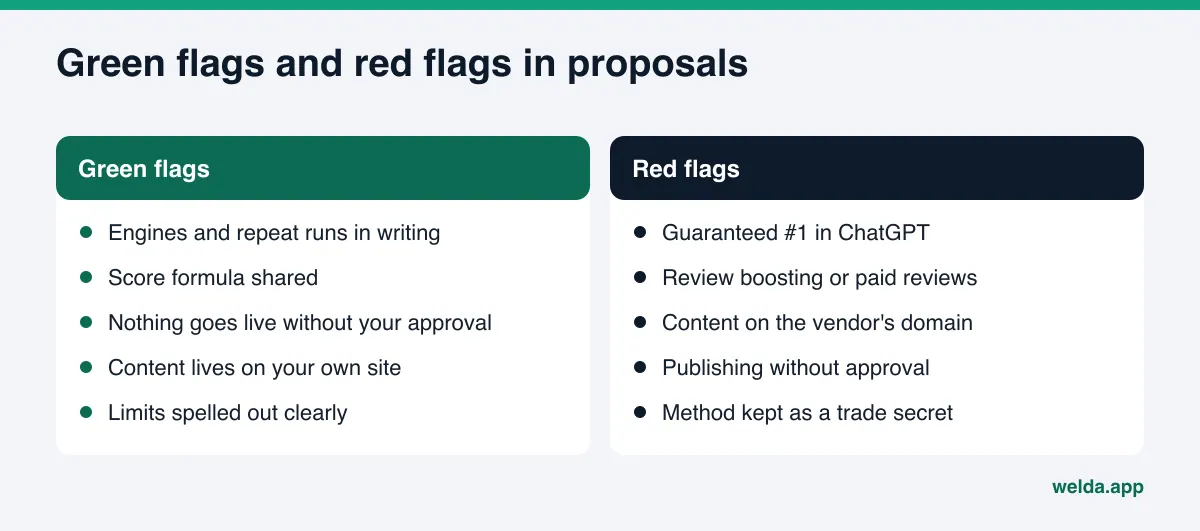
- Ranking guarantees. No outside party controls what an AI assistant says. A vendor promising "#1 in ChatGPT" is either promising something it does not measure or tying the promise to a very narrow query. More on this in why guaranteed ChatGPT rankings do not hold up.
- Review generation. The FTC's final rule on fake reviews and testimonials bans fake reviews, including AI-generated ones, and reviews bought on the condition that they are positive. Anything labeled "review boosting" deserves a close look. The acceptable version is asking real customers for reviews and replying well to the ones you get.
- Content on someone else's site. If content goes on the vendor's domain or an unnamed "publisher network," it leaves with the vendor.
- Publishing without approval. This is especially risky in regulated fields like healthcare. You should see every sentence published under your name before it goes live.
- "Proprietary" measurement. If the method is a trade secret, you cannot verify what the numbers in your reports mean.
One red flag alone may not disqualify a vendor. Just do not sign until each one has a written answer.
How Welda answers the questions in this RFP template
Welda is not an agency. It is software that measures where a business shows up in AI answers and fills the gaps on the business's behalf. Most sections of the template still have a written answer. Here we go deep on three: measurement, approval and content location, and reporting.
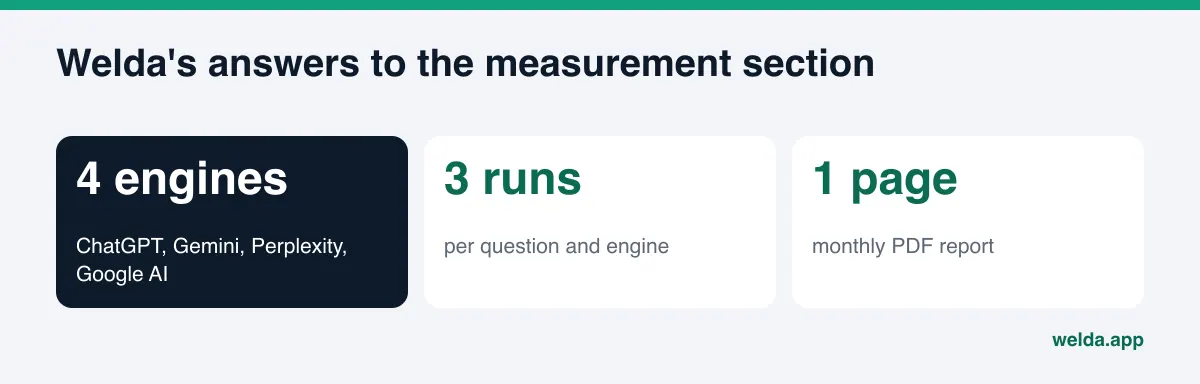
Measurement. In the Welda dashboard, the questions your customers would ask are put to ChatGPT, Gemini, Perplexity and Google AI, three times each. The questions view shows, question by question, which engines name you and in what position. Click a question and you see a summary of the answer and the sources it cited. That screen is the answer to "can we see the question list": the list is not hidden, and you can go through it one question at a time.
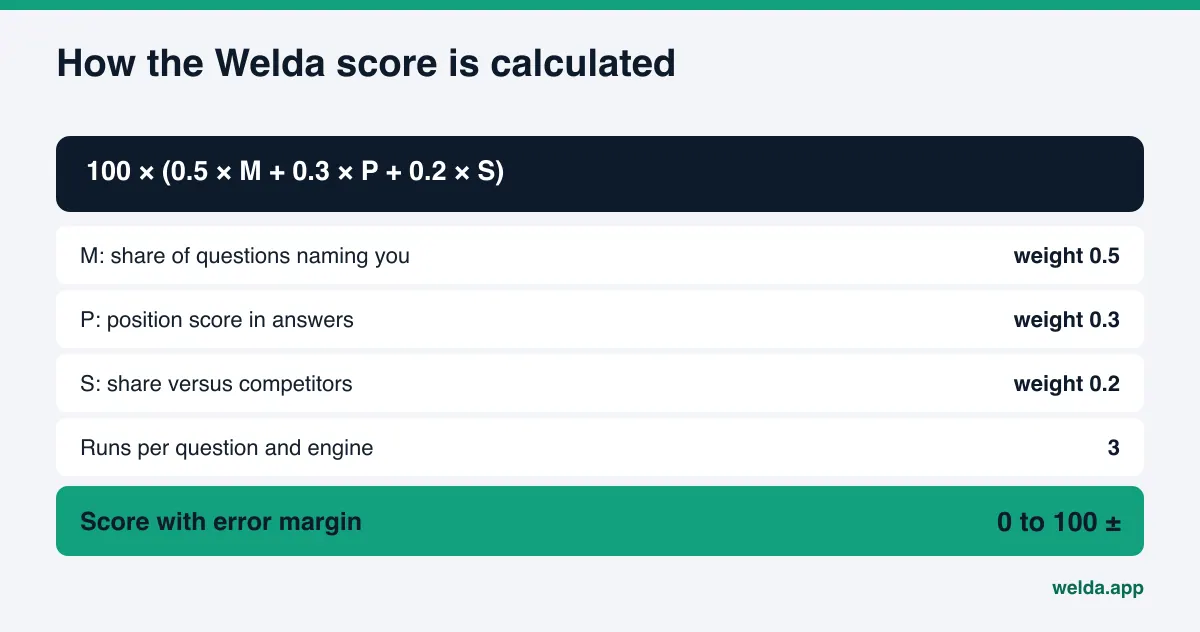
The score formula is published: 100 × (0.5 × share of questions that name you + 0.3 × position score + 0.2 × share versus competitors). The spread across the three runs produces a ± margin of error next to the score. That answers the "what is the formula" question directly, and it gives you a benchmark to hold other vendors to.
Approval and where content lives. Welda drafts content, profile copy and review replies; the decision to publish stays with you. Content always lives on your own website. Welda does not host content. On WordPress sites, you create a separate Editor user and an application password for Welda; no code is installed. Drafts open in WordPress as drafts and go live only after you approve them. To revoke access, you delete that user. For other site platforms, Welda gives you a ready-to-apply package and the changes are made by hand. Before anything is published, a compliance check flags patterns like price claims, guarantees, superiority claims and diagnostic suggestions; it is not legal advice and has not been reviewed by legal counsel. In healthcare there is no automatic publishing at all: every piece comes to you for approval, and patient data is never sent to AI models.
Reporting. Each month Welda produces a one-page report as a PDF: score, share of questions that name you, share versus competitors, what you gained and lost that month, and next month's plan. A method line at the bottom states which engines were measured and how many runs were used, so the reader of the report never has to guess.
On pricing, the honest answer is this: the Welda dashboard is in early access and is opening first in Turkey. Regular four-engine tracking is being added during early access, and the sample screens in the dashboard use representative data. The free site analysis is the part anyone can use today, in English. Pricing is not published; it is discussed in an early access conversation. Other screens such as the to-do list, competitors, sources and before-and-after comparison map to the "scope of work" section of your RFP, but they are beyond this article.
Limits: what Welda does not do
Your RFP has a separate "what do you not guarantee" section for a reason: that answer matters as much as the rest of the proposal. Welda's answer:
- No ranking guarantee and no promise that you will "show up in ChatGPT."
- Welda does not invent facts. If hours, prices or service details are missing, it asks you.
- No sensitive content is published without your approval.
- No fake reviews.
- Handling negative reviews themselves, setting up directory listings and press outreach stay with you. Welda can draft text for them, but you do the work.
- New content usually takes weeks to show up in AI answers. Factor that delay in when you ask vendors about timelines.
The free analysis does not measure rankings or guarantee them either. It shows how readable your site is and where the gaps are.
Final checklist before you accept a proposal
After scoring, run through this list once more. A proposal where you can answer "yes" to every line is, at the very least, one where you know what you are buying.
- I have seen the question list and it sounds like my customers.
- The engines and number of runs are in writing.
- If there is a score, its formula is in writing.
- Nothing goes live without my approval.
- Content lives on my website and my profiles.
- I can revoke access to my site and accounts at any time.
- There is no ranking guarantee, and the reason is explained.
- I have seen a sample report.
- The work that stays with me (reviews, directories, press) is spelled out.
- What is included, what costs extra and how to exit are in writing.
If you also want to estimate the return before you commit, how to think about AEO ROI pairs well with this checklist.
Example: scoring two proposals with the template
Take an example boutique hotel. It sends the template to two vendors: Proposal A from an agency, Proposal B from a software provider. This is a made-up scenario, not a real business or a real proposal.
Proposal A is long and polished. It lists a monthly article count, social posts and an "AI visibility report." The measurement section says only "ChatGPT and other AI tools," with no repeats and no formula. The approval section says "we'll define the process together." The guarantee section says "we'll make you visible in ChatGPT within 90 days."
Proposal B is shorter. Engines are named, each question is asked three times, and the score formula is included. The question list is attached. It states that content will open as drafts on the hotel's own site and nothing goes live without approval. The guarantee section says "we do not guarantee rankings." The pricing section has no number and says "to be discussed on a call."
On the scoring table, Proposal A scores low on measurement, approval and guarantees; Proposal B is incomplete on pricing. The owner asks the agency for its measurement method in writing and asks the software provider for a pricing call. The decision comes after the second round. The template's job is not to decide for you. It shows you which questions are still open.
Frequently asked questions
Who should receive my AEO RFP?
Anyone who would do AI visibility work for you: agencies, independent consultants and software vendors. Sending everyone the same template makes responses comparable. Software vendors may point to product pages for some sections; ask for written answers anyway.
Should I include a budget in the RFP?
A range helps vendors propose a realistic scope. Without one, you will get proposals at very different scales, which makes comparison harder.
Does a free site analysis replace a proposal?
No. The analysis shows your site's current state and gaps and runs a one-time check with 5 questions. It is not ongoing measurement or fix work. It is useful as the baseline you attach to the RFP.
What if a proposal includes a ranking guarantee?
Ask in writing which questions, which engines and which measurement method the guarantee is tied to. Since no outside party controls AI answers, a general guarantee is not a measurable commitment.
How many repeat runs are enough?
There is no single right number. What matters is that repeats happen and that variation is shown in the report. Welda asks each question three times per engine and calculates the margin of error from the spread.
I'm in healthcare. What should I add to the template?
Add a separate section asking that nothing is published without approval, that patient data is never sent to AI models, and how wording that may conflict with advertising rules is checked. Those checks are not a substitute for legal advice.
What should I keep if the engagement ends?
The content published on your site, the copy on your profiles and the reports you received. If content lives somewhere else, it may disappear when the contract ends. Settle this at the proposal stage.
Want a baseline before you send your AEO RFP template out? Run the free site analysis and attach the PDF. You will see right away which vendors wrote their proposal for your site and which sent a stock package.