How do you calculate AEO ROI? AEO ROI compares what you spend to show up in AI answers, in money and in hours, with the extra profit those answers bring in. You build it in three layers: first measure visibility, then track the leads that come from AI assistants, and finally compare the profit on those leads with the cost. An honest AEO ROI figure is a range with a margin of error, not a single number.
When ChatGPT, Gemini, Perplexity or a Google AI Overview tells someone "here are three HVAC companies in Plano that do same-day repairs," most people pick from that short list. If you are on it, you have a chance at the job. If you are not, you never hear about the customer at all. AEO (answer engine optimization) is the work of getting onto that list with accurate information. You will also see it called GEO, short for generative engine optimization; the two terms describe the same work. Every owner who puts time or budget into it eventually asks the same question: is this paying for itself?
This guide answers that with a method rather than made-up benchmarks. You will see which costs belong in the calculation, how to separate AI-referred customers from everyone else, which early signals are worth watching, and where the math can mislead you. In the middle there is a clearly labeled sample scenario; its numbers do not come from a real business and exist only to show how the calculation is assembled. If you want your own starting point before you begin, the free site analysis reads your site the way Google and AI assistants do, gives you a score out of 100, and checks whether your business is named in answers to five questions a customer might ask. That becomes the "before" column of your ROI sheet.
Why is AEO ROI harder to measure than paid ads?
With a paid search campaign, the chain is visible end to end. You pay for the ad, the ad platform shows clicks, and you tie sales back to the campaign. With AI search visibility, that chain breaks in several places.
- Zero-click decisions: The customer reads the answer, sees your name, and calls you or taps for directions without ever loading your website. Your analytics never see that visit.
- Delayed decisions: Someone asks an AI assistant on Monday and types your business name into Google on Thursday. In analytics, that visit shows up as direct or organic search.
- Answers that vary: Ask the same question twice and you can get two different answers. One screenshot proves neither success nor failure.
- Lagging effect: New content usually takes weeks to show up in AI answers. If you run the numbers at the end of month one, you see the cost but not yet the return.
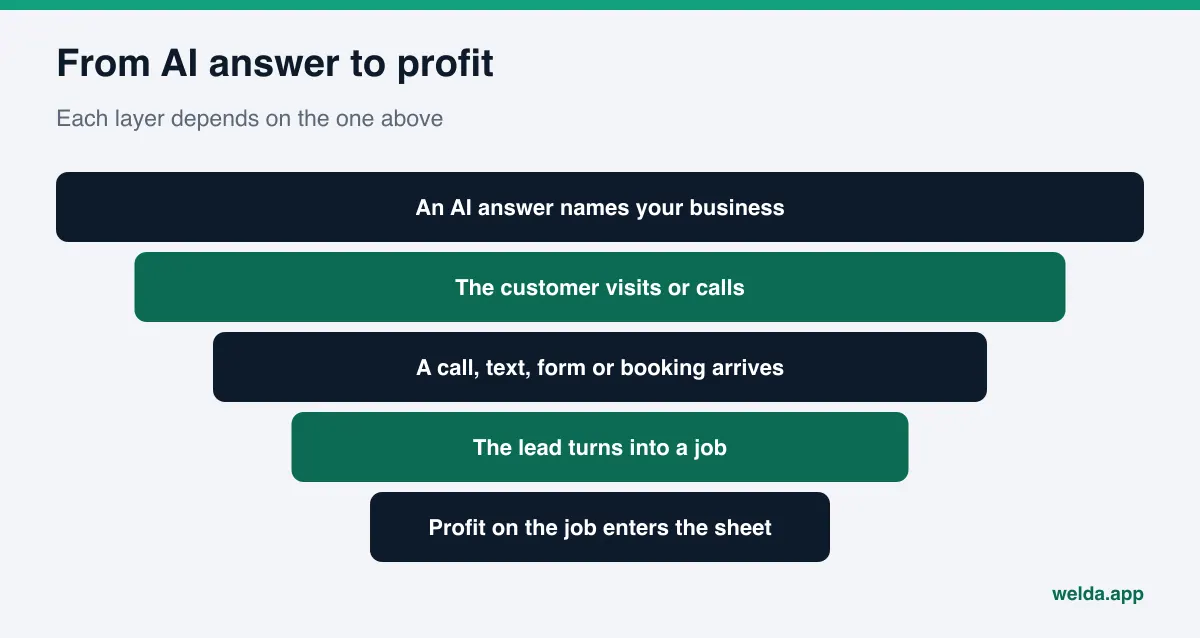
That is why AEO ROI works best as three connected layers rather than one number. Visibility gives early signals, leads show up in the medium term, and revenue gives the clearest answer last. Leave out a layer and your calculation will be either too optimistic or too pessimistic.
It also helps to keep AEO and classic SEO apart. Ranking on page one of Google does not mean ChatGPT will recommend you. We covered the difference between rank tracking and tracking AI answers in our guide to a ChatGPT rank tracker. For ROI, the distinction matters: counting organic search traffic as an AEO result inflates the return.
The three layers of AEO ROI: visibility, leads and revenue
The table below shows what to measure in each layer, where the data comes from, and when it starts to mean something.
| Layer | What you measure | Where it comes from | When it becomes meaningful |
|---|---|---|---|
| Visibility | Share of questions that name you, your position in the answer, your share against competitors | Asking the same question set across AI engines, repeatedly | From the first baseline; changes take a few weeks |
| Leads | Visits, calls, texts, form fills and bookings that came from AI assistants | Analytics, link parameters, a "how did you hear about us" question, your lead log | After visibility moves, usually within a few months |
| Revenue | Gross profit on those leads, plus repeat customer value | Your POS, booking system, invoicing or accounting software | As leads accumulate and close |
The order matters. Leads do not rise before visibility does, and revenue does not rise before leads do. The reverse is not always true, though. If visibility goes up and leads stay flat, the problem is usually the information in the answer. Your name appears, but your service area, hours or price range is wrong. The fix there is accurate information, not more visibility.
How to calculate AEO ROI, step by step
The seven steps below work with a spreadsheet or a notepad. None of them needs special software; software only makes the measurement consistent and repeatable.
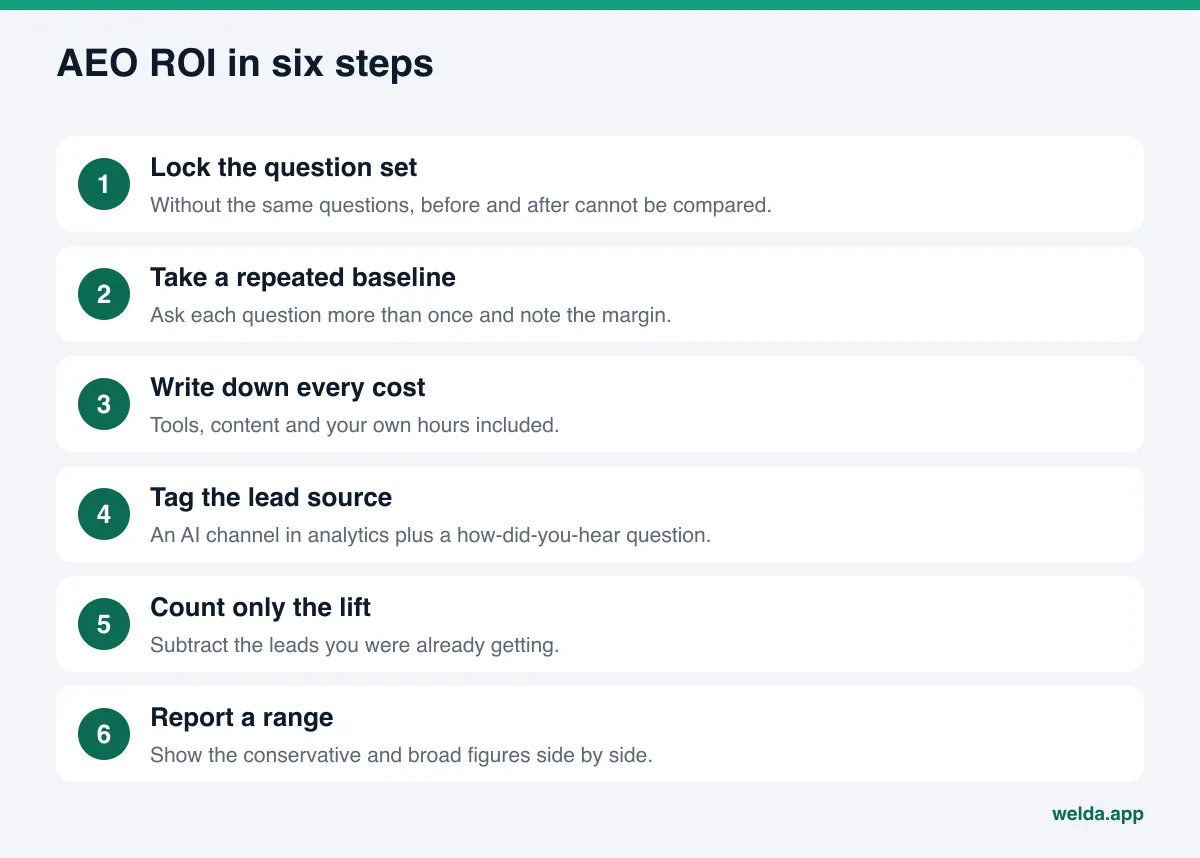
- Lock your question set. Write 10 to 30 questions your customers would ask an AI assistant, broken out by service, neighborhood, price and who it is for. If the list keeps changing, your before-and-after comparison stops meaning anything. Our guide on how to find the questions customers ask AI walks through building it.
- Take a baseline. Ask those questions across the engines and record which ones name you and in what position. Ask each question more than once; a single answer is partly luck.
- Write down every cost. Software or service fees, content writing, photography, and the one owners forget most: hours spent by you and your staff. Multiply those hours by what that time would earn on other work.
- Tag the lead source. Separate AI-referred visits in analytics, and make "how did you hear about us" a standard question on calls, texts and booking forms. Add "ChatGPT or another AI assistant" as an explicit answer option.
- Work out customer value. Use profit, not revenue. Take the gross profit on an average sale and multiply by how often a customer comes back in a year. For one-time jobs, count only the first sale.
- Count only the lift. Not every AI-referred lead is the result of your AEO work; some were already coming in. Average the baseline period and count only the increase.
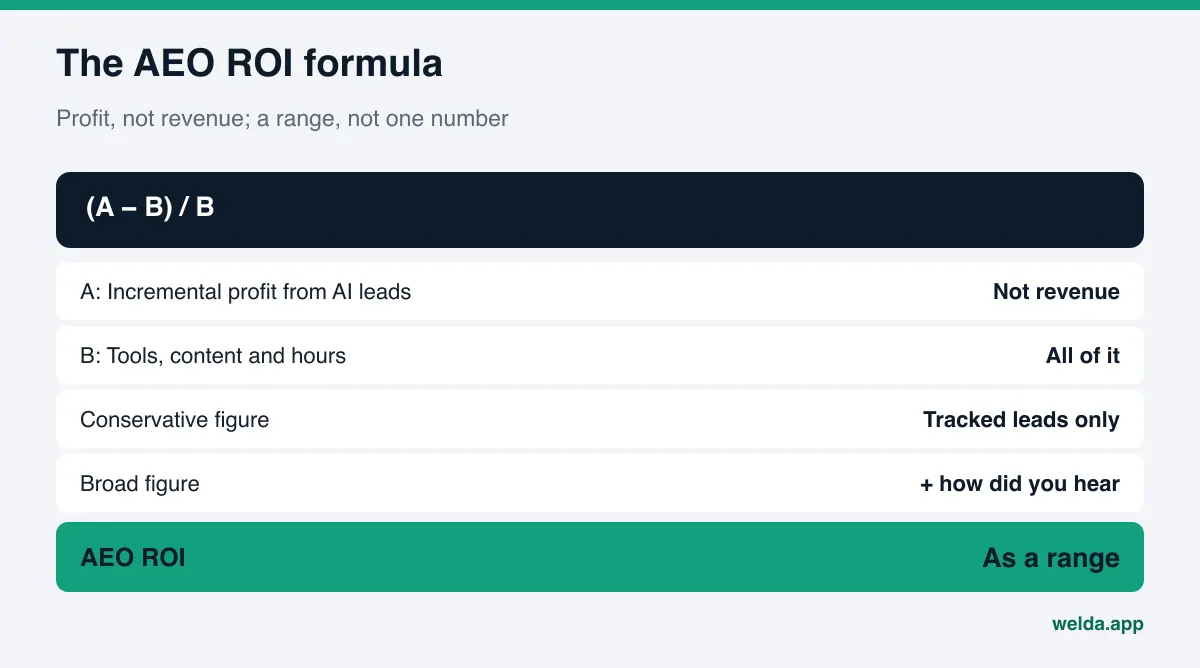
- Report a range. ROI = (incremental profit minus cost) divided by cost. Calculate it twice: once with only the tracked leads (conservative) and once adding the "how did you hear about us" answers (broad). The true figure sits somewhere between the two.
The weakest link is usually step four. If AI-referred customers are not tagged, the other six steps cannot save the calculation. For a practical setup checklist across your site, our AEO audit guide is a good place to start.
How do you tell which customers came from AI search?
The lead layer is the backbone of AEO ROI. You need three sources at once, because none of them shows the whole picture on its own.
Analytics and link parameters. Some AI assistants tag the links they send to your site. OpenAI states in its publishers and developers FAQ that ChatGPT automatically adds utm_source=chatgpt.com to referral links from ChatGPT search. That parameter appears as a source in your analytics. Visits from other engines can usually be separated by the referring domain. Creating a dedicated "AI assistants" channel group in your analytics makes month-over-month comparison much easier.
Asking directly. On the phone, in text replies, on booking forms and at checkout, a "how did you hear about us" question is the only way to catch zero-click decisions. Fix the answer options. Instead of a vague "online," offer "Google search," "Google Maps," "Yelp," "ChatGPT or another AI assistant," and "referral" as separate choices. Make sure your team asks every time; skipped questions drag the number down.
Your lead log. Keeping calls, messages, form fills and appointments in one place is what lets you count, at month end, which lead came from where. If leads are scattered across inboxes and phones, your ROI becomes a guess.
When you combine the three, avoid counting the same customer twice. A visitor who arrived with the ChatGPT parameter may also say "ChatGPT" on the phone. In the conservative calculation count only one source; in the broad one, merge both and remove duplicates.
Sample scenario: AEO ROI for a local HVAC company
This scenario exists to show how the math fits together. Every number is a sample value; none comes from a real business, a real measurement or Welda pricing. We use "units" instead of dollars so you can drop in your own figures.
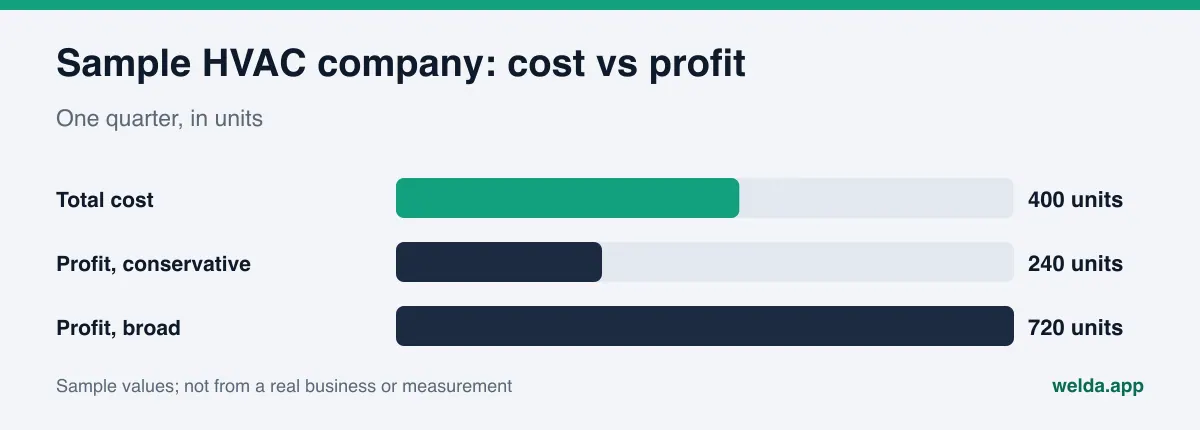
A sample HVAC company works on AI search visibility for one quarter. It adds business information (Schema) to its site, writes a clear FAQ section, aligns its Google Business Profile and Yelp listing with the website, and replies to reviews. At the end of the quarter, the sheet looks like this:
| Line item | Conservative | Broad |
|---|---|---|
| Tools and content | 300 units | 300 units |
| Owner time (20 hours × 5 units) | 100 units | 100 units |
| Total cost | 400 units | 400 units |
| Extra jobs from AI assistants | 2 (tracked links only) | 6 (links plus "how did you hear") |
| Gross profit per job | 120 units | 120 units |
| Incremental profit | 240 units | 720 units |
| AEO ROI | (240 − 400) / 400 = −40% | (720 − 400) / 400 = 80% |
The lesson is not the number. It is how wide the range is. The conservative view says the work lost money; the broad view says it paid off. What decides which view is closer to reality is how consistently the team asked "how did you hear about us." If they asked on every call, trust the broad number more. If they asked now and then, the conservative number is the better guide.
The second lesson is about time. An HVAC company sells maintenance plans and sees the same households again. If you know a customer typically comes back for a tune-up each year, part of the profit lands in later quarters, which means the first quarter understates the return. The third lesson is about cost: the first months carry most of the fixing work, and later months shift toward monitoring and small updates. Judging quarter one by the same yardstick as quarter three is misleading.
Which early AEO metrics are worth watching?
In the first two or three months, revenue has not caught up yet. That is when you decide based on the visibility layer. For a visibility metric to be useful, it has to meet three conditions.
- Same questions: Every measurement uses the same question set. If the questions change, the score moves because of the questions, not your work.
- Repeated runs: Each question is asked more than once. AI answers vary; a jump seen in a single run can be noise.
- A margin of error: The score comes with a plus-or-minus range. A change inside that range is not a real change.
Visibility does not replace revenue, but it shows direction. If the share of questions that name you is rising and your share against competitors is growing, you can reasonably expect leads to move within a few months. If visibility does not move at all, find out why before spending more. How soon it starts to move depends on your category, your competitors and the work you do. Be wary of anyone who promises a fixed timeline; we discussed realistic expectations in how long AEO takes.
How Welda supports your AEO ROI calculation
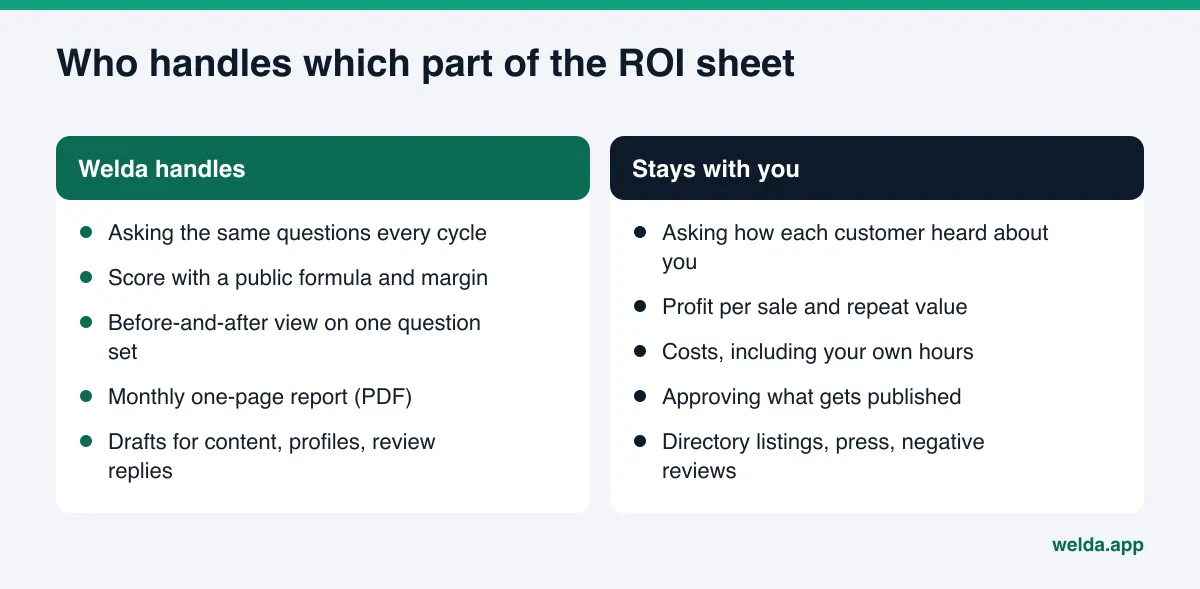
Welda is software that measures where a business shows up in AI answers and fills in what is missing on the business's behalf. In an ROI calculation, Welda takes on the two hardest and most repetitive parts: measuring visibility consistently and comparing before and after on the same yardstick. The revenue layer, your profit and your costs, stays with you.
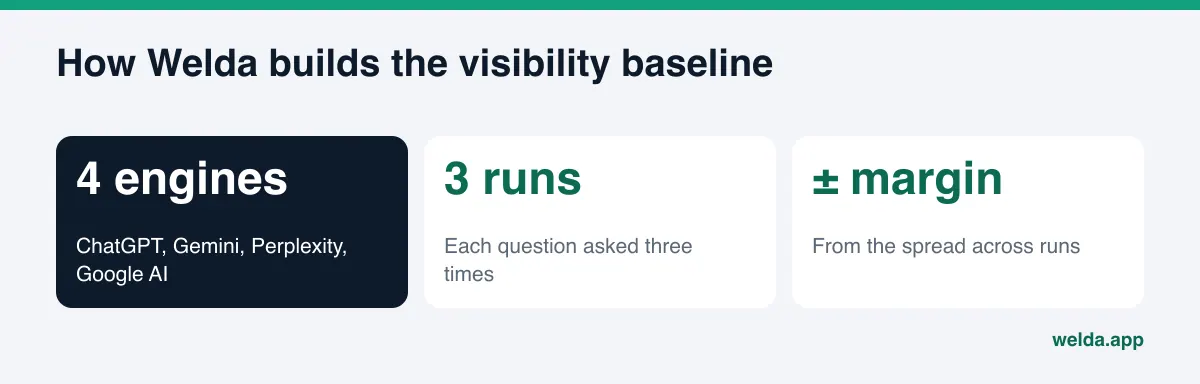
A baseline you can trust. In the Welda dashboard, the questions your customers would ask are sent to ChatGPT, Gemini, Perplexity and Google AI three times each. The score formula is public: the share of questions that name you is weighted at 50 percent, your position in the answer at 30 percent, and your share against competitors at 20 percent, all multiplied by 100. The spread across the three runs produces a plus-or-minus margin. For your ROI sheet, that means something concrete. If your baseline is 22 ± 2 and two months later you read 24, nothing may have changed yet. If you read 31, the move is outside the margin and worth talking about.
Before and after on one page. The before-and-after view shows, on the same question set, which questions started naming you and which ones dropped. The monthly one-page report (PDF) puts the score, the share of questions naming you and your share against competitors side by side, and lists what was completed that month and what is planned next. That report fills in the visibility layer of your ROI sheet. When your bookkeeper or business partner asks "what did we do and what changed," the answer is on that page.
Leads in one place. The incoming leads view keeps messages, sign-ups and the calendar together, which makes the lead layer easier to count. Asking "how did you hear about us" and calculating profit per sale are still your jobs. Welda does not know your margins and does not guess them.
Welda also helps on the cost side. The free site analysis lists what is missing and runs a simulation showing how much each fix would raise your score. That lets you spend limited hours on the work with the most effect; the fastest way to shrink the cost side of ROI is to skip low-impact tasks altogether. When it comes to fixing, Welda drafts content, profile text and review replies. You approve what gets published, and the content always lives on your own website. Whether you need a tool that only monitors or one that also does the work changes the cost side noticeably; we compared the two in AI visibility monitoring vs done-for-you AEO.
Here is where things stand today. The Welda dashboard is in early access and is opening first to businesses in Turkey. Regular four-engine measurement is being added during early access, and sample screens in the dashboard use representative data. The part anyone can use right now is the free site analysis, which works in English. Pricing is discussed in the early access conversation.
Limits: where AEO ROI can mislead you, and what Welda does not do
Even an honest AEO ROI calculation does not produce a definitive answer. Keep these limits in mind when you read one.
- Attribution is never complete. Some zero-click decisions never land in any record. The conservative figure always understates the truth.
- Other factors get mixed in. Seasonality, a promotion, a new competitor or a local news story can move demand in the same period. If you do not separate AI-referred leads from other channels, you credit AEO with someone else's work.
- Engines change. AI engines adjust their sources and answer formats from time to time. Visibility that looked strong one month can dip without anything changing on your side.
- Short windows mislead. New content usually takes weeks to show up in AI answers. Month-one ROI is almost always negative.
Here is what Welda does not do. It does not guarantee rankings or promise you will "show up in ChatGPT"; nobody can honestly promise that. It does not invent information it does not have; it asks you. It does not publish sensitive content without your approval. It does not write fake reviews. Handling negative reviews, managing directory listings like Yelp, BBB or Angi, and press work stay with you. And Welda does not run your ROI calculation for you; it makes the visibility side measurable, while profit and cost stay in your books.
Common AEO ROI mistakes
These are the errors that show up most often, and what each one does to the result.
| Mistake | Effect on ROI | Do this instead |
|---|---|---|
| Using revenue instead of profit | Overstates the return | Use gross profit per sale |
| Leaving your own time out of cost | Understates the cost | Multiply hours by an hourly value |
| Crediting all AI-referred leads to the work | Counts leads you already had | Subtract the baseline average |
| Deciding on a single measurement | Mistakes noise for results | Use repeated runs and a margin of error |
| Changing the question set monthly | Before and after cannot be compared | Lock the set; track additions separately |
| Deciding at the end of month one | Misses the lagging effect | Wait at least a quarter |
Two of these mistakes inflate the return; four shrink or blur it. Calculation errors cut both ways, so an optimistic pitch and a gloomy one can come from the same sloppiness. If an agency or consultant presents you with an ROI figure, ask about each of these six rows. A proposal that hides the calculation or shows only one line of it deserves caution.
Decision checklist: keep going, or change course?
At the end of a quarter you have data for all three layers. Use this checklist before you decide.
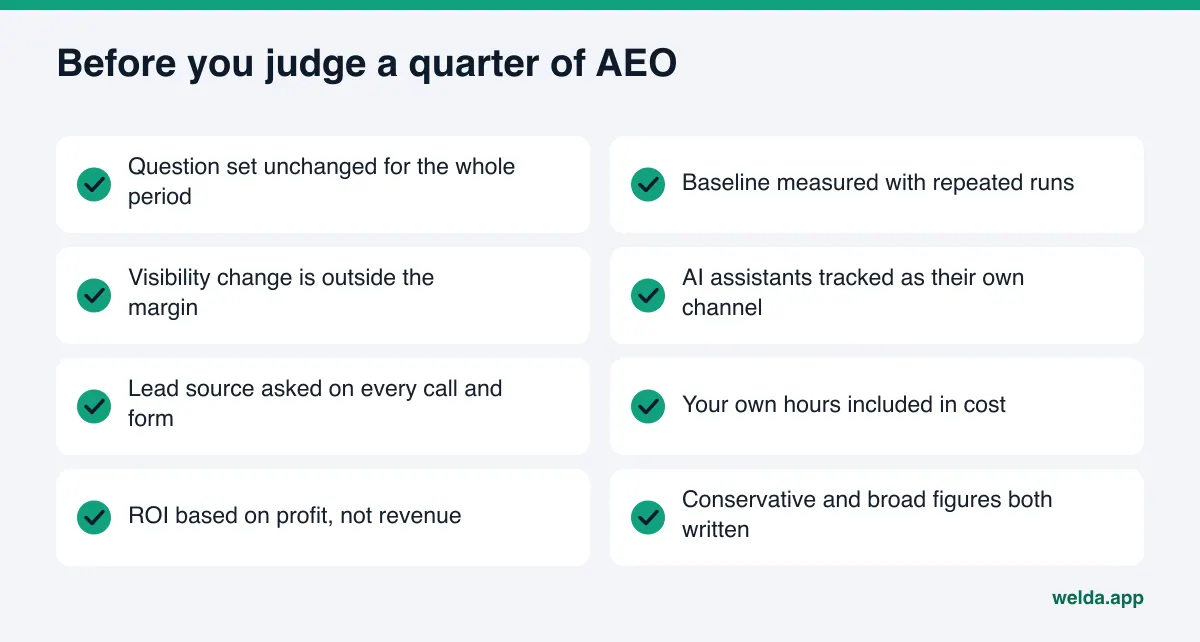
- Did the question set stay the same for the whole period?
- Was the baseline measured with repeated runs, and do you know the margin?
- Is the visibility change outside the margin of error?
- Are AI-referred visits tracked as their own channel in analytics?
- Was "how did you hear about us" asked on every lead?
- Did your own hours go into the cost?
- Was ROI calculated on profit, not revenue?
- Did you write down both a conservative and a broad figure?
If you answered "no" to several of these, the problem may be the measurement, not the AEO work. Fix the measurement first, then decide. If measurement is solid and visibility rose but leads did not, check what the answers say about you; wrong or missing information is the usual culprit. If visibility did not rise at all, check whether the basic gaps were actually closed.
Frequently asked questions
When does AEO ROI become measurable?
The visibility layer can be tracked from the first baseline. The lead and revenue layers usually need at least a quarter, because new content takes weeks to show up in AI answers and leads have to accumulate before the math means anything.
Can I fully track customers who come from ChatGPT?
Not fully. Visits that arrive through a link can show up in analytics, but customers who read the answer and call you directly leave no trace there. That is why analytics should be paired with a "how did you hear about us" question.
Which costs belong in an AEO ROI calculation?
Software or service fees, content and photography, and the hours you and your staff spend. Leaving hours out is the most common mistake, and it makes the return look better than it is.
My visibility score went up but leads did not. What now?
First check what the answers say about you: your address, hours, service area or pricing may be wrong. Then confirm that lead sources are tagged correctly. Sometimes leads did rise but were logged as "direct" or "referral."
Will Welda calculate my ROI for me?
No. Welda measures visibility, prepares the before-and-after comparison and the monthly report, and keeps incoming leads in one place. Your margins, customer value and costs stay with you, and the ROI calculation happens on your side with that information.
Does Welda guarantee a return or a ranking?
No. Nobody can honestly guarantee placement in AI answers. Welda shows measurement with a public formula and a margin of error, offers ready-to-approve work to close gaps, and reports results as they are.
Start your AEO ROI sheet with a baseline
You cannot calculate AEO ROI on a sheet with no "before" column. The first thing you can do today is record how your site looks to AI. The free site analysis reads your site, scores technical and content factors separately, explains how to fix each gap, and shows how much each fix would raise your score. Save the PDF; it becomes the first row of the calculation you run three months from now.