How long does AEO take before your business shows up in ChatGPT answers? There is no single date. Technical blockers can clear within days, new content usually takes weeks to show up in AI answers, and earning a steady place against established competitors takes months of consistent work. The real driver is where your gaps are, so the better question is which gap to close first and how you will measure progress.
"How long does AEO take" is one of the first questions owners and marketing leads ask once they decide to work on answer engine optimization (AEO), the practice of making a business easy for AI assistants to find, understand and recommend. You may also see it called GEO, short for generative engine optimization; in the US the two terms describe the same work. Before you commit budget, you want to know when you will see results. This guide explains why timelines vary so much, how long each type of fix takes to become readable, what is realistic in the first few weeks, and how to track AI search visibility with repeated measurement instead of a single screenshot. If you want to know your starting point today, Welda's free site analysis reads your site the way Google and AI assistants do and lists every gap with a fix. Every honest timeline starts from that baseline.
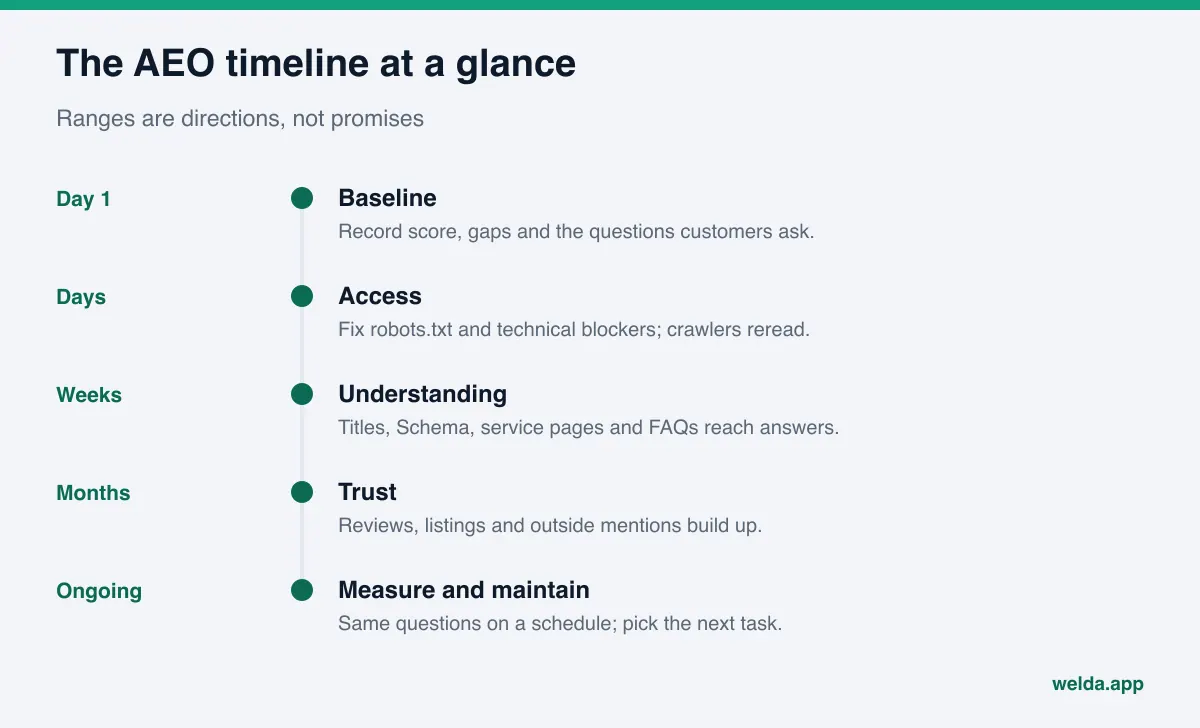
How long does AEO take? Why the honest answer is "it depends"
Most business owners know that a new page takes a while to get indexed and ranked in classic search. AI answers are a bit more complicated, because ChatGPT, Gemini, Perplexity and Google's AI features can draw on two different kinds of knowledge when they answer:
- What the model learned in training. A model picks up general knowledge from the text it saw during training. That knowledge only changes when a new model version ships, and no business controls that schedule.
- A live web search at answer time. For local and commercial questions, assistants increasingly search the web, read the pages they find and build the answer from them. Changes you make on your site and on outside sources reach AI answers mostly through this route.
The second route explains why the timeline depends on your situation. Before an assistant names you, it has to be able to reach your page, then read it well enough to match you to the question, and finally trust you enough to pick you over the other options. Which of those three steps you are stuck on decides how long you wait.
Take a simple example. If your robots.txt file blocks AI crawlers, the problem is one line and the fix is quick. OpenAI notes in its documentation that after a site updates robots.txt, it can take about 24 hours for its search systems to adjust. On the other hand, if your competitors have built up years of reviews and mentions on Google Business Profile, Yelp and local best-of lists, closing that gap takes weeks and months. Both count as AEO work. Their timelines have little in common.
The three stages that set your AEO timeline: access, understanding, trust
The most reliable way to estimate how long AEO will take for your business is to sort your gaps into three stages.
1. Access: can AI crawlers reach your site?
If crawlers cannot get in, your content cannot be a source for answers built from a live search, no matter how good it is. Typical problems at this stage are a robots.txt rule that blocks AI bots, pages that only load after a login, very slow pages, and menus or price lists that exist only as images. These are usually fast to fix. After the fix you still wait for crawlers to come back. Even for Google, crawling can take, in Google's own words, anywhere from a few days to a few weeks.
2. Understanding: can the assistant match you to the right question?
Being reachable is not enough. The assistant needs to read clearly what you do, where you are and who you serve. Page title and meta description, the main heading, LocalBusiness structured data (Schema), name, address and phone, one clear page per service, and an FAQ that answers real customer questions all belong here. You can do this work in a few days, but the effect depends on the page being read again and on customers asking the matching questions. First changes here typically appear within a few weeks.
3. Trust: does the assistant consider you a safer pick than competitors?
AI answers usually name only a handful of businesses. To choose them, assistants look beyond your site at what others say about you: Google Business Profile reviews, Yelp, the BBB, Angi for home services, Healthgrades for medical practices, Tripadvisor for hospitality, plus local news and best-of lists. This is the slowest stage, because trust is built through steady reviews, consistent listings and being mentioned elsewhere. Progress here is measured in months.
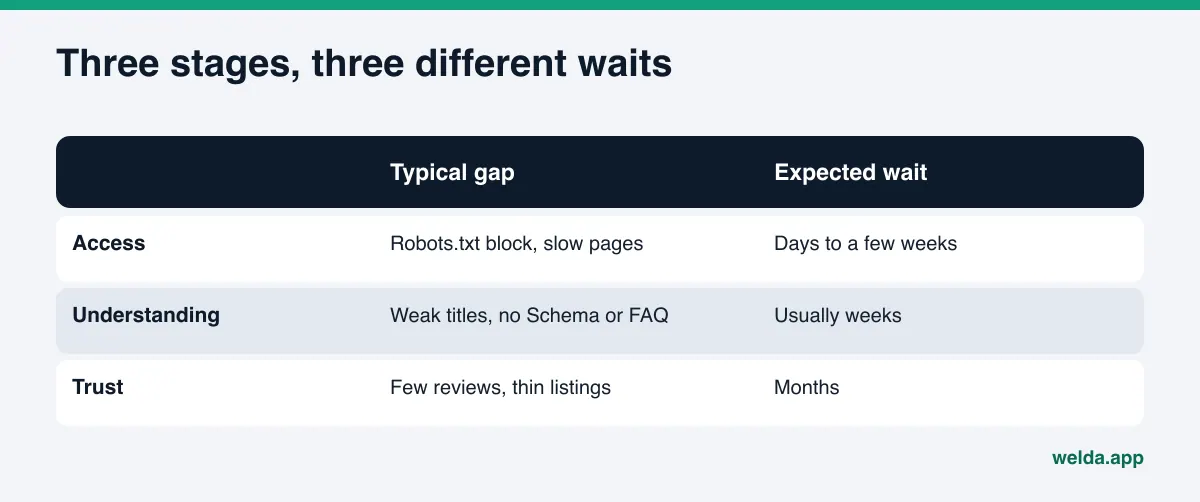
Which fixes show up when? A stage-by-stage timeline
The table below splits common AEO tasks by how long the work takes and when it is reasonable to expect an effect. These ranges are directions, not promises: every assistant crawls on its own schedule and does not give the same answer twice.
| Task | Time to do | Reasonable expectation for an effect |
|---|---|---|
| Unblock AI crawlers in robots.txt | Minutes | Depends on recrawl; first effect in days to a few weeks |
| Rewrite title, meta description and main heading | An hour or two | Once the page is reread; usually a few weeks |
| Add LocalBusiness Schema, address and phone | Half a day | Once the page is reread; usually a few weeks |
| Write service pages and an FAQ | A few days | For related questions within weeks; new content often takes weeks |
| Complete Google Business Profile | A day | Depends on how the profile and reviews are read; weeks |
| Earn reviews and reply consistently | Ongoing | Builds up over months |
| Get mentioned in local guides and best-of lists | Weeks to months | After the source is published and read; months |
The practical takeaway: in the first weeks you mostly see the effect of access and understanding fixes. Trust shows up later. So if your numbers have not moved much after the first month, it is usually not a failure. It is a sign that it is time to move to the next stage.
What speeds up or slows down AI search visibility
Two businesses doing the same work can move at different speeds. These factors matter most:
- How crowded the question is. Breaking into "best family dentist in Austin" takes longer than a question in a smaller market with only a few providers.
- Your starting point. A site with no structured data and a menu that exists only as a photo moves faster in the first weeks than a site that is already in decent shape, because the easy wins are still waiting.
- Consistency. If your phone number differs between your site, Google Business Profile and Yelp, assistants cannot tell which one to trust. Fix that before adding new content.
- Whether your content answers questions. A paragraph that answers exactly what a customer asks becomes a source more easily than a general "about us" page.
- Approval and publishing speed. If drafts wait weeks for sign-off or never get published, the clock never starts.
- Type of question. Branded questions ("Where is X Dental?") usually improve sooner. Broad "best" or "recommend" questions take longer; our guide on how to get on ChatGPT best-of lists covers that case.
One shortcut that does not exist today: buying your way into organic ChatGPT answers. We cover that in can you pay to appear in ChatGPT answers.
Example scenario: two businesses, two very different timelines
To make this concrete, picture two example businesses. Both are made up; neither describes a real company.
An example boutique hotel. The website looks great, but a plugin setting in robots.txt blocks AI crawlers. Room types are explained only through photos, and there is no structured data. Its Google Business Profile, however, is complete, and its Tripadvisor reviews are steady. This hotel's problem sits mostly in the access and understanding stages. Once crawlers can get in and the pages say clearly what the hotel offers, the trust it already earned elsewhere can come into play. Its first changes may come relatively soon, because what is missing is the reading of a reputation that already exists.
An example newly opened physical therapy practice. The site is technically clean, crawlers can get in, and service pages are written. But the practice is only a few months old: few reviews, an incomplete Healthgrades listing, and long-established competitors who have been mentioned for years. This practice's problem sits in the trust stage. More on-site edits will make limited difference; real progress comes from reviews building up and accurate listings appearing on outside sources. This business should plan for months of patient work.
If both owners asked "how long does AEO take," the honest answers would be very different. That is why any timeline should rest on the distribution of your own gaps, not on an industry average.
Your first 12 weeks of AEO: a sample plan
The plan below is a general sequence for an example local service business. The weeks show the order of work. They do not promise a result at the end of each week.
- Week 1: measure your baseline. Record where your site stands today and which questions your customers ask. Without a baseline, you cannot answer "did anything change?" later.
- Weeks 1 and 2: remove access blockers. Fix robots.txt, slow pages and text locked inside images. These are the fastest to show up.
- Weeks 2 and 3: make your identity clear. Use the same title logic, structured data, address, phone and hours on every page and every listing.
- Weeks 3 to 6: content that answers questions. One clear page per service, short answers to questions customers really ask, and a section about your location. Start with the pages you already have; see how to update old content for AI search.
- From week 4: outside sources. Complete Google Business Profile, reply to reviews on a schedule, and check that the directories that matter in your industry list you correctly.
- Weeks 6 to 12: measure again and choose the next task. Ask the same questions the same way. Where did your name start to appear, and where is a competitor still ahead? Pick the next job from that.
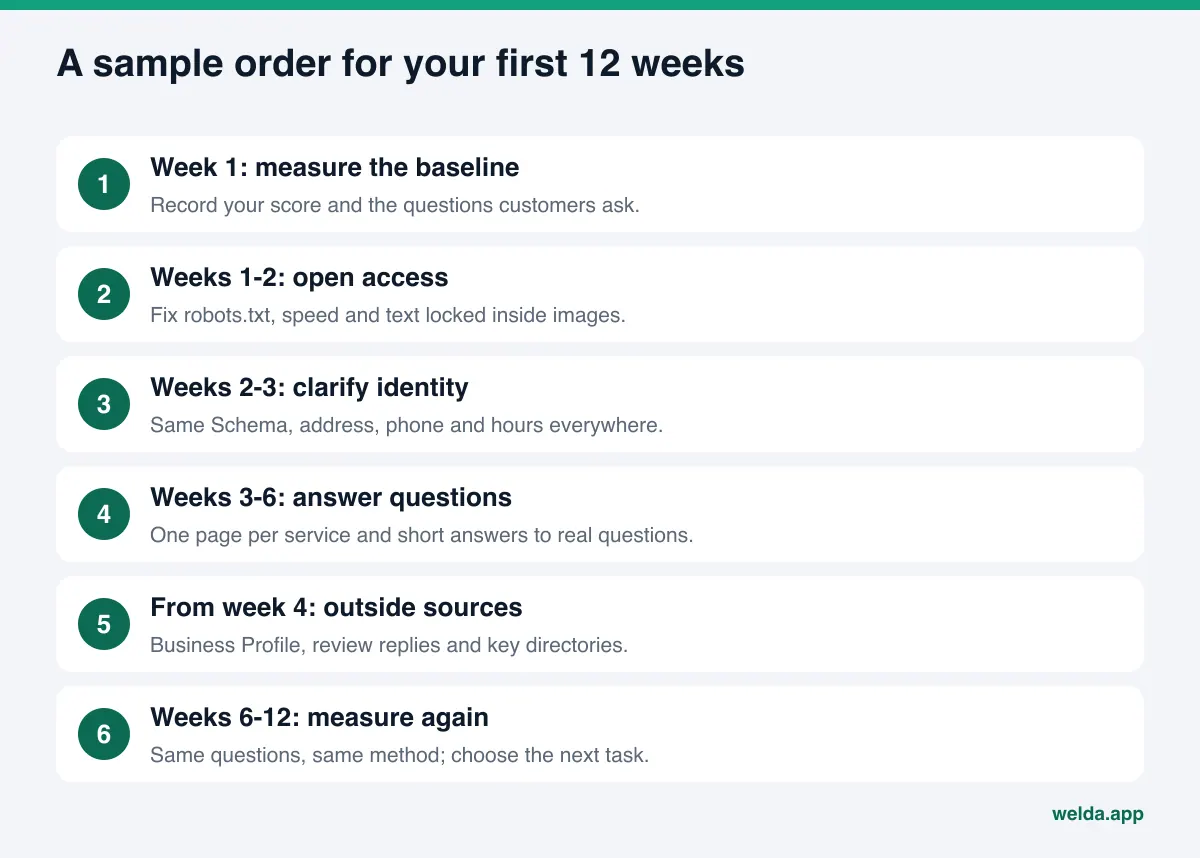
The key to this plan is order. Content written before access is fixed does not get read, and reviews gathered while your details are inconsistent do not carry their full weight. Getting the order right is the most concrete way to shorten the wait.
How to measure AEO progress without fooling yourself
The second half of "how long does AEO take" is "how will I know it worked?" The most common mistake is asking ChatGPT once and saving a screenshot. AI answers can change every time, even for the same question; you can be named today and missing tomorrow. We explain why in why AI answers change every time.
Three rules keep your tracking honest:
- Keep the question set fixed. If you change the questions every time, you are measuring your questions, not your visibility.
- Ask each question more than once. One answer can be chance. Several repeats give a more dependable rate.
- Check more than one assistant. Showing up in ChatGPT does not mean you show up in Gemini or Google's AI features. Each relies on different sources.
If you report to an owner, a board or a regional manager, show the trend, not the weekly noise. Our guide to AEO reporting for executives shows how to keep it to one page.
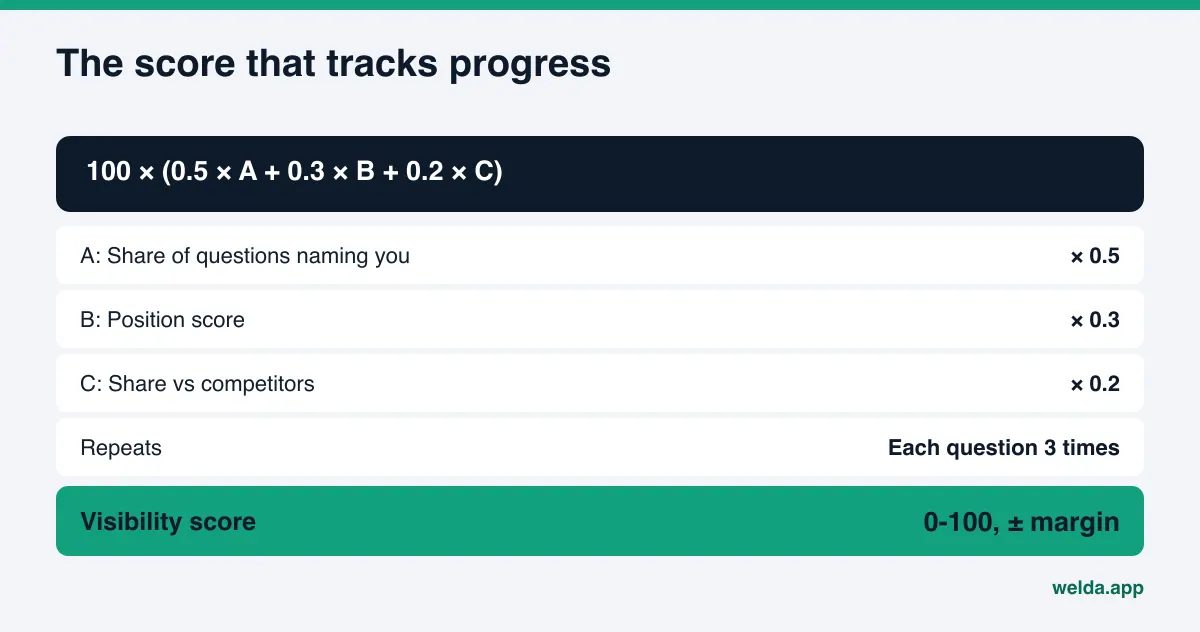
How Welda handles the timeline question
Welda's answer to "how long" is to make the work measurable: where you started, what was done and when, and what changed afterward. Three parts of Welda matter most for this topic.
Your baseline: the free site analysis
The free analysis reads your homepage and a few inner pages such as services, pricing, about and contact. You get a score out of 100, with technical and content scores shown separately. For timeline planning, its most useful output is showing which stage your gaps belong to: is there a quick fix like a robots.txt block, or is the site clean but missing an FAQ and clear service descriptions? A simulation shows how much each fix would raise the score, so you can order the work by impact. The analysis also asks five questions a customer might ask to an AI assistant that can search the web, and checks whether your business name appears in the answers. That is a one-time snapshot, but it is enough to draw your starting line. The free analysis works in English and German.
Change over time: the visibility view and before-and-after comparison
In the Welda dashboard, the same questions go to ChatGPT, Gemini, Perplexity and Google AI on a regular schedule, three times each. A visibility view shows how your score moves week by week, how it breaks down by assistant, and what changed that week, including which question named you for the first time and which piece of work came before it. That way you answer "how long did it take" with your own data instead of a guess. The score formula is published, and a margin of error from the three repeats is shown alongside the score, so a small wobble does not look like real progress. A before-and-after comparison puts the state before a fix next to the state after it.
The part that shortens the wait: ready-made work and approval
As noted above, slow implementation is what stretches timelines most. Welda drafts content, profile copy and review replies, and each item on the task list comes with its draft attached. On WordPress, Welda connects through a separate Editor user and an application password, with no code to install; content opens as a draft on your site and goes live when you approve it. For other systems, Welda gives you a ready package and the change is made by hand. When Welda cannot find a fact on your site, it does not invent one; it asks you. You approve every publication, and the content always lives on your own site.
A clear note on availability: the Welda dashboard is in early access and is opening first in Turkey. Regular four-assistant measurement is being added during early access, and sample dashboard screens use representative data. The part anyone can use today is the free site analysis. Pricing is discussed in the early access conversation.
Limits: what Welda does not do, and the honest timeline
The most common timeline promise in this field sounds like "get into ChatGPT in 30 days." Welda does not make that kind of promise. Here is why:
- No guarantees. The assistants decide which businesses they name. Welda does not guarantee rankings or placement in ChatGPT, and the free analysis does not measure rankings.
- Change takes time. New content usually takes weeks to show up in AI answers. Nobody can shorten that on their own.
- No invented facts. No copy that overstates your services to get faster results. Missing information is requested from you.
- No fake reviews. Welda drafts replies; earning reviews is part of your customer relationship. Fake reviews are also a legal risk: the FTC has a final rule banning fake reviews and testimonials.
- Some work stays with you. Handling negative reviews, claiming directory accounts and press outreach remain the business's job. Welda can provide draft copy but does not open accounts for you.
- No unapproved sensitive content. In healthcare nothing publishes automatically; every item waits for approval. A compliance check flags pricing, guarantee and superiority claims before publishing. It is not legal advice.
Since some steps stay in your hands, how fast you complete them directly affects the total time. To plan spending around that reality, see our guide to an AEO budget.
Checklist: keep waiting or change course?
You have been at it for a while and the results are not what you hoped. Before you change direction, go through these questions in order:
| Question | If the answer is "no" |
|---|---|
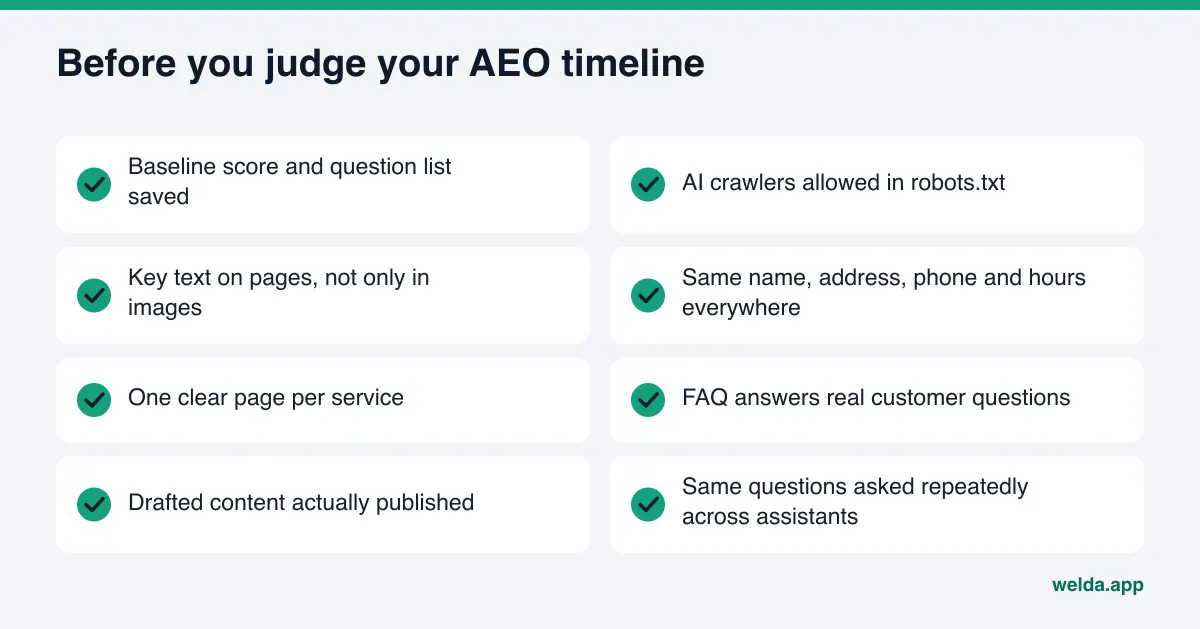
| Do you have a baseline measurement? | Measure first; you cannot judge time without a comparison. |
| Can AI crawlers reach the site? | Pause other work and open access first. |
| Is the drafted content actually live? | The clock starts on publish day; clear the approval queue. |
| Are name, address, phone and hours identical everywhere? | Fix inconsistencies before adding new content. |
| Was progress measured with fixed questions and repeats? | Do not decide on single answers; lock the method. |
| Have a few weeks passed since publishing? | Waiting is normal; use the time on outside sources. |
| Do you know which source your competitor wins from? | Find that source and focus there. |
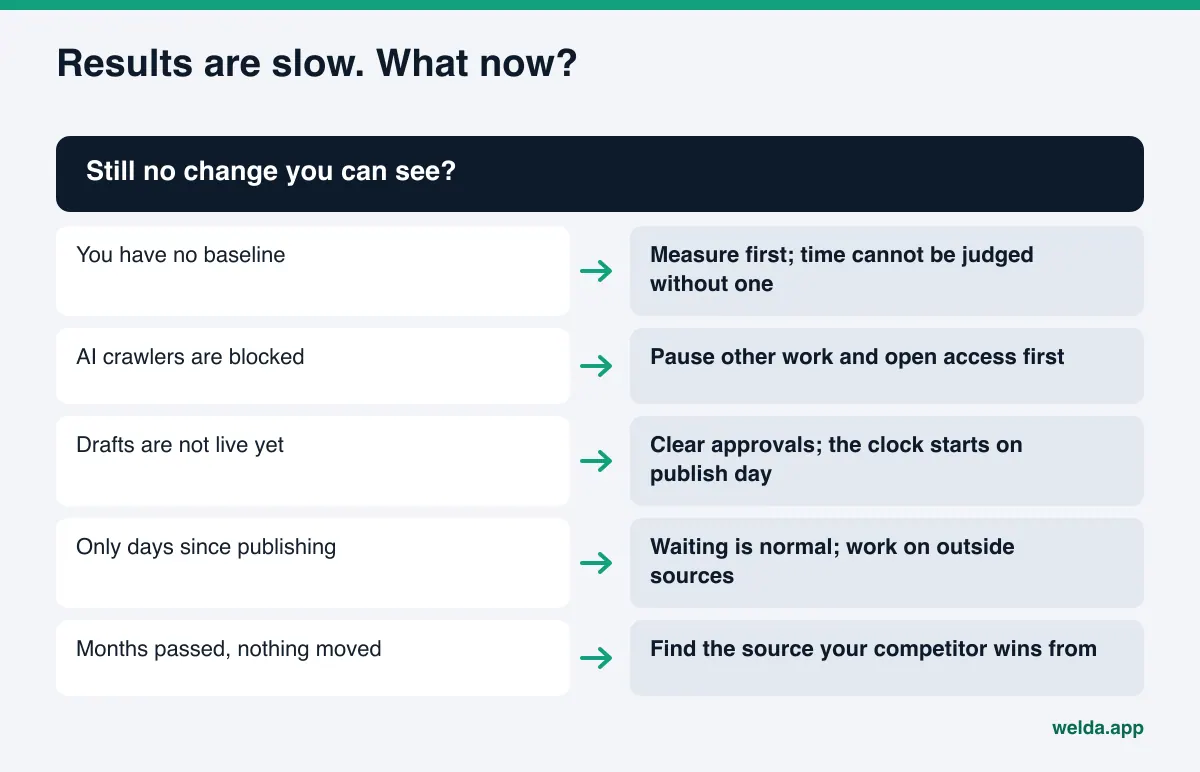
If you can answer "yes" to every question and nothing has moved on any question after several months, the problem is most likely trust. At that point it makes sense to shift effort from on-site work to outside sources.
Frequently asked questions
What is the shortest time it takes to show up in ChatGPT?
There is no fixed minimum. Removing a technical blocker can show an effect within days, while new content usually takes weeks. A steady place in broad questions can take months.
I asked ChatGPT after one week and my business was missing. Is something wrong?
Probably not. One week is short for most work, and one question is one data point. Ask the same question several times across several assistants, look at rates, and evaluate after a few weeks.
Once I show up, does the spot stay mine?
No. Competitors keep working, sources change, and answers are built fresh each time. AI search visibility needs ongoing measurement and upkeep, not a one-time project.
Will I show up in Gemini and Google's AI features on the same timeline?
Not necessarily. Each assistant crawls on its own schedule and trusts different sources. Appearing in one early and another later is normal, so measure each one separately.
What is the most effective way to shorten the AEO timeline?
Do the work in the right order and publish approved drafts without delay: access first, then identity details and content that answers questions, then outside sources.
How fast does Welda guarantee results?
Welda does not guarantee timelines or rankings. It measures regularly with a published formula, fills gaps with ready drafts, and shows you change over the same set of questions.
Start with your baseline, not a guess
Nobody can honestly tell you how long AEO will take without knowing which stage your gaps sit in. That makes your starting point the first step. Run the free site analysis to see how AI reads your site, which gaps will close fast and which will take longer, and how much each fix is likely to move your score. Your timeline starts with that report.