Can you pay to appear in ChatGPT answers? You can pay for an ad slot, in the countries where ChatGPT ads are open: a labeled "sponsored" unit shown below the answer. You cannot pay to be named inside the answer itself. That part, where the assistant says "here are a few businesses worth calling," is earned through a clear website, complete profiles and what other sources say about you.
That distinction matters more than it sounds. The ad slot and the answer look close together on screen, but they run on different systems, follow different rules and earn different levels of trust from the person asking. This guide separates the two, explains how to evaluate offers that promise "guaranteed ChatGPT placement," walks through the AEO work that gets you into the answer, and shows where Welda fits. If you want a baseline first, run a free AI visibility analysis of your site; the rest of this article is easier to apply with your own results in hand.
Can you pay to appear in ChatGPT answers today?
OpenAI announced in early 2026 that it would start testing ads in ChatGPT. The test began in the US with logged-in adult users on the Free and Go plans, and OpenAI has since opened ads in more countries. According to OpenAI's help center article on ads, the program works like this:
- Ads appear at the bottom of an answer when there is a relevant sponsored product or service for the current conversation.
- Ads are labeled as sponsored and kept visually separate from the answer.
- OpenAI says ads run on systems separate from the chat model, and advertisers cannot shape, rank or alter ChatGPT's responses.
- Several paid plans (Plus, Pro, Business, Enterprise and Edu) do not show ads.
Which countries can buy ads through OpenAI's self-serve tool is listed on its Ads Manager availability page. That list has been changing quickly, so check the live version before you plan a campaign rather than relying on any article, including this one.
Google draws the same line. It runs ads within AI Overviews and AI Mode in a set of markets that includes the US, and its Google Ads help page on AI experiences lists those markets and formats. Those ads are labeled "Sponsored." They are a paid placement next to the AI response, not a line written into it.
So the honest answer to "can you pay to appear in ChatGPT answers" is: you can pay to appear next to them. Being part of the answer is a different job.
Why the ad slot and the answer are different products
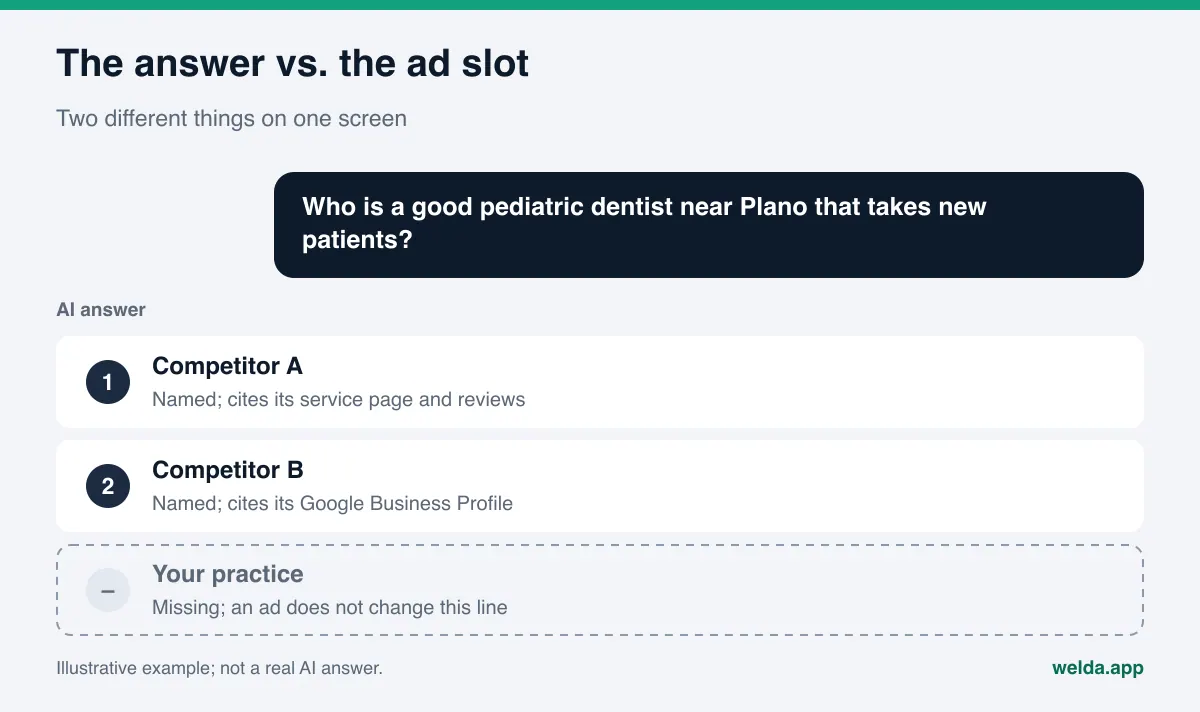
Picture a parent in Plano, Texas, asking ChatGPT: "Who is a good pediatric dentist near Plano that takes new patients?" The screen can show two things. First, the answer: a few practice names, each with a sentence on why it was picked, drawn from web search, maps data, review sites like Yelp and Healthgrades, and the practices' own websites. Second, possibly, a sponsored unit underneath.
People read those two parts differently. Most of us learned years ago to spot "Sponsored" on a search page and treat it as an ad. The names inside the answer feel like the assistant's own judgment, and that short list is where the decision usually starts.
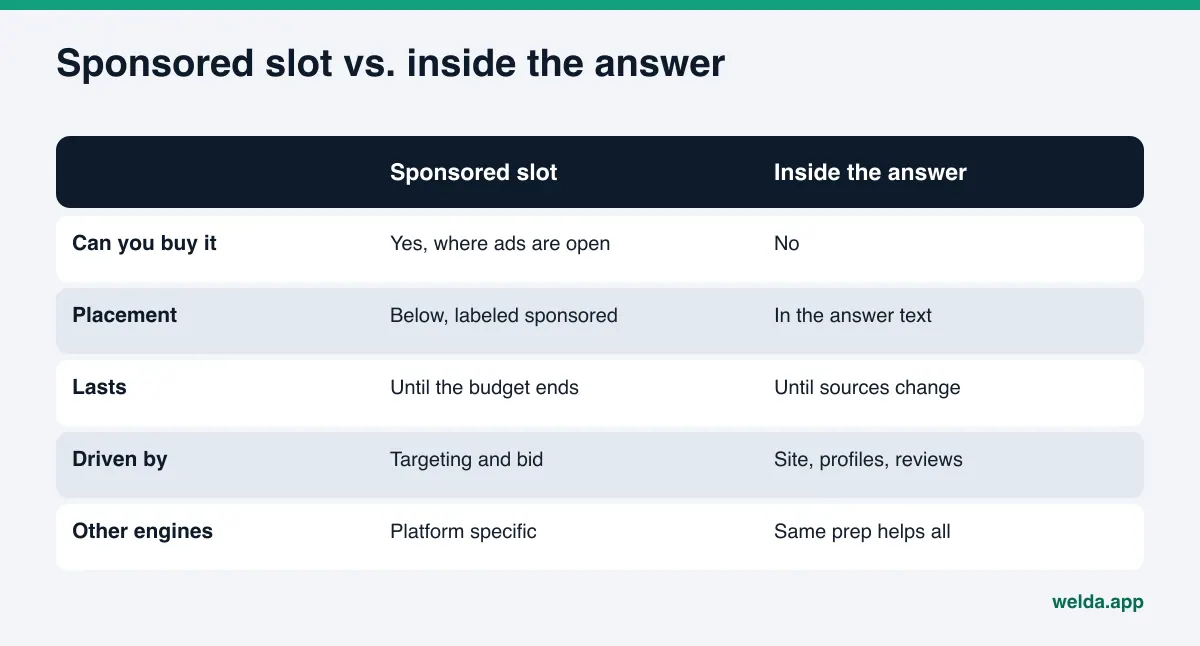
| Question | Sponsored ad slot | Inside the answer |
|---|---|---|
| Can you buy it? | Yes, where ads are open and under platform rules | No; OpenAI says advertisers cannot influence answers |
| Where does it show? | Below the answer, labeled sponsored | In the answer text, as a recommendation |
| When does it stop? | When the budget runs out | When the underlying sources change |
| What drives it? | Targeting, bid, creative | Your site, profiles, reviews, third-party mentions |
| Who never sees it? | Users on ad-free plans, markets without ads | Everyone sees an answer built from the same sources |
The last row is easy to miss. An ad only reaches people who are shown ads. The answer reaches paid subscribers too, and the same logic applies on Gemini, Perplexity and Google's AI Overviews: the assistant names businesses it can find and trust in its sources. We cover how Gemini picks businesses in how to get recommended by Gemini.
How to vet "guaranteed ChatGPT placement" offers
As AI search has grown, so have pitches promising to "get you to #1 in ChatGPT." Some are honest AEO services described with too much enthusiasm. Some sell something that cannot be sold. A handful of questions separate the two:
- Is it clear what you are buying? If the pitch says "ChatGPT ads," is it a labeled campaign run through OpenAI's ad tools, or a claim about the answer itself? There is no paid entrance to the answer.
- How will results be measured? One screenshot of a single chat is not measurement. AI answers vary from run to run on the same question; a credible report uses many questions, repeated runs and more than one engine.
- What work will actually be done? Real AEO work lists concrete tasks: missing service pages, structured data, Google Business Profile copy, review replies, gaps on the sites AI cites. "Proprietary relationships with AI platforms" is a red flag.
- Are fake reviews or fake content involved? The FTC's rule on consumer reviews and testimonials targets fake and AI-generated reviews, and review platforms remove them. Any plan that depends on them puts your profiles at risk.
- Is a ranking guaranteed? Neither OpenAI, Google nor any vendor can guarantee where you appear in an AI answer. A guarantee is a reason to reread the contract.
None of this is an argument against advertising. Labeled ads with clear rules are a legitimate channel. The problem is when an ad slot and the answer are sold as if they were the same thing.
Step by step: AEO work that gets you into the answer
AEO, short for answer engine optimization, is the work of making your business easy for AI assistants to find, understand and recommend. You may also see it called GEO (generative engine optimization); the goal is the same. Here is a practical sequence for a local or regional business:
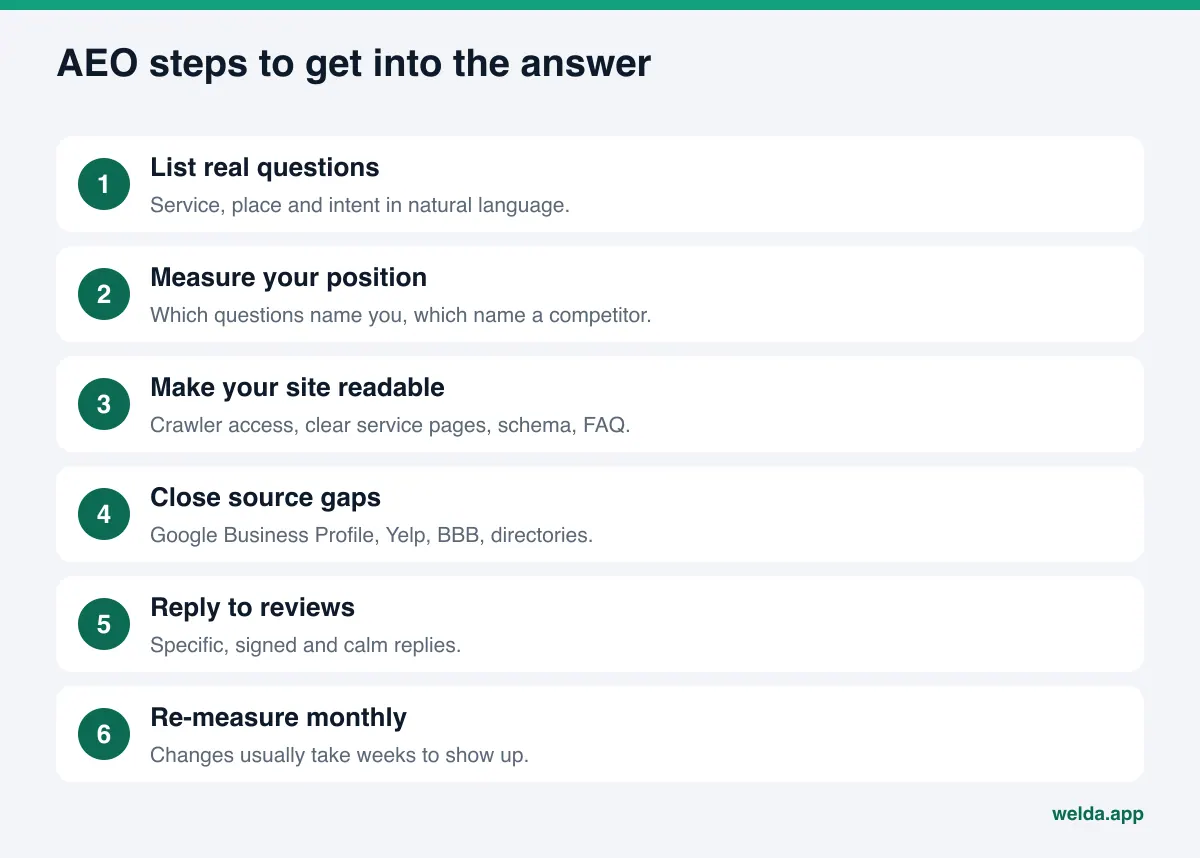
- Write down the questions customers really ask. Combine service, place and intent in natural language: "emergency plumber in Mesa open Sunday," "family-friendly B&B near Asheville with parking." These are conversational questions, not ad keywords.
- Measure where you stand. Which questions name you, and which name a competitor instead? One manual test can mislead you; we explain why in manual ChatGPT checks vs tracking tools.
- Make your site readable. Confirm AI crawlers are not blocked in robots.txt, give each service its own clear page, keep name, address, phone and hours identical everywhere, add LocalBusiness structured data and write a real FAQ section.
- Close gaps on the sources AI cites. For local questions, assistants lean on Google Business Profile, Yelp, the BBB, Angi, Tripadvisor, Healthgrades and industry directories. Finding which ones you are missing is the heart of a citation gap analysis.
- Reply to reviews. Specific, signed, calm replies show both customers and AI that the business is active. How critical reviews surface in AI answers is covered in negative reviews in AI answers.
- Re-measure monthly. Changes usually take weeks to show up in AI answers. Track the same questions on a schedule instead of checking every day.
An ad budget cannot speed these steps up. But once done, they keep working after a campaign ends.
Ads, AEO or both: how to decide
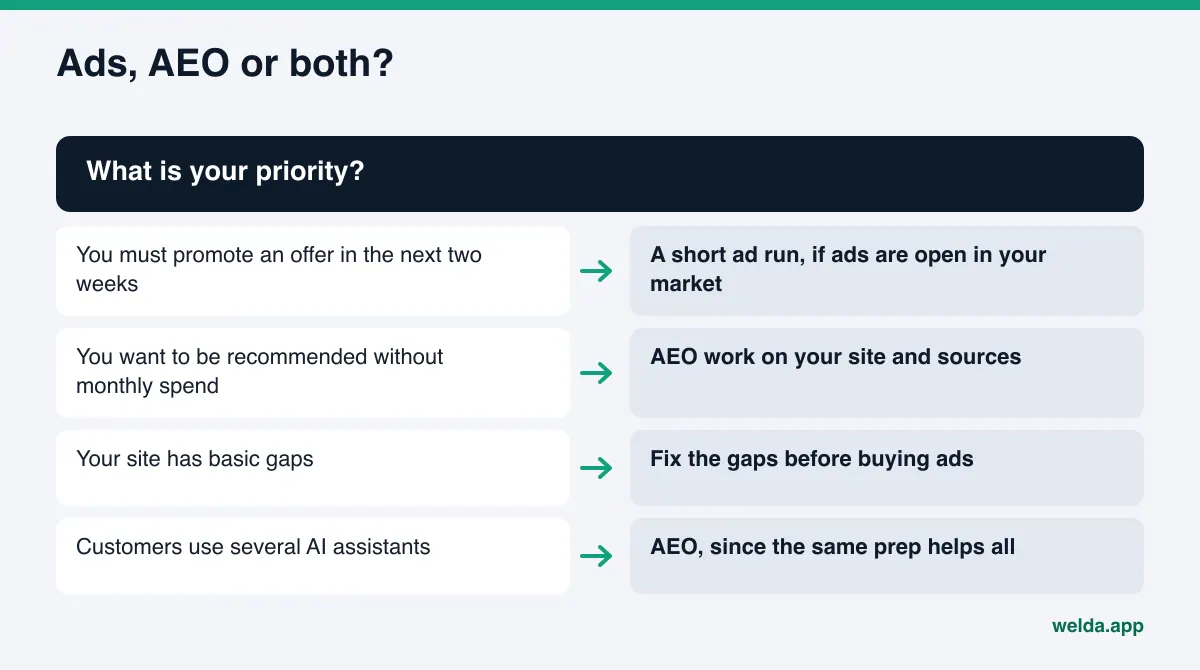
ChatGPT ads and AI search visibility are not rivals. They answer different needs. Use these criteria to set priorities:
- Time pressure. If you need to promote a seasonal offer in the next two weeks and ads are open in your market, an ad is fast. Getting named inside the answer is measured in weeks and months.
- Durability. If you want to be recommended without paying every month, AEO is the path. A clear service page keeps working after the budget is gone.
- Trust. In healthcare, legal services, home improvement and other high-ticket categories, people trust a recommendation more than an ad. Being in the answer matters more there, and ad rules in these categories tend to be stricter.
- Audience. Ads reach only the users who see ads. If your customers use paid ChatGPT plans, Gemini or Perplexity, the answer is how you reach them.
- Landing quality. An ad click ends on your site. A slow site with vague services and missing contact details wastes the spend. Fixing those gaps helps both channels.
For most local businesses the order that works is: readable site and complete profiles first, then measurement, then ads for a defined period if they still make sense. Reverse the order and you are paying to send traffic to a site that AI, and often people, cannot read well.
How Welda handles this
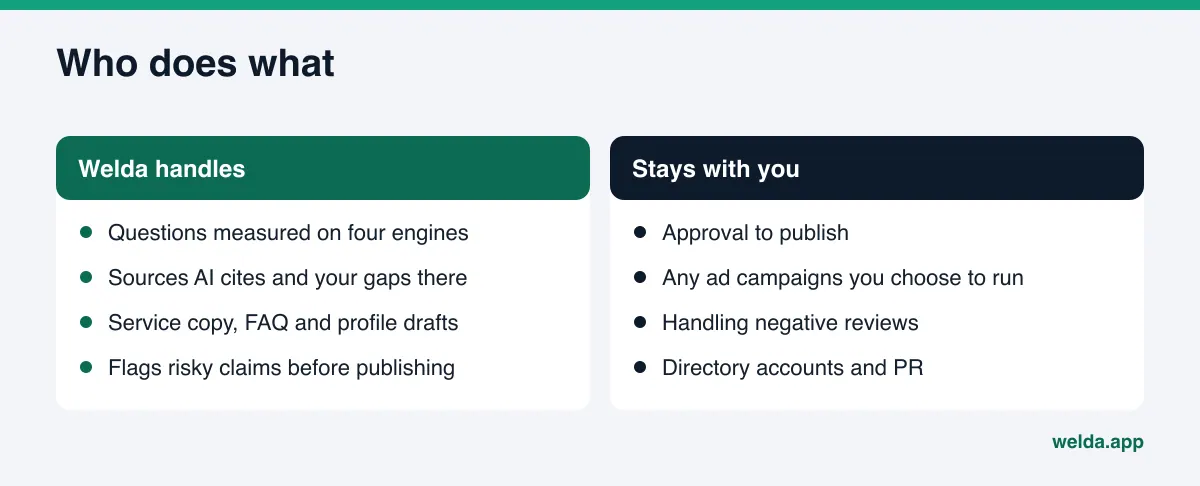
Welda does not sell ad inventory and cannot buy you a place inside an answer. Its job is to measure where you stand inside AI answers and to fill in the information assistants need to recommend you. Three parts of the product matter most for this topic.
Question-by-question measurement. In the Welda dashboard, each customer question is its own row. Every question is asked three times each on ChatGPT, Gemini, Perplexity and Google AI. The row shows which engines name you and in what position. Open a question and you see an illustrative answer, the sources it cited and the result of each run. For a business weighing ads, this is the view that answers "are we already in the answer, outside the sponsored box?"
The sources view. Being in the answer depends on being present, with accurate information, on the sites AI trusts. Welda lists the sources assistants cite for your questions, how much each one is cited and your status there: missing, incomplete, unverified or done. Next to each sits the task: complete the profile, update the amenities, add a signed reply. This is exactly the work an ad budget cannot buy.
Drafts with your approval. Gaps turn into a single to-do list. Welda drafts missing service copy, FAQs, profile descriptions and review replies, and the decision to publish stays with you. On WordPress sites Welda connects through a separate Editor user with an application password, so content opens on your site as a draft and goes live only when you approve it. Where there is no connection, Welda gives you a ready package to apply by hand. Content always lives on your own site.
The score formula is public: the share of questions that name you, a position score and your share against competitors are combined with fixed weights, and the spread across three runs gives a margin of error. When the score moves, you can see which part moved.
To be clear about where things stand: the Welda dashboard is in early access and is opening first to businesses in Turkey. Regular four-engine tracking is being added during early access, and the sample dashboard screens use representative data. What anyone can use today, in English, is the free site analysis. Pricing is discussed in the early access conversation.
What the free analysis tells you before you spend on ads
Knowing how your site reads today helps you put budget in the right place. The free analysis reads your homepage and a few inner pages (services, pricing, about, contact) the way Google and AI do. It checks whether AI crawlers can get in, your title and description, main heading, business structured data, address and phone details, whether your map and social profiles link to the site, your FAQ, reviews and trust signals, how clearly services are described, and page speed.
You get a score out of 100 split into technical and content, a finding for each gap with why it matters and how to fix it, ready-to-use homepage copy suggestions, a simulation of how much each fix could move the score, and a competitor comparison. The analysis also asks 5 customer-style questions to an AI assistant that can search the web and checks whether your business name appears. It is a one-time snapshot, but it answers the first question: are we already in the answer before we pay for space next to it?
From there you are usually in one of three places:
- You appear in most of the 5 questions and the site has no major gaps: ads can be extra reach in a space where you are already recommended.
- You appear in some questions and not others: look at what the missing questions depend on. Often it is one service page or one incomplete profile.
- You do not appear and the site has basic gaps: fix those first. Otherwise ad clicks land on a site that does not explain what you do.
Limits: what Welda does not do
The most honest way to talk about AI visibility is to state the limits up front:
- Welda does not guarantee a position in ChatGPT, Gemini or any other engine. The assistant builds the answer; no one decides it on your behalf.
- Welda does not buy ad placements and does not blur the line between the sponsored unit and the answer.
- It does not invent facts. If your hours, service area or price range are unclear, it asks you.
- It does not publish sensitive content without approval. In healthcare there is no automatic publishing; every item comes to you for review.
- It does not create fake reviews. Handling negative reviews, opening directory accounts and PR stay with you; Welda can draft replies.
- Its compliance check flags price, guarantee and superiority claims before publishing, but it is not legal advice.
Timing needs realism too. New content usually takes weeks to show up in AI answers; how long AEO takes explains why.
Checklist: before you pay to appear in ChatGPT answers
Before you put budget behind a ChatGPT ad, run through this list. Every "no" is a gap worth closing first.
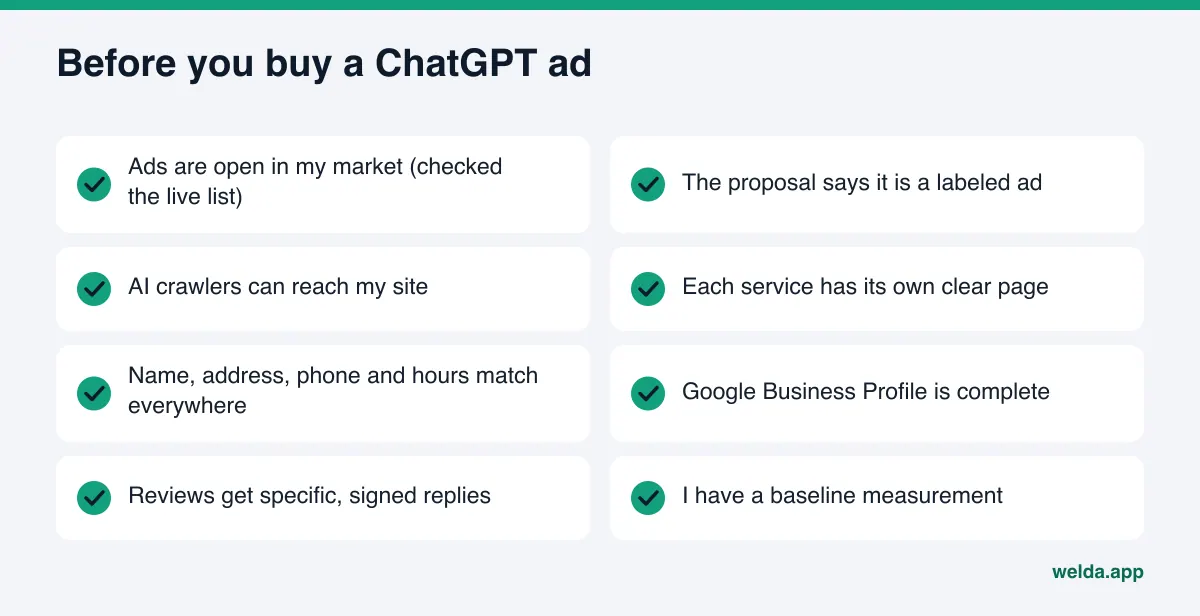
| Check | Why it matters |
|---|---|
| Are ChatGPT ads open in my market? | OpenAI's Ads Manager availability page lists countries, and it changes. |
| Is what I am buying a labeled ad? | The answer itself is not for sale; any proposal should say so plainly. |
| Can AI crawlers reach my site? | If they are blocked, getting into answers is harder and ad traffic lands on a weak site. |
| Does each service have its own clear page? | The assistant needs a direct answer to "what do you do, and where?" |
| Is my Google Business Profile complete? | It is one of the most cited sources for local questions. |
| Are my Yelp, BBB or industry listings accurate? | Inconsistent details make assistants hesitate to name you. |
| Have I measured my current position? | Without a baseline you cannot see what ads or AEO changed. |
Once this is filled in, it usually becomes clear whether ads are an extra channel for you or an early expense.
Frequently asked questions
Can I pay ChatGPT to recommend my business in its answers?
No. OpenAI says ads are shown in separate, labeled units and that advertisers cannot shape, rank or alter ChatGPT's responses. Being recommended in the answer depends on your site, your profiles and the sources that mention you.
Where do ChatGPT ads appear?
Below the answer, labeled as sponsored, when a relevant sponsored product or service matches the conversation. Users on several paid plans do not see ads.
What is the difference between ChatGPT ads and AEO?
Ads show in a sponsored unit for as long as you pay. AEO is the work of giving AI assistants the information they need to name you inside the answer; it runs on content and sources, not budget, and it does not switch off when spending stops.
Should I trust offers that guarantee a top spot in ChatGPT?
Read them carefully. No one can guarantee a position in an AI answer. A credible offer lists the work, explains how results are measured across repeated runs and rules out fake reviews.
Does running ChatGPT ads help or hurt my organic visibility?
According to OpenAI, ads do not influence answers. That cuts both ways: buying ads will not lift you inside the answer, and not buying them will not push you down.
Does Welda run ChatGPT ad campaigns?
No. Welda measures where you stand inside AI answers and fills in missing information. Drafts go live on your own site and profiles only with your approval.
Where should I start?
See how your site reads to AI today. The free analysis gives you the gaps, fix suggestions and a 5-question check in one report.
Bottom line: what you can buy and what you have to earn
Can you pay to appear in ChatGPT answers? You can pay for a labeled slot next to them, where ads are open. A place inside the answer, on the short list a customer actually acts on, is earned by making your site, profiles and outside sources clear enough for AI to trust. If ads are on your plan, checking that foundation first protects the budget.
See where you stand today with a free AI visibility analysis. Your results link arrives by email and stays open for 14 days, and each site can be analyzed once for free.