Are manual ChatGPT checks good enough, or do you need a tracking tool? They answer different questions. Typing a few prompts into ChatGPT is a useful way to learn what customers see and to build your question list. But if you want to know whether a change worked, where you stand against competitors, and what happens across more than one AI engine, you need the same questions asked on a schedule, repeated, and recorded. That is what a tracking tool is for.
Most owners start the same way. They open ChatGPT on their phone, type "best family dentist near me" or "plumber in Plano who does same-day repairs," and read the answer. If their business shows up, they relax. If it does not, they worry. Both reactions make sense, but a single answer in a single chat window does not represent what hundreds of customers see. This guide compares manual ChatGPT checks vs tracking tools on concrete criteria: when a manual check is enough, where it misleads you, how to do it properly if you stick with it, and what a measurement tool does differently. It is written for owners and marketers working on AEO (answer engine optimization, also called GEO, for generative engine optimization), the practice of getting your business named in AI answers. If you want a baseline first, you can run the free AI visibility analysis on your site right now.
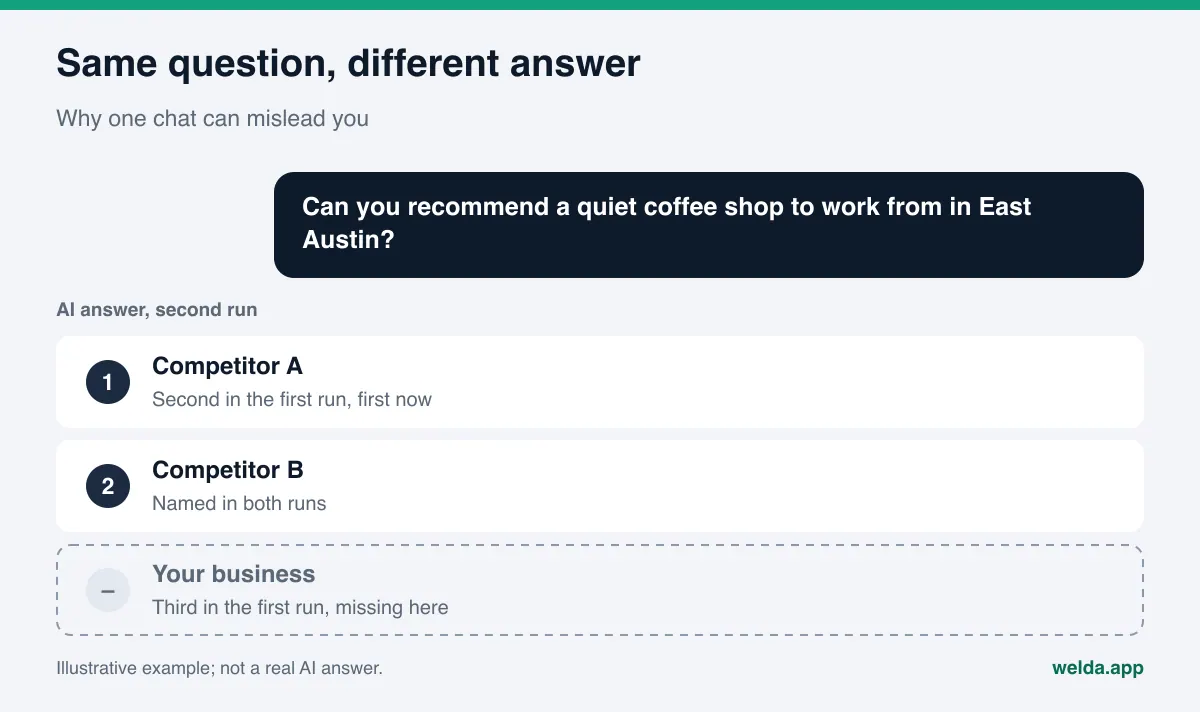
Why one ChatGPT conversation is not a measurement
An AI answer is not a fixed list like a page of search results. The model generates the answer fresh each time. Ask the same question twice in the same afternoon and you may get a different order, sometimes different business names. Engines that search the web can also pull from different sources between runs. A single attempt does not tell you "we are in" or "we are out." It shows you one sample.
The second issue is personalization. When memory is turned on, ChatGPT can draw on saved details and past conversations when it answers you. OpenAI explains this on its memory help page. An owner has often asked ChatGPT about their own business many times, pasted their website into a chat, or asked it to rewrite their menu or service list. That history can separate the answer you see from the answer a customer sees. You see your name. The customer may not.
The third issue is location. For "near me" questions or questions with a neighborhood or city in them, the engine weighs where the user is or which place the question names. A question asked from your front desk may not match one asked by a customer across town. We cover this in detail in local AI rank tracking.
The fourth issue is coverage. Customers do not only use ChatGPT. Some ask Gemini, some use Perplexity, and many see an AI Overview or AI Mode answer while searching on Google. Each engine leans on different sources. Showing up in ChatGPT does not mean you show up in Google's AI answers.
The fifth issue is the record. Manual checks are usually done without notes. Three months later, nobody can say where things stood before. You added an FAQ section, rewrote your Google Business Profile description, and replied to old Yelp reviews. Which of those moved anything? Without a before-and-after comparison, you cannot tell. We go deeper on that in before and after AEO measurement.
Why the difference matters for a small business
A bad measurement leads to a bad decision. An owner who saw their name once may assume they are covered when most customers see answers without them, and do nothing. An owner who checks on a bad day may panic and abandon work that was actually helping. In both cases the problem is the same: a general conclusion drawn from one sample.
There is also the time cost. Twenty questions, four engines, three repeats each comes to 240 separate answers. Reading each one, noting whether you appear, at what position, which competitors are named, and which sources are cited is not something an owner can do every month by hand. So most people ask a few questions now and then and guess the rest.
Finally, when you report to a partner, a franchise owner, or a manager, they will ask for numbers. "I saw us in ChatGPT twice last month" does not support a budget decision. A table showing which question, which engine, and in how many of the repeats your name appeared does. Our guide to AEO reporting for executives covers how to present that.
Where manual ChatGPT checks still help
Manual checks are not useless. For some jobs they are the fastest and cheapest option. Here is where they genuinely add value:
- Building your question list. Chatting with the engine shows you how real questions are phrased and which wording feels natural to a customer.
- Seeing the shape of the answer. How many businesses does the engine list? What reasons does it give: reviews, location, price range, a specialty? That tells you what your site may be missing.
- Catching wrong facts. If the engine lists an old address, a closed location, or wrong hours, you will spot it in one conversation.
- Finding sources. Engines that search the web show their citations. Those sites point you to directories, review platforms, and local guides where you should be listed.
- A quick first impression. If you have done nothing yet, five or ten questions give you a rough sense of the landscape.
The common thread: manual checks are for discovery, not measurement. They teach you what to ask and what to look for. They are not reliable for measuring the effect of a change, the gap to a competitor, or a trend over time.
How to run manual ChatGPT checks properly: step by step
If you decide to keep checking by hand for now, set up a routine that reduces the error. These steps will give you a much more reliable picture than one chat.
- Write questions the way customers ask them. Leave your business name out. Not "Is [your practice name] any good?" but "family dentist in Round Rock that takes new patients." A question with your name in it guarantees your name in the answer and measures nothing.
- Group questions by intent. Informational ("how often should a water heater be flushed"), comparison ("which plumbers in Plano have the best reviews"), and transactional ("emergency plumber open now in Plano") questions behave differently. Include a few of each.
- Turn personalization off. Use a temporary chat or a logged-out browser so your account history does not shape the answer.
- Ask each question more than once. Use at least three separate chats. Base your conclusion on the set of answers, not on one.
- Check all four engines. ChatGPT, Gemini, Perplexity, and Google's AI Overviews or AI Mode. Use the same question list for each.
- Record every answer the same way. Date, engine, question, repeat number, whether you appeared, your position, competitors named, sources cited. A spreadsheet is enough.
- Repeat on a fixed schedule. Same week each month, same question list. If you change the list, comparisons with earlier months break.
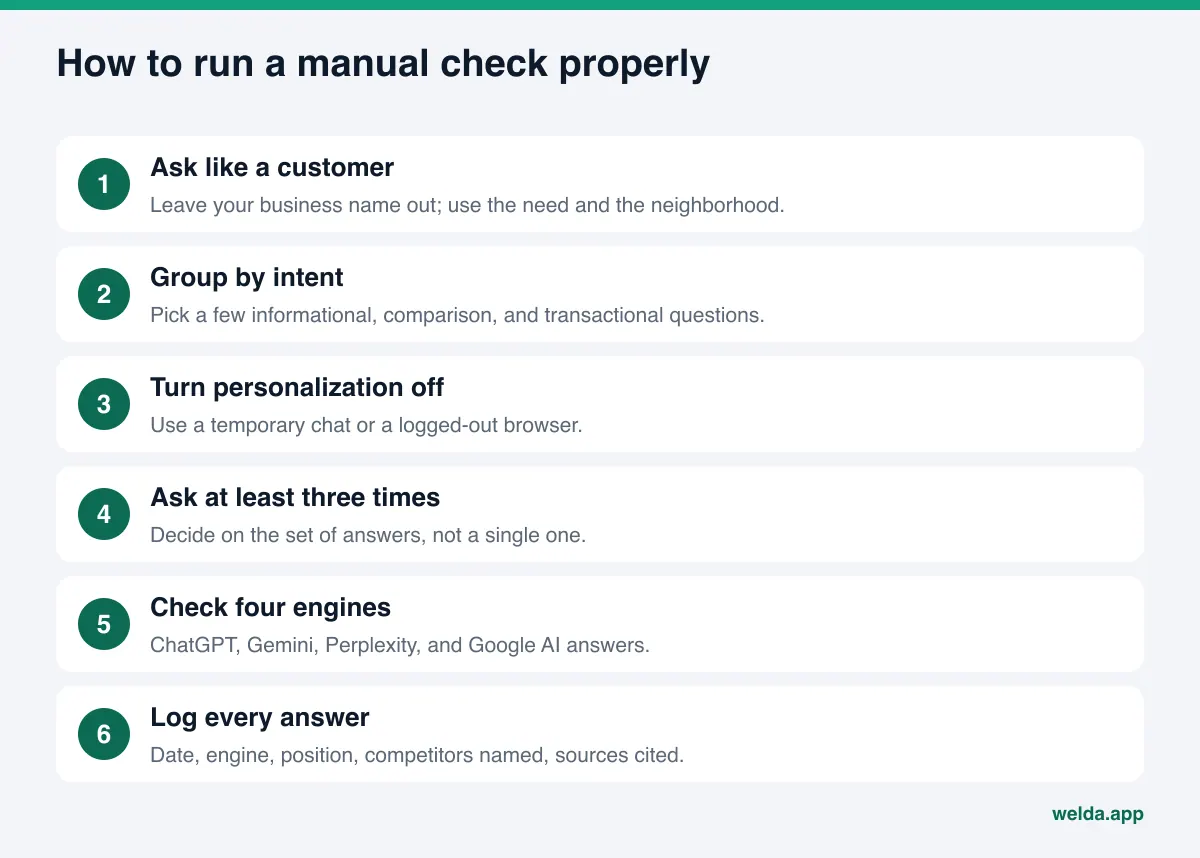
This routine improves manual checking a lot, and it also exposes the workload. Fifteen questions, four engines, and three repeats is 180 answers a month. Reading and logging each one takes hours. It also helps to know that answers in the consumer app can differ from answers returned through an engine's API; we explain that in API vs app answers in AI visibility tracking.
What a manual tracking log looks like
The format of the log matters as much as keeping one. If you fill in the same columns every time, you can compare months later. The table below shows what a log might look like for an example coffee shop. The rows are illustrative, not from a real measurement.
| Date | Engine | Question | Repeat | You | Competitors named | Source cited |
|---|---|---|---|---|---|---|
| First Monday | ChatGPT | Quiet coffee shop to work from in East Austin | 1 | Position 3 | Competitor A, Competitor B | Yelp |
| First Monday | ChatGPT | Quiet coffee shop to work from in East Austin | 2 | Not named | Competitor A, Competitor C | A local city guide |
| First Monday | Gemini | Quiet coffee shop to work from in East Austin | 1 | Not named | Competitor B | None shown |
Even three rows tell a story. ChatGPT names you in one run and not the next. Gemini does not name you at all. Competitor A shows up in both ChatGPT runs. The source column gives a first clue about where that competitor is strong. A business that keeps this log for a month can say where it is weak based on a record, not a hunch. The catch is how fast it grows. Every new question and every new engine multiplies the rows.
Manual ChatGPT checks vs tracking tools: side by side
Put both methods against the same criteria and it becomes clear which one fits which job.
| Criterion | Manual checks | Tracking tool |
|---|---|---|
| Personalization | Your history and memory can shape the answer | Questions run under the same conditions, without personal history |
| Repeats | Usually one try | Each question asked several times, spread is visible |
| Engine coverage | Usually ChatGPT only | Several engines with the same list |
| Record | Lost unless you write it down | Every answer stored with a date |
| Competitor view | A few names you notice | Which question each competitor wins, row by row |
| Before and after | Hard, no earlier data | Direct comparison on the same list |
| Time | Hours as the list grows | Runs on a schedule once set up |
| Insight | Strong: easy to read and understand | You need to open the answer detail |
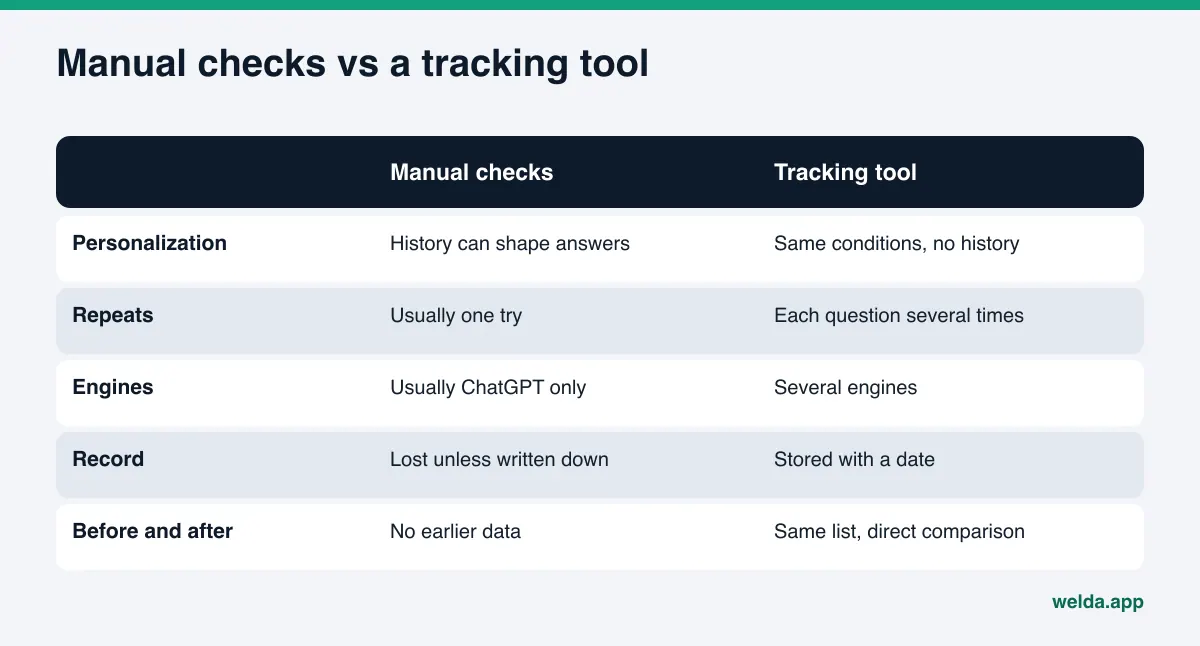
The last row matters. A tracking tool does not replace reading answers. A good one shows the answer text next to the number, so you can read why you are missing. You get the best result when the discipline of the tool and the intuition of reading answers work together.
What a tracking tool does differently
A tracking tool's job is to lock down the steps that stay loose in manual checking. Four things need to be fixed.
The same question list. Every run uses the same questions, so this month can actually be compared with last month. New questions are tracked separately.
Repeats and a margin of error. Each question is asked more than once. If your name appears in one repeat and not the other two, that information is kept, and the result reads as a range. Small comparisons without a known margin are misleading: a two-point gain inside the normal spread is not a real change.
A transparent score. You should know how the score is calculated. Share of questions naming you, position, share against competitors, and how each is weighted. A score with a hidden formula cannot tell you where an improvement came from.
Source and competitor data. Tracking answers more than "are we in." It records which competitor wins which question and which sites the engine relied on. That decides the next task. If a competitor is listed on a local directory or has a strong BBB or Healthgrades presence and you do not, the work is clear. Our citation gap analysis guide walks through that process.
Manual ChatGPT checks vs tracking tools: which one fits you?
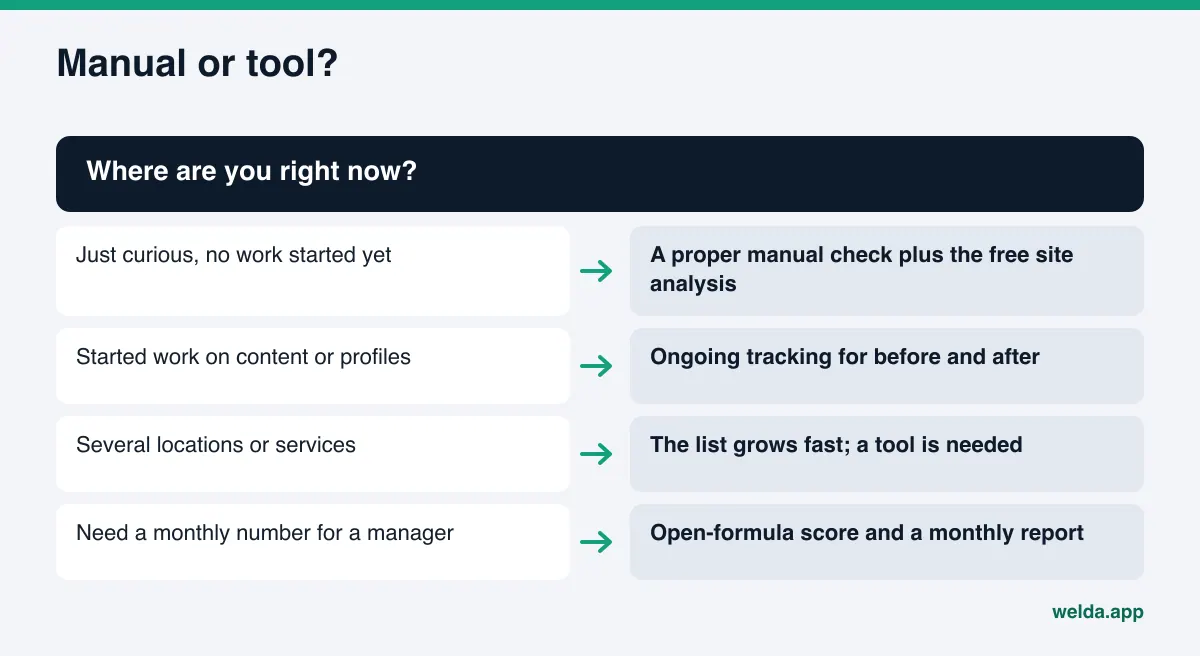
Not every business needs a tracking tool on day one. The right choice depends on the problem you are trying to solve.
If you have not done anything yet and are simply curious, a few properly run manual checks plus a free technical analysis of your site are a sensible start. If AI crawlers cannot read your site or your business details are incomplete, fix that before worrying about measurement numbers.
If you have started work on content, profiles, or reviews, measurement becomes necessary. If you cannot see whether the work helped, you cannot tell whether you are spending time on the right things. Manual checks fall short here quickly, because you need before-and-after data.
If you have several locations, several services, or a crowded local market, the question list grows fast and manual tracking becomes impractical.
How Welda handles AI visibility measurement
For this job, Welda has two parts: the free site analysis that anyone can use today, and the dashboard, which is in early access. Each closes a different gap left by manual checks.
The free analysis: a one-time first measurement. The analysis reads your homepage and a few inner pages, such as services, pricing, about, and contact, the way Google and AI systems would. It also asks five questions your customers might ask to an AI assistant that can search the web, and checks whether your business name appears in the answers. Think of it as a more disciplined version of your first manual check: the questions do not contain your name, your account history plays no part, and the result stays in the report. It is a one-time measurement, though. It does not repeat runs and does not cover four engines. Its real value is showing the site-side reasons you may be left out: whether AI crawlers can access your site, whether business details are marked up with Schema, whether there is an FAQ section, whether your services are described clearly. For each gap it shows what was found, why it matters, and how to fix it. The free analysis works in English.
The dashboard: question by question, with repeats. In the dashboard, the questions your customers would ask are sent to ChatGPT, Gemini, Perplexity, and Google AI three times each. On the questions screen, each question takes one row showing which engines named you and at what position. Open a row and you see the answer text, your position in each of the three repeats, and the sources the engine cited. Everything that stays scattered in a manual log sits in one place: on one question you are second in ChatGPT, fourth in Gemini, and missing from Google AI, and you can see which sites the engine leaned on.
The decision on that screen is simple. Look at where you are missing and pick the work from there. If three engines name you on a question but Google AI does not, your Google Business Profile and Google Maps presence are the obvious place to look. If no engine names you and the same local directory keeps showing up in citations, getting listed there goes on the to-do list.
A published formula and a margin of error. The score formula is open: 100 × (0.5 × share of questions that name you + 0.3 × position score + 0.2 × share against competitors). The spread across the three repeats produces a ± margin. That closes the biggest weakness of manual checking: you can see whether a one-point change is real or inside the normal variation.
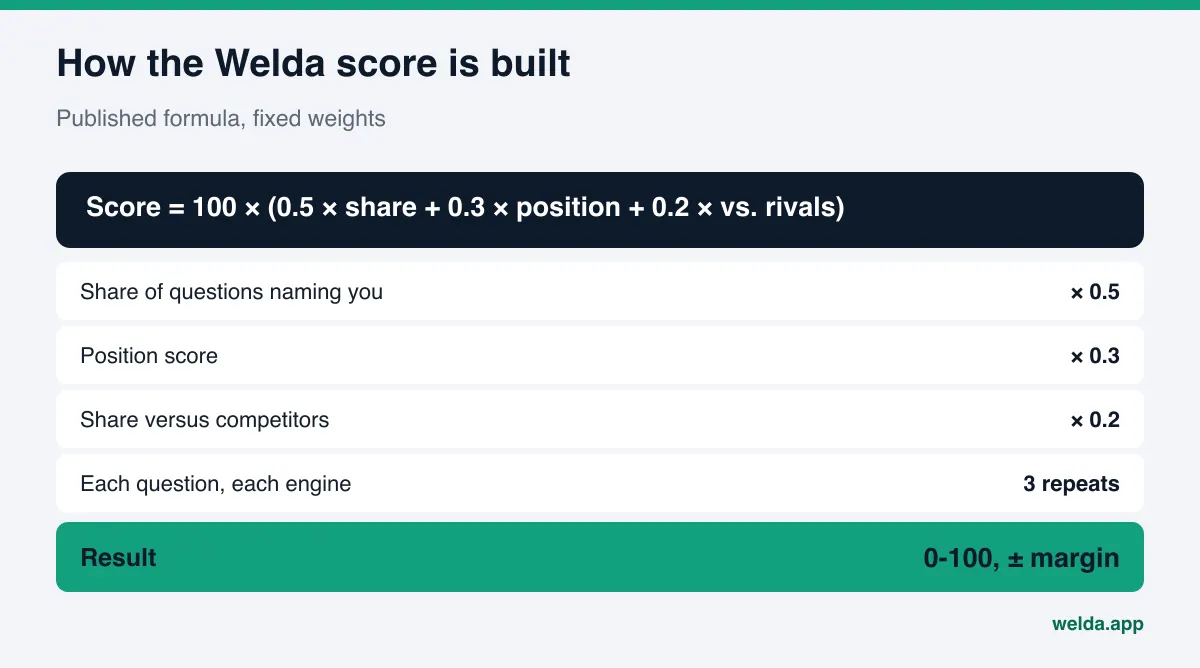
From the same data, the dashboard builds the weekly trend by engine, a before-and-after comparison, and a one-page monthly PDF report for a partner or manager. Once you see the gaps, Welda drafts the missing content, profile copy, and review replies. You approve what gets published, and the content always lives on your own site. Questions can be run in English or Turkish.
Early access, plainly. The Welda dashboard is in early access and is opening in stages, starting with businesses in Turkey. Regular four-engine measurement is being added during early access, and the dashboard views shown in our materials use representative data. The free site analysis is available today in English and German for anyone. Pricing is discussed in the early access conversation.
Limits, and what Welda does not do
A tracking tool does not show everything either. An honest picture means knowing the limits.
- Tracking is a sample. The dashboard asks a chosen set of questions under set conditions. It does not see every answer every customer gets. Repeats and a margin of error reduce the uncertainty, they do not remove it.
- Personal answers cannot be measured. A customer's own account history can change what they see. No tool sees that one person at a time.
- No guarantees. Welda does not promise rankings or "getting into ChatGPT." No tool can, because the engine writes the answer.
- Changes take time. New content usually takes weeks to show up in AI answers. Expecting a fix to appear in the next day's numbers is not realistic.
- No invented facts. Welda does not make up information it does not have; it asks the business. It does not write fake reviews and does not publish sensitive content without approval.
- Some work stays with you. Handling negative reviews, claiming directory listings, and press outreach remain the business's job. Welda puts them on the to-do list, it does not run them for you.
- The free analysis does not track rankings. The five-question test is a one-time signal and does not show change over time.
Checklist: keep checking by hand, or move to a tool?
If more than two of these apply to you, manual checks are no longer doing the job.
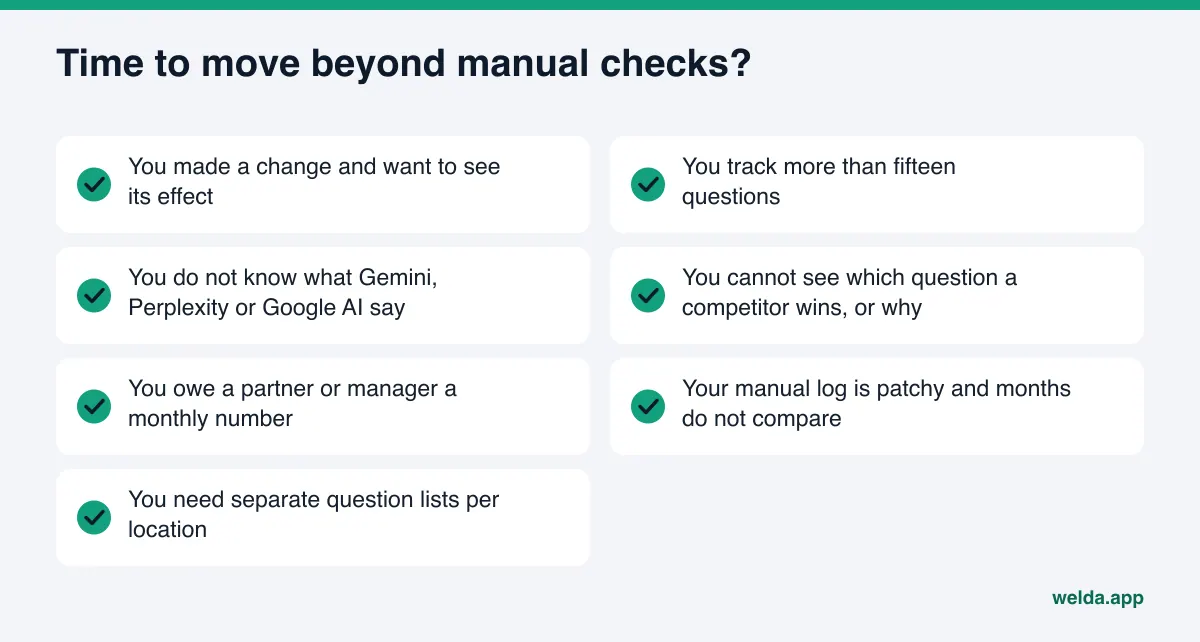
If none apply, a well-run manual routine plus the free site analysis may be enough for a while. What matters is that you run the checks with the steps above and keep a log.
Frequently asked questions
I see my business in ChatGPT. Do my customers see it too?
Not necessarily. Your account history and memory can shape the answer you get. Try again in a temporary chat or a logged-out browser, with a question that does not include your business name, and repeat it a few times. One answer is not enough.
How many questions and repeats are enough for a manual check?
There is no fixed number, but one question asked once tells you nothing. A few questions across different intents, each asked at least three times, gives a more reliable picture. In the Welda dashboard, each question is asked three times on each of four engines.
Can the free analysis replace ongoing tracking?
No. The free analysis asks five questions once and mainly shows what is missing on your site. Tracking change over time, share against competitors, and four engines requires ongoing measurement, which is the dashboard's job.
Does tracking change what ChatGPT says about me?
No. Tracking asks the question and records the answer. What changes the answer is the work you do on your site and on outside sources. Tracking shows whether that work had an effect.
My score went up two points. Is that a real improvement?
It depends on the margin. Welda shows a ± margin from the spread across three repeats next to the score. If the gain is inside that margin, do not count it as real. If it holds across several runs, you can start talking about a trend.
Should I stop checking ChatGPT by hand altogether?
No. Manual checks are still useful for building your question list, understanding how answers are shaped, and catching wrong facts. A tool gives you the consistent number; reading answers helps you understand why the number is what it is.
Bottom line: see where you stand, then measure
Asking ChatGPT by hand is a reasonable first step and a good way to explore. But because of personalization, location, engine differences, and how much answers vary, one conversation cannot support a decision. To see the effect of a change, your position against competitors, and the picture across four engines, the same questions need to be asked repeatedly and recorded. As a first step, run the free site analysis to see how AI systems read your site and whether your name appears in five customer questions. The report lists the gaps worth fixing before you start tracking.