What should AEO reporting for executives look like? One page with five parts: where you stand, what changed, why it changed, what happens next, and the one decision you need from leadership. Keep the numbers few and the method visible, and put last month's figure and the margin of error next to every score. If the page does not make a decision easier, rewrite it.
Answer engine optimization, or AEO, is the work of getting your business named when customers ask ChatGPT, Gemini, Perplexity or Google's AI Overviews and AI Mode a question. Plenty of teams now track this. Far fewer report it well. What usually lands on the CEO's desk is either a folder of screenshots or a spreadsheet with hundreds of prompt-level rows that nobody above the marketing team reads. This guide covers AEO reporting for executives: which metrics belong on the page, how to read movement without overreacting, how to write the ask, and how Welda builds the monthly report. If you need a baseline before your first report, run your site through the free AI visibility analysis. It returns a score out of 100 and a list of gaps you can put in front of leadership on day one.
Why AEO reporting for executives is its own job
Executives have spent two decades learning the vocabulary of search reports: rankings, clicks, sessions, conversions. Most of that vocabulary breaks down in AI answers. A customer types a question, the engine writes a paragraph, and two or three businesses get named in it. There is an order, but there is no fixed results page. Ask the same question tomorrow and the answer may shift. Telling a CEO "we're number three in ChatGPT" is incomplete at best and misleading at worst.
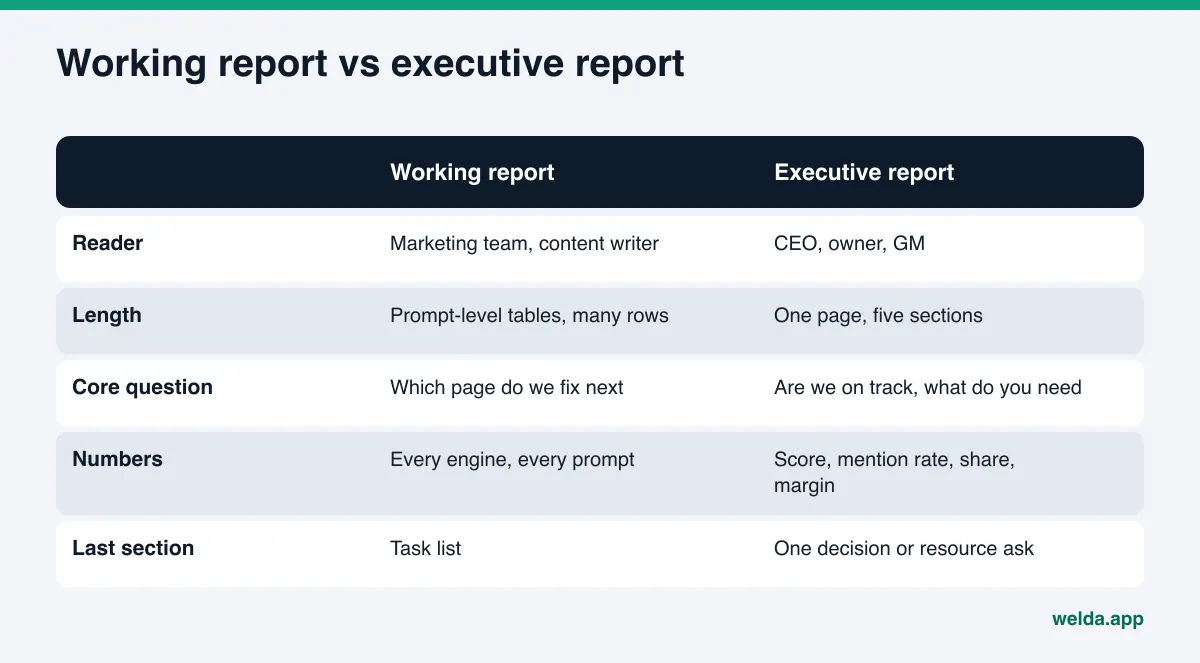
The second problem is the audience. Your marketing manager wants prompt-by-prompt detail: which service page is thin, which directory is feeding a competitor, which engine ignores the location page. The owner or general manager comes with different questions. Is this working? How much time is it taking? What do you need from me? Write one document for both readers and either the executive drowns or the team can't find the detail it needs.
The third problem is timing. Changes you make to your site and profiles usually take weeks to show up in AI answers. If a monthly report says "no change" and doesn't explain why, leadership can reasonably conclude the effort is wasted. A report that shows the lag is normal and lists what is already in the pipeline prevents that wrong call. We cover the timing in more depth in how long AEO takes to show results.
What leadership actually wants from an AEO report
When a CEO, founder or regional VP opens a monthly report, the same five questions are usually on their mind. Answer them in order and the report gets read. Skip them and they get asked out loud in the next meeting, which makes the report pointless.
- Where do we stand? Today's score and the share of customer prompts that mention us.
- What changed? The difference from last month, and whether it is a real change or measurement noise.
- How do we compare? How often competitors get named on the same prompts, and how often we do.
- Why? The likely work behind prompts we won or lost: a new page, a completed Google Business Profile, missing details on Yelp or a review site.
- What's next, and what do you need from me? Next month's few tasks, who owns them, and the single decision leadership has to make.
Those five questions are the skeleton. Two or three lines per question is enough. If you can't answer one, say so. "We didn't measure competitor share this month; it will be added in July" beats a blank row every time.
Which AEO metrics belong in an executive report?
Every metric you add costs readability. For an executive page, four core metrics and two supporting items are plenty. For the full menu of metrics and how to pick them, see our guide to AEO KPIs. Here we only list what should travel upstairs.
| Metric | What it tells leadership | How to present it |
|---|---|---|
| AI visibility score | Overall position and direction | This month, last month and margin of error side by side |
| Mention rate | How many customer questions we show up in | A percentage, with the number of tracked prompts |
| Share versus competitors | Our slice of the AI conversation in our market | A percentage and where we sit among named competitors |
| Won and lost prompts | What the change looks like in practice | Up to three example prompts each, with the engine |
| Completed work | Where the effort went | A short list: pages, profiles, review replies |
| Open decisions | What leadership needs to do | One item, on the last line |
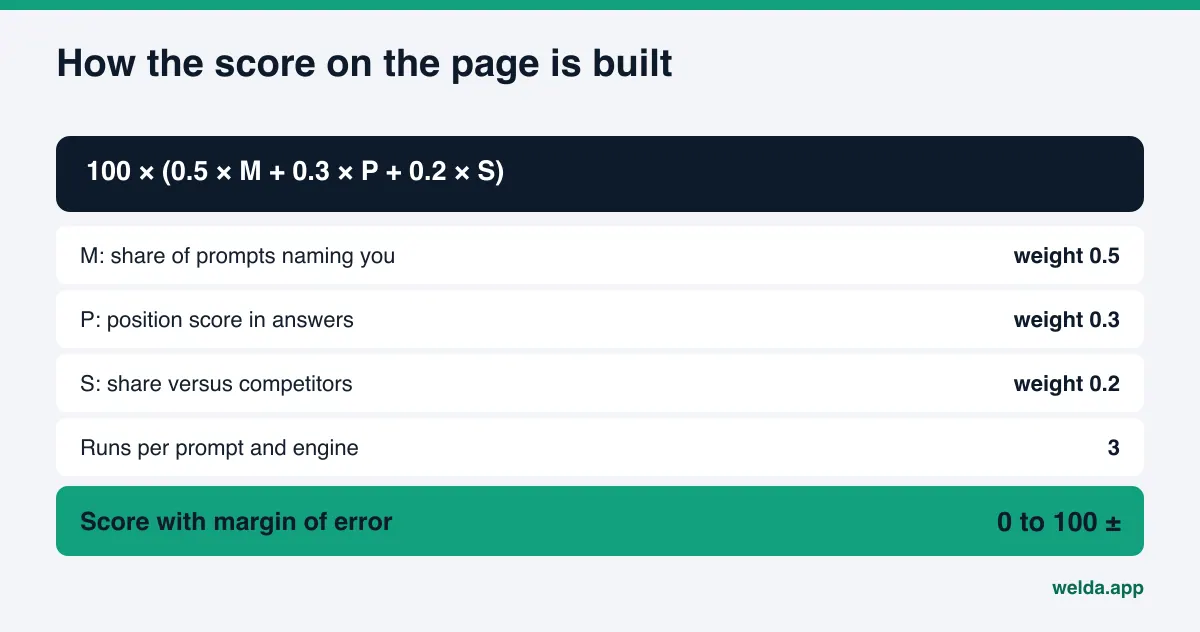
Share versus competitors is usually the easiest metric for executives to grasp, because it maps to the market share thinking they already use. We explain how it is calculated in AI share of voice. The score is a weighted sum of three parts, and its formula should be public. When a CEO asks why the score dropped, "that's how the formula works" is the wrong answer. "Our mention rate held steady, but we slipped a position on two high-intent prompts" is the right one.
Some things should stay off the executive page. Engine-by-engine results for every prompt, raw answer text, technical site audit details and long lists of cited sources belong in the working report. If a leader gets curious about any of them, send it as an appendix. Holding the line at one page is the single habit that gets the report read.
How to build an AEO report for executives, step by step
The report starts when you write the prompt list, not when the numbers come in. What you ask determines what you can report. Repeat these steps in the same order every month.
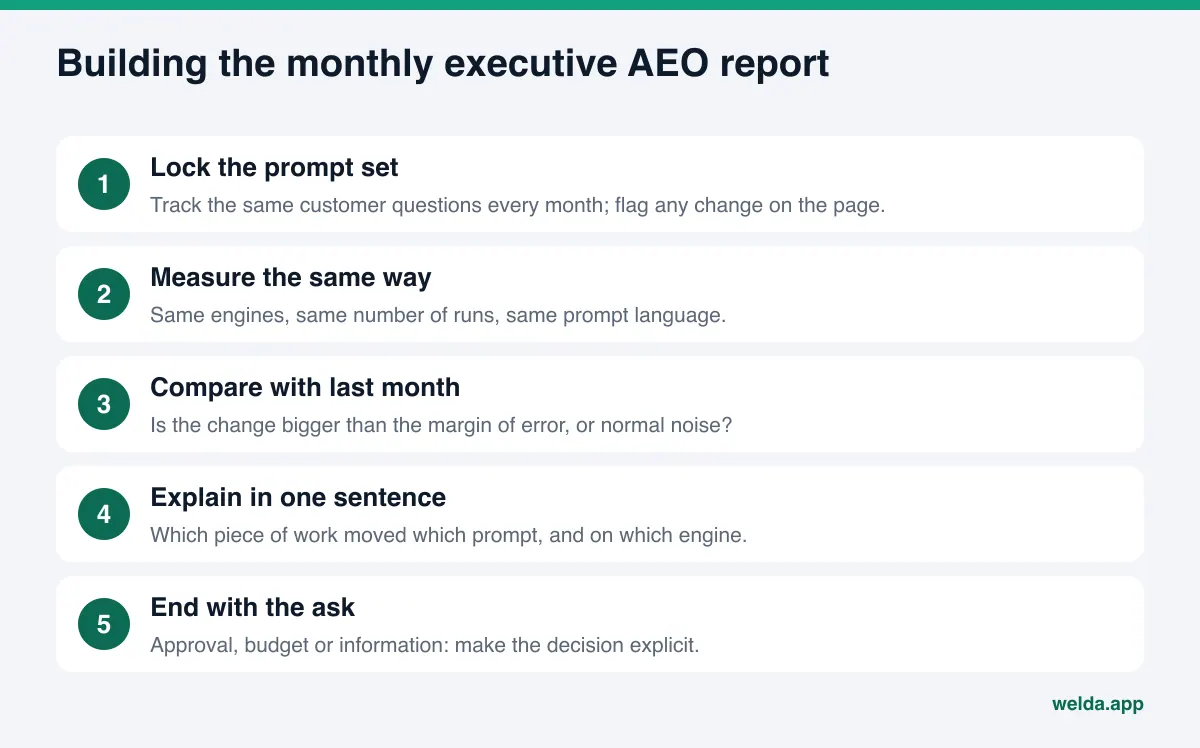
1. Lock the prompt set. Write down the questions your customers are likely to ask AI assistants, then measure that same list every month. If the list changes month to month, the score moves for artificial reasons and the comparison is worthless. When you must add prompts, note it in one line on the report. Our guide to prompts to track for AI visibility covers how to build that list.
2. Measure the same way. Same engines, same number of runs, same prompt language. Change the method and the numbers stop being comparable. Asking ChatGPT by hand and grabbing screenshots gives you a feel for the first month, but it isn't repeatable: nobody records which account, which day or how many times a question was asked, so next month's conditions can't be recreated.
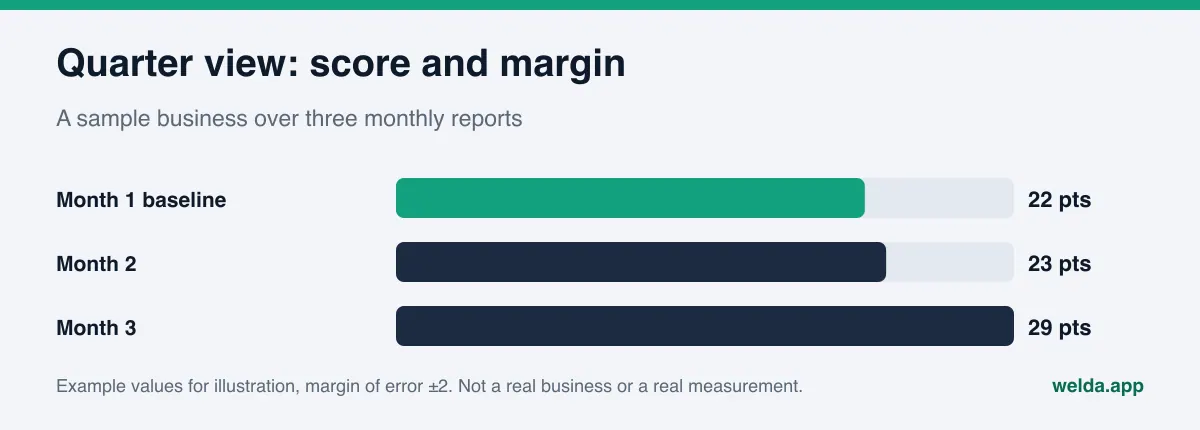
3. Compare with last month and check the margin. AI answers vary even for the same prompt. That is why each prompt is run several times and a margin of error is derived from the spread. If the score rose one point and the margin is two, the report should say "no meaningful change." That honesty is what earns leadership's trust in the next report, when the change is real.
4. Explain each real change in one sentence. Every meaningful move needs a likely cause next to it. For example: "After the service area page went live, we were named for the first time on two suburb prompts." If you don't know the cause for sure, use the word "likely." Engines don't publish why they pick one business over another.
5. End with the ask. The last line is what you need from leadership: approval on a page, information for a profile, hours set aside for a task. Keep it to one item. Three asks means none of them stands out.
Reading the numbers: margin of error, volatility and lag
The most common mistake in AEO reporting for executives is presenting every wiggle as a result. Three properties of AI answers shape how the numbers should be read.
- Volatility: Ask the same engine the same question three times and you may get three different answers. You're named in one and missing in another. A single check is misleading for that reason; the average and spread across runs give a far more reliable picture.
- Engine differences: Each engine leans on different sources. Strong in ChatGPT and weak in Google AI Mode is a normal pattern. One line on the engine split is fine, but the headline metric should be the score across all four engines.
- Lag: A page published this month may not show up in this month's measurement. The report should list completed work and, separately, whether that work has shown up in answers yet.
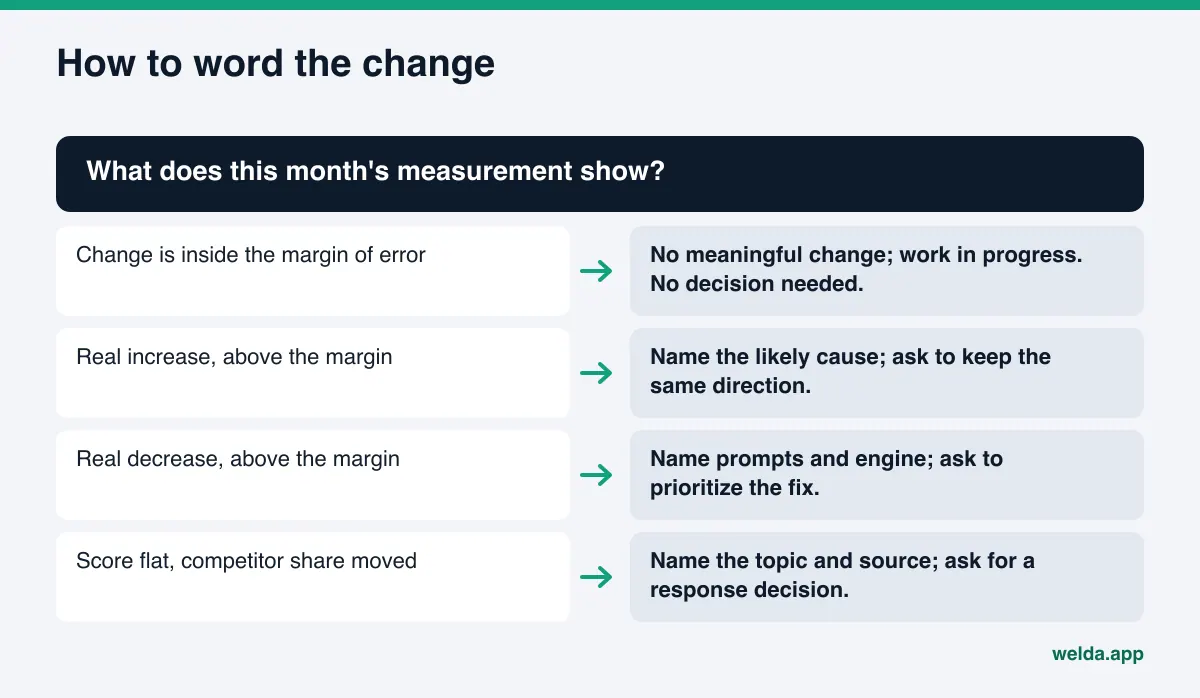
It helps to agree on the wording before the first report goes out. When the same situation always produces the same sentence, leaders learn to read the report quickly, and it doesn't matter who on the team writes it that month.
Explain these three properties once, in the first report. After that, a one-line method note at the bottom of the page is enough: which engines, how many prompts, how many runs, and the size of the margin of error.
Example: a one-page executive report
The draft below is written for an example HVAC company serving several suburbs. The business and the numbers are made up. The point is the structure.
Where we stand: AI visibility score 31 (last month 27, margin ±2). We are named on 40 percent of tracked prompts. Among five competitors named on the same prompts, our share ranks fourth.
What changed: The increase is larger than the margin. We were named for the first time on "emergency AC repair" and "heat pump installer" prompts. We dropped off one engine's list for "duct cleaning near me."
Likely cause: The heat pump service page and business details markup went live. Our duct cleaning service is missing from our Yelp and Angi profiles.
Next month: Complete Yelp and Angi service lists, draft a maintenance plan page, refresh review replies on Google Business Profile.
What we need from you: Approval of the maintenance plan page draft.
Each of the five leadership questions gets one or two sentences. There are few numbers, but every number has a comparison and a margin next to it. The last line asks for one thing. An owner can read this in a minute and sign off.
If you want to show visits or leads from AI assistants, settle how you separate that traffic first. We cover the limits of that work in attribution for AI referrals. Filling a number you can't measure with a guess damages trust in the whole page.
Tailoring the report: owner, CEO, multi-location brand
The skeleton stays the same, but the emphasis shifts with the reader.
Owner-operator. In a small business the report often goes to the owner, who both decides and holds most of the missing facts: hours, service area, what drives price, the team's credentials. For this reader the ask is the most important section. Saying which customer question each missing fact would help answer makes it far more likely the owner sends it over.
CEO or general manager. In a larger company the reader cares about direction, not detail. Share versus competitors and the three-month trend move to the top. Completed work stays short: "four pages updated, two profiles completed" is enough. The ask is usually about resources or priorities.
Multi-location brand. For a business with several locations, AI questions are often asked by city or neighborhood. One row per location is enough on the executive page: score, mention rate and the biggest gap. Location-level detail stays in the working report. Showing at a glance which location trails makes the decision about where to put effort much easier.
Whatever the audience, describe the method once in the first report and keep it stable. If you have to change it, put the change and its effect on the numbers at the top of the page.
How Welda handles AEO reporting for executives
Welda treats the executive report as a natural output of measurement rather than a separate project. Three parts of the product matter most for this topic: the one-page monthly report, the public score formula, and the before-and-after comparison.
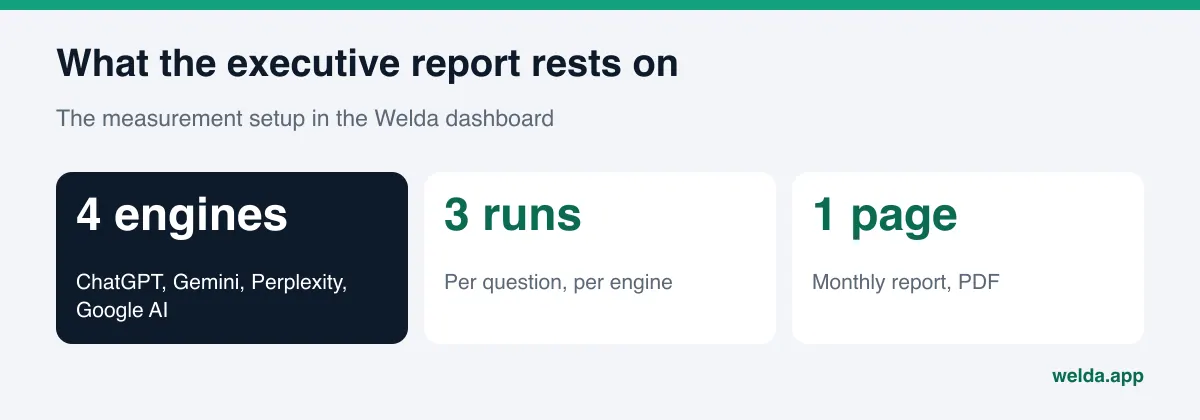
The one-page monthly report. Each month the Welda dashboard produces a single-page report you can download as a PDF. The top shows the score, mention rate and share versus competitors next to last month's numbers. Below that come the prompts won that month, the prompts lost and the risks, and finally next month's plan. That layout maps directly to the five leadership questions above. It's still a good habit for the team to read it once before forwarding and check the "likely cause" lines against what they know about the business.
The public formula and margin of error. In Welda, each customer question is asked three times in ChatGPT, Gemini, Perplexity and Google AI. The score weights mention rate, position in the answer and share versus competitors, and the spread across the three runs produces a ± margin of error. So next to "the score went up," the page also shows whether the rise clears the margin. When a CEO asks whether it's real, the answer is already on the page.
Before and after. The dashboard puts the state before and after a piece of work side by side, and completed tasks are compared against later measurements. A line like "the service page went live; you were named for the first time on two prompts" comes from that comparison. The visibility view shows the same trend week by week; the monthly report is its summary.
Most of the work behind the report is prepared by Welda too. Missing page copy, profile descriptions and review replies land on a to-do list, and publishing approval stays with the business. On WordPress, content opens as a draft on your site; on other systems Welda hands over a ready package and the change is made by hand. The "completed work" line on the report reflects work that actually happened.
A plain statement of where things stand: the Welda dashboard is in early access, rolling out in stages and opening first in Turkey. Regular four-engine measurement is being added during early access, and sample dashboard screens use representative data. What anyone can use today, in English, is the free site analysis. It reads your site, scores it out of 100, lists each gap with how to fix it, compares you against competitors and gives you a PDF. That makes a solid baseline for the "where we stand" line of your first executive report. Pricing is discussed in an early access conversation.
Limits: what Welda doesn't do and what the report can't tell you
A good executive report is as clear about what it doesn't know as about what it does. Welda's limits here:
- Welda does not promise rankings or placement in ChatGPT or any other engine. A report can set a target, but a target is not a promise.
- The score is a measurement, not a revenue figure. The business impact of AI visibility has to be measured separately.
- Welda doesn't write facts it doesn't know; it asks the business. Those questions appear on the report as pending information.
- Handling negative reviews, managing directory listings and PR stay with the business. Welda can draft replies or list the tasks, but it doesn't do that work itself.
- Welda doesn't create fake reviews and doesn't publish sensitive content without approval.
- New content usually takes weeks to show up in AI answers. A month with no movement doesn't necessarily mean something is wrong.
The free analysis has limits as well. It doesn't track rankings, and the five questions it puts to a web-enabled AI assistant are a one-time check, not a trend. Present it to leadership as a baseline snapshot.
Executive AEO report checklist
Once the report is written, read it once as if you were the executive. If anything below is missing, the report will get read but won't produce a decision.
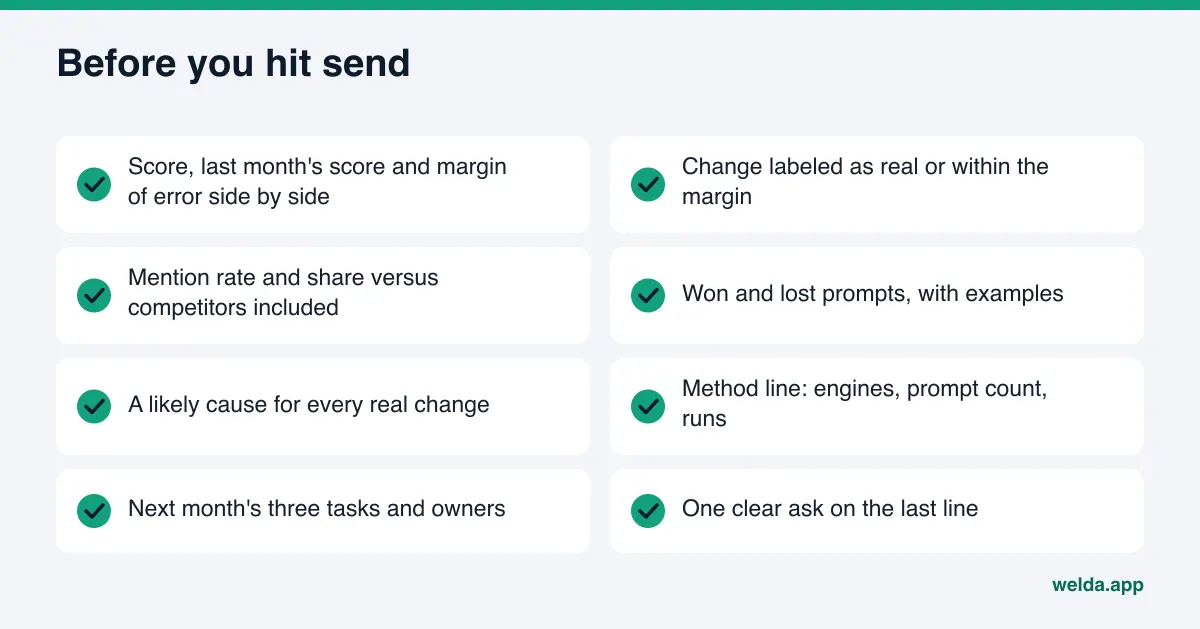
One more test: if the same "what we need from you" item has sat on the report for more than a month, the problem is the process, not the measurement. Move that open decision to the first line of the next report and say plainly what is waiting on it. If you're setting up the split of work between marketing and leadership, AEO for marketing managers is a useful companion.
Frequently asked questions
How often should executives get an AEO report?
Monthly works for most businesses. Changes in AI answers tend to surface over weeks, so a weekly executive report usually presents noise as news. Weekly tracking can stay with the team.
How many metrics should the report include?
Four core metrics: the score, mention rate, share versus competitors, and won and lost prompts. Add completed work and the open decision. Anything beyond that belongs in the working report.
How do I report a drop in the score?
First state whether the drop is larger than the margin of error. If it is, name the prompts and engines involved, the likely cause and next month's fix. Hiding a drop makes every later report less credible.
What if the CEO asks for revenue from AI search?
If you can separate visits and leads coming from AI assistants, show them on their own line and explain how you measured them. If you can't, say so. A visibility score on its own is not revenue.
What should the first report contain?
The first report is a baseline: today's position, which prompts will be tracked, which competitors are in view, and the method. The score and gap list from a free site analysis make a good foundation.
Can Welda's monthly report go straight to leadership?
It is one page and downloads as a PDF, so it can be shared as is. Even so, have the team read it first and check the likely-cause lines against what they know.
Is AEO the same as GEO?
Largely, yes. GEO, short for generative engine optimization, is another name for the same work and is more common outside the US. Either way, the executive report answers the same five questions.
Get your baseline before the first report
The hardest line on a first executive report is "where we stand today." Fill it with a measurement, not a guess. Run your site through the free AI visibility analysis and you'll get a score out of 100, the reason behind each gap and how to fix it, a competitor comparison and a PDF you can bring to your next leadership meeting.