How should a marketing manager approach AEO? Treat it as a measurable visibility program, not a new channel to experiment with. Build a list of the questions your customers actually ask AI assistants, track whether your brand shows up in the answers, close the gaps with approved content, and report to leadership on one page each month. Don't promise rankings. Report what you measure.
This guide is for the person who owns marketing at a company and has recently started hearing "Do we show up in ChatGPT?" from the CEO, the owner or the board. AEO for marketing managers usually lands on the desk without a budget line, an owner or a metric. Below we cover how to define the work, who on your team should do what, which numbers to put in front of leadership, and how to plan the first 90 days. If you want a baseline before your next meeting, run the free site analysis. It reads your site the way Google and AI assistants do and returns a score, a list of gaps and how to fix each one.
Why AEO for marketing managers is its own job
AEO stands for answer engine optimization: making sure that ChatGPT, Gemini, Perplexity, Google AI Overviews and AI Mode mention your business when customers ask questions. You will also hear it called AI search visibility, AI visibility, or GEO (generative engine optimization). They all describe the same work.
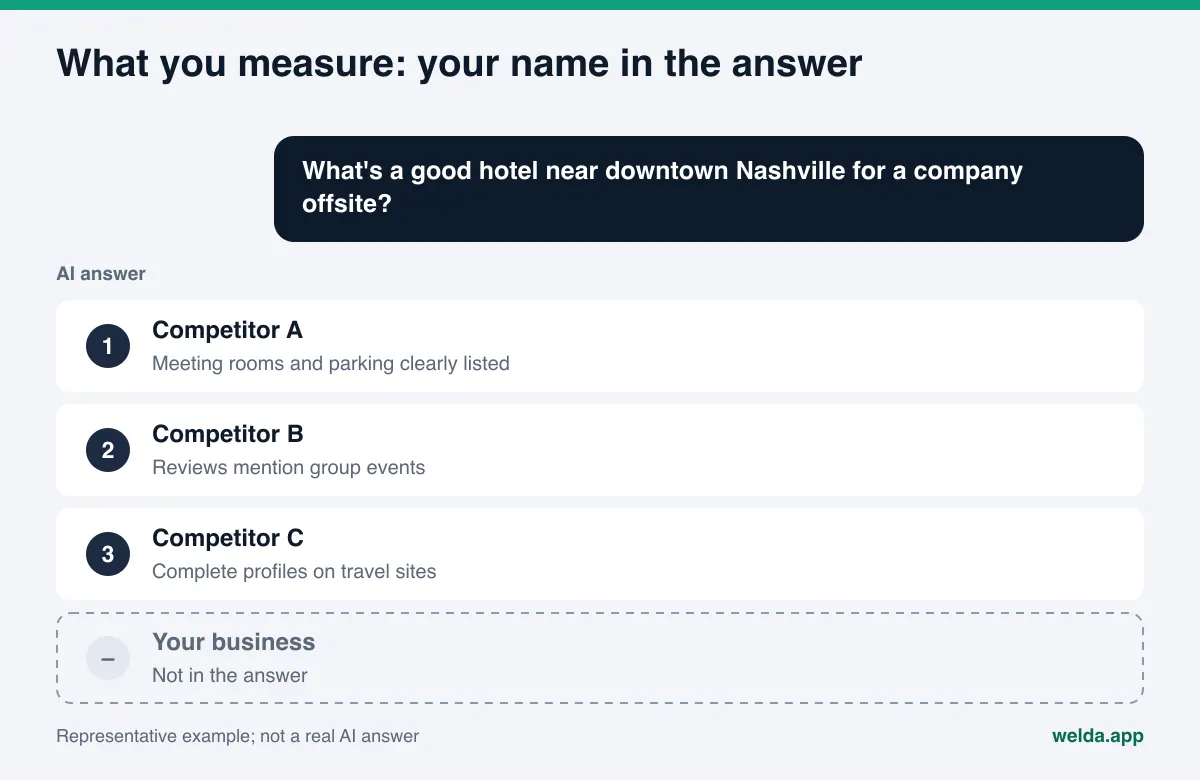
Your customers are no longer choosing only from a page of links. They ask, "Which pediatric dentist in Denver takes new patients on Saturdays?" or "What's a good hotel near downtown Nashville for a company offsite?" The assistant names a few businesses and adds a line of reasoning for each. If you are not on that short list, the customer may never consider you.
For a marketing manager this creates three problems. First, your existing reports do not show the loss. Search Console, your analytics platform and your ad dashboards measure clicks and sessions. None of them tell you whether your brand was named in an AI answer. Second, ownership is unclear. The SEO person says it is a content problem, the content team says it is technical, and whoever manages reviews and listings does not see it as theirs. Third, leadership wants a result, and in this area there is no honest result anyone can promise. No tool or agency can guarantee that an AI model will recommend you.
So the right way to set up AEO is as an ongoing loop of measuring and fixing, not as a campaign with an end date. It overlaps with SEO, because most AI engines draw on web search and a site that is easy to read helps on both sides. But the question changes. Instead of "Where do we rank?" you ask "When a customer asks this question, are we in the answer, and which source is driving it?" If you need a shared starting point with your SEO contractor, AEO for SEO freelancers covers the same ground from their side.
Which numbers should go in front of leadership?
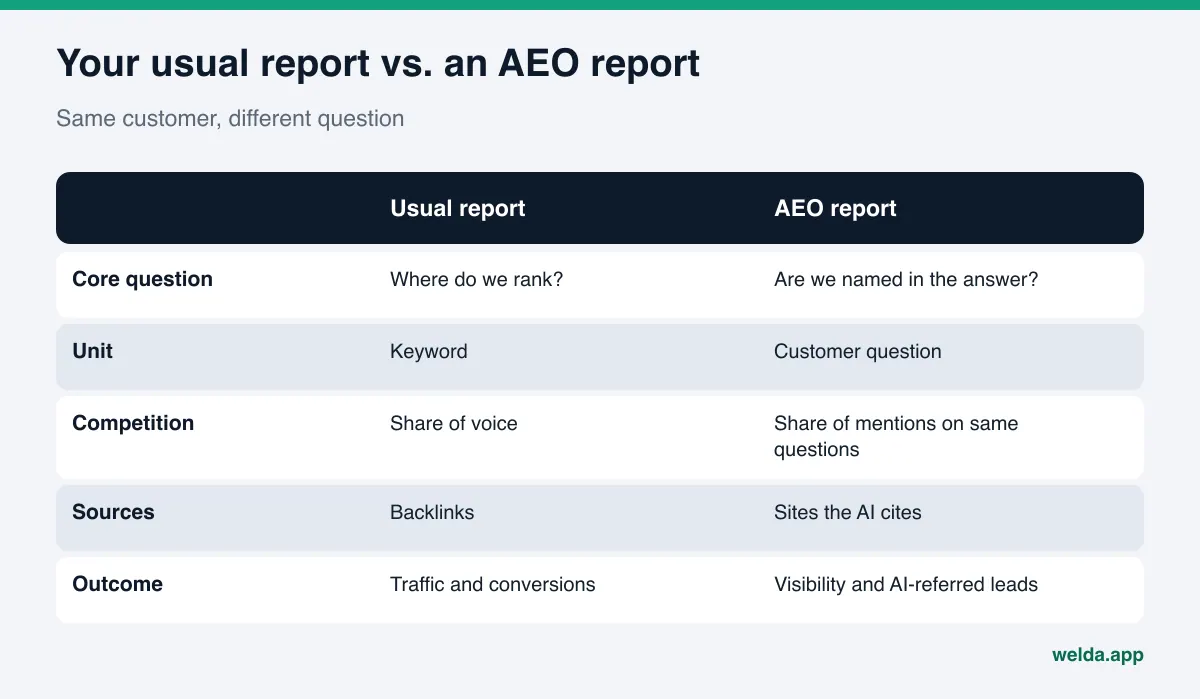
The hardest part of AEO for a marketing manager is presenting a number that is both meaningful and honest. Pick the wrong one and the work is either oversold or shut down a quarter later as "not working." The table below maps the metrics you already report to their AEO counterparts.
| Metric you already use | AEO counterpart | What it tells you |
|---|---|---|
| Keyword rank | Share of questions where you are mentioned | How many customer questions include you in the answer |
| Top-of-page position | Where you appear in the answer | Whether you are named first or last on the list |
| Share of voice | Share versus competitors | How often competitors are named on the same questions |
| Backlink profile | Cited sources | Which sites the AI relies on, and whether you are on them |
| Organic sessions | AI-referred leads | Visits, calls and forms that come from AI answers (needs its own setup) |
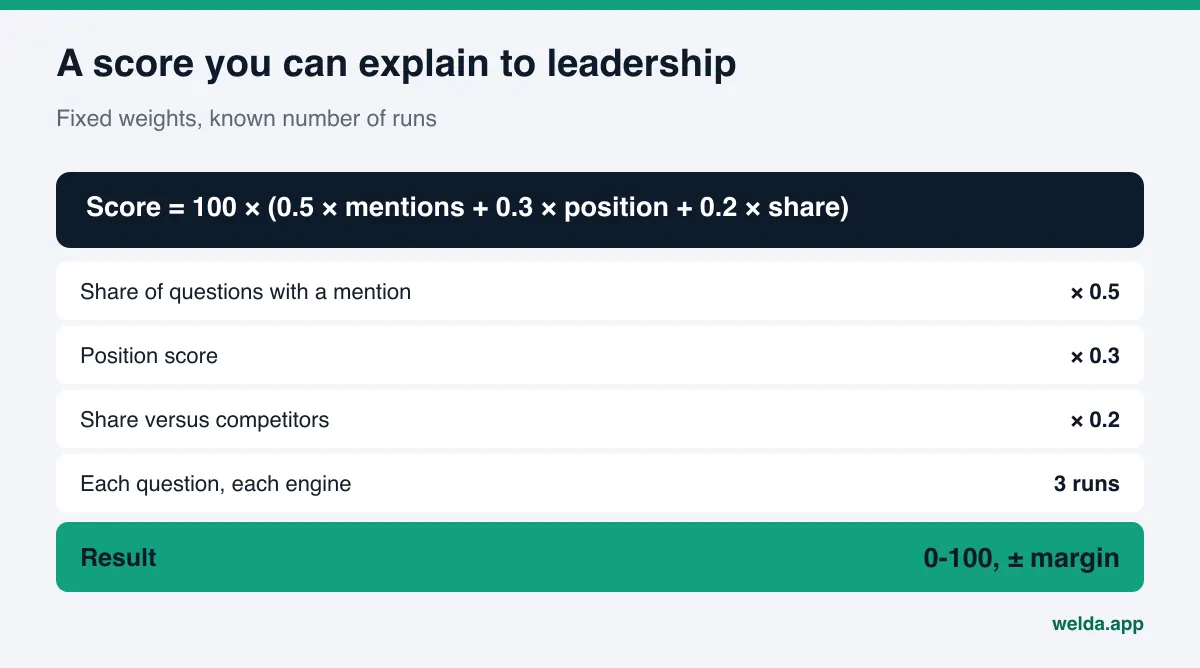
If you want to show leadership a single score, show them how it is calculated too. A score without a published formula can't explain itself when it moves. AI answers also vary: ask the same question twice and you can get two different lists. A result based on asking each question once will bounce around from week to week for no real reason. That is why each question should be asked more than once and the score should come with a margin of error.
A sentence that works in a leadership meeting: "We track whether our brand is named across a set list of customer questions on four AI engines. This month we appeared on these questions, a competitor led on those, the reason was this source, and here is what we did about it." There is no guarantee in that sentence, but there is accountability.
A 90-day AEO plan for marketing managers
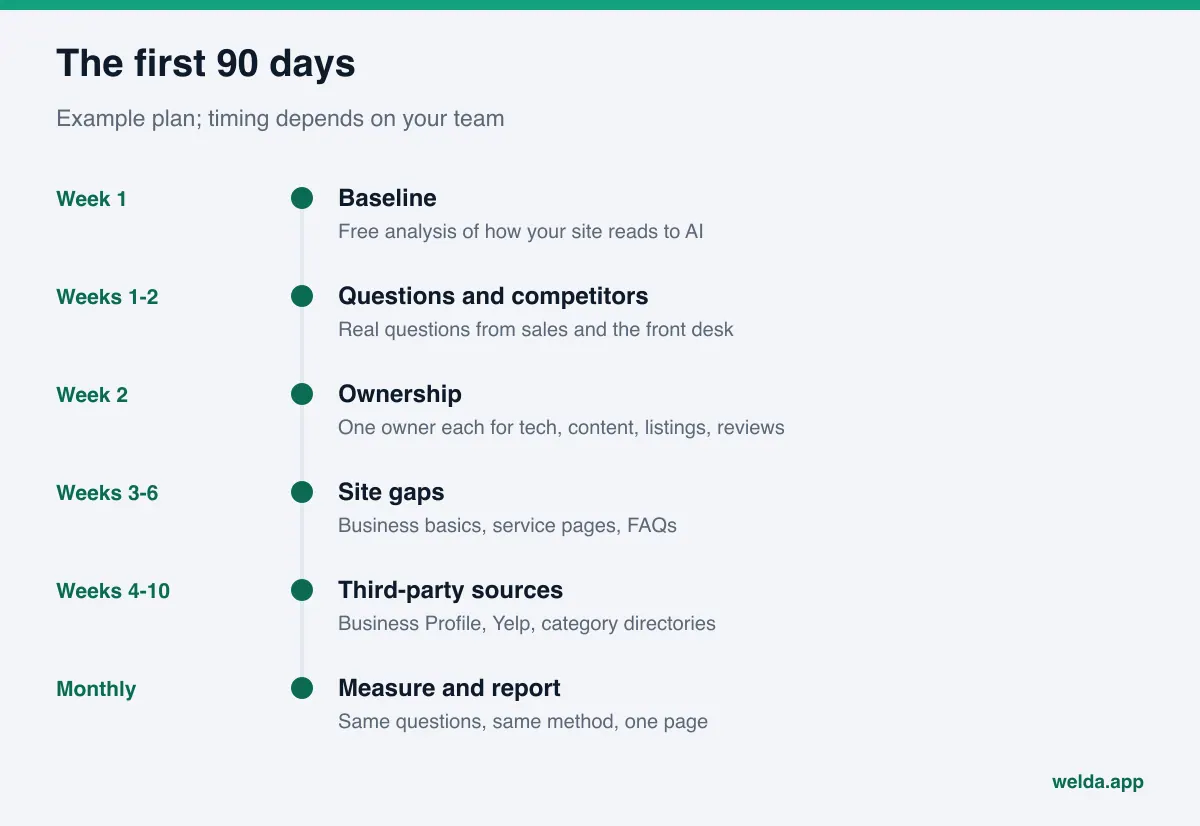
This plan is designed to run with the team you already have, without hiring a new function. The timing is an example and may stretch depending on your resources.
- Take a baseline (week 1). Check how your site reads to AI: can the crawlers get in, is there structured business data (schema), are your services described plainly, is your name, address and phone number consistent, do you have an FAQ section? The free analysis gives you this baseline as a score out of 100 with a list of gaps.
- Build the question list (weeks 1 and 2). Pull real questions from sales, the front desk, the call center and inbound email. Group them into service, location, comparison and pre-purchase clusters.
- Define the competitor set (week 2). The companies leadership considers competitors and the companies customers actually see in AI answers are often different. Track both.
- Write down ownership (week 2). Decide in a single table who handles technical fixes, content approval, listing updates and review responses.
- Close site gaps (weeks 3 to 6). Work through the analysis in order of impact. First the basics that help AI identify you correctly, then pages that answer your question clusters.
- Clean up third-party sources (weeks 4 to 10). Google Business Profile, Yelp, the BBB, and the directories and review sites that matter in your category, such as Tripadvisor for hospitality, Healthgrades for medical practices, or Angi for home services.
- Measure and report (monthly). Run the same question list with the same method. Compare against last month and present it on one page.
Step four is the one teams skip most often. Without written ownership, the analysis report sits in a shared drive. With it, every gap has a name and a date attached.
How to build a question list that reflects real demand
An AEO program is only as good as the questions it tracks. Marketing teams tend to make one of two mistakes here. They either track branded questions ("Is Company X legit?"), which measures customers who already know you, or they track generic questions ("best hotel"), which measures a market you will never compete in.
A strong question list covers these clusters:
- Service questions: "Which clinics in Phoenix offer same-day crowns?"
- Location questions: questions with a neighborhood, suburb or city name, and "near me" intent.
- Situation questions: questions with a constraint, such as "wheelchair accessible," "open on Sundays," or "Spanish-speaking staff."
- Comparison questions: "A or B?" or "compare the options in this area."
- Pre-purchase questions: price range, process, how long it takes. The questions people ask right before they buy.
Write each question the way a customer would say it. The sentences your sales team hears every day are usually the best source. Don't build the list once and forget it; revisit it when you add a service, open a location or hit a seasonal peak. For guidance on cadence, see how often to measure AI visibility.
Who on your team owns what?
A marketing manager's job is not to do AEO personally but to make sure every part of it has an owner. The split below is an example for a mid-sized marketing team.
| Task | Who does it | Who signs off |
|---|---|---|
| Question list and competitor set | Marketing specialist, with input from sales | Marketing manager |
| Technical fixes (robots.txt, schema, speed) | Web developer or site admin | Marketing manager |
| Service pages and FAQs | Content lead | Marketing manager, plus legal where needed |
| Google Business Profile and directory listings | Marketing specialist | Location or operations manager |
| Review responses | Customer service or marketing | Marketing manager |
| Monthly report | Marketing specialist | Marketing manager, who presents it |
On a small team most of these rows land on one person. That is fine, as long as every row has a name. If your colleagues ask why review responses matter here, review responses for AI visibility is a short primer.
How Welda handles AEO for a marketing manager
Welda is software that measures where a business appears in AI answers and fills the gaps on the business's behalf. For a marketing manager, three parts matter most: the monthly report, the competitor view and the approval workflow.
The monthly report is the page you bring to leadership. Each month the Welda panel turns that month's measurement into a one-page report you can download as a PDF. The top shows the score and its change from last month, the share of questions where you are mentioned, and your share versus competitors. Below that are two columns: the questions where you showed up for the first time and the questions where you dropped off the list. The last section is next month's plan, with concrete tasks such as which listing to complete and which page to publish. A method line sits at the bottom: how many questions, which engines, how many repeats, and the score formula. When someone asks "where did this number come from," the answer is on the page.
The score formula is published. Welda calculates the score as 100 × (0.5 × share of questions where you are mentioned + 0.3 × position score + 0.2 × share versus competitors). Each question is asked three times on ChatGPT, Gemini, Perplexity and Google AI, and the spread across those three runs produces a ± margin of error. When the score moves two points, you can tell whether that is a real change or noise. Making that call before you tell leadership "the score dropped" saves a lot of unnecessary alarm.
The competitor view is where budget decisions come from. It shows each competitor's share on the same questions, the question cluster where they win most, and the sources they are cited from. For a marketing manager, its value is in setting next month's priority. For an example hotel, it might show that a competitor leads on wedding and honeymoon questions because its profiles on two booking platforms are complete. That points to "finish those two profiles," not "publish more blog posts," and the reasoning is right there on the screen.
The approval workflow takes work off your content team while you keep control. Welda drafts missing pages, FAQs, profile copy and review responses. Everything it drafts goes to a to-do list where you, or someone you delegate, can read, edit and approve it. On WordPress sites, Welda connects through a dedicated Editor user and an application password, with no code to install. Content opens as a draft on your site and goes live only after approval. On other platforms, Welda hands you a ready-to-apply package and your team makes the change. Content always lives on your own site.
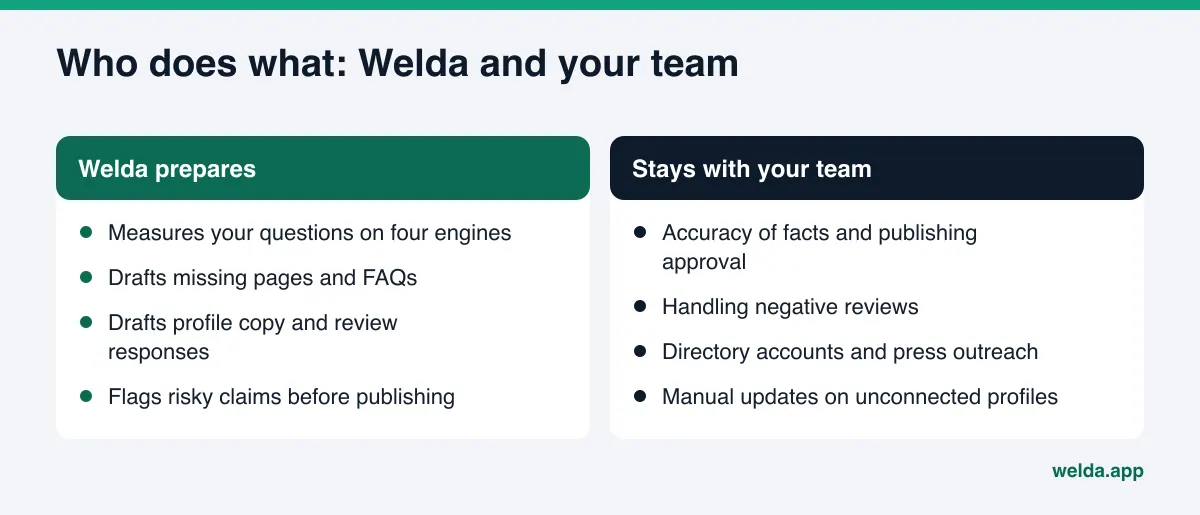
A compliance check also flags risky patterns before publishing, such as price claims, guarantees and superiority claims. It is not legal advice and has not been reviewed by counsel, but it shows you where to loop in your legal team.
Where things stand today: the free site analysis works in English and is available to anyone. The full Welda panel is in early access and is opening first in Turkey. Regular four-engine measurement is being added during early access, and sample panel screens use representative data. Pricing is discussed in an early access conversation.
Example: reading a monthly report in a leadership meeting
The following is an example scenario, not a real company. A marketing manager at an example downtown hotel presents the second month's report. It tells her four things.
First, the score is up two points from last month, but the margin of error is also two points. She does not present this as a win. She says, "We're flat, the trend may be up, and we'll watch it another month." That keeps her credible when the score does move three months later.
Second, the hotel appeared for the first time on two questions: one about meeting rooms and one about accessibility. Both match service pages published last month. She presents this as a likely connection, not a proven cause, because AI answers draw on many sources.
Third, the hotel dropped off one question. The competitor view shows that the business now leading on it has a more complete profile on a booking platform. "Complete that profile" goes into next month's plan with an owner.
Fourth, two pieces of content are waiting for approval. One mentions a price and was flagged by the compliance check. She sends it to legal and pushes the publish date by a week.
Leadership leaves the meeting with a roadmap rather than a headline number: what changed, what didn't, what the likely reason is, and who does what next month. A steady, explainable progress report protects the budget far better than a success story that can't hold up.
How to talk about budget and ROI
At some point leadership will ask what you are spending and what you are getting for it. The honest answer has two layers.
The first layer is visibility: the share of customer questions where you appear in the answer, and how that changes month to month. You can measure this directly. The second layer is demand: visits, calls, forms and messages that come from AI answers. To measure that, segment AI-referred traffic in your analytics and make "How did you hear about us?" a consistent question at intake. Be careful connecting the two. Many AI answers produce no click; the customer reads the answer, remembers the name, and later calls or finds you on a map. Don't credit AEO with all of your lead growth, and don't credit it with none. For a broader framework, see AEO ROI, and if you are weighing AEO against paid search, Google Ads vs AEO lays out the trade-offs.
Set expectations on timing up front. New content or a corrected profile usually takes weeks to show up in AI answers. Expecting a big change in the first monthly report is the most common reason these programs get cut early.
What Welda does not do
What you promise leadership depends on knowing your tool's limits. Welda's are clear:
- It does not guarantee rankings or that you will "show up in ChatGPT." It measures, closes gaps and reports.
- It does not make up information. If it doesn't know your hours or how long a service takes, it asks you.
- It does not publish sensitive content without approval. In healthcare there is no automatic publishing at all; every piece goes to approval, and patient data is never sent to AI.
- It does not write fake reviews.
- Handling negative reviews, managing directory accounts and press outreach stay with you. Welda lists the work and drafts copy where it can, but it does not log into those accounts for you.
The free analysis has limits too. It evaluates your site and five customer questions once. It does not measure rankings, and it is a snapshot. Ongoing measurement and monthly reporting belong to the panel.
AEO checklist for marketing managers
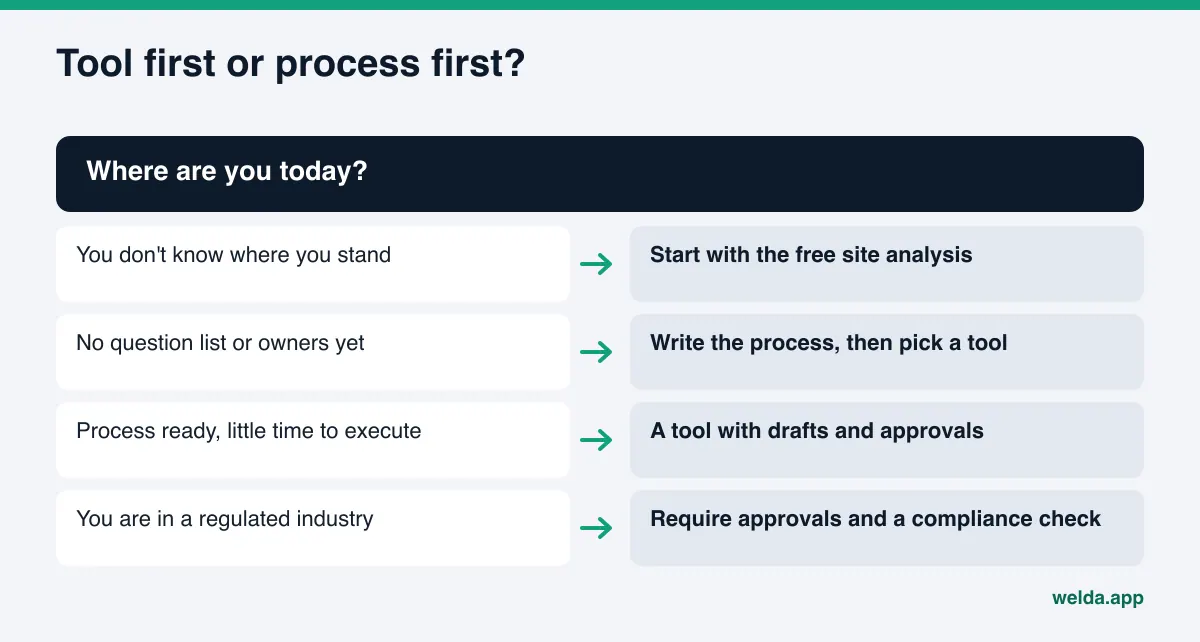
Before you start an AEO program or pick a vendor, get written answers to these questions:
- Do we have a question list, written in the customer's own words?
- Does our competitor set include the businesses customers actually see in AI answers?
- Can we explain the score formula to leadership?
- Is each question asked more than once, with a margin of error reported?
- Does each task (technical fixes, content approval, listings, reviews) have an owner?
- Does content live on our own site, and do we hold publishing approval?
- Is there an approval step for regulated topics like health, finance or legal?
- Can we measure AI-referred leads separately?
- Have we agreed with leadership on a realistic timeline in weeks and months?
If you answer "no" to more than half, build the process before you buy a tool. If most answers are "yes," the next decision is which tool runs that process with the least manual effort.
Frequently asked questions
Should AEO come out of the SEO budget?
At many companies the same team handles both, so the budgets sit close together. The metrics are different, though. A separate line item makes it easier to report AEO on its own terms.
Should we hire an agency or use software?
If someone on your team has time to approve content and apply changes, software may be enough. If not, decide who will do the implementation before you choose a tool. Either way, ask about the measurement method and the score formula.
When will we see results?
Technical gaps close quickly, but changes usually take weeks to show up in AI answers. A meaningful comparison is more reliable after a few months of consistent measurement.
Which AI engines should we track?
The ones your customers use. ChatGPT, Gemini, Perplexity, and Google AI Overviews and AI Mode are a sensible starting set for most businesses. Engines draw on different sources, so showing up on one and not another is normal. Break your report out by engine.
Does Welda host content on its own servers?
No. Content always lives on your site. On WordPress it opens as a draft and goes live with your approval; on other platforms it comes as a ready-to-apply package.
Can we use Welda in the US today?
The free site analysis works in English and anyone can run it. The full panel is in early access and is opening first in Turkey.
Next step
AEO for marketing managers starts with reporting what you measure accurately, not with promises to leadership. Get your baseline first: run the free site analysis, take your score and gap list, and use it to shape the first two weeks of the 90-day plan above.