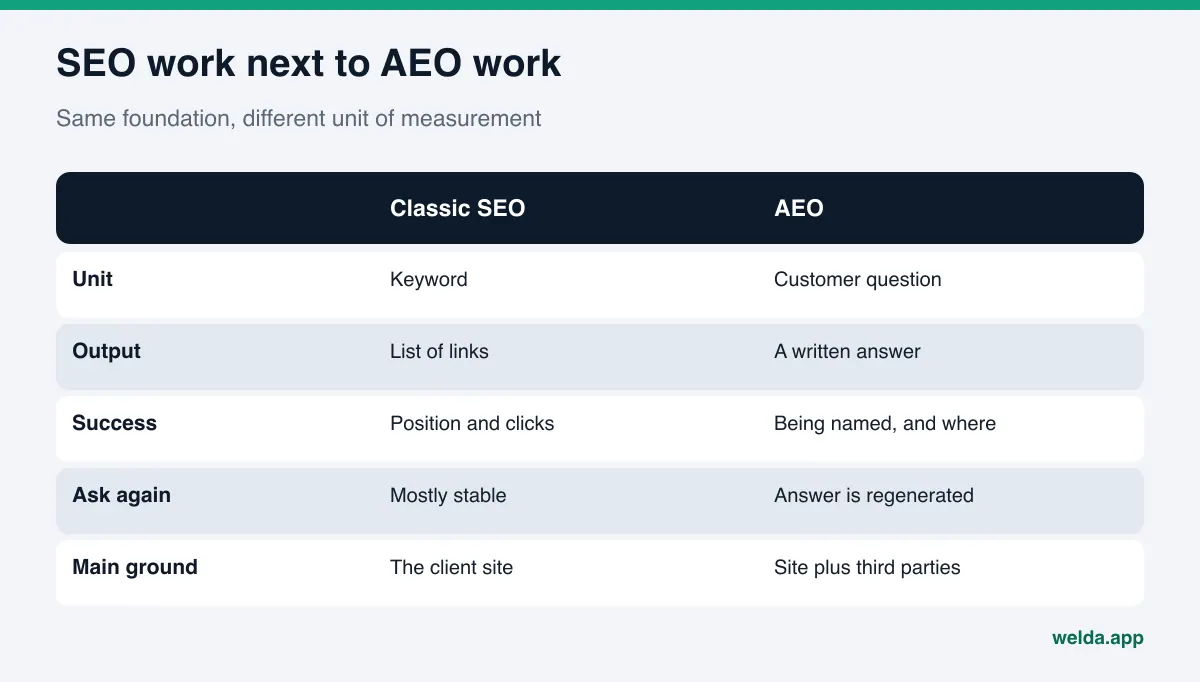
What does AEO mean for SEO freelancers? Most of your technical skill set still applies: crawl access, indexing, structured data and clear page copy are the foundation for AI answers too. What changes is the unit of measurement. You track customer questions instead of keywords, mentions instead of positions, and the third-party sources AI answers rely on instead of a single page.
Clients used to ask one question at the monthly check-in: "Where do we rank?" Now a second one comes up more often: "When I ask ChatGPT, do we show up?" The work that answers it goes by a few names. In the US the most common one is AEO, answer engine optimization. You will also hear GEO, generative engine optimization, which describes the same job. This guide covers AEO for SEO freelancers in practical terms: what you carry over from SEO unchanged, what is genuinely new, how to measure and report AI search visibility for a client, and which parts of the job Welda handles for you and your client. If you want to start with a client site you know well, the free AI visibility site analysis shows how that site reads to Google and to AI systems today.
Why AEO for SEO freelancers is a separate line of work
A client can hold page one for its target keywords and still never be named when someone asks ChatGPT, Gemini, Perplexity or Google's AI Overviews a question about the same service. That does not mean the SEO failed. The two systems produce different outputs. A search result is a list of links. An AI answer is a written paragraph that names a few businesses. The reader does not scan a list and pick; they read the answer and usually act on the first name that fits. We go deeper into that gap in ranking first on Google but not in ChatGPT.
For your client, the problem is commercial. Questions like "best," "near me" and "which one should I choose" sit close to a purchase. A business that is not named in the answer never makes the shortlist. For you, the problem is retention. When a client notices the gap, the first person they ask is their SEO. If your answer is "we can't measure that," the work goes to someone who says they can.
Google is clear about its own AI features. Its documentation says there are no additional requirements to appear in AI Overviews or AI Mode, no special optimizations, and no special schema.org markup or AI text files; a page needs to be indexed and eligible to show a snippet (Google Search Central, AI features). That confirms your SEO foundation still matters. But ChatGPT and Perplexity run their own crawlers, answers are regenerated each time, and information on other sites carries real weight. The foundation is shared. The measurement and the task list are not.
What carries over from SEO and what is new in AEO
You do not need to learn AEO from scratch. Most of what an SEO freelancer already does is directly useful. The table below separates work that continues unchanged, work that changes shape, and work that is new.
| Task | In SEO | In AEO |
|---|---|---|
| Crawl access | Googlebot and robots.txt | Same, plus AI search crawlers such as OAI-SearchBot and PerplexityBot |
| Title and meta description | Click-through and keyword match | Stating plainly what the business does, for whom, where |
| Structured data | Rich results | Consistent business name, address, phone and services |
| Keyword research | Volume and difficulty | The full sentences customers type into an AI assistant |
| Rank tracking | Position per keyword | Per question: named or not, in what order, over repeat runs |
| Link profile | Inbound links | Sources the answer cites, and the client's status there |
| Local SEO | Google Business Profile, Maps | Same, plus Yelp, BBB, Tripadvisor, Healthgrades, Angi and similar |
The biggest shift is in two rows. The question list replaces keyword research, and mention tracking replaces rank tracking. Those two pieces are what turn AEO into a service you can scope, price and report.
Crawler access: checking AI bots in robots.txt
The first task is an extension of the technical audit you already run. Check whether the client's robots.txt blocks AI crawlers, and separate them by purpose. OpenAI documents that OAI-SearchBot is used to surface websites in ChatGPT's search features, while GPTBot collects content that may be used to train models, and each can be controlled on its own (OpenAI, overview of crawlers). Perplexity states that PerplexityBot is used to surface and link websites in its search results and respects robots.txt (Perplexity, bots).
A common finding: a developer or a security plugin added a blanket "block AI bots" rule that shuts out both the training crawler and the search crawler. Opting out of training can be a reasonable choice. Blocking the search crawler, though, reduces the chance that ChatGPT search uses the client's site as a source. Explaining that difference is one of the fastest ways an SEO freelancer adds value here.
The second check is whether the copy is readable. Some AI crawlers read pages without running JavaScript. If services, hours or the address load only on the client side, those crawlers may not see them. We cover this in JavaScript rendering and AI crawlers. To confirm which bots actually visit, log file analysis for AI bots walks through the steps.
From keywords to questions: the unit of AEO
In SEO you agree on a keyword list with the client. In AEO the question list plays that role. People do not type keywords into an AI assistant; they write sentences. Instead of "dentist austin," they ask "Can you recommend a dentist in Austin open on Saturdays?" That one sentence carries location, timing, need and comparison intent at once.
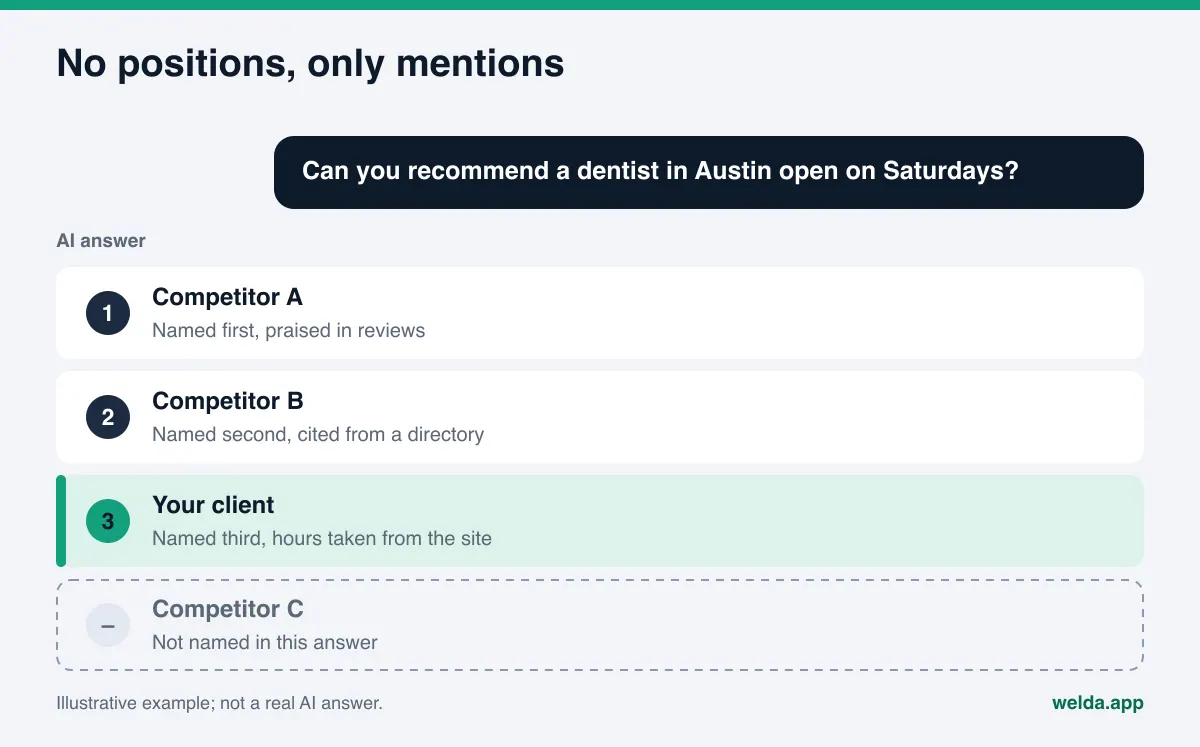
Your existing SEO data is a good starting point, but it is not enough on its own. Combine these sources:
- Call and message logs: The first questions people ask the business often match what they ask an AI assistant.
- Reviews on Google, Yelp and industry sites: What customers praise or ask about shows the criteria they use to decide.
- Search Console queries: Long, question-shaped queries can move straight onto the list.
- Comparison intent: "X vs. Y" and "which is better for" patterns deserve their own group.
- Neighborhoods and suburbs: For local businesses, many questions name a neighborhood or nearby city.
Group the questions by intent: information, comparison, booking or purchase. In reporting, those groups are the shortest way to tell a client "this is where we show up, and this is where we don't." The method is covered in more depth in how to find the questions customers ask AI.
How to add AEO to an SEO client, step by step
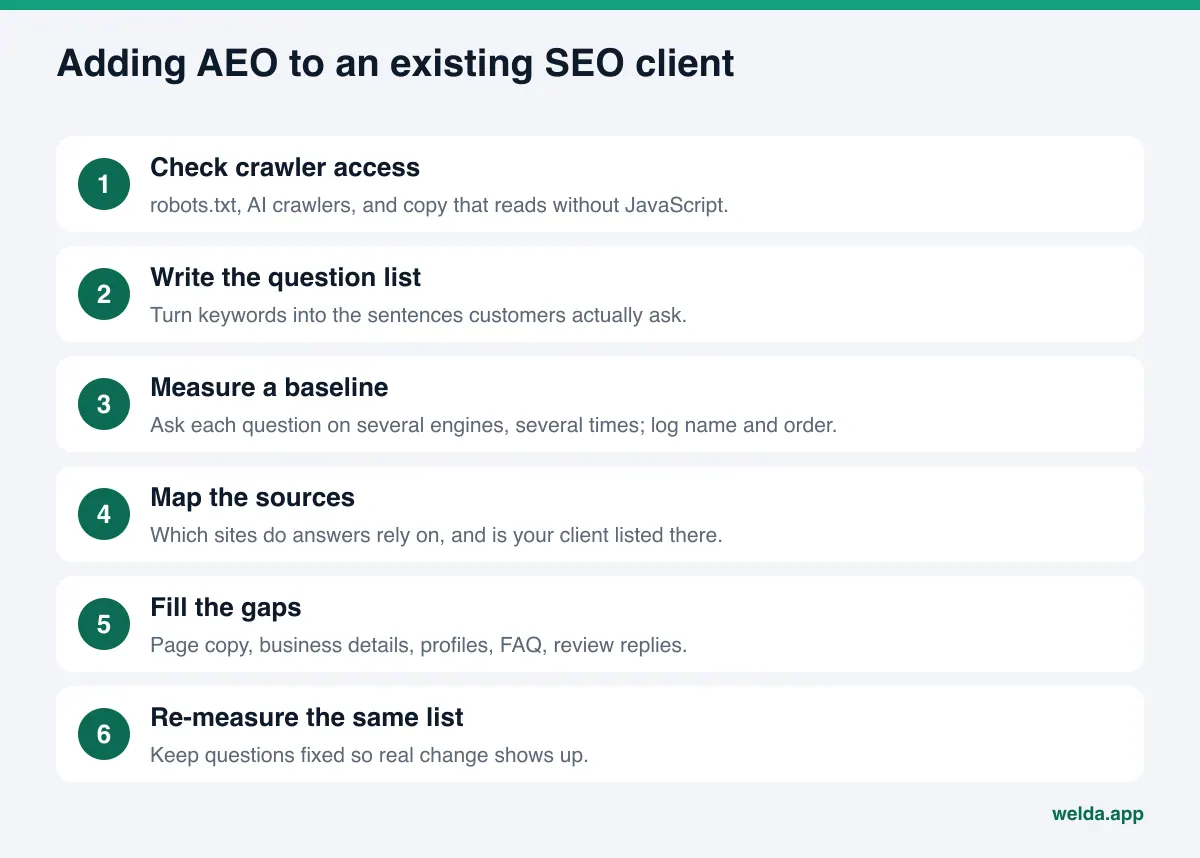
When you add AEO to an existing SEO retainer, the workflow looks like this. Several steps are things you already do. The new parts are repeat measurement and mapping third-party sources.
- Access audit. robots.txt, AI crawlers, core copy present in the HTML, page speed. This adds a few lines to your technical audit.
- Business details. Is the name, address, phone, hours and service list the same on the site, the Google Business Profile and the directories? AI systems tend to avoid naming a business when the facts conflict.
- Question list. Built from the sources above and grouped by intent.
- Baseline. Ask each question on more than one engine and more than once. A single answer can be chance. Log whether the client is named, in what order, and which competitors come first.
- Source map. Which sites do the answers rely on? Directories, review sites, map profiles, forums. Is the client listed there, and is the information correct?
- Fill the gaps. Clear service pages, an FAQ section, business schema, complete profiles, replies to reviews.
- Re-measure. Same question list, same engines. Change the list and you can no longer read the change.
Timing matters. New content usually takes weeks to show up in AI answers. Instead of promising movement in the first month, use that month for the baseline and the gap-filling work. It sets a more honest expectation and protects the relationship.
Mention tracking instead of rank tracking
In SEO, if you check a keyword twice in one day, you mostly see the same position. AI answers behave differently. Ask the same engine the same question twice and the answer is regenerated; the businesses named and their order can change. A single screenshot that says "we're in ChatGPT" or "we're not" is therefore a misleading report.
The sound method is to ask each question several times and read the result as a distribution. A business named in three of three runs is in a different position from one named in one of three. Showing a margin of error in your reports is both honest and defensible. When the client sees a small drop from one week to the next, they can tell whether it is a real change or normal variation.
How Welda does this work
Welda is software that measures where a business appears in AI answers and fills the gaps on the business's behalf. For an SEO freelancer, three parts matter most: the free site analysis as a starting audit, the question-by-question measurement, and the sources view.
A starting audit: the free site analysis
The free analysis automates the first two steps of the workflow above, and it runs in English. It reads the home page and a few inner pages such as services, pricing, about and contact the way Google and AI systems would. It checks whether AI crawlers are blocked in robots.txt, the title and description, the main heading, business schema, address and phone details, whether social and map profiles link to the site, an FAQ section, reviews and trust signals, how clearly services are described, and page speed.
You get a score out of 100, with technical and content scored separately. Every gap comes with what was found, why it matters and how to fix it. The parts most useful to a freelancer are the simulation that shows how much each fix would raise the score (handy when you prioritize with the client), the competitor comparison, and a ready-made fix package for the site, including business schema code. You also get suggested copy for the home page: title, description, main heading, intro paragraph and FAQ.
The analysis also asks five likely customer questions to an AI assistant with web search and checks whether the business name appears in the answers. That is a one-time check, not ongoing tracking. The analysis does not measure rankings and makes no ranking promise. It is free once per site; email and phone are verified, the results link arrives by email and stays open for 14 days. If you run it for a client site, agree with your client up front on whose details are used and who receives the result. The PDF and the shareable score card make it easy to bring into a client meeting.
Question-by-question measurement
In the Welda panel, the questions customers are likely to ask go to ChatGPT, Gemini, Perplexity and Google AI three times each. The questions view is the counterpart of a keyword ranking report: each row is a question, each column an engine, and each cell shows whether the business was named and in what position.
The decision you make on this screen is where the gap is and on which engine. If a client is named for information questions on every engine but only on one engine for comparison questions, the task list looks different. Each question also shows which sources the answer drew on, which leads to the next view.
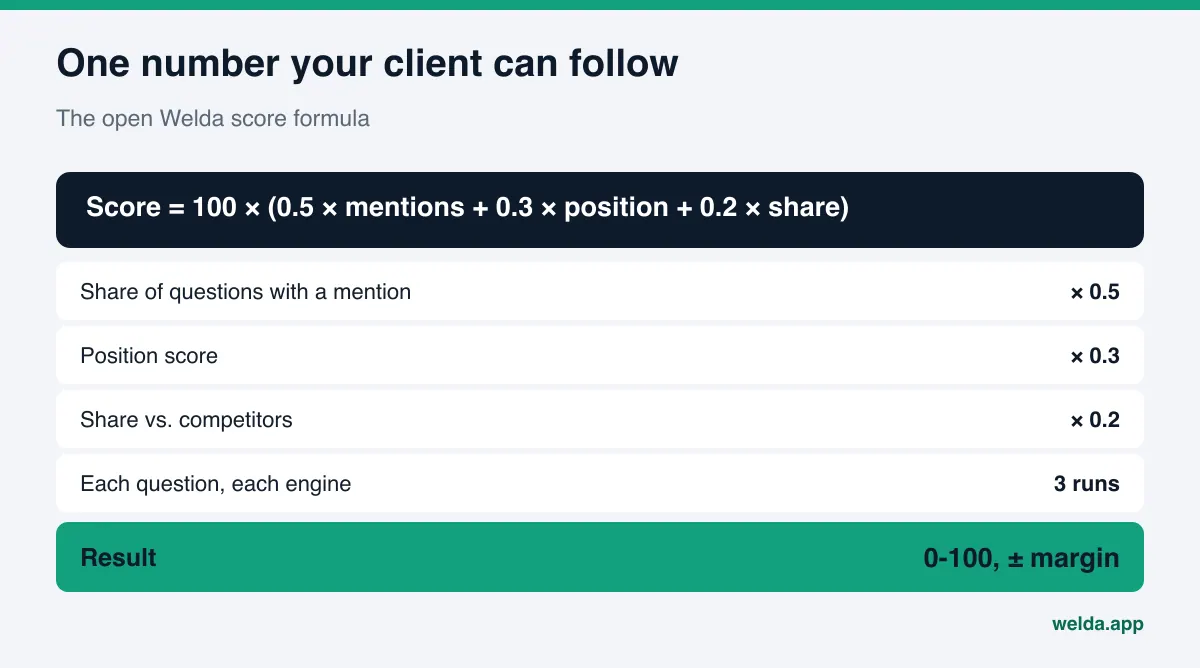
The score formula is public: 100 × (0.5 × share of questions where the business is named + 0.3 × position score + 0.2 × share against competitors). The spread across the three runs gives a ± margin. When a client wants one number, you have one you can explain line by line.
The counterpart of a link profile: sources
The sources view lists the sites AI engines draw on when they build answers and the business's status on each: listed or not, incomplete, unverified, reachable or not. SEO freelancers are used to link profile analysis. This view applies the same thinking but asks a different question: not "who links to us," but "which source does the answer rely on."
What it leaves you is prioritization. A missing profile on a directory that gets many citations comes before a gap on a forum that gets few. Welda drafts profile copy and review replies. Google Business Profile, Instagram and Facebook can be connected; if they are not, the task lands on the to-do list as manual work. Opening directory accounts and press work stay with the business, or with you.
The rest of the panel, and approvals
The panel also has a competitors view, a single to-do list, ready-to-publish pages, a compliance check that flags risky phrasing before publishing, a before-and-after comparison and a one-page monthly PDF report. On WordPress sites Welda connects through a separate Editor user and an application password, with no code to install; content opens as a draft on the site and goes live once approved. Publishing approval always stays with the business, and content always lives on the business's own site. How a freelancer and a client share the panel is best settled in the early access conversation.
To be clear about where things stand: the panel is in early access and is opening first in Türkiye. Regular measurement across all four engines is being added during early access, and sample screens in the panel use representative data. The part anyone can use today is the free site analysis, which works in English and German. Pricing is discussed in the early access conversation.
How to report AEO to a client
You can keep most of your SEO report structure. The units change. A client-friendly AEO report covers four things:
- One score with a margin: The reason it moved should be explainable.
- Status by question group: Is the client named for information, comparison and booking questions?
- Questions where competitors lead: And which source the competitor wins from.
- Work done this period: Pages updated, profiles completed, items waiting on approval.
Avoid presenting a single AI answer screenshot as the result. When the client asks the same question and sees a different answer, your report loses credibility. Repeat measurement and an open formula prevent that argument before it starts.
Limits: what Welda does not do, and promises you should not make
Ranking guarantees have long been a credibility problem in SEO. In AEO the problem is sharper, because answers are regenerated every time. Welda is direct about its limits:
- It does not guarantee rankings or "showing up in ChatGPT."
- It does not write facts it does not know; it asks the business.
- It does not publish sensitive content without approval. In healthcare there is no automatic publishing, every item goes to approval, and patient data is not sent to AI.
- It does not create fake reviews. The FTC's rule on fake reviews and testimonials, announced in August 2024, covers this ground (FTC press release). This is not legal advice.
- Handling negative reviews, directory accounts and press work stays with the business.
- The compliance check flags patterns such as price, guarantee and superiority claims, but it is not legal advice and has not been reviewed by legal counsel.
The promises you make to a client should stay inside the same frame. You can promise measurement, gap-filling and regular tracking. You cannot promise outcomes. Since new content usually takes weeks to show up in AI answers, plan reporting in weeks and months.
Decision guide: should you add AEO to your services?
Not every SEO client needs the same AEO work. Use the chart and the table below to decide where to start.
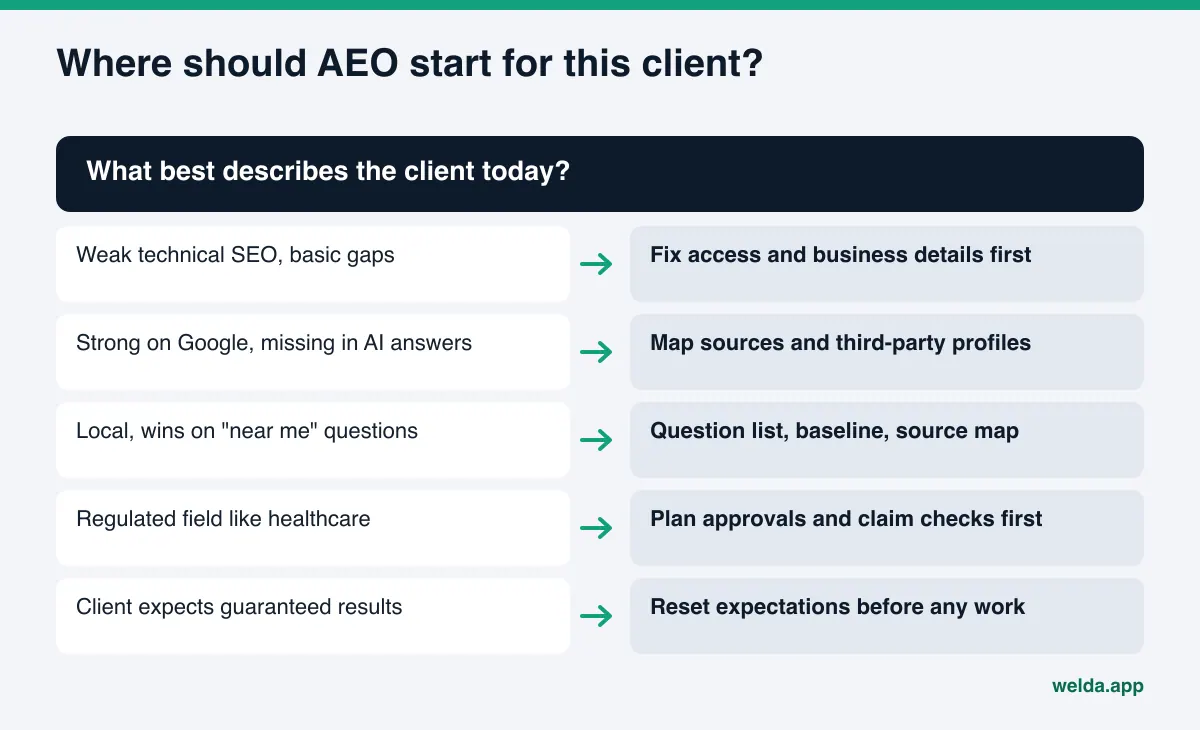
| Client situation | Reasonable first step | What to tell the client |
|---|---|---|
| Local business that wins on "near me" and "best" questions | Question list, baseline, source map | We will measure where you are named before changing anything |
| Weak technical SEO with basic gaps | Access and business details first | AI answers depend on the same foundation |
| Strong on Google, absent in AI answers | Third-party profiles and sources | The answer relies on sites beyond yours |
| Healthcare, legal or another regulated field | Approval flow and claim checks | Nothing goes live without your sign-off |
| Expects guaranteed results | Reset expectations | No one can promise placement in AI answers |
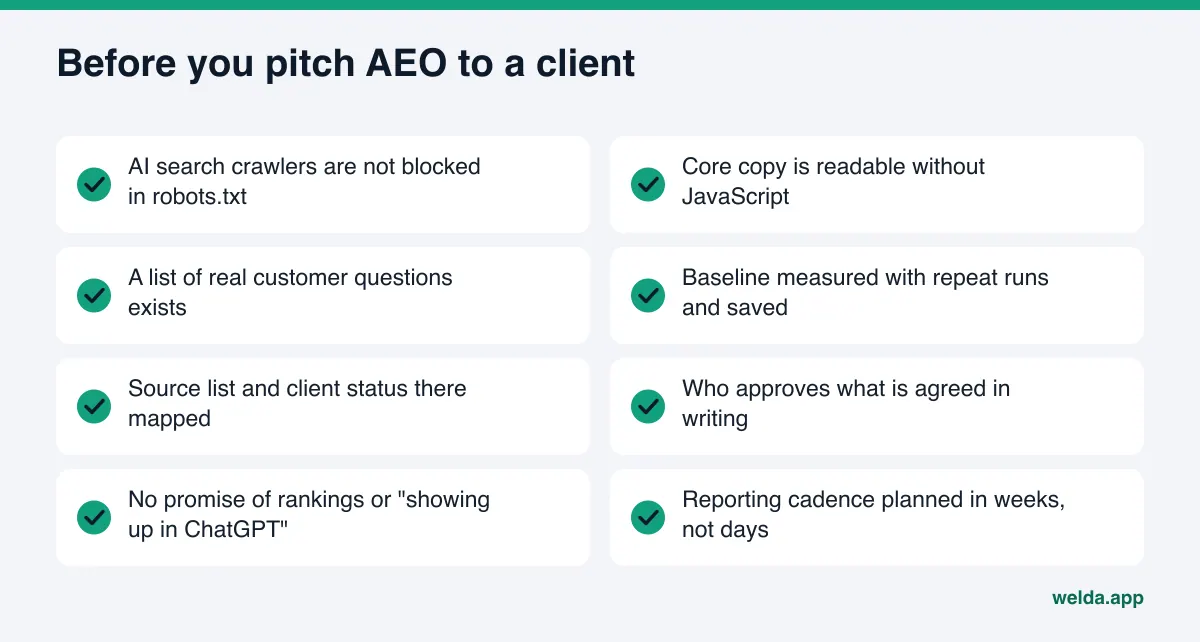
For a broader list covering the site and third-party sources, see the AEO checklist.
Frequently asked questions
Is AEO replacing SEO?
No. Google's own documentation says AI Overviews and AI Mode have no extra requirements beyond being indexed and snippet-eligible. The SEO foundation stays. AEO adds measurement by question and mention, and it extends the work to third-party sources.
Do I need a new tool to offer AEO?
You can do most of the technical audit with what you already use. What is new is asking questions on several engines repeatedly and logging the answers. You can do that by hand; as your client list grows, software for regular measurement saves time.
Can I run the free analysis for a client's site?
The analysis is free once per site. Email and phone are verified and the results link arrives by email. Agree with your client beforehand on whose details are used and who gets the result.
Should I add an llms.txt file?
Google says no new machine-readable files or special markup are needed to appear in its AI features. Put crawler access, clear copy and consistent business details first.
How long until results show?
New content usually takes weeks to show up in AI answers. Use the first period for the baseline and gap-filling so the client's expectations match how the system works.
Can I use the Welda panel for US clients today?
The panel is in early access and is opening first in Türkiye. Question language can be set to English, but the full panel is not yet open in the US. The free site analysis works in English today.
Start with one client site
The shortest way into AEO for SEO freelancers is to look at a site you already know through an AI system's eyes. In a few minutes you see which crawlers are blocked, where business details fall short and which fix would move the score most. Run the free AI visibility analysis and bring the result to your next client call.