How do you find the questions customers ask AI about businesses like yours? Start with your own inbox: calls, texts, emails and contact forms hold the exact sentences real customers use. Widen the list with reviews, complaint threads and local forums, group the questions by intent, then test them in ChatGPT, Gemini, Perplexity and Google's AI features. This guide walks through each step and shows how Welda measures those questions for AEO.
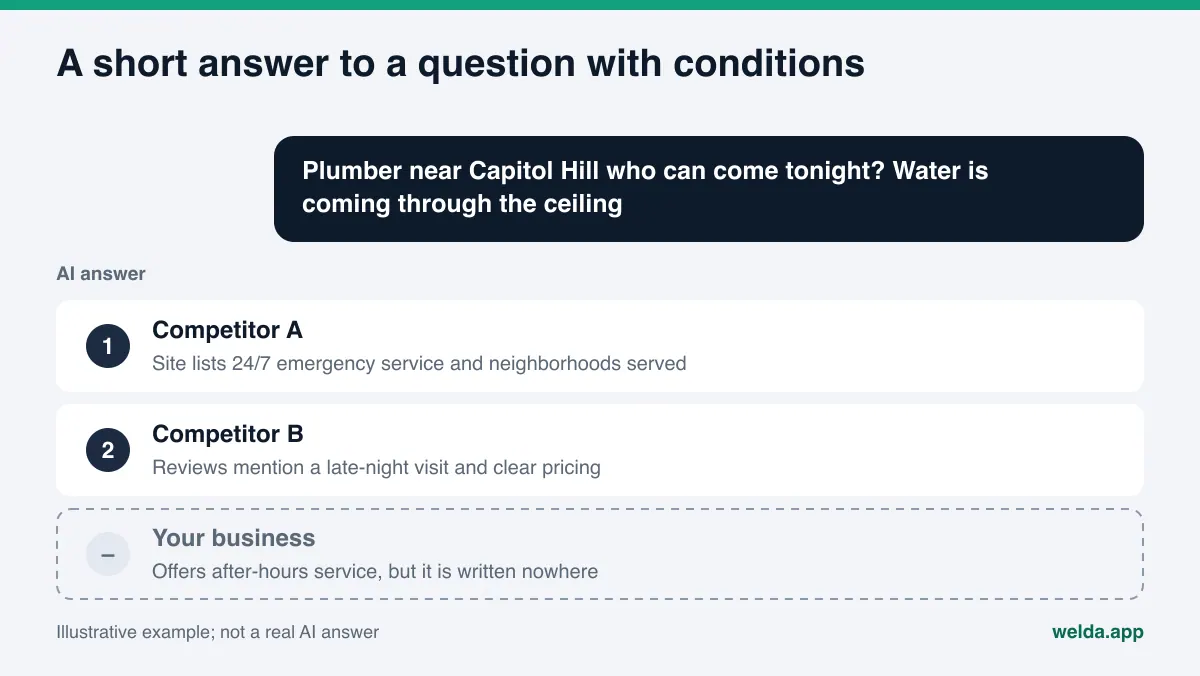
Why is finding the questions customers ask AI its own job?
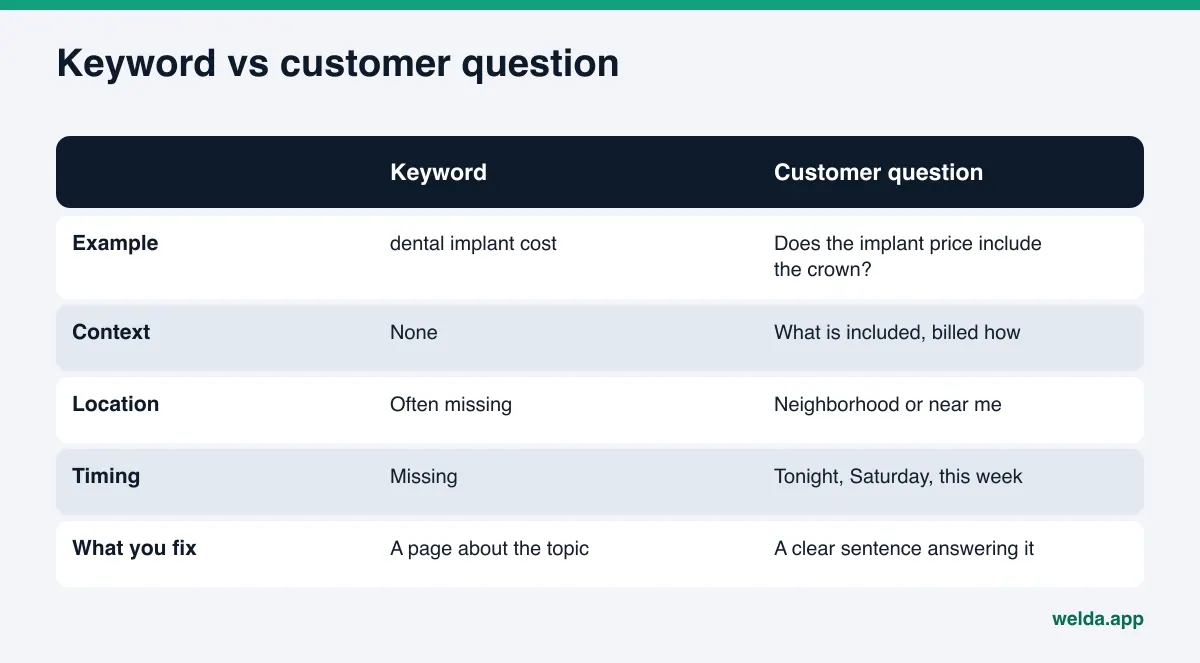
On a classic search engine, people type fragments: "plumber Denver", "dental implant cost", "coffee shop wifi". When they ask an AI assistant, they write the way they would text a friend. The sentence gets longer, and it carries conditions: a time of day, a budget, a neighborhood, a worry. "Is there a plumber near Capitol Hill who can come tonight? Water is coming through the ceiling." "Does the implant price usually include the crown, or is that billed separately?" Neither question shows up in a keyword list. Yet those details are exactly what decides which business an AI answer names.
That is the core idea behind AEO (answer engine optimization): getting your business named in the answers AI assistants give. You will also see it called AI search visibility, or GEO (generative engine optimization) in some circles; the goal is the same. And every piece of AEO work starts with the question. You cannot know which information is missing from your site until you know which questions it has to answer.
Here is why. When an assistant answers a question like the plumbing one, it breaks the question into parts and looks for something it can read for each part. "Tonight" is answered from your hours and emergency service details. "Near Capitol Hill" comes from your address and service area. "Without getting ripped off" comes from reviews and how you explain pricing. If your website, your Google Business Profile or your Yelp page has nothing for one of those parts, a competitor that does gets named instead.
The second reason is measurement. "Do we show up in ChatGPT?" is not a useful question on its own. For which question? In which assistant? In what position? A measurement built on the wrong questions can look good or bad, but it will not reflect your real customers. A dental practice that only checks "best dentist in town" will never see that it is missing from "does my insurance cover a night guard", which is what patients actually ask.
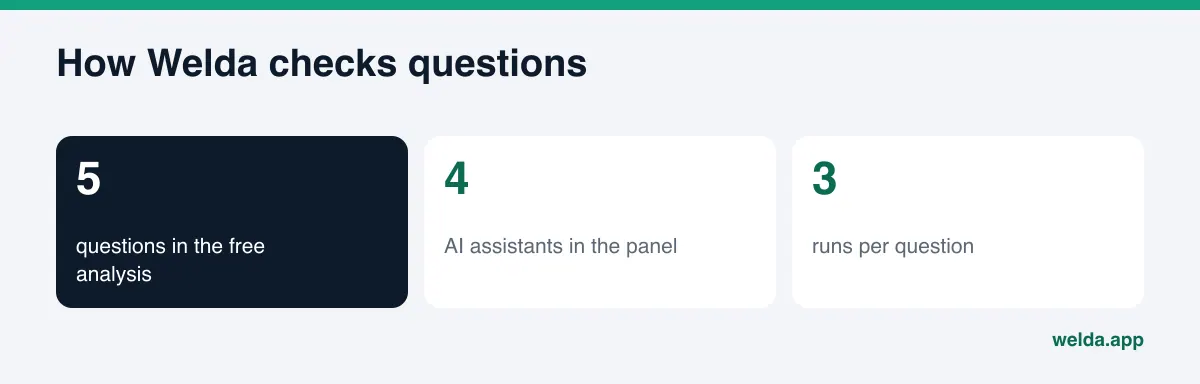
The quickest way to see where you stand is to measure it. Welda's free site analysis reads your site the way AI assistants do, then asks an AI assistant with web search 5 questions your customers might ask and checks whether your business is named in the answers. It works in English.
What kinds of questions do customers ask AI?
Across local businesses, customer questions tend to fall into a handful of patterns. Each pattern is answered from a different piece of information. The examples below are illustrative, written for this guide.
| Question pattern | Example question | What the answer relies on |
|---|---|---|
| Recommendation | "Quiet coffee shop near downtown where I can work for a few hours?" | A clear description of your space and services, review language |
| Status and timing | "Urgent care open right now that takes walk-ins?" | Hours, holiday closures, walk-in policy, structured business data (Schema) |
| Price and trust | "Is a pest control contract worth it or should I pay per visit?" | How pricing works, what is included, cancellation terms |
| Location | "Good pediatric dentist in Brooklyn Heights that's open Saturdays?" | Address, map listing, neighborhoods served, parking and transit details |
| Comparison | "Clear aligners or braces for a 14-year-old, and who does both nearby?" | Service pages that explain options plainly, an FAQ |
| Brand | "Is [your business] legit? Any complaints?" | Reviews, BBB profile, how you answer complaints |
The takeaway is simple. Most questions are not "who is the best". Customers usually ask about a condition: open now, what is included, do you take my insurance, can I bring my dog, do I need an appointment. The business that has written that condition down gets into the answer.
Where do you find the questions customers ask AI? Seven sources
The most common mistake is guessing. Owners use their own vocabulary; customers use theirs. A practice that writes "orthodontic treatment options" can miss a parent asking "my kid's teeth are crowded, do they need braces or will aligners work". The sources below give you the customer's own sentence, roughly in order of how reliable they are.
- Calls, texts and emails: Go back through the last three months of first messages from new customers and copy the questions. Strip out names, phone numbers and anything personal, and keep only the question. This is your most honest list, because these people already found you and wanted to know something.
- Front desk and staff notes: Ask whoever answers the phone what people ask most. Better yet, have them jot down every question for one week. The ones that repeat show up on their own.
- Your reviews and your competitors' reviews: On Google Business Profile, Yelp, Tripadvisor, Healthgrades or Angi, reviewers often write as if answering a question they had: "they didn't tell me the price upfront", "I asked about parking and there was none". Every complaint in a review is a question another customer will ask an AI.
- Complaint threads and local forums: BBB complaints, neighborhood forums and local discussion threads show the worry behind a question. A thread titled "locksmith opened my door in two minutes and charged a fortune" explains why people ask "how much should a lockout cost".
- Directories and industry guides: Look at which questions sit in the FAQ sections of the directories in your field, and which topics they lead with. AI assistants read these sites too.
- Search box suggestions: When you type the start of a question into a search box, the autocomplete suggestions and the "people also ask" style boxes show how people phrase it.
- Your own site search and contact form: If your site has a search box, read what people search for. Read what they type into your contact form. A question that shows up there is a question your site failed to answer.
In the first week, these seven sources usually turn up dozens of raw questions. You do not need to measure all of them. The next step is turning the raw pile into a clean list you can test.
How do you build a customer question list, step by step?
Raw questions are messy. The same need is phrased five ways, and some questions are too personal to reuse. These steps turn the pile into something measurable.
- Merge the same need. "Are you open Sunday", "do you work weekends" and "can I book a Sunday slot" are one need: weekend service. Pick one main question per need and keep the customer's most natural wording.
- Keep the context in the question. Neighborhood, time, budget and situation change the AI answer. Write "pediatric dentist in Brooklyn Heights open Saturdays", not "dentist". Strip the context and you are no longer measuring a real customer's question.
- Tag each question by intent. Recommendation, comparison, price and trust, status, information. The tag tells you which page should answer it. Price questions belong on your pricing page; status questions belong in your hours and business data.
- Keep brand questions separate. Questions that include your name ("is [your business] any good") are their own group. A competitor showing up there is a separate problem.
- Prioritize. Score each question on two things: how often it comes in, and how much a customer who asks it is worth. Questions that score high on both make your first 20.
- Check whether your site answers it. For each question, find the sentence on your site that answers it plainly. If you cannot find one, you have found a gap before measuring anything.
- Decide on language. If you serve Spanish-speaking customers, write those questions separately, in the words those customers actually use, not as a translation of your English list.
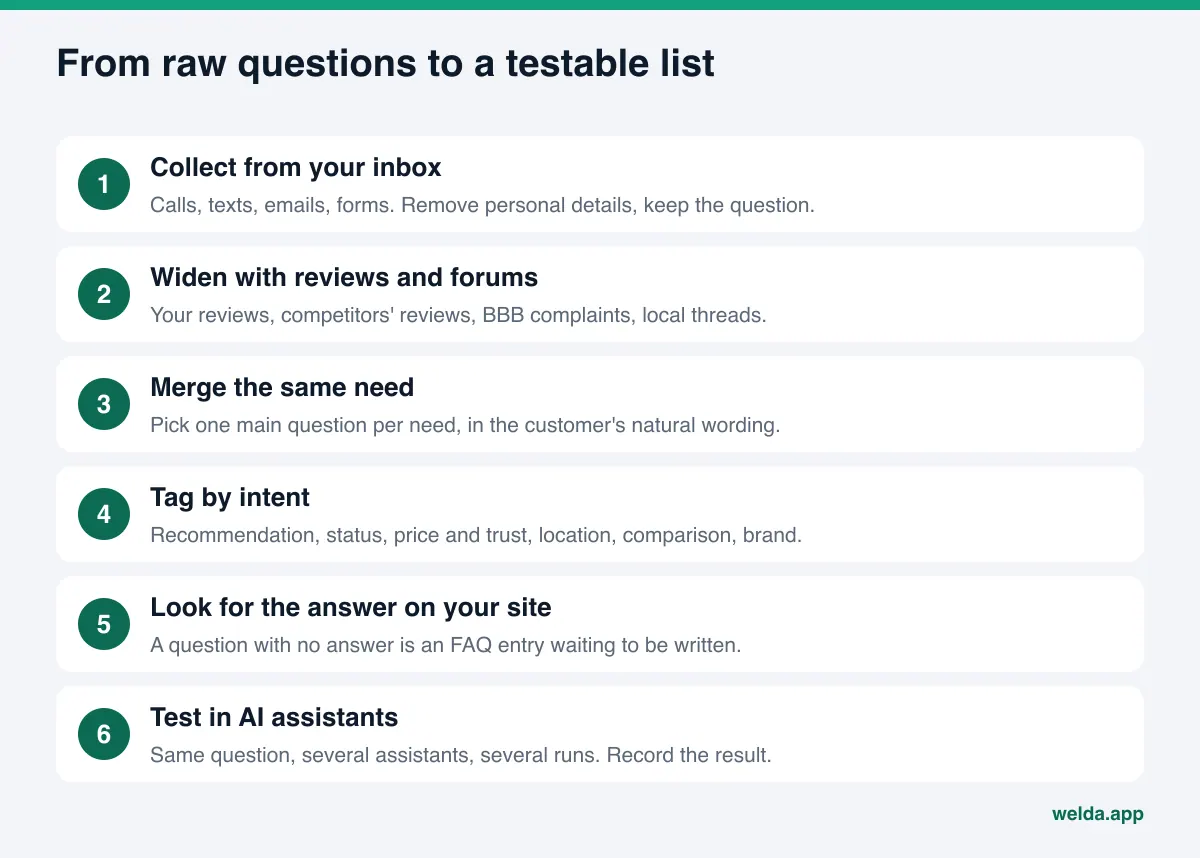
The most valuable output of this list is not even the measurement. The questions in step 6 that have no answer on your site are the raw material for your FAQ section. Price questions deserve extra care: explaining what is included often helps more than a number. We cover that in pricing pages for AI answers.
How do you test the questions in AI assistants?
Once the list is ready, you can start asking. If you do it by hand, watch for three things.
- Answers change every time. Ask the same assistant the same question twice and you may get different businesses. Do not decide on one try. Ask a few times and note in how many of them you were named.
- Your account shapes the result. When you ask from your own account and location, the assistant may already know you from earlier chats. Where you can, ask while logged out or with chat history turned off.
- Look at the sources. Perplexity and Google's AI Overviews and AI Mode show the sites they cite. Wherever a competitor is being cited from is where you are missing.
Twenty questions, four assistants, three runs each: that is 240 checks. Doing it once teaches you a lot. Doing it every month is hard. We compare the two approaches in manual ChatGPT checks vs tracking tools. If a competitor appears when people ask about your own name, read competitors show up when AI is asked about my brand.
How does Welda find and measure customer questions?
Welda takes on three parts of this job: choosing questions, asking them repeatedly across assistants, and turning unanswered questions into content you approve.
Five questions in the free analysis. The free site analysis reads your homepage and a few inner pages, then picks 5 questions your customers might ask and puts them to an AI assistant that can search the web. The report shows, question by question, whether your business was named. It is a one-time snapshot, but it is a useful check against your own list: if Welda picks a question your list does not have, you may be missing how customers phrase things. The analysis also suggests ready-to-use FAQ entries for your homepage, which makes it concrete where your answers should live.
Question-by-question tracking in the panel. The Welda panel asks the questions your customers would ask to ChatGPT, Gemini, Perplexity and Google AI, three times each. Those three runs are the answer to "the answer changes every time": you are not relying on one lucky or unlucky try, and the score comes with a margin of error. On the questions screen, every row is one question, and each assistant column shows whether you were named and in what position. Question language can be set to English or Turkish.
The decision on that screen is straightforward. Questions where you are missing in every assistant usually point to information missing from your site. Questions where you appear in one assistant but not the others usually mean a source that assistant leans on does not have you. The competitors screen shows which topics and which sources a competitor is winning on for the same questions.
From unanswered question to draft copy. When you are missing from a question, Welda adds it to a single to-do list and drafts the fix: an FAQ answer, a service description or a profile text. It does not make up facts it does not have. If it does not know what your price includes, it asks you. You approve what gets published, and the content always lives on your own site. On WordPress, the draft opens on your site as a draft post; on other systems, Welda gives you a ready package to apply by hand.
A note on availability. The Welda panel is in early access and is opening first in Turkey. Regular four-assistant measurement is being added during early access, and sample panel screens use representative data. What anyone can use today is the free site analysis, which works in English. Pricing is discussed in the early access conversation.
What are the limits, and what doesn't Welda do?
A question list is valuable, but it helps to be clear about what it cannot do.
- AI assistants do not publish question volume. There is no "asked this many times a month" number for AI assistants the way there is for classic search terms. You prioritize using how often a question reaches your own inbox and what it is worth to you.
- A collected question is not a measurement. Questions from forums and reviews show what people want to know. They do not show what an assistant answers.
- No ranking guarantee. Welda measures where you stand on each question and helps close the gaps. It does not guarantee placement in ChatGPT or any other assistant for any question.
- Change takes time. A new FAQ section usually takes weeks to show up in AI answers. Re-checking a week later and expecting a result will mislead you.
- Some work stays with you. Negative reviews, directory accounts and press work remain the business's job. Welda can draft review replies; it never writes fake reviews.
- Personal data stays out of the list. When you pull questions from messages, remove names, contact details and any health information. In healthcare, Welda never auto-publishes, every piece goes to approval, and patient data is not sent to AI.
Which question should you start with? A decision guide and checklist
If your list hits a hundred questions, do not try to work on all of them at once. The decision guide below helps you pick the first job.
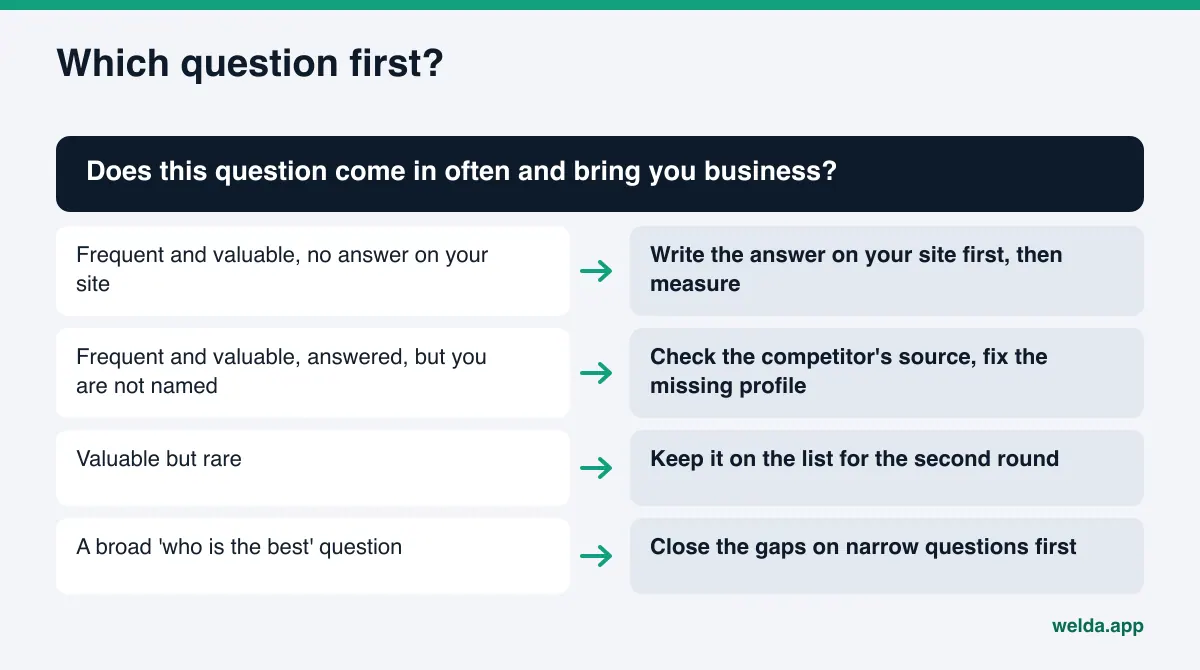
A short example. An example plumbing company sees "can you come tonight, and what will it cost" more than any other question in its texts. Its site does not mention after-hours service or explain how after-hours pricing works. That question is frequent, valuable and unanswered. The first job is writing the answer on the site, then measuring. A broad question like "best plumber in the city" can wait; winning there usually starts with closing the gaps on the narrow questions.
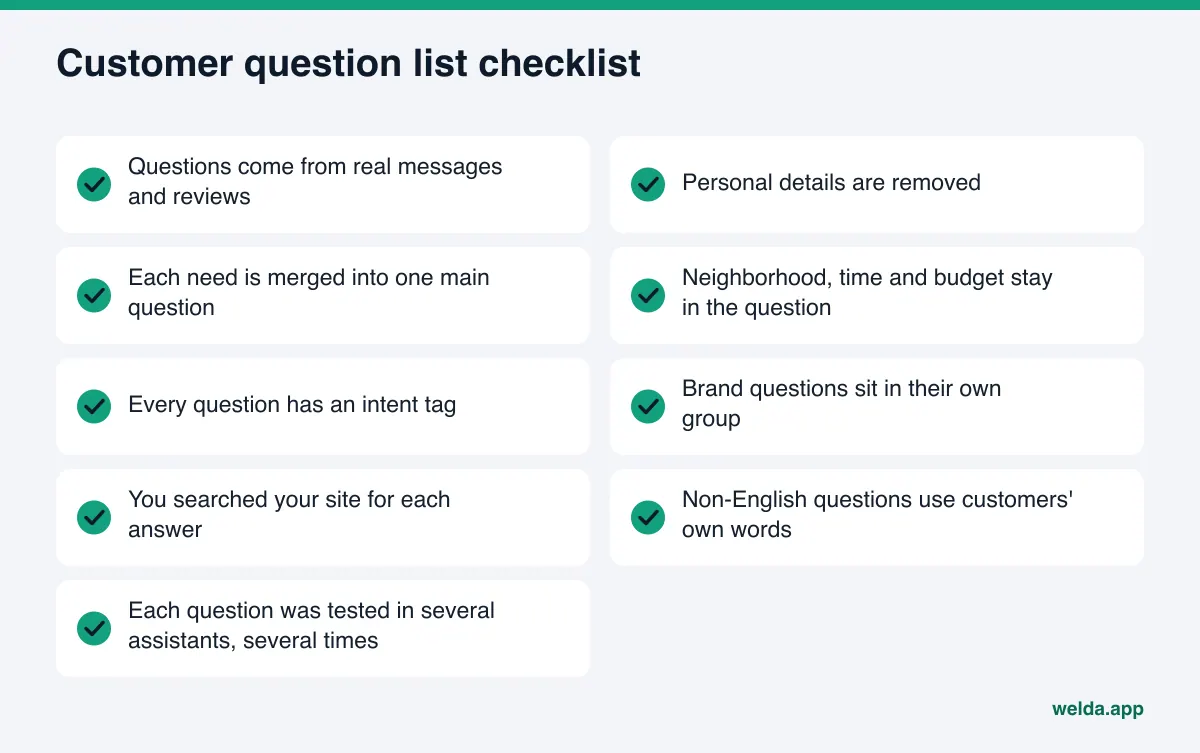
Once your question list is in shape, the AEO checklist walks through the rest of your site, technical and content items in order. For questions that keep repeating in reviews, see reviews and AI recommendations.
Frequently asked questions
Can I see the exact questions people ask AI about my business?
No. AI assistants do not share user questions with businesses. You find them indirectly: your own messages, staff notes, reviews, complaint threads, forums and search suggestions. Most questions in those places are the same ones the same people will ask an AI.
How many questions should I start with?
For a small business, 20 to 30 well-chosen questions is a solid start. Variety matters more than volume: include a few from each intent group, such as recommendation, status, price and trust, location and brand.
Can I turn my keyword list into questions?
It is a starting point, not the finish. Keywords strip out context. Instead of "implant cost", write the full question a patient asks, such as "does the implant price include the crown". Take the wording from a real message whenever you can.
Isn't it enough to ask ChatGPT myself?
Doing it once is very instructive. But answers change between tries, and your account and location affect what you see. For results you can compare over time, you need to ask the same question in several assistants several times and record the outcome.
Which questions does Welda measure?
The free site analysis picks 5 questions your customers might ask and asks them once. The Welda panel, in early access, asks your customers' questions to four assistants three times each and shows the results question by question, in English or Turkish.
Where should the answers to my questions go?
By intent: pricing and inclusions on your pricing page, hours and status in your business data and Google Business Profile, general questions in the FAQ on your homepage and service pages. Keep the same facts identical everywhere they appear.
Find your questions, then measure them
Finding the questions customers ask AI takes an afternoon: open your messages, ask your staff, read your reviews, group the list by intent. That list tells you both what to write and what to measure. To see where to start, run Welda's free site analysis. You get your site's gaps, ready FAQ suggestions for your homepage, and whether your business is named in answers to 5 customer questions, all in one report.