Google Ads vs AEO: if my budget is limited, which one should come first? They do different jobs. Google Ads rents a labeled "Sponsored" spot in search results, and that spot disappears the day you stop paying. AEO (answer engine optimization) works on the facts that ChatGPT, Gemini, Perplexity and Google's AI Overviews read about your business, so your name can come up in their answers on its own. It is slower, but what you fix stays fixed. This guide covers when each one should lead, how to run them together, and which part of the work Welda takes on.
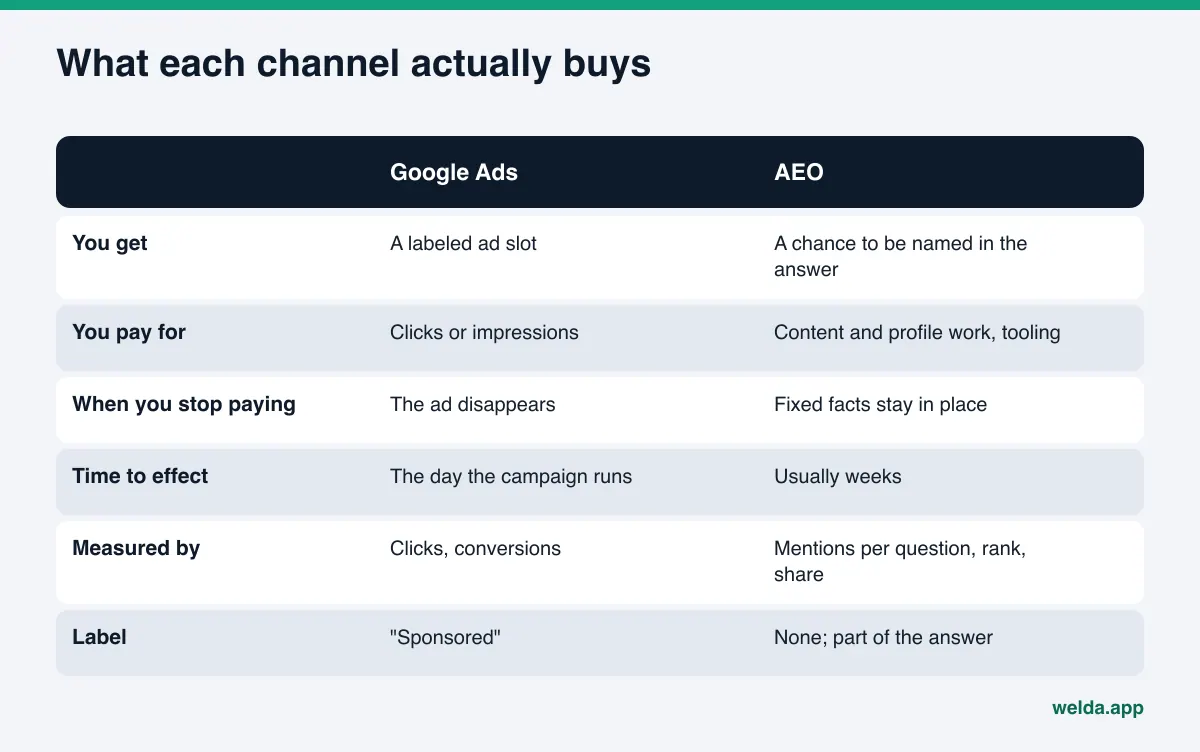
What Google Ads and AEO actually buy
To a small business owner, both channels seem to lead to the same place: a customer searches, your business shows up. The difference is what you are exchanging for that appearance.
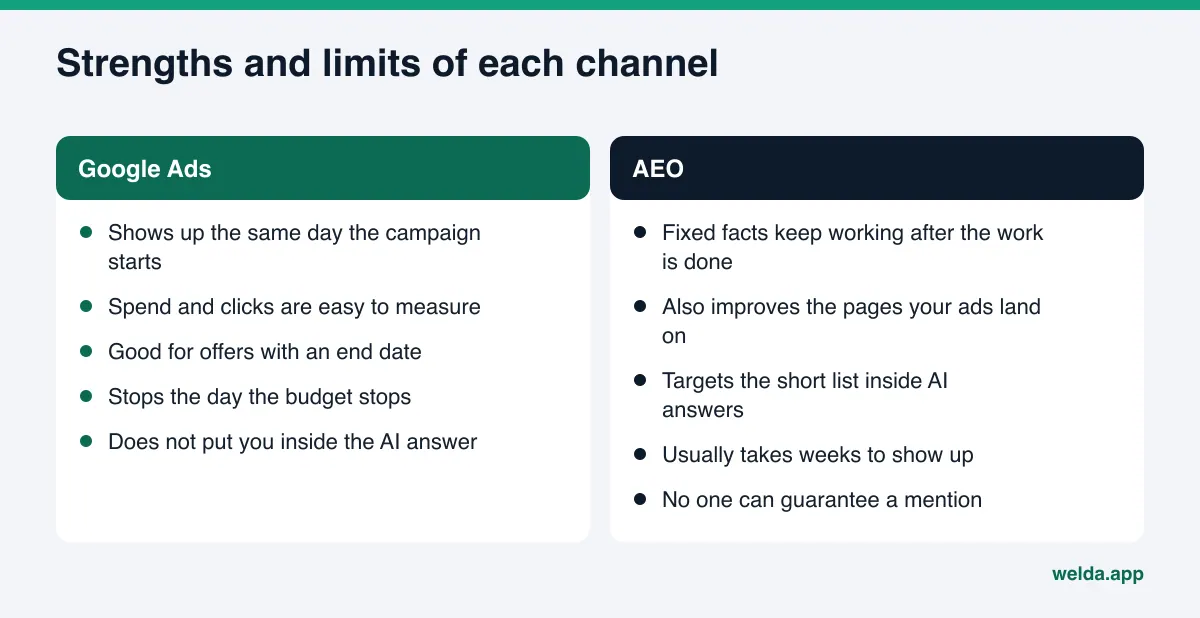
With Google Ads, you bid on search queries. Your ad shows in a marked slot, and you pay when someone clicks. The mechanics are transparent: you know the budget, the cost per click, and how many people called or filled out a form. But it is a rental. Pause the campaign and you are gone from that results page the next morning.
AEO is the work of earning AI search visibility. There is no slot to buy. When an AI assistant answers a question, it picks a handful of businesses and gives each a short reason: "offers same-day service," "licensed and insured," "reviews mention clear pricing." To write those reasons, it needs clear facts it can read. AEO is the job of making those facts complete and consistent on your website, your Google Business Profile, and the other sources AI systems trust. You will also see this called GEO (generative engine optimization); the two terms describe largely the same work, and our comparison of GEO and AEO explains where people draw the line.
In short, Google Ads buys placement, while AEO builds the information an answer is made of. One works immediately and ends when the money ends. The other starts slowly and largely stays in place when you stop, because the pages and profiles you fixed do not go anywhere.
Why small businesses are asking this question now
A few years ago the debate was "ads or SEO." Today a growing number of customers skip the keyword and type a full sentence into an AI assistant: "Who's a reliable plumber in Austin that can replace a water heater today?" or "What's a quiet, family-friendly hotel near the beach in San Diego?" The reply is a short list with two or three names. Getting onto that list has no direct connection to how much you spend on Google Ads.
The businesses that feel this most are the ones whose phones ring while ads run and go quiet when ads pause. When paid search is the only thing carrying demand, there is no lasting base, either in organic search or in AI answers. On the other hand, a brand-new business that refuses to advertise and waits for "organic to kick in" may be invisible for its first critical weeks.
So the real task is not choosing one channel over the other. It is figuring out which gap needs closing this month. That starts with knowing where you stand without ads: which questions name you today? The quickest way to find out is a free AI visibility analysis of your site. It shows how your pages read to AI systems and checks whether your business is named when five likely customer questions are put to an AI assistant.
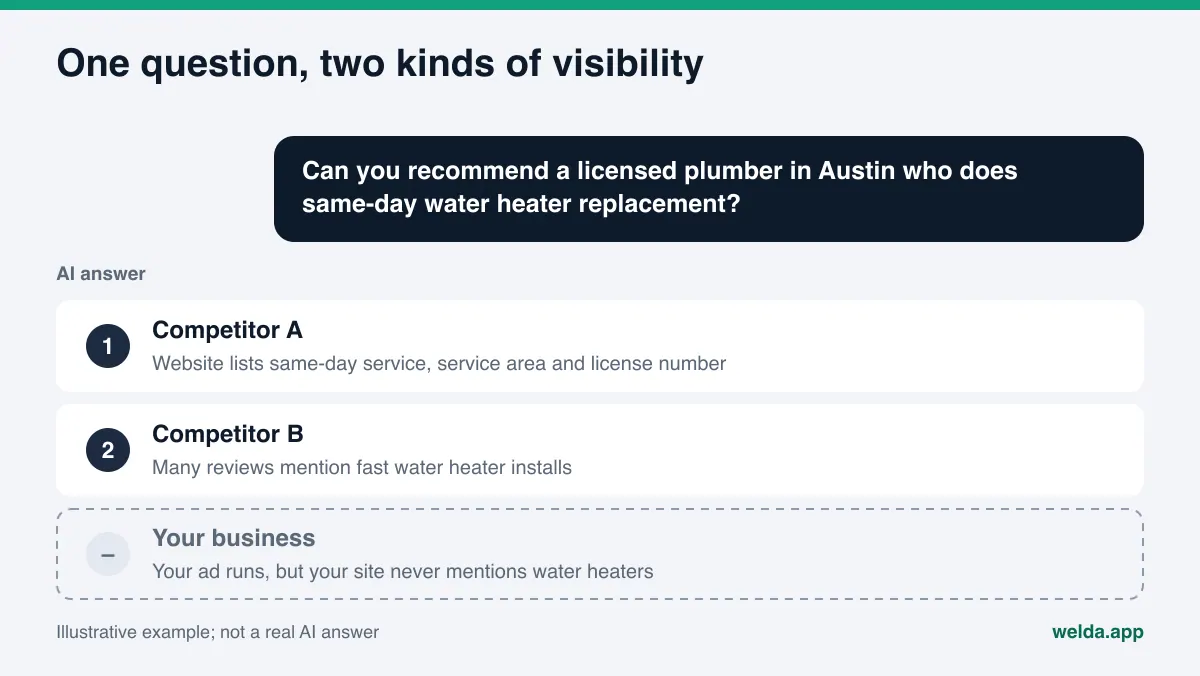
Does running ads get you into AI answers?
This is where many owners get confused. Google now shows ads in and around AI Overviews and AI Mode, and in the US those ads can appear inside the AI response itself. But as of November 2026, Google's own help page states that buying ads does not influence organic AI answers, and that ads carry a "Sponsored" label (Google Ads Help: ads and AI Overviews). The same page notes that performance for these placements is reported in aggregate with your regular campaign data.
ChatGPT follows a similar principle. OpenAI has started showing ads in ChatGPT in the US, and in its statement on its approach to advertising it says ads do not influence the answers ChatGPT gives and are shown separately and labeled (OpenAI: our approach to advertising).
What this means in practice:
- An ad can put you next to or below the answer. It does not put you on the "here are three plumbers I'd suggest" list inside the answer.
- Your ad reports will not tell you whether AI answers mention you organically. Paid performance on AI surfaces is mostly blended into your normal campaign numbers.
- To be named in the organic answer, the AI system needs facts about you it can read. Those come from your website, your listings, and the sites that mention you, not from your ad copy.
It is the same split that frustrates businesses ranking first on Google but missing from ChatGPT: visibility in one channel does not automatically carry over into another.
Google Ads vs AEO: which should lead in your situation?
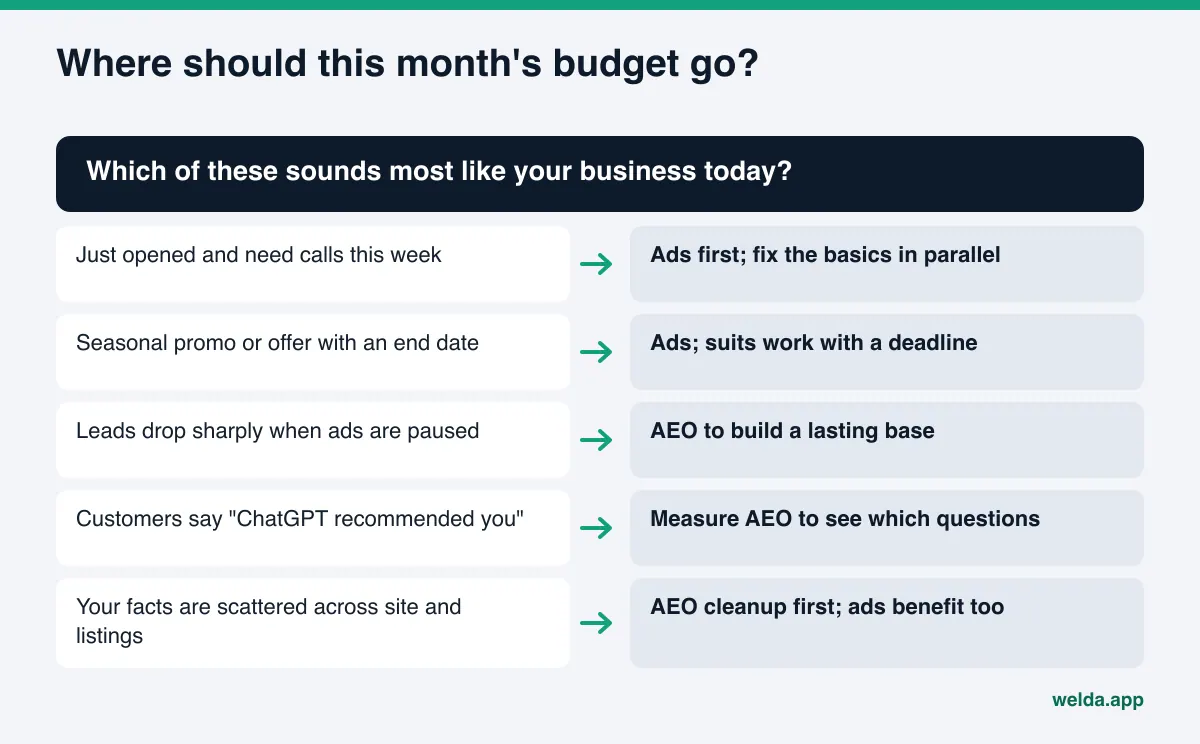
The table below lays out common situations and a sensible starting priority for each. It is not a rule. Put your own numbers next to it (leads with ads running, leads with ads paused) and the decision gets clearer.
| Situation | Priority | Why |
|---|---|---|
| New business that needs its first customers | Ads first, fix the basics in parallel | AEO takes weeks; ads can bring calls this week |
| Seasonal promotion or limited-time offer | Ads | No need to build lasting content for an offer that expires |
| Leads fall off when ads are paused | AEO | Paid search is the only thing holding demand up |
| Customers say "ChatGPT recommended you" or "I asked AI" | Measure AEO | You need to see which questions name you and which name competitors |
| Competitors keep showing up in AI answers | AEO | Ads cannot buy a spot on that list; find the source they win from |
| Outdated site, vague services, inconsistent address details | AEO cleanup first | Your ad landing page suffers from the same gaps |
| High-value, highly competitive searches | Both | Ads give visibility now; AEO aims for an organic mention on the same question |
One row stands out: when the site is outdated and the details are inconsistent, AEO cleanup comes first, because ads perform poorly on that foundation too. A customer clicks your ad, lands on a page that never says what you actually do, and leaves. An AI system reads the same page and recommends someone else. Your website is the ground both channels stand on.
Budget and timing: how the costs behave differently
You can compare the cost structure of the two channels without inventing numbers. The difference is what the money turns into.
With Google Ads, money turns into clicks. Spend and visibility move together. Raise the budget and you get more impressions; cut it and visibility ends. In competitive local categories, click costs can climb over time as more businesses bid on the same terms. The channel is valuable because it is fast and measurable, but you pay for it again every month.
With AEO, money and effort turn into information. Rewriting a service page, adding an FAQ section, completing your Google Business Profile, responding to reviews on Yelp: each is done once and stays in place. It needs upkeep, because prices, hours and services change, but you do not start from zero each month. In return you accept a wait: new content usually takes weeks to show up in AI answers, and nothing is guaranteed.
That is why judging both channels by the same yardstick is misleading. Ads are judged by cost per click and cost per lead. AEO is judged by which questions name you, how high you are mentioned, and your share against competitors. Our guide to before and after AEO measurement explains how to set that up properly.
Consider an example scenario. An example HVAC company in Phoenix runs Google Ads heavily in summer and cuts back in the cooler months. Off-season calls drop too. The owner notices that customers ask AI assistants things like "Who does furnace tune-ups in Phoenix?" but the website only talks about air conditioning. One option is to keep ads running year-round. The more durable fix is to describe heating services, service area and scheduling clearly on the site and on Google Business Profile, so an AI system has something to read when that question comes in. This is an illustration, not a real company's result.
Running ads and AEO together, step by step
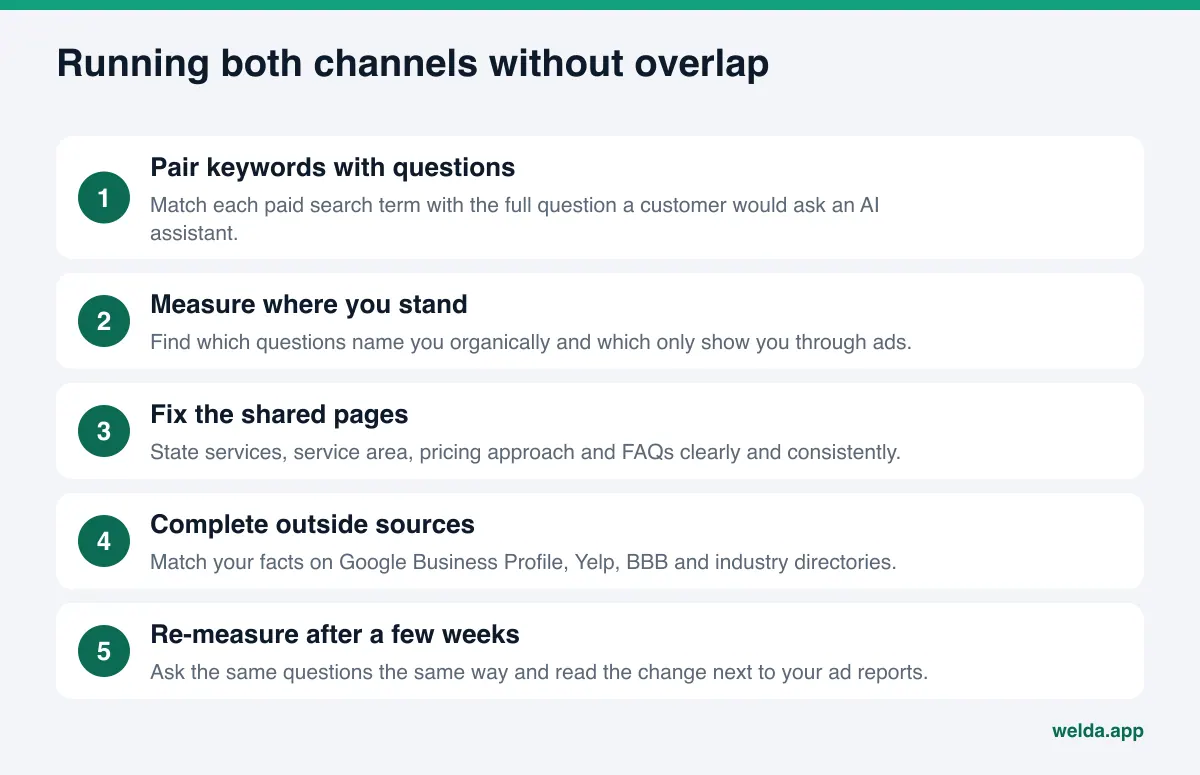
For most small businesses, the realistic answer is "both, with different roles." Ads carry short-term demand; AEO builds the lasting base. Here is an order that keeps them from stepping on each other:
- Pair keywords with questions. List the search terms you bid on. Next to each, write the full sentence a customer would type into an AI assistant for the same need. "plumber austin" might become "Can you recommend a licensed plumber in Austin who does same-day repairs?"
- Measure where you stand. Ask those questions in AI assistants and note whether you are named. One try is not enough, because answers shift from run to run. Asking the same question several times gives a more reliable picture.
- Fix the shared page. The ad landing page and the service page an AI system reads are often the same. Spell out the service, the service area, hours, how pricing is determined, and common questions. This also helps your ad conversion rate.
- Make your business facts consistent. Name, address, phone and hours should match on your site, Google Business Profile, Yelp, BBB and the directories in your trade, such as Angi for home services or Healthgrades for medical practices. Add business schema markup to your site.
- Complete the outside sources. AI systems look beyond your website. Read what review sites, directories and local forums say about you, fill in incomplete profiles, and reply to reviews calmly and specifically.
- Adjust ads around the AEO gaps. On questions where you are already named strongly, you may decide to review ad spend. On important questions where you are never named, ads act as a bridge until AEO work has a chance to show up.
- Re-measure after a few weeks. Ask the same questions the same way and read the change next to your ad reports.
Treat step six as a question, not a recommendation. An organic mention and an ad can reach the same customer at different moments. The final call should rest on your own conversion data.
Reading ad data and AI visibility data side by side
A business that runs both channels ends up with two reports that speak different languages. The ad report counts clicks, impressions and conversions. AI visibility measurement shows mentions per question, position, and share against competitors. Rather than forcing both into one spreadsheet, read them as two sides of the same customer questions.
A practical method is to keep one line per important customer need: the search term you bid on, the matching AI question, how the ad has been performing, and whether you are named organically on that question. That record sorts into four kinds of lines:
- Ad running, named organically: both channels cover the same question. These are the first candidates when you think about shifting budget.
- Ad running, not named: your visibility depends entirely on spend. This is where AEO work should start.
- No ad, named organically: your lasting base is working here. Keeping the facts current may be enough.
- No ad, not named: you are invisible for this need. If it matters, decide which channel can move faster.
This turns the budget debate from "are ads good or bad" into specific questions. Repeat it every quarter and you will see which lines move.
How Welda handles the AEO side
Welda does not manage ads and does not build ad campaigns. Its job is the other half of the picture: measuring where AI answers name your business without paid placement, and preparing what is missing on your behalf. In a Google Ads vs AEO decision, Welda's role is to make the AEO side visible and measurable. Three parts matter most here.
The free site analysis: your starting point. This is the part anyone can use today, and it runs in English. It reads your homepage and a few inner pages (services, pricing, about, contact) the way Google and AI systems do. Your ad landing page is very likely one of those pages, so the gaps it flags, such as a vague service description, missing business schema, no FAQ section, or a slow page, affect both channels. You get a score out of 100 split into technical and content, an explanation of each gap (what was found, why it matters, how to fix it), a simulation of how much each fix could move the score, and a ready-made fix package to add to your site. The analysis also asks an AI assistant with web search five questions your customers might ask and checks whether your business is named. It is a one-time snapshot of where you stand without ads.
The questions view: where ads do not reach. In the Welda dashboard, customer questions are asked three times each in ChatGPT, Gemini, Perplexity and Google AI. For every question you see whether you were named, in which engine, and in what position. If you track the questions you paired with your ad keywords, you can separate "I'm already named here organically" from "I only show up here because I pay." That distinction is where the budget decision comes from.
The sources view: the information you cannot buy. This lists the sites AI systems cite when they answer, with your status on each: incomplete profile, unverified details, or missing entirely. No ad budget changes what those sites say about you. Welda drafts the missing profile text and review responses; publishing stays your decision. Connected Google Business Profile, Instagram and Facebook accounts can be worked through directly; anything not connected is listed as a manual task.
The rest in brief: the score formula is public, 100 × (0.5 × share of questions that name you + 0.3 × position score + 0.2 × share versus competitors), and the spread across three runs gives a margin of error. A competitor view shows which topic and which source a competitor wins on. On WordPress sites, Welda connects through a separate Editor user, opens content as a draft, and publishes only after you approve; content always lives on your own site. A before-and-after comparison and a one-page monthly PDF report let you set the change beside your ad reports. Questions can be tracked in English.
To be clear about where things stand: the Welda dashboard is in early access, and the full dashboard is opening first in Turkey. Regular four-engine measurement is being added during early access, and sample dashboard screens use representative data. The free site analysis is what anyone, including US businesses, can use today. Pricing is discussed in an early access conversation.
Limits: what AEO and Welda do not do
AEO is not a faster replacement for ads, and it is worth being plain about its limits:
- No guarantees. Welda does not guarantee rankings or a mention in ChatGPT. AI answers vary, which is why measurement is repeated and read with a margin of error.
- Not fast. New content usually takes weeks to show up in AI answers. If you need calls this week, AEO alone is not the answer.
- No invented facts. Welda does not make up information it does not have, such as price ranges, hours or credentials. It asks you.
- No sensitive content without approval. A compliance check flags patterns like price claims, guarantees and superiority claims before publishing. It is a pattern check, not legal advice, and it does not replace your own review against FTC rules on advertising claims.
- No fake reviews. Handling negative reviews, creating directory accounts and press outreach stay with you.
- No ad management. Welda's work is AI visibility. Building campaigns, setting bids and writing ad copy are outside it.
The same honesty applies to ads: they do not get you onto the recommendation list inside an AI answer, and the ad report will not tell you whether you are on it. Knowing where each channel stops is the first step to splitting the budget well. If you are weighing tools as well as channels, rank tracker vs AI visibility tracker covers that distinction.
Google Ads vs AEO: a decision checklist
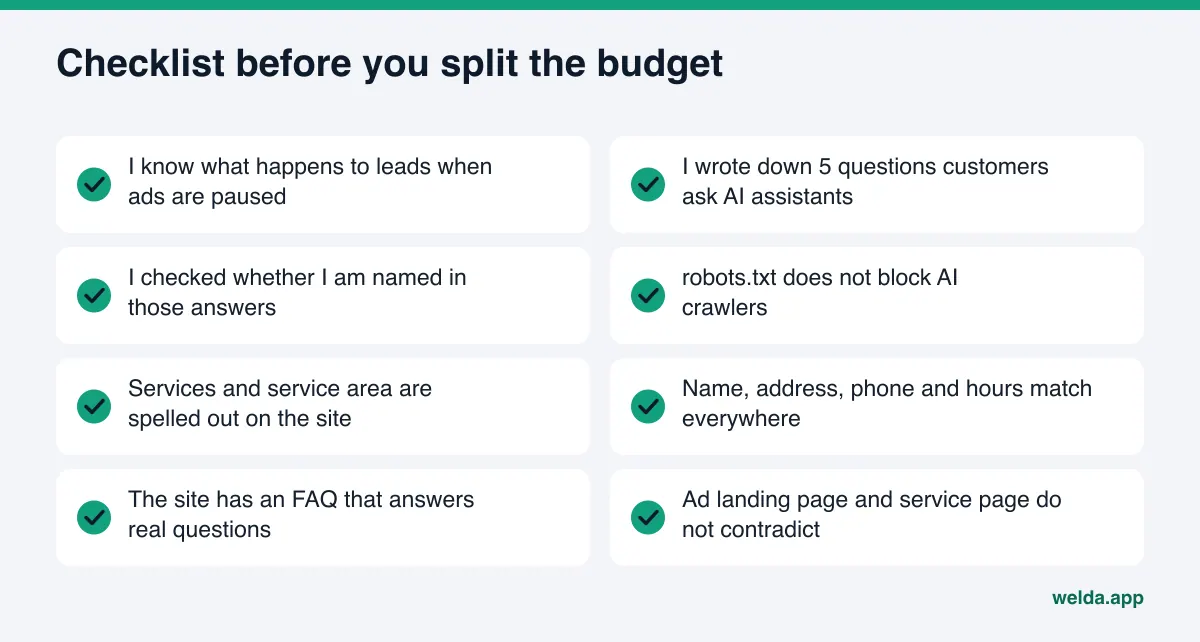
Answer these before you split the budget. Any item where the honest answer is "I don't know" is something to measure first.
- If I paused ads for a week, how far would leads drop? Can I see that in past data?
- Can I write down, as full sentences, the five most important questions customers ask AI assistants about my kind of business?
- Am I named in those answers without ads? If so, in what position?
- Where do competitors win those questions from: their own sites, Google Business Profile, Yelp, a trade directory?
- Does my ad landing page clearly state the service, the service area and how pricing works?
- Do my name, address, phone and hours match on the site and every listing?
- Is there an FAQ section that answers questions real customers ask?
- Am I running offers with an end date, or do I need steady demand all year?
Questions one and three give you half the budget decision. If leads collapse when ads stop and you are not named organically anywhere, the lasting base is missing. If you are already named on many questions without ads, you might point ad spend only at the questions where you are absent. We take a similar look at content spend in content marketing vs AEO.
Frequently asked questions
If I spend more on Google Ads, will ChatGPT recommend my business?
No. Both Google and OpenAI say ads do not influence organic AI answers. An ad may appear next to an answer with a label; getting onto the recommendation list inside it depends on facts the AI system can read about you.
Can AEO replace Google Ads?
For most businesses, no. Ads deliver fast, controllable demand; AEO builds a lasting base. They play different roles. How much weight each gets depends on how far leads fall when ads pause and where you stand in AI answers today.
How long does AEO take to show results?
New or corrected content usually takes weeks to show up in AI answers. There is no fixed timeline and no result can be guaranteed, which is why measurement should be regular and use the same questions each time.
Can I see AI Overviews performance in my Google Ads reports?
According to Google's help page, ad performance in AI Overviews and AI Mode is included in aggregate in your standard campaign reports. Whether AI answers mention you organically is not in your ad reports at all; that needs separate measurement.
With a small budget, which should I start with?
If you need customers this week, ads. If demand depends on ads or customers mention AI assistants, AEO. Either way, it makes sense to check your site's basic gaps first with a free analysis, because the same gaps also lower your ad conversion rate.
Does Welda manage Google Ads campaigns?
No. Welda only does AI visibility work: it measures, shows the gaps, and drafts content and profile text. Building and managing ad campaigns is not part of what Welda does.
First step: see where you stand without ads
The hardest part of a Google Ads vs AEO decision is not knowing where you stand without paid placement. Your ad report tells you about clicks. It does not tell you whether AI answers name your business. The shortest way to close that gap is to see how your site reads to AI systems and whether you are named on five likely customer questions.
Run the free AI visibility analysis. It is free once per site, the results link arrives by email and stays open for 14 days. Once you have seen your score, your gaps and the ready-made fix package, you can decide how much of your budget goes to ads and how much to lasting information on firmer ground.