Rank tracker vs AI visibility tracker: which one do you actually need? They measure different things. A rank tracker tells you where a page on your site sits in Google's list of results for a keyword. An AI visibility tracker tells you whether your business is named in the answer ChatGPT, Gemini, Perplexity or Google's AI features give when a customer asks a question, and in what position. Which one matters first depends on where your customers make their decision.
This guide treats rank tracker vs AI visibility tracker as a buying decision. We cover what each type of tool measures, the situations where the two numbers disagree, the questions to ask before you pay for anything, and how Welda measures AI visibility. If you want to see how your own site looks to AI systems before deciding, you can run a free site analysis in a few minutes.
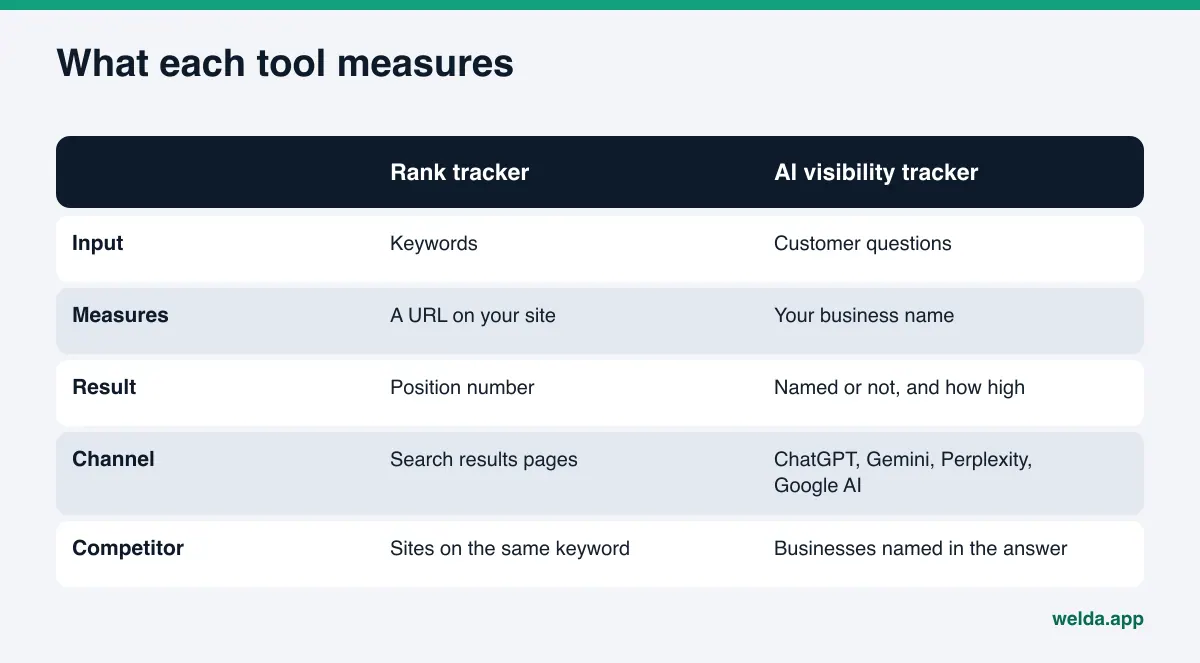
What does a rank tracker measure, and what does an AI visibility tracker measure?
Rank trackers have worked the same way for a long time. You give the tool a list of keywords, such as "emergency plumber austin", "boutique hotel savannah" or "family dentist near me". The tool runs those searches from a set location and device type, then records which URL from your site appears and in which position. Run daily or weekly, that produces a position number and a trend line. The thing being measured is a web page's place in a list.
An AI visibility tracker looks at a different object. Answer engines do not hand the customer a list of ten blue links. They write an answer. Someone who asks "Can you recommend a plumber in South Austin who does same-day water heater repair?" gets a paragraph that names three or four businesses. In that paragraph, your URL is not the unit that matters. Your business name is. An AI visibility tracker sends those questions to the engines, reads the business names in each answer, and records whether you appear, how high you are mentioned, and which competitors show up instead. This work is usually called AEO, short for answer engine optimization. You will also see it called GEO (generative engine optimization); the two labels describe largely the same job, and we compare them in GEO vs AEO.
Put simply, a rank tracker asks "where is my page?" and an AI visibility tracker asks "is my name in the answer?" The questions are related, but they are not the same question.
Rank tracker vs AI visibility tracker: why the difference matters for your business
This can look like a technical detail. It is not. It decides what you budget for and what work you plan. If you only watch a rank tracker, you cannot see the customers who make a decision without ever scrolling to the organic results. Google's AI Overviews and AI Mode summarize an answer above or instead of the classic list. In ChatGPT or Perplexity there is often no results list at all. In those places, "you rank number three" says nothing useful. You are either in the answer or you are not.
The reverse is also a risk. If you only watch AI answers, you can miss a slide in classic organic search, which is still a major source of customers for most local and service businesses. So the useful question is not "which tool is more modern?" It is "where does my customer decide, and which tool lets me see that?"
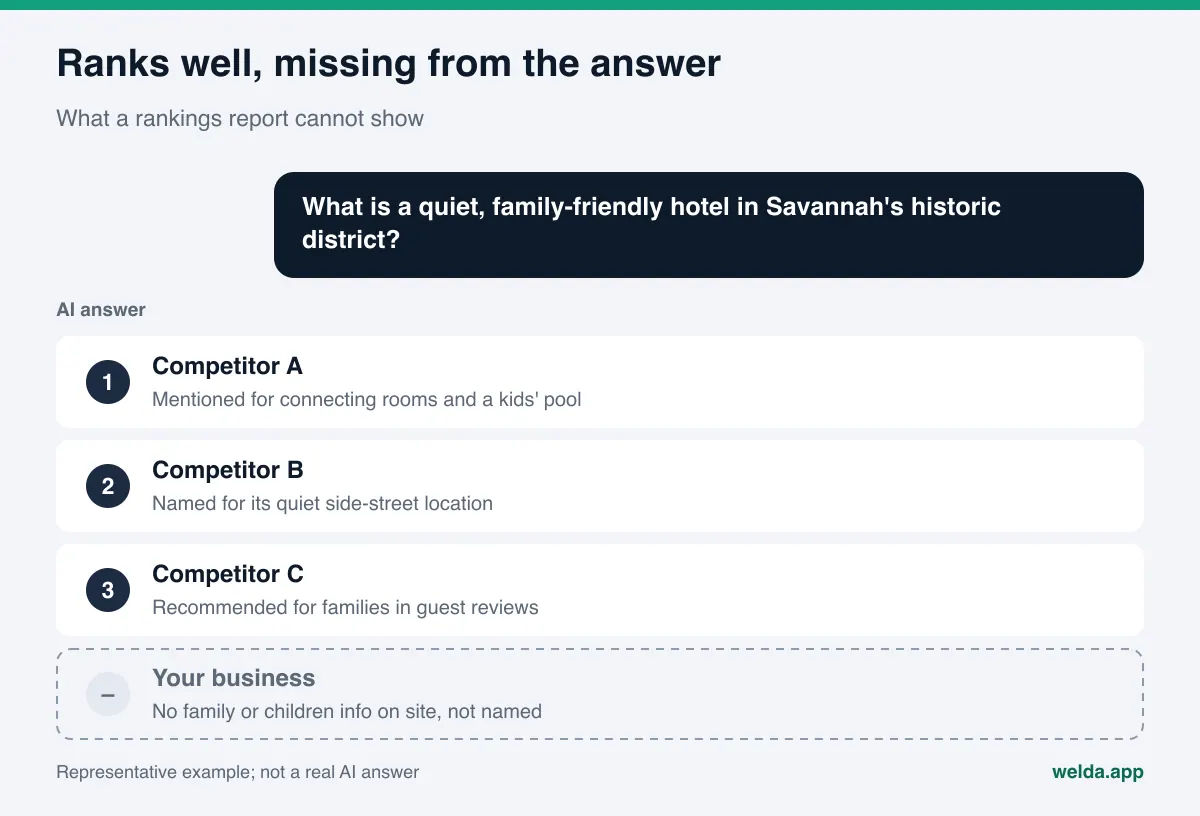
There is a third problem: the two numbers can point in opposite directions. Plenty of businesses rank first on Google for their main keyword and never get named in ChatGPT. The reasons are covered in ranking first on Google but not in ChatGPT, and they come straight from the fact that these two tools measure different things. A business looking at only one dashboard reads the other side as "all good".
Five situations where rankings and AI answers disagree
The scenarios below are examples, not real businesses. They show why a rankings report and an AI answer often tell different stories.
- High ranking, missing from the answer. An example boutique hotel ranks in the top three for "boutique hotel savannah". But when someone asks "What is a quiet, family-friendly hotel in Savannah's historic district?", the AI answer names three other properties. The hotel's site never says clearly that it welcomes children, has connecting rooms, or sits on a quiet street.
- Low ranking, present in the answer. An example plumbing company has a thin website that sits on page two. But its Google Business Profile is complete, it has a long record of reviews on Yelp and Angi, and its BBB listing is current. The AI answer to "emergency plumber in South Austin" mentions it, because the engine built the answer from those sources, not from the company's own site.
- No keyword, but a real question. You put "dentist" in your rank tracker. Your customer asks an AI assistant "Which dentist near me is open Saturdays and takes new patients with bleeding gums?" Long, conditional questions like that do not fit in a keyword list.
- Different competitors. In a rank tracker, your competitors are the sites ranking for the same keyword, often directories and review platforms. In an AI answer, your competitors are the other businesses being named. The two competitor lists rarely match.
- Same day, different answer. A rank tracker sees a fairly stable result for a keyword within a day. An AI answer can change even when the same question is asked twice in a row. The causes are explained in why AI answers change every time.
The unit of measurement: position number or being named?
When you compare tools, the most overlooked question is what the tool counts as "one". The table below puts the measurement units of the two tool types side by side. It describes how the categories generally work, not any specific product.
| Topic | Rank tracker | AI visibility tracker |
|---|---|---|
| Input | A keyword list | Questions customers ask in plain language |
| What is measured | A URL on your site | Your business name |
| Result | Position (1, 2, 3...) | Named or not, and how high |
| Channel | Search engine results pages | ChatGPT, Gemini, Perplexity, Google AI answers |
| Repetition | One check is usually enough | Answers vary, so each question needs several runs |
| Who counts as a competitor | Sites ranking for the same keyword | Businesses named in the same answer |
| Source insight | Which of your pages ranks | Which sites the engine built the answer from |
| Work it leads to | On-page content, technical SEO, links | Missing facts, consistency, third-party sources, FAQs |
The last row matters most. A measurement tool quietly tells you what to work on. A rank tracker points you toward page optimization. An AI visibility tracker points you toward different questions: what does the AI not know about me, what does it get wrong, and which site is it learning about my competitor from? Those are two different to-do lists.
What to ask if a rank tracker says it covers AI answers
Some tools may advertise AI answer data alongside rankings. We are not making claims about specific products. Whatever you evaluate, these questions will save you time before you sign up:
- Which engines are covered? Only Google AI Overviews, or also ChatGPT, Gemini and Perplexity? Measure the ones your customers use.
- What exactly is measured? Your URL showing up as a cited source, or your business being named in the answer? Those are different. You can be named without being cited, and cited without being recommended.
- Whose questions are they? Keywords with a question mark added, or questions a customer would really ask, with a neighborhood, a constraint and a need?
- How many runs per question? A single check is a snapshot of a moving answer. Without repetition, a one-week "drop" may be noise.
- Is there a margin of error? Is the score shown as a bare number, or does the tool tell you how reliable it is?
- Is the scoring formula published? If you do not know how the score is calculated, you will not know why it moved.
- Does the data turn into work? "You are not in the answer" is not enough. You need to see why and what to do next.
The same questions apply if your main concern is Google's AI features. We go deeper on that channel in choosing an AI Overviews tracking tool.
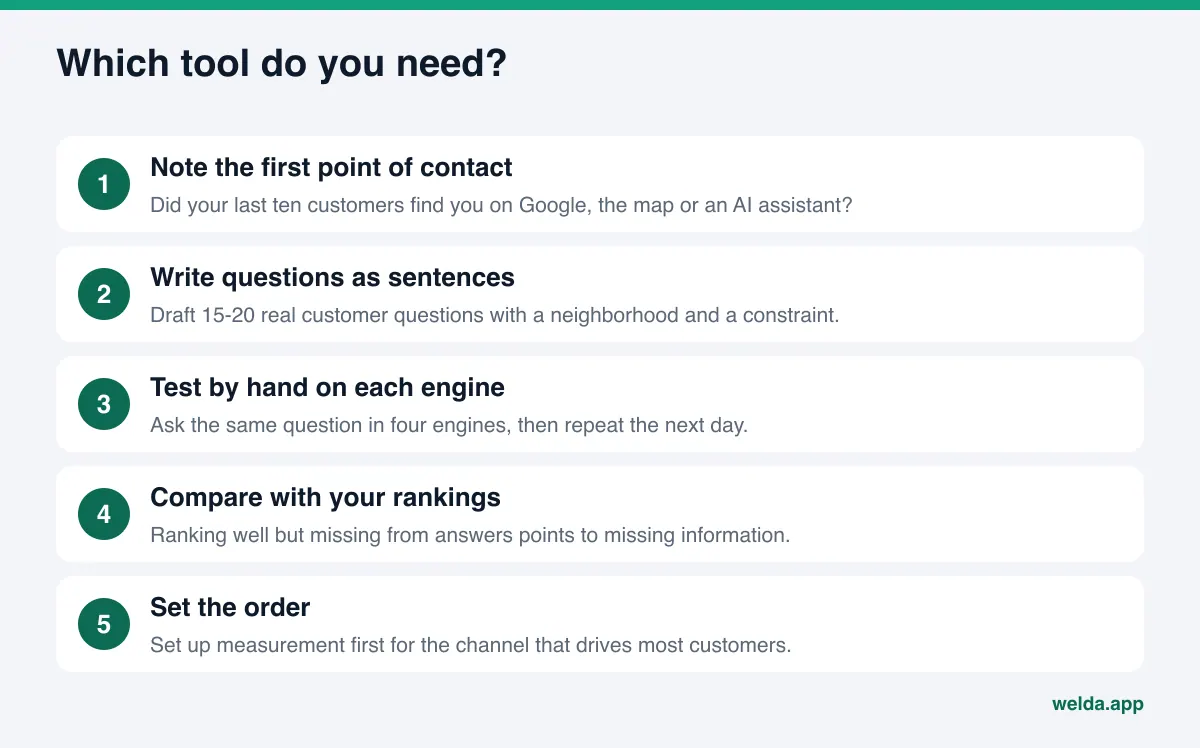
How to figure out which tool you need, step by step
Start this decision with your customers, not with a feature grid. The steps below are a few hours at a desk, not a project.
- Write down the first point of contact. Look at your last ten customers or leads. How many said "I found you on Google", how many "ChatGPT suggested you", how many "I saw you on the map"? If you do not know, add "How did you hear about us?" to your intake form or first call.
- Write customer questions as sentences, not keywords. Not "boutique hotel", but "dog-friendly quiet hotel in Savannah within walking distance of the squares". Fifteen to twenty questions is enough.
- Test them by hand. Ask each question in ChatGPT, Gemini, Perplexity and Google. Are you named? Who is? Ask again the next day. Did it change?
- Compare with your rankings. If you already use a rank tracker, check where you stand on the related keywords. If you rank well but are missing from answers, the problem is not ranking. It is what the AI knows about you.
- Decide the order. If organic search drives most of your business, keep your rank tracker. If you are missing from answers and your customers use these assistants, add AI visibility tracking. For help deciding how often to measure, see one-time AEO audit vs ongoing tracking.
Testing by hand gives you a feel for the situation. It is not measurement. A few questions, on one day, in one session, can mislead you. Real tracking means asking the same questions, on the same engines, at a fixed interval, more than once.
How Welda does this
Welda is not a rank tracker. It does not measure your position in Google's results. What Welda measures is whether your business is named in AI answers to the questions your customers ask. Here are the three parts that look most different to someone used to a rank tracker.
Question tracking: questions instead of keywords, mentions instead of positions
In a rank tracker, each row is a keyword. In Welda's questions view, each row is a customer's sentence. Next to every question there is a separate cell for each of four engines: ChatGPT, Gemini, Perplexity and Google AI. The cell shows either where your business was named in the answer or that it was not named at all. Questions are grouped by intent, such as booking, comparison and information. That lets you read a result like "we do well on booking questions in Perplexity but are missing in ChatGPT" at a glance.
Open a question and you see the answer itself, where each engine placed you, and which sources the answer leaned on. When a keyword drops in a rank tracker, you have to guess why. Here you have the answer text and the cited sites in front of you. Every question is asked three times per engine, so a single lucky or unlucky answer does not distort the picture.
A published scoring formula instead of average position
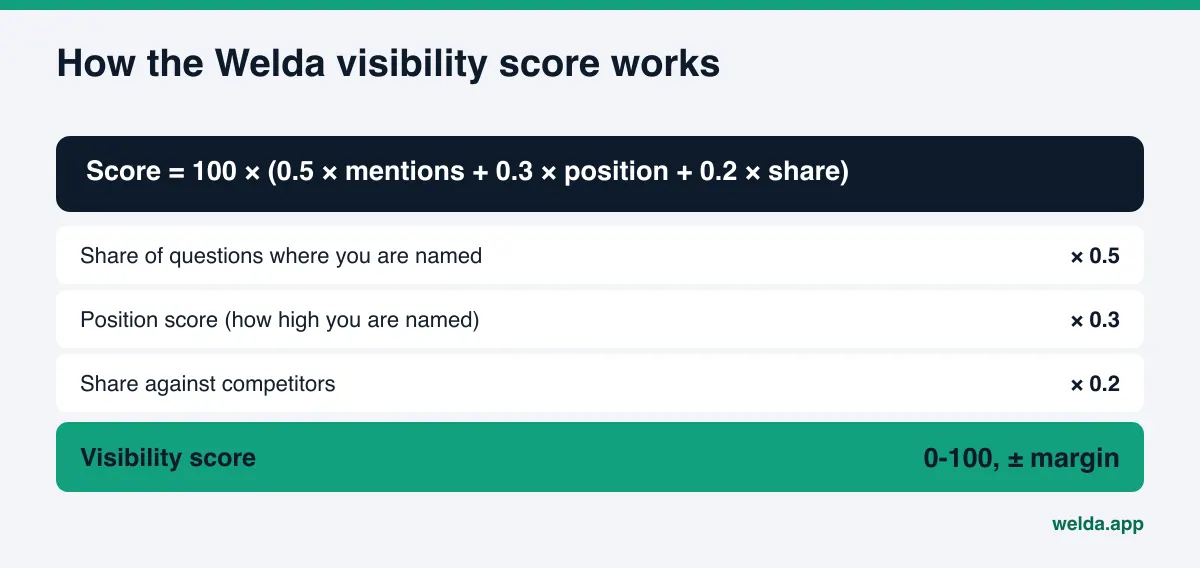
The headline number in most rank trackers is average position. Welda's equivalent is a visibility score out of 100, and the formula is public. Half the score comes from the share of questions in which your name appears. Thirty percent is a position score based on how high you are mentioned when you do appear. The remaining twenty percent is your share against competitors on the same questions. The spread across the three runs produces a margin of error that sits next to the score as "±".
That changes how you read a change. If the score drops two points and the margin is also two points, that is not a decline. It is normal variation. You check whether a change is larger than the margin before acting on it.
Competitors and sources: who is winning, and from which site?
A rank tracker's competitor list is the set of sites ranking for your keywords. Welda's competitors view shows the businesses named in answers, with their share across the same questions. More useful, for each competitor it shows which group of questions they lead and which source the answer came from. Seeing that a competitor wins "anniversary trip" questions because of a detailed description on Tripadvisor gives you a concrete task: is your own information there thin or missing? The sources view asks the same thing from the other side: which sites do AI engines rely on in your category, and are you present on them?
After measuring, Welda turns what it finds into a to-do list. It asks you for missing facts, drafts content and profile text, and leaves the publishing decision with you. Content always lives on your own website. The part anyone can use today is the free site analysis, which works in English. It reads your homepage and a few inner pages, checks whether AI crawlers can reach the site, looks at business schema, FAQs and how clearly your services are described, and asks five customer questions to an AI assistant that can search the web to see whether your name comes up. That is a one-time check. It does not replace tracking, but it shows you where to start.
Limits: what Welda does not do, and where it stands today
Knowing what a tool does not do is as important as knowing what it does. For Welda, plainly:
- It does not track rankings. If you need to follow your organic positions, you still need a rank tracker. Welda does not replace it.
- It does not guarantee anything. No ranking guarantee and no promise that you will appear in ChatGPT. No tool controls AI answers.
- It does not make things up. If a fact is not on your site or in what you have told it, Welda asks you instead of guessing.
- It does not publish without approval. Drafts come to you first. It does not write fake reviews.
- It does not do everything. Responding to negative reviews, managing directory accounts and PR stay with you.
- It does not promise speed. New content usually takes weeks to show up in AI answers.
And the honest product status: the Welda dashboard is in early access, and it is opening first to businesses in Turkey. Regular four-engine tracking is being added during early access, and the sample dashboard screens use representative data. The part anyone can use today, in English or German, is the free site analysis. Pricing is discussed in the early access conversation.
Reading both reports together: an example week
Here is an example scenario, not a real business. A small downtown hotel uses both tools. This week the rankings report shows a two-position slip for "downtown boutique hotel". The AI visibility score is flat, but on questions like "small hotel with a meeting room for 20 people" the hotel is not named by any engine.
Those two signals point to different work. The ranking slip calls for a look at page content and technical health, and it may simply be a one-week wobble worth watching. The meeting-room gap is more concrete. If the site never states the room's capacity, equipment or how it is priced, an AI engine has nothing to base a recommendation on. The task is a clear service page, a few FAQs, and the same facts updated on Google Business Profile.
Someone who reads only the rankings report spends the week worrying about two positions and never sees the meeting-room gap. Someone who reads only the AI report misses whether the ranking slip is turning into a trend. Reading both is what tells you which job comes first. If you need to present that picture upward, AEO reporting for executives shows how to keep it to one page.
Decision checklist: rank tracker vs AI visibility tracker
The decision chart below helps you answer rank tracker vs AI visibility tracker for your own situation. For most businesses the answer is not "one or the other" but "which one first".
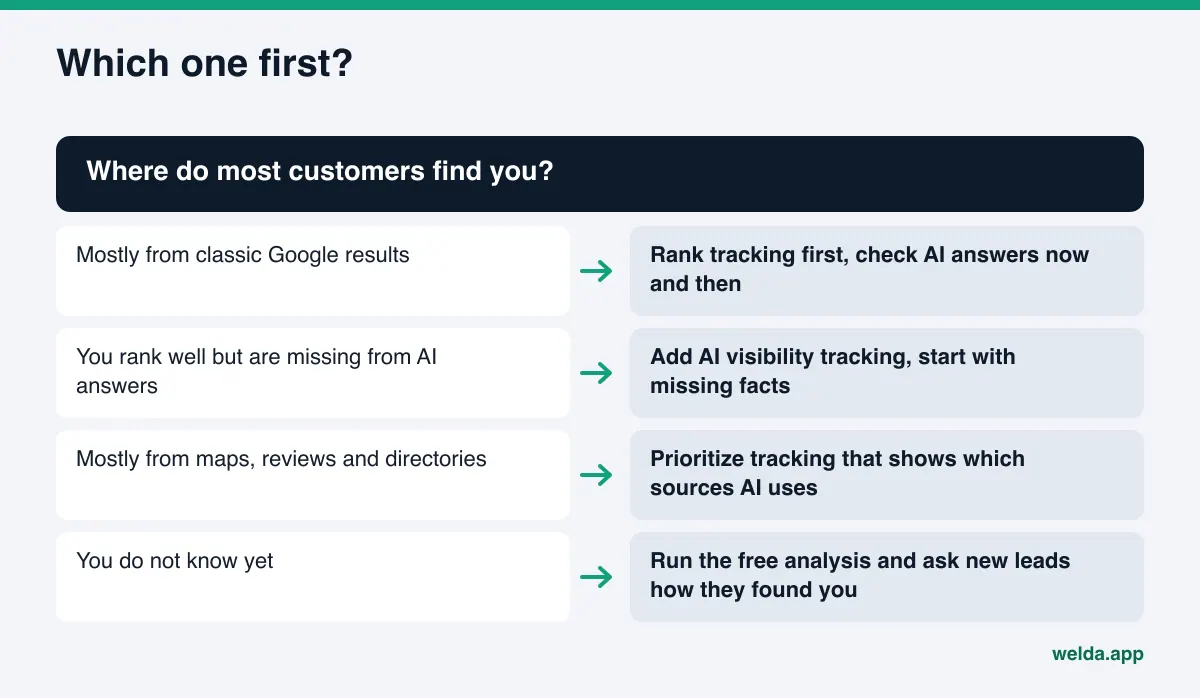
Keep one distinction in mind. A rank tracker is a good gauge of your site's technical and content health. An AI visibility tracker follows the answer your customer actually reads, and that answer is often built from sources outside your site. Run through this checklist before you buy:
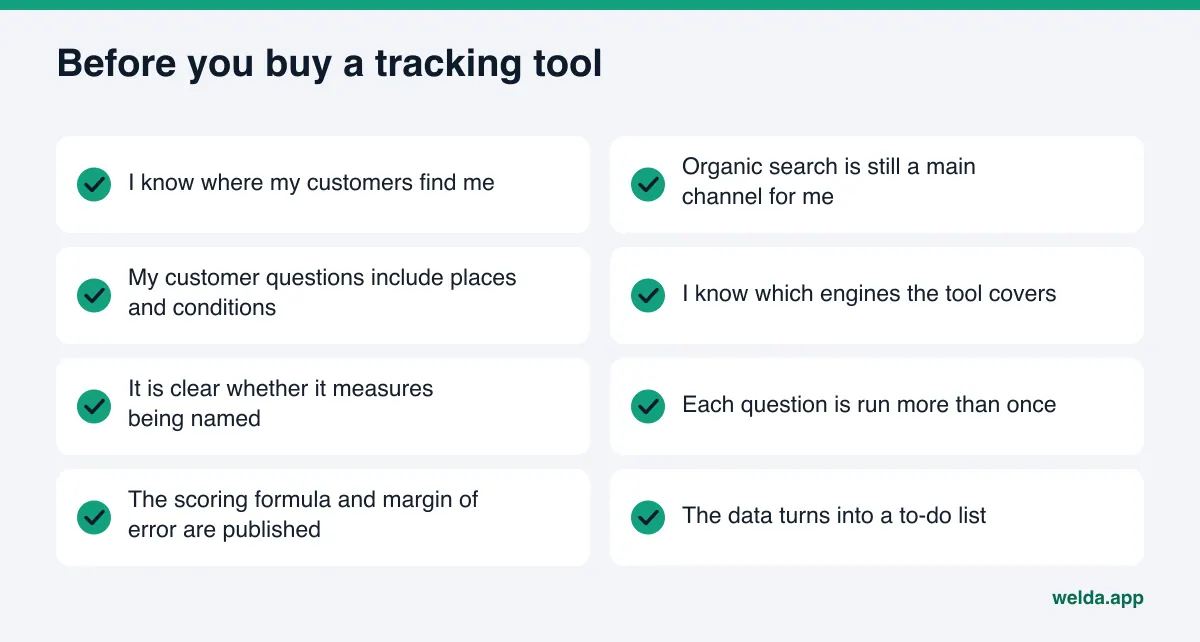
If most of your "yes" answers sit with classic search, a rank tracker is probably your priority. If they lean toward AI answers, long questions and third-party sources, AI visibility tracking is more urgent. If both apply, seeing your current state with the free analysis and then deciding is a sensible order.
Frequently asked questions
I already have a rank tracker. Do I also need an AI visibility tracker?
If your customers decide through ChatGPT, Gemini, Perplexity or Google AI Overviews, yes. A rank tracker tells you where your page sits in the list. It does not tell you whether your business is named in the answer. The two tools answer different questions.
If I rank first on Google, will I show up in AI answers?
Not necessarily. AI answers draw on your site, but also on map listings, review sites, directories and forums. A strong ranking can help, but it is not the only condition for being named.
Can an AI visibility tracker replace my rank tracker?
No. As we say plainly for Welda, an AI visibility tracker does not measure organic rankings. If organic search is still an important channel for you, keep tracking it.
If AI answers change every time, can tracking be trusted?
A single check cannot. Reliability comes from asking the same question several times and reading the results together. Welda asks each question three times on each engine and shows a margin of error from those runs next to the score.
Which questions should be tracked?
The ones your customers really ask, with a neighborhood, a constraint and a need. A keyword with a question mark is not enough. "Pediatric dentist in Denver open Saturdays" says far more than "dentist".
Is the free analysis the same as an AI visibility tracker?
No, but it is a good place to start. The free analysis reads your site the way AI systems do, shows what is missing and how to fix it, and checks once whether your name comes up in five customer questions. Ongoing tracking and competitor monitoring are dashboard features, and the dashboard is in early access.
Where to start
The answer to rank tracker vs AI visibility tracker sits in where your customer makes the call. Buying a tool before you know that is like buying a lock before you know which door. The first step costs nothing: write down your customers' questions, try them by hand, and look at how readable your site is to AI systems.
For that last part, start the free site analysis. It reads your site, lists the gaps in order, simulates how much each fix would move your score, and checks whether your name appears in AI answers to five customer questions. The results link is emailed to you and stays open for 14 days. With that in hand, choosing a tool and choosing the first job both get easier.