Content marketing vs AEO: which one should a small business invest in? They are not two names for the same thing. Content marketing creates useful material to attract readers to your site and build trust over time. AEO, answer engine optimization, aims to get your business named inside the answer when a customer asks ChatGPT, Gemini, Perplexity or Google's AI features a question. Good content feeds AEO, but on its own it neither guarantees a mention nor tells you whether you got one.
This guide puts the two side by side: what each one measures, where they overlap, which to prioritize in which situation, and how to rebuild an existing content calendar around AI search visibility. You may also see this work called GEO, generative engine optimization; it is the same goal under a different label, and this article uses AEO. If you want a baseline before reading on, run a free AI visibility analysis of your site. The results arrive by email and make it easier to map the steps below to your own pages.
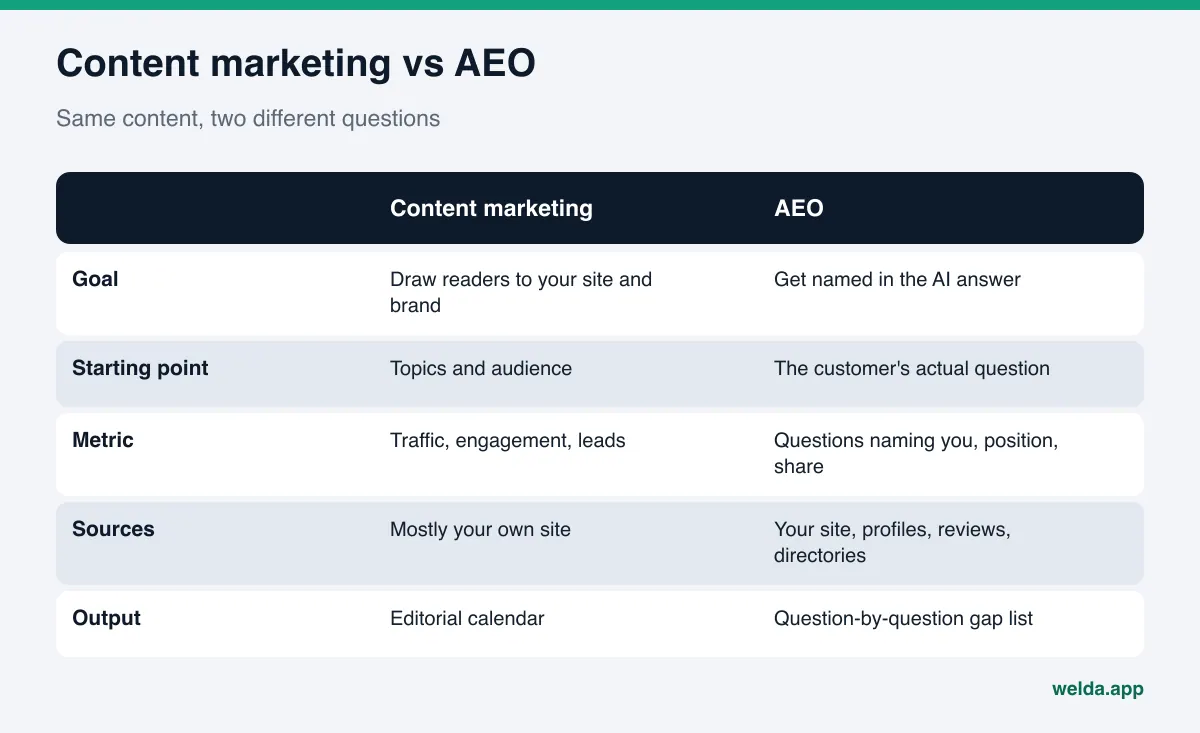
Content marketing vs AEO: what is each one trying to do?
Content marketing is a mature discipline. You publish blog posts, guides, case write-ups, videos and newsletters that help your audience. The goal is for people to discover you, trust you and eventually buy from you. Success is usually tracked with traffic, time on page, form fills, email signups and influenced revenue. Every one of those metrics has something in common: the reader has already landed on your page.
AEO targets a different moment, the one where a customer reads an answer and may never visit your site at all. Someone types "who is a reliable kitchen remodeling contractor in Raleigh?" or "how do I choose a bookkeeper for a small restaurant?" The assistant writes a paragraph, names a few businesses, and often adds a one-line reason for each. The customer builds a shortlist from that paragraph. AEO asks three questions about it: are you in it, where in the list do you appear, and why is a competitor ahead of you?
That difference changes what you measure. In content marketing you ask, "how many people did this post reach?" In AEO you ask, "for the questions customers actually ask, does the answer name us?" The first answer lives in your analytics. The second lives inside the AI engines and can only be seen by asking those questions and reading what comes back.
What content marketing does well, and what it cannot see
A well-run content program leaves valuable ground for AI search visibility. Over time your site accumulates pages that answer questions clearly, guides that show expertise, and service descriptions that explain what you do. AI engines build answers from text on the web. If your site has little clear, current information, the engines have less material to describe you with.
But the standard content marketing scorecard misses several things:
- Your position inside the answer. A guide can be your most-read page while the AI answer on the same topic names a competitor. Traffic reports do not show that.
- Answers that are not built from your site. AI tools often learn about a local business from Google Business Profile, Yelp, Angi, the BBB, industry directories or Reddit threads, not from its own blog. An editorial calendar does not touch those sources.
- Wrong or outdated information. You may be named with an old address, a location you closed, or a service you no longer offer.
- Technical blockers. If robots.txt blocks AI crawlers, or your business information markup (Schema) is missing, great content is harder for the engines to read and attribute to you.
That is why "we publish a lot, so we don't need AEO" is a common blind spot. The search-side version of the same mistake is covered in ranking first on Google but not showing up in ChatGPT: being strong in one channel does not mean you are strong in the other.
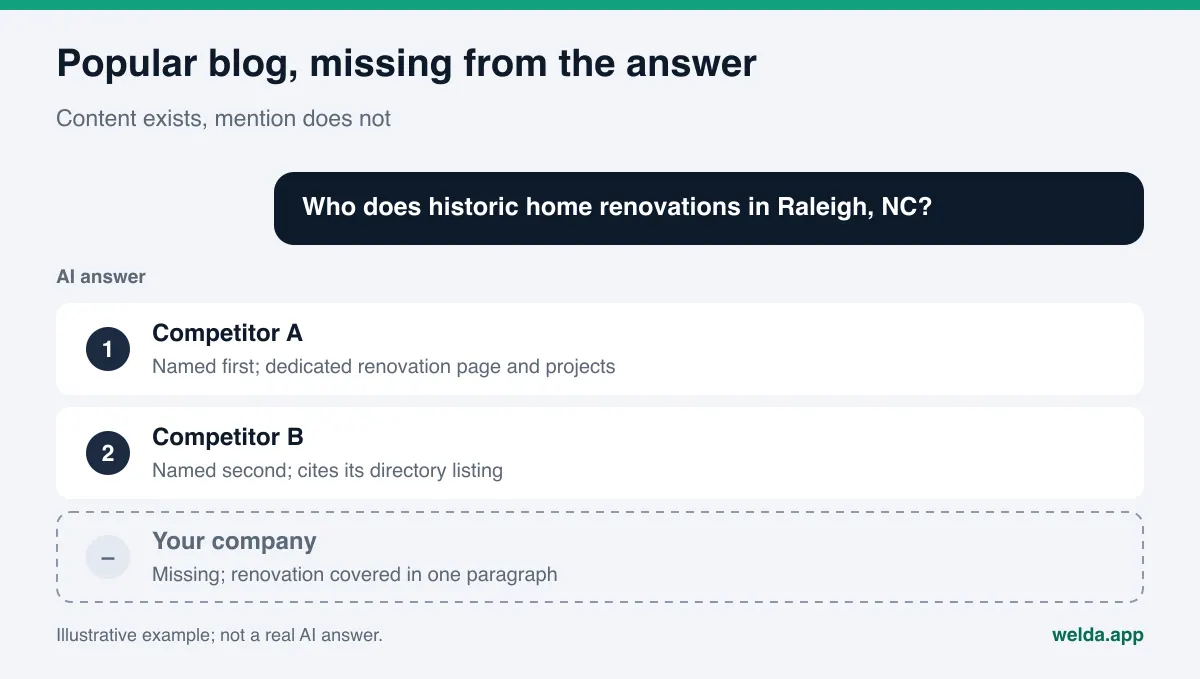
What AEO measures and why it is a separate job
AEO starts from questions, not topics. First you list what your customers ask AI before they buy: questions that look for a provider, compare options, ask about cost or process, or include a city or neighborhood. We walk through how to build that list in how to find the questions customers ask AI.
Then you ask those questions in the engines and read the answers. You look at three things:
- Are you named? For which question, in which engine.
- Where are you named? Being the first business mentioned and being the last name in a list do not carry the same weight.
- Why is a competitor ahead? On which topic, and based on which source.
The output is what makes AEO a separate job. A content calendar answers "what are we publishing this month?" An AEO measurement answers "which questions are we missing from, and is the cause our site, our Google Business Profile, our reviews, or the fact that we are not listed in a directory the AI trusts?" Sometimes the fix is a new article. Often it is smaller: rewriting a vague service page, correcting a business category, adding a FAQ section, or replying clearly to an old complaint on a review site.
There is also a technical layer. Google states that there are no additional requirements or special optimizations needed to appear in AI Overviews or AI Mode, and that normal search fundamentals apply: the page must be indexed and eligible for a snippet, crawling should not be blocked, important content should be in text, and structured data should match the visible page (Google Search Central, AI features and your website). In other words, even strong content falls short if these basics are not checked.
Where content marketing and AEO overlap
The two are not competitors. Built the right way, the same piece of content can serve both. The table below shows how common content types map to each side.
| Content type | Content marketing goal | AEO contribution | What to add for AEO |
|---|---|---|---|
| Service page | Move visitors to a quote or call | Tells AI what to name you for | The service name, who it is for, the cities or area you serve |
| Blog guide | Traffic and trust | Can become a cited source for a question | A two or three sentence direct answer at the top, your business name and location |
| FAQ section | Handle pre-sale objections | Offers text that matches the customer's question | Real customer questions with short, plain answers |
| About page | Brand story | Confirms who the business is | Address, phone, founding details, profile links, business information markup |
| Project or case write-up | Persuasion | Evidence of expertise | What was done, where and how, stated without hype |
| Social posts | Reach and engagement | Indirect; some engines cite social sources | Profile details that match your website |
The last column is the useful one. A piece written for content marketing can often become something AI can cite with small changes: putting the direct answer at the top instead of after a long intro, writing out which cities you serve, or replacing generic claims like "quality service" and "experienced team" with concrete facts.
The overlap has a limit. Content marketing mostly does not cover outside sources. The profiles, review platforms, directories and forums AI relies on fall under AEO. If those carry missing or conflicting details, the answer can still go to a competitor, no matter how good your blog is.
It also helps to remember what Google asks of content in general. Its guidance on helpful, reliable, people-first content describes people-first content as content created primarily for people, not to manipulate rankings. AEO does not change that. It adds a second check on top: once the content is helpful, does it actually show up in the answer?
Which should you start with? A decision by situation
For a business with a limited budget, the real question is not "which is better?" but "which comes first for us?" These situations make the call easier.
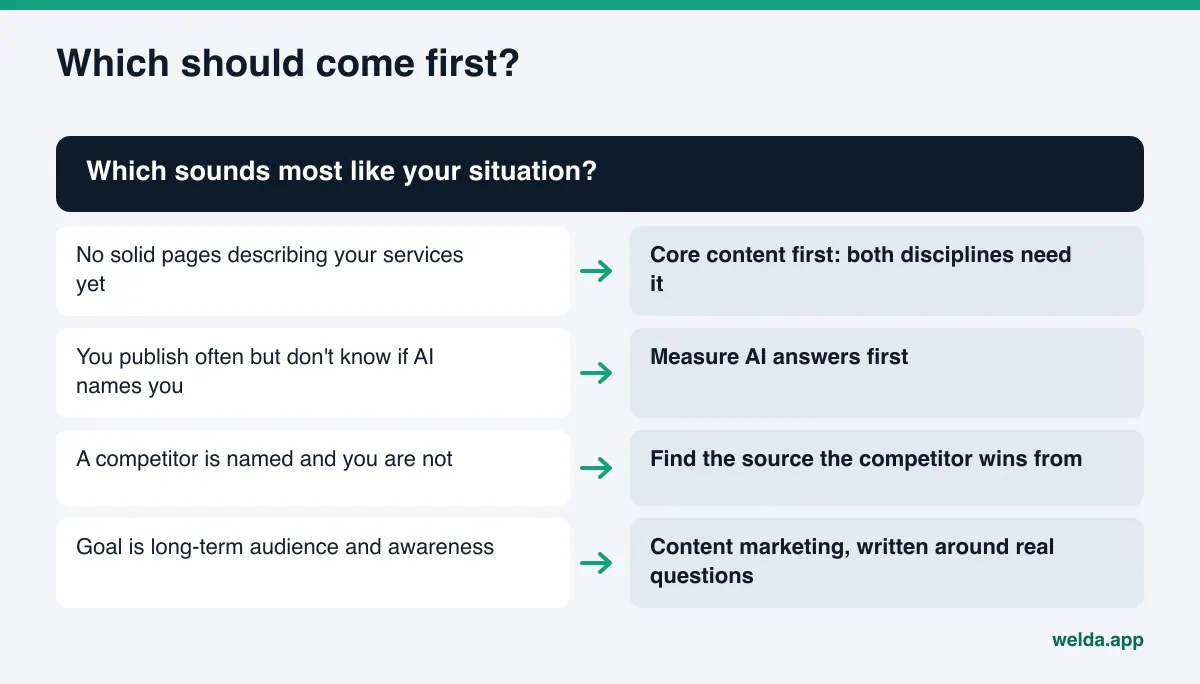
Your site does not have solid pages describing your services yet. Start with core content. Without service pages, an About page, contact details and a FAQ, neither content marketing nor AEO has much to build on. Here both ask for the same work.
You publish regularly but have no idea whether AI answers mention you. Start with measurement. Planning new posts without knowing which questions you already cover and which you miss is choosing a direction in the dark.
A competitor is named and you are not. Look first at which source the competitor wins from. Often the gap is not content at all but a missing directory listing, an incomplete profile or unanswered reviews.
Your goal is long-term audience and brand awareness. Content marketing is worthwhile on its own terms. To make that content useful in AI answers too, write it around real questions from the start.
How to rebuild your content plan for AEO, step by step
You do not need to throw out your editorial calendar. These steps connect the plan you already have to AI search visibility.
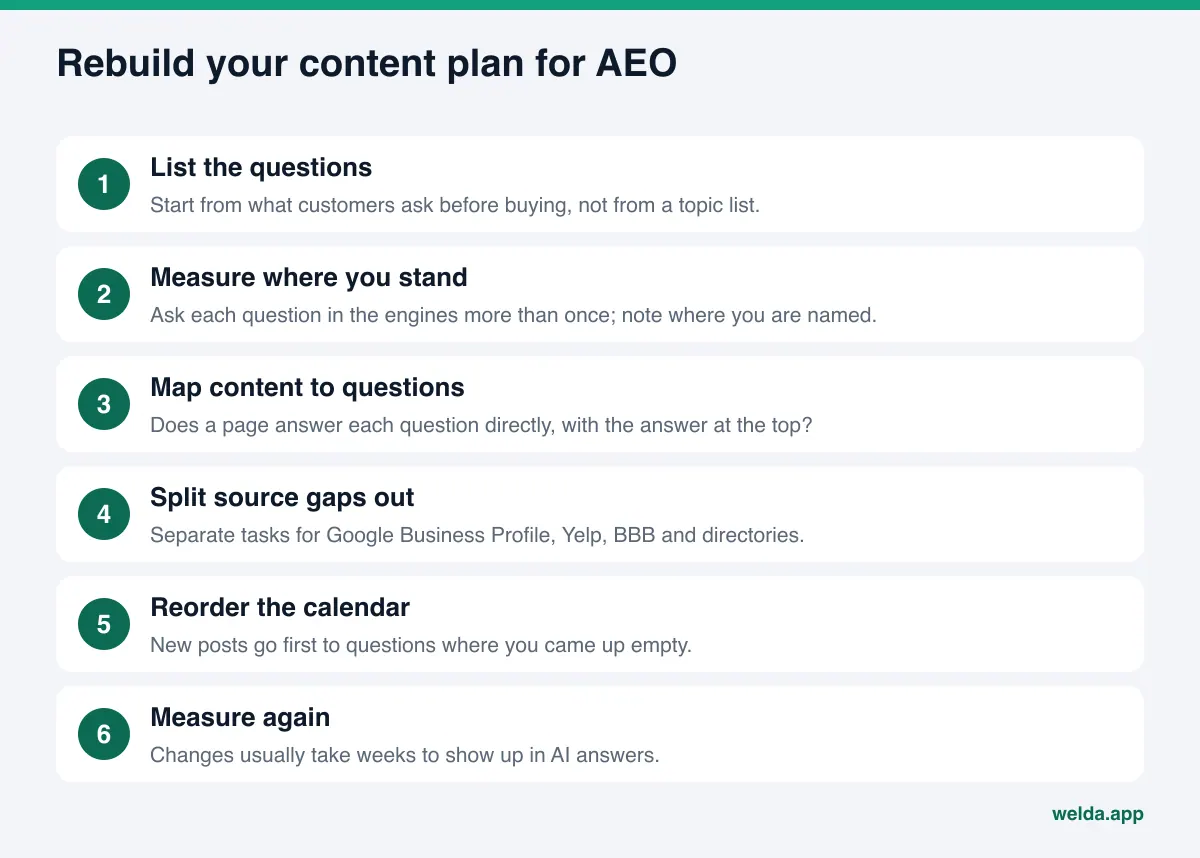
- List the questions. Write down what customers ask before they buy: "best X for Y," "how to choose X," "what does X cost and why," "X near [neighborhood]." Start from questions, not topics.
- Measure where you stand. Ask those questions in the AI engines and note where you are named and where a competitor is. One query can mislead; answers to the same question change over time, so repeat it.
- Map existing content to questions. For each question, is there a page on your site that answers it directly? If not, add it to a gap list. If yes, check whether the answer sits at the top and is stated plainly.
- Separate source gaps from content gaps. Some answers are built from outside sources. Keep a separate task list for Google Business Profile, Yelp, the BBB and the directories in your industry.
- Run the technical checks. Confirm AI crawlers can reach the site, page titles and descriptions are clear, business information markup is correct and pages load quickly.
- Reorder the calendar around the gaps. New posts go first to questions where you came up empty. High-traffic topics that match no buying question can wait.
- Measure again at set intervals. New content usually takes weeks to show up in AI answers. We compare a single snapshot with continuous tracking in one-time AEO audit vs ongoing tracking.
One side effect is worth expecting: your content team starts producing fewer but better-aimed pieces. "Four blog posts this month" gives way to "pages that can serve as the source for these three questions."
Example scenario: a home remodeling company's content plan
Picture an example remodeling contractor that has blogged consistently for two years: design trends, small-bathroom ideas, material comparisons. The posts get read. But for "who does historic home renovations in Raleigh?" or "which contractor should I hire to remodel an older house?" the AI answer names two other firms. A measurement shows the contractor's site mentions historic renovation in a single paragraph, the service area appears only on the contact page, and the Google Business Profile category is generic. In this scenario the fix is not another trend post. It is a dedicated renovation page, the service area written into the copy, a handful of FAQ answers, and a corrected profile category. The existing content stays; AEO adds the context it was missing.
How Welda handles this
Welda does not replace your editorial calendar. Its job sits before and after content production: measuring where you stand in AI answers and preparing what is missing on your behalf. Three parts matter most for this comparison.
Question-by-question gaps. In the Welda panel, the questions your customers are likely to ask are put to ChatGPT, Gemini, Perplexity and Google AI three times each. For every question you see whether you were named, in which engine and in which position. Open a question and you see the gist of the answer and the sources it cited. For a content team this turns into a brief: every empty row raises the question, "do we have a page that answers this?"
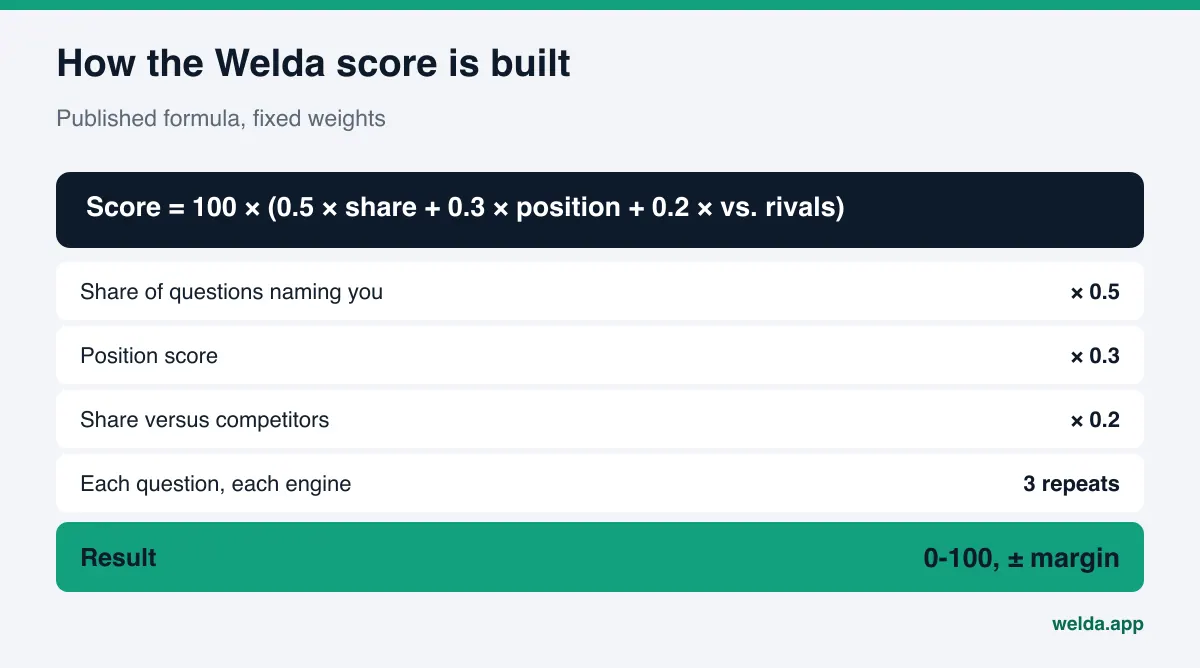
A published score you can read. The score is not a black box. It is built from three parts with fixed weights, and the spread across the three repeats gives a margin of error. When the score moves, you can see whether it came from being named in more questions, from a better position, or from gaining ground on competitors. That matters when you are deciding whether a content push actually changed anything.
Sources and a single task list with drafts attached. A sources view shows which sites the engines lean on and where your business is missing or incomplete, so you can tell a content gap from a listing gap. The resulting work lands in one task list. Welda drafts the missing page sections, profile descriptions and review replies, and the draft sits next to the task. You decide what gets published. On WordPress sites Welda connects through a separate Editor user and an application password, with no code to install; drafts open on your site as drafts and go live when you approve them. For other platforms Welda hands you a ready package to apply yourself. The content always lives on your own website; Welda does not host it.
The panel also includes a competitor view, a before-and-after comparison and a one-page monthly PDF report, which we show in the AI visibility report template article.
To be clear about availability: the Welda panel is in early access and is opening first in Turkey. Regular four-engine measurement is being added during early access, and the sample panel screens use representative data. What anyone can use today is the free site analysis, which works in English and German. Pricing is discussed in an early access conversation.
The free analysis is a practical starting point for a content team. It reads your homepage and a few inner pages, and for every gap it explains what it saw, why it matters and how to fix it. It suggests a homepage title, description, main heading, intro paragraph and FAQ, and simulates how much each fix would move the score. It also asks five customer-style questions to an AI assistant that can search the web and checks whether your business name appears in the answers. That is a one-time measurement, free once per site.
Limits: what Welda does not do
Setting expectations correctly matters in a content marketing vs AEO decision. Here is what Welda does not do:
- No guarantees. There is no ranking guarantee and no promise that you will "show up in ChatGPT." AI answers are the engines' own decision.
- No made-up facts. Welda does not invent your service scope, price ranges or hours. It asks you.
- Not your whole content program. Welda's drafts target AI visibility gaps. Brand storytelling, campaign content and your general blog plan are outside its scope.
- No sensitive content without approval. A compliance check flags patterns such as pricing, guarantee and superiority claims before anything goes live. It is not legal advice.
- No fake reviews. Welda drafts replies to reviews; it does not write reviews.
- No outreach on your behalf. Handling negative reviews, creating directory accounts and PR stay with your business.
- No overnight results. New content usually takes weeks to be reflected in AI answers.
None of this lowers the value of content marketing. It shows why the two should be planned separately: your content team keeps working toward its own goals, and Welda measures whether that content shows up in AI answers and drafts what is still missing.
Checklist: content marketing vs AEO
If more than three of these apply to you, measuring AI visibility before producing more content is the sensible order.
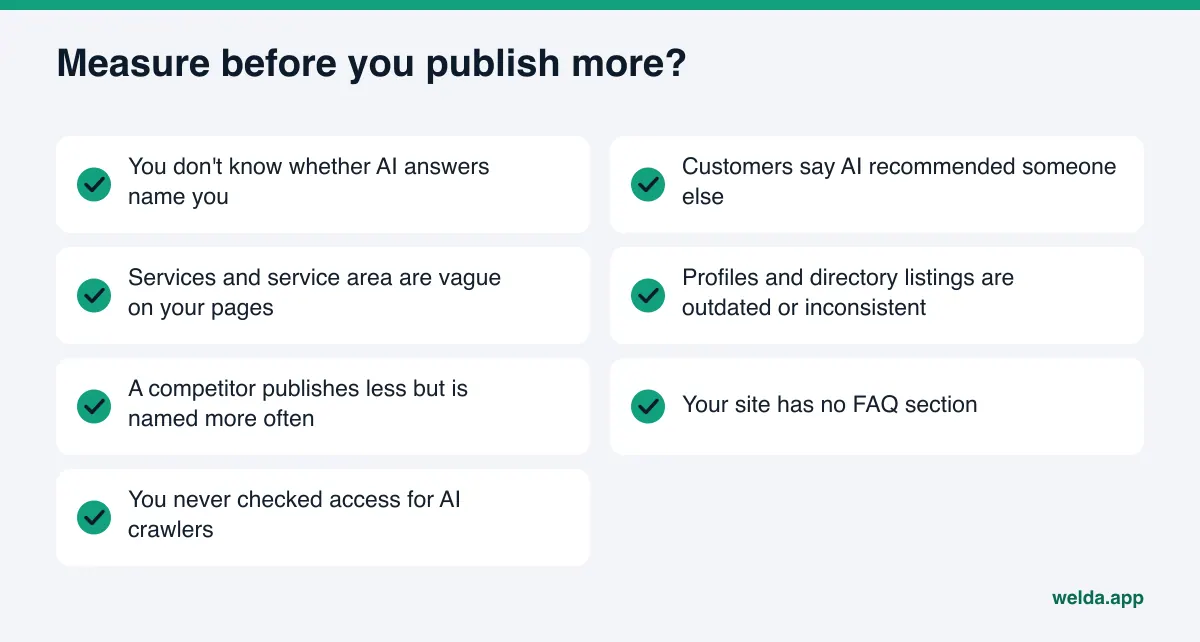
- You publish regularly but do not know whether AI answers name you.
- Customers say "I asked ChatGPT and it suggested you," or that it suggested someone else.
- Your service pages use generic language, and services and service area are not spelled out.
- Your Google Business Profile, Yelp or directory listings are outdated or disagree with each other.
- A competitor publishes less than you but is named more often in AI answers.
- Your site has no FAQ section.
- You have never checked whether your site is open to AI crawlers.
If most of these are a no and your goal is long-term audience building, content marketing can continue on its own track. Writing around real questions and checking AI answers every few months is still a good habit. If you rely on SEO tooling, whether SEO plugins are enough for AEO rounds out the decision.
Frequently asked questions
If I already do content marketing, do I need AEO too?
Content marketing produces the raw material AEO uses, but it does not measure whether AI answers name you and it does not cover outside sources. Without measuring, you cannot know whether your content is landing in AI answers.
Does AEO mean producing more content?
Not always. Often it means adding a direct answer to an existing page, spelling out services and service area, fixing business information markup or completing a profile. New content is written for the questions where measurement shows you are missing.
My blog gets a lot of traffic. Does that mean AI will mention me?
No. Traffic does not show whether AI names you on that topic. Answers often draw on several sources, and a competitor can win through a different one. You only see this by asking the questions in the engines.
Does Welda replace a content marketing agency?
No. Welda measures AI visibility and drafts copy for the gaps in that area. General content strategy, campaigns and brand content are outside its scope.
Where is the content Welda drafts published?
Always on your own site. On WordPress, it opens as a draft and goes live when you approve it. For other platforms Welda provides a ready package. Welda does not host content.
How long until I see results?
New or corrected content usually takes weeks to show up in AI answers, which is why measuring again at set intervals beats a single check. Welda does not guarantee results or timelines.
What does the free analysis give my content team?
A list of gaps on your homepage and a few inner pages, with why each matters and how to fix it, ready-to-use homepage copy suggestions, a simulation of how each fix affects the score, and a one-time five-question AI test. The results link arrives by email and stays open for 14 days.
See whether your content shows up in AI answers first
For most businesses, the answer to content marketing vs AEO is "both, in the right order." First see where you stand in AI answers, then shape your content plan around the gaps. The easiest place to start is a free AI visibility analysis that reads your site the way Google and AI engines do. It takes a few minutes to start, the results come by email, and it gives your content team its first task list.