Do review responses affect AI visibility? Not as a ranking switch, but they shape the material AI reads. When ChatGPT, Gemini, Perplexity or Google's AI Overviews describe a local business, they summarize what review pages say, and your replies are part of those pages. Unanswered complaints and copy-paste thank-yous leave a weak picture; specific, calm, accurate replies leave a stronger one.
This guide looks at review responses for AI visibility in practical terms: what an AI assistant can take from a review page, how to write a reply that carries real information, how to handle negative reviews without making things worse, which platforms to prioritize, and where Welda fits in. In the US this work usually goes by AEO, short for answer engine optimization: getting your business named and described accurately in AI answers. You will also see it called GEO (generative engine optimization); the two terms describe the same goal. If you want to see how your own website reads to AI first, the free AI visibility analysis checks reviews and trust signals along with everything else and tells you how to fix each gap it finds.
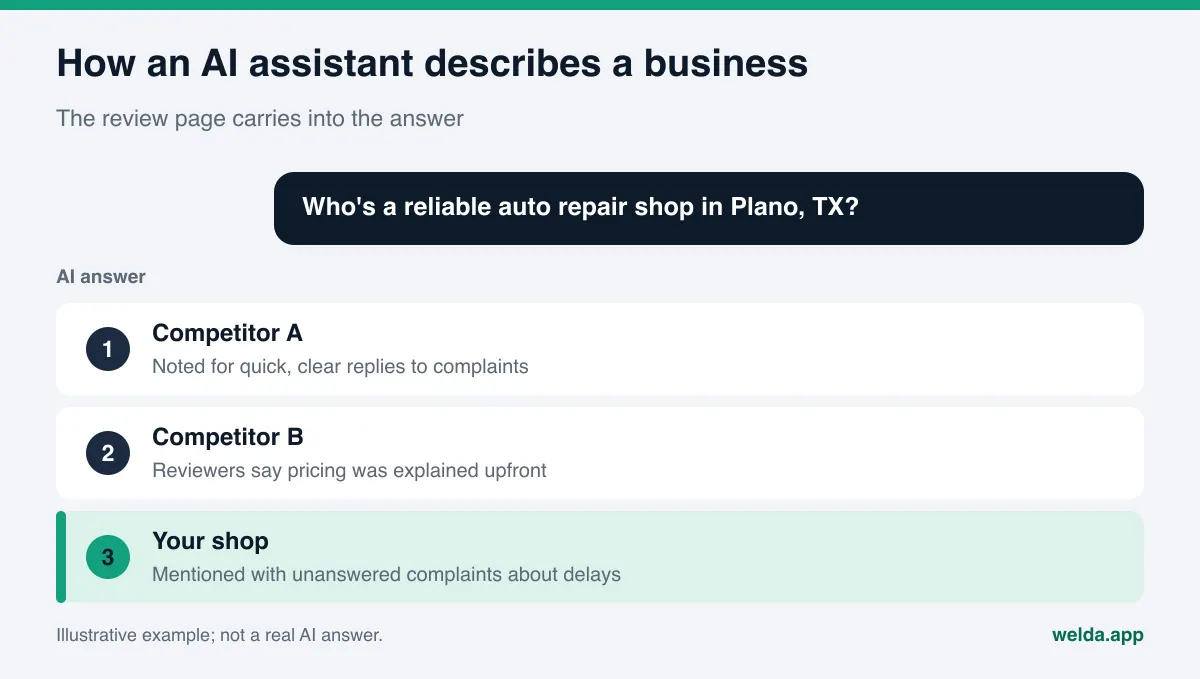
Why review responses matter for AI visibility
When someone asks an AI assistant "who's a reliable auto repair shop in Plano?" or "which dentist near me is good with nervous patients?", the answer does not come from nowhere. Assistants that search the web look at Google Business Profile, Yelp, the Better Business Bureau, industry directories such as Healthgrades or Angi, and forum threads. From those pages they build short summaries: "customers mention fast turnaround," "some reviewers say pricing was not explained upfront."
Your replies sit right under those reviews, published under your business name, visible to anyone. That gives them three kinds of influence:
- They change the tone of the page. An unanswered complaint and a complaint with a clear, accountable reply do not say the same thing. A human reader sees the difference, and so does a model summarizing the page.
- They carry facts. "We're open Saturdays," "parking is behind the building," "we book this service by appointment only." Each of these confirms something about how you operate.
- They signal that the business is active. Replies on recent reviews show someone is paying attention today. A profile nobody has touched in two years tells the opposite story.
Google describes the purpose of replies in similar terms. Its help page says that when you reply to reviews, you show customers you value their feedback, and that helpful replies show you are responsive (Google Business Profile Help: read and reply to reviews). The same page notes that you need a verified profile to reply and that Google reviews replies against its content policies before they appear.
An honest caveat: no AI company has published a rule like "businesses that reply to reviews get recommended more." Replies are not a score. They are source material. The clearer, more consistent and more current that material is, the better the chance an assistant describes you accurately and favorably. Everything below is built on that logic, not on a secret algorithm.
What does an AI assistant read on a review page?
An assistant does not count reviews one by one. It reads the text on the page and condenses it. So what matters is the overall picture. A review page has four layers an AI can use:
- Rating and review count. A broad trust signal. On its own it says little, but no reviews at all, or only very old ones, leave the assistant little to work with.
- Recurring themes in reviews. "Clean," "explained the price upfront," "had to wait." Phrases like "customers often mention" in AI answers come from here.
- Your replies. How problems were handled, what facts were added, what tone you used.
- The rest of the profile. Category, address, hours, services, photos. If your replies contradict this information, the assistant has two conflicting sources and no way to know which one is right.
The third layer is the only one fully in your hands. You cannot write the reviews or set the rating, but you write every reply. The table below compares three ways of handling the same negative review.
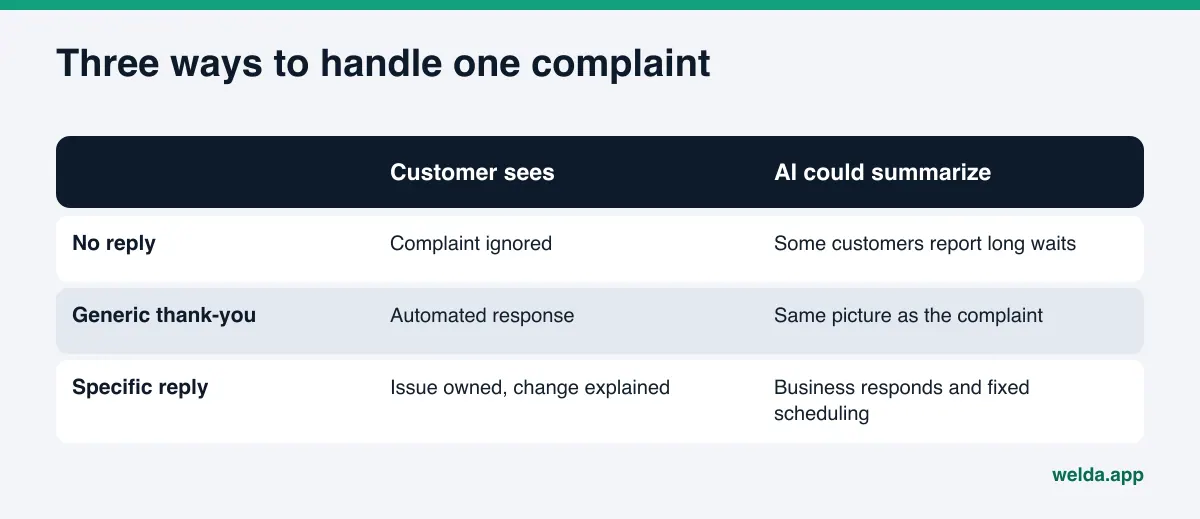
| Situation | What a customer sees | What an AI summary could say |
|---|---|---|
| No reply | The complaint was ignored | "Some customers report long waits" |
| Generic reply ("Thanks for your feedback") | An automated response that skipped the issue | Same picture as the complaint alone |
| Specific reply | The issue was acknowledged and something changed | "The business responds to complaints and says it changed its scheduling" |
The last column is an illustration, not a prediction. Nobody can know in advance exactly what an assistant will write, and answers can differ from one query to the next. If you are curious why, see why AI answers change every time. What you can count on is simpler: an assistant is unlikely to state something that is not in its sources. If your reply does not say the problem was fixed, the answer will not say it either.
How to write review responses for AI visibility, step by step
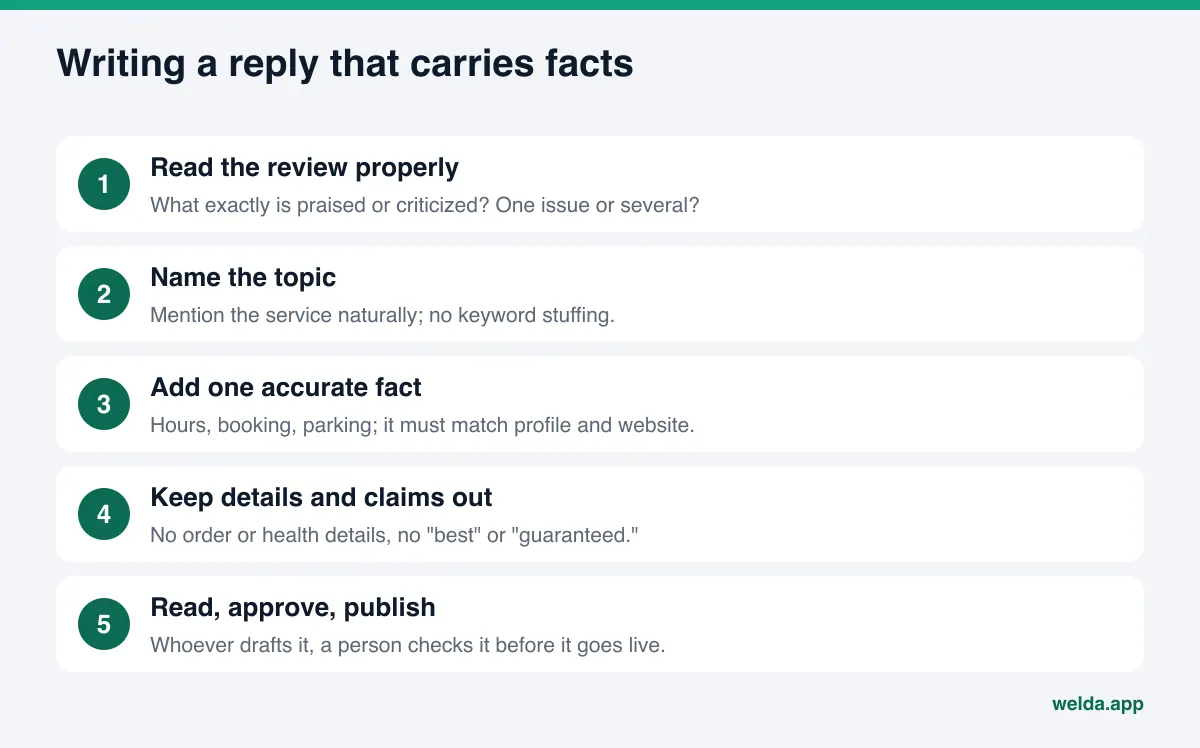
A good reply does not need to be long. It needs to tell both the customer reading it and the AI summarizing it something real. This sequence works for positive and negative reviews alike.
- Read the review properly. What is the customer praising or complaining about? One issue or several? A reply that does not touch the actual topic is just a thank-you note.
- Name the topic. "Thanks for mentioning that the team took time to explain your brake repair" carries far more information than "thanks for the kind words." The service or neighborhood can come up naturally; stuffing keywords into every reply looks artificial to people and models alike.
- Add one accurate, current fact. Hours, how booking works, parking, payment options, a new service. That fact has to match your profile and your website exactly.
- On a negative review, acknowledge and say what changed. No defensiveness. A short apology or explanation, then a concrete step: "We've added more time between weekend appointments."
- Keep personal details out. No order numbers, treatment details, phone numbers or anything that identifies the customer beyond what they posted. Offer a direct contact channel instead.
- Skip claims and promises. "Best in town," "results guaranteed" and similar phrases cost trust and, in some industries, run into advertising rules.
- Keep a steady rhythm. You do not need to reply the same hour, but a fixed weekly review session keeps replies from piling up.
The step most businesses skip is the third. They either thank or apologize, and that is all. Yet a reply is a good place to confirm something that is not spelled out elsewhere. When an auto shop writes "for same-day service, drop your car off by 10 a.m.," that sentence could later feed an answer to "who does same-day repairs near me?" There is no guarantee, but if the sentence is never written, there is nothing for an assistant to find.
Consistency matters more than volume. Writing "we're open Saturdays" in a reply while your profile shows Saturday as closed puts two contradicting sources in front of the model. If you run several locations, each one has its own profile and its own reviews, so the facts in replies need to match the right location page; location pages for AI search covers how to keep that straight.
Example: a weak reply and a strong reply to the same review
The following is a made-up example, not a real business or customer. Say a hair salon receives this review:
"Loved my color, but I waited 40 minutes past my appointment and nobody told me anything."
A weak reply looks like this:
"Thank you for your feedback. We hope to see you again soon."
Polite, but empty. The complaint stands exactly as it was. Neither a reader nor an AI summarizing the page can tell the salon noticed the problem. A stronger reply could read:
"We're glad you're happy with your color, and we're sorry about the wait and the lack of updates. Color appointments can run long, so we now leave extra time between them and text clients if we're running behind. If you'd like to tell us more, you can reach the front desk directly."
The stronger reply contains four facts: the salon offers color services, it acknowledges the problem, it changed its scheduling, and it notifies clients about delays. Each one should only be written if it is true. The reply does not call the salon the best colorist in the city, and it does not name or identify the customer. It will not erase the complaint, but it places a resolution right next to it, and anything that summarizes the page sees both.
Positive reviews work the same way. Instead of "Thanks so much," a reply like "We're glad the trial run before your wedding helped" confirms, once more, that the salon does bridal styling and offers trial appointments. One sentence, one fact. That is enough.
Responding to negative reviews: what to write and what to avoid
Negative reviews are the most sensitive part of AI visibility. An assistant may include a negative theme in its description: "some customers say prices weren't clear upfront." Even as a single line, that can change a customer's decision. Your reply cannot delete that line, but it can add a second fact next to it: the business knows about the issue and changed something.
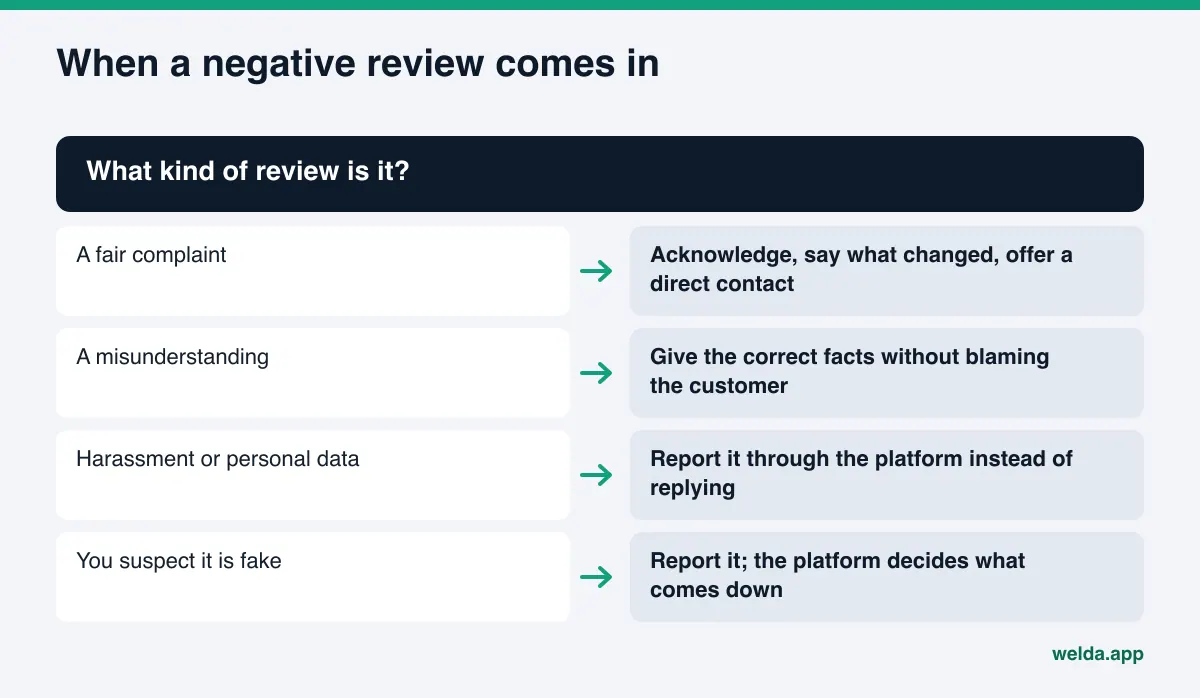
It helps to sort negative reviews into three types:
- A fair complaint: Acknowledge it, say what changed, offer a direct contact. If nothing actually changed, do not claim it did.
- A misunderstanding: Give the correct information politely. "We offer this service by appointment only; here's how to book." A tone that blames the customer tends to draw more attention to the review.
- Content that breaks the platform's rules: Harassment, personal information, a review meant for a different business, or one you believe is fake. Use the platform's reporting process instead of arguing in public. The platform decides what comes down.
Some lines should never be crossed. Do not argue with customers in public, threaten legal action, or reveal who a reviewer is. The FTC's rule on consumer reviews and testimonials, announced in August 2024, bans fake reviews, including AI-generated ones, and prohibits using baseless legal threats or intimidation to prevent or remove negative reviews (FTC press release). In healthcare, privacy rules reach into replies as well: the HHS Office for Civil Rights has settled with providers whose responses to online reviews disclosed patient information (HHS announcement). This article is not legal advice; if you are unsure what applies to your industry, ask your attorney or professional association.
Forums are a separate case. A thread about your business on Reddit can show up as a source in AI answers, and there is no "reply as owner" button. If you decide to respond, do it openly as the business, with facts, and only where the community's rules allow it. We cover how these threads enter AI answers in Reddit and AI answers.
Which review platforms should you prioritize?
Replying to every review on every site the same day is not realistic for a small business. Priority should follow which sources AI assistants actually use for your type of business. The table is a starting point; your industry may look different.
| Platform | Why it matters | What to watch in replies |
|---|---|---|
| Google Business Profile | A frequent source for local questions; reviews and replies sit on the same page | Match profile facts, name the service, reply steadily |
| Yelp | Can surface for restaurants, salons and home services | Calm tone, concrete fix, no customer details |
| Better Business Bureau | Can surface in trust questions ("is this company legit?") | Clear resolution steps, consistent facts |
| Industry sites (Tripadvisor, Healthgrades, Angi) | Can surface for industry-specific questions | Industry facts: room types, insurance accepted, service area |
| Your own website | Reviews and trust signals on your site are read too | Show real reviews; never invent testimonials |
Picking the right priority takes measurement, not guesswork. Seeing which sites AI answers actually cite for your questions tells you where effort pays. A hotel may find Tripadvisor carries the most weight, while a plumber may find Google and Angi matter more.
How Welda handles review responses for AI visibility
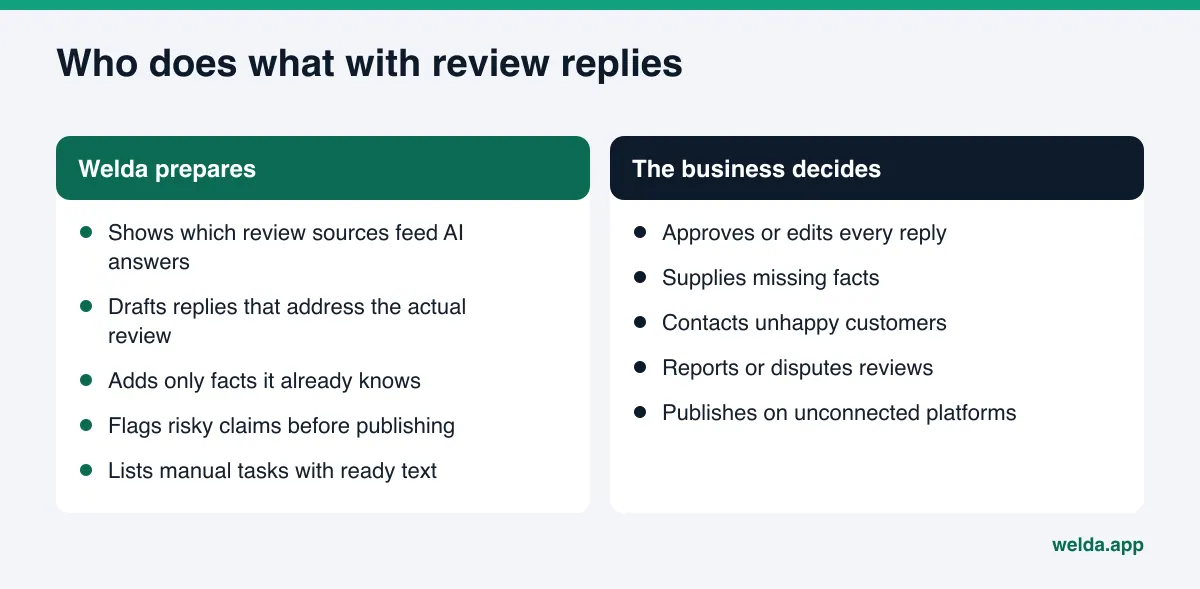
Welda is software that measures where a business shows up in AI answers and fills in the gaps on the business's behalf. For reviews, Welda does two things: it shows which review sources matter for your questions, and it drafts the replies. The decision to publish always stays with you.
Sources: where your effort should go. In the Welda dashboard, the sources view lists the sites AI assistants draw on when they answer your customers' questions, and shows your status on each: profile present, incomplete or unverified. For one business that might put Google Business Profile and Yelp at the top; for a hotel it might be Tripadvisor and booking sites. Instead of "reply to everything everywhere," you get a short list of the two or three platforms that actually feed the answers.
Drafted replies in one to-do list. Welda prepares review responses and places them in a to-do list for your approval. A draft addresses what the reviewer actually said, adds accurate facts Welda already knows about your business, and avoids promises. When a reply needs a fact Welda does not have, such as new opening hours, it leaves a gap and asks you instead of guessing. You read the draft, edit if needed, and approve.
What stays manual. Google Business Profile can be connected to Welda. Where a profile is not connected, or a platform offers no way to publish, the task is marked as manual: the text is ready, you paste it in and mark the task done. Welda's compliance check flags patterns like pricing claims, guarantees, superiority claims and anything that reads like a diagnosis before anything goes live. It is not legal advice and has not been reviewed by counsel. In healthcare nothing is published automatically, every reply goes to approval, and patient data is never sent to AI.
To see whether any of this moves the needle, you need measurement. In the Welda dashboard, the questions your customers would ask are put to ChatGPT, Gemini, Perplexity and Google AI three times each, and you see which questions name you and where competitors lead; a before-and-after view tracks change over time. New content usually takes weeks to show up in AI answers. A note on availability: the Welda dashboard is in early access and opening first in Turkey, so it is not yet generally available in the US. Regular four-engine tracking is being added during early access, and sample screens use illustrative data. What anyone can use today is the free site analysis, which works in English. Pricing is discussed in an early access conversation.
What Welda does not do with reviews
Review management can drift into bad practice quickly, so here is what Welda does not do:
- No fake reviews. Not for you, not about competitors. Reviews have to come from real customers.
- No publishing without approval. Every drafted reply passes through you before it goes live.
- Negative reviews stay your responsibility. Contacting the customer, resolving the issue, reporting a review or requesting removal are yours. Welda can draft a suggested reply, but it does not take over the decision.
- No invented facts. If a reply needs information Welda does not have, it asks.
- No ranking promises. Welda does not guarantee placement or that you will "show up in ChatGPT." Replies strengthen the source material; the assistants decide whom to name.
Directory listings and PR work also stay with the business. And reviews are only one part of the trust picture; the rest lives on your own site, which is the subject of about page trust signals for AI.
Checklist: are your review responses ready for AI search?
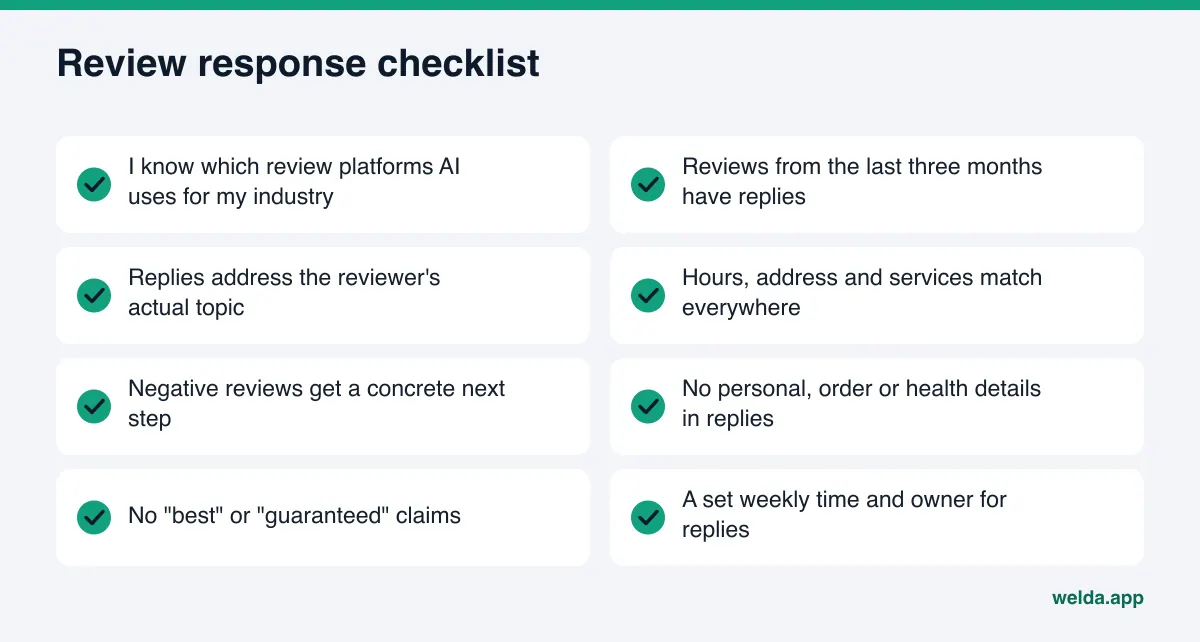
You can run through this list in one afternoon. Answer yes or no; every no is next month's work.
- Do you know the two or three review platforms AI assistants use for your industry?
- Have reviews from the last three months received replies on those platforms?
- Do replies address the reviewer's actual topic, or is it the same thank-you every time?
- Do hours, address and services in replies match your profile and website?
- Do replies to negative reviews acknowledge the issue and name a concrete step?
- Are replies free of personal, order or health details?
- Are replies free of "best," "guaranteed" or similar claims?
- Have rule-breaking reviews been reported through the platform rather than argued?
- Is there a set weekly time and a named person for review replies?
Stale profiles undo good replies over time, so it is worth reading how content freshness for AI search plays into the same picture.
Frequently asked questions
Do review responses directly improve AI visibility?
No published rule says so. Replies add facts and tone to the review pages AI assistants read, so the effect is indirect: the source that describes your business gets stronger. Measuring answers over time is the only way to see real impact.
Do I need to reply to every review?
Ideally, yes, but order matters more. Start with negative reviews and reviews that ask questions, then recent reviews on the platforms AI uses for your industry. Short, older positive reviews can wait.
Should I put keywords in review replies?
A service name or neighborhood can appear naturally. Repeating the same phrases in every reply looks artificial and puts off real readers. One sentence with a real fact is worth more than a keyword.
Is it a problem to use AI to draft review replies?
The tool is not the issue; oversight is. Whoever drafts a reply, a person should read it and confirm the facts before it is published. That is why every Welda draft goes to approval and missing facts are asked for, not invented.
Can I remove a negative review?
Generally you cannot delete reviews on third-party platforms yourself. You can report reviews you believe violate the platform's policies, and the platform decides. For a fair negative review, a calm and specific reply is the best response.
How long until replies show up in AI answers?
New content usually takes weeks to be reflected, and each assistant updates at its own pace. Comparing measurements a few weeks apart tells you more than checking a single query.
Where to start
Review responses for AI visibility come down to order and consistency: pick the platforms that matter, put accurate facts in replies, own negative feedback, and measure the result. Start by finding out how your website looks to AI today. The free AI visibility analysis reads your site, including reviews and trust signals, explains what it found and how to fix each gap, and asks an AI assistant with web search five questions your customers might ask to see whether your business is named.