Which AEO KPIs should a business actually track? Start with three: the share of tracked questions where your business is mentioned, where you appear in the answer, and your share of mentions against named competitors. Put site readiness in front of those as a leading indicator and AI referral visits and leads behind them as outcomes. Read all of it against a fixed question list, with repeated runs and a margin of error. A single screenshot is not a KPI.
AEO, short for answer engine optimization, is the work of getting ChatGPT, Gemini, Perplexity and Google's AI Overviews to find, understand and recommend your business. Some people call the same work GEO (generative engine optimization). AEO KPIs are the numbers that tell you whether that work is paying off. Traditional SEO gave you rankings, impressions and clicks. An answer engine gives you a paragraph, and your business is either in it or not. This guide covers which AEO KPIs to track, how to set them up, where teams misread them and how Welda measures them. If you want a baseline first, the free AI visibility analysis scores how ready your site is for AI search and checks whether your business shows up for a handful of customer questions.
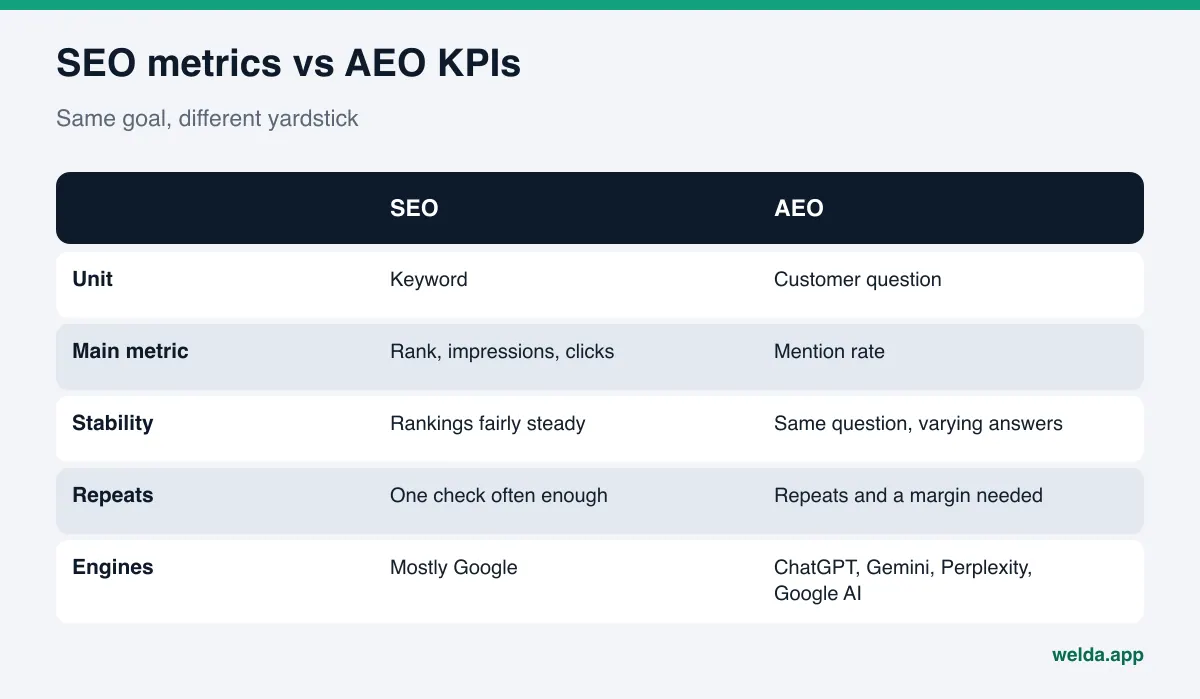
Why AEO KPIs differ from your SEO dashboard
When an owner asks "do we show up in ChatGPT?", they are really asking three things. Are we mentioned when a customer asks the question that matters? If we are, are we first or fifth? And is the competitor down the street mentioned more often than we are? A standard SEO report answers none of those directly. Ranking third on a Google results page and being recommended inside an AI answer are different events.
A few properties of answer engines shape how you measure them:
- Answers are not stable. Ask the same question twice and you can get a different list. One check is noise; you need repeated runs and an average.
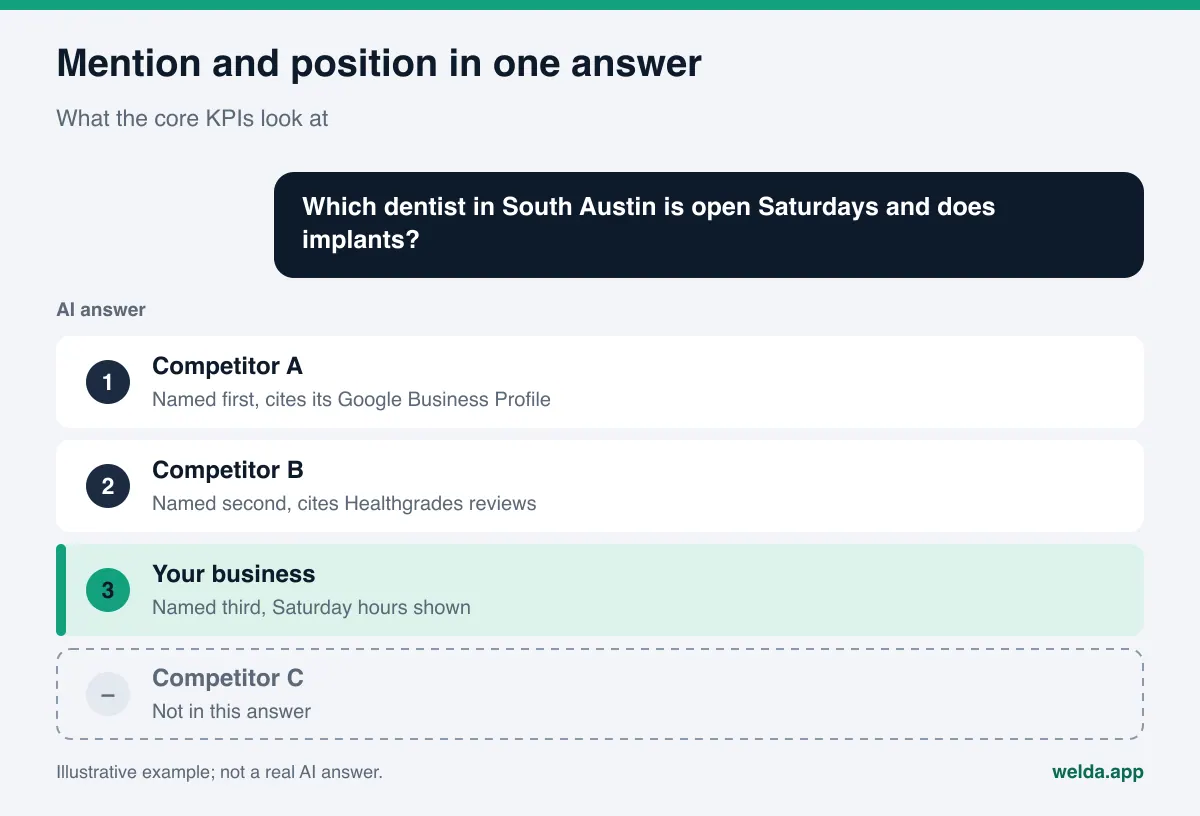
- The unit is a question, not a keyword. A customer does not type "dentist Austin." They ask, "Which dentist in South Austin is open Saturdays and does implants?" Your KPIs hang on a list of questions like that.
- Each engine behaves differently. Each one leans on different sources. Showing up in ChatGPT and not in Gemini is normal, so a single blended number hides the gap.
- Few clicks, real influence. The answer often ends the search. The customer reads your name, then calls you, taps you in Google Maps or checks your Yelp page. Your analytics only sees part of that path.
So AEO KPIs sit next to your SEO metrics; they do not replace them. SEO still matters because answer engines draw on web search and indexes when they build a response. But "we rank third on Google" is not the same sentence as "AI recommends us."
Which AEO KPIs belong on your scorecard?
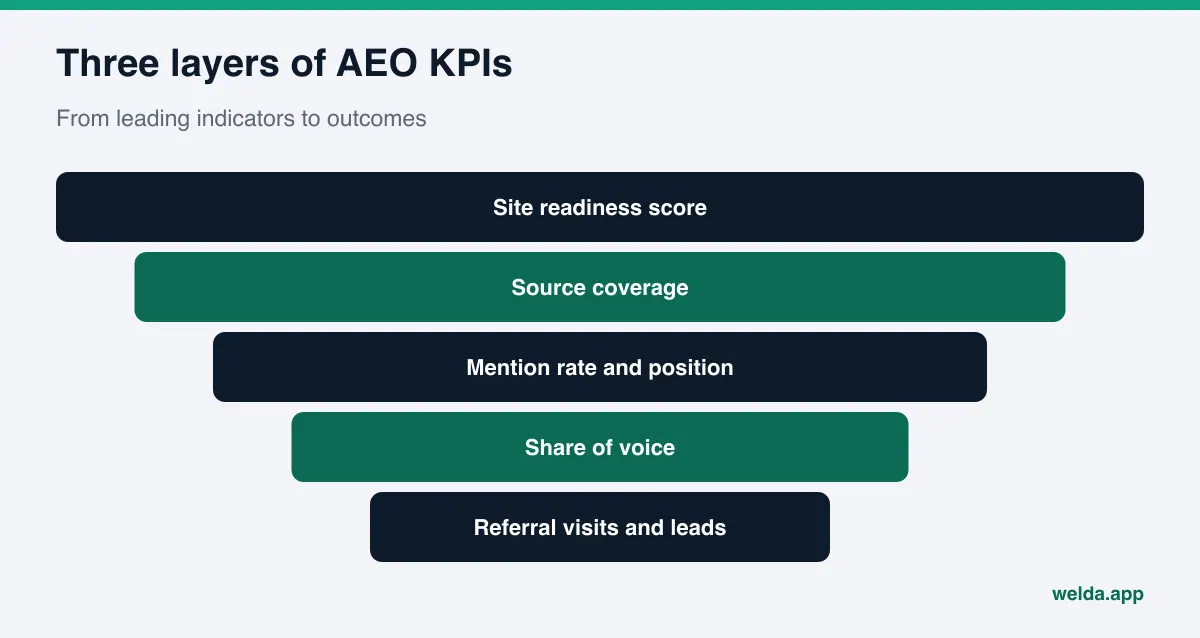
It helps to think in three layers. Leading indicators tell you whether your site and profiles are ready to be read by AI. Visibility metrics tell you whether you are actually mentioned. Outcome metrics tell you whether that visibility turns into visits and leads. Leading indicators move fast and are under your control. Outcomes arrive late and depend on many other things.
| KPI | What it measures | Layer | How to read it |
|---|---|---|---|
| Site readiness score | Crawler access, business schema, titles, name, address and phone, FAQ content, page speed | Leading | A precondition for visibility, not visibility itself |
| Source coverage | Whether you are present and accurate on the sites engines cite, such as Google Business Profile, Yelp, BBB or Angi | Leading | A missing source is a common reason a competitor wins a question |
| Mention rate | Share of tracked questions where your business is named | Visibility | Your core KPI; read it engine by engine |
| Position | Where you appear in the answer when you are named | Visibility | Named first and named fifth are not worth the same |
| Share of voice | Your mentions compared with named competitors on the same questions | Visibility | Shows relative standing even when the market shifts |
| Answer accuracy | Whether hours, address, services and price range in the answer are correct | Visibility | Being named with wrong hours can cost more than not being named |
| AI referral sessions | Visits from AI assistants in your analytics | Outcome | Undercounts by design; use it for trend |
| Leads | Calls, form fills, messages and bookings | Outcome | The slowest metric and the most influenced by other factors |
You do not need every row in every monthly report. For a small business, the three visibility metrics plus one outcome metric are a solid start. We go deeper on the competitor side in our guide to AI share of voice.
Why AI referral traffic undercounts
There are a couple of verified signals on the analytics side. Google states in its documentation on AI features that traffic from AI Overviews and AI Mode is included in overall search traffic in Search Console and reported in the Performance report under the Web search type. In other words, you cannot pull it out as its own line. OpenAI says in its publishers and developers FAQ that ChatGPT adds utm_source=chatgpt.com to referral URLs from ChatGPT search, which lets you segment those visits in Google Analytics. Neither signal captures the customer who reads the answer and then calls your front desk. Treat referral sessions as a trend line, not a full count.
How to set up AEO KPIs step by step
Setting up AEO KPIs does not start with picking a tool. It starts with deciding what you will ask and what you will compare against. This order keeps the numbers readable from day one.
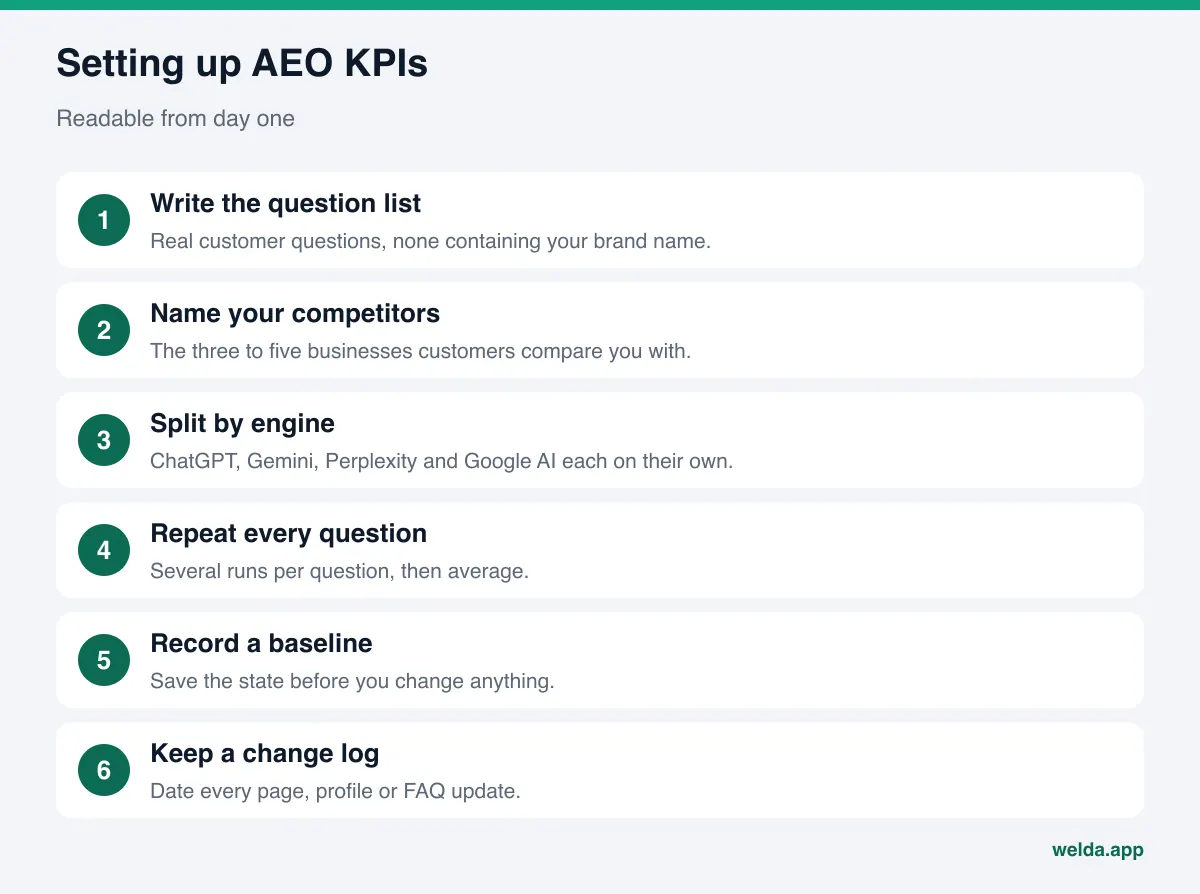
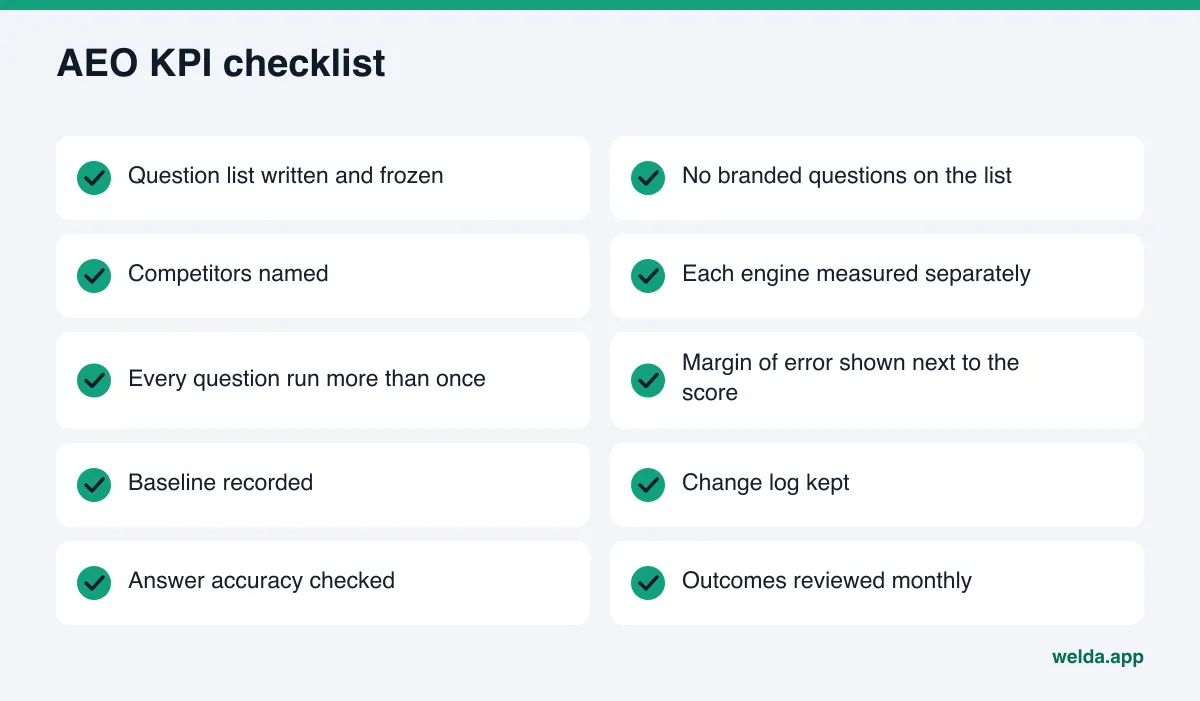
- Write the question list. Collect the questions customers actually ask: service plus neighborhood or city, "best" and "recommend" questions, price and comparison questions. Leave out questions that already contain your brand name. Our guide on prompts to track for AI visibility walks through how to pick them.
- Name your competitors. Share of voice needs a defined field. Pick the three to five businesses customers really compare you with, not the biggest names in your category.
- Measure each engine separately. ChatGPT, Gemini, Perplexity and Google's AI answers each get their own numbers.
- Run every question more than once. One answer can be luck. Repeats give you an average and a spread.
- Record a baseline. Save the state before you change anything. Without it you cannot say what a later gain is a gain over.
- Keep a change log. Note the date of every page edit, profile update or new FAQ. When a KPI moves, the log tells you what might explain it.
- Fix the reading rhythm. Check visibility metrics on a regular schedule and outcomes monthly. New content usually takes weeks to show up in answers, so do not act on day-to-day swings.
Step five is the one teams skip most. Without a baseline, the effect of the work blurs into whatever was already true when tracking began. Our piece on before and after AEO measurement explains how to make that comparison fair.
Does the method behind the numbers matter?
Yes. Some tools query a model through its API, while customers use the consumer app with search turned on. The two can give different answers to the same question. Before you trust a KPI, find out which one it is built on. We compare the two in API vs app answers in AI visibility tracking.
One AEO score or separate metrics?
Separate metrics give detail, but an owner or a marketing lead does not want eight numbers every month. A single score is easy to read, but if you cannot open it up, you will not know why it dropped. The practical answer is a score with a published formula and every component shown next to it.
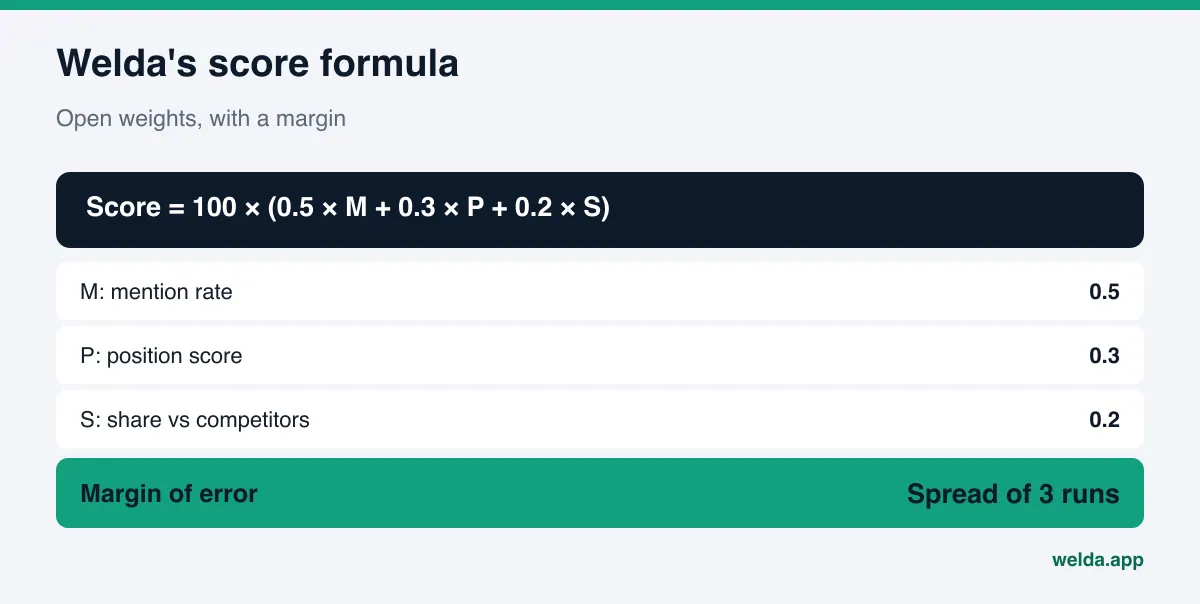
Welda's panel uses this formula: the score is 100 times the sum of three weighted parts. Mention rate carries 50 percent, the position score 30 percent and share against competitors 20 percent. The weights reflect priorities. Being mentioned comes before being mentioned first, and share of voice gets less weight because on its own it can mislead; you can gain share simply because a competitor slipped.
An open formula does two jobs. When the score drops, you can see which part dropped: are you named in fewer questions, or lower down in the ones you are named in? And you can rebuild the score in your own spreadsheet to check it. You never have to trust a black box.
Why the margin of error is part of the KPI
Ask a question three times and you may get three different answers. How far those runs disagree becomes a plus-or-minus next to the score. With example values: if the score is 27 one month and 28 the next, and the margin is 2 points, that change sits inside the noise. Calling it growth is premature. A move from 22 to 31 is well outside a 2-point margin and points to a real change. A report that leaves out the margin will present ordinary wobble as wins and losses.
How Welda tracks AEO KPIs
Welda splits the job in two. The free site analysis, available to anyone today, measures the leading indicators. The panel, in early access, tracks the visibility metrics over time.
Free analysis: your readiness score and a first visibility check
The free analysis reads your homepage and a few inner pages such as services, pricing, about and contact. It returns a score out of 100, split into technical and content. Whether AI crawlers can reach your site, whether you have business schema, whether your name, address and phone are consistent, whether you have an FAQ section and how clearly you describe your services all feed that score. That is your site readiness KPI.
The analysis also asks 5 likely customer questions to an AI assistant that can search the web and checks whether your business is named in the answers. It is a one-time measurement. It does not replace ongoing tracking, but it is a useful first data point for your baseline. A simulation shows which fix would raise the score by how much, which helps you decide which leading indicator to work on first. The analysis works in English, is free once per site, and the results link stays open for 14 days.
Panel: mention rate, position and share of voice over time
In the panel, the questions your customers would ask are sent to ChatGPT, Gemini, Perplexity and Google AI three times each. The overview puts the score, the mention rate and your share against competitors side by side, with the trend over time and a breakdown by engine underneath. Say, as an example, you are named in roughly a third of questions on ChatGPT but far fewer on Google AI Mode. That points to the sources that engine trusts, not to a general problem, and the sources screen shows where you are missing.
The questions screen breaks the core KPI down question by question: which engine names you, and in what position. The competitors screen shows the reason behind share of voice: which topic a competitor wins and which source it wins from. The score alone says "down." Those two screens answer "where and why." A one-page monthly report pulls the KPIs together for a manager and downloads as a PDF, and a before-and-after view puts the measurements on either side of a change next to each other.
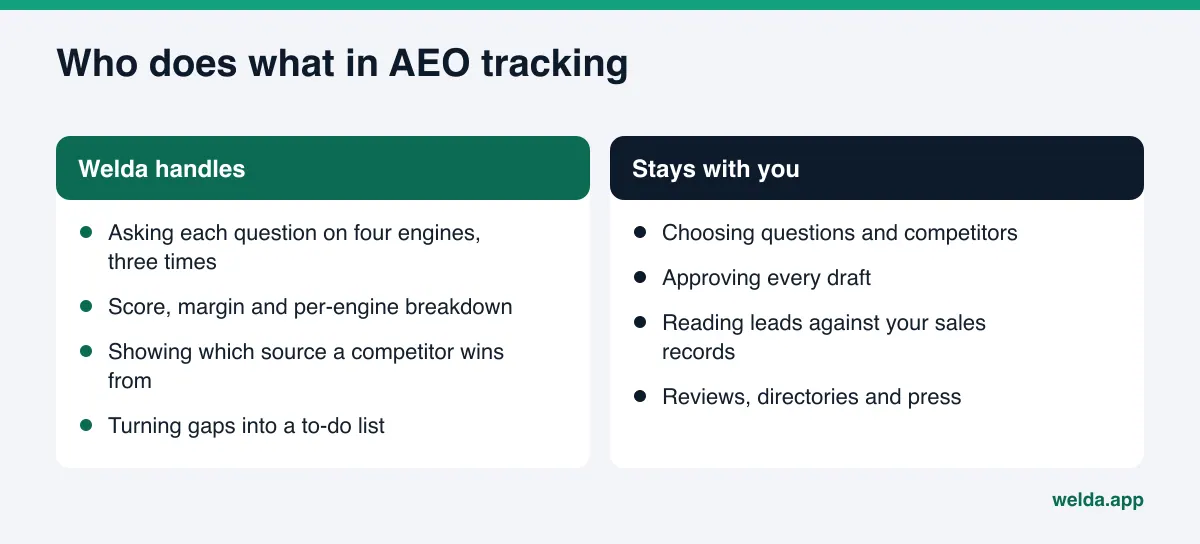
What stays with you is clear. You decide the question list and the competitor set, you approve the copy Welda drafts, and you read the outcome numbers against your own sales records. Welda's job is to keep the measurement consistent and to turn gaps into a to-do list.
To be straightforward about status: the Welda panel is in early access and is opening first in Turkey. Regular four-engine tracking is being added during early access, and sample panel screens use representative data. The part anyone can use today, in English, is the free site analysis. Pricing is discussed in an early access call.
Common mistakes and limits when reading AEO KPIs
Choosing the right metric is half the job. Reading it correctly is the other half. These are the mistakes that come up most:
- Treating a screenshot as proof. "ChatGPT recommended us" is an observation, not a KPI. The same question may get a different answer tomorrow. Without repeated runs, any AEO ROI calculation rests on sand.
- Changing the question list often. If the list changes every month, scores stop being comparable. When you add questions, note it and read the old and new sets separately.
- Including branded questions. A question that already contains your business name will name you every time. It inflates the score and says nothing about new customers.
- Crediting one cause for an outcome. More leads may come from season, a promotion or a new review, not only from AI visibility.
- Judging too early. New content usually takes weeks to show up in answers. A flat score in the first two weeks does not mean the work failed.
Here is what Welda does not do. It does not guarantee rankings or a spot in ChatGPT; no measurement tool controls what the engines say. It does not write facts it does not know; it asks you. It does not publish sensitive content without your approval, and it does not create fake reviews. Handling negative reviews, managing directory accounts and press outreach stay with you. The free analysis does not measure rankings either; it shows site readiness and a one-time AI check.
AEO KPI checklist and decision guide
Before you start reporting, run through this list. If an item is missing, you cannot read changes in that metric with confidence.
| What you see | KPI to check | Likely next step |
|---|---|---|
| Low readiness score | Technical and content score | Fix crawler access, business schema and homepage copy first |
| Good readiness, few mentions | Mention rate, source coverage | Fill gaps on the sources engines lean on |
| Mentioned, but always near the bottom | Position, share of voice | Find the topic and source a competitor wins on and strengthen that page |
| Strong on one engine, weak on another | Breakdown by engine | Focus on the sources that engine trusts |
| Visibility up, leads flat | Answer accuracy, leads | Check that answers carry correct details and that contact paths work |
Frequently asked questions
Can AEO KPIs and SEO KPIs live in the same report?
Yes, in separate sections. Impressions and clicks sit on the SEO side; mention rate, position and share of voice sit on the AEO side. Folding them into one number adds up things that measure different events.
How many questions should I track?
There is no magic number. A list that covers your main services and the questions customers ask at the moment of choosing is enough. What matters is that the list stays stable and leaves out branded questions.
My score did not move in a month. Did the work fail?
Not necessarily. New content usually takes weeks to reach AI answers. Look at the leading indicators first: are the gaps closed, are you present on the sources that matter? Visibility metrics follow those.
What if the margin of error is large?
A large margin means the engines are unsettled on those questions. Watch the trend rather than single runs, and do not count a change between two measurements unless it is bigger than the margin.
Does the free analysis replace ongoing tracking?
No. It scores site readiness and runs a one-time, five-question AI check. It is a good baseline. Regular four-engine tracking lives in the panel, which is in early access.
Can I measure every customer who came from AI?
No. Some visits show up in analytics with their source, but a customer who reads the answer and calls you will not. Read outcome metrics as a trend, and ask new customers how they found you.
Where to start
The easiest first step toward AEO KPIs is knowing where you stand today. Run the free AI visibility analysis to get your readiness score, the gaps behind it and an estimate of how much each fix would move it. That report becomes the baseline every later measurement is compared against.