How do you get on ChatGPT best-of lists? When someone asks ChatGPT for "the best pediatric dentist in Austin" or "the best taco spot in San Diego," the list it returns is assembled from sources it finds on the web: roundup articles, review sites, directories and business websites. To get named, you need to show up consistently in the sources it reads and give it a clear reason on your own site. Nobody can guarantee a spot, but you can measure where you stand and work through the gaps one by one.
A growing share of buying decisions now start with a question typed into ChatGPT, Gemini, Perplexity or Google's AI Overviews instead of a list of blue links. "Best" questions are the sharpest version of that shift. The answer is usually a short list of three to seven names, and the person asking rarely looks past it. If you want to get on ChatGPT best-of lists, you are working on the most commercial part of AEO (answer engine optimization), the practice of earning visibility in AI-generated answers. You may also see it called GEO, generative engine optimization; it is the same idea. This guide explains how these lists get built, which ones you can realistically win, the steps to take, and which part of the work Welda handles. If you want a baseline first, run a free AI visibility analysis of your site.
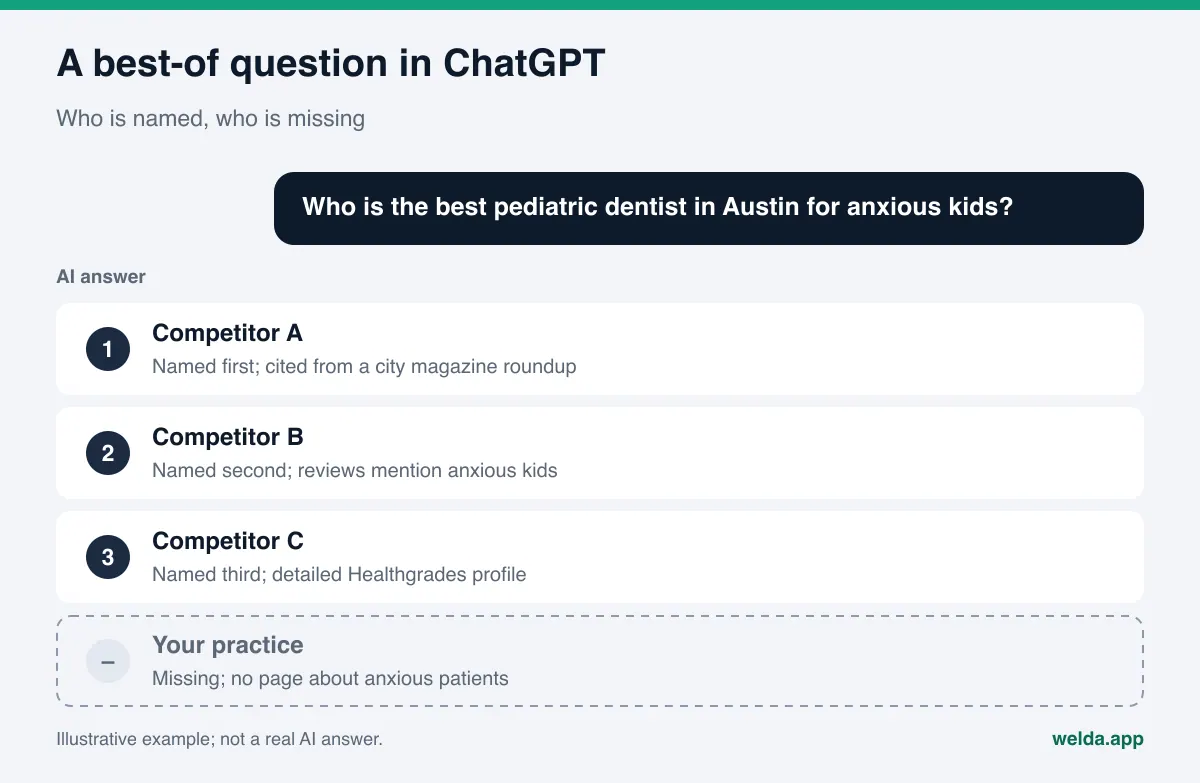
How does ChatGPT decide who makes a best-of list?
A "best" question asks for a comparison, not a fact. When ChatGPT answers one with web search turned on, it looks up pages, reads them and builds its list from what it finds. You can usually see the sources as links in or under the answer. Those links tell you where the list came from, and they are the most useful clue you have.
For local and small businesses, the sources tend to fall into four groups:
- Third-party roundups: "best of" articles from local news sites, city magazines, neighborhood blogs and industry publications.
- Review and directory platforms: Google Business Profile and Google Maps, Yelp, Tripadvisor, the Better Business Bureau, and vertical sites like Healthgrades for doctors or Angi for home services.
- Community discussion: Reddit threads, local forums and public social posts where people compare options.
- Your own website: service pages, who you serve, your team, how you work and your FAQ.
The pattern we see in answers is simple: businesses that are named across several independent sources, for similar reasons, are more likely to make the list. A single glowing review on one site is not enough. Your website's job is to supply the reasoning. When the AI can find a clear answer to "why this business, for this need" on your own pages, it has something concrete to repeat.
Why best-of lists matter more than most AI answers
People who ask "what is a dental implant" are learning. People who ask "who is the best implant dentist in Phoenix" are choosing. Best-of questions sit right at the decision point, which makes them the AI answers most closely tied to new customers.
The list is also short. A classic search results page shows ten links, a map pack and more below. An AI answer often names a handful of businesses and stops. If you are not one of them, you never make it into the comparison at all.
And a top Google ranking does not carry over automatically. A business can rank well for its own site and still be missing from the AI answer if it is thin on the review platforms and roundups the model relies on. We cover that gap in detail in ranking first on Google but not in ChatGPT.
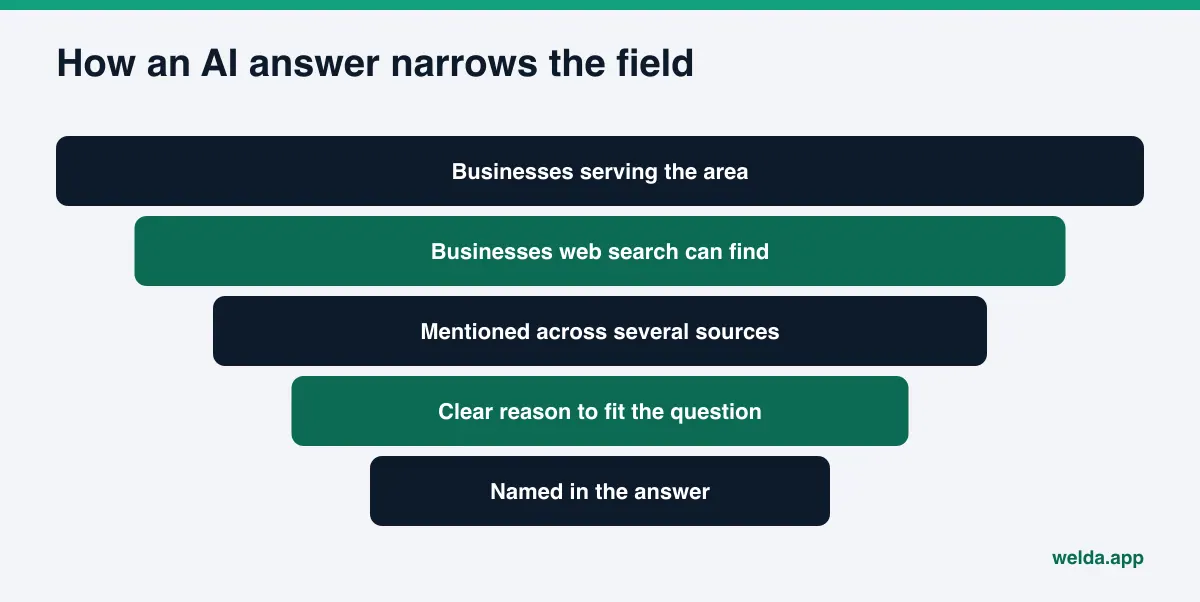
What signals show up in best-of answers?
AI engines do not publish their selection rules, so nobody outside those companies can give you the formula. What we can describe is what tends to be present for businesses that get named, and what that means for your to-do list.
| Signal | What the AI can see | Your job |
|---|---|---|
| Mentions in roundups | Your name in independent "best of" articles | Get accurate information to the local writers and publications that keep these lists |
| Review volume and tone | Ratings, review counts and review text on Google, Yelp and vertical sites | Ask real customers for reviews and reply to them openly |
| A clear specialty | A defined niche: "kid-friendly," "same-day service," "vegan brunch" | Pick the need you serve best and say so plainly on your site |
| Consistent basics | The same name, address, phone and hours everywhere | Align your Google Business Profile, site and directory listings |
| A readable site | Pages AI crawlers can access, with clear services | robots.txt, titles, business schema markup and an FAQ |
| Reasons, not claims | Specific sentences that explain why you fit the need | Describe your team, process, scope and who you serve |
Notice that most of these signals live off your website. Best-of lists rely more on what others say about you than on what you say about yourself. Your site supplies the reasoning; outside sources confirm it.
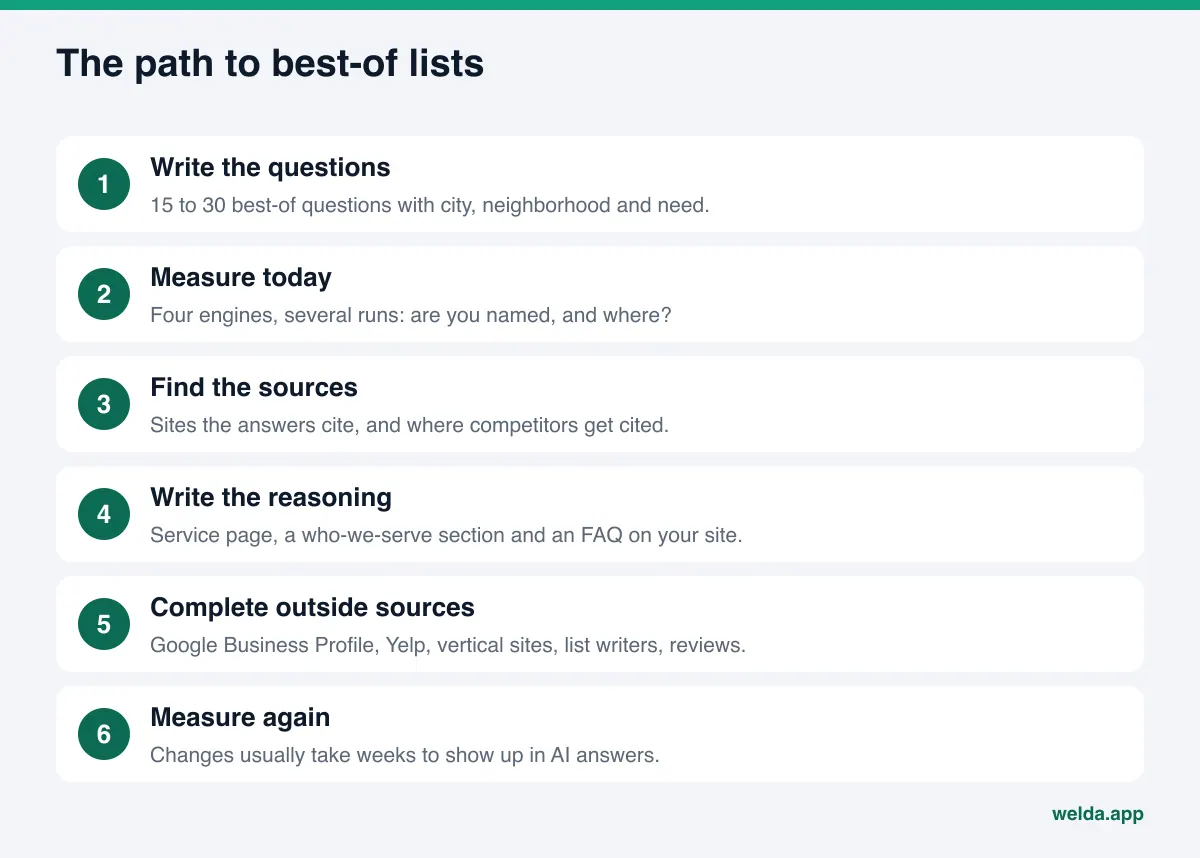
How to get on ChatGPT best-of lists, step by step
The sequence below is a practical path for a local or small business. Each step produces the input for the next one, so it pays to go in order.
- Write your best-of questions. List 15 to 30 questions the way a customer would type them, with your city or neighborhood, your service and the kind of customer: "best Pilates studio in Park Slope," "best dog-friendly hotel in Asheville," "best pediatric dentist near Plano that takes weekend appointments."
- Measure where you stand today. Ask those questions in ChatGPT, Gemini, Perplexity and Google's AI Mode or AI Overviews. Are you named? In what position? Who is named instead? One try can mislead you, so ask each question more than once.
- Record the sources. Note every site the answers link to. Which local magazine, which Yelp page, which Reddit thread keeps showing up? Flag the sources that put your competitors on the list.
- Write the reasoning on your own site. One clear page per core service, a "who we are a good fit for" section, team and experience details, and an FAQ. Explain what you do and how, instead of writing "we're the best."
- Complete your outside profiles. Google Business Profile, Yelp, the BBB, and the directories that matter in your vertical. Fix missing categories, old phone numbers and empty descriptions.
- Reach the people who write the lists. Local editors and bloggers refresh their roundups and need current facts. Give them clear, verifiable information and good photos. This overlaps with digital PR for AI visibility.
- Build a review routine. Ask real customers for reviews and reply to them, including the critical ones. Our guide to negative reviews in AI answers covers how replies shape what AI repeats.
- Measure again. Changes usually take weeks to show up in AI answers. Re-run the same question set every two to four weeks.
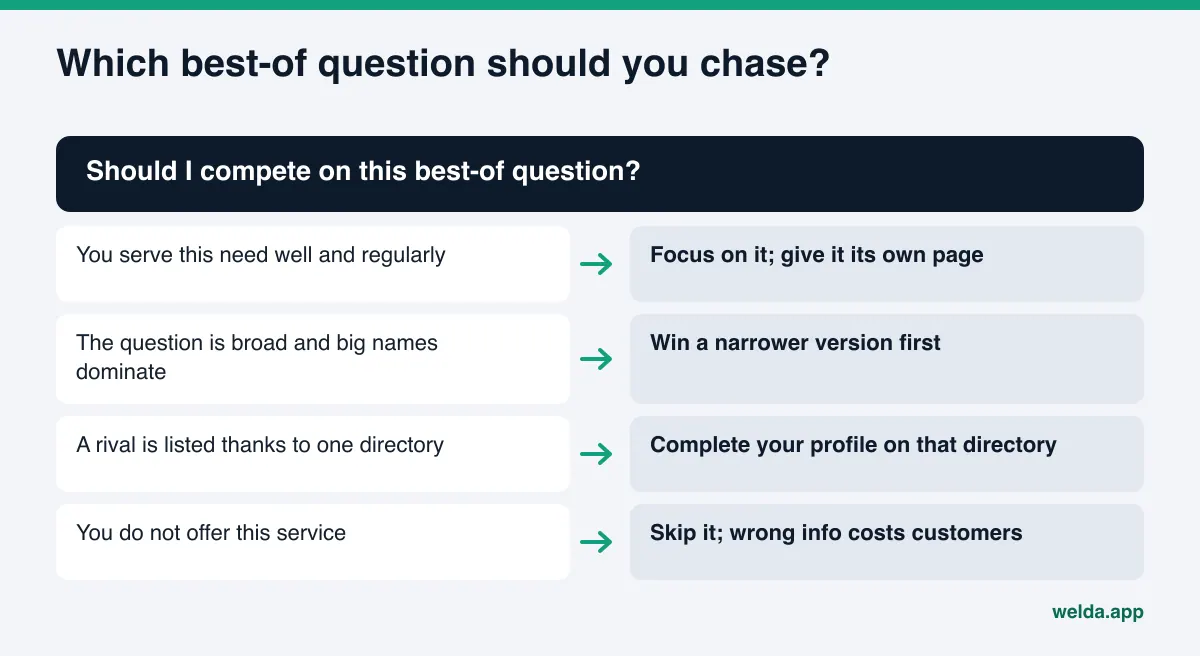
Which best-of questions can you actually win?
Not every business can make "best restaurant in Chicago," and most do not need to. Broad best-of questions tend to go to the largest and most-discussed names. For a small or mid-sized business, the realistic target is a narrower question tied to a specific need.
- Broad questions: "best dentist in Denver," "best hotel in Savannah." Competition is heavy and the list fills with well-known names.
- Narrow questions: "best dentist in Denver for anxious patients," "best quiet adults-only inn in Savannah," "best coffee shop in Midtown to work on a laptop." Here the list is built from businesses that clearly serve that need.
You win narrow questions by owning the need, both on your site and in outside sources. An inn that has a dedicated page about its adults-only policy, its quiet hours and its rooms, and whose Tripadvisor reviews mention "peaceful getaway," gives the AI a reason to name it for that question. The decision chart below can help you pick where to focus.
Example best-of questions by industry
These are examples we wrote to show the difference between broad and narrow questions; they are not research results. The best source for your own list is the questions customers already ask you by phone, email and text.
| Industry | Broad question | Narrow question | Where the reasoning lives |
|---|---|---|---|
| Restaurant | "Best restaurant in Austin" | "Best gluten-free friendly restaurant in South Austin" | Menu page with allergen notes, Yelp and Google reviews |
| Hotel or inn | "Best hotel in Sedona" | "Best small hotel in Sedona for a quiet couples trip" | Room pages, policies, Tripadvisor listing |
| Dental practice | "Best dentist in Columbus" | "Best Saturday pediatric dentist in Columbus" | Service page, team page, hours, Healthgrades profile |
| Salon | "Best hair salon in Brooklyn" | "Best curly hair specialist in Brooklyn" | Service menu, stylist bios, photos of real work |
| Home services | "Best plumber in Tampa" | "Best same-day water heater repair in St. Petersburg" | Service area page, hours, Angi and BBB listings |
The last column matters most. A narrow question can only be answered if the AI can find the answer somewhere. If your gluten-free options only exist as a photo of a printed menu, a crawler may not read them. Writing the same information as plain text on your site and repeating it in your Google Business Profile description makes the answer findable.
One warning: do not claim a need you do not truly serve. Being named as "dog-friendly" and then turning a guest away at the door costs more than not being on the list. Wrong information also takes time to correct once it spreads.
Paid placements, fake reviews and the rules
Some roundup sites sell spots on their best-of lists, and those pages can end up among the sources AI reads. If you pay for a placement, it should be clearly disclosed as advertising to readers. Undisclosed paid praise misleads readers and can create legal exposure.
Reviews deserve the same care. In August 2024 the Federal Trade Commission announced a final rule banning fake reviews and testimonials. According to the FTC, it covers fake reviews (including AI-generated ones), paying for reviews with a required sentiment, undisclosed insider reviews and review suppression. This is not legal advice; if you are unsure whether a tactic is allowed, ask an attorney. The practical takeaway for AEO is simple: the only reviews worth pursuing are real ones, and the same goes for community sites like Reddit, where posting as a "happy customer" is both risky and easy to spot. Reply openly as the business instead.
How Welda handles best-of lists
Welda is software that measures where a business appears in AI answers and completes the missing pieces on the business's behalf. For best-of lists, the work comes down to three things: showing which best-of questions you win or lose and to whom, finding the sources that put competitors on the list, and turning your gaps into a to-do list with drafts ready to review.
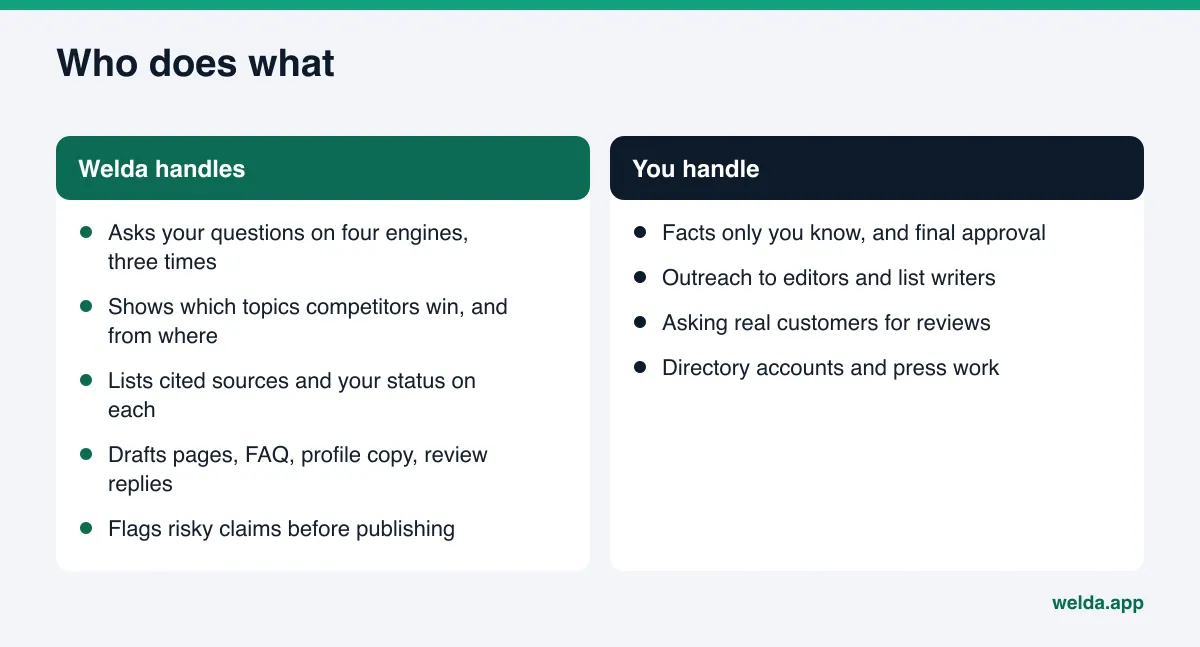
Questions and competitors: who is named, and why. Welda asks your chosen questions in ChatGPT, Gemini, Perplexity and Google AI, three times each, so a single lucky or unlucky run does not skew the picture. You see, question by question, whether your name appears and in which position, plus where a competitor is ahead. The competitor view groups questions into topics. If an inn is missing from every "romantic getaway" question while a rival keeps getting cited from Tripadvisor, that shows up in one place. The decision you make there is where to spend effort: chase the topic you are losing, or grow your share in one you already hold.
Sources: what feeds the list. Welda lists the sites the AI engines cite in your answers and your status on each one: unverified, incomplete, missing or done, with the action next to it. Instead of guessing which directory deserves your time, you work through the sources that actually feed the answers, starting with the ones cited most.
Drafts, with you in control. Welda drafts the content these lists depend on: a service page, a "who we serve" section, FAQ entries, profile descriptions and replies to real reviews. If it does not know a fact, such as what your adults-only policy includes, it asks you instead of making it up. You approve before anything is published, and the content always lives on your own website. On WordPress, Welda connects through a separate Editor user and an application password and opens content as drafts; on other systems it hands you a ready-made package to apply yourself. Outreach to list writers, press work and directory accounts stay with you; Welda marks them as manual tasks.
The Welda score uses a published formula built from the share of questions that name you, your position score and your share versus competitors, with a margin of error from the three repeats. We compare it to other approaches in our overview of AEO software.
A note on availability: the Welda dashboard is in early access and is opening first in Turkey. Regular four-engine measurement is being added during early access, and dashboard examples are shown with sample data. What anyone can use today is the free site analysis, which works in English. It reads your homepage and key inner pages the way Google and AI systems do, scores what it finds, suggests ready-to-use copy, and asks five customer-style questions to an AI assistant with web search to check whether your business name comes up. That last check is a one-time snapshot. Pricing is discussed in an early access conversation.
What Welda does not do
Best-of lists are where AEO promises get inflated the most, so here are the limits in plain terms.
- No guaranteed placement. Welda does not guarantee rankings or that you will "show up in ChatGPT." AI answers vary, and engines do not publish how they choose.
- No fake reviews. Welda does not write reviews or post praise under other names. It drafts replies to real reviews only.
- No bought placements. Relationships with list writers, press work and directory accounts remain your job.
- No invented facts. Welda does not add services you do not offer or claims you cannot back up. It asks you for missing information.
- No publishing without approval. Every piece of content goes through you. In healthcare there is no automatic publishing at all, and patient data is never sent to AI.
- No instant results. New content and updated listings usually take weeks to show up in AI answers.
Welda's compliance check flags superiority claims such as "best," "number one" and "guaranteed" in drafted text before it goes live. It is not legal advice and has not been reviewed by counsel; it exists so risky phrases do not slip through. There is an irony worth stating: writing "we're the best" on your own site rarely gets you onto a best-of list. AI looks for the specific facts behind the claim and for what others say.
Your first 30 days if a competitor is listed and you are not
This is the most common starting point: a competitor is named second in a best-of answer and you are missing. A realistic first month looks like this.
| Week | Work | Output |
|---|---|---|
| Week 1 | Write and measure your questions | Who is named for which question, and which sources are cited |
| Week 2 | Write the reasoning on your site | Service page, "who we serve" section, FAQ |
| Week 3 | Complete outside listings | Google Business Profile, Yelp and vertical profiles, consistent basics |
| Week 4 | Contact list writers, start a review routine | Updated facts sent to editors, replies posted to reviews |
It is normal not to be on the list after 30 days. The goal at this point is not the result; it is confidence that the gaps are closed. For how often to check progress, see how often to measure AI visibility.
Checklist: are you ready for ChatGPT best-of lists?
If you can answer yes to every item below, the groundwork is done. Every no is a line on your to-do list.
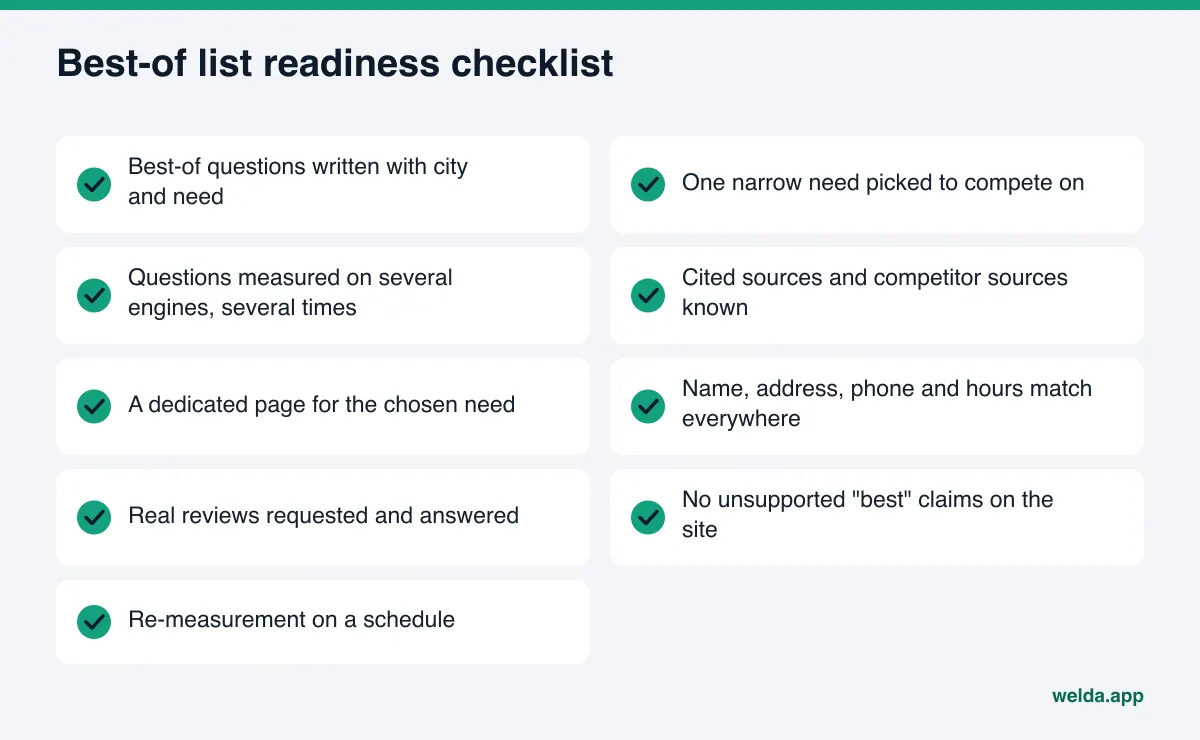
- I have written the best-of questions my customers ask, with city, neighborhood and need.
- I have picked at least one narrow need I can realistically compete on.
- I have measured those questions on more than one AI engine, more than once.
- I know which sources the answers cite and where my competitors get cited.
- My site has a dedicated, clear page for the need I picked.
- My name, address, phone and hours match everywhere.
- I ask real customers for reviews and reply to them.
- My site has no unsupported "best" or "number one" claims.
- I re-measure on a regular schedule.
Frequently asked questions
Can I pay to get on a ChatGPT best-of list?
We are not aware of any way to buy a spot in ChatGPT's own answers. Some websites sell placements in their own roundups, and those pages may be among the sources AI reads. Any paid placement should be clearly disclosed to readers as advertising.
If I write "best in town" on my site, will AI repeat it?
Usually not. AI looks for specific facts that back a claim and for independent mentions, not for self-description. Unsupported superiority claims can also create advertising risk.
Can a small business appear next to big competitors?
On broad questions it is hard. On narrow questions tied to a specific need, it is far more realistic, provided your site and outside sources clearly show you serve that need.
Once I am on the list, do I stay there?
Not necessarily. AI answers change as sources change, and the same question can return different lists on different days. That is why measurement should be ongoing rather than a one-time check.
Which AI engine should I focus on?
It depends on what your customers use. Engines can lean on different sources, so measuring the same question in ChatGPT, Gemini, Perplexity and Google's AI features separately shows which sources deserve your attention first.
Does the free analysis show my position on best-of lists?
The free analysis checks how readable your site is for AI, and asks five customer-style questions once to see whether your name comes up. It does not measure rankings or track you over time; ongoing measurement is part of the Welda dashboard, which is in early access.
Where to start today
Getting on ChatGPT best-of lists is a routine, not a campaign: pick the right questions, measure today, write the reasoning on your site, show up consistently in outside sources and track the results. Start by seeing what your site leaves out from an AI's point of view. Run the free AI visibility analysis; your score, the gaps it found and suggested homepage copy arrive by email.