Does digital PR help with AI visibility? Yes, but indirectly. When ChatGPT, Gemini, Perplexity or Google's AI Overviews recommend a business, they look beyond that business's own website to what other sources say about it, and news and trade outlets are among those sources. Digital PR for AI visibility works when the coverage is on the right topic, in an outlet the answer engines actually read, and consistent with your own site.
In the US, the work of getting named in AI answers is usually called AEO, short for answer engine optimization. You may also see the term GEO (generative engine optimization); both describe the same goal, and this article uses AEO. Here we look at how press coverage feeds AEO, which kinds of coverage help and which do not, and what to do in what order. One thing up front: the PR work itself is done by the business or the communications person it hires. Welda does not pitch reporters on your behalf; it shows which sources AI answers draw on and where you are missing. Before any outreach, run a free AI visibility analysis of your website, because that is the foundation any coverage will be checked against.
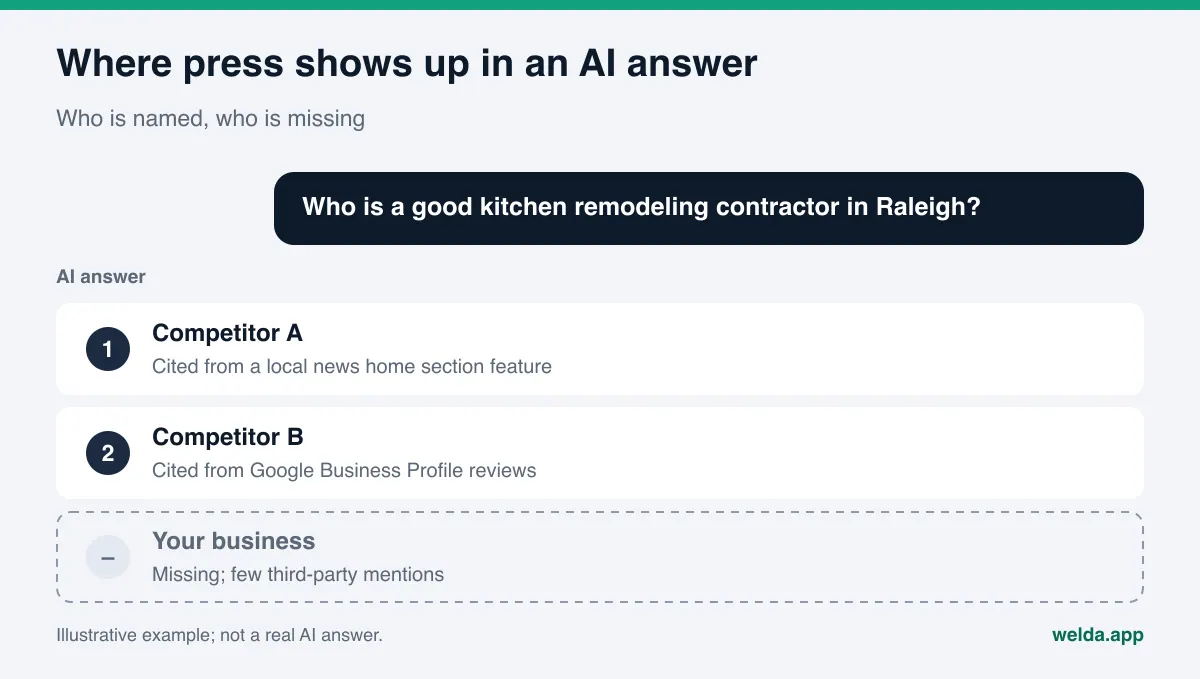
Why digital PR matters for AI search visibility
When a homeowner asks an AI assistant "who is a good kitchen remodeling contractor in Raleigh," the answer is usually a short paragraph and a handful of names. To pick those names, the assistant gives more weight to what others say about a business than to what the business says about itself. Your homepage calling you "the Triangle's most trusted remodeler" is a claim. A local paper's home section feature that quotes your project manager on permit timelines is a third-party signal.
Third-party signals come from many places: Google Business Profile, Yelp, the Better Business Bureau, Angi, Reddit threads, industry directories and news sites. How much weight each one carries depends on the question, the industry and the engine. For a hotel question, booking and review sites tend to dominate. For a law firm, a B2B software company or a financial advisor, trade publications and news coverage can appear more often. So "every business needs press" is not the right conclusion. The right question is narrower: for the questions your customers ask, do AI answers cite news and trade outlets, and if so, which ones?
Coverage does a second job: it ties your name to a topic. A story about a bakery's gluten-free line connects that bakery with gluten-free questions. An interview with a structural engineer about retrofitting older homes connects that firm with retrofit questions. Being known is not enough to be named in an AI answer. You need to be known for the thing the customer is asking about.
The third job is confirmation. When an answer engine finds conflicting facts about a business (a different address, a different founding year, a different list of services), it may avoid naming it at all. Coverage that matches your website and profiles adds confidence. Coverage that contradicts them adds doubt.
What kinds of coverage do answer engines cite?
Content that earns citations in AI answers tends to share three traits: it answers a question directly, it is clear who is speaking, and it adds information that was not already everywhere. Sorting coverage types by those traits helps you spend your effort where it counts.
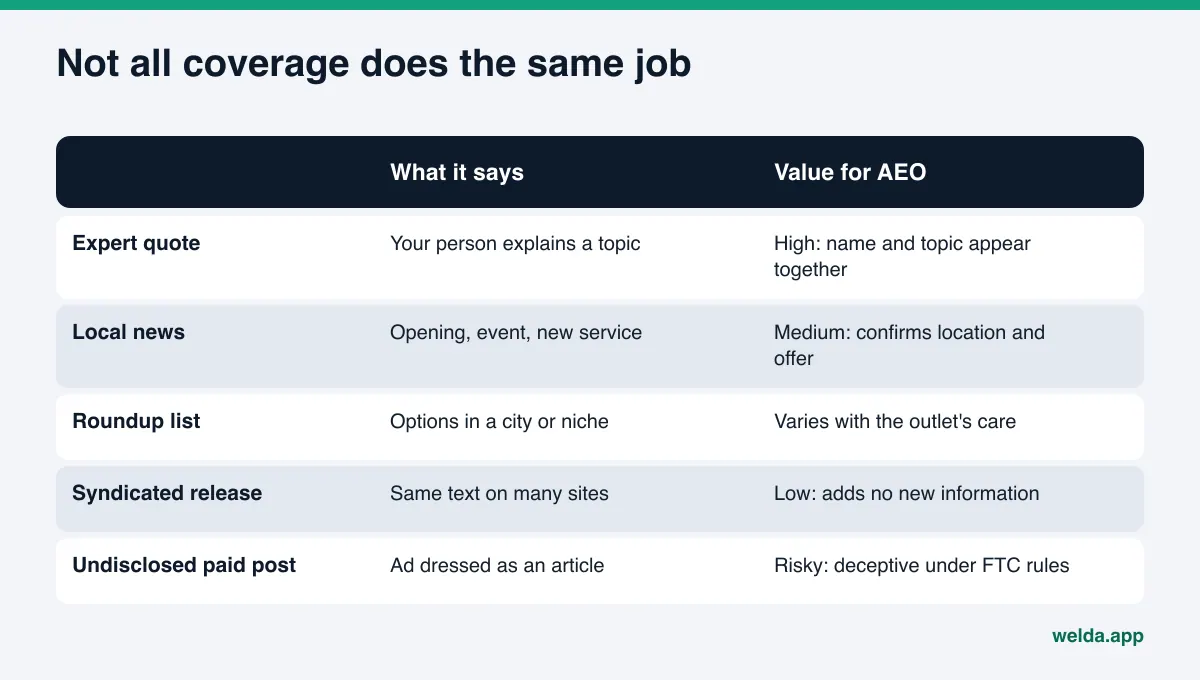
| Coverage type | Example | Contribution to AEO |
|---|---|---|
| Expert quote or interview | A dietitian explaining holiday meal planning in a local outlet | Name and topic appear together; the piece answers a real question |
| Local news | A new children's art studio opening in a neighborhood | Confirms location and services from a third party |
| Data or field observation | An auto repair shop sharing the failures it sees most before winter | New information is more likely to be quoted |
| Roundup list | "10 independent bookstores worth a visit in Portland" | Varies with the outlet's reputation and the list's care |
| Syndicated press release | The same wire text republished across dozens of sites | Adds nothing new; weak on its own |
| Undisclosed paid placement | A paid article formatted as regular editorial | Regulatory risk; covered in its own section below |
The examples are illustrative; the point is the difference between types. Two criteria matter most in practice. The first is fit with the customer's question. For a caterer that wants to show up for "corporate event catering in Austin," an anniversary announcement adds nothing, while a piece on how the team handles a 500-person conference does. The second is the outlet's standing on that topic. A trade publication that covers your industry every week, or your city's local news site, can be a more meaningful source than a large general portal with no connection to the subject.
Digital PR for AI visibility, step by step
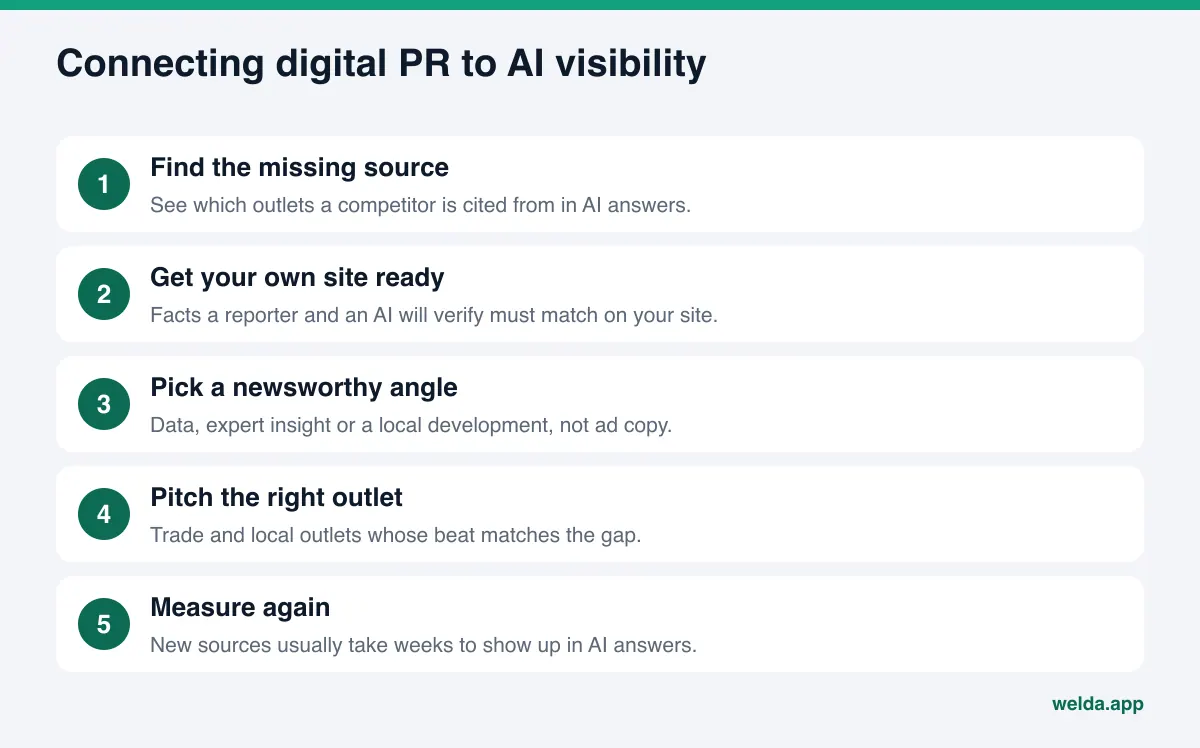
The way to connect PR to AEO is to start with measurement and end with measurement. The sequence below replaces "get us in the news somewhere" with "close a specific source gap."
- Write down your customers' questions. List 15 to 20 questions people could ask an AI assistant: service, city, price range, comparisons and trust. "Reliable estate planning attorney in Columbus," "best wedding photographer in Savannah for small weddings."
- See who wins those questions and from which sources. Which competitors are named, and which sites are they cited from? Are news or trade outlets on that list? This is a citation gap analysis: it surfaces the sources where a competitor is present and you are not.
- Get your own site ready. A reporter checks your website before writing about you, and an answer engine compares the coverage with your site afterward. Services, address, founders and experts, and FAQs should be complete and consistent.
- Pick a newsworthy angle. Not ad copy. Something useful to the outlet's readers: a field observation, expert insight, a local development.
- Find the right outlet and the right reporter. Choose outlets that match the gap. Trade publications, local news sites and reporters who cover your topic regularly beat a generic blast list.
- Connect the coverage to your site. When the story runs, check that its facts match your site. Update your About or service page if needed.
- Measure again. New sources usually take weeks to show up in AI answers. Ask the same questions a few weeks apart and note what changed.
What to pitch: newsworthy angles that also help AEO
The hardest part of digital PR is finding a story an editor will want. A business introducing itself is not news. Something the business knows and readers do not is news. The angles below also work for AI search visibility, because each one ties your name to a question.
- Field observations: A locksmith describing the lock problems that spike every winter. Useful to readers, and it links the business to emergency locksmith questions.
- Expert commentary: A CPA explaining what a new tax rule means for small businesses. If an outlet needs an expert on a timely topic, this is the easiest way in.
- Local developments: A new location, extended hours, a service tailored to a neighborhood. These confirm your location from a third-party source.
- Findings from your own work: A tutoring center summarizing the topics students struggle with most. Use aggregated, anonymized observations, never personal data.
- Community involvement: A free workshop at a local school, support for a neighborhood nonprofit. Local outlets are often open to these.
What these have in common: your name appears next to a topic. When the answer engine gets a question on that topic, it has a source that makes the connection. It helps when the expertise of the person quoted is also visible on your site; the steps in author bios and expertise signals for AI cover how.
Paid placements and the FTC: disclose or skip it
The common shortcut in digital PR is paying to have an article published. Paying for placement is not illegal in itself; a clearly labeled sponsored article is a legitimate ad. The problem is an ad dressed up as editorial. The FTC's native advertising guide for businesses says an ad should not suggest or imply that it is anything other than an ad, and that when a paid article looks like the publisher's regular content, a clear and prominent disclosure of its commercial nature is needed.
This is not legal advice; we are passing on what the guidance says, so check your own case with counsel. From an AEO angle there is a second reason to be careful: identical paid articles that appear on dozens of sites on the same day give an answer engine nothing new. If you are wondering whether you can simply buy a spot in an AI answer, we cover that in can you pay to appear in ChatGPT answers.
Fix your own site first: why coverage may not find you
A mention on a news site is not always enough to get you named in an AI answer. Coverage helps an answer engine recognize you, but when it builds an answer about you, it pulls most of the facts from your own site and profiles. If your services are vague, your address is missing or AI crawlers are blocked from your site, the signal from the coverage has nowhere to land.
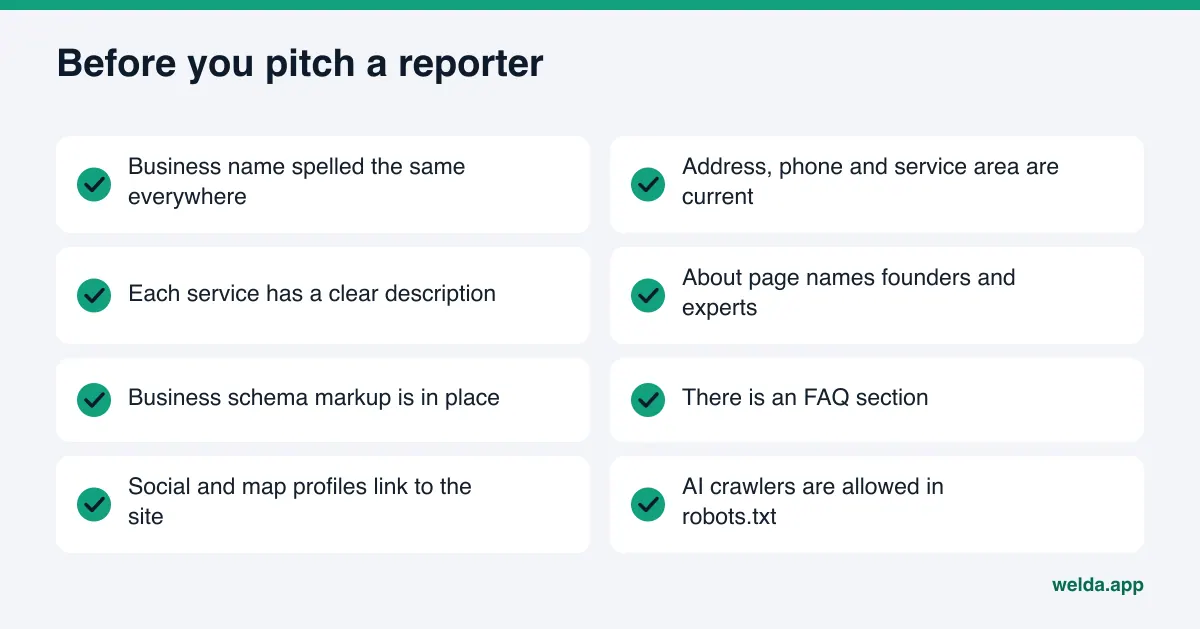
Before you pitch anyone, your site should answer four questions clearly: what does this business do, where does it serve, who works here, and what do customers say? When those answers match between the story and your site, the answer engine can link the two. When they differ, it cannot tell which to trust. The free analysis checks exactly this foundation: whether AI crawlers can reach the site, page titles and descriptions, business schema, address and phone, whether social and map profiles are linked, FAQs and how clearly services are described. Closing those gaps before a story runs is what lets the story pay off.
How Welda handles digital PR for AI visibility
Welda does not do PR. Finding a story, pitching reporters and building relationships with outlets stays with the business. What Welda does is replace guesswork with measurement, so your PR effort goes where AI answers actually look. In the Welda panel, which is in early access, two views matter most for this.
The sources view. It lists the sites AI engines cite when they answer questions in your category. Next to each source you see how often it was cited, its share of all citations, whether you are present there and the suggested next step. If a news or trade outlet sits near the top of that list and your status there is "not present," the target for your PR work stops being abstract. The view does not tell you which publication to call; it shows which publications the engines actually read, and the decision is yours.
The competitors view. It shows which question clusters each competitor leads in and which sources they win those questions from. If a competitor leads on "corporate event" questions and its citations come from a regional business journal, the angle for your outreach is clear: a newsworthy story on that topic. You stop thinking "we need press" and start thinking "this topic is missing this kind of source."
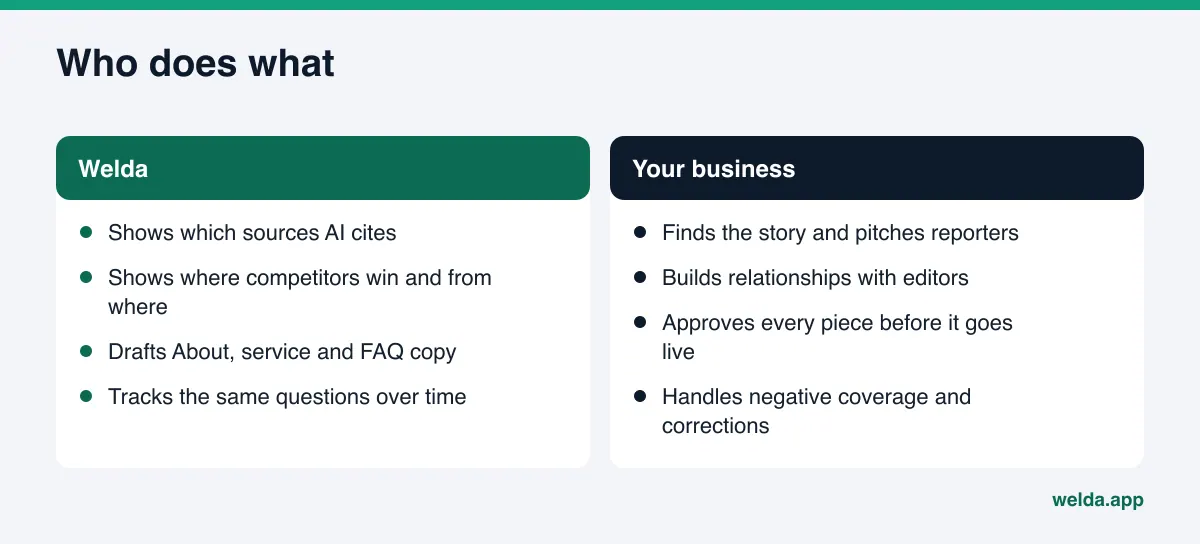
The work that comes out of these views lands on one to-do list. Tasks Welda cannot do itself, such as press outreach, are marked as manual, so they are not forgotten but the responsibility stays with you. The part Welda can draft is the on-site content the coverage relies on: your About copy, service descriptions and FAQs. That content always lives on your own website, and you approve it before it goes live. On WordPress sites, Welda opens it as a draft and it is published once you approve.
Measurement continues after the story runs. In the panel, the questions your customers might ask are put to ChatGPT, Gemini, Perplexity and Google AI three times each, and you see which questions name you. The before and after comparison shows which questions changed after the coverage. To be honest about it: no one can prove that a change came from the coverage alone, since your site or your competitors may have changed in the same weeks. Welda shows the change and leaves the interpretation to you.
Example: from a source gap to a story angle
Here is a fictional example to make the process concrete. An example interior design studio does home renovation work in a mid-sized US city. Its customers ask AI assistants things like "interior designer for a kitchen remodel near me," "what to watch for when renovating an older house," and "how to make a small bathroom feel bigger." The studio's site is in good shape, its Google Business Profile is current and it replies to reviews.
Measurement shows the studio is sometimes named for local questions but never for informational ones like "renovating an older house." On those questions, Competitor A is cited mostly from interviews in a home design magazine and a feature in the local paper. Competitor B is cited from a detailed answer in a Reddit thread.
The conclusion follows. The studio's problem is not general awareness; it is the lack of a third-party source on one specific topic. The PR work focuses there: the founder prepares expert commentary on the problems that come up most when renovating older homes and offers it to home design and local editors. In the same weeks, a question and answer section on that topic is added to the studio's own site, so whatever the coverage says can be confirmed there. After the story runs, the studio measures the same questions for several weeks. The example is fictional and makes no claim about results; it shows the method.
Limits, and what Welda does not do
PR is one of the most misunderstood parts of AI visibility, so the limits deserve to be stated plainly.
- Welda does not distribute press releases, contact reporters or buy placements. PR stays with you or the communications person you choose.
- Welda does not promise that any story will show up in AI answers. Which sources an engine uses, when and how much, is the engine's decision. A service that promises rankings or "getting into ChatGPT" is promising something it does not control.
- Welda does not write facts it does not know. When on-site content is missing something (founding year, credentials, service area), it asks you.
- Welda does not create fake content. No fake reviews, fake articles or quotes written in someone else's name.
- Negative coverage and crisis communication stay with you. Welda lets you track whether you are named and which sources lead; talking to an outlet or requesting a correction is your job. Reviews need their own approach, covered in negative reviews in AI answers.
The product's current status is a limit too. The Welda panel is in early access and is opening first in Turkey. Regular four-engine measurement is being added during early access, and the sample screens in the panel use representative data. What anyone can use today is the free site analysis, which works in English. Pricing is discussed in the early access conversation.
Checklist: is digital PR your next move?
PR is not every business's first job. For a business with an incomplete site, a half-filled Google Business Profile and unanswered reviews, coverage is like adding a floor to a building with no foundation. The chart shows what to prioritize in which situation.
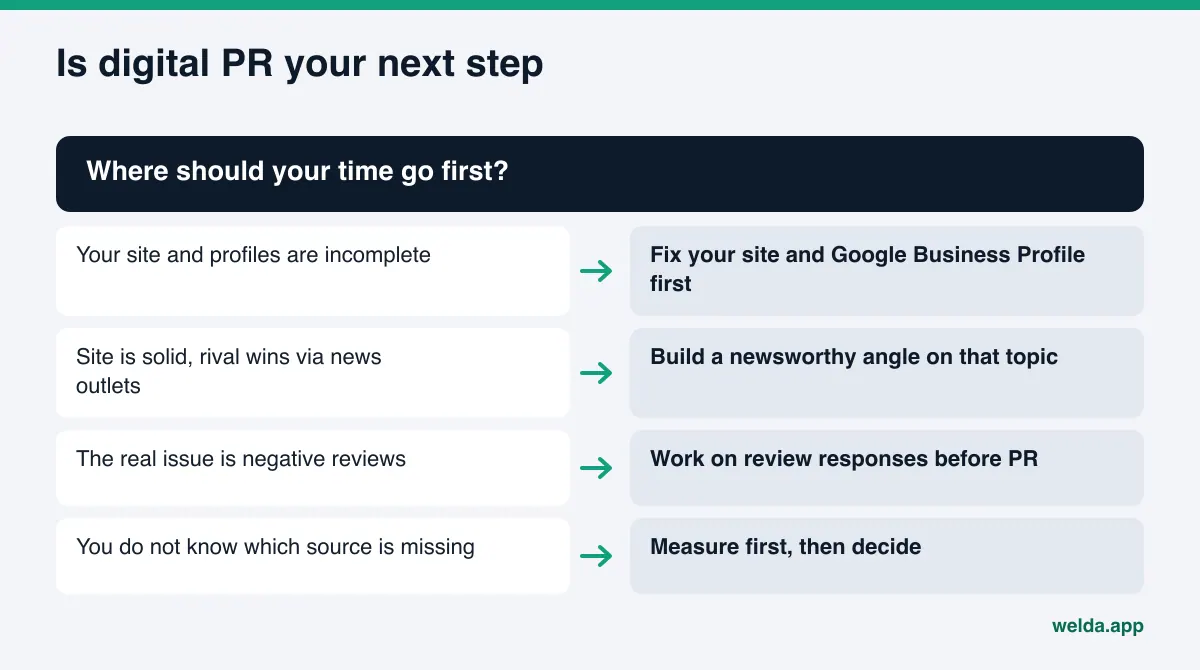
| Question | If the answer is no |
|---|---|
| Does your site clearly cover services, address and expert credentials? | Fix the site first; coverage needs something to be confirmed against. |
| Is your Google Business Profile current and linked to your site? | Complete it; it is one of the first sources checked for local questions. |
| Do you know the questions your customers ask? | Write them down; the PR angle comes from them. |
| Have you seen competitors cited from news or trade outlets on those questions? | PR may not be your priority; the missing source may be elsewhere. |
| Do you have a genuinely newsworthy story? | Wait until you do; a forced release leaves no trace. |
| Is the placement paid? | Disclose it clearly as advertising. |
If every answer is yes, digital PR is a sensible next step for your AI search visibility. If one or two are no, closing those gaps first gets more done with less effort.
Frequently asked questions
Will press coverage alone get my business into ChatGPT answers?
No. Coverage is one of the sources that help an answer engine recognize you and connect you with a topic. If your own site, map profile and reviews are thin, its effect stays limited. No story guarantees a place in an answer.
Do national outlets matter more than local or trade ones?
It depends on the question. For a local service, your city's news site or a trade publication can matter more than a large national outlet with no connection to the topic. You find out by looking at which sources AI answers cite for your questions.
Do sponsored articles help AEO?
A clearly disclosed sponsored article is legitimate, but the same text on many sites gives an answer engine nothing new. An undisclosed one can be deceptive under FTC guidance. This is not legal advice.
Does Welda write or send press releases?
No. PR stays with the business. Welda shows which sources you are missing and where competitors win from, and drafts the on-site content the coverage relies on (About, services, FAQs) for your approval.
How do I see whether a story made a difference?
Ask the same questions at regular intervals and check whether your business is named. New sources usually take weeks to show up. In the Welda panel this measurement runs on a schedule with a before and after comparison; the panel is in early access.
Does the free analysis check my press coverage?
No. The free analysis reads your own site: crawler access, business information, clarity of services, linked profiles and more. It also asks an AI assistant with web search five questions customers might ask and checks once whether your name comes up. It does not scan news sites.
Start with the foundation
Digital PR is one of the upper floors of AI visibility; the foundation is your own website. If the facts a story states about you are not complete and consistent on your site, even good coverage only gets you halfway. The free AI visibility analysis reads your site the way an answer engine does, explains each gap and how to fix it, compares you with competitors and gives you a ready-made fix pack to add to your site. It is free once per site, and the results link arrives by email.