Do you need AEO consulting, or will software do the job? AEO consulting is human judgment applied to one question: how does your business show up in ChatGPT, Gemini, Perplexity, and Google's AI answers, and what should change? Software handles the repeatable half of that work: asking the same questions on a schedule, flagging gaps, and drafting fixes. For most small and mid-sized businesses, the useful question is not "which one" but "who should own which task."
Answer engine optimization is new enough that two kinds of offers now sit side by side. On one side are AEO consultants and freelancers who work by the hour or on a monthly retainer. On the other are tools that measure AI search visibility and, in some cases, prepare the fixes. Both can be pitched with the same promise ("we'll get you into ChatGPT"), but they do different work. This guide breaks down what AEO consulting actually covers, which parts can be handed to software, which parts need a person, and where Welda fits in that split. If you want something concrete in hand before you talk to anyone, the free site analysis reads your site the way Google and AI assistants do, lists each gap, and checks whether your business name comes up in answers to five questions a customer might ask. Even if you do hire a consultant, that report makes the first call much shorter.
What is AEO consulting, and what does a consultant actually do?
AEO stands for answer engine optimization: the work of making sure your business is described accurately and mentioned when people ask AI assistants for recommendations. You will also see it called AI search visibility or AI visibility. A smaller group of people call the same work GEO (generative engine optimization), a term that took hold after a 2023 research paper proposed a framework for measuring and improving visibility in generative engine responses. If you want to sort out the vocabulary, we cover the difference between the two terms separately. In practice, the work is the same.
AEO consulting means an expert runs that work for you. Engagements vary, but a typical consulting scope includes some mix of the following:
- An audit: whether AI crawlers can reach the site, whether business details are marked up with structured data (Schema), whether your name, address, and phone number match across the web, and how clearly your services are described.
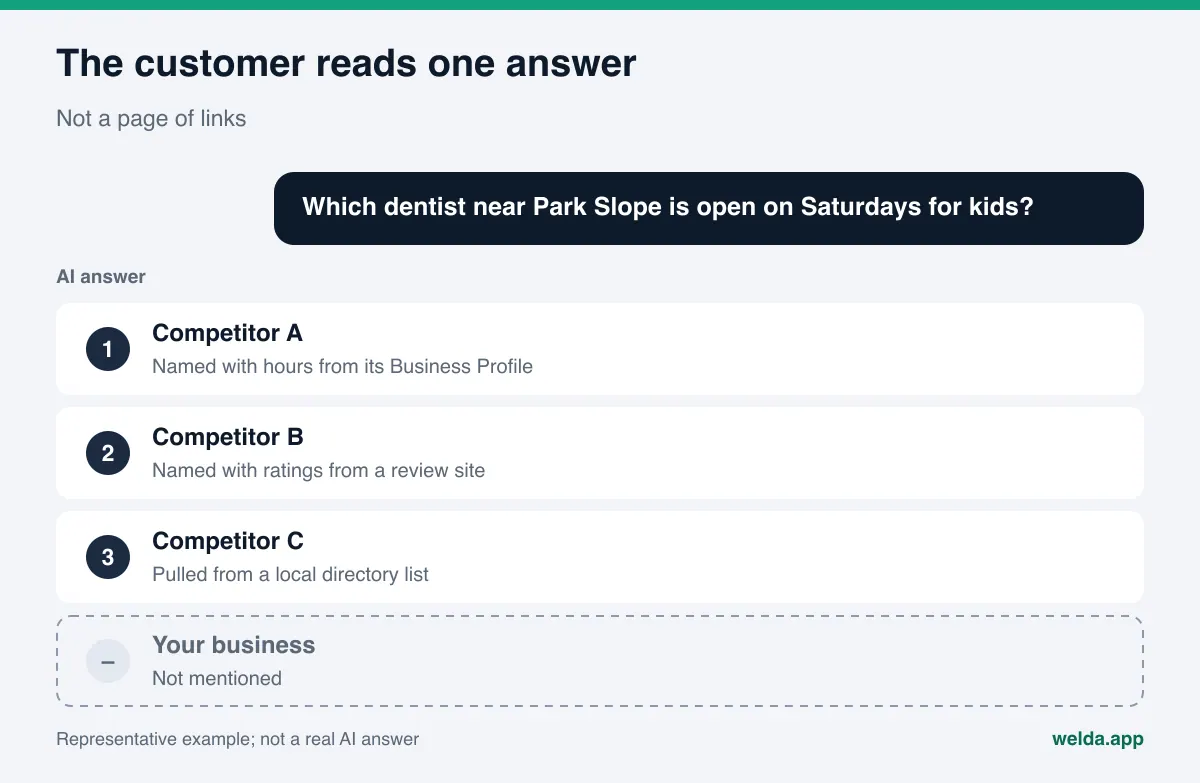
- A question set: the prompts customers actually type. For a dental practice, something like "pediatric dentist open Saturdays near Park Slope." For a contractor, "licensed roofer in Plano with good reviews."
- Measurement and interpretation: running those prompts through the major assistants, noting who gets named and which sources the answers lean on.
- A priority list: deciding which gaps to fix first.
- Implementation help: writing or editing page copy, FAQ sections, and profile descriptions.
- Off-site work: outreach to directories, local press, partners, and industry lists so the business gets mentioned in the places AI answers draw from.
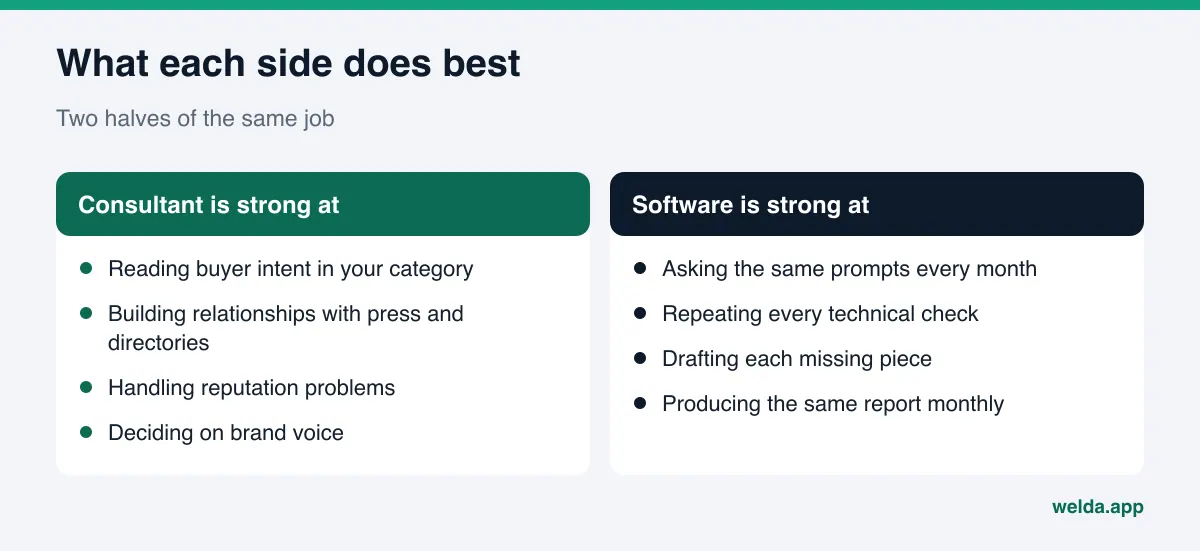
Look closely at that list and you will see two kinds of work. Some of it repeats every month in exactly the same way: run the same prompts, run the same checks, log the results in the same sheet. The rest requires judgment: deciding which competitors matter, building a relationship with an editor, choosing how the brand should sound. The real line between consulting and software runs between those two kinds of work.
Why AEO matters for your business right now
When a customer searches Google, they see a page of links and click a few. When the same customer asks ChatGPT or Google's AI Mode, they often read a single answer. If that answer names three businesses and you are not one of them, the customer may decide without ever seeing you. That is why AI visibility has become something worth measuring on its own.
One expectation needs correcting up front. In its official guidance on AI features, Google says there are no additional requirements or special optimizations needed to appear in AI Overviews or AI Mode, and no special markup or new files to create. It points to the fundamentals instead: let crawlers in, keep important information in text, keep structured data consistent with what is visible on the page, and keep your Business Profile current. So an AEO consultant cannot sell you a secret technique. What a good one sells is doing the fundamentals in the right order, for your category and your customers' questions. If a proposal leans on a "proprietary method" or a guarantee, that is a reason to ask more questions.
The second thing to know is timing. A new page or a corrected listing usually takes weeks to show up in AI answers. Whether you hire a consultant or use software, progress shows up in month-over-month comparisons of the same questions, not in a single week.
How to split AEO consulting work between a person and software
The table below takes the tasks that appear in a typical AEO consulting scope and shows where a person adds the most and where software adds the most. The software column describes the general tool category; what Welda specifically does is covered in its own section further down.
| Task | Where a consultant is strong | Where software is strong |
|---|---|---|
| Technical checks (robots.txt, Schema, titles) | Interpreting findings and spotting exceptions | Running every check, every time, without skipping |
| Building the question set | Knowing the category and the buyer's intent | Keeping the set fixed and asking it every month |
| Asking assistants and logging answers | Reading a handful of answers in depth | Asking many prompts, across engines, with repeats |
| Competitor and source analysis | Explaining why a rival leads, with industry context | Listing who wins which question and from which source |
| Drafting copy | Brand voice and sensitive claims | A ready draft for every missing piece |
| Off-site outreach | Building relationships, pitching, following up | Preparing the target list and the pitch text |
| Reporting | Walking leadership through what it means | Producing the same report, in the same format, monthly |
The pattern is simple. Work that repeats, can be measured, and follows rules is done more consistently by software. Work that depends on relationships, judgment, and accountability stays with a person. If a consultant spends much of their time on the right-hand column, they are doing a tool's job by hand. That is not wrong, but you should know you are paying for it.
Steps to take before you hire an AEO consultant
A few things you can do yourself will make any consulting conversation sharper and help you see what you actually need. None of them require technical skills.
- Write down where you stand today. Run an analysis that shows how AI assistants read your site: crawler access, page title and description, business markup, name/address/phone consistency, whether you have an FAQ section. Get each item into a single list. That list covers the first hours of any consultant's audit.
- Write your customers' questions in their words. What do you hear most on the phone, in email, and at the counter? Write 10 to 20 prompts with a location, a service, and a need in each. Not "best dentist," but "dentist in Austin who takes walk-ins and is good with anxious patients."
- Name your competitors. List the three to five businesses customers actually compare you with. Any competitor analysis, human or software, starts there.
- Try a few prompts yourself. Ask ChatGPT and Google's AI Mode a few of your questions. Note who gets named and which sources are cited, not just what the answer says. A single try can mislead; this is only to get a feel.
- Check your sources. Are your hours, phone number, and services current on Google Business Profile, Yelp, Bing Places, the BBB, and the directories that matter in your category, such as Healthgrades for medical practices, Tripadvisor for hospitality, or Angi for home services? AI answers draw on these, and an outdated detail can travel straight into an answer.
- Decide who signs off. Who can publish on your site, edit your listings, and approve claims about pricing, guarantees, or health outcomes? Without an answer, neither a consultant nor a tool can move fast.
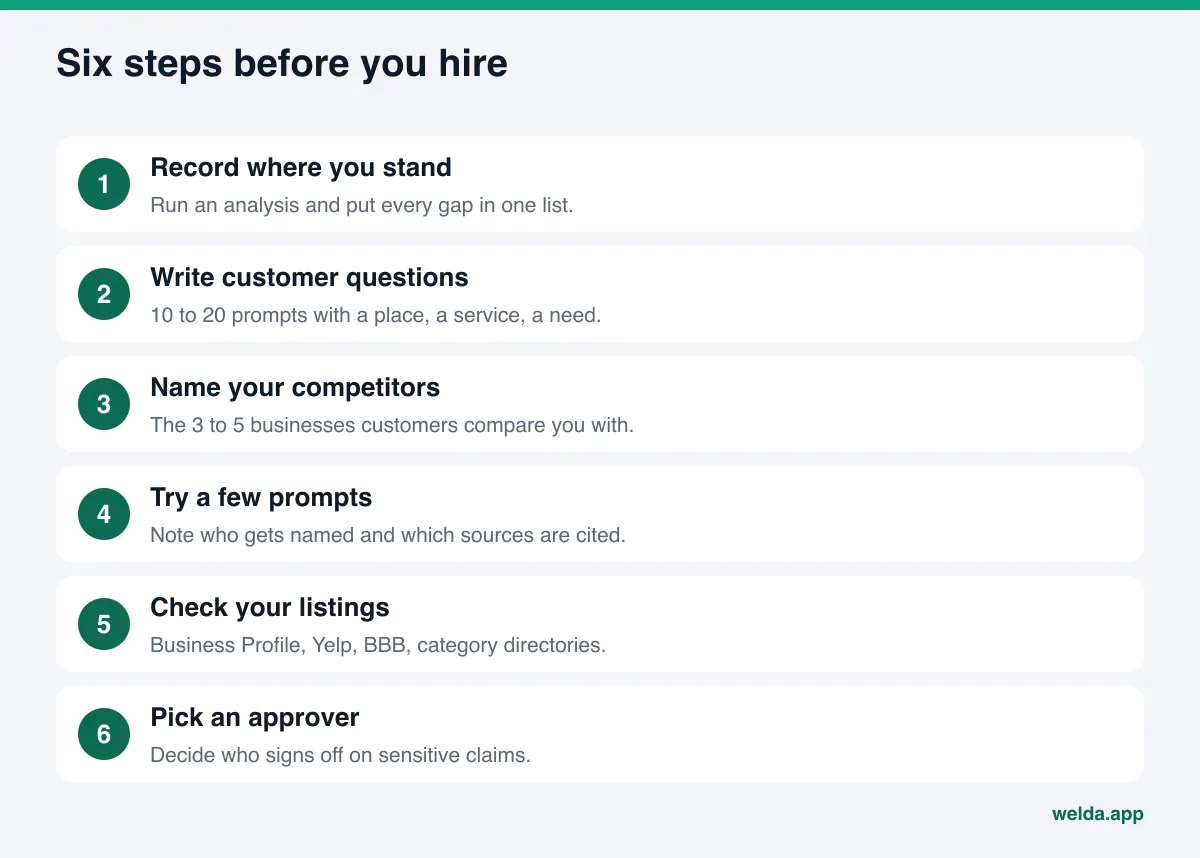
After these six steps you have a gap list, a question set, a competitor list, and an owner for approvals. When you meet a consultant, you can skip "make us show up in ChatGPT" and say "these competitors lead on these questions, here are our gaps, where do we start?" For a more detailed version of step one, our AEO audit guide walks through how to check each item.
Which tasks belong with a consultant, and which with a tool?
The decision depends less on the size of your business than on the kind of work in front of you. A few situations come up again and again.
If your gaps are mostly basics (no business markup, no FAQ section, profiles not linked from the site), the fixes follow clear rules. Drafts and checks from software may be enough, and paying consultant hours for this is an expensive route.
If nobody can run measurement consistently, meaning no one will ask the same prompts the same way every month and log the results, that is a job for software. Repeating hundreds of prompts across several assistants by hand is slow and hard to keep consistent.
If the problem is reputational, for example AI answers repeat an inaccurate or negative claim rooted in a news story, a complaint, or a dispute, you need human judgment. A tool can make the problem visible and draft responses, but a person manages the relationship and the decision.
If you work in a regulated field such as healthcare, law, or financial services, content approval must stay with you or an expert you authorize. In the US, claims in marketing also fall under FTC rules on truthful advertising and reviews. A tool can flag risky phrasing; a qualified person makes the call.
If you want coverage in press, partner sites, or industry lists, that is relationship work. Software can prepare the target list and the pitch; a person makes the calls and follows up.
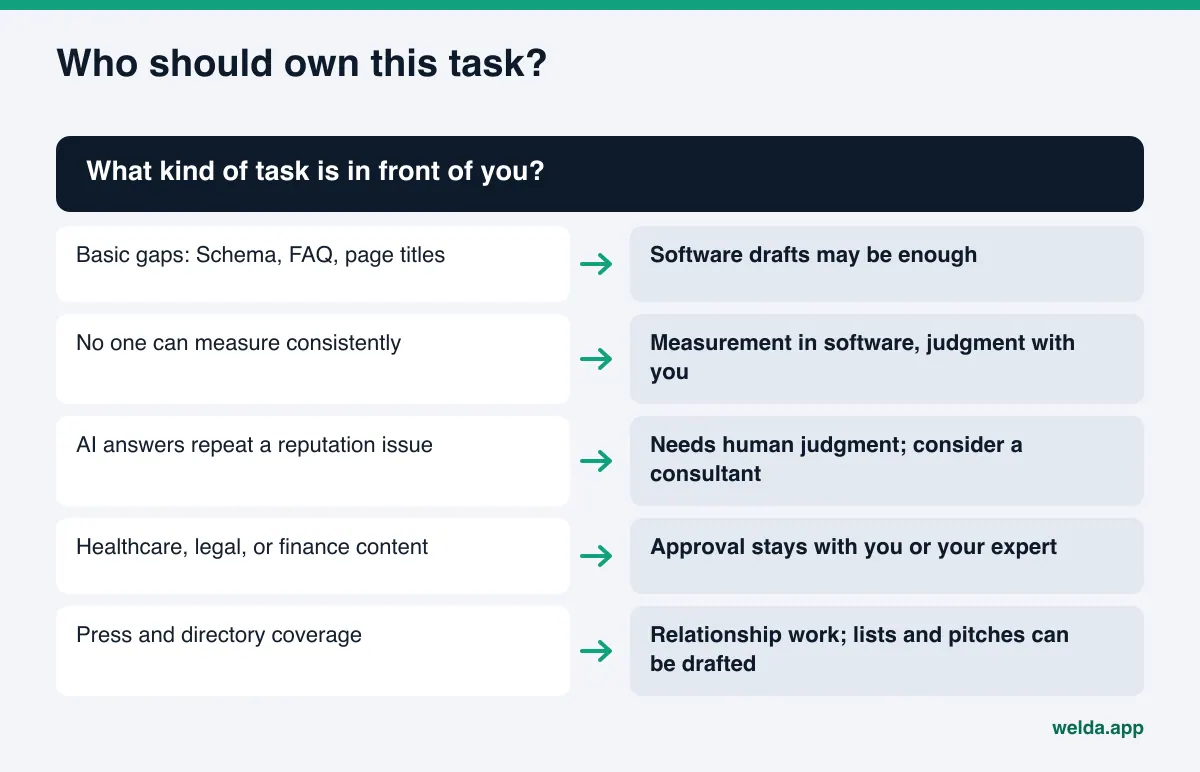
For many businesses the most sensible setup is this: measurement, checks, and drafts in software; approvals and brand decisions in-house; outreach and special problems with a consultant, on a limited scope if needed. That way the hours you pay for go to work that truly needs a person. We compare the two tool models in more depth in AI visibility monitoring vs done-for-you AEO.
How Welda handles the repeatable half of AEO consulting
Welda is software, not a consulting firm. In the split above, it takes the right-hand column: measuring, finding gaps, drafting fixes, and keeping everything in one task list. Here are the three parts most often confused with consulting.
The task list: who does what is written down
The biggest time sink in a consulting engagement is unclear ownership. In the Welda dashboard, that is settled on one task list, split into three groups. First, "information we need from you": Welda does not invent facts it cannot find on your site. It leaves the field blank and asks. A detail like the name of the lead practitioner or the length of a service sits here; once you fill it in, it carries into every related draft. Second, content waiting for approval: page copy, profile descriptions, and review replies that Welda drafted, held until you approve them. Third, manual tasks: listings with no publishing connection or a press target list, each with ready-to-paste text next to it. You copy the text, put it where it belongs, and mark it done.
The decisions you make on that screen are straightforward: which missing detail to supply, which draft to approve, which manual task to finish this week. In a consulting engagement these decisions tend to scatter across email threads. Here they sit in one place.
Competitor view: who leads, on which question, from which source
Competitor analysis is one of the most valuable things a consultant does, and Welda takes on the data side of it. The competitor view shows your share of answers against the competitors you choose, which question clusters each rival leads, and which source the answer cites in those cases. For an example boutique hotel, that might show Competitor A leading on "romantic getaway" prompts on the strength of its travel-site listings. Deciding what to do with that (which page to write, which listing to strengthen) is still your call. But the decision now rests on a question-by-question record instead of a guess.
Measurement: the score formula is published
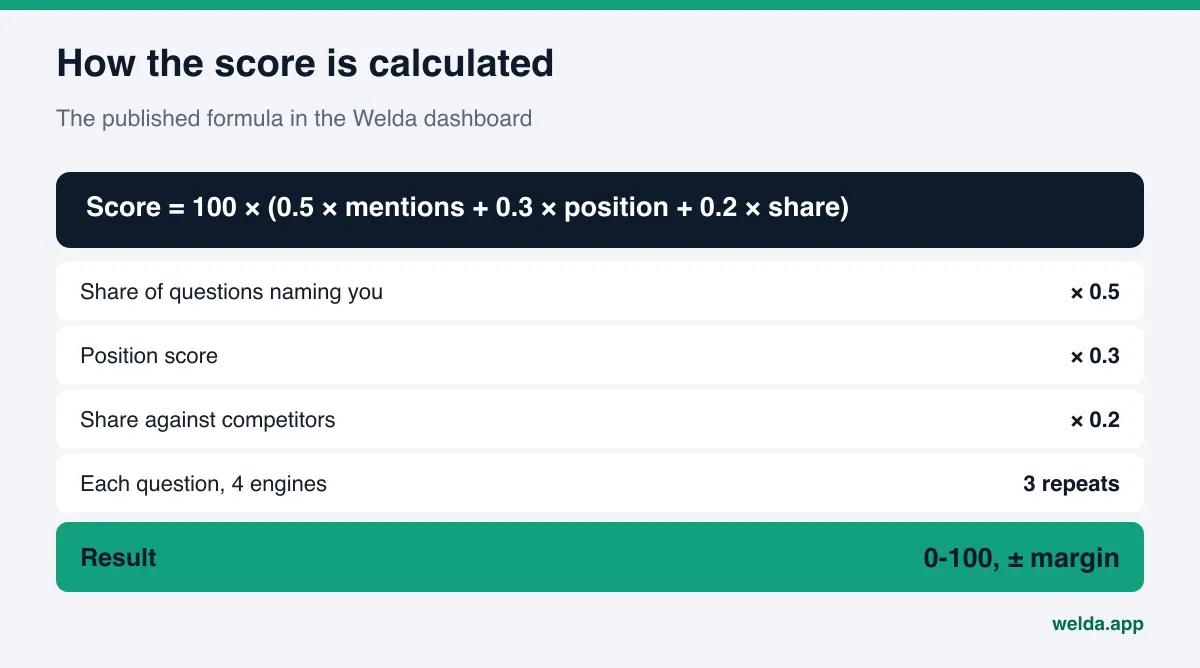
A common problem with consulting reports is that nobody can explain how the score was calculated. In the Welda dashboard, each customer question is asked three times on ChatGPT, Gemini, Perplexity, and Google AI. The score is 100 × (0.5 × share of questions where your name appears + 0.3 × position score + 0.2 × share against competitors), and the spread across the three repeats gives a ± margin of error. When the score moves, you can see which part moved, and you can hold any consultant's report to the same yardstick.
Beyond that: on WordPress sites, Welda connects through a separate Editor user with an application password, with no code to install. Drafts open on your site as WordPress drafts and go live only when you approve them. Content always lives on your own site; Welda does not host it. On other platforms, Welda gives you a ready-made package and the changes are applied by hand. A one-page monthly report comes as a PDF, and the question language can be set to English.
What stays with you is clear: publishing approval, brand decisions, the accuracy of your facts, and the manual tasks. Welda does not make those calls for you. It lines them up.
Limits: what Welda does not do, and where it does not replace a consultant
Software can take over the repeatable half of AEO consulting, but not all of it. Saying so plainly is the best way to start with the right expectations.
- No guarantees. Welda does not guarantee rankings or that you will "show up in ChatGPT." No tool or consultant controls AI answers, and any proposal that guarantees placement deserves a careful read.
- No made-up facts. If information is missing from your site, Welda asks you for it.
- No unapproved sensitive content. Patterns like pricing claims, guarantees, superiority claims, and diagnostic suggestions are flagged before publishing. This compliance check is not legal advice and has not been reviewed by legal counsel. In healthcare, nothing publishes automatically; every piece goes to approval, and patient data is never sent to AI.
- No fake reviews. Welda drafts replies to reviews; the reviews themselves come from your customers.
- Relationship work stays with you. Handling a negative review, setting up directory accounts, and press outreach are yours or your chosen expert's. Welda can prepare lists and text, but it does not make the calls.
- Results take time. New content usually takes weeks to show up in AI answers.
There is also the product's current status. The Welda dashboard is in early access and opening in stages, starting with businesses in Turkey. Regular four-engine measurement is being added during early access, and the sample screens are shown with representative data. What anyone can use today is the free site analysis, which works in English. Pricing is discussed in the early access conversation, which is why this article compares scope, not price.
Checklist for evaluating an AEO consulting proposal
Whether you plan to work with a consultant alone or a consultant plus software, you want the answers below in writing. If any are vague, raise them on the first call.
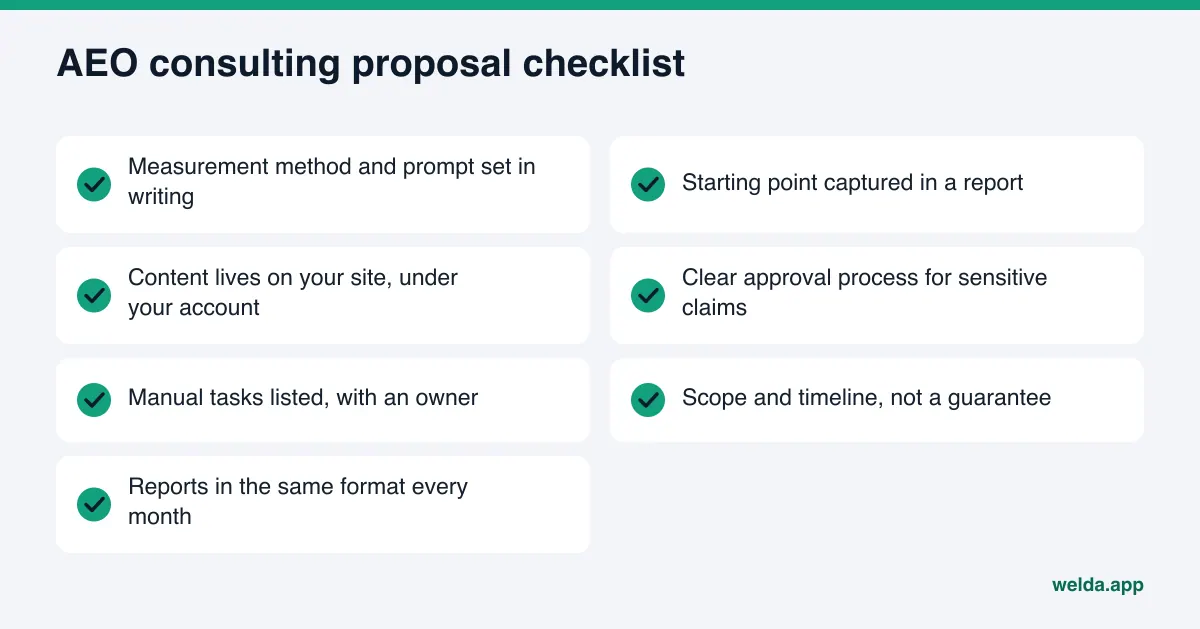
A few items deserve a closer look:
Is the measurement method written down? Which prompts, on which assistants, how many times, and how is the score calculated? Without a written method, you cannot answer "did it get better?" objectively three months in.
Is the starting point recorded? The state before work begins should be captured in a report. Even a free analysis is a usable baseline.
Whose site does the content live on? Pages written for you should sit on your site, under your account. If content disappears when the contract ends, you rented the investment.
Is the approval process clear? What can never go live without your sign-off? For pricing, guarantees, and health claims, that answer should be in writing.
Which tasks are manual, and who does them? Some listings have no way to update automatically. Will the consultant handle them, or will you? Tasks a proposal leaves vague usually end up on your desk.
Is there a guarantee? If so, ask exactly what it covers. Nobody can guarantee placement in AI answers. What can be guaranteed is the scope of work and the timeline.
For a longer list of questions to bring to that first meeting, see questions to ask an AEO agency. And if you are weighing whether a single platform could cover most of the work, our guide to an AI visibility platform for small business lays out what to expect.
Frequently asked questions
Is AEO consulting the same as SEO consulting?
No, though they overlap. Crawler access, page titles, and structured data matter to both. AEO consulting adds a focus on whether your name appears in AI answers, which sources feed those answers, and which competitors lead on which questions.
Does a small business need an AEO consultant?
Not always. If most of your gaps are basic, an analysis can find them and ready-made drafts can close them. A consultant tends to earn their fee when there is a reputation problem, a regulated industry, or outreach that depends on relationships.
Is Welda an AEO consulting service?
No. Welda is software. It measures, finds gaps, drafts fixes, and keeps the work in one list. Publishing approval, brand decisions, and relationship work stay with your business.
Can I use Welda alongside a consultant?
Yes. The two do not exclude each other. With measurement and drafts in the dashboard, a consultant can spend their time on interpretation and outreach. Keep in mind the dashboard is in early access and opening first in Turkey; the free analysis is available now in English.
How long before AEO work shows results?
New content usually takes weeks to appear in AI answers. Judge progress by comparing the same questions month over month; a one-week snapshot can mislead.
What should I do if a proposal includes a guarantee?
Ask in writing what exactly is guaranteed. No consultant or tool controls AI answers. What can be promised is the scope of work and the schedule, not the outcome.
See where you stand first, then decide who does what
The most useful step before hiring for AEO consulting is getting your current state on paper. Only then can you tell which gaps follow clear rules and which need a person's judgment. The free site analysis reads your site, gives you a score out of 100, explains each gap and how to fix it, drafts suggested copy for your homepage, and checks whether your name comes up in answers to five customer questions. It is free once per site, and the results link arrives by email. With that report, you can move ahead on your own, brief a consultant, or talk to us about early access, and decide who owns which task based on what you actually see.