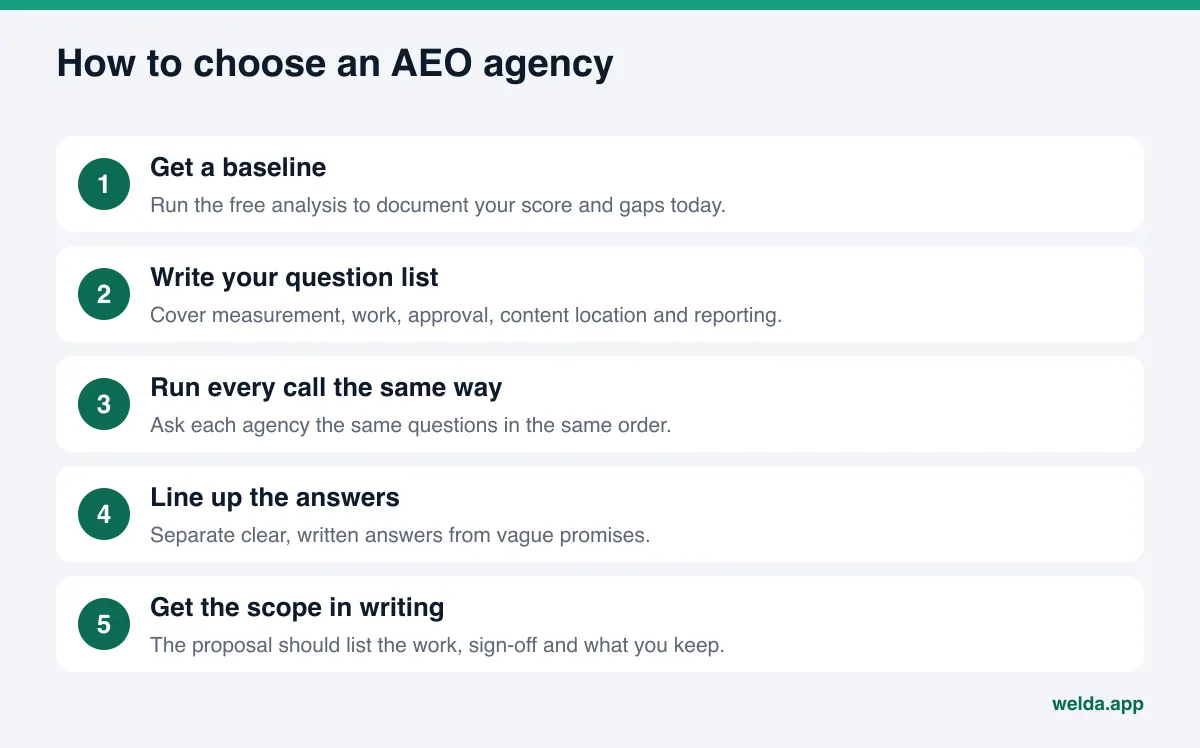
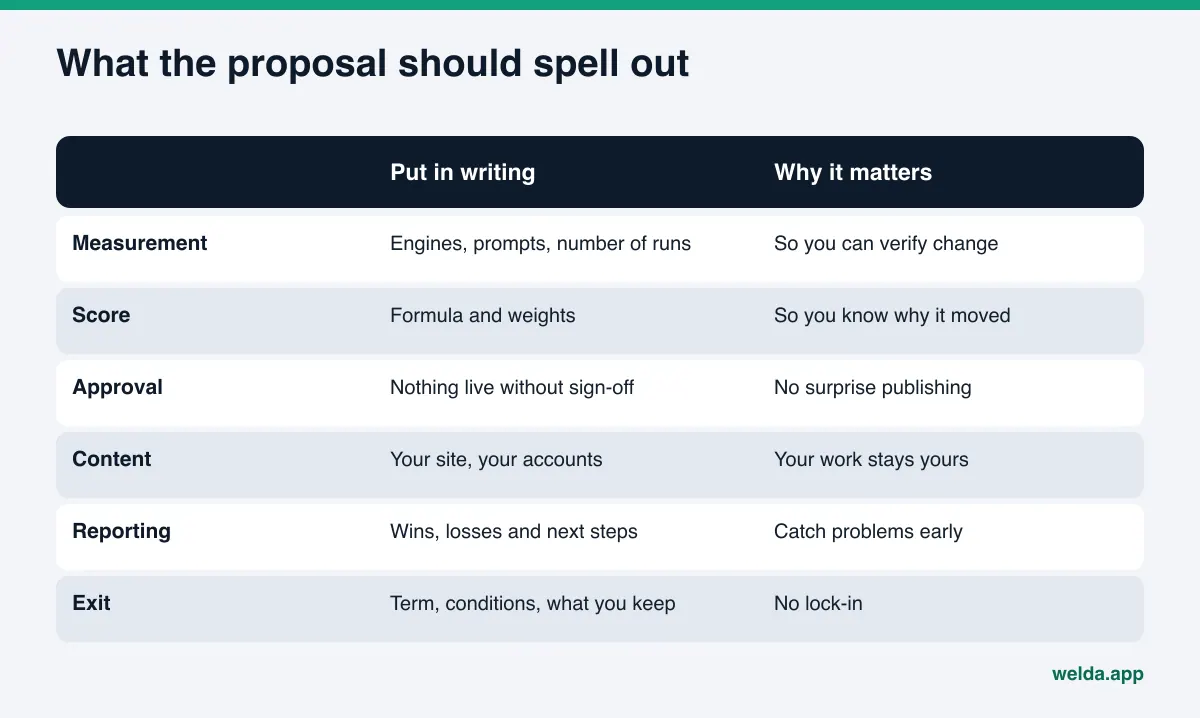
What questions should you ask an AEO agency before you sign? Ask about five things: how they measure, what work they will actually do, who approves what gets published, where the content lives, and how they report results. A good proposal answers each of these in writing, in a way you can check later. A promise like "we'll get you to #1 in ChatGPT" is the first answer to rule out.
What an AEO agency does, and why the questions matter
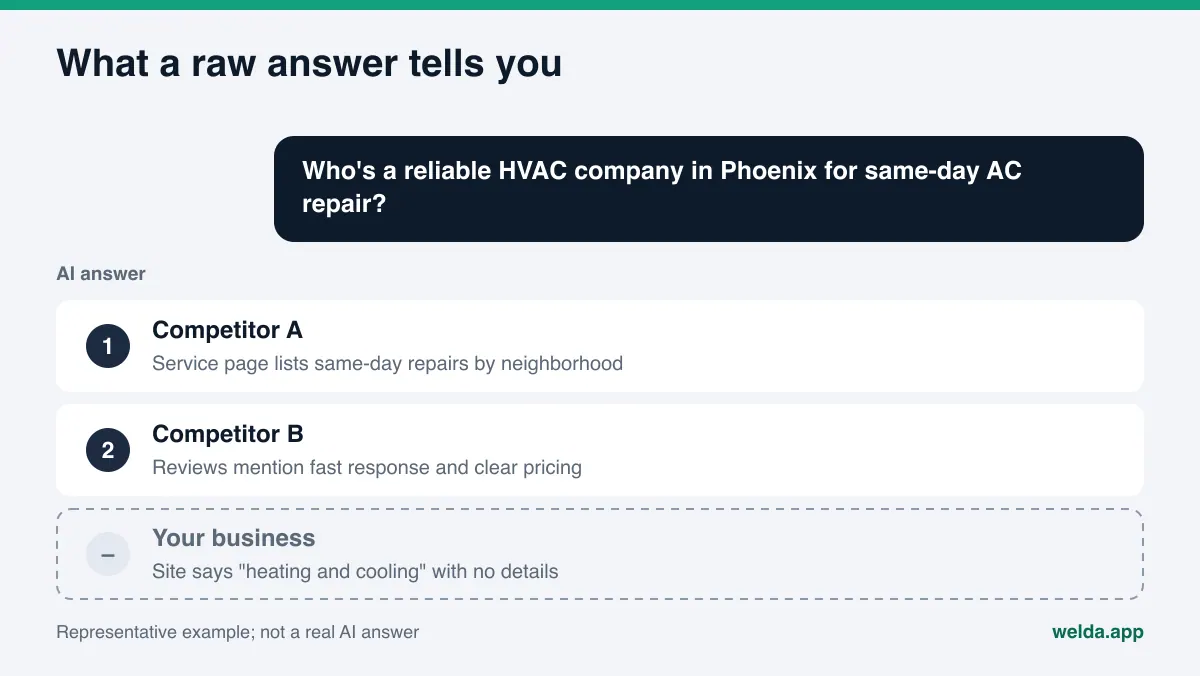
AEO, or answer engine optimization, is the work of getting your business mentioned when people ask AI tools like ChatGPT, Gemini, Perplexity and Google's AI Overviews and AI Mode for a recommendation. You may also hear it called GEO (generative engine optimization); in the US the two terms describe the same job, and AEO is the one most buyers search for. Either way, the goal is AI search visibility: being one of the two or three names an assistant gives when a customer types "Who's a reliable HVAC company in Phoenix that does same-day repairs?" or "Best pediatric dentist near Wicker Park that takes new patients?"
Because the field is young, there's no shared definition of what an AEO service includes. One agency may be selling a classic SEO retainer with a few extra blog posts. Another may only fix technical issues on your site. A third may run ongoing measurement plus content and profile work. The proposals often carry similar headlines and very different contents. So asking "Do you do AEO?" tells you almost nothing. You learn what you're buying only when you ask about each piece of the work separately.
Skipping these questions has real costs. You can pay for months without knowing what changed. Content can go live on your site without your sign-off. When the engagement ends, the pages and profiles may not be yours. Or you get a "visibility is up" slide that nobody actually measured. The questions below are designed to surface those risks at the table, before a contract exists. They work just as well for software, a freelancer, or Welda; the standard doesn't change with the vendor.
Before the first call: know your starting point
Walking into a sales call with your own baseline changes the conversation. When an agency tells you "your site has serious gaps," you can judge how accurate that is and which gap actually matters first. You also need a baseline if you want to ask, six months from now, what changed.
The free AI visibility analysis gives you that baseline. It reads your homepage and a few inner pages (services, pricing, about, contact) the way Google and AI systems read them. It checks whether AI crawlers can reach your site through robots.txt, your page title and meta description, your main heading, your business information markup (Schema), your address and phone details, whether your social and map profiles are linked from the site, your FAQ section, reviews and trust signals, how clearly your services are described, and page speed. You get a score out of 100, split into technical and content, and for every gap you see what was found, why it matters and how to fix it. It also asks five questions a customer might ask to an AI assistant that can search the web, and checks whether your business name appears in the answers. That's a one-time snapshot, but it means you show up to the call with a document.
If you're not sure how to interpret the results, the guide on how to read your AI visibility report walks through each section. Bring the report and ask the agency: "Which of these gaps would you fix in month one, which later, and why?" The answer shows immediately whether they actually looked at your site.
Questions to ask an AEO agency about measurement
Of all the questions to ask an AEO agency, the measurement questions matter most. Work that isn't measured can't be reported, and work that isn't reported can't be judged. AI answers also shift from one run to the next: the same prompt may list you second today and skip you tomorrow. A method that ignores that variation will mislead you.
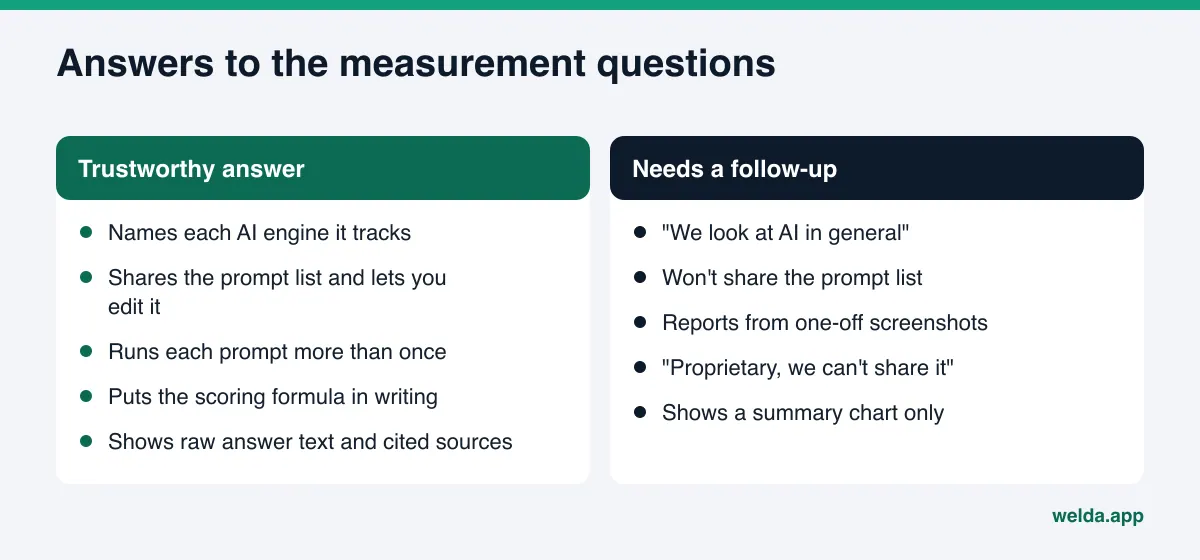
- Which AI engines do you track? Are ChatGPT, Gemini, Perplexity and Google's AI features tracked separately, or just one of them? Your customers use different tools. A report built on one engine is a partial picture.
- Which prompts do you run, and who chooses them? The prompts should look like what your customers really ask: neighborhood, service, price range, comparisons. Ask to see the list and to be able to change it.
- How many times do you run each prompt? A single run is a coin flip. A method that repeats each prompt and looks at the average and the spread is far more reliable.
- How is your score calculated? Ask for the formula in writing. "It's our proprietary algorithm" means you won't be able to tell why the number moved next month.
- Can I see the raw answers? Seeing the actual answer text, the sentence where your name appears and the sources the engine cited is a reasonable request.
- How do you track competitors? Knowing which competitor gets named for the same prompts, and why, sets the direction for the work.
How specific these answers are tells you how seriously the agency takes measurement. If an agency says "we don't do that yet," that's not a red flag on its own; being upfront earns trust. The problem is a vague method with a precise-sounding number attached to it.
Questions about the work, the content and publishing approval
After measurement, the second big topic is what the agency will actually do. AEO work has several layers: technical fixes, content on your site, outside profiles, and reviews. Ask which layers are in the proposal, one by one. The overview of what AEO services include breaks these layers down in more detail.
- Technical work: Who handles robots.txt, business markup, titles and descriptions, on which site, and when?
- Content: Who writes service pages and FAQs? Where does the writer get facts about your business? When they don't know something, do they ask you or guess?
- Publishing approval: Can anything go live on your site without your approval? How does sign-off work, and who gives it?
- Where content lives: Does the content sit on your own website, or on a domain or network the agency controls? What happens when the contract ends?
- Outside profiles: Who owns the logins for your Google Business Profile, Yelp, BBB and Angi listings? Do you keep access?
- Reviews: Who writes review responses? What exactly does "review growth" mean in their proposal?
That last point deserves care. In August 2024 the FTC announced a final rule banning fake reviews and testimonials, including reviews from people who don't exist, AI-generated fake reviews, and company-controlled review sites posing as independent. Any agency offering ready-made reviews, sock-puppet accounts, or "independent" best-of lists written on your behalf is putting your business at risk. This is not legal advice; if you're unsure, ask your own counsel. Likewise, content hosted on an agency's domain can disappear with the contract. Your content should always live on your own site.
If you're in a regulated field such as healthcare, legal or financial services, add one more question: "How do you catch claims about prices, guarantees, superiority or medical outcomes before anything is published?" The agency should have a review step, and final approval should stay with you.
Questions about guarantees, timelines and the contract
No one can buy a spot in an AI answer, and no one can guarantee a specific position. The engines decide on their own, and their answers vary by prompt and over time. So when you see "guaranteed top 3 in ChatGPT" or "appear in Gemini within 30 days, guaranteed," stop and ask how. The article on guaranteed ChatGPT rankings explains why those promises don't hold up.
Instead of a guarantee, ask:
- What will you do in month one, and what in months two and three?
- How long until new content shows up in AI answers? (The honest answer is usually "weeks" and "no certainty.")
- Which metric do you expect to move, and how will you show it to me?
- How long is the contract, and what are the exit terms?
- When we part ways, do I keep the accounts, the content and the reports?
- What's included in the fee, and what costs extra?
When you compare prices, look at what each number buys. The same monthly fee might cover only a report at one agency and measurement, content and profile work at another. Compare only once the scope is clear on both sides.
Questions about reporting
The monthly report is your most regular contact with an agency. A good one is short and answers a few things: Which prompts mentioned us this month, and where did we drop? Which competitor is ahead on which prompt, and because of which source? What got done? What's next, and what do you need from us?
Ask for a sample report on the call. Does it state the method (number of prompts, engines, runs, formula)? Does it show losses as well as wins? A report that only shows good news keeps you from catching problems early. The piece on what belongs in a monthly AEO report goes deeper.
Also check the link between measurement and action. Every recommendation in the report should trace back to a finding: "On this prompt a competitor is cited from this source, so we're completing that profile." Recommendations without that link are generic advice, not a plan for your business.
How to score the answers you get
After a few calls you'll have several agencies' answers. The table shows what a strong answer looks like for each question and which answer should make you pause.
| Question | Strong answer | Answer that needs a follow-up |
|---|---|---|
| Which engines do you track? | Names each engine and shows results per engine | "We look at AI in general" |
| How is the score calculated? | Written formula with visible weights | "Proprietary, we can't share it" |
| Can I see raw answers? | Answer text and sources, prompt by prompt | A summary chart only |
| Who approves publishing? | Nothing goes live without your sign-off | "We'll handle it, don't worry" |
| Where does content live? | On your site and in your accounts | On the agency's domain or network |
| Do you guarantee results? | No position guarantee; commits to process and measurement | "Top 3, guaranteed" |
| How do you grow reviews? | A process for asking real customers | Ready-made reviews or accounts |
| What if you lack a fact? | Asks you and gets your approval | Fills it in from similar businesses |
Example: two proposals side by side
The business and agencies in this section are made up. A sample HVAC company in Phoenix gets AEO proposals from two agencies. Before the calls, it runs the free analysis. The report shows missing business markup, no FAQ section, and service pages that list "heating and cooling" without saying which repairs, which brands or which neighborhoods. Out of five sample prompts, the company's name appears in one.
Agency A leads with "top 3 placement in ChatGPT and Gemini." Asked about measurement, they say they'll share screenshots of a few prompts each month. They won't share a scoring formula. For content, they propose publishing articles about the company on a home-services guide site they run. For reviews they mention a "review boost" package and get vague when asked for details.
Agency B gives no position guarantee and says new content can take weeks to show up in answers. They share the engines they track and their prompt list, and ask which prompts the company wants added. They state in writing that all content will be drafted on the company's own site and published after approval. For reviews they propose a process for asking real customers after a job and templates for responses. Their sample report has a "losses" section.
At first glance Agency A sounds more ambitious. Run it through the table and the picture flips: A's measurement can't be checked, the content won't live on the company's site, and the review method is unclear. B's proposal is more modest, and every step is verifiable. B is the one that lets the company answer "what changed?" in six months. This is a template for thinking, not a real comparison; ask the same questions in your own calls and build your own table.
How Welda handles this work
Welda isn't an agency. It's software that measures where your business shows up in AI answers and prepares the fixes on your behalf. You can still put every question in this article to Welda. Here's how Welda answers the two that matter most: measurement and publishing approval.
Measurement you can check. In the Welda panel, the prompts your customers are likely to ask run against ChatGPT, Gemini, Perplexity and Google AI three times each. The prompts view shows, row by row, whether your name came up on each engine and in what position. Open a prompt and you see the answer text, the result of all three runs, and the sources the engine cited. So when your score drops, you can trace it to a prompt, an engine and a source. Prompts can be run in English or Turkish.
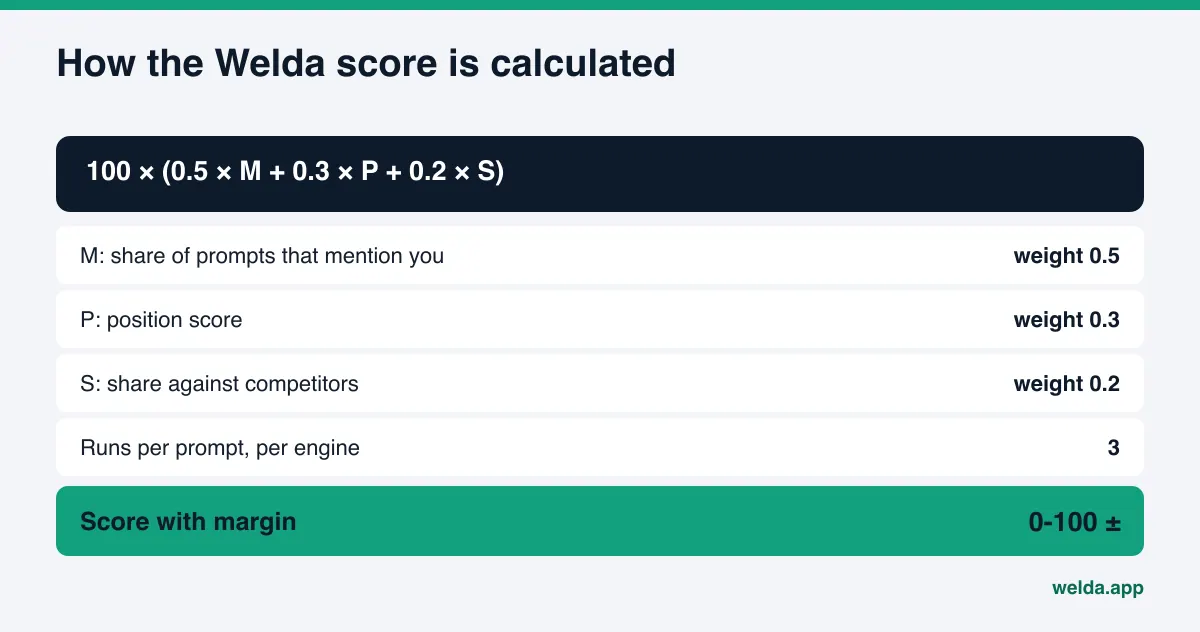
The formula is published: 100 × (0.5 × share of prompts that mention you + 0.3 × position score + 0.2 × share against competitors). The spread across the three runs gives a ± margin of error. That margin matters. When the score moves two points in a month, it tells you whether that's a real change or normal noise in the answers. It's the level of openness you should expect from any agency when you ask how they score.
You keep publishing approval. Welda drafts content, profile copy and review responses; the decision to publish is yours. On WordPress, Welda connects through a separate Editor user and an application password you create, with no code to install. Drafts open on your site as drafts and go live only after you approve them. Where no connection is possible, Welda hands you a ready-to-apply package and you or your web person apply it. Content always lives on your own site; Welda doesn't host content. That also answers "what happens when we stop?": everything published is already on your site and in your accounts.
Welda doesn't guess at facts. If your site doesn't say which areas you serve or how long a service takes, the question lands on your to-do list for you to answer. Before anything is published, a compliance check flags patterns like price claims, guarantees, superiority claims and diagnostic suggestions. That check is not legal advice and hasn't been reviewed by legal counsel. In healthcare there is no automatic publishing; everything comes to you for approval, and patient data is never sent to the AI.
A one-page monthly report, downloadable as a PDF, lists losses and risks alongside wins, plus next month's plan and a method note.
Where things stand: Welda is in early access. The free analysis works in English today and anyone can use it. The full panel is in early access and is opening first in Turkey. Regular four-engine tracking is being added during early access, and the sample screens in the panel use representative data. Pricing is discussed in the early access conversation.
Limits: what Welda doesn't do
"What don't you do?" is as useful a question for an agency as "what do you do?" Here is Welda's answer:
- No ranking guarantees and no promise that you'll "show up in ChatGPT."
- It doesn't write facts it doesn't know; it asks you.
- It doesn't publish sensitive content without your approval.
- It doesn't create fake reviews.
- Handling negative reviews, opening directory accounts and press work stay with you. Welda can draft the text, but it doesn't open or run those accounts for you.
- New content usually takes weeks to show up in AI answers. Welda doesn't promise to speed that up; it measures the change and shows it to you.
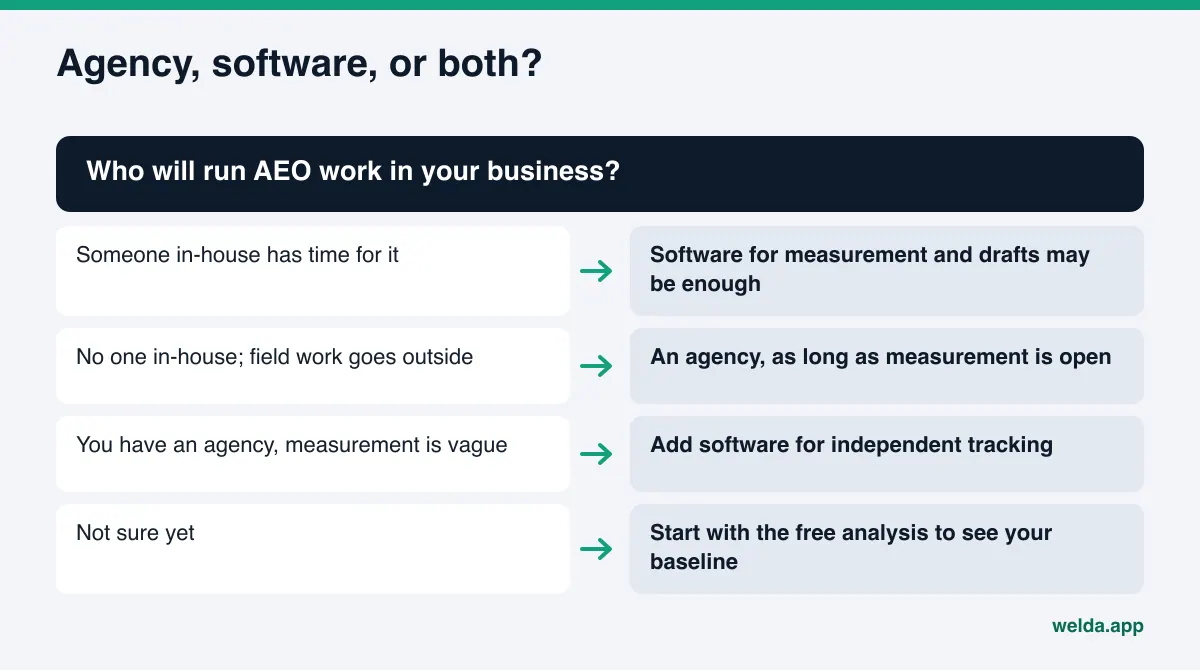
For some businesses it makes sense to use an agency and software together: the software measures and drafts, and the agency or someone in-house handles the field work. If you're comparing tools as part of that decision, the AI visibility tool demo checklist covers what to look for in a live demo.
Your pre-call checklist
Write the questions to ask an AEO agency on one page and ask them in the same order on every call, so you can line the answers up afterward:
- Run the free analysis first and bring the report.
- Ask which engines they track, which prompts they run and how many times.
- Get the scoring formula in writing.
- Ask for a sample that shows raw answers and cited sources.
- Pin down who approves publishing and where content will live.
- Ask exactly how they handle reviews and profiles.
- If there's a guarantee, ask how they'd deliver it and write down the answer.
- Ask for a sample monthly report and look for a losses section.
- Get the contract length, exit terms and what you keep in writing.
Frequently asked questions
How is an AEO agency different from an SEO agency?
An SEO agency focuses on your position in search results. AEO looks at whether AI answers mention you at all. The two overlap, because AI tools also read your site and other sources on the web, but the measurement and priorities differ. Ask any agency how it measures AI answers specifically.
Is it normal for an AEO agency to guarantee results?
No. Positions in AI answers can't be bought, and no one can guarantee a specific spot. An agency can commit to a process, measurement and a work schedule. It can't commit to a position.
How long does it take to see results?
New content usually takes weeks to show up in AI answers, and it varies by engine, prompt and industry. Be cautious with anyone who gives you an exact date.
What should I do before hiring an agency?
Measure your starting point. The free analysis shows your technical and content gaps, your score, and whether five sample prompts mention you. Bringing that report to the call makes it much easier to judge an agency's recommendations.
Is it a problem if content is published on the agency's site?
It's risky. The content can vanish when the contract ends, and it does little for your own site's credibility. Keeping content on your own site and in your own accounts is safer.
Is Welda an AEO agency?
No. Welda is software: it measures, finds gaps, drafts content and profile copy, and leaves publishing approval with you. The panel is in early access; the part anyone can use today is the free analysis.
Go into the call with a baseline
Most of the questions to ask an AEO agency come down to one thing: is the work measurable, checkable, and yours to keep? If the method is open, approval stays with you, content lives on your site and the report shows losses too, you're on solid ground. Guarantees, secret algorithms and "don't worry about it" answers mean there's another question to ask.
Before you take any calls, see where your site stands today. Run the free AI visibility analysis to get your score, your gaps and a ready-made fix for each one. That report becomes your first data point, in agency calls now and when you ask "what changed?" six months from now.