What should AEO services actually include? A well-defined scope for AEO services covers four kinds of work: measuring where your business shows up in AI answers, fixing the technical and content gaps on your website, cleaning up your information on outside sources like business profiles, directories and reviews, and measuring again with the same questions. Software can handle a large part of that. Some of it always stays with the business owner. When you compare offers, the useful question is not "do you do AEO?" but "who does each item on this list?"
Why the scope of AEO services needs to be spelled out
AEO (answer engine optimization) is the work of getting your business named when people ask ChatGPT, Gemini, Perplexity or Google's AI Overviews and AI Mode for a recommendation. You will also see it called GEO, generative engine optimization; in the US the two terms describe the same thing. A homeowner asks "who can fix a leaking water heater in Mesa today?" or a parent asks "what's a good pediatric dentist near Naperville that takes new patients?" Instead of ten blue links, they get a short answer with two or three names. AI search visibility is about being one of those names.
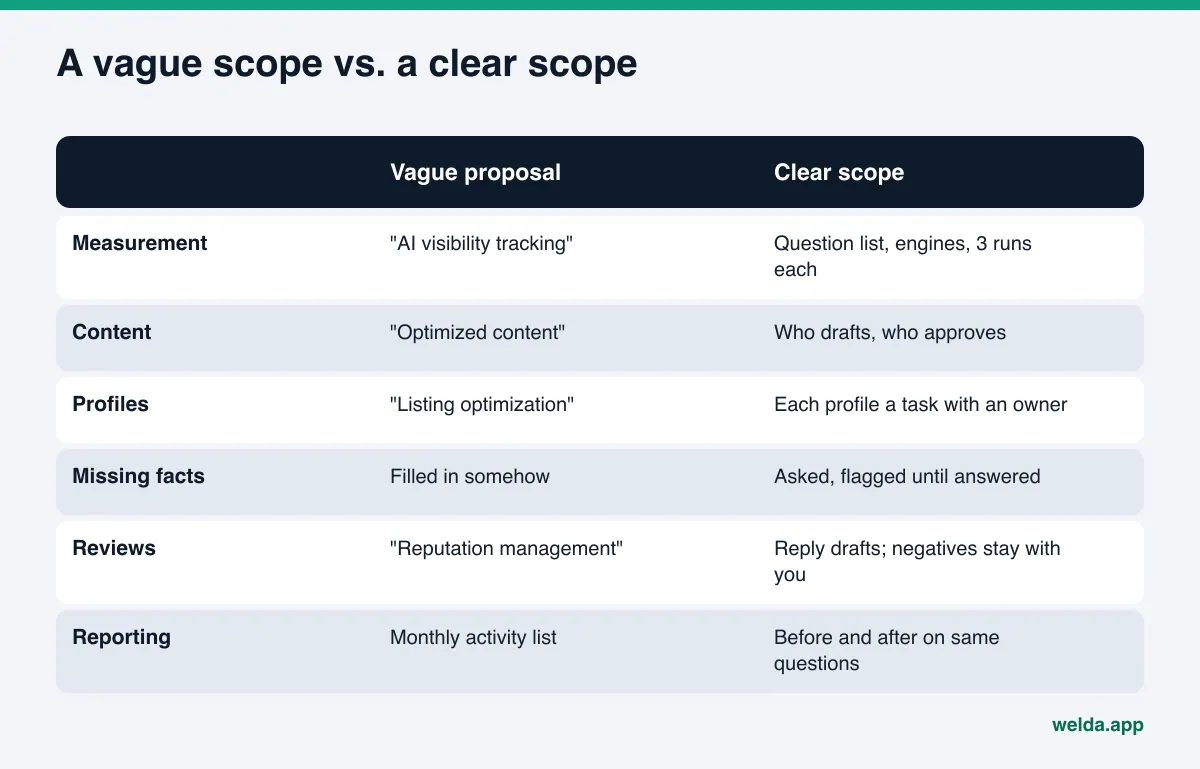
The trouble is that the category is young and nobody agrees on what it includes. One proposal labeled "AEO services" is a handful of blog posts. Another is a one-time technical audit. A third tracks AI answers every month but never fixes anything. The headlines look alike while the work behind them is very different. When the scope is not written down item by item, three problems follow:
- Work falls through the cracks. Each side assumes a task belongs to the other. Outdated hours on your Google Business Profile are not on the web developer's list or the content writer's list, so they stay wrong for months.
- Results can't be checked. If nobody recorded which questions were asked at the start, there is no honest answer to "what changed?" three months later.
- Expectations drift. "We'll get you into ChatGPT" is a promise, not a scope. No outside party controls AI answers. A scope can only describe the work and how it will be measured.
This article breaks AEO work into its parts, shows what Welda does for each one and what stays with you, and ends with a checklist you can use on any proposal, whether it comes from an agency, a freelancer or a software vendor. If you want to see the different tool types side by side first, read our guide to the best AEO tools for small businesses.
Before you compare proposals, know your starting point
It is much easier to judge a scope when you already know what is missing on your own site. You can spot line items you don't need and gaps nobody mentioned.
Welda's free site analysis gives you that baseline. It reads your homepage plus a few inner pages such as services, pricing, about and contact the way Google and AI systems would. It checks whether AI crawlers can reach the site through robots.txt, your page title and meta description, the main heading, business schema markup, your address, phone and location details, whether your social and map profiles are linked from the site, an FAQ section, reviews and trust signals, how clearly your services are described, and page speed. You get a score out of 100 with technical and content parts shown separately, a finding for each gap with why it matters and how to fix it, ready-to-use homepage copy suggestions, and a simulation of how much each fix could move the score.
The analysis also asks an AI assistant with web search 5 questions your customers might ask and checks whether your business name appears in the answers. That is a one-time snapshot, not ongoing tracking, but it gives you something concrete to bring to any scope conversation. The analysis runs in English and is free once per site. Your email and phone number are verified, and the results link arrives by email and stays open for 14 days.
What work goes into AEO services?
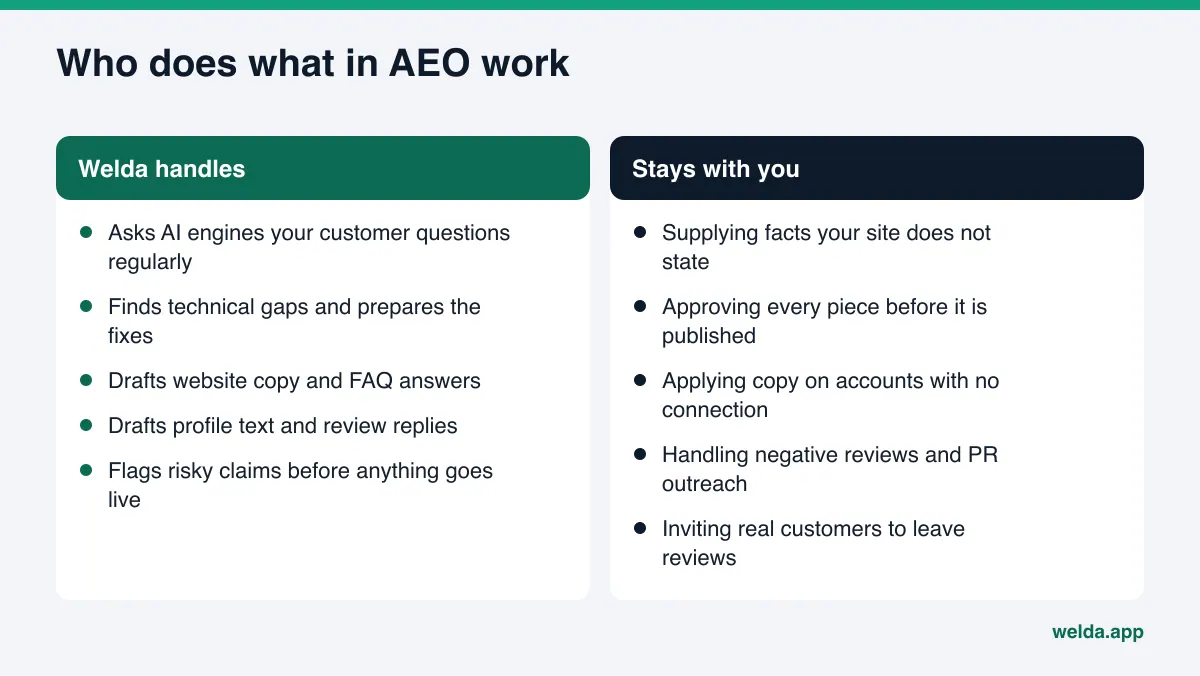
The table below lists the work you are likely to see in a complete AEO engagement and where each item sits when you work with Welda. "Shared" means the preparation happens in the software and the final decision or execution stays with you.
| Work item | What it means | Who does it with Welda |
|---|---|---|
| Question list | Choosing the questions customers ask AI tools | Shared: Welda suggests, you adjust for your market |
| Measurement | Asking those questions regularly, tracking your name and competitors | Welda |
| Technical foundation | Crawler access, page titles, schema markup, page speed | Shared: Welda finds and prepares fixes, how they are applied depends on your site |
| Website content | Service pages, FAQ, about page copy | Shared: Welda drafts, you approve publishing |
| Missing facts | Information only the business knows and the site doesn't say | You: Welda does not guess, it asks |
| Business profiles | Google Business Profile, Instagram, Facebook copy | Shared: Welda prepares when connected, otherwise it becomes a manual task |
| Directories and platforms | Yelp, BBB, Angi, Tripadvisor, Healthgrades and similar listings | You: Welda drafts the copy, the account owner applies it |
| Reviews | Review replies, handling negative reviews | Shared: reply drafts in Welda, negative review handling stays with you |
| PR and outside sources | News sites, editor relationships | You |
| Compliance check | Flagging risky claims about price, guarantees or superiority | Shared: Welda flags, you decide and get legal advice if needed |
| Reporting | Before and after comparison, monthly report | Welda |
Each row could fill an article of its own. What matters here is that the scope can be split into rows at all. If a proposal can't tell you which of these rows it covers, it can't tell you what you are buying.
Measurement is where the scope starts
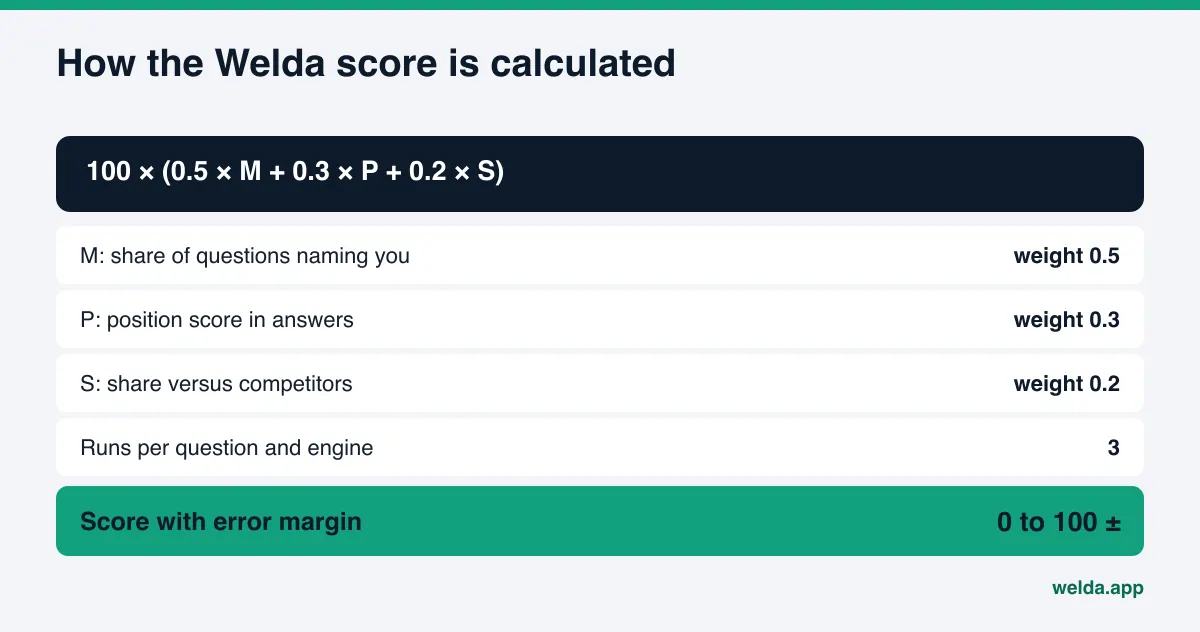
AEO work without measurement turns into content production with no visible outcome. Measurement has three parts: which questions are asked, which AI engines they are asked to, and how many times each one is repeated. AI answers can change even for the same question, so a single query is not a reliable measurement. Our guide on prompts to track for AI visibility covers how to build the question list.
Technical foundation and website content
When AI engines recommend a business, they tend to rely on clear, readable facts on that business's website and on outside sources. If your services are vague, your address only appears inside an image, or there is no FAQ, the engine has no sentence to quote about you. That is why the technical foundation and on-site content are the most concrete part of any AEO scope.
Outside sources: information that lives off your site
AI answers don't look at your website alone. Your Google Business Profile, Yelp page, BBB listing, Angi profile or Tripadvisor reviews can all shape the answer, depending on your industry. Software usually cannot write to most of these directly, because the account belongs to you. So you want to see this work split into "prepare" and "apply" in any scope. Our article on business directories for AI visibility goes deeper on which listings matter.
AEO services step by step: what order should the work follow?
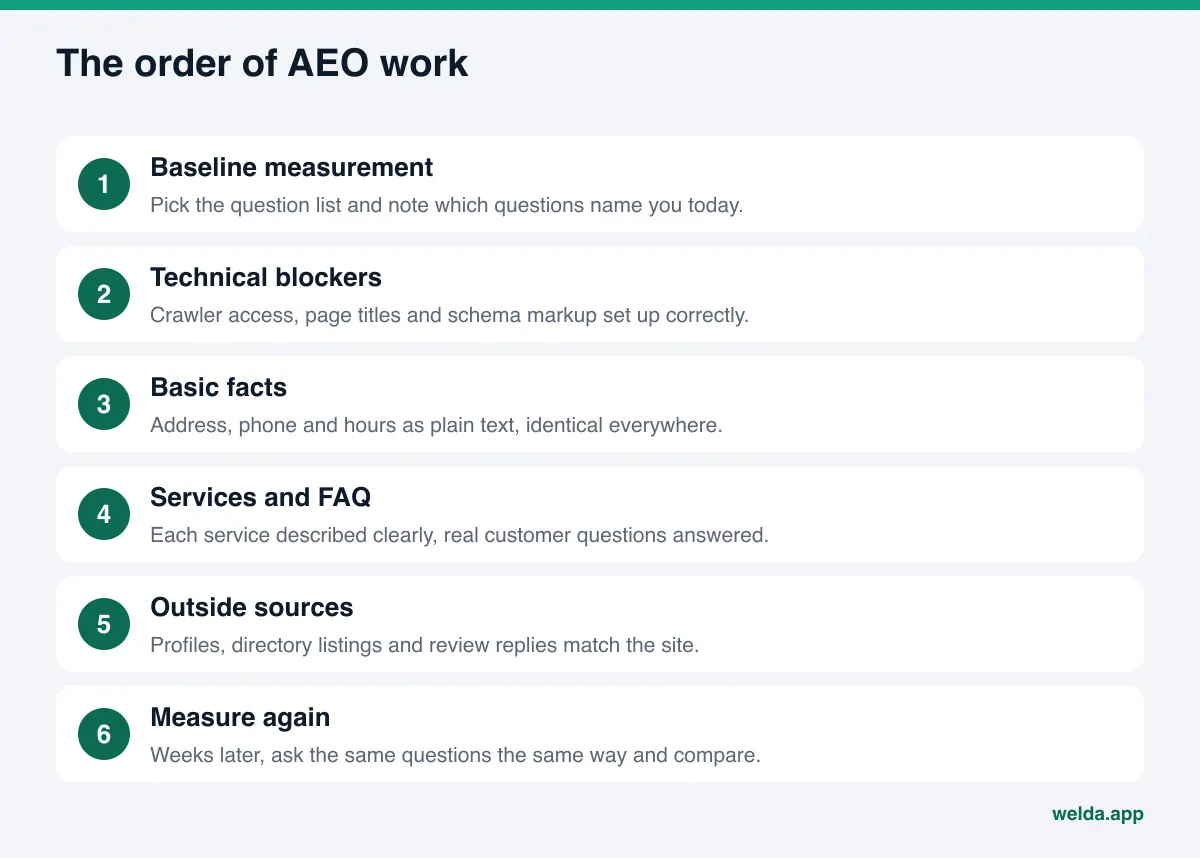
The order matters as much as the list. Producing content before measuring means you never learn what worked. Writing content before the technical basics are fixed can mean nobody reads it. This sequence fits most local and small businesses:
- Baseline measurement. Settle on the question list and take the first measurement. Note which questions name you and which competitor leads on which question.
- Remove technical blockers. Make sure AI crawlers can reach the site and that page titles and schema markup are correct.
- Complete the basic facts. Address, phone number, hours and service area should appear as plain text on the site and match on every profile.
- Describe each service clearly. Each main service needs a section or page that says what you do, for whom and where.
- Answer real questions. Put answers to common customer questions on the site. The questions where you are missing in the baseline set the priority.
- Align outside sources. Bring profiles, directory listings and review replies in line with the website.
- Measure again with the same questions. New content usually takes weeks to show up in AI answers. Ask the same questions the same way and compare.
None of these steps is one and done. When you add a service, move, change your phone number or a new competitor opens nearby, the cycle starts again. A good scope separates one-time work from recurring work and says so in writing.
How Welda handles AEO services
Welda is software that measures where a business appears in AI answers and fills in the gaps on the business's behalf. For the scope question, the feature that matters most is that Welda keeps all the work in one to-do list and labels each item by who has to act on it.
A plain note on availability: the full Welda dashboard is in early access and is opening first to businesses in Turkey. Regular measurement across all four engines is being added during early access, and the sample screens are shown with representative data. What anyone in the US can use today is the free site analysis, which works in English. Pricing is not published; it is discussed in an early access conversation.
The to-do list: the whole scope on one screen
Welda's to-do list splits work into three groups. The first is information we need from you. When Welda can't read a fact from your site, say the owner's name and credentials or how long a typical job takes, it does not fill the gap with a guess. It leaves the field empty and asks. Once you type the answer, it flows into every piece of copy that uses it. Fields that are still empty stay flagged in the preview, so nothing goes live with a missing fact.
The second group is waiting for approval. Website copy, FAQ answers, profile text and review replies that Welda has drafted sit here until you approve them. The publishing decision always stays with the business.
The third group is things only you can do. These are tasks Welda can't technically complete: profiles on platforms that offer no publishing connection, or press outreach that depends on a relationship with an editor. Each line says briefly why it has to be done by hand, and the ready-to-use text sits next to it. You copy the text into the account and mark the task done. That way, the part of the scope that stays with you is visible and doesn't get forgotten.
This is the difference that matters in a scope. In a typical service proposal, "optimize business listings" is one line, and it is never clear who does what. Here, each profile is its own task with a status and a clear owner.
Connections: how much of the work is automatic
How much Welda can apply on its own depends on how your site is built. On WordPress, Welda connects without installing any code, through a separate Editor user and an application password that you create for it. Content opens on your site as a draft and goes live only when you approve it. If your site runs on a system without a connection, Welda gives you a ready-made package and the changes are applied by hand. Google Business Profile, Instagram and Facebook can also be connected; any account that is not connected shows up as a manual task.
One detail worth noting in any scope: your content always lives on your own site. Welda doesn't host content. The pages, FAQ answers and profile text that get written stay where they are.
Measurement and the compliance check
In the dashboard, measurement works by asking ChatGPT, Gemini, Perplexity and Google AI each customer question three times. The score formula is public: 100 × (0.5 × share of questions that name you + 0.3 × position score + 0.2 × share versus competitors). The spread across the three runs produces a ± error margin, so you don't mistake normal noise for real change. Before anything is published, a compliance check flags patterns such as price claims, guarantees, superiority claims and diagnostic suggestions. It is a warning layer, not legal advice, and it has not been reviewed by a lawyer. US businesses still need to apply their own judgment on FTC advertising standards and any rules specific to their industry.
Which tasks stay with the business, and why?
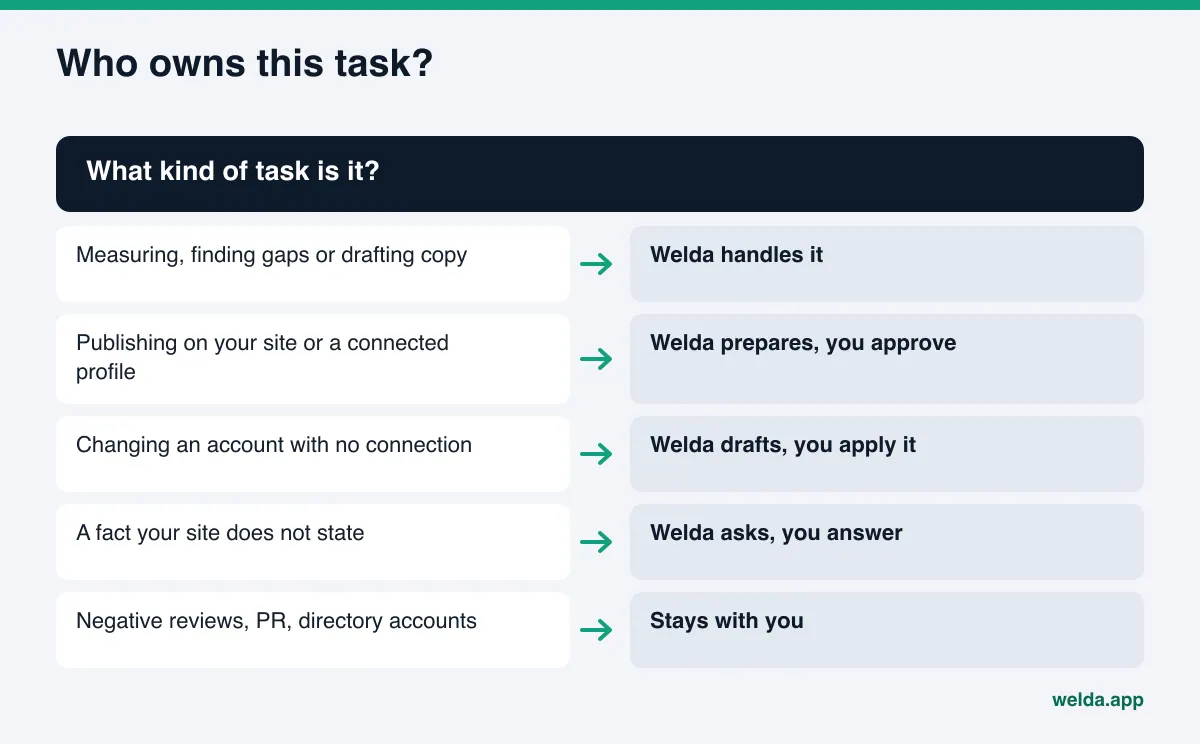
The part of a scope most often skipped is the work no vendor or tool can do for you. That is not a gap in the service; it is the nature of the work. With Welda, these tasks stay with you:
- The facts themselves. You know which services you offer, how long you have been in business and which neighborhoods you cover. Welda uses what it can read on your site and asks for the rest.
- Publishing approval. You decide what appears on your site and profiles. That matters most for pricing, warranties and service terms.
- Accounts without a connection. On platforms the software can't write to, the account owner pastes in the prepared copy.
- Negative reviews. How you respond to an unhappy customer and how you follow up offline is a business decision. Welda can draft a reply, but it does not run that process.
- Directory accounts and press. Claiming and verifying listings, working with editors and sending pitches stay with you. Welda prepares the copy and the list; it does not send anything automatically.
- Collecting real reviews. Welda does not write fake reviews. Reviews come from real customers, and inviting them to leave one is your job.
The list looks long, but most items take minutes: typing a fact, approving a draft, pasting text into a profile. Reading a scope well means knowing in advance how much time these tasks will take. If you are deciding between an agency and software, remember that most of these tasks stay with the business under either model. For a closer look at the software side, see our article on AEO software.
Limits: what Welda does not do
Writing down the limits of a scope is as important as writing down the scope. Welda does not:
- Guarantee rankings or promise that you will "show up in ChatGPT." No outside party decides what AI answers say.
- Write facts it doesn't know. It asks you, and the field stays flagged until you fill it in.
- Publish sensitive content without your approval. In healthcare there is no automatic publishing at all; every piece of content goes to approval, and patient data is never sent to AI.
- Create fake reviews.
- Take over negative review handling, directory account setup or PR outreach.
- Give legal advice. The compliance check is a helper that flags risky patterns.
There is also a time limit. New content usually takes weeks to be reflected in AI answers, so expecting a big shift at the end of month one is not realistic. The way to see change is regular measurement with the same questions. Our guide to before and after AEO measurement shows how to set that up.
An example scope: a family-run plumbing company
To see how the work actually splits, take an example scenario. An example family-run plumbing company serves two suburbs outside Phoenix. The website runs on WordPress. It has a Google Business Profile that isn't linked from the site, a Yelp page, a BBB listing and an Angi profile. Say the free analysis found these gaps: no FAQ section, missing schema markup, a services page that lists "residential plumbing" and nothing else, and a service area that only appears in a map image.
In this example, the scope splits like this:
| Work item | What Welda does | What the plumber does |
|---|---|---|
| Schema markup | Prepares the code and places it on WordPress as a draft | Approves it |
| Service area | Flags it as missing and asks | Types in the cities and neighborhoods served |
| Services section | Drafts copy for water heaters, drain cleaning, repiping, emergency calls | Fills in facts like license details and after-hours terms, then approves |
| FAQ | Drafts answers for the questions where the business wasn't named | Checks the answers and approves |
| Google Business Profile | If connected, prepares and applies the copy; if not, provides ready text | Chooses to connect or enters the text by hand |
| Review replies | Drafts replies | Approves; handles follow-up with unhappy customers |
| Yelp, BBB, Angi | Prepares consistent listing copy | Logs in and updates each listing |
Most of what the plumber does here is giving facts and approving drafts. Writing, preparing and measuring sit with Welda; decisions and the facts themselves stay with the business. This is an example; every business's list depends on its own gaps.
AEO services checklist: what to look for in a proposal
Whether you are evaluating Welda or another option, ask these questions in writing. If an answer is vague, that task is probably on nobody's list.
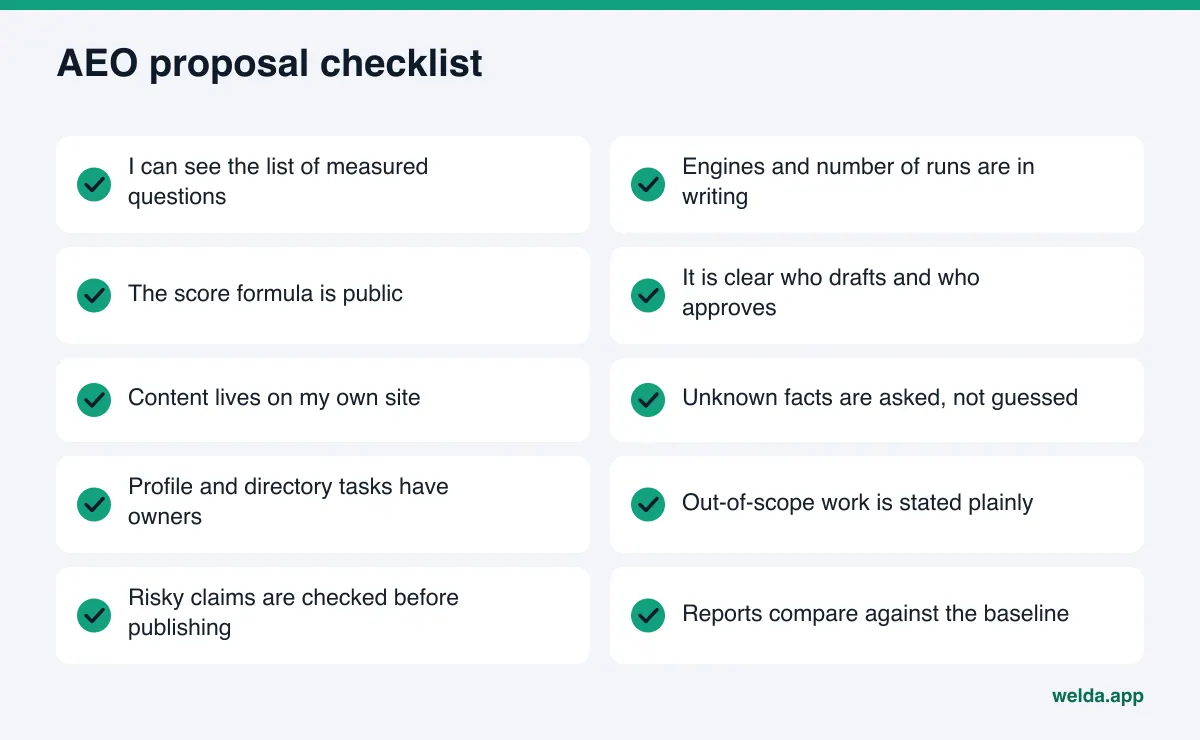
- Which questions are being measured, and will I see the list?
- Which AI engines are asked, and how many times is each question repeated?
- How is the score calculated, and is the formula public?
- Who writes the content on my site, and who approves publishing?
- Where does the content live, and does it stay with me if we stop working together?
- What happens when a fact is unknown: is it guessed or am I asked?
- For profiles and directories, which tasks are yours and which are mine?
- Are negative reviews and PR included, and if not, does the proposal say so?
- Is there a check for risky claims before anything goes live?
- How are results reported, and is there a comparison to the baseline?
For a concrete example of what a good report should show, see our AI visibility report template. If a proposal can't give clear answers to at least half of these ten questions, the scope hasn't really been written yet.
Frequently asked questions
How are AEO services different from traditional SEO services?
Traditional SEO focuses on rankings in search results. AEO focuses on whether your name appears in AI answers. The technical foundation and on-site content overlap, but an AEO scope puts more weight on question-by-question measurement in AI engines, consistent facts across outside sources, and content that can be quoted as an answer, such as FAQ sections.
Will Welda publish content on my site without my approval?
No. Welda drafts the content and you approve publishing. With the WordPress connection, content opens on your site as a draft and goes live only after you approve it. Healthcare businesses have no automatic publishing option at all.
Does Welda manage my Google Business Profile?
If you connect the profile, Welda drafts profile text and review replies and applies them once you approve. If you don't, the task stays in your to-do list as a manual item with the ready text next to it.
What happens to the content if I stop using Welda?
Your content always lives on your own site and accounts. Welda doesn't host it, so the pages and copy stay where they are.
How long until I see results in AI answers?
Technical fixes and new content can go live quickly, but they usually take weeks to show up in AI answers. Welda does not guarantee rankings or mentions; it shows change by measuring the same questions over time.
Can US businesses use Welda today?
The free site analysis works in English and anyone can use it today, once per site. The full dashboard is in early access and is opening first in Turkey. Pricing is not published and is discussed in an early access conversation.
The first step to a clear AEO scope
The best way to evaluate any AEO services proposal is to walk in knowing your own gaps. Once you can see which technical items are missing, which facts your site never states, and whether your name shows up when customers ask AI tools, you can hold every line of a proposal up against your actual situation. Run the free site analysis to get that baseline: a score, a list of gaps, ready homepage copy and a 5-question AI test. Then fill in the table above for your own business, and it becomes clear which work sits with software and which stays with you.