What are the best AEO tools for small businesses? The best tool is the one that measures the questions your customers actually ask, across the AI engines they use, and then helps you close the gaps without hiring a team. Judge every tool on the same criteria: which engines it checks, how often it repeats each question, how the score is calculated, who writes the fixes, and who approves what goes live. This guide walks through those criteria and ends with a checklist you can take into any demo.
AEO (answer engine optimization) is the work of getting your business named in the answers that ChatGPT, Gemini, Perplexity and Google's AI Overviews and AI Mode give to customers. You may also see it called GEO, short for generative engine optimization; in this article we treat the two as the same thing and use AEO. The number of products promising "AI search visibility" has grown fast, and most describe themselves in almost identical language. Behind the dashboards, though, they do very different jobs. Instead of ranking specific brands, this guide explains tool categories and evaluation criteria, so you can ask the same questions of any vendor. If you want a baseline before you compare, run a free AI visibility analysis of your website first; it gives you something concrete to hold every tool up against.
Why is it so hard to compare AEO tools?
Comparing classic SEO tools was relatively simple. Everyone measured keyword rankings, backlinks and crawl errors; the difference was data quality. AI search visibility works differently. What gets measured is not a position on a results page but whether your name appears inside a generated answer. That answer is rewritten every time, shifts with the wording of the question, and differs from one engine to the next.
That is why two tools can show very different results for the same business, and neither has to be wrong. One asks a question once and looks at a single answer. Another asks it three times and reports the spread. One tracks only ChatGPT, another tracks four engines. One uses broad national prompts, another uses local questions like "family dentist open Saturday in Austin." If you compare the scores without seeing those differences, you are comparing apples to oranges.
The second difficulty is that measurement alone does not move anything. When a tool tells you that your business appears in only a handful of the questions it tracks, the real questions start: What is missing, who fixes it, and when? Some tools stop at the report. Some give you a list of recommendations but no copy. Some draft the content and place it on your site for review. For a small business without a marketing department, that difference often decides whether the tool gets used at all.
The third difficulty is local context. Customers in the US ask about their own city and neighborhood, and AI answers lean on sources like Google Business Profile, Yelp, the Better Business Bureau, Angi, Healthgrades or Tripadvisor, depending on the industry. A tool that tracks only generic, nationwide prompts will miss most of what decides whether a local business gets recommended.
What types of AEO tools are on the market?
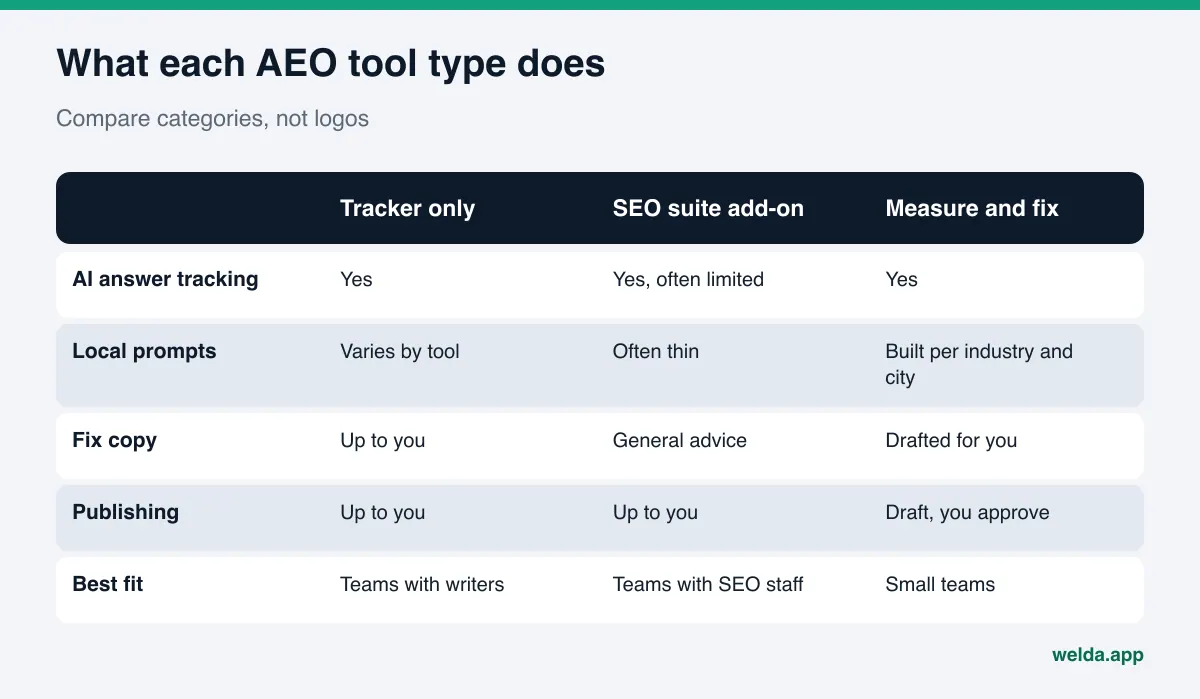
Set the brand names aside and, as of November 2026, the options fall roughly into five categories. A single product can mix features from more than one, but the categories help you figure out which questions matter.
| Category | What it does | Best fit | Watch out for |
|---|---|---|---|
| AI add-ons inside SEO suites | Tracks AI answer mentions within an existing SEO platform | Companies already paying for the suite, with an in-house SEO team | Prompts are often derived from keyword lists; local questions can be thin |
| Monitoring-only trackers | Sends your chosen prompts to AI engines and reports whether you are named | Teams that will read the report and do the work themselves | Fixing is entirely on you; the gap between report and action stays open |
| Free website checkers | Scans your site once and lists technical gaps | Anyone who wants a first look | One-time only; no ongoing tracking |
| Agencies and consultants | A specialist measures, plans and writes content | Businesses with budget that want to hand the job off entirely | Method and measurement are often opaque; results depend on the person |
| Measure-and-fix software | Measures, finds gaps, drafts copy and code, sends it to you for approval | Small teams that want a steady process without hiring | Ask which steps are automated and which still need your hands |
This is not a ranking. For a company with a full SEO team, an add-on inside the suite it already uses may be the sensible choice. For a single-location coffee shop, a monitoring-only tracker can turn into a dashboard nobody acts on. We dig into the people-versus-software question in whether to hire an AEO specialist or use software.
Which criteria should you use to compare the best AEO tools?
The ten criteria below turn into concrete questions you can ask while reading a vendor's website or sitting in a demo. Write down each tool's answer in one sentence; it makes the side-by-side comparison much easier later.
- Which engines are measured? ChatGPT, Gemini, Perplexity and Google AI each reach a different slice of your customers. A tool that checks only one shows part of the picture. Ask whether every listed engine is actually queried, not just mentioned on the pricing page.
- How many times is each question asked? AI answers can change from run to run. A tool that looks at a single answer is measuring a lucky or unlucky moment. Repeating each question and showing the variance tells you how reliable the result is.
- How is the score calculated? Is the formula published, or is it a proprietary black box? What weight does each component carry? Is there a margin of error? A score you cannot explain cannot be tracked month over month.
- Whose questions, and how local? Are the prompts built for your industry, your city and your neighborhood? Can you add your own?
- How do competitors show up? Can you see which competitor wins which question, and from which source? A competitor score is a number; "they are listed on a directory where you are missing" is a task. We cover this in more detail in our piece on ChatGPT rank trackers.
- Are sources shown? Knowing which websites an AI answer relies on tells you where to spend effort. Without source data, a tool can tell you what happened but not why.
- Who does the fixing? Does the tool only flag problems, or does it also draft the copy, the FAQ section and the structured data (Schema) code? Where does that content go?
- Who approves publishing? Does anything go live on your site without your sign-off? In healthcare, legal and financial services this is not a detail.
- Where does the content live? On your own website, or on pages the vendor hosts? What stays with you if you cancel?
- What is being promised? A tool that promises "we will get you to the top of ChatGPT" is promising something it does not control. No tool decides what an AI engine says. An honest tool explains what it measures and prepares, and does not guarantee outcomes.
These criteria do not all carry the same weight. For a small business, three usually decide the matter: local, relevant questions, whether fixes are actually drafted for you, and whether you keep approval over what gets published. Measurement quality matters, but excellent measurement that nobody can act on is still just a dashboard.
How do you run an AEO tool comparison step by step?
Knowing the criteria is not enough; you have to apply them under the same conditions. The sequence below fits into about a week of part-time evaluation.
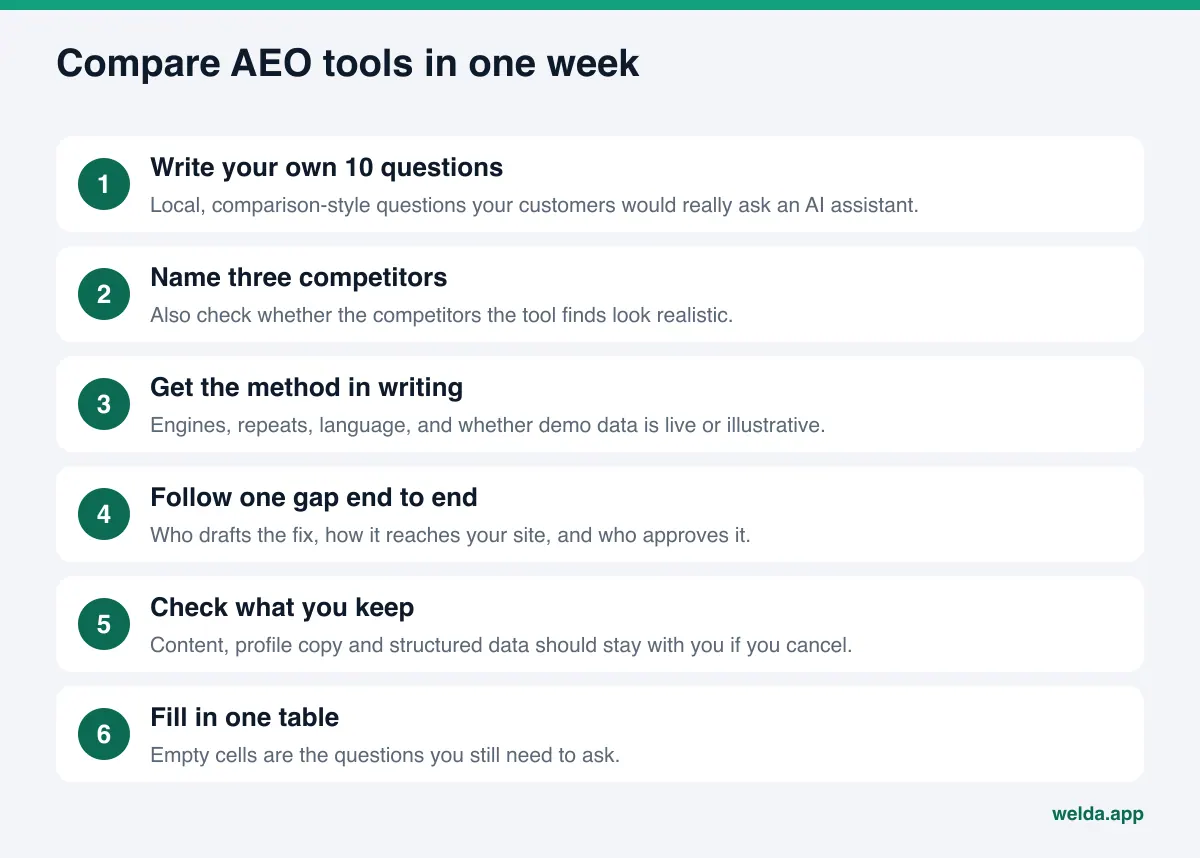
1. Write your own 10 questions. Use questions customers would really ask an AI assistant: "best HVAC repair near me in Phoenix," "kid-friendly brunch spot in Brooklyn," "which physical therapist in Denver takes walk-ins." At least three should name a city or neighborhood, and at least two should carry comparison intent ("which is better," "most affordable"). Give the identical list to every tool.
2. Name your competitors. Pick three businesses you know customers weigh against you. Also look at which competitors the tool finds on its own; if its picks look unrealistic, its prompts probably are too.
3. Ask for the method in writing. Which engines, how many repeats, what date, what language. Ask whether demo data is a live measurement or illustrative sample data. We collected the full list of questions in our AI visibility tool demo checklist.
4. Follow one gap end to end. When the tool says "you have no FAQ section," what happens next? Do you get copy? How does it reach your site? Who approves it? Tracing a single gap from detection to publication tells you more than any feature list.
5. Check what you keep. If you stop using the tool, do the content on your site, your profile descriptions and your structured data stay with you? Can you export reports?
6. Put everything in one table. Record each tool's answer to all ten criteria in the same grid. Empty cells are the questions you still need to ask.
Marking cells "yes" or "no" is not enough. The template below shows what a good answer sounds like for each criterion and which answer should raise a flag.
| Criterion | A good answer | A red flag |
|---|---|---|
| Engines | Each engine named, with how often it is checked | "We monitor all AI platforms" with no detail |
| Repeats | Each question asked several times, variance shown | A score built on a single answer |
| Score | Formula and weights published | "Proprietary algorithm" with no explanation |
| Prompts | Built around your industry, city and neighborhood | Generic national prompts or a raw keyword list |
| Fixes | Copy and code drafted, sent to you for approval | Only "improve your content" advice |
| Content location | Your own website, live once you approve | Separate pages hosted by the vendor |
| Promise | Measurement and preparation explained, limits stated | A promise of top placement in AI answers |
How should you read an AEO score?
Most tools eventually show you a number. That number is only as useful as your understanding of how it is built. Putting two vendors' scores side by side is usually meaningless, because one may count only the share of questions where you are named while another also weighs your position and your share against competitors. The right question is not "which score is higher" but "what exactly does this score track month to month."
A trustworthy score has three traits. First, its components are visible: the share of questions where you appear, the position you are mentioned in, and your share relative to competitors. Second, it carries a margin of error derived from repeats; if answers change when the same question is asked three times, an honest score says "plus or minus a few points." Third, the formula stays stable over time, or any change is disclosed, so last month's number still means something.
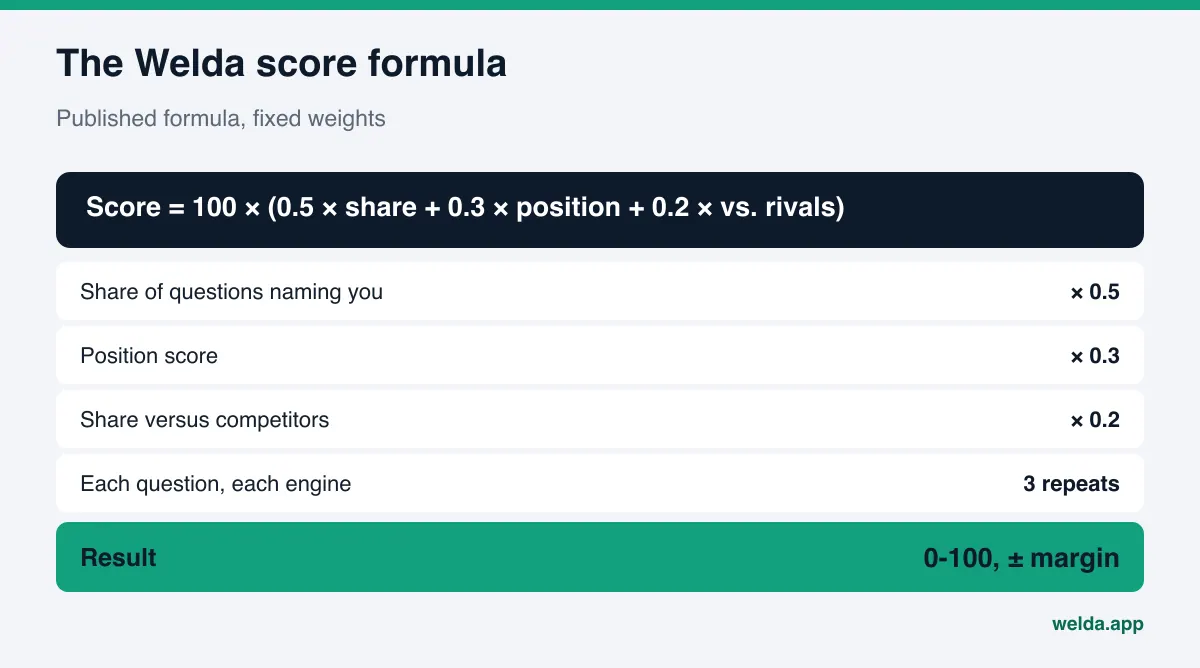
In the Welda dashboard the formula is published: 100 × (0.5 × share of questions where your name appears + 0.3 × position score + 0.2 × share versus competitors). Each question is asked three times per engine, and the margin of error comes from the spread across those three runs. If you already have a report in hand, our guide on how to read your AI visibility report explains each part. Another vendor may weigh things differently; what matters is that they can explain it to you.
One more caution: do not confuse rank tracking with AI visibility tracking. Where you rank on Google and whether you are named in an AI answer are related but separate. Our article on whether SEO plugins are enough for AEO covers where the overlap ends.
How does Welda handle AEO for small businesses?
Welda falls into the last category above: software that measures your AI visibility and prepares the fixes on your behalf. Here is what it does, criterion by criterion, and what stays with you.
First, the honest status. The free analysis works in English and German today. The full Welda dashboard is in early access and is opening first in Turkey; regular four-engine measurement is being added during early access, and the sample dashboard screens are shown with illustrative data. Pricing is discussed in an early access call. If you are a US business, the free analysis is the part you can use right now.
The free website analysis. It reads your homepage and a few inner pages (services, pricing, about, contact) the way Google and AI systems do. It checks whether AI crawlers can access your site (robots.txt), your page title and meta description, your main heading, your business structured data (Schema), your address, phone and location details, whether your social and map profiles are linked from the site, your FAQ section, reviews and trust signals, how clearly your services are described, and page speed. You get a score out of 100 (technical and content scored separately), and for every gap: what was found, why it matters, and how to fix it. It also gives you ready-to-use copy for your homepage (title, description, main heading, intro paragraph, FAQs), a simulation showing how much each fix would raise your score, a competitor comparison, a ready-made fix package to add to your site including the structured data code, and a PDF plus a shareable score card. On top of that, it asks 5 questions your customers might ask to an AI assistant that can search the web, and checks whether your business is named in the answers. That is a one-time measurement. Each site gets one free analysis.
Question tracking in the dashboard. Questions your customers would ask are sent to ChatGPT, Gemini, Perplexity and Google AI three times each. You see which questions name you, where you are mentioned, and where competitors lead. Questions can be run in English or Turkish.
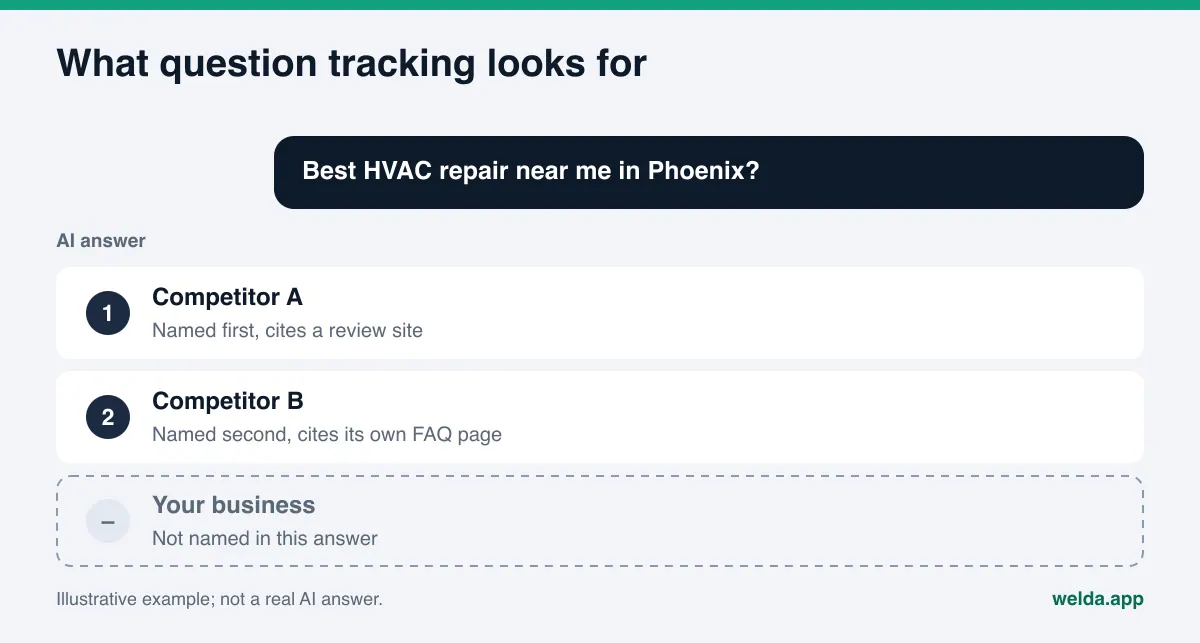
Competitors and sources. The competitors view shows which topic a competitor wins and which source it wins from. The sources view lists the sites AI engines draw on and where you are missing. "Why are they ahead?" becomes a to-do item.
To-do list and ready copy. The to-do list has three parts: information Welda needs from you, items waiting for your approval, and tasks you do by hand. Welda drafts content, profile descriptions and review replies, and the ready copy sits next to each task. Welda does not invent facts it cannot find; it asks you.
Publishing and connections. On WordPress sites, Welda connects through a separate Editor user and an application password, with no code to install. Content opens on your site as a draft and goes live only when you approve it. For systems without a connection, Welda hands you a ready package and you apply it yourself. Google Business Profile, Instagram and Facebook can be connected; if they are not, the task is listed as manual. Your content always lives on your own website; Welda does not host content.
Compliance check and reporting. Before anything is published, a compliance check flags patterns such as price claims, guarantees, superiority claims and diagnostic suggestions. This is not legal advice and has not been reviewed by legal counsel. In healthcare, nothing is published automatically; every piece comes to you for approval, and patient data is never sent to AI. A before-and-after view and a one-page monthly PDF report show what changed.
What no AEO tool can do, and what Welda does not do
When you compare tools, knowing the limits matters as much as knowing the features. Some limits apply to every tool. Others are deliberate choices on Welda's side.
- No guarantees. The companies that build AI engines decide what those engines say. Welda does not guarantee rankings or placement in ChatGPT. Be skeptical of any tool that does.
- It takes time. New content usually takes weeks to show up in AI answers. A first-week measurement shows your starting point, not the result of the work.
- No made-up facts. If Welda cannot read a detail from your site, it leaves it blank and asks you.
- No sensitive content without approval. In sensitive fields, every piece of content waits for your sign-off.
- No fake reviews. Welda drafts replies to reviews; it never writes reviews.
- Some work stays with you. Handling negative reviews, claiming directory listings and press outreach stay with the business. Welda can draft the text.
- The free analysis does not track rankings. It reads your site and runs a one-time, 5-question check; ongoing tracking is what the dashboard is for.
A tool that will not state its limits plainly deserves a lower mark in your comparison table. An honest pitch says "we measure, we prepare, you approve." It does not say "we will put you first."
Checklist: which AEO tool fits your business?
Once your comparison table is filled in, make the decision with the questions below. Start with your own situation, then pick the tool that matches it.
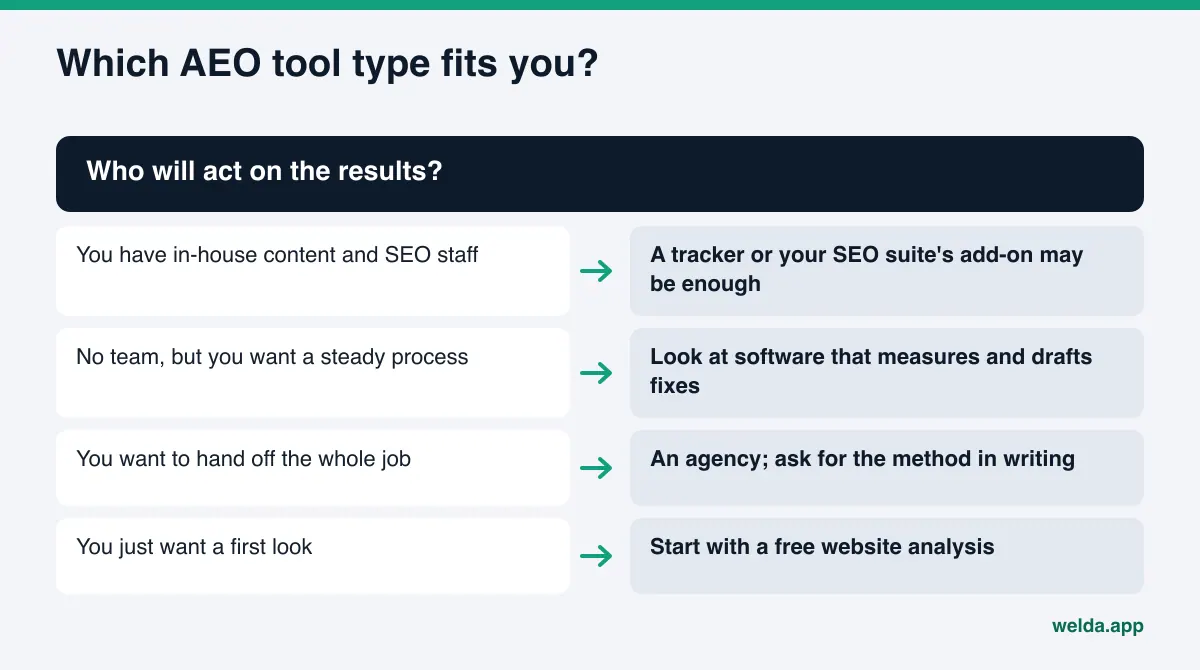
Consider an example. Picture a hypothetical independent dental practice in a mid-sized US city, with no marketing staff and a WordPress website. A monitoring-only tracker would tell this practice every month that it is missing from certain answers, but nobody would be assigned to write the fix. A large SEO suite's AI add-on might be broader than it needs and light on local questions. Here, a tool that measures, drafts the copy and places it on the WordPress site as a draft makes more sense; the dentist just reviews and approves. Now imagine the same practice is part of a regional group with its own content team. A monitoring-only tracker could be perfectly adequate. The right tool depends on who will turn the report into action.
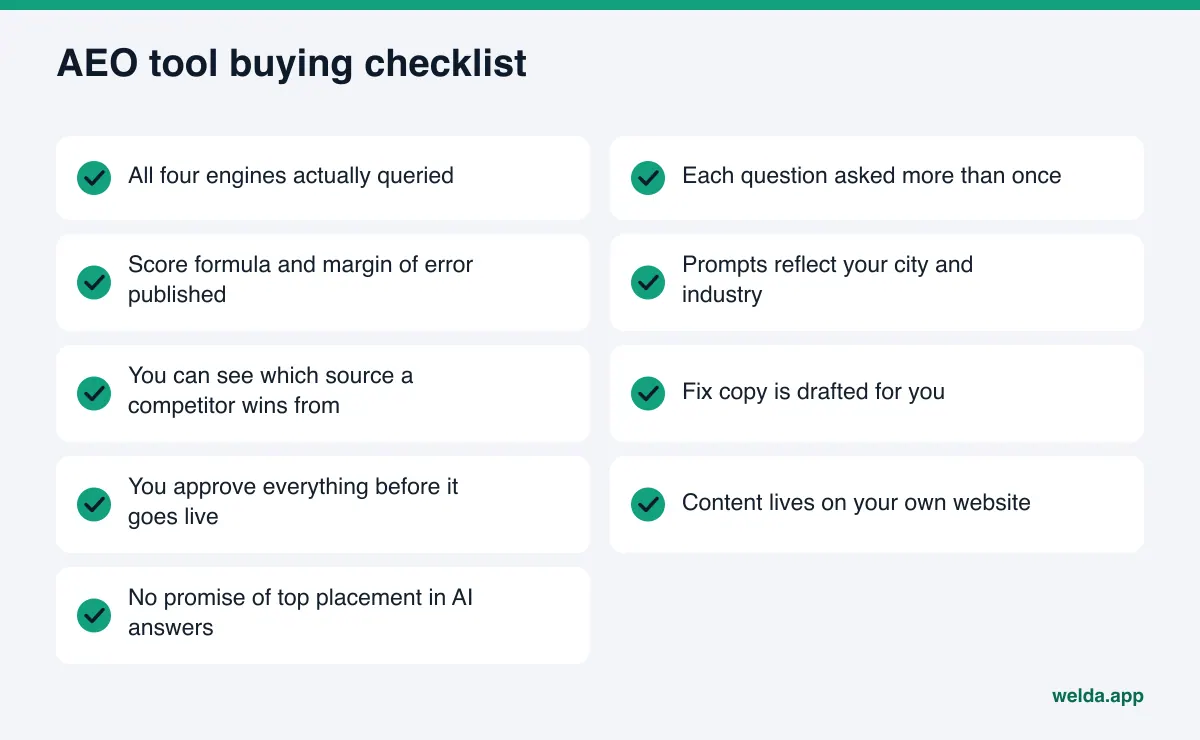
As a final test, check whether every tool you are considering gives a clear answer to three questions: "How is this score calculated?", "Who will fix this gap?", and "Who approves publishing?" If a vendor cannot answer those plainly, the rest of the feature list will not change much.
Frequently asked questions
What is the single best AEO tool?
There is no single best tool for everyone. A company with its own team may need only a tracker; a small business usually gets more from software that also drafts the fixes. Apply the ten criteria above using the same question set for every vendor.
Is a free AEO checker enough?
It is enough to get started. A free analysis shows technical and content gaps on your site. Because AI answers change over time, though, a one-time scan cannot replace ongoing measurement.
My SEO platform already tracks AI answers. Do I need another tool?
Check whether its prompts reflect your local customers and whether it drafts fixes or only reports. If both are covered, you may not need anything else. If not, there will be a gap between knowing and doing.
Can any tool guarantee my business shows up in ChatGPT?
No. The company that builds the engine decides the answer. A tool can measure, prepare fixes and track change over time; it cannot guarantee the outcome.
Which AI engines does Welda measure?
The Welda dashboard measures ChatGPT, Gemini, Perplexity and Google AI, asking each question three times. The dashboard is in early access, and regular four-engine measurement is being added during this period. The free analysis asks 5 questions once to an AI assistant that can search the web.
Can US businesses use Welda today?
Yes, the free analysis works in English. The full dashboard is in early access and is opening first in Turkey. The results link from the free analysis arrives by email and stays open for 14 days.
Start your comparison with your own site
The best way to evaluate any AEO tool is to see it work on your own data. Welda's free AI visibility analysis shows how AI systems read your site, which fix would move your score the most, and how you compare with competitors. Your email and phone are verified, and the results link arrives in your inbox. With that report in hand, you can ask every vendor on your shortlist the same question: "How would we close these gaps with you?"