What should a small business look for in an AI visibility platform? A good AI visibility platform for small business does three things together: it measures whether your business is named in ChatGPT, Gemini, Perplexity and Google AI answers to the questions your customers actually ask, it turns every gap into a ranked to-do list with ready-to-use copy, and it leaves the final publishing decision with you. Tools that only draw charts and leave the work to you tend to stall in a business without a marketing team.
Once a small business owner starts looking into answer engine optimization (AEO), the market looks crowded fast. There are monitoring dashboards built for national brands, AI modules bolted onto classic SEO suites, and services promising to "get you into ChatGPT." You will also see the term GEO, short for generative engine optimization; it describes the same goal, and in the US AEO and "AI search visibility" are the more common names. This guide explains what an AI visibility platform for small business should do, why you should judge it by different criteria than an enterprise tool, the prep work you can do yourself, and how Welda approaches the job. If you want to know where you stand before talking to any vendor, run the free AI visibility analysis of your website. It takes a few minutes, and its report becomes the starting point for the checklist further down.
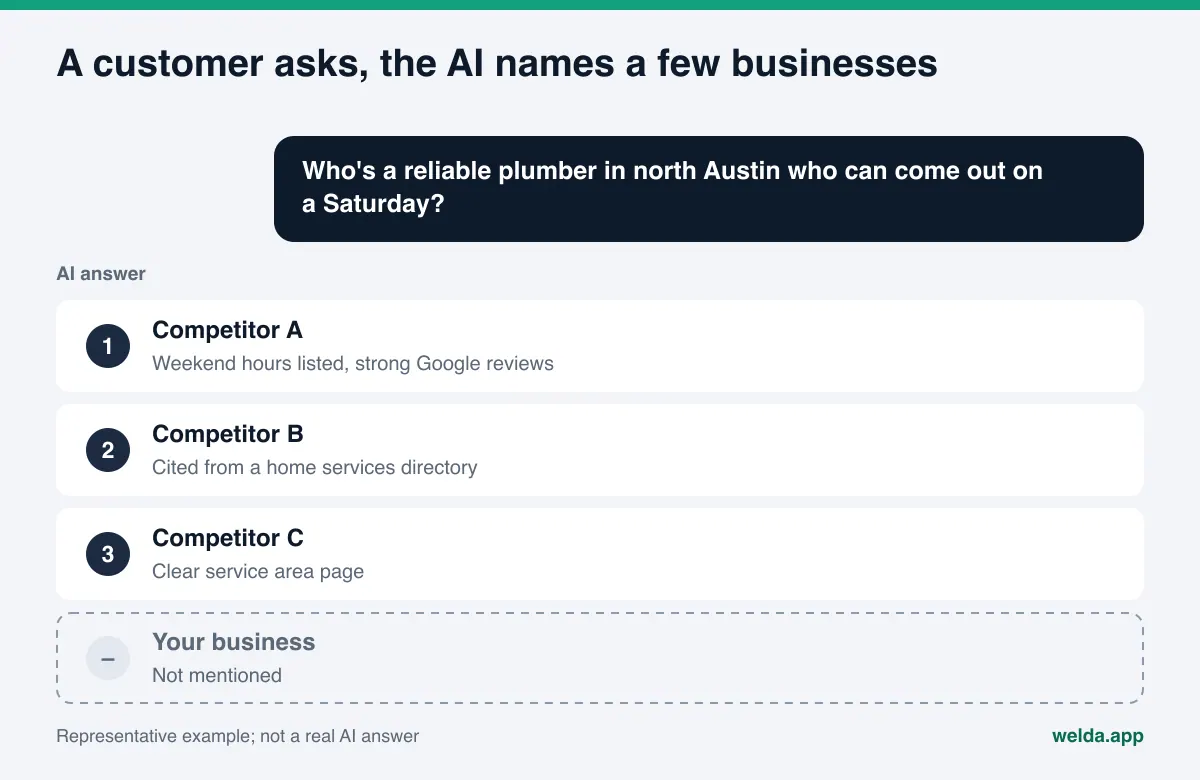
What does an AI visibility platform for small business actually do?
Customers don't only type into a Google search box anymore. They ask ChatGPT "Who's a good pediatric dentist near Cherry Creek that takes new patients?", they ask Perplexity "Best taco truck in East Nashville open late?", and they read Google's AI Overviews or AI Mode before they ever see a list of links. An AI answer has no page one and page two. It has a paragraph and usually three to five business names. If you're not on that short list, a strong classic ranking doesn't help with that particular customer.
The core job of an AI visibility platform is to make that hidden layer visible. It measures which questions mention your business, which don't, where you appear in the answer when you are named, and where competitors are ahead. A good platform doesn't stop at the measurement. It turns the gaps into tasks and drafts the copy for those tasks.
For a small business, this matters for three practical reasons:
- Local questions get short answers. "Near me" and neighborhood questions produce a handful of names. That short list is exactly where a small business competes.
- AI can only describe what it can find. If your hours, service area, services, address and common customer questions aren't clearly written on your site and profiles, an AI answer will describe you vaguely or leave you out.
- Your time is the scarcest resource. An owner running a shop, a practice or a crew doesn't want to interpret charts. The value of a platform is being able to say: "Here's this week's task, and the copy is already written."
So when you compare platforms, the useful question isn't "Which one has the most charts?" It's "Which one prepares the most work for me, and how honestly does it measure the result?"
Why enterprise AEO tools often miss the mark for small business
The first wave of AI search visibility tools was built for large brands. They typically track how often a brand is mentioned across broad category questions, the sentiment of those mentions, and share of voice at a national or global level. For a company with a marketing team, a data analyst and content writers, that works: the tool measures, the team interprets and acts.
In a small business, one person usually wears all three hats. An enterprise-style tool tends to create four problems there:
- The questions aren't local. Brand-level tools measure prompts like "best running shoes." A neighborhood vet clinic or a family-owned HVAC company needs questions that include a city, a neighborhood and a specific need.
- Measurement ends, work doesn't start. A chart says a competitor is ahead. It doesn't say why, which source the AI pulled from, or what you should change.
- Writing is still on you. The tool flags a missing FAQ section or a thin service page, but drafting the new copy falls back on the owner.
- The interface speaks analyst. Terms like "entity coverage" and "share of voice" don't tell a bakery owner what to do on Monday morning.
On the other side are agencies. An agency both measures and executes, but the cost can strain a small budget, and the measurement method often lives inside the agency's own reports. If you're weighing that route, our list of questions to ask an AEO agency will help you compare proposals on equal terms.
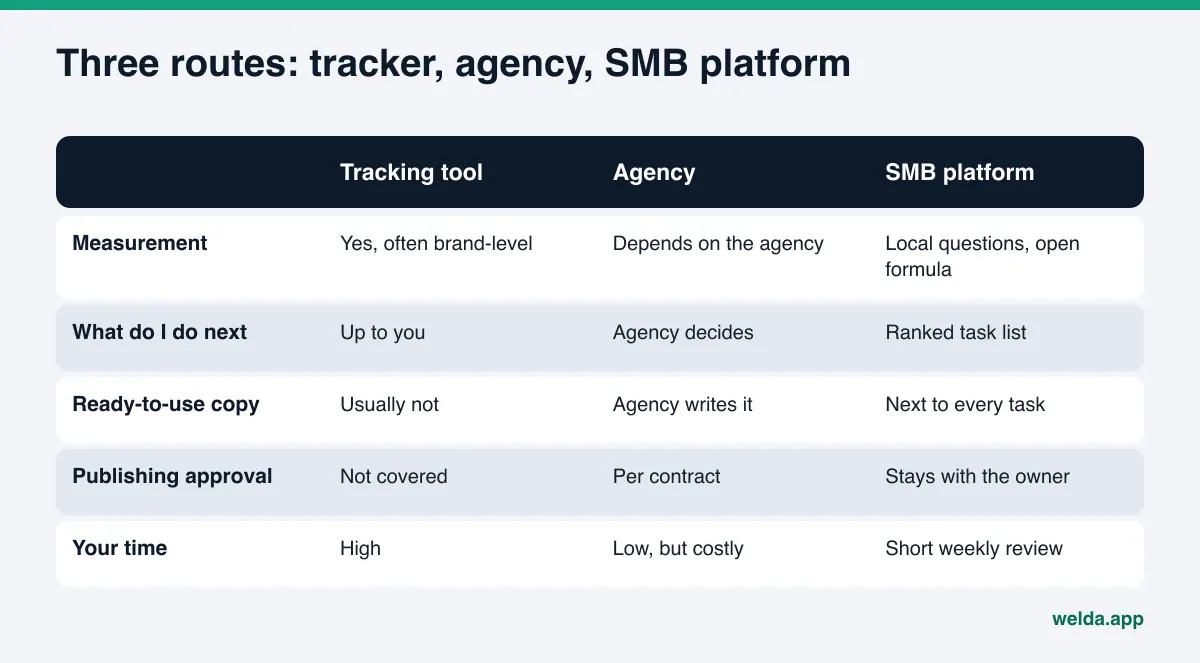
A platform built for small business should sit between those two: measure with the consistency of software, take on the preparation work the way an agency would, and leave the final call and the publishing with the owner.
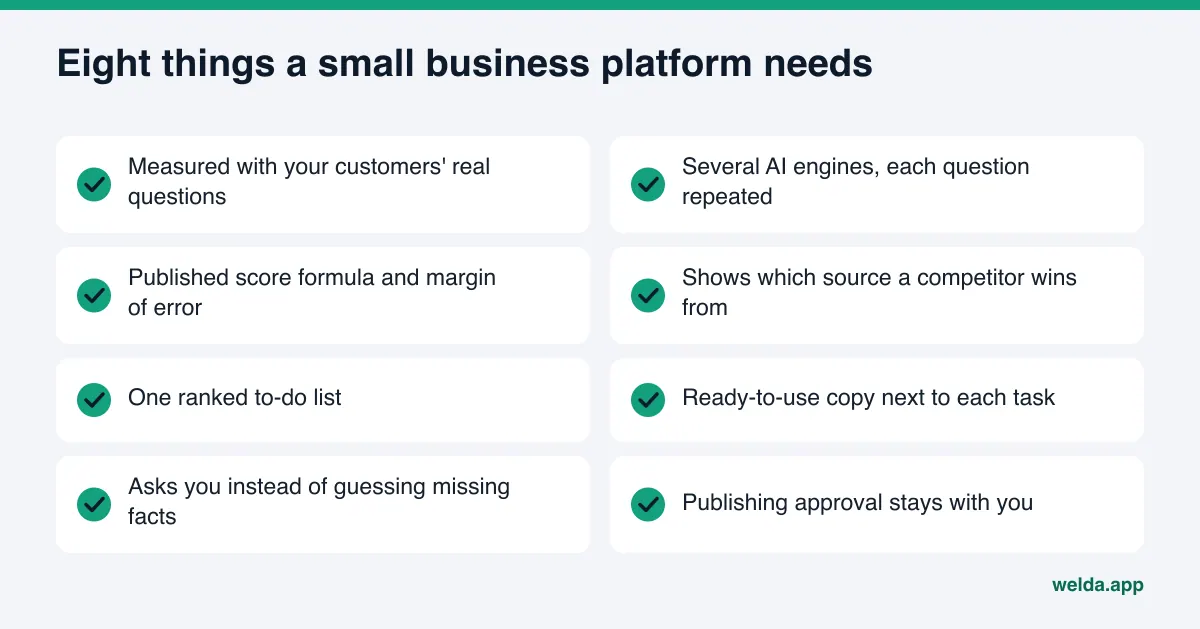
What to look for in an AI visibility platform for small business
The table below lists the questions to ask any vendor and what a good answer looks like for a small business. For a deeper feature-by-feature breakdown, see our guide to AEO tool features.
| Criterion | Question to ask | Good answer for a small business | Red flag |
|---|---|---|---|
| Question set | Which questions do you measure? | Questions your customers would ask, with location and need | Only searches for your brand name |
| Engines | Which AI engines do you check? | ChatGPT, Gemini, Perplexity and Google AI | One engine, one screenshot |
| Repeats | How many times is each question asked? | Several runs; the spread is shown as a margin of error | Firm conclusions from a single run |
| Score | How is the score calculated? | Published formula, parts visible separately | "Proprietary algorithm," no explanation |
| Competitors | Why is a competitor ahead? | Which question, which source they win from | "Competitor is more visible," nothing more |
| Task list | What do I actually do? | One ranked list, ready-to-use copy for each task | A long recommendations PDF |
| Approval | Who publishes? | Platform prepares, owner approves | Automatic publishing without sign-off |
| Promises | Are results guaranteed? | No guarantee; changes take weeks to show | "We'll get you to #1 in ChatGPT" |
The row people skip most often is "Repeats." AI answers aren't fixed. Ask the same question twice in one afternoon and you may get different names. A single screenshot that says "we show up in ChatGPT" or "we don't" proves very little. A trustworthy platform asks each question several times, measures how much the results move between runs, and treats only changes larger than that movement as real. How often you should run those measurements is its own topic; we cover it in how often to measure AI visibility.
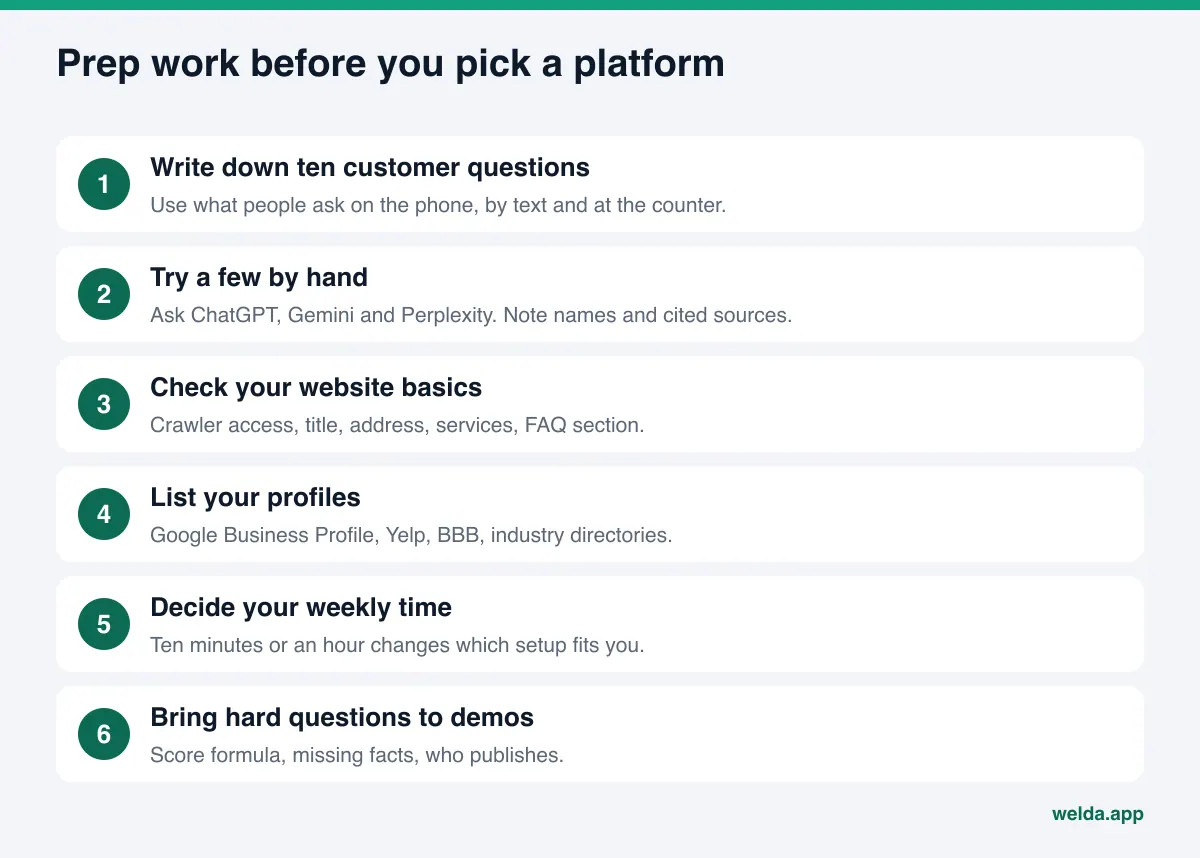
Prep work to do before you choose a platform
A bit of preparation makes the choice easier and gets more out of whichever platform you pick. Most of this fits into one afternoon.
- Write down ten customer questions. Use the questions you hear on the phone, by text and at the counter: "Are you open Sundays?", "Do you take my insurance?", "Is there parking?", "Do you serve the suburbs?" Then rewrite them the way a customer would ask an AI assistant, with a neighborhood, a need and a service.
- Try a few of them by hand. Ask ChatGPT, Gemini and Perplexity. Note whether you're named, which competitors are, and which sites the answer cites, such as Yelp, Tripadvisor, Angi, Healthgrades or a local news site. This is a spot check, not a measurement, but it gives you a picture.
- Check your website basics. Can AI crawlers reach your site (robots.txt)? Do your page title and description say what you do and where? Are your address, phone number and service area clear? Is each service described on its own? Do you have an FAQ section? The free website analysis runs this check automatically.
- List your profiles. Google Business Profile, Yelp, BBB, Facebook, Instagram and the directories that matter in your industry. Note which are current, which link back to your site and which have been forgotten.
- Decide how much time you have each week. Ten minutes or an hour? That answer largely decides which kind of setup fits. If time is short, you need ready-to-use copy and a quick approval flow.
- Bring hard questions to every demo. Take the table above with you. Ask: "What's your score formula?", "How do you handle facts you can't find on my site?", "Who hits publish?" A vague answer is an answer.
Curious how far you can get without paying for anything? Our roundup of free AEO tools shows which parts of this prep work free tools can cover.
How Welda approaches AI visibility for small business
Welda is software that measures where a business shows up in AI answers and prepares the fixes on the business's behalf. Two things stand out from a small business point of view: the measurement is transparent and easy to read, and most of the preparation work is taken off the owner's plate.
A clear word on availability first. The Welda platform is in early access and is opening in stages, starting with businesses in Turkey. Regular measurement across all four engines is being added during early access, and the sample screens in the platform use representative data. What anyone in the US can use today is the free website analysis, which runs in English. The platform interface itself is not yet available outside the early access group. Pricing is discussed in the early access conversation.
Here are the parts that matter most for the topic of this article.
A score you can take apart
In the platform, Welda asks the questions your customers would ask on ChatGPT, Gemini, Perplexity and Google AI, three times each. For every question it records whether you were named, where you appeared in the answer, and how much of the answer went to competitors. The score formula is published:
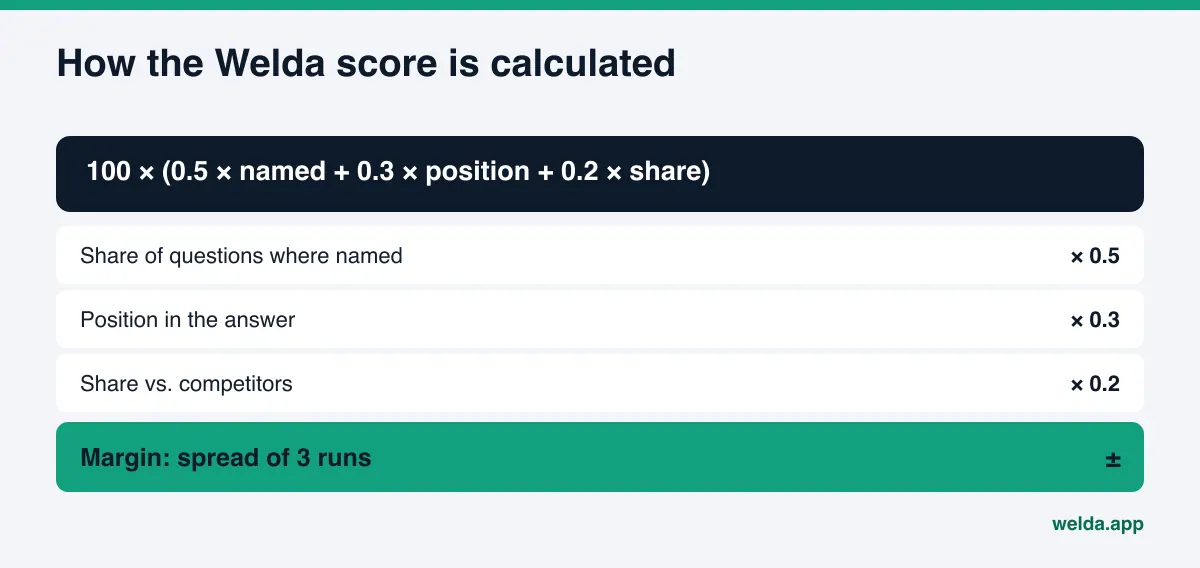
This has a practical payoff for a small business. When the score drops, you can see which part dropped. Are you named in fewer questions? That usually points to missing content or an outdated profile. Are you still named, but further down? That often means a competitor got stronger in a source the AI relies on. The margin of error, taken from the spread of the three runs, tells you when a small dip is just noise. Questions can be asked in English or Turkish.
One task list, with the copy already written
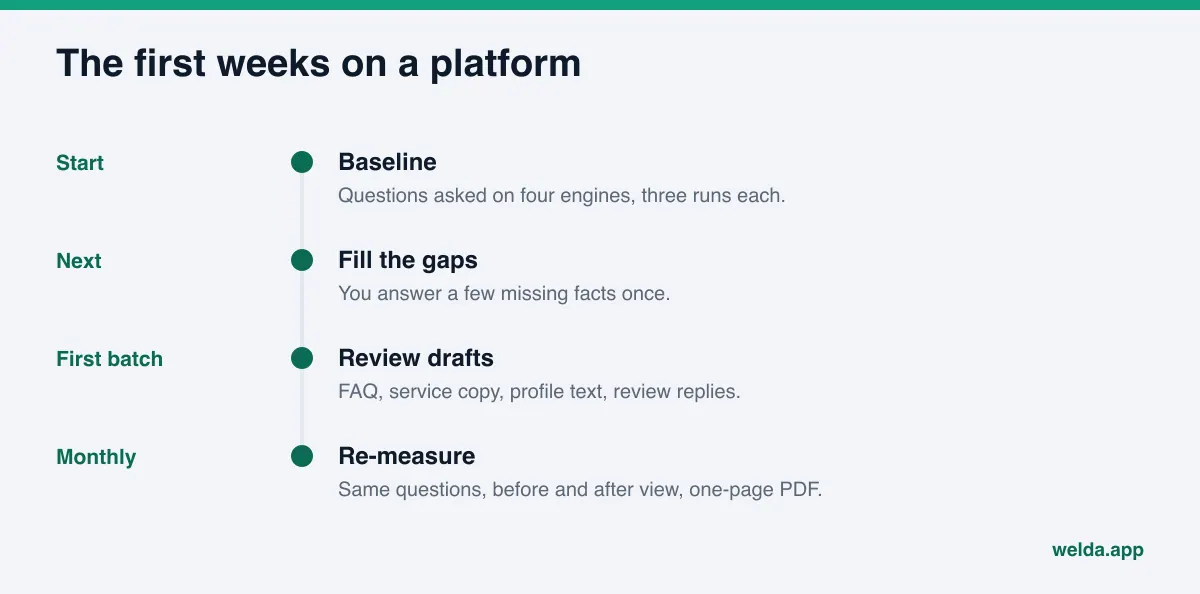
Every gap the measurement finds lands in a single to-do list, split into three groups. First, facts Welda needs from you: if it can't find something on your site, such as the owner's name or a detail about a service, it doesn't make it up. It leaves the field blank and asks. Whatever you type once is carried into every draft. Second, drafts waiting for approval: a new FAQ section, a service page, a profile description or a review reply. Third, manual tasks: for a profile Welda isn't connected to, the copy is ready, and pasting it in and verifying it is up to the account owner.
If your site runs on WordPress, Welda connects through a separate Editor user and an application password, with no code to install. Drafts open on your site as WordPress drafts and go live only when you approve them. Content always lives on your own website; Welda doesn't host content. For other website platforms, Welda provides a ready-made package and the changes are applied by hand. Google Business Profile, Instagram and Facebook can be connected; if they aren't, the related task shows up as manual.
The rest of the platform, including competitor and source views, a compliance check that flags pricing, guarantee and superiority claims before publishing (not legal advice), a before-and-after comparison and a one-page monthly PDF report, rounds out the picture. Most small business owners will spend their time on the home screen and the to-do list.
Start with the free AI visibility analysis
Before you commit to any platform, you need to know how your website looks to Google and to AI systems. Welda's free analysis answers that, and it's open to everyone today in English. It reads your homepage and a few inner pages, such as services, pricing, about and contact.
It checks whether AI crawlers can access your site (robots.txt), your page title and meta description, your main heading, business information markup (Schema), address, phone and location details, whether your social and map profiles are linked from the site, your FAQ section, reviews and trust signals, how clearly your services are described, and page speed. You get a score out of 100, with technical and content scores shown separately, and for every gap: what was found, why it matters, and how to fix it.
The outputs a small business owner tends to use most are the ready-to-use homepage suggestions (title, description, main heading, intro paragraph and FAQs), a simulation showing how much each fix would raise the score, a competitor comparison, and a ready-made fix package that includes the business information code for your site. You also get a PDF and a shareable score card. On top of that, the analysis asks five likely customer questions to an AI assistant that can search the web and checks whether your business name appears in the answers. That's a one-time check, not ongoing tracking.
The analysis is free once per website. Your email and phone number are verified, the results link arrives by email and stays open for 14 days. It doesn't measure rankings and doesn't promise any.
Limits: what Welda won't do
Knowing what a platform won't do is as useful as knowing what it will. Welda is upfront about these:
- No guarantees. There's no promise of rankings or of "showing up in ChatGPT." No platform controls AI answers. What can be done is making sure the information an AI needs to describe you accurately is complete and easy to find.
- No guessing. Facts that aren't on your site aren't invented. You're asked.
- No unapproved sensitive content. Publishing approval stays with the business. In healthcare there's no automatic publishing at all; every piece goes to approval, and patient data is never sent to AI.
- No fake reviews. Welda drafts replies to reviews. It doesn't write reviews.
- Some work stays with you. Handling negative reviews, claiming and verifying directory listings and press outreach remain the owner's job. Welda can prepare copy and lists, but doesn't run those efforts.
- No overnight results. New content usually takes weeks to show up in AI answers. Expecting a big jump in month one isn't realistic.
These limits can look like downsides, but in practice they protect you. A service that promises the top spot in ChatGPT is either promising something it can't control or measuring in a way that flatters itself.
Checklist: choosing an AI visibility platform for small business
Print this list before your next vendor call and mark each line yes, no or unclear. If you end up with more than three noes or unclears, the platform was probably built for a bigger team than yours.
- Is measurement based on the local, need-specific questions my customers ask?
- Are several AI engines checked, and is each question repeated?
- Is the score formula explained, with a margin of error?
- Can I see which question and which source a competitor wins from?
- Do findings turn into one ranked to-do list?
- Is there ready-to-use copy next to each task?
- Are missing facts asked of me rather than guessed?
- Does publishing approval stay with me, and does content live on my own site?
- Does the vendor avoid guarantees and say plainly that results take weeks?
- Does the weekly time this takes fit my schedule?
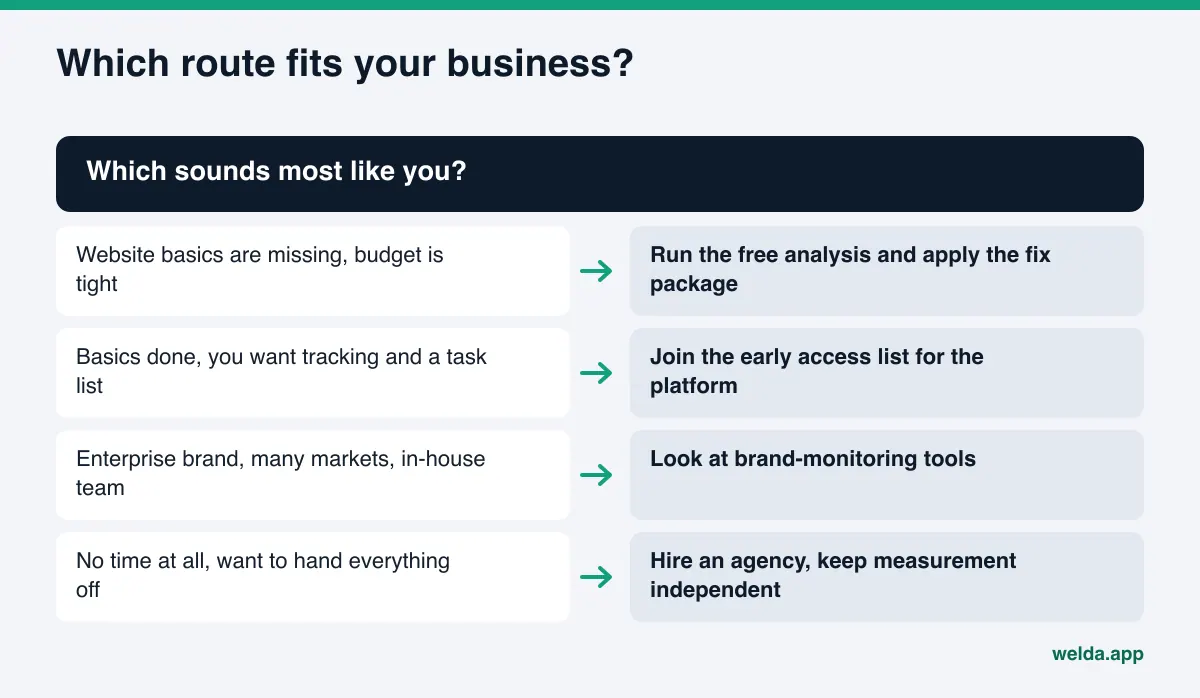
Two example scenarios make the choice more concrete. Picture an example family bakery in the suburbs: the owner starts at 4 a.m., the website is a few years old, and the Google Business Profile still shows last year's holiday hours. A chart-heavy tracking tool would be dead weight here. Running the free analysis, applying the fix package and updating the profile comes first. Once the basics are in place, the owner can decide whether ongoing measurement and a task list are worth it. If you want a broader look at tracking options, our ChatGPT rank tracker guide explains what tracking alone can and can't tell you.
Now picture an example boutique inn in a tourist town: competitors are strong on Tripadvisor, guests ask detailed questions about pets, parking and accessibility, and some ask in other languages. For a business like that, question-by-question measurement and a view of which sources competitors win from carry much more weight.
Frequently asked questions
How is an AI visibility platform different from an SEO tool?
An SEO tool tracks keyword rankings and clicks. An AI visibility platform tracks whether your business is named in AI answers to customer questions, where in the answer you appear, and how you compare with competitors. Solid SEO basics support AI visibility, but they don't replace measuring it.
How much time does a small business need to spend on AEO?
It depends on the setup. With ready-to-use copy and an approval flow, most of the work is reviewing drafts and filling in missing facts once. Manual profile updates typically take a few minutes each.
Can I use Welda in the US today?
The free website analysis works in English and is open to everyone. The full platform is in early access and is opening first in Turkey. Pricing is discussed in the early access conversation.
Will a platform guarantee I show up in ChatGPT?
No. No platform controls AI answers, and Welda makes no such promise. What a platform can do is make your information complete and consistent across your site and profiles, then measure the result over time.
My site isn't on WordPress. Does that matter?
On WordPress, Welda connects without code and opens drafts on your site. On other platforms, Welda provides a ready-made package and you or your web person apply it by hand. Either way, the content lives on your website.
When will I see results?
New content usually takes weeks to show up in AI answers. That's why measurement should be regular rather than one-off, and why small changes should be read against the margin of error.
Your first step: see where you stand today
The most reliable way to choose an AI visibility platform for small business is to know your starting point first. To see how your website reads to AI systems, which gaps cost you the most points and how you compare with competitors, start the free AI visibility analysis. Along with your score you'll get ready-to-use copy suggestions and a fix package you can apply right away, with or without a platform.