Reputation management software vs AEO tools: which one does your business need? They answer different questions. Reputation management software gathers what customers write about you and helps you reply. An AEO tool checks whether ChatGPT, Gemini, Perplexity and Google's AI features name your business when customers ask, and helps fix what is missing. If your reviews are strong but AI assistants still recommend someone else, the second one is the gap.
This guide puts the two tool types side by side: what each measures, what each leaves out, where they overlap, and how to decide. There is a decision checklist and an FAQ at the end. If you want to see your own situation first, the free AI visibility analysis shows in a few minutes how your website reads to search engines and AI systems.
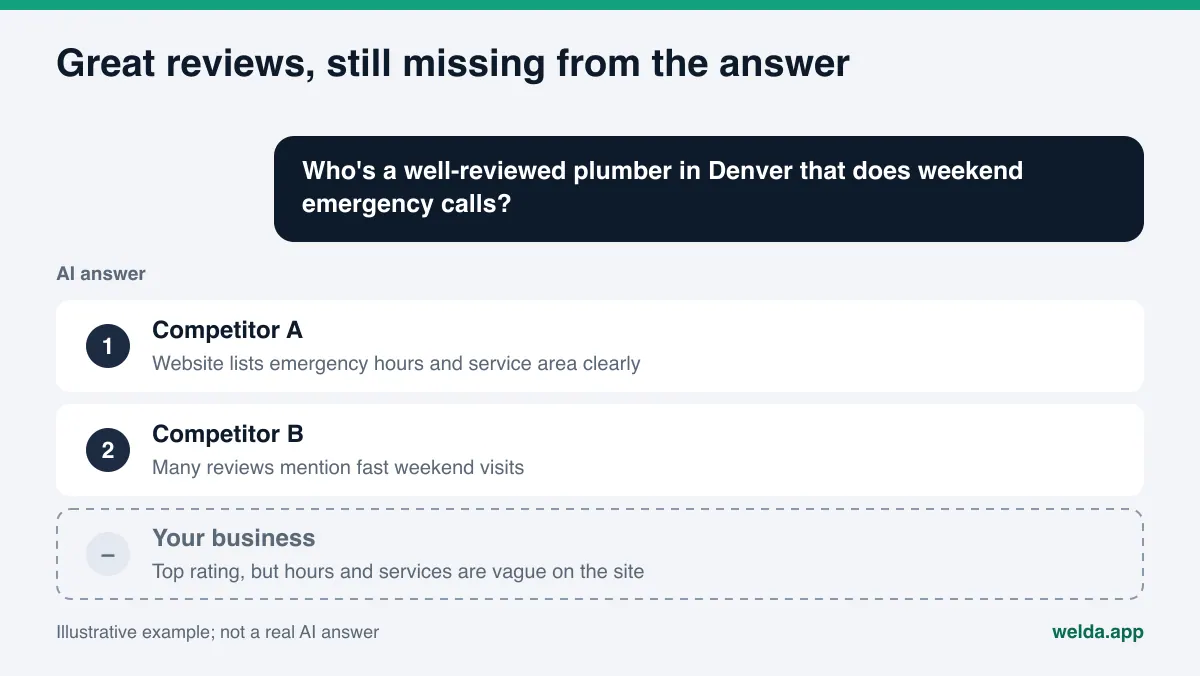
What reputation management software does, and what an AEO tool does
Reputation management software pulls together what people say about your business. In a typical setup it collects reviews from Google Business Profile, Yelp, Facebook, Tripadvisor, the BBB and industry sites such as Healthgrades or Angi into one inbox. It alerts you to new reviews, makes replying faster, tracks your average rating, and often sends review requests to recent customers by text or email. Its center of gravity is the customer's voice: what was said, when, and whether anyone answered.
An AEO tool looks from a different angle. AEO stands for answer engine optimization: making sure AI assistants that answer questions directly can find, understand and name your business. You may also see the term GEO (generative engine optimization) used for the same work; in the US, AEO and "AI search visibility" are the more common labels. An AEO tool takes the questions your customers actually ask ("best family dentist in Plano", "plumber open Sunday in Denver") and checks whether AI answers to those questions mention you. Then it looks for the reasons: Can AI crawlers reach your site? What do your page title and description say? Is there LocalBusiness schema? Are your services spelled out? Which source is your competitor winning with?
The two overlap on reviews. When AI assistants search the web to answer a local question, they draw on review sites and map listings as well as business websites. So well-managed reviews do help your AI visibility. But reviews are not the only condition for being named. For an AI system to connect you to a specific question, it needs to read what you do, where you do it and who you serve.
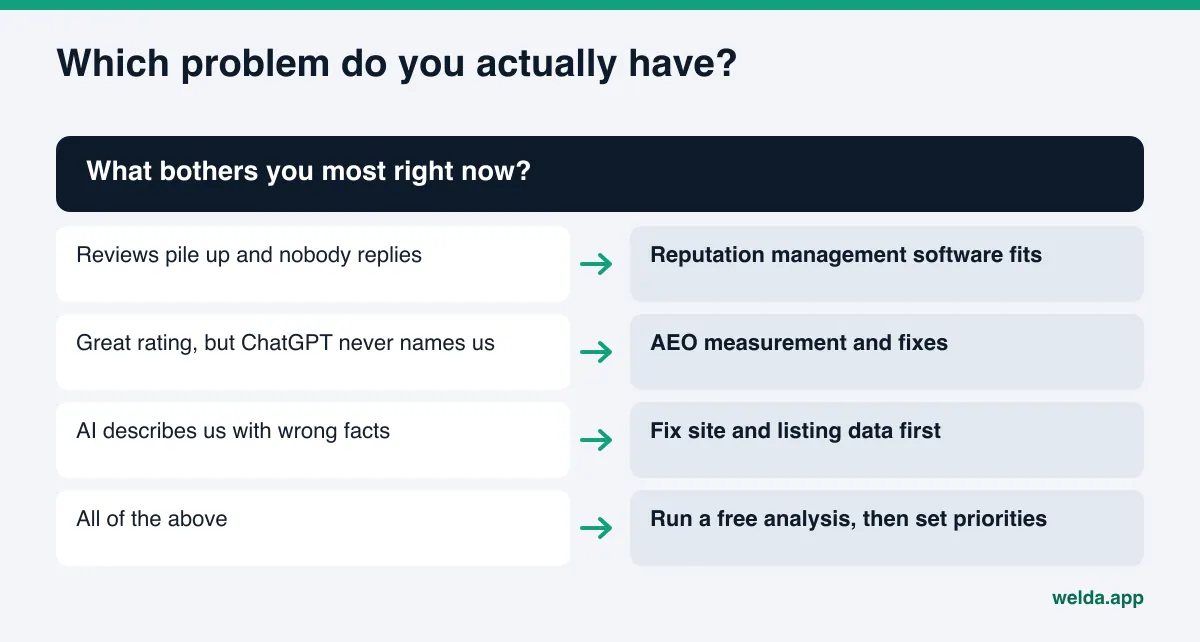
| Topic | Reputation management software | AEO tool |
|---|---|---|
| Question it answers | What are customers saying about us? | Do AI answers name us, and if not, why? |
| Where it looks | Review sites, map listings, business profiles | AI answers, the sources they cite, your own website |
| What it measures | Review count, rating, response rate, sentiment | Which questions name you, in what position, your share versus competitors |
| Relation to your website | Usually none, or a review widget | Direct: titles, descriptions, schema, FAQ, service copy |
| Work it produces | Review replies, review requests, alerts | Gap list, ready-to-use copy, fix package, re-measurement |
| When it falls short | Good rating, but AI still does not recommend you | You need to run a daily review workflow |
Why the two get confused so often
The first reason is language. Both are sold as being about "reputation." When an owner asks how AI describes their business, it sounds like a reputation question, so the first tool that comes to mind is the one that watches reviews.
The second reason is that many reputation platforms have added AI features: drafting review replies with AI, summarizing review themes, flagging sentiment. Those features can be useful, but they use AI as a writing assistant. They do not tell you whether you show up in AI answers. "AI-powered review management" and "a tool that measures your visibility in AI answers" are different products. Before you buy, look for a direct answer on the vendor's site to one question: does this tool ask ChatGPT, Gemini or Perplexity real customer questions and show whether we are named?
The third reason is that the symptoms land in the same place. When a customer cannot find you, or hears wrong facts about you, it feels like a reputation problem. Often the root cause is something else: hours that are not on your site, services that are never described one by one, or a Google Business Profile that shows a different address than your website. Those are information problems, and more reviews will not fix them.
We have drawn similar lines for other tool categories. For tools that track brand mentions on social platforms, see social listening vs AI monitoring. For tools that track Google rankings, see rank tracker vs AI visibility tracker.
Reputation management software vs AEO tools: start with a diagnosis
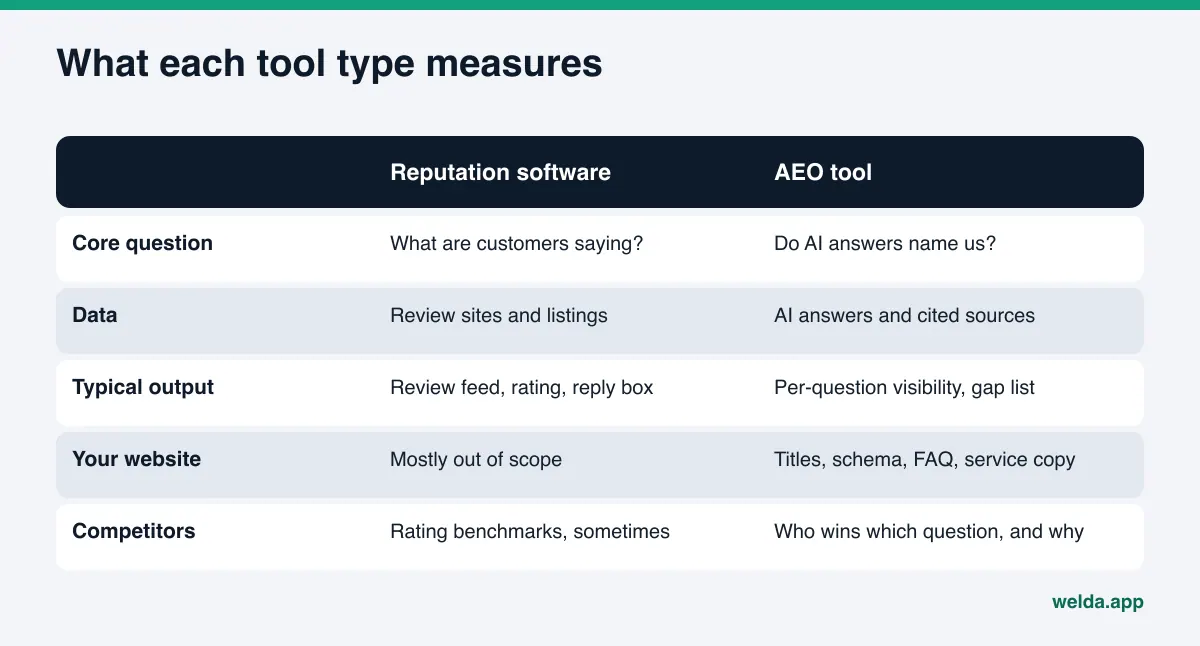
The right choice starts from the problem in front of you, not from a feature grid. These four situations are where most businesses land when they face this decision.
- Reviews pile up and nobody answers. You get reviews on several platforms, some sit unanswered for weeks, and you notice negative ones late. That is a workflow problem, and it is exactly what reputation management software is built for.
- Your rating is strong, but AI does not recommend you. When customers ask for the "best" or "near me" option, competitors appear and you do not. That is a visibility problem. More reviews alone may not change it.
- AI describes you with wrong facts. An old address, hours that say you are closed, a service you stopped offering. That is a data consistency problem. You need to find the source and bring your site and listings to the same facts.
- You are not sure which it is. This is the most common case. Measure first, then decide.
A step-by-step way to decide
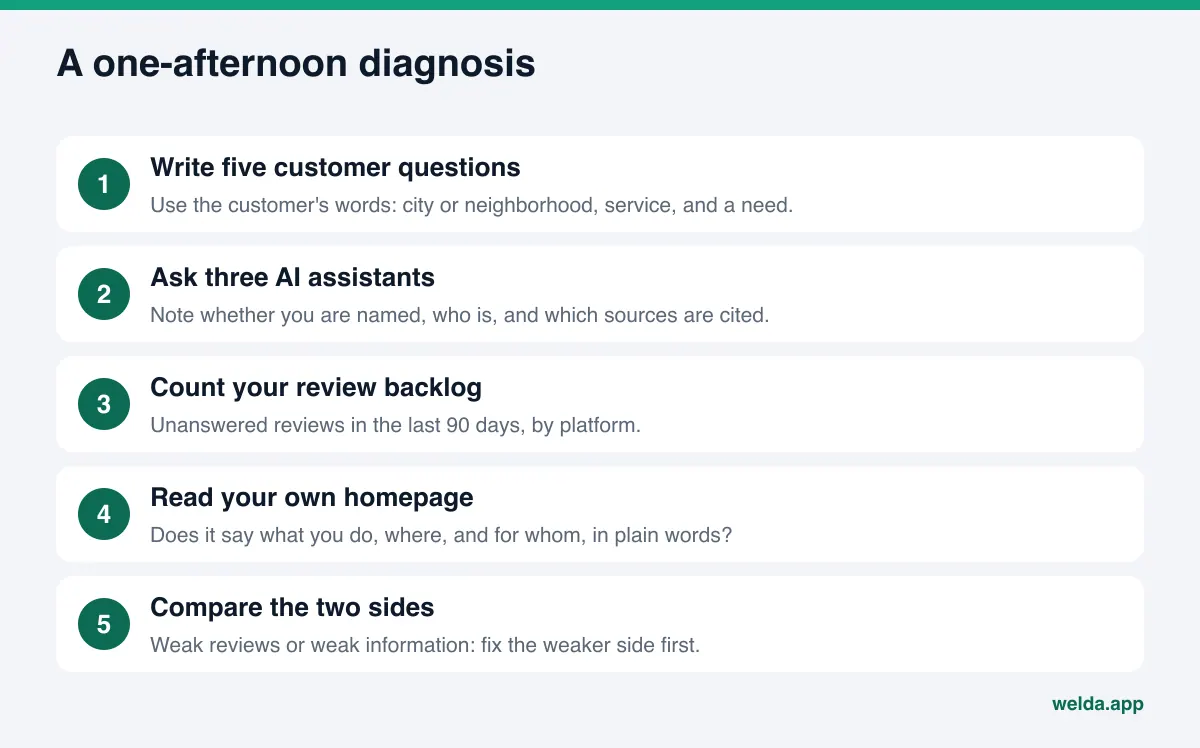
You can run the steps below in one afternoon without buying anything. At the end you will know which tool you need, or whether you need both.
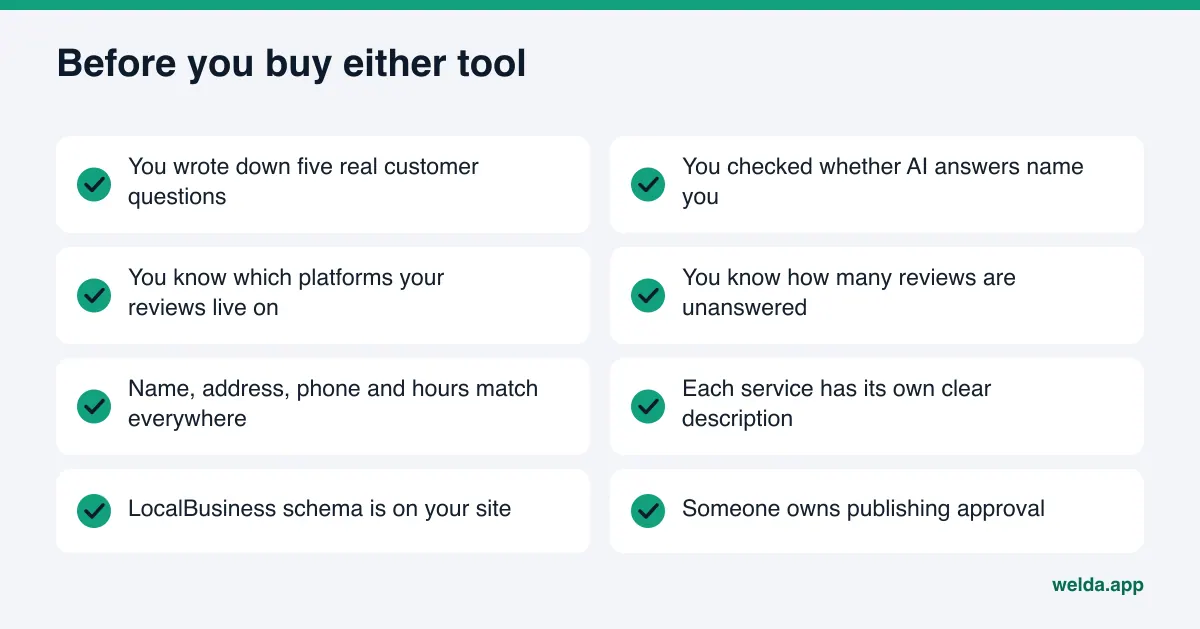
- Write down five customer questions. Use the customer's words, not yours. "Quiet brunch spot in Wicker Park", "pediatric dentist that takes new patients in Plano", "dog boarding near me with webcams". Each should include a place, a service and a need.
- Ask the AI assistants. Put the same question to ChatGPT, Gemini and Perplexity and write down the answers. Are you named? Who is? Which websites are cited as sources? A single run varies, so treat the result as a direction, not a verdict.
- Count your review backlog. Which platforms carry your reviews? How many went unanswered in the last 90 days? How long did it take to respond to negative ones? Your own dashboards can answer this.
- Read your own website. Does the homepage title say what you do and where? Does each service have its own clear description? Are your name, address, phone and hours identical on the site, on Google Business Profile, on Yelp and in directories? Is there a real FAQ section?
- Put the picture together. If the review side is messy but AI already names you, start with reputation software. If reviews are under control but AI does not name you, start with AEO. If both are weak, fix the information and website side first; reviews then attach to something AI can understand.
There is also a difference between checking once and tracking over time. AI answers shift from week to week. We cover that trade-off in one-time AEO audit vs ongoing tracking.
How reviews feed AI answers
It is easy to overstate or understate the role of reviews in AI search visibility. When an AI assistant searches the web to answer a question, it combines several sources before naming a business. Some of those are map listings, directories and review sites. Some are the business's own website. How much weight each source carries depends on the question, the industry and the AI system.
Reviews contribute in three ways. First, the words customers use connect a business to a need. Phrases like "came out on a Sunday", "great with nervous kids" or "easy parking" can match the way a customer phrases a question. Second, a steady flow of reviews can read as a trust signal. Third, your replies to reviews carry extra information about the business: which services you offer and how you work.
What reviews cannot do is describe your business completely. Each customer writes about their own visit. Your service list, hours, service area and how you price work belong on your website and your listings. AI systems need that structured information to connect you to a question. That is why a business with excellent reviews and a thin website can still lose the answer to a competitor.
Source mix matters too. Depending on the industry, AI answers in the US may cite Google Business Profile, Yelp, Tripadvisor, the BBB, Healthgrades, Angi or local news and city guides. Your review software may not watch every one of them, and it will not tell you which of them AI actually cites in your category. Knowing which sources matter tells you where to spend effort. For the directory side of this, see business directories for AI visibility.
Example scenario: a top-rated plumber who never gets named
This is an illustrative example, not a real business. Picture a plumbing company in a mid-size city with hundreds of Google reviews and a strong rating. The owner uses reputation management software and answers almost every review within a couple of days. Still, when someone asks an AI assistant for "a plumber open on Sunday for a burst pipe", two competitors are named and this company is not.
A quick diagnosis tells the story. The company's website is a single page with a logo, a phone number and a contact form. Emergency hours are not written anywhere. The service area is not listed. The homepage title is just the company name. One competitor has a page titled "24/7 emergency plumbing" listing every neighborhood it covers. The other has a detailed, verified profile on a home services directory that AI answers cite often in this category.
More reviews would not fix this. The work is to state emergency hours, service area and services clearly on the site, add LocalBusiness schema, add an FAQ with questions like "do you come out on weekends", and complete the directory profile that keeps getting cited. The reputation software keeps doing its job. What was missing was information.
How Welda does this work
Welda is not reputation management software. It does not gather your review feed into one inbox and it does not send review requests to customers. Welda's job is to measure where you stand in AI answers and to fill the gaps on your behalf. Three parts of it relate directly to this comparison: the free analysis, the sources view and review reply drafting.
The free analysis. This is the part anyone can use today, and it works in English. It reads your homepage and a few inner pages (services, pricing, about, contact) the way search engines and AI systems do. On the review side, it checks whether reviews and trust signals are visible on your site, whether your Google Business Profile and social profiles are linked from it, and whether your address, phone and location details are consistent and readable. You get a score out of 100 (technical and content scored separately), what was found for each gap, why it matters and how to fix it, plus a competitor comparison and a ready-to-add fix package that includes LocalBusiness schema code. It also asks five likely customer questions to an AI assistant that can search the web and checks whether your business name appears in the answers. That is a one-time snapshot, and it tells you which side of the problem to start on.
The sources view. In the Welda dashboard, the sites AI answers cite are listed with your status on each: profile present, incomplete or unverified, or site not reachable. That is the piece review software cannot give you. If AI answers in your category lean heavily on one directory, an incomplete profile there matters. If a review site is never cited, it drops in priority. You decide what to act on; the view shows where to look.
Review replies and profile copy. Welda drafts review replies and profile text that address what the reviewer said and carry accurate facts about the business. Publishing approval stays with you. When Google Business Profile is connected, an approved reply goes there. When a platform has no publishing connection, the task appears as a manual item with the drafted text next to it, ready to paste. Welda does not write fake reviews and does not try to remove negative ones.
Behind all this, the dashboard asks your customer questions to ChatGPT, Gemini, Perplexity and Google AI three times each, so you can see whether your review and listing work shows up in the answers. The score formula is public; see AEO KPIs for how to read it.
A plain note on status: the free analysis works in English and German today. The full Welda dashboard is in early access and is opening first for businesses in Turkey; regular four-engine tracking is being added during early access, and sample dashboard screens use representative data. Pricing is discussed in the early access conversation.
Limits: what Welda does not do
When you compare two tool types, knowing what each does not do matters as much as what it does. On Welda's side:
- No guarantees. Welda does not guarantee rankings or that you will "show up in ChatGPT." The AI system decides what it answers.
- No fake reviews. It does not write reviews, buy them or ask staff to post them. The FTC's final rule on fake reviews and testimonials, announced in August 2024, bans fake reviews, including AI-generated ones, and certain review suppression tactics. This is not legal advice.
- Negative reviews stay with you. A reply can be drafted, but talking to the customer, fixing the issue and disputing a review with the platform are the business's job.
- Directory accounts and press outreach stay with you. Welda prepares text and lists; creating and verifying accounts and talking to editors is your work.
- It does not make things up. If it cannot read a fact from your site, it asks you instead of guessing.
- No sensitive content without approval. Price, guarantee and superiority claims are flagged before publishing.
- It takes time. New content usually takes weeks to show up in AI answers.
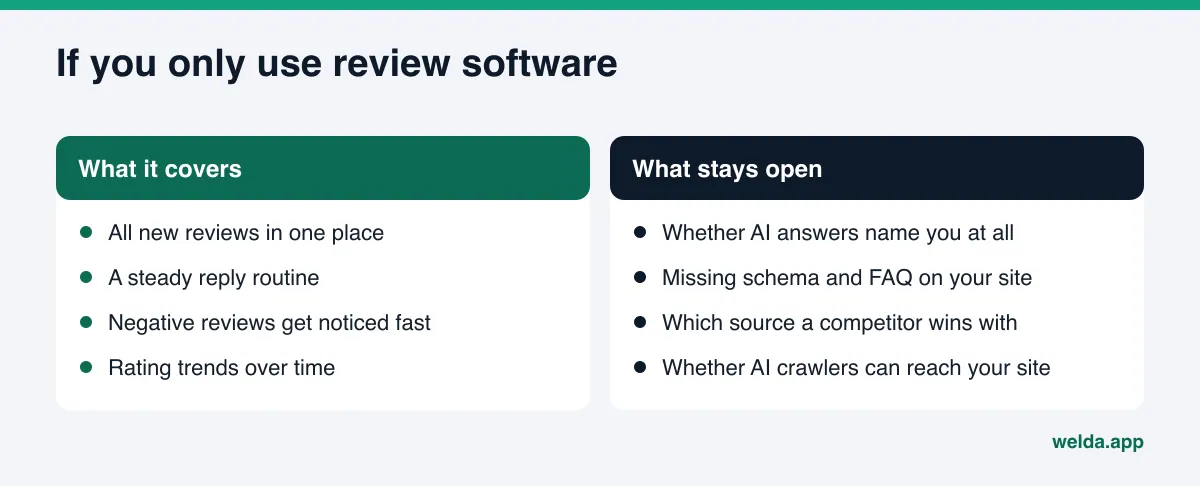
Reputation management software has its limits too. Even a flawless review workflow will not show you missing schema, a robots.txt file that blocks AI crawlers or a vague service list. It will not show which source a competitor is winning the answer with. Those need a separate measurement.
When does it make sense to use both?
For some businesses, running both tool types side by side is reasonable: multi-location businesses, high review volume, or reviews spread across many platforms. Think of a hotel getting reviews every week on booking sites, Tripadvisor and Google. Managing that flow is a job of its own, and review software lightens it. If the same hotel is missing from the answer to "boutique hotel near the beach in San Diego", that is a second job.
If you run both, split the roles clearly. Collecting reviews and replying quickly stays in the reputation tool. Measuring AI answers, analyzing sources and fixing the website side stays in the AEO tool. Write down who owns which platform so the same review does not get two different drafted replies.
For most small businesses, one tool is enough. A salon that gets a handful of reviews a month can reply directly in Google Business Profile. The real gap is more likely what its website and listings tell AI systems.
| Your situation | Priority | Why |
|---|---|---|
| Few reviews, thin website | AEO and website information | Not much review flow to manage; the gap is information |
| Many reviews, no reply routine | Reputation management | Unanswered reviews affect customers and the sources AI reads |
| Many reviews, strong rating, absent from AI | AEO | The review side works; information and sources are missing |
| AI states wrong facts | Data consistency | Reviews cannot fix conflicting site and listing data |
| Multi-location, many platforms | Both, with clear roles | Volume and visibility are two separate workloads |
Decision checklist
Answer each with a yes or no. The answers point you to the right tool.
- Do you get reviews on more than one platform every week? If yes, review software will ease the workflow.
- Were any reviews left unanswered in the last 90 days? If yes, set up a reply routine first.
- Do AI answers name you for your five customer questions? If not, AEO is the priority.
- Does AI describe you with wrong facts? If yes, fix site and listing data first.
- Is there LocalBusiness schema and a real FAQ on your site? If not, that is AEO work.
- Do you know which source your competitor wins the answer with? If not, you need source analysis.
- Who approves what gets published? Whatever you choose, name that person up front.
Frequently asked questions
Will reputation management software improve my AI visibility?
It can help indirectly. Answered, steady reviews make you look better in sources AI assistants draw on. But it does not measure whether you are named in AI answers, and it does not fill gaps on your website.
Does an AEO tool manage my reviews?
It depends on the tool. Welda drafts review replies for your approval, but it is not a review management system that collects every review into one inbox, and it does not send review requests.
My rating is high, so why doesn't ChatGPT recommend me?
A high rating is not the only condition for being named. The AI system has to be able to read what you do, where and for whom. If your site does not say that clearly, or blocks AI crawlers, your rating alone will not carry you.
AI keeps surfacing a negative review about us. What should we do?
Find which source it comes from and post a calm, specific reply. If the issue was resolved, say so. Clear information on your own site about the topic helps too. Asking a platform to remove a review goes through that platform's own rules and is the business's call.
Do I need both tools?
Most small businesses do not. If your review volume is low, reply from your profile dashboards and put the effort into AEO. Multi-location businesses with high review volume may find both useful because the two tools do different jobs.
Does the free analysis look at my reviews?
It does not read reviews one by one. It checks whether reviews and trust signals are visible on your site, whether your map and social profiles are linked from it, and whether your contact details are consistent.
See where you stand
The answer to reputation management software vs AEO tools is already sitting in your website and in today's AI answers. If customers praise you in reviews but cannot find you through AI assistants, the first step is to see what is missing. Run the free AI visibility analysis to see how your site reads to AI systems, which fixes come first, and whether your business is named for five customer questions.