Social listening vs AI monitoring: which one does your business actually need? Social listening tracks what people say about you on social networks, forums and news sites. AI monitoring checks whether your business is named when a customer asks ChatGPT, Gemini, Perplexity or Google's AI Overviews for a recommendation. One follows the conversation, the other follows the recommendation, and if you want new customers to find you while they research, the AI answers are where to look first.
The two get mixed up all the time. When an owner says "we already monitor our brand," they usually mean social notifications or a mention-tracking tool. But a growing share of buyers now ask an AI assistant "who should I go with?" before they pick a restaurant, a dentist, a contractor or a hotel. That answer is never posted anywhere. Nobody tags you. No alert fires. The exchange happens between the customer and the AI, and you have no way of knowing whether you were in it. To see where you stand today, run the free AI visibility analysis: it reads your site the way AI does and checks whether you come up for five questions a customer might ask.
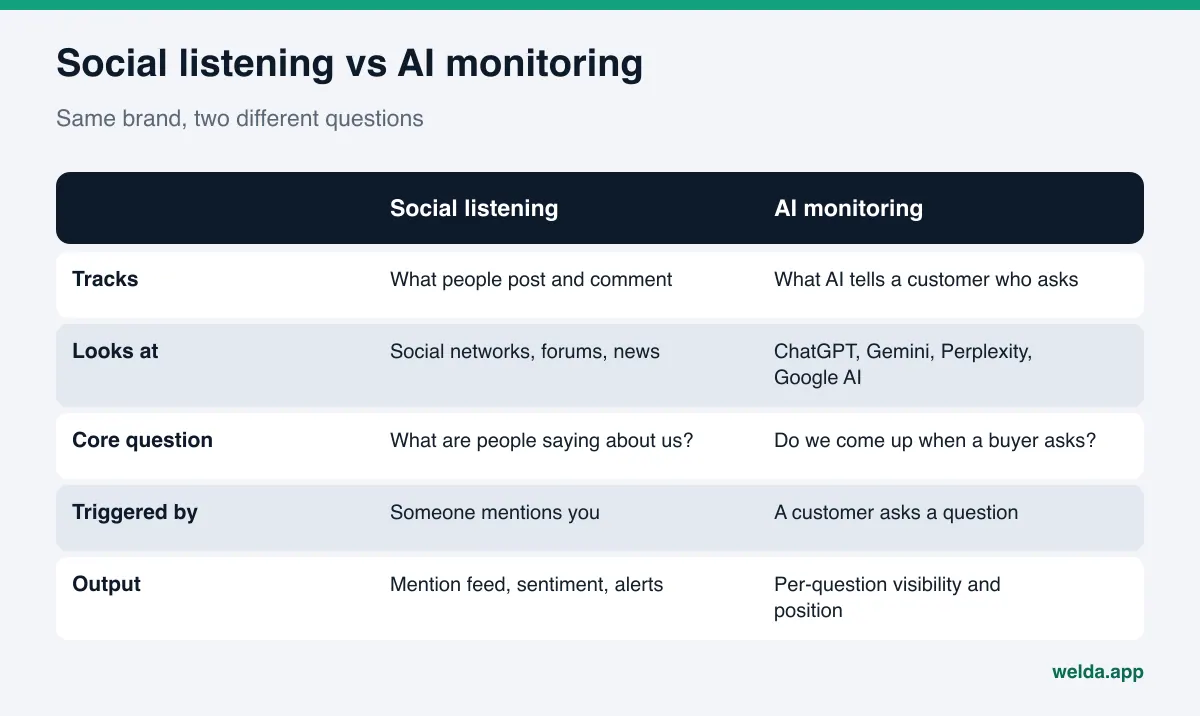
Social listening vs AI monitoring: what does each one measure?
Both deal with the same broad question: what is happening with your brand outside your own walls? Where they split is the source they read and the moment they capture.
Social listening collects a backward-looking, scattered signal. Someone posts your coffee shop on Instagram, a Reddit thread mentions your firm, a review lands on Yelp, a local news site quotes you. Each of those is a "mention." Social listening gathers them, counts them, tags them as positive or negative, and alerts you to spikes. The question it answers: what are people saying about us right now?
AI monitoring, the measurement side of AEO (answer engine optimization), captures the moment of demand. A customer asks "What's a good family-friendly brunch spot in East Austin?" and the AI names a few places and explains why. AI monitoring asks the questions your customers would ask, on a regular schedule, across the major engines, and reads the answers: are you named, in what position, which competitor is ahead, and which sources did the answer lean on. The question it answers: when a buyer asks, do we get recommended?
Here is the core difference. In social listening, no signal exists until someone mentions you. In AI monitoring, the customer never mentions you at all. They describe a need, and the answer decides whether they ever hear your name. A new customer who doesn't know you yet arrives through exactly that second path. That is why one cannot stand in for the other.
What social listening sees, and what it misses
Social listening has clear strengths. It warns you early when a complaint starts to spread. It shows how a campaign or a launch landed. It surfaces the words customers use when they describe you, what they praise and what annoys them. It can also show what people say about competitors. For brands that get talked about at volume, that information is worth having.
Its blind spots, though, are structural:
- It can't see the AI answer. A conversation between a customer and an AI assistant is not a public post. No listening setup can collect it. The only way to see the answer is to ask the question.
- It doesn't measure absence. Social listening counts mentions that exist. Your name missing from an AI answer is not a mention; it's a gap. Gaps don't get counted. You only notice them by asking.
- It goes quiet for small businesses. A neighborhood restaurant, a dental practice or a boutique inn might get a handful of posts a week. The dashboard looks empty most days, which feels like "all good" when it may not be.
- It doesn't connect volume to recommendation. A business people talk about constantly may never appear in AI answers. A quieter competitor with a clear website and a complete profile may show up in nearly every one.
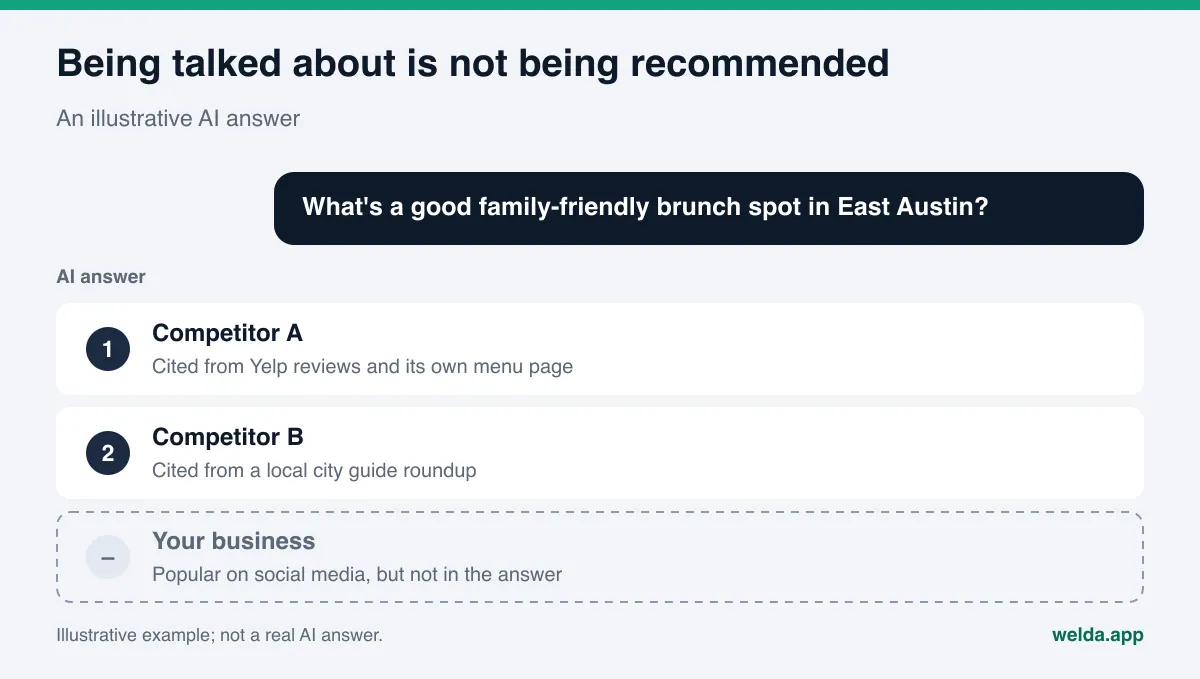
The example above shows that last point. A brunch spot that gets shared all over Instagram can still be missing from an AI answer, because the AI doesn't build its answer from post counts. It builds it from sources it can read and trusts: the business's own website, its Google Business Profile and reviews, Yelp, local city guides, Reddit threads. Being talked about and being recommended are two separate things.
What AI monitoring measures, and why it's its own job
AI monitoring tracks three things at once: visibility, position and sources. None of them can be inferred from social listening data.
Visibility is the share of relevant questions in which you're named. Position is where you appear when you are named; being fifth of five is not the same as being first. Sources are the sites the AI drew on to build the answer, and they tell you where any fix has to start.
One more property makes this a separate discipline: AI answers are not stable. Ask the same question twice today and you can get a different order, or different businesses entirely. Making a decision from one screenshot is misleading. The measurement has to be repeated, tracked engine by engine, and read with a margin of error. In social listening a mention either exists or it doesn't. In an AI answer, the result is a probability.
| Criterion | Social listening | AI monitoring |
|---|---|---|
| Data source | Public posts, comments, reviews, news | Questions asked to AI engines and their answers |
| What it measures | Mention count, sentiment, topics | Share of questions naming you, position, competitor share, sources |
| Sees absence? | No, it counts only what exists | Yes, a question that misses you shows up directly |
| Data for a small business | Often sparse and sporadic | As much as your question list, regardless of size |
| Buying moment | Captures talk after the purchase | Captures research before the purchase |
| How you fix things | Responding, communication, crisis handling | Site content, profiles, missing info in cited sources |
The "buying moment" row matters most. Social listening mostly hears what people say after the experience: they came, they ate, they stayed, they posted. AI monitoring catches the question asked before anyone has decided. For a business trying to win new customers, that second moment is where the decision gets made.
Where the two overlap: Reddit, Yelp and review sites
The two aren't completely separate worlds. They meet at the sources AI reads.
When AI engines build an answer, they read public pages. Those can include Reddit threads, Yelp listings, Google reviews, Tripadvisor, BBB profiles, Healthgrades pages, Angi listings and local guides. So part of the conversation that social listening picks up is also part of what AI reads. If a competitor keeps getting named in a "best dentist in Brooklyn" Reddit thread, that shows up as a mention in social listening and can also become the reason the competitor is named in an AI answer.
But the overlap runs one way. AI monitoring can trace an answer back to the source it cited. Social listening can't tell whether any given mention ever made it into an AI answer. So the question "which thread, which guide, which review site actually matters?" is answered by the citations in AI answers, not by mention volume. We cover how reviews feed into these answers in reviews and AI recommendations.
The practical takeaway: if you already do social listening, you still need the AI answers to know which of those sources to prioritize. If you don't, AI monitoring will tell you which forums and review sites deserve your attention anyway.
Which should you start with? A decision by situation
For a small or mid-sized business with limited time and budget, running both at once is often unrealistic. What decides the order is the question you need answered right now.
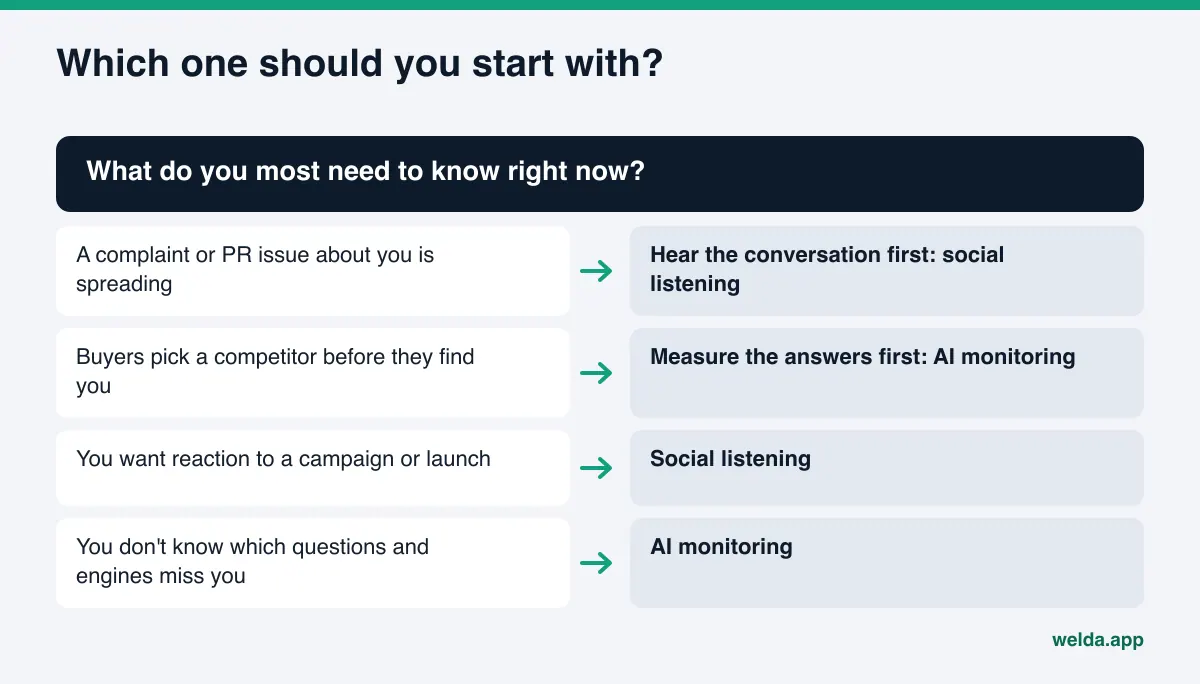
Start with social listening if:
- A complaint, a bad press story or a PR issue is spreading and you need to see where the conversation is going,
- Your brand already gets heavy social volume and that conversation shapes product decisions,
- Your main concern is existing customer satisfaction and response speed, not new customers.
Start with AI monitoring if:
- Your customers research before choosing (hotels, clinics, restaurants, contractors, professional services),
- You rank well on Google but new inquiries are dropping, or competitors get "recommended" more than you,
- You don't know which questions and which engines leave you out,
- Almost nobody talks about you on social, so there's little to listen to.
For most local businesses the second list is longer, for a simple reason: there isn't much talk about a small business, but the customer's question gets asked every day. We compare tracking reputation with tracking visibility in more depth in reputation management software vs AEO tools.
How to set up AI monitoring step by step
You can start AI monitoring with software or by hand. Done by hand, it runs in this order:
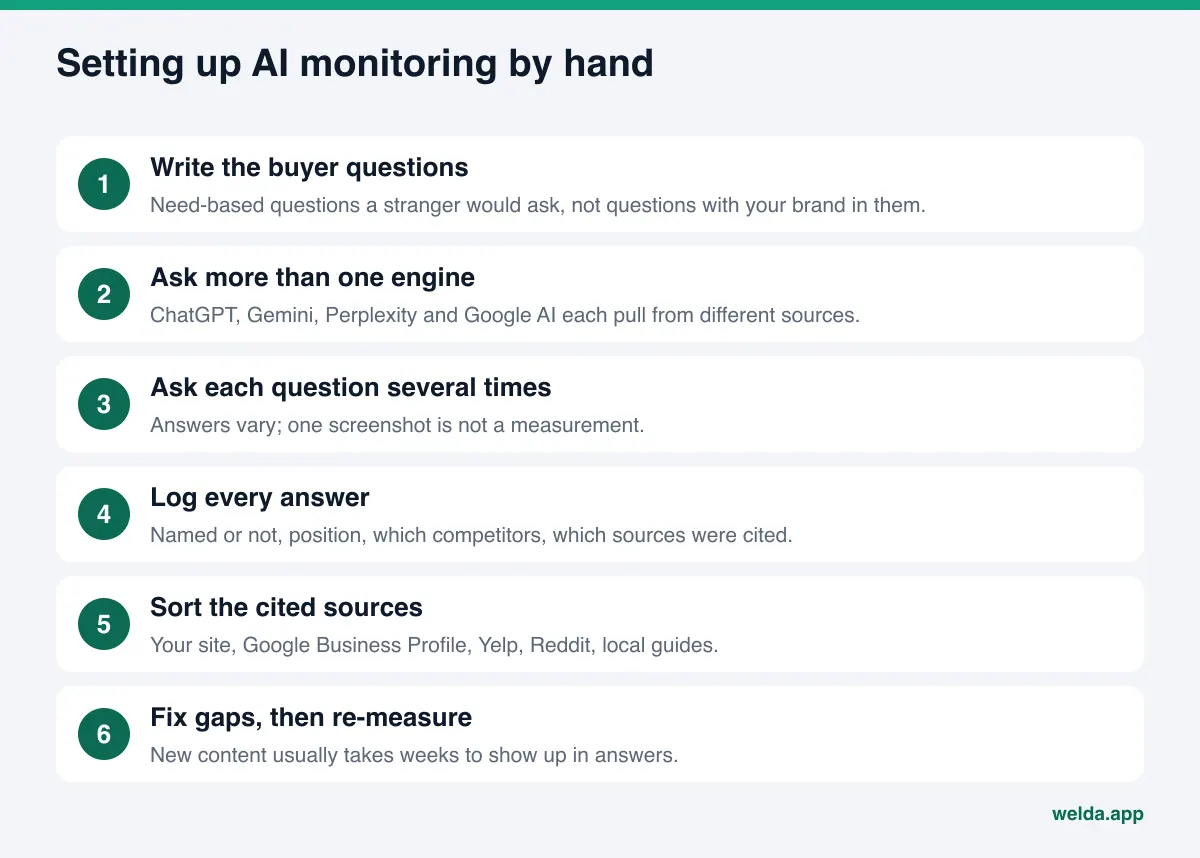
- Write the question list. Write the questions a customer would ask without knowing you exist: "family-friendly brunch spot in East Austin," "emergency plumber in Phoenix open on Sunday," "boutique hotel in Savannah's historic district with parking." Questions that describe the need matter more than questions containing your brand. We walk through picking them in prompts to track for AI visibility.
- Ask more than one engine. ChatGPT, Gemini, Perplexity and Google's AI Overviews or AI Mode look at different sources and answer differently. Checking only one gives you half the picture.
- Ask each question several times. Answers vary. Don't conclude "we show up" or "we don't" until you've asked the same question at least three times at different times.
- Log each answer in a sheet. For every question: are you named, in what position, which competitors, which sources were cited. That sheet is your baseline.
- Sort the sources. List the sites the answers cite: your own site, Google Business Profile, Yelp, Reddit, BBB, local guides. Sources where a competitor leads tell you where to start fixing.
- Fix the gaps, then measure again. Fill in a missing service page, a wrong address, absent business schema, unanswered FAQs. New content usually takes weeks to show up in AI answers, so re-run the same questions later.
By hand, this takes hours and is hard to repeat consistently. We compare a one-off check with continuous tracking in one-time AEO audit vs ongoing tracking.
How Welda handles AI monitoring
Welda is not a social listening tool. It does not collect posts or count mentions. What it does is the AI side of the steps above: ask the customer's question, read the answer, and fill in what's missing. Two parts of it relate directly to this comparison.
The Questions view: seeing inside the conversation. This is exactly where social listening can't go. In the Welda dashboard, the questions your customers would ask are put to ChatGPT, Gemini, Perplexity and Google AI three times each. In the Questions view every row is one question, and for each engine you see whether you were named and in what position, side by side. Click a row and you see a sample answer and the sources it cited. The decision you make here: which questions are critical for you, and which ones you're missing from. A brunch spot might learn, for example, that it never appears on "kid-friendly" questions but leads on "bottomless brunch" ones. That insight never shows up in a mention feed.
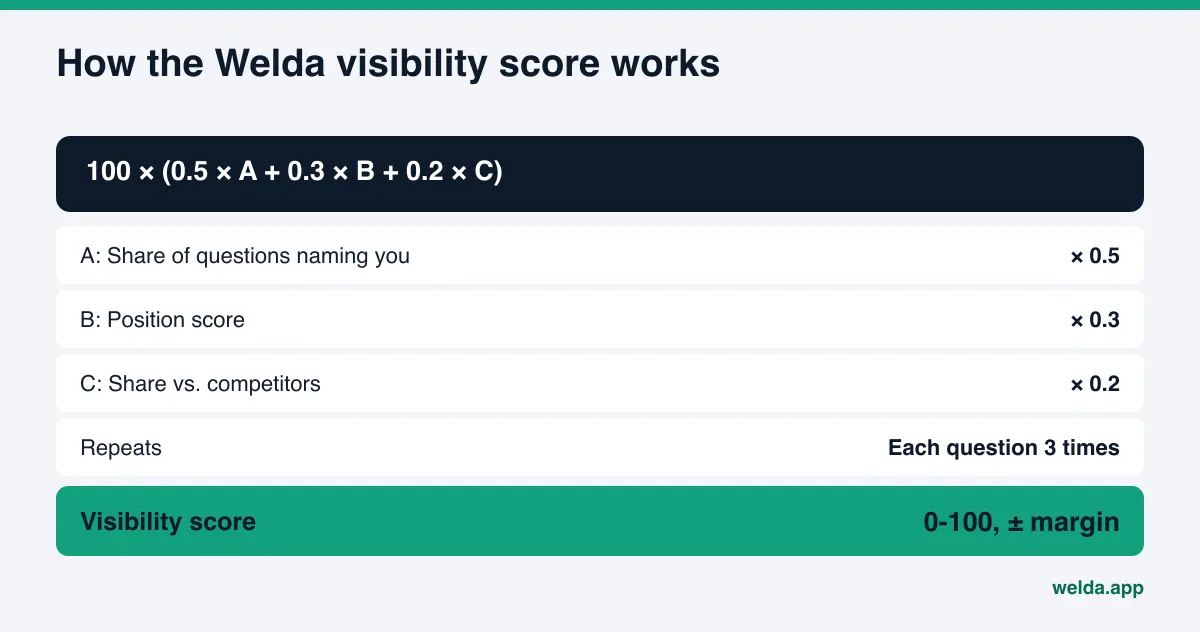
The score formula is open: share of questions naming you carries 50 percent of the weight, position 30 percent, and share against competitors 20 percent. The spread across the three repeats is shown next to the score as a margin, so one lucky answer doesn't look like progress.
The Sources view: the real weight of social sources. This is where the two disciplines meet. The Sources view lists which sites the AI relied on to build its answers and how you stand on each: your own site, directories, your map listing, forum threads, social accounts. Social listening tells you how often you're mentioned on a forum. The Sources view tells you whether that forum is actually being used in AI answers, so you spend your effort on sources that reach the answer. If a Reddit thread is in the citation list and you have no presence there, Welda puts it on the to-do list as a manual task; writing an open, signed reply stays with you.
On the fix side, Welda drafts content, profile copy and review replies, and publishing approval stays with you. On WordPress sites it connects through a separate Editor user and an application password, and content opens on your site as a draft. Where no connection exists it hands you a ready package. The content always lives on your own site.
A note on availability. The Welda dashboard is in early access and is opening first in Turkey. Regular four-engine tracking is being added during early access, and the sample dashboard screens use representative data. Pricing is discussed in an early access conversation. What anyone can use today, in English, is the free site analysis: it reads your site the way AI does, gives you a score out of 100, explains how to fix each gap, and asks five customer questions to an AI assistant with web search to see whether your name comes up. That's a one-time measurement, but it's a fast way to see how big the gap between "talked about" and "recommended" is for your business.
Limits: what Welda doesn't do
When comparing the two, it's worth being clear about what falls outside Welda's scope:
- No social listening. It doesn't collect posts, mention volume or sentiment. Forums and social sites show up only as sources that AI cites.
- No crisis management. How to handle negative reviews and complaints, PR outreach and directory account management stay with you. Welda can draft review replies; the decision to publish is yours.
- No fake reviews or forum posts. Nothing is written in someone else's voice, and nothing gets posted to forums unsigned.
- No ranking guarantee. There's no promise that you'll "show up in ChatGPT." AI answers are the engines' own decision.
- Nothing invented. If information can't be read from your site (hours, service area, price range), Welda asks you instead of making it up.
- No overnight results. New content usually takes weeks to show up in AI answers.
In practice: if you need to manage a large volume of social conversation, you may need a separate listening setup for that. Welda doesn't replace it. It takes on the other side: being named when a customer asks AI.
Decision checklist: social listening vs AI monitoring
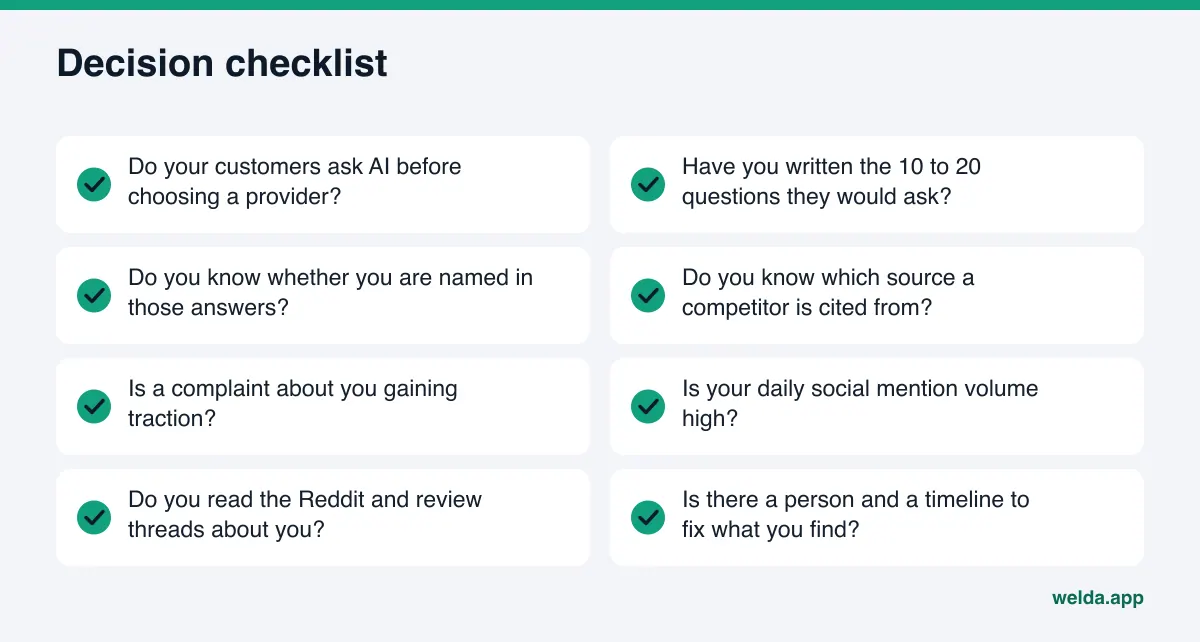
Work through the items below. The first four point to an AI-side need, the next three to a social listening need. The last one decides whether either kind of measurement will pay off: if nobody is going to fix what you find, measuring alone won't change anything.
Reading both sets of results together usually puts you in one of four situations, and each one points to a different next step:
| Social conversation | AI answers | What it means | Next step |
|---|---|---|---|
| High and positive | You're not named | People like you, but AI can't read you | Fix gaps on your site, profile and cited sources |
| Low | You're not named | You're invisible to new customers | Question list, core pages, business schema |
| Low | You're named | Your sources are in order; volume isn't the issue | Improve position and cover more questions |
| Negative topic growing | You're named | The conversation may reach answers over time | Hear it out and reply openly, under your name |
Take a sample scenario. A boutique hotel gets shared constantly on Instagram and its social dashboard shows mostly positive mentions. But direct bookings are slipping. Looking at AI answers, the hotel isn't named for "boutique hotel in Savannah's historic district with a pool"; the answer draws on booking sites and a city guide, and the hotel isn't listed in that guide. Social listening says "all good" while AI monitoring shows where the problem is. The reverse happens too: a sample dental practice is named regularly in AI answers, but a complaint thread is growing on a review site. In that case, hearing that conversation comes first.
For most small businesses the sensible order is: measure AI answers first, then read the forums and review sources those answers cite on a regular basis. Add social listening as its own job only once conversation volume calls for it. If you're weighing this against content production, see content marketing vs AEO.
Frequently asked questions
Can my social listening tool see AI answers?
A conversation between a customer and an AI isn't a public post, so standard listening methods can't collect it. The way to see the answer is to ask the engine the question and read what comes back. You can tell whether a tool does this by checking whether it actually puts questions to the engines.
If I'm popular on social media, will AI recommend me?
Not automatically. AI builds answers from sources it can read and trusts, not from post counts. If your services aren't clearly described on your site or your Google Business Profile is incomplete, you can be left out despite the buzz.
Do Reddit and Yelp affect AI answers?
As public pages, they can appear as sources in some answers. You can see which of your questions rely on them by checking the citations in AI answers. What matters isn't overall volume but which thread or listing is used for your specific question.
Is AEO the same thing as GEO?
GEO (generative engine optimization) is another name for the same work and is used more outside the US. Both describe getting your business named in AI-generated answers. AI monitoring is the measurement part of that work.
Does Welda monitor my social media accounts?
No. Welda doesn't track posts or mentions. Instagram and Facebook accounts can be connected so that your profile information is complete and consistent from an AI's point of view. If they aren't connected, the related task is listed as manual.
Does the free analysis replace social listening?
No, they're different jobs. The free analysis reads your site the way AI does and checks once whether you're named for five questions. It shows whether you're recommended, not what people are saying about you.
Find out which side you're on first
For most businesses, the answer to social listening vs AI monitoring is "both matter, just not at the same time." Hearing the conversation protects your reputation. Measuring the answers shows whether new customers can find you. If new customers are the goal, the starting point is whether your name comes up when they ask. To see that in a few minutes, run the free AI visibility analysis and get your site's gaps, ready-to-use copy suggestions and a first five-question check in one report.