Can your SEO agency do AEO? Partly, yes. Crawlable pages, clear titles, schema markup and plain-language content are the foundation of both, and a good SEO agency already handles them. But answer engine optimization (AEO) measures whether your business is named inside an AI answer, not where a page ranks. It depends heavily on sources outside your website, and it requires asking the same questions again and again. A few specific questions will tell you whether your agency understands that difference.
Why "can your SEO agency do AEO" is suddenly a real question
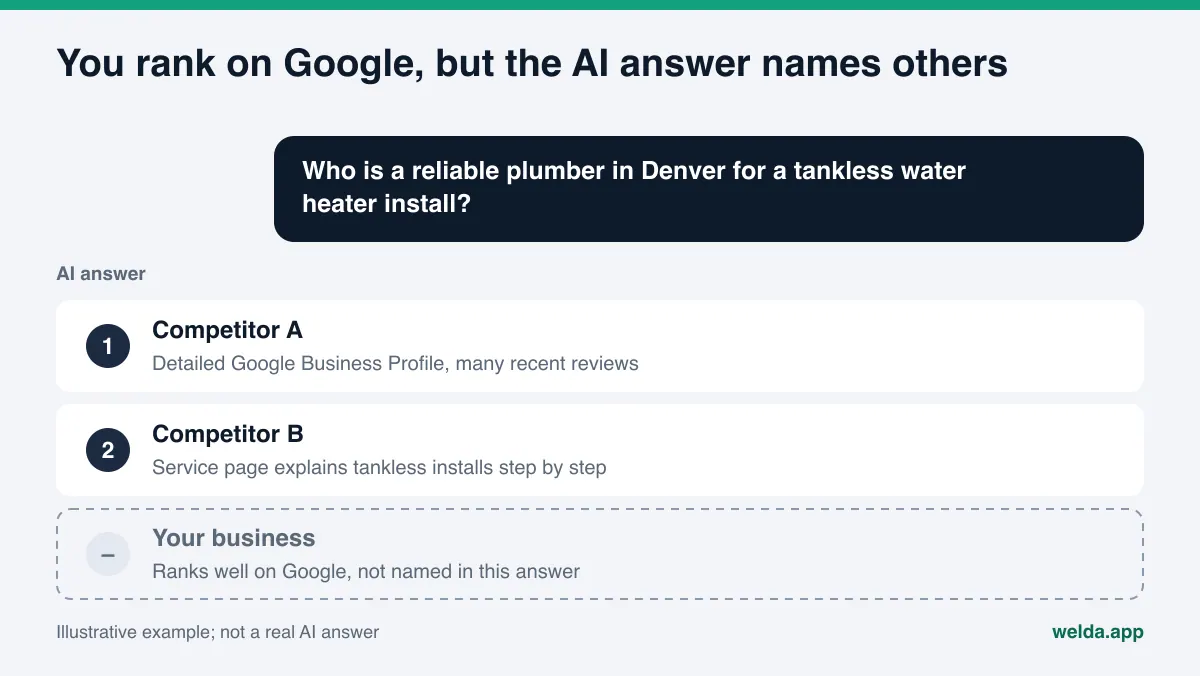
Plenty of small and mid-sized businesses in the US have worked with the same SEO agency for years. Every month a report arrives: keyword positions, organic sessions, pages that moved up. Over the last year or two, a new question has appeared next to that report. Customers no longer type "plumber denver" into Google and scan ten blue links. They ask ChatGPT, Gemini, Perplexity or Google's AI Overviews and AI Mode a full sentence, such as "who is a reliable plumber in Denver for a tankless water heater install", and get back two or three business names with a short reason for each.
So owners ask the obvious thing: "I already pay an SEO agency. Isn't getting into ChatGPT their job too?" Some agencies answer "Yes, we do AEO now." Others say "If your SEO is strong, AI will find you." Neither answer is flat wrong. Both can leave gaps.
This article is not a case against agencies. It is meant to help you have a better conversation with yours: which parts of AI search visibility overlap with SEO, which parts need a different method, and what you should expect to see in a report. You may also hear the work called GEO (generative engine optimization); in the US, AEO is the more common label, and the two describe the same goal.
It helps to walk into that conversation with a baseline. The free site analysis reads your homepage and several inner pages the way Google and AI tools do, gives you a score out of 100, and explains each gap: what was found, why it matters and how to fix it. Bringing that report to your agency turns a vague discussion into a list of concrete items.
Where SEO and AEO overlap, and where they split
The overlap is large. Most AI assistants lean on web search when they write an answer, so your site still has to be crawlable, readable and easy to understand. Google's own documentation says there are no additional requirements or special optimizations needed to appear in AI Overviews or AI Mode, and that the usual SEO best practices apply (Google Search Central, AI features and your website). In other words, a competent SEO agency is not starting from zero.
The split shows up in what gets measured and which sources get attention.
| Topic | Traditional SEO work | AEO work |
|---|---|---|
| Basic unit | Keyword ("plumber denver") | The full customer question ("Who installs tankless water heaters in Denver and offers same-week appointments?") |
| Success metric | Rank, impressions, clicks | Share of questions that name you, your position in the answer, your share versus competitors |
| Stability | Rank is fairly stable day to day | The same question can return a different answer later; repeats are needed |
| Engines | Mostly Google | ChatGPT, Gemini, Perplexity and Google AI, each separately |
| Off-site work | Mostly link building | Sources AI tools cite: Google Business Profile, Yelp, BBB, Angi, Tripadvisor, Healthgrades, industry directories |
| Content style | Pages built around a target keyword | Quotable sentences that state services, service area and answers to common questions |
| Report | Rank and traffic charts | Question-by-question, engine-by-engine table, plus which source a competitor wins from |
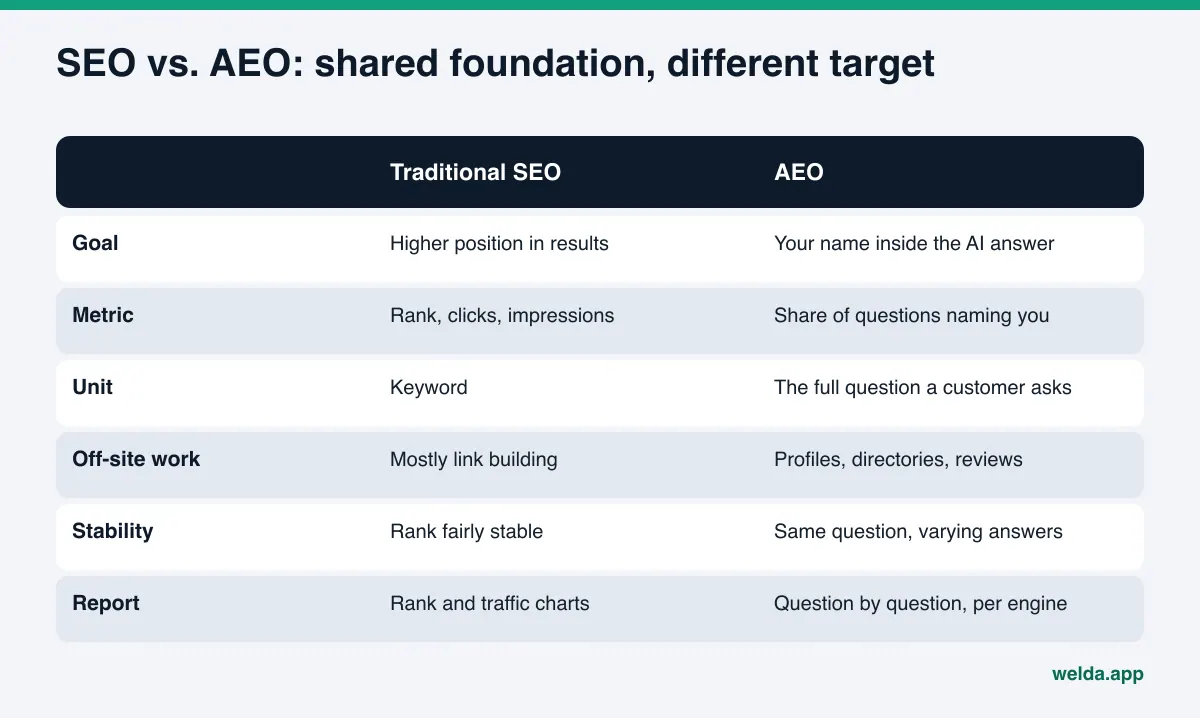
Most of these differences are about method, not talent. An SEO specialist can learn to measure by question, write profile copy and clean up inconsistent directory listings. The problem is that AEO often gets added to the SEO report as a new heading without a real measurement method behind it. A report that says "AEO work completed" but never shows which questions name you does not tell you whether anything changed.
For local businesses the overlap is bigger, but it is still not the same thing. We go through that in detail in local SEO vs. AEO.
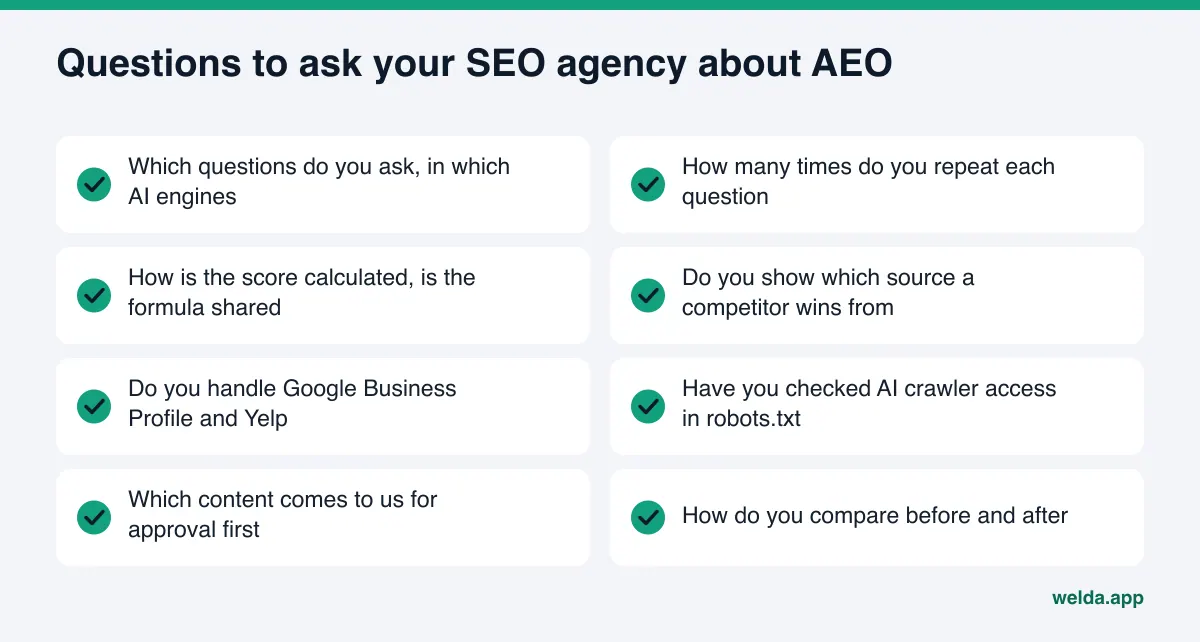
8 questions to ask your SEO agency about AEO
Bring these to your next agency call. The point is not to catch anyone out. It is to make clear what you are paying for. A good agency can answer most of these in writing.
- Which questions do you ask, and in which engines? The answer should be a list of full sentences a customer would actually type, not a keyword export. Engines should be named separately: ChatGPT, Gemini, Perplexity, Google AI.
- How many times do you ask each question? AI answers vary. A single screenshot can look great or terrible by chance. Without repeats, nobody knows the margin of error.
- How is the score calculated? A report that says "AI visibility: 64" is impossible to interpret unless it tells you what that number is a weighted average of.
- Do you show which source a competitor wins from? When a competitor shows up first, the reason is often not their website. It is a fuller Google Business Profile, a Yelp page with recent reviews or a detailed directory listing.
- Do you handle Google Business Profile, Yelp and directories? Many SEO contracts cover on-site work only. That is fine, as long as you know who owns the off-site part.
- Have you checked AI crawler access? A robots.txt rule added for security reasons can also block search crawlers. OpenAI recommends allowing OAI-SearchBot if you want your site to appear in ChatGPT search results (OpenAI crawler documentation).
- Which content comes to us for approval before it goes live? Claims about price, warranties, "best in town" and, in healthcare, treatment outcomes should pass through the business owner. Advertising claims in the US fall under the FTC's truth-in-advertising rules, whoever wrote the copy; this article is not legal advice.
- How do you compare before and after? If the same questions are not asked again in the same wording weeks later, any claim of improvement cannot be checked.
"We don't do that" is an acceptable answer to some of these. Many SEO agencies do excellent on-site work and prefer to leave AEO measurement to a tool. What matters is that you know what you are getting and what is left uncovered.
Here is an example scenario. A sample HVAC company in Phoenix has worked with the same SEO agency for two years. The agency report shows the company in the top three for "ac repair phoenix". The owner asks ChatGPT "Who is a trustworthy AC repair company in Phoenix that does weekend service?" and sees two competitors, not their own name. The agency replies: "Your site is technically clean; AI answers are outside our control." That is partly true. But if question four had been asked, the reasons might have been visible: a competitor with a complete Google Business Profile listing weekend hours, another with a detailed Angi profile, or a service page that explains weekend emergency calls in plain words. The agency's technical work was not wasted. There was simply an area nobody measured and nobody owned.
How an SEO agency should approach AEO, step by step
If your agency wants to take this on, it is reasonable to ask for a plan that follows roughly this order. Each step should end with something you can see.
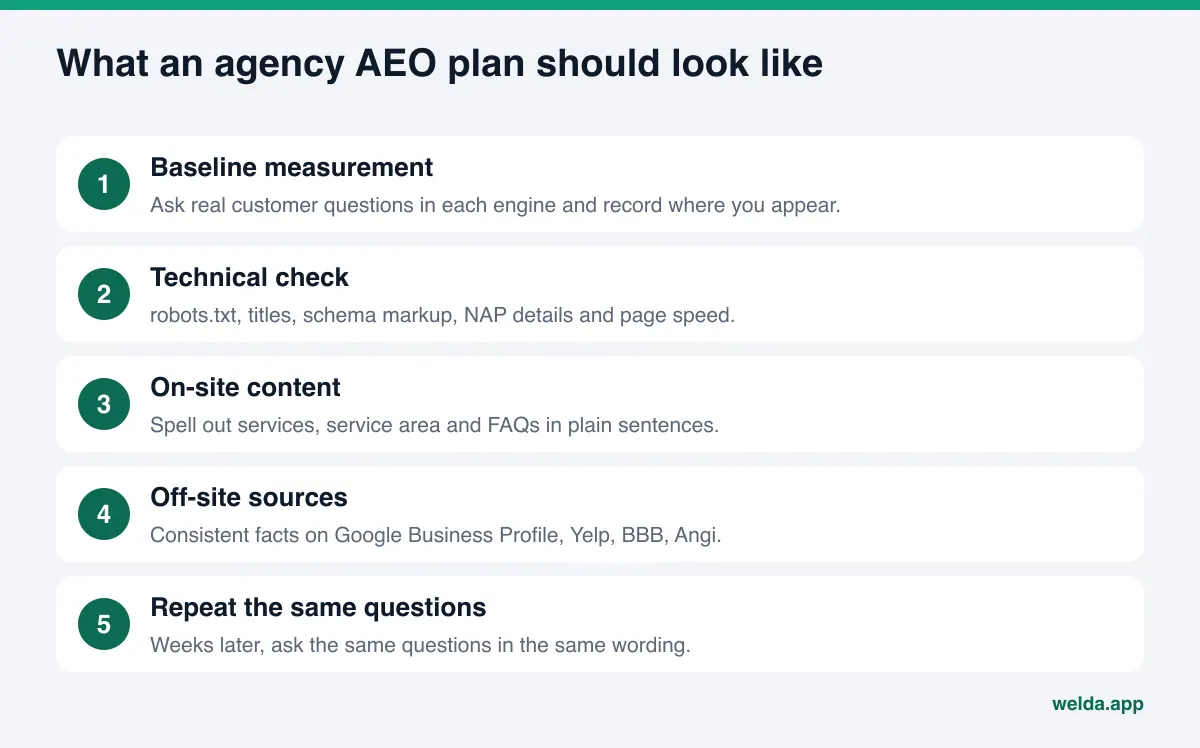
1. Baseline measurement. Start with a list of questions customers actually ask. That list comes from phone calls, sales conversations and the common needs of your industry, not from a keyword tool. For a sample roofing contractor it might include "who repairs hail damage on roofs in Dallas", "roofer that works with insurance claims near me" and "how long does a roof replacement take". These questions are asked in each engine, and the result is recorded. Without a baseline, nobody can tell later what changed.
2. Technical check. This is where SEO agencies are strongest. Is robots.txt blocking AI search crawlers by accident? Do the page title and meta description say what the business does and where? Does the main heading describe the actual service? Is LocalBusiness schema in place and correct? Are name, address and phone (NAP) readable on the page? Is the site reasonably fast? Most agencies already do this.
3. On-site content. AI tools look for sentences they can quote. "Committed to quality service" does nothing. "Open until 8 p.m. on weekdays, we install and repair tankless water heaters across the Denver metro" does a lot. Each service deserves its own section, the FAQ should answer questions customers really ask, and the page should explain how pricing is put together. This is slightly different from classic SEO content work: the measure is clarity, not keyword density. Our guide on how to get cited by AI covers this content style in more depth.
4. Off-site sources. This is the step SEO agencies skip most often. AI answers frequently draw on Google Business Profile, Google Maps reviews, Yelp, BBB, Angi, and industry directories such as Healthgrades for medical practices or Tripadvisor for hospitality. If your business name, address, hours and service list are inconsistent across those sources, excellent website copy may not be enough. Completing directory profiles, replying to reviews calmly and specifically, and fixing outdated facts all belong here.
5. Repeat with the same questions. New content usually takes weeks to show up in AI answers. After several weeks, the same questions are asked again in the same wording and compared with the baseline. If the question list changes every month, the comparison means nothing.
What should be in your agency's AEO report?
If your agency says it does AEO, look for these sections in the monthly report. If they are missing, the work might still be happening, but you cannot see it.
| Report section | Why it matters | What to ask for if it is missing |
|---|---|---|
| Question list | Shows which customer needs are being measured | The exact wording of each question |
| Results by engine | Appearing in ChatGPT but not in Gemini is common | Separate results for each engine |
| Run count and variance | Separates real change from chance | How many runs, how much results moved |
| Competitor comparison | Shows who is ahead and why | Questions and sources where a competitor leads |
| Source list | Makes off-site work visible | Sites AI answers cite, and your status on each |
| Work log with dates | Lets you match changes to results | What was published or updated, and when |
| Before and after | Shows whether the work paid off | Baseline and latest results on the same question set |
Not every report needs all seven. But without the question list, per-engine results and a before-and-after comparison, it is hard to judge AEO work at all. Our AI visibility tool demo checklist uses the same criteria for evaluating a tool or an agency pitch.
How Welda does this work
Welda is software that measures where a business appears in AI answers and prepares the missing pieces on the business's behalf. Whether or not you keep your agency, three parts of it matter most for this question: measurement, the source list and drafted content.
Question-by-question measurement. In the Welda panel, the questions your customers would ask are put to ChatGPT, Gemini, Perplexity and Google AI three times each. The questions view lists one question per row and one engine per column, and each cell shows whether your name appeared and in which position. Open a row and you see a summary of the answer, the result of each of the three runs and the sources the answer cited. If your agency report says "AI visibility improved", this view shows which questions improved and which engines did not move. Question language can be set to English or Turkish.
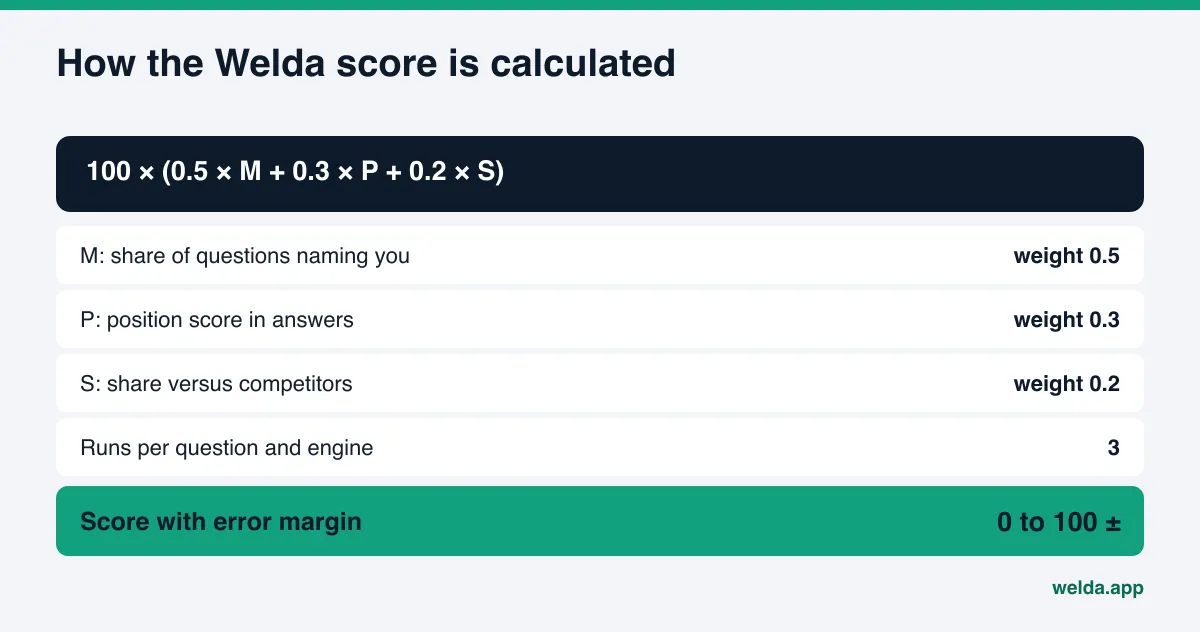
The score formula is published: 100 × (0.5 × share of questions naming you + 0.3 × position score + 0.2 × share versus competitors). The spread across the three runs produces a ± margin of error. That changes the conversation with your agency. Instead of "the score dropped", you can say "we are named in the same share of questions, but our position slipped on two of them."
Source list. The sources view shows which sites AI answers cite and your status on each: profile present, incomplete or unverified. The competitors view shows which topic a competitor leads on and which source they win from. Because off-site sources are what SEO agencies most often leave out, this list is the easiest way to split the work: your agency takes the on-site items, and you or Welda handle directory profiles and review replies.
Drafted content, your approval. Welda drafts page content, profile copy and review replies for the gaps it finds. They appear in a single to-do list with the draft text right next to each item. Publishing approval always stays with the business, and content always lives on your own website; Welda does not host it. On WordPress sites, Welda connects through its own Editor user and an application password, with no code to install; drafts open on your site and go live once you approve them. If your agency manages your site, you can review those drafts together. Where there is no connection, Welda provides a ready package and the change is made by hand. A monthly one-page PDF report gives you something simple to forward to your agency.
Please note where things stand. The Welda panel is in early access and opening in stages, starting in Turkey. Regular four-engine measurement is being added during early access, and the panel screens you may see use representative data. The free site analysis works in English today and is the part anyone can use now. Pricing is discussed in the early access conversation.
Working alongside your agency: who does what
If you have an SEO agency, you do not need to replace it with Welda. For most businesses the sensible move is to split the work. The table below shows a common split; adjust the rows to match your contract.
| Task | Who can own it | Note |
|---|---|---|
| robots.txt, page speed, technical errors | SEO agency | The free analysis lists gaps; the agency fixes them |
| Title, meta description, main heading | SEO agency or business | The analysis includes suggested copy as a starting point |
| LocalBusiness schema | SEO agency | The analysis fix package includes ready-made markup |
| Question-level measurement and competitor tracking | Welda | Share the PDF report so both sides see the same numbers |
| Directory profiles and review replies | Business, using Welda's drafts | Drafted for connected accounts; otherwise done by hand |
| Resolving negative reviews | Business | Talking to the customer is the owner's job |
| Press and directory account setup | Business or agency | Welda does not take this on |
Writing the split down prevents two problems: the same task done twice, and tasks nobody does. Off-site sources in particular tend to fall between "the agency probably handles it" and "the owner probably handles it."
Limits: what Welda does not do
Being clear about what you expect from an agency means being equally clear about what you expect from software. Welda does not:
- Promise rankings or guarantee that you will show up in ChatGPT. No agency or tool controls AI answers.
- Make up facts. If your hours, service area or pricing approach are missing, it asks you.
- Publish sensitive content without approval. In healthcare there is no automatic publishing; every item goes to approval, and patient data is not sent to AI.
- Write fake reviews.
- Handle negative review disputes, directory account setup or press outreach. Those stay with the business.
- Track keyword rankings or build links. It does not remove the need for an agency; it measures the part an agency usually does not.
The free site analysis has limits too. It does not measure rankings. It asks an AI assistant with web search 5 questions customers might ask and checks whether your business name appears; that is a one-time check, not ongoing tracking. It is free once per site, your email and phone are verified, and the results link arrives by email and stays open for 14 days.
Finally, timing: new content usually takes weeks to show up in AI answers. If an agency or a tool promises results in a few days, ask how they plan to prove it.
Decision checklist: can your SEO agency do AEO well enough?
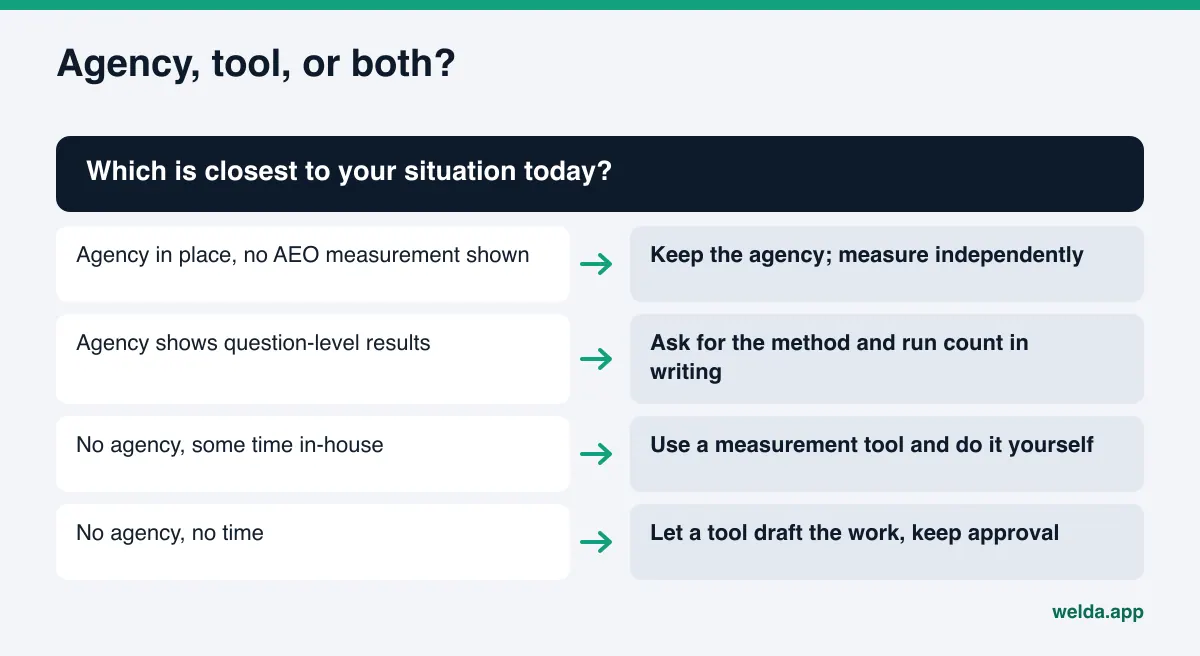
Use this chart and checklist after your next call with the agency.
- Did the agency give you the question list in writing?
- Are results shown separately for each engine?
- Is each question asked more than once, and is variance reported?
- Does the report show which source a competitor wins from?
- Is ownership of Google Business Profile, Yelp and directories written down?
- Does every sensitive claim come to you for approval before it goes live?
- Is there a baseline, and will the same questions be measured again?
If you can answer yes to most of these, your agency takes AEO seriously. If most answers are no or "not sure", you have two options: ask the agency for its method in writing, or measure independently and let the agency keep doing the on-site work. If you have some time in-house, you can also do part of the work yourself; our guide to DIY AEO for small business owners shows where to start.
Frequently asked questions
Should I fire my SEO agency if it cannot do AEO?
Not necessarily. If the agency does solid technical and on-site work, that work is the foundation for AEO too. What is usually missing is measurement and off-site sources, and a separate tool or a clear division of work can cover that.
If my SEO is strong, will I show up in AI answers?
Strong SEO improves your odds, but it may not be enough on its own. AI answers also draw on directories, reviews and forums. Ranking first on Google and not being named in a ChatGPT answer is a common situation.
Do I need a separate keyword list for AEO?
You need a question list instead. Write the full sentences customers use, including location and need, and use the same list in the same wording every time you measure.
How can I trust my agency's AEO measurement?
Ask for the method in writing: which questions, which engines, how many runs, and how the score is calculated. You can also measure the same questions with an independent tool and compare.
Does Welda replace an SEO agency?
No. Welda does not track keyword rankings or build links. It measures visibility in AI answers, lists the gaps and drafts content for your approval. You can keep working with your agency on technical and on-site SEO.
What if the free analysis disagrees with my agency's report?
The analysis explains what it found for each gap and how to fix it. Go through those items with your agency one by one. Differences usually come from method: the analysis reads your site the way AI tools do, while most agency reports focus on rank and traffic.
Next step: see your baseline before the agency call
The easiest way to find out whether your SEO agency can do AEO is to have a concrete report in hand. Run the free site analysis and bring the score, the gap list, the suggested copy and the competitor comparison to your next agency meeting. Deciding who owns each item from that report saves time on both sides.