Local SEO vs AEO: which one should a local business invest in first? For most local businesses the honest answer is both, in a sensible order. Local SEO gets you into the Google map pack and local results. AEO, answer engine optimization, gets your name into the answers that ChatGPT, Gemini, Perplexity and Google's AI features give when a customer asks for a recommendation. The two share a foundation, but they are measured in different places and they expose different gaps.
This guide is for owners and marketing leads who already do some local SEO and are now asking whether AEO is a separate job or just a new label. It does not matter much whether you run a dental practice in Phoenix, a family-owned HVAC company in Ohio or a bed and breakfast in Vermont. Some of your customers still open Google Maps and tap the first result with good reviews. Others now type a full sentence into an AI assistant: "Who is a reliable plumber in north Austin who can come out on a Saturday?" Both paths matter. They simply do not reward exactly the same work. Below we cover where local SEO and AEO overlap, where they split, how to decide what comes first, and how Welda makes the AI side visible.
Local SEO vs AEO: what does each one actually measure?
Local SEO is the work of showing up for searches with local intent: "urgent care near me", "best tacos in Logan Square", "roof repair Tulsa". The result is the map pack and the local listings under it. Google is unusually direct about what drives this. Its Business Profile help page names three main factors: relevance (how well a profile matches the search), distance (how far the business is from the searcher) and prominence (how well known the business is). The same page states that you cannot request or pay for a better local ranking.
AEO deals with a different output. When a customer asks an AI assistant a question, the result is not a ranked list of ten links. It is a short answer that names a handful of businesses and gives a reason for each one. You may also see this work called GEO, generative engine optimization; in the US the terms AEO and AI search visibility are more common, and they describe the same goal. What you measure is not "what position am I in" but "is my business named for this question, for what reason, and who is named instead of me".
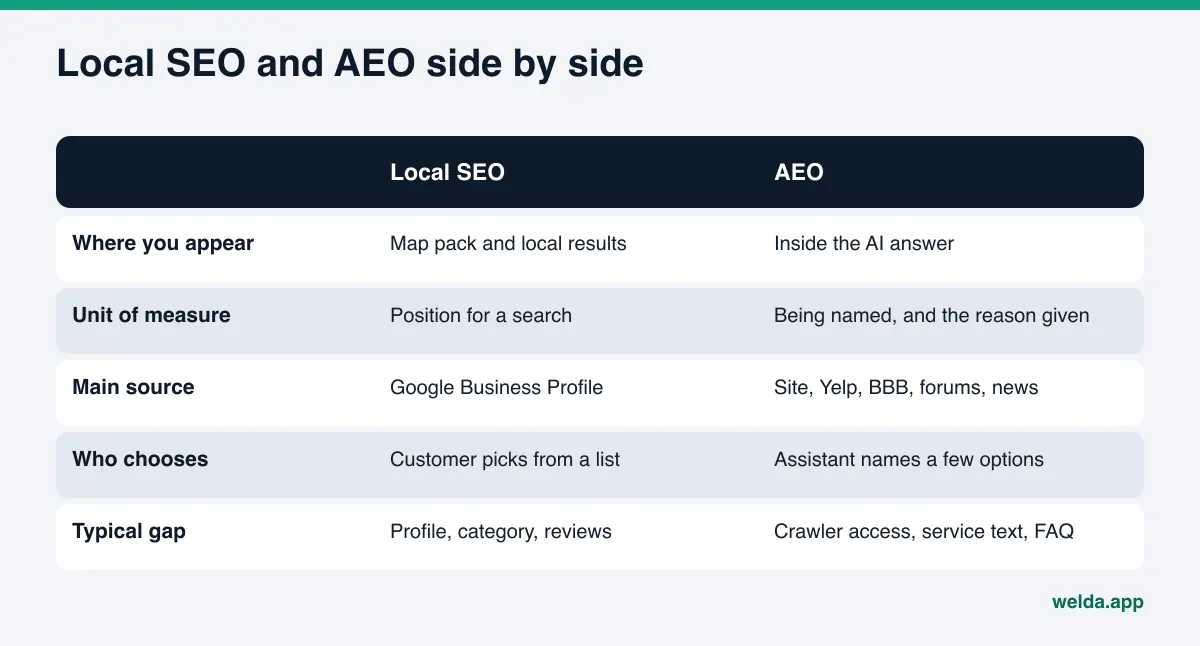
The core differences look like this:
- In local SEO, the unit is a listing. Your profile, category, reviews and location decide whether you appear in a list. The customer then chooses.
- In AEO, the unit is an answer. The assistant does part of the choosing for the customer. A business that is not named is simply absent from that conversation.
- Local SEO leans on Google's own data. Your Google Business Profile and map data sit at the center.
- AEO draws on scattered sources. Assistants read your website, your profiles, Yelp, BBB, Tripadvisor, Angi, Reddit threads and local news, then compress all of it into a few sentences.
So local SEO vs AEO is less a choice than a question of order and scope. If the shared foundation is weak, AEO work stalls. If the foundation is solid, AEO shows you gaps your local SEO reports were never built to catch.
Same customer, two screens: where the gap opens
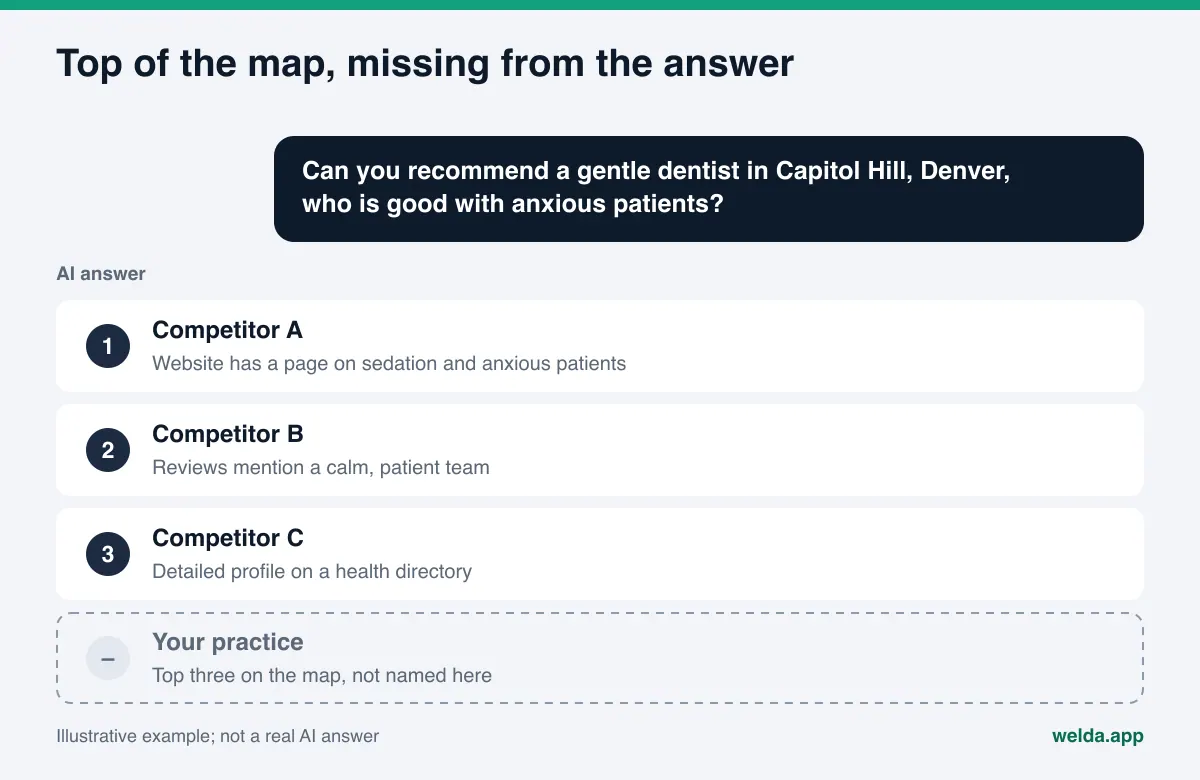
Take an example. An example independent dental practice in Denver ranks in the top three of the map pack for "dentist Capitol Hill". Its Google Business Profile is complete, reviews are strong and photos are current. On the local SEO scorecard, everything looks fine. Then the owner asks ChatGPT: "Can you recommend a gentle dentist in Capitol Hill, Denver, who is good with anxious patients and takes walk-ins?" The practice is not in the answer.
The explanations are usually ordinary. The website may never say "anxious patients" or "walk-ins" in text; the team mentions it on the phone, but nobody wrote it down. The practice's listings on directories that the assistant tends to cite may be thin or outdated. Or the site's robots.txt file may be blocking AI search crawlers without anyone noticing. Map rankings will not flag any of this, because map rankings measure something else.
If you suspect a gap like this, start by checking what an AI system can actually read on your site. Welda's free site analysis gives you that first look in a few minutes: what is readable, what is missing, and which fix would move your score the most. For a deeper walk through this exact situation, see our piece on ranking first on Google but not showing up in ChatGPT.
The shared foundation of local SEO and AEO
The good news is that a lot of local SEO work carries straight over. Google itself says in its Search Central documentation on AI features that there are no extra technical requirements for AI Overviews or AI Mode beyond normal Search fundamentals. The same page recommends keeping Business Profile information current and making sure structured data matches the visible text on the page. In other words, the local SEO you have already done is not wasted. The table shows which tasks pay off on both sides.
| Task | What it does for local SEO | What it does for AEO |
|---|---|---|
| Consistent name, address and phone everywhere | Trust in your map data | Assistants match you to the right business |
| A complete Google Business Profile | Eligibility for the map pack | Current facts for AI Overviews and AI Mode |
| Reviews and owner replies | Prominence signal | The "reason" an assistant gives for naming you |
| Business schema markup | Helps search engines parse the page | Machines read your type, address and hours cleanly |
| Social and map profiles linked from your site | Limited | Connects facts from different sources to one business |
| Clear, separate service pages | Relevance | Getting named for specific, detailed questions |
| An FAQ section | Limited | Text that answers the customer's question directly |
The first row matters more than it looks. An old phone number on a directory is a minor weakness in local SEO. In an AI answer, it can turn into the assistant confidently handing a customer the wrong number. We cover this in detail in NAP consistency for AI search.
Five places where local SEO falls short for AEO
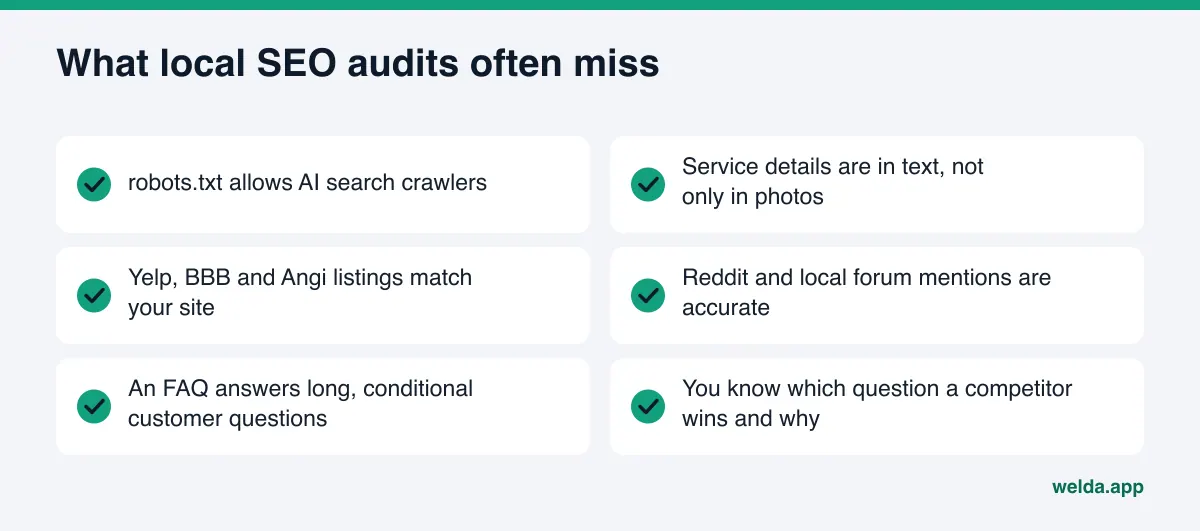
Even with a strong foundation, some gaps only show up when you look through the AEO lens. If your local SEO report is green but you are missing from AI answers, the cause is usually in one of these five areas.
- Crawler access. AI search tools run their own crawlers. OpenAI, for example, documents that OAI-SearchBot is used to surface websites in ChatGPT search, and that sites which opt out of it will not appear in ChatGPT search answers. Typical local SEO audits only look at Googlebot.
- Services and differentiators written in plain text. Map rankings solve a lot with category and location. Assistants look for details in text: "open Saturdays", "family-friendly", "financing available", "licensed for commercial work". A feature that only appears in a photo often does not exist for an assistant.
- Sources outside Google. AI answers can lean on Yelp, BBB, Healthgrades, Angi, Tripadvisor, Reddit and local news. In local SEO these are supporting citations. In AEO they are sometimes the main basis of the answer.
- Question-shaped content. Customers ask assistants long, conditional questions. If your site has no FAQ that answers those questions directly, the assistant builds its answer from someone else's text.
- Your position against competitors. In the map pack you see who is above you, but you have to guess why. AEO measurement can show which question a competitor wins, the reason the assistant gives, and the source it relies on.
None of this means your local SEO was done badly. It just answers a different question. We compare classic rank reports with AI visibility measurement in rank tracker vs AI visibility tracker.
Local SEO vs AEO: which should your business prioritize?
When budget and time are limited, order matters. The decision path below gives a general direction, not a prescription. Every business gets customers through a different mix of channels.
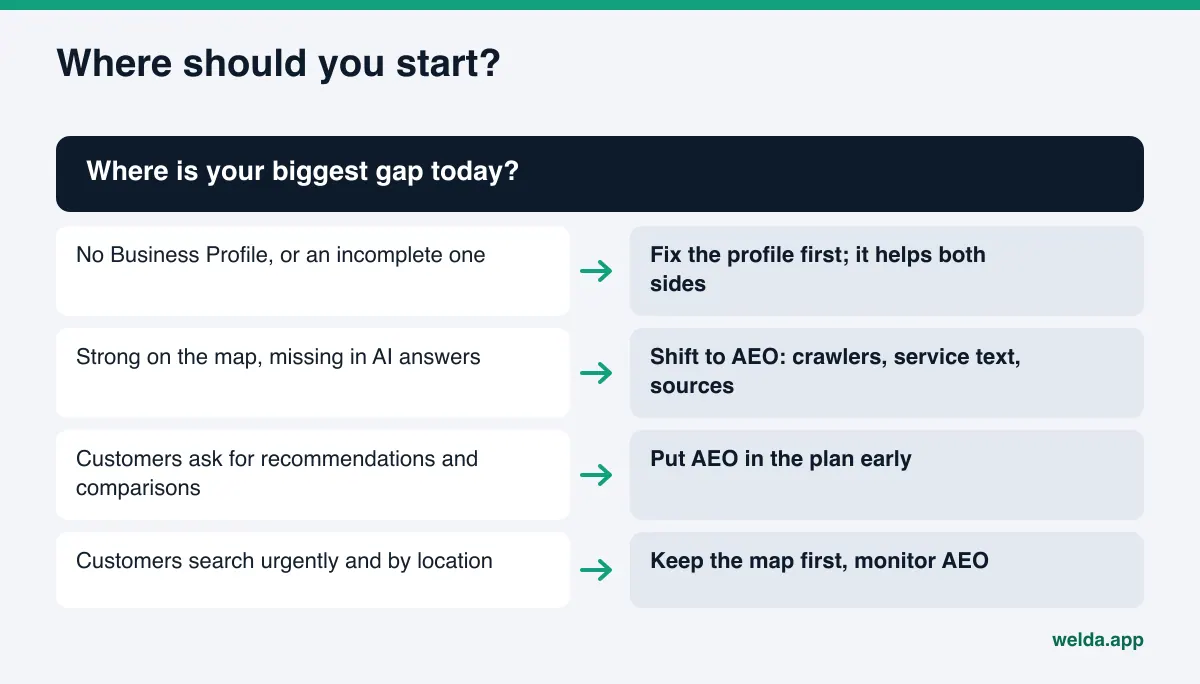
If your Google Business Profile is missing or incomplete, start there. Without the right category, hours, address, phone and service list, it is hard to earn a reliable place in either the map pack or an AI answer. This is step one for both local SEO and AEO.
If your profile is solid and you rank well on the map but are absent from AI answers, it is time to shift weight toward AEO. The work is making your site readable to AI systems, adding detail to service pages and cleaning up your presence on sources outside Google.
If your customers mostly ask comparison and recommendation questions, the "who is best", "which one should I pick", "where should I stay" type, plan for AEO early. Dental and medical practices, hotels and inns, restaurants, salons, home services with big-ticket jobs and private schools see a lot of these questions.
If your customers mostly search in a hurry and by location, such as locksmiths or 24-hour towing, the map result stays your first priority. Keep an eye on AEO, but most of the effort can stay with local SEO.
A combined local SEO and AEO plan, step by step
For most small businesses, running both jobs as one plan is more efficient than splitting them across separate vendors. The sequence below tries to make each hour of work pay off in both channels.
- Pick one source of truth. Decide where the correct business name, address, phone, hours, service list and policies live. Usually that is the contact page on your own site.
- Update your Google Business Profile to match. Category, services and description should not contradict your site.
- Check crawler access. Make sure
robots.txtdoes not block search and AI search crawlers. Blocking training crawlers is a separate decision; do not confuse the two. - Add business schema. Mark up business type, address, phone, hours and social profile links, and keep the markup identical to the visible text.
- Expand your service pages. For each main service, say who it is for, how it works, which neighborhoods or towns you cover, and what people ask most.
- Build an FAQ section. Publish short, direct answers to the questions you hear most on the phone and by text.
- Align sources outside Google. Bring Yelp, BBB, Angi, Healthgrades or Tripadvisor listings in line with your source of truth. Reply calmly and under your name to open complaints.
- Run two separate measurements. Track map visibility for local SEO, and track whether you are named for specific customer questions for AEO. Do not mix them in one number.
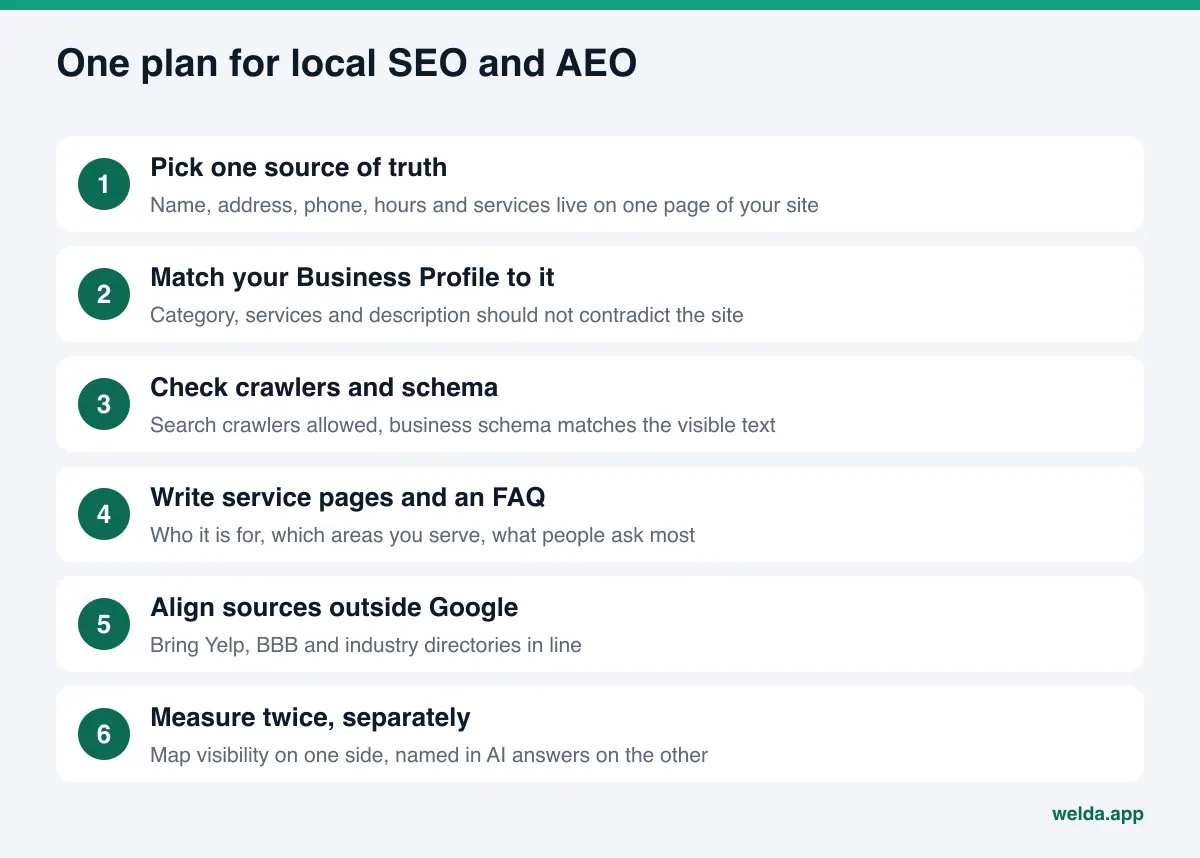
The first six steps happen mostly on your site and profile. The last two need ongoing attention. If you are wondering whether your current agency can cover the AEO side, the questions in can your SEO agency do AEO are a useful checklist.
How do you measure local SEO and AEO separately?
The most common mistake is putting both into one report. Map rankings go up and someone concludes AI visibility improved too, or the other way around. The two measurements answer different questions and need different routines. Here is how a measurement plan could look for an example HVAC company.
| What you measure | Local SEO | AEO |
|---|---|---|
| Core question | Do I show up on the map for "AC repair Columbus"? | Am I named for "Who is a trustworthy AC repair company in Columbus that offers weekend service?" |
| Where you look | Google Maps and Business Profile performance | Answers from ChatGPT, Gemini, Perplexity and Google AI |
| How often | The same search from different locations | The same question several times, because answers vary |
| What you record | Position and profile interactions | Whether you are named, in what order, the reason and the source |
| Competitor view | Which competitor is above you | Which question a competitor wins and on what source |
Repetition is not optional in AEO. Ask the same assistant the same question twice and you may get different businesses. Judging from a single try is misleading. Write your question list the way customers actually talk: full sentences with neighborhood, need and conditions, not short keywords. Once the list exists, you can compare against it every month, and the effect of a fix is measured instead of guessed.
How Welda handles the AEO side
Welda is not a local SEO tool and does not track your map ranking. Its job is the part local SEO cannot see: your visibility in AI answers, and filling the gaps on your behalf. Three parts of Welda matter for this topic.
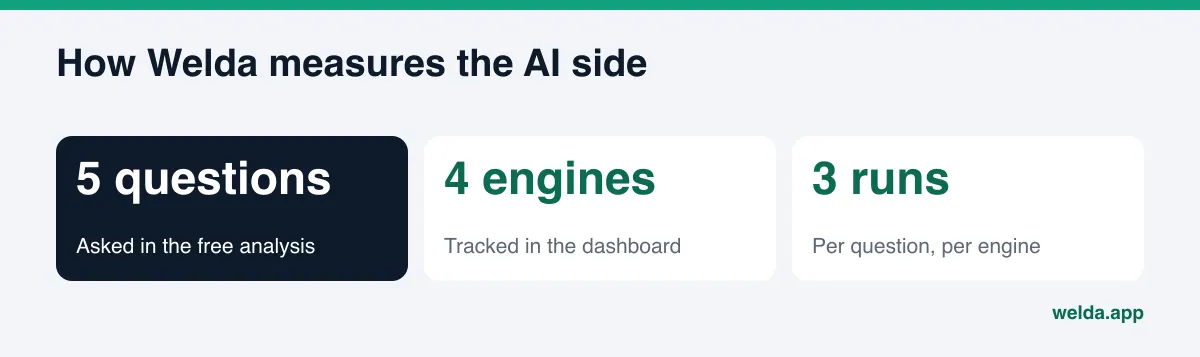
1. The free site analysis: checking the shared foundation. The analysis reads your homepage and a few inner pages such as services and contact. It checks the signals where local SEO and AEO overlap: whether your address, phone and location are clearly written, whether business schema is present, whether your map and social profiles are linked from the site, and whether AI crawlers can get in. Technical and content scores are reported separately, so you can see whether the problem is in the code or in the copy. Each gap comes with what was found, why it matters and how to fix it, and you get a ready-to-install fix pack that includes the business schema code. The analysis also asks five likely customer questions to an AI assistant that can search the web and checks whether your business name shows up. It is a one-time snapshot, but it gives a concrete first answer to "I rank on the map, so why am I not in the answer?"
2. Question tracking: the measurement the map cannot give you. In the Welda dashboard, the questions your customers are likely to ask are put to ChatGPT, Gemini, Perplexity and Google AI three times each. Every question is a row, and you see per engine whether you are named and in which position. Where a local SEO report gives you one rank for "dentist Capitol Hill", here you see the full answer to a real customer question and the sources it cites. The decision becomes concrete: which questions am I missing, and how much does each one matter to my business?
3. Sources view: the ground outside Google. The sources view lists the sites that AI answers cite, their type (your own site, directory, review site, forum, social) and your status there: missing, incomplete, unverified or done, each with a suggested next step. If a competitor wins because of a detailed directory listing you never claimed, it shows up here.
Work from these views lands in one to-do list. Welda drafts site copy, profile descriptions and review replies; you approve before anything goes live, and content always lives on your own site. On WordPress, Welda connects through a separate Editor user and application password, without installing code, and opens content as drafts. Without a connection you get a ready-made package to apply yourself, and tasks for unconnected profiles are listed as manual.
To be clear about where things stand: the free analysis works in English today and anyone can use it. The Welda dashboard is in early access and is opening first to businesses in Turkey. Regular four-engine measurement is being added during early access, and the example dashboard views are shown with representative data. Pricing is discussed in the early access conversation.
Limits: what Welda does not do
When you compare local SEO and AEO, it helps to know what software can handle and what stays with you.
- No map rank tracking. Welda does not measure your position in Google Maps. You need a separate method for that.
- No guarantees. Welda does not promise a map position or "showing up in ChatGPT". AI answers change; Welda measures and fills gaps.
- No guessing. If hours, service area or policies are missing, Welda asks you instead of inventing them.
- No fake reviews. Welda only drafts replies to real reviews. The FTC has a final rule banning fake reviews and testimonials, and Welda stays out of that entirely.
- Some work stays with you. Handling negative reviews, claiming directory listings and press outreach remain your team's job.
- Results take time. New content usually takes weeks to show up in AI answers.
Checklist: local SEO vs AEO, what does your business need?
Answer each question with yes or no. Every "no" tells you which side has the gap.
| Question | Which side it affects |
|---|---|
| Is my Google Business Profile complete and current? | Local SEO and AEO |
| Are my address and phone identical everywhere? | Local SEO and AEO |
| Can AI search crawlers access my site? | AEO |
| Is each service described on its own page, in detail? | AEO, partly local SEO |
| Does my site answer the questions customers ask most? | AEO |
| Are my Yelp, BBB or industry directory listings accurate? | AEO, partly local SEO |
| Do I know whether I am named for specific customer questions? | AEO |
| Do I know which searches put me in the map pack? | Local SEO |
Most businesses score better on the local SEO rows and weaker on the AEO rows. That is expected; local SEO has been around for years. The upside is that if your foundation is in place, most AEO work is concrete and happens on your own site.
Frequently asked questions
If I already do local SEO, do I need AEO too?
Local SEO builds much of the AEO foundation, not all of it. Crawler access, detailed service text, sources outside Google and question-shaped content usually need separate attention. Measurement settles it: if you are already named for your key questions, there is little extra work; if not, you will see where the gap is.
I rank at the top of Google Maps. Will AI assistants recommend me?
Not necessarily. Google's AI features can draw on Business Profile data, but ChatGPT, Gemini and Perplexity read different sources with different weight. A strong map position is a good start, not a guarantee of being named.
Should I drop local SEO and switch to AEO?
No. For urgent and location-driven searches, the map result is still where customers decide. AEO adds a channel; it does not replace one.
Is AEO the same thing as GEO?
They describe the same goal: being named in AI-generated answers. AEO is the more common term in the US. We explain the difference in naming in GEO vs AEO.
Does Welda track my map ranking?
No. Welda measures visibility in AI answers and fills the gaps. It checks the signals shared with local SEO, such as address, phone, business schema and linked map profiles, but it does not track map positions.
Which one shows results faster?
There is no honest universal timeline. For AI answers, new content usually takes weeks to be reflected. That is why it pays to take a baseline before you fix anything and then compare against the same questions.
See where you stand first
The right answer to local SEO vs AEO depends on which side your business is weaker on today, and that is easier to see than to guess. Run the free AI visibility analysis. In one report you will see how an AI system reads your address, phone, business details and services, your technical and content scores, and whether your business is named for five customer questions. It is free once per site, and the results link arrives by email.