Does AI-generated content help or hurt AEO? On its own, it does neither. Google has said plainly that it judges content by how useful it is, not by how it was produced, and answer engines like ChatGPT, Gemini, and Perplexity pick sources that carry specific, verifiable facts. The real problem is generic copy that an AI tool wrote without knowing your business: it reads fine, says nothing, and never gets cited. This guide covers how AI-generated content and AEO fit together, a safe workflow for using AI to write, how Welda handles this work, and where its limits are.
AI-generated content and AEO: where is the actual problem?
Getting copy for a website now takes minutes. Type "write a services page for an auto body shop" into a chat tool and you get smooth, grammatical text with no typos. So a lot of owners reasonably ask: if AI writes the copy anyway, isn't that enough to show up in AI answers?
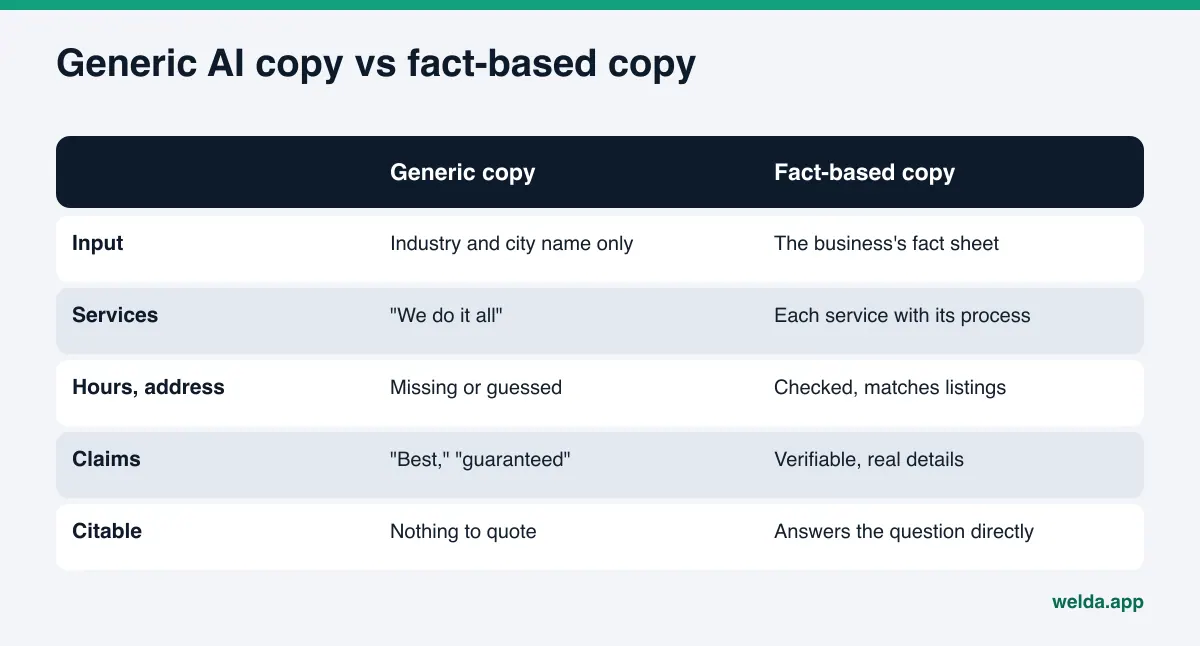
Two different jobs are getting mixed up here. The first is producing text. The second is putting information inside that text that an answer engine can actually use. A chat tool is good at the first job. It cannot do the second, because it does not know your business. It does not know which part of town you are in, which makes you work on, how long a paint job takes, how you handle insurance claims, or whether you are open on Saturday. Where it lacks facts, it does one of two things: it fills the gap with filler ("our experienced team", "our commitment to quality"), or it makes up something that sounds plausible and may be wrong.
Both outcomes are bad for AEO (answer engine optimization, also called GEO or generative engine optimization). Filler tells the engine nothing; the same sentences sit on thousands of sites and none of them separates one business from another. Invented facts are worse. A wrong opening time, a service you do not offer, or a warranty you never gave can travel into an AI answer, and a customer shows up expecting something you cannot deliver. In short, the risk with AI-generated content is not who wrote it. It is where the facts in it came from.
This matters most for small businesses. A national brand has plenty of independent coverage online, so its own site copy carries less weight. For a local shop, the sources an answer engine can read are often just a handful: the website, the Google Business Profile, a Yelp page, maybe a BBB listing or an Angi profile. If the biggest of those, your own site, is full of generic copy, the engine has very little to describe you with. If you want to see where you stand first, the free site analysis reads your homepage and a few inner pages and shows whether your services are spelled out, whether you have an FAQ section, and whether your business details are missing.
What does Google say about AI-generated content?
The most common question is whether Google penalizes AI-written text. Google's February 2023 post on AI-generated content on the Search Central blog answers it directly: Google rewards quality content however it is produced, and using AI does not give content any special boost. Being written with AI is neither a plus nor a minus.
The line is intent. Google's spam policies include a section on "scaled content abuse," and one of the listed examples is using generative AI tools to generate many pages without adding value for users. Hundreds of city pages with identical bodies, near-duplicate service pages, and automated blog posts nobody reads all drift toward that category.
The same Google post suggests evaluating content with "who, how, and why" questions: who created it, how it was made, and why it exists. It also suggests explaining how content was produced where readers would reasonably wonder. For a local business site, the practical version is this: if a service page describes work you actually do and the owner has checked every fact, who wrote the first draft is a secondary question.
Answer engines have not published rules as explicit as Google's. The logic works the same way, though. When an engine builds an answer, it prefers information that addresses the question directly, is specific, and does not contradict other sources. A generic compliment meets none of those tests. We go deeper on this in how to get cited by AI.
Why AI answers skip generic copy
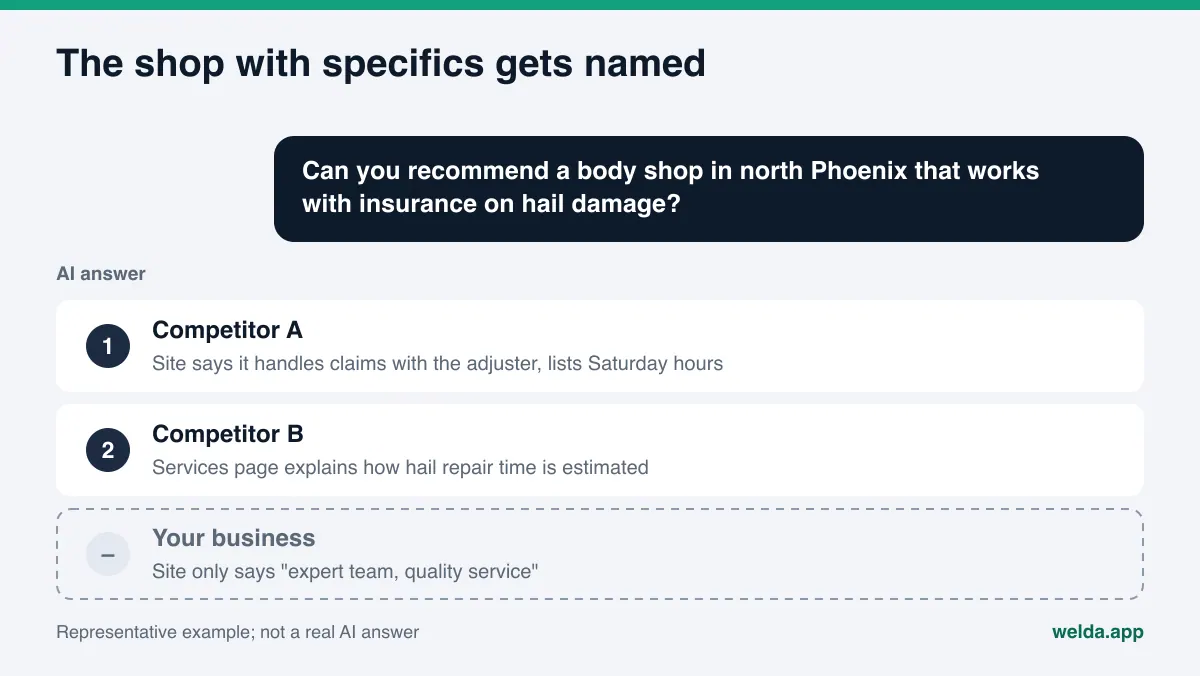
Say a customer asks ChatGPT: "Can you recommend an auto body shop in north Phoenix that works directly with insurance and can fix hail damage?" The engine reads a few sources and names two or three shops, each with a short reason. To write that reason, it needs sentences like these somewhere it can read them: "We handle the claim with your insurance adjuster." "Hail repair time depends on the number of dents; we give you a written estimate after inspection." "Open Saturdays until noon."
A services page left entirely to a chat tool usually says something else: "Our certified experts deliver the best service for your vehicle." "Customer satisfaction is our top priority." "State-of-the-art equipment for flawless results." Pleasant to read, but none of it answers the question. The engine cannot tell from that page whether you work with insurance, how long a repair takes, or when you are open. So it names the competitor who wrote those things down.
Consistency is the other trap. Content produced quickly with AI can state the same fact differently on different pages: "Monday to Friday, 8 to 5" on one, "open seven days" on another. If the Google Business Profile shows a third set of hours, the engine cannot tell which to trust. Conflicts like this can lead to a business being left out of answers, or mentioned with the wrong information. We cover the hours problem specifically in keeping business hours accurate for AI.
The table below sums up the most common problems with AI-generated content and what each does to your AI visibility.
| Problem | What it looks like on the page | Effect on AI answers |
|---|---|---|
| Filler | "Experienced team, quality service, great prices" | Nothing specific to cite, so the business is not named |
| Invented facts | Services you do not offer, wrong hours, a warranty you never gave | Wrong details can reach the answer and set false expectations |
| Contradictions | Different hours, address, or services across pages and profiles | The engine cannot tell which version to trust |
| Duplicate pages | Dozens of city or service pages with the same body | Drifts toward Google's scaled content abuse policy |
| Overclaiming | "Best in town," "guaranteed work," "number one" | Weakens trust signals and can create legal exposure in some industries |
A step-by-step workflow for writing with AI safely
Using AI to write is sensible. It saves time and turns scattered notes into clean paragraphs. What matters is the direction of the facts: information should flow from the business into the AI tool, not the other way around. Here is a practical sequence.
- Build a fact sheet first. Before you generate anything, write down the real facts: each service, hours, address, service area, what happens when a customer arrives, the questions customers ask most and your answers, how pricing works, and what you do not do.
- Give the AI tool only that sheet. Add a clear instruction such as "do not add anything that is not on this list; if you are unsure, leave a blank and flag it." The more specific the sheet, the more specific the copy.
- Put the answer first. Each section should answer the reader's question in its first two sentences. We break this structure down in answer-first content.
- Strip the filler. Search the draft for words like "quality," "expert," and "customer-focused." Replace each sentence with a concrete fact or delete it.
- Have someone who knows the work check it. Every sentence with hours, location, services, process, or a claim gets confirmed one by one.
- Flag risky claims. Review anything about price, warranties, superiority, or, in healthcare, diagnosis and outcomes. Your industry's advertising rules may limit what you can say.
- Keep it consistent. The facts in the new copy should match the rest of the site and your Google Business Profile, Yelp, and other listings.
- Measure and be patient. After publishing, ask the same customer questions the same way every few weeks. New content usually takes weeks to show up in AI answers.
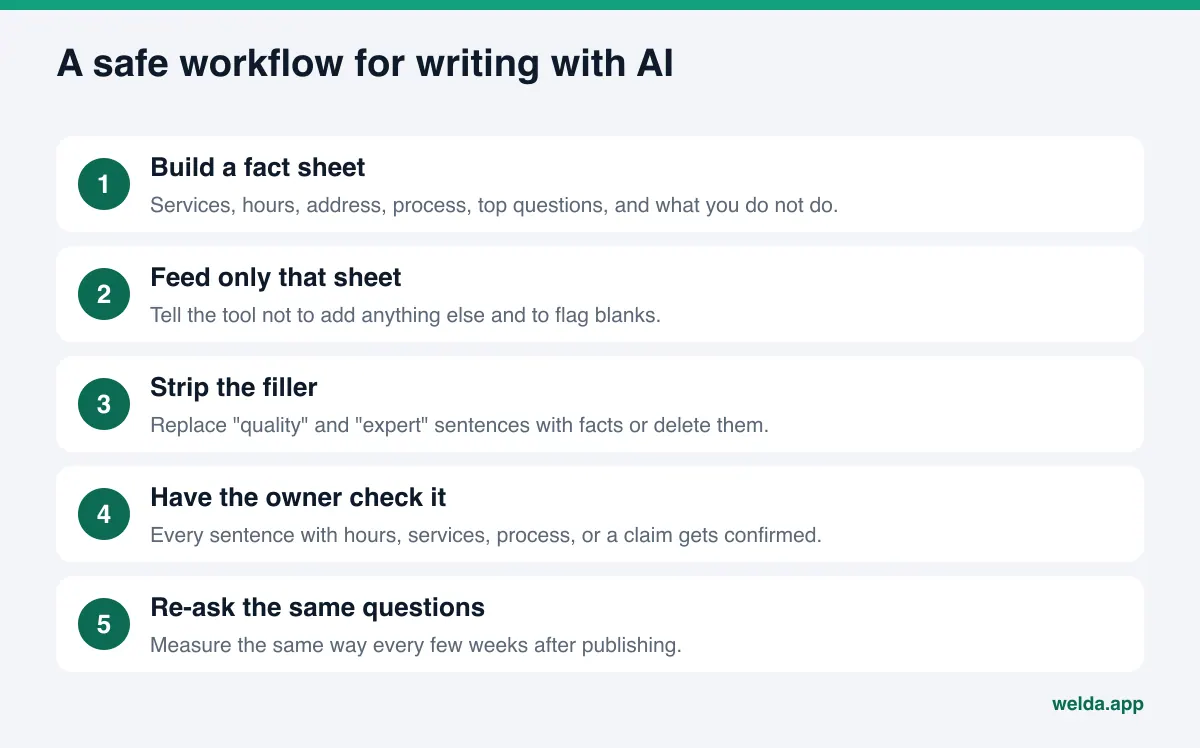
The steps people skip most are two and five. Many owners type only their industry and city into a chat tool and let it handle the rest. The result is tidy, but it is not about their business. On step five, there is a pull to publish because "it reads well" without anyone checking it. Every unchecked page is a wrong fact waiting to be corrected later. We describe how to set up that review step in a content approval workflow for AEO.
Example: the same paragraph, two ways
To make the difference concrete, take a sample auto body shop. The owner types "write a services page for an auto body shop in Phoenix" and gets this:
"With years of experience, we provide top-quality collision and paint services for your vehicle. Our expert team and state-of-the-art equipment guarantee flawless results every time. Your satisfaction is our priority."
There is not a single fact in that paragraph an answer engine can use. And "flawless results every time" may be a promise the shop never meant to make. Now the same owner writes a fact sheet first and gives the tool only that sheet:
"Our north Phoenix shop repairs collision and hail damage. We work directly with your insurance adjuster and handle the paperwork for the claim. Repair time depends on the number of panels involved; we give you a written estimate after we inspect the car. Open weekdays and Saturday until noon."
The second paragraph may also have been written with AI. The difference is that every sentence came from the business and answers a customer question: where, what work, insurance, timing, hours. The details here are illustrative; your own paragraph needs your own facts.
Which facts should never be left to AI to guess?
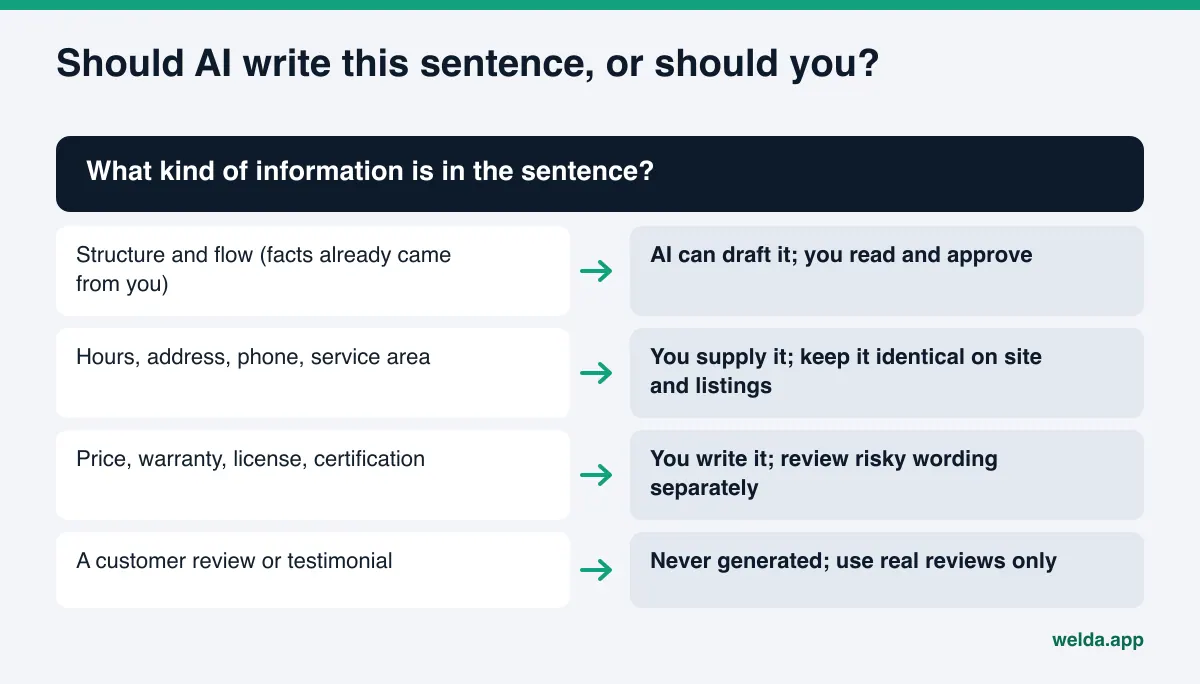
AI is strong at arranging words and weak at knowing your business. Some kinds of information cause trouble with customers and with AI answers when they are wrong. These should always come from the business itself.
- Hours and holiday schedules. Wrong hours mean customers at a locked door.
- Address, service area, and phone. One character off creates a conflict between your site and your listings.
- Services. Listing work you do not do means being recommended for it.
- Timing and process. "Same-day service" that is not true ends trust on the first visit.
- Prices and how pricing works. Numbers change, and old prices can linger in answers.
- Warranties, licenses, and certifications. If you do not have them, they are not mentioned. If you do, state the scope.
- People's names and titles. Owner names, credentials, and quotes come from the people themselves.
- Reviews and testimonials. Never generated on a customer's behalf.
The last point deserves emphasis. On August 14, 2024, the FTC announced a final rule banning fake reviews and testimonials, which explicitly covers reviews that misrepresent they are by someone who does not exist, such as AI-generated fake reviews. Beyond the legal risk, platforms like Yelp and Google can remove them. The trust signals answer engines rely on have to come from real customer experience. This is not legal advice; check the rule and your own situation with counsel.
How Welda handles AI-generated content: blanks, approval, and a claims check
Welda uses AI when it drafts content too. So every risk above applies to us as well, and the product is built around them. Here are the three parts most relevant to this topic.
First, unknown facts stay blank. Welda reads your site and connected profiles and pulls the facts it will use from there. If it cannot find something, say your holiday hours or the owner's name, it does not guess. Its to-do list opens with a section that asks you for exactly that information, and next to each field it shows how many drafts will use it. You answer once and the fact is filled into every related draft. Fields you leave empty stay flagged in the preview, so a draft with a missing fact does not slip into publication unnoticed.
That is a direct guard against the biggest risk in AI-generated content, which is invention. The drafting side is fast, but the source of every fact is either what is already on your site or what you told Welda. For an auto body shop, the open fields might be how you work with insurers, your Saturday hours, and what your paint warranty covers. Until those are filled in, the services page draft stays marked as incomplete.
Second, publishing stays with you. Every draft Welda prepares goes into an approval queue. On a WordPress site, Welda connects through a separate Editor user you create for it, with an application password and no code to install, and it opens content on your site as a draft. It goes live when you approve it. On other platforms, Welda gives you a ready-to-apply package and you make the change yourself. Either way, the content lives on your own site; Welda does not host content. In healthcare there is no automatic publishing at all; every piece comes to you for approval.
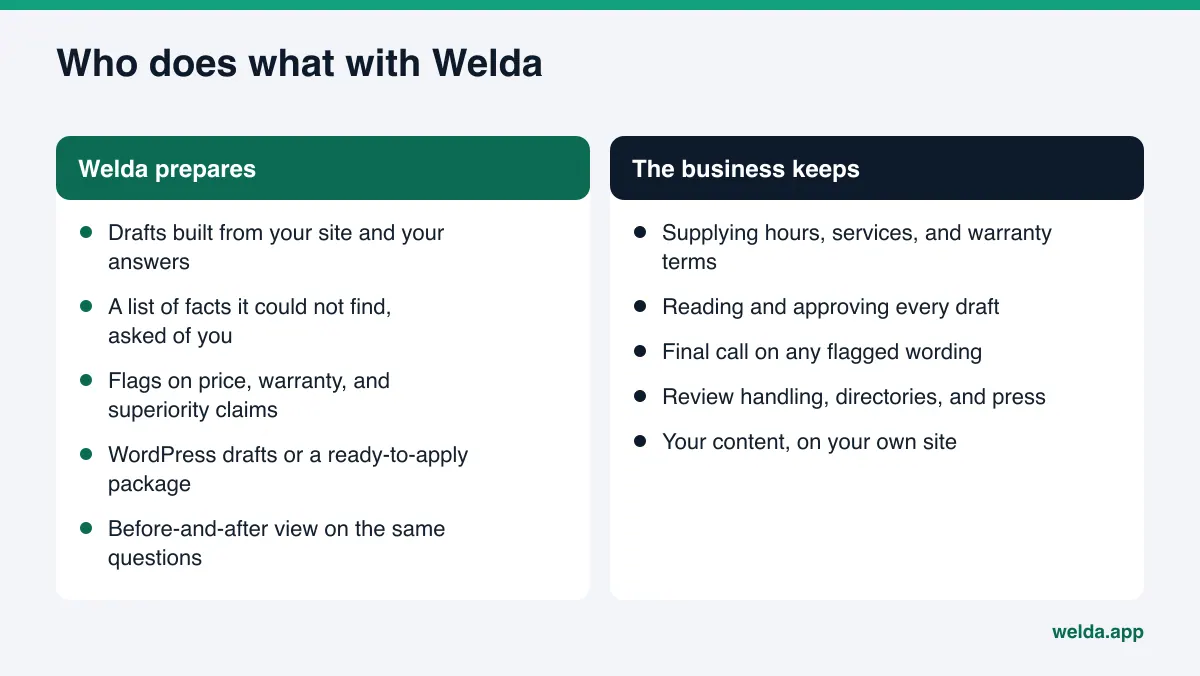
Third, risky phrasing is flagged before it goes out. Welda's legal check scans drafts for patterns such as prices, warranties, superiority claims, and anything that reads like a diagnosis, and flags them. That is useful with AI-written text because words like "best," "guaranteed," and "flawless" tend to creep in on their own. Whether to change or keep a flagged sentence is your call. The check is not legal advice and has not been reviewed by legal counsel; the final word on your industry's rules sits with you and your advisor.
Beyond these three, Welda measures visibility by asking the questions your customers would ask in ChatGPT, Gemini, Perplexity, and Google AI three times each, and shows which questions mention you. After new content goes live, a before-and-after view compares the same questions.
A note on availability: the Welda dashboard is in early access, and the full dashboard is opening first in Turkey. Regular four-engine tracking is being added during early access, and the dashboard screens shown in our materials use representative data. What anyone can use today is the free site analysis, which works in English. Pricing is discussed in the early access conversation.
Limits: what Welda does not do
Being honest about AI-generated content means being clear about what cannot be done.
- Welda does not guarantee that a page will appear in ChatGPT or any other engine after it is published. Nobody can; engines rebuild each answer every time.
- It does not write facts it does not know. If an hour, service, or warranty is not on your site or profiles, it asks you.
- It does not publish sensitive content without your approval. In healthcare every piece needs approval, and patient data is not sent to AI.
- It does not generate fake reviews, testimonials, or customer quotes.
- Handling negative reviews, setting up directory accounts, and press outreach stay with the business. Welda can prepare text for them, but you own the accounts and the decisions.
- New content usually takes weeks to show up in AI answers. Seeing no change in week one is normal.
One more limit: Welda drafts the copy, but it does not know your work the way you do. A sentence that looks right in a draft can still be incomplete or wrong for your business. That is why the approval step is not a formality. It is the real control point.
Pre-publish checklist: is your AI-generated content ready?
Whether the copy came from a chat tool, an agency, or Welda, run every AI-assisted page through these questions before it goes live. If the answer to any of them is no, the page is not ready.
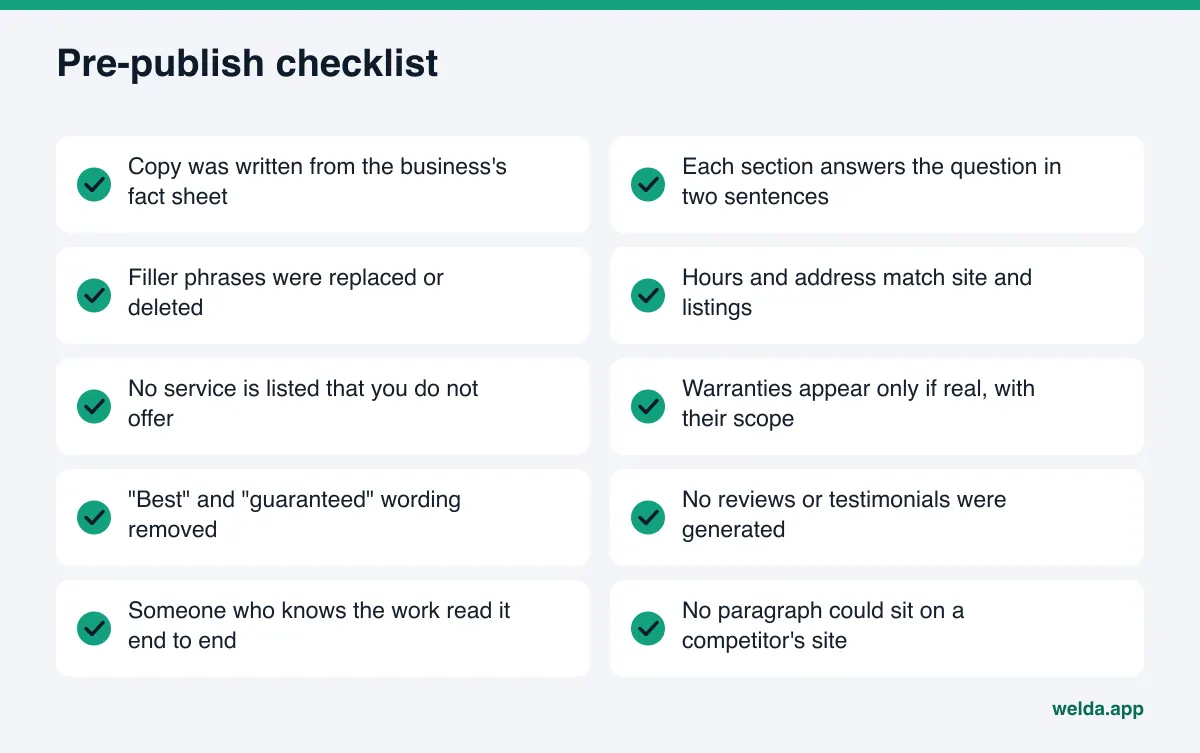
You can apply the same checklist to copy already on your site. Many small business sites still carry generic text a template or an agency wrote years ago. Rewriting it with AI is reasonable, as long as you start from the fact sheet. We walk through building those pages in service pages AI can quote.
A quick test helps with the decision: read a paragraph and ask, "Could this exact sentence appear on my competitor's site?" If yes, that paragraph does not set you apart in AI answers. If no, because it holds a fact only true of your business, you are on the right track.
Frequently asked questions
Does Google penalize AI-generated content?
According to Google, no. It evaluates quality and usefulness, not the production method. Generating many pages with AI that add no value for users does fall under its spam policies.
Is AI-written content more likely to show up in ChatGPT answers?
No. Being written by AI gives a page no advantage. What gets cited is information that answers the question directly, is specific, and matches other sources.
Do I need to disclose that my site copy was written with AI?
Google suggests explaining how content was made where readers would reasonably wonder. For business pages like services or hours, what matters most is that the facts are correct and checked by the business. If your industry has its own disclosure rules, follow them.
Are separate pages for every city good for AEO?
They can be, if each page holds real information specific to that area. Pages with the same body and only the city name swapped add no value and drift toward Google's definition of scaled content abuse.
Does Welda use AI to write content?
Yes, it uses AI to prepare drafts. The facts come from your site and your own answers. Unknown details are left blank and you are asked for them, and publishing stays with you.
Can I use AI to write customer reviews?
No. The FTC rule on fake reviews covers AI-generated reviews, and platforms remove them. Welda does not create reviews; it can draft responses to real ones.
How can I tell how generic my current copy is?
The free site analysis reads your homepage and inner pages such as services, about, and contact, and reports whether services are clearly described and whether you have an FAQ section. It also suggests ready-to-use homepage copy.
Start with your own site
The relationship between AI-generated content and AEO comes down to this: the tool speeds up the writing, and you supply the facts. Generic copy makes you invisible, invented facts make you look wrong, and specific, checked information is what an answer engine needs to describe you. The first step is seeing what your site tells AI today. Run the free site analysis to get a score out of 100, the reason behind each gap, and suggested homepage copy you can use right away.