What is answer-first content, and why does it matter for AI search visibility? Answer-first content puts the direct answer to the reader's question in the first sentence or two of each section, and saves the background and the story for after. ChatGPT, Gemini, Perplexity and Google's AI Overviews build their answers from short passages; a page that states the answer up front and plainly is a better source for that passage. This guide shows how to rewrite the pages you already have, step by step, and what Welda prepares for you along the way.
What does answer-first content actually mean?
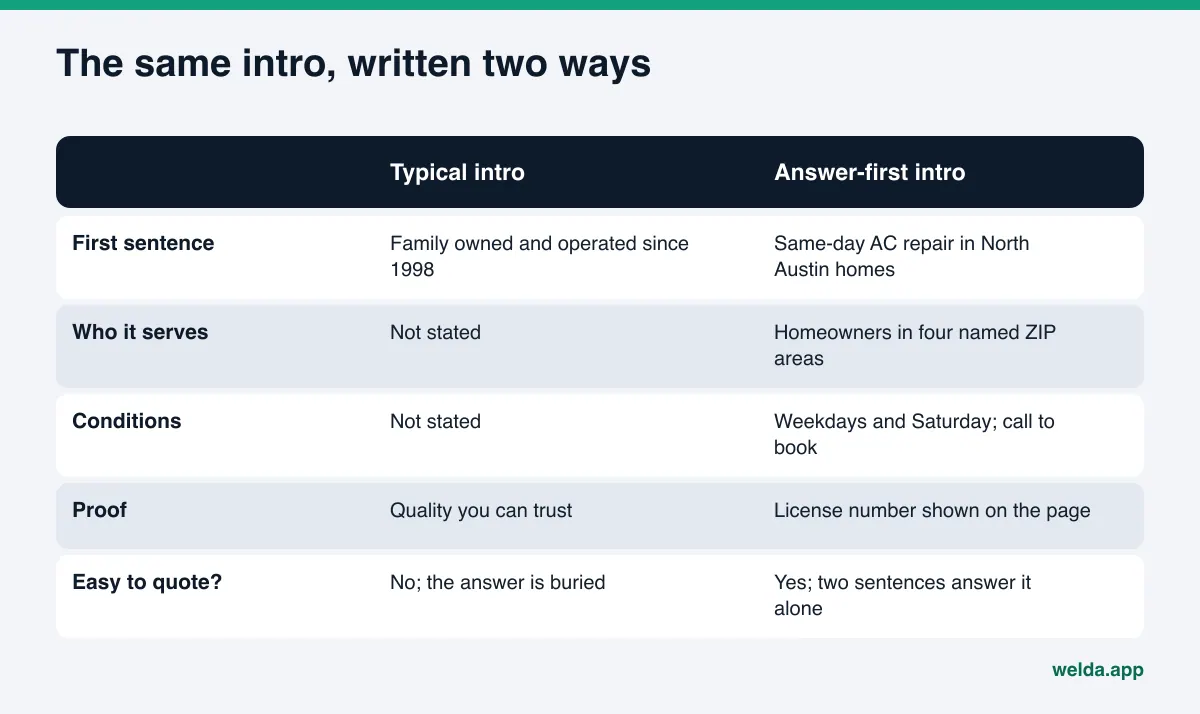
Journalists call it the inverted pyramid: the most important fact goes first, the detail follows. Answer-first content applies the same idea to a business website, with one twist. The "most important fact" is not what you want to say about yourself. It is the answer to the question your customer is asking.
Most small business sites do the opposite. The service page opens with "Family owned and operated since 1998." What the company actually does shows up in the third paragraph, the service area sits at the bottom, and the hours live inside an image in the footer. A patient human can scroll and find it. An AI assistant looking for the one passage that best matches a question will not reward that patience. If the matching passage is "family owned since 1998," it adds nothing to the answer.
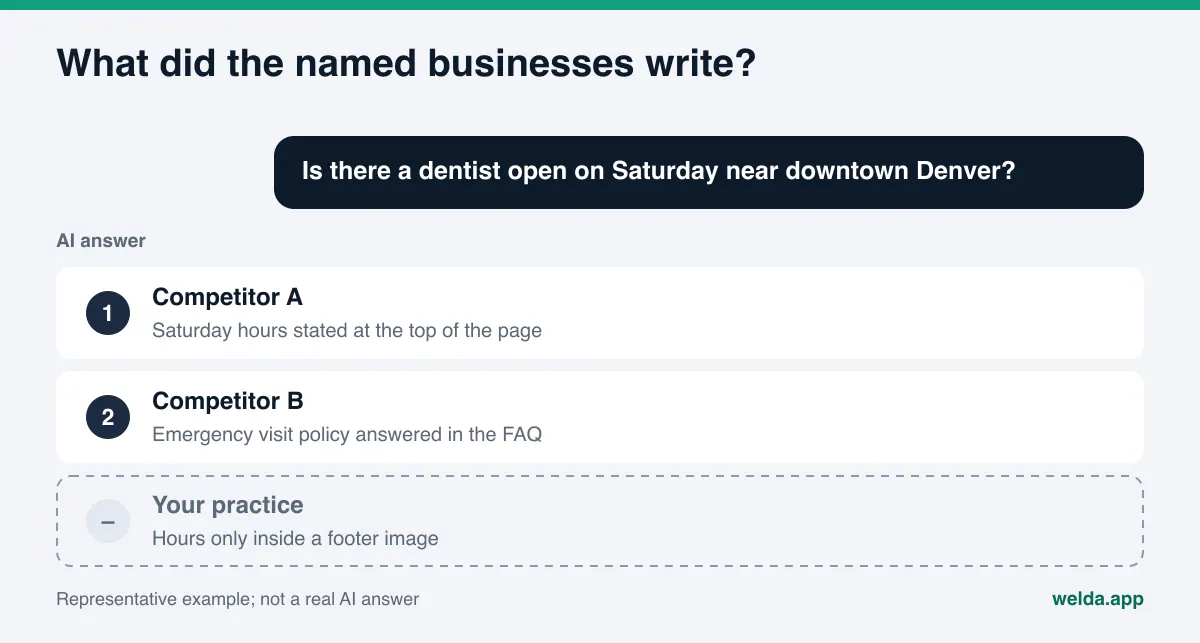
The skeleton of an answer-first section is simple:
- Question: The subheading is a question a customer would really ask. Not "Our Services," but "How long does an AC tune-up take?"
- Direct answer: The first sentence answers it. "A standard AC tune-up takes about an hour on site."
- Conditions: When the answer holds. "If a part needs replacing, it takes longer, and we tell you before we start."
- Proof or detail: Something a reader, or an AI, can check. A license number, an address, a step in your process.
This is not a new trick. Google states on its AI features and your website page that there are no special optimizations required for AI Overviews or AI Mode, and that the usual fundamentals apply, including keeping important content in text form. Google's guidance on helpful, reliable, people-first content points the same way. Answer-first writing is simply clear, people-first content, organized so the answer is easy to find.
If you want to see where your own site stands, Welda's free site analysis reads your homepage and a few inner pages, checks how clearly your main heading and opening paragraph say what you do, and suggests ready-to-use replacement text. It works in English.
Why does answer-first content help with AEO?
AEO (answer engine optimization) is the work of getting your business named in the answers AI assistants give. You will also see it called AI visibility or GEO (generative engine optimization); they describe the same goal. Answer-first writing is one of the most overlooked parts of AEO, and one of the cheapest. You do not need new pages or ad spend. You rewrite the pages you have, in the right order.
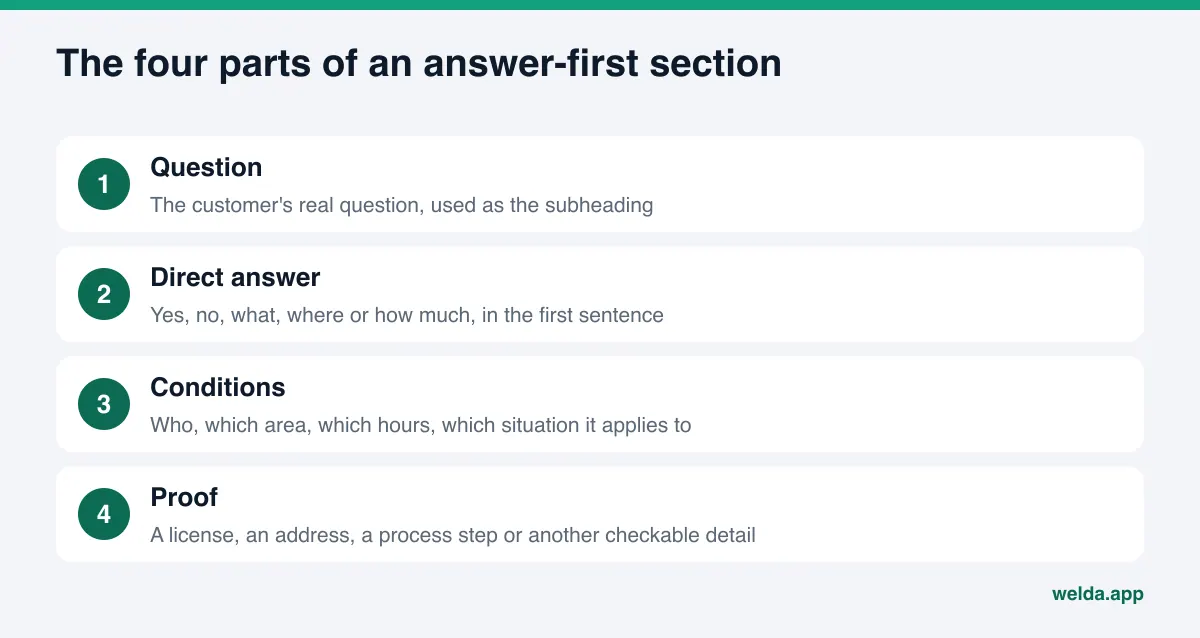
Picture a customer asking ChatGPT, "Is there a dentist open on Saturday near downtown Denver?" The assistant looks at a handful of sources, builds a short answer and usually names a few practices. To be one of them, the assistant has to be able to answer a simple question about you with confidence: is this practice open on Saturday, and is it downtown?
If your site has that fact but hides it in an image, a PDF or behind "Call us for hours," the assistant either misses it or cannot rely on it. A competitor who wrote it out plainly gets the mention.
There are three concrete reasons answer-first content helps:
- It is quotable. AI answers do not copy long stretches of text. They use short passages that make sense on their own. A paragraph whose first two sentences already answer the question is ready for that.
- It removes ambiguity. "Serving the greater metro area" answers no neighborhood question. "We come to homes in Round Rock, Pflugerville and Cedar Park the same day" answers three.
- It can be cross-checked. Assistants can compare your site with your Google Business Profile, Yelp, BBB or Angi listings. When your site is clear and matches those sources, it is safer to use. For the details, see our guide to NAP consistency for AI search.
One honest caveat: answer-first content does not guarantee a mention. Assistants also weigh reviews, directories and press. But if your own pages are vague, you stay out of the answer even when everything else is in order. Clear writing is the biggest piece fully under your control.
How can you tell if a section is answer-first?
Here is a quick test. Copy the first two sentences of a section, read them to someone who has not seen the rest of the page, and ask the question in the subheading. If they can answer it, the section is answer-first. If they say "I would need to scroll up," it is not.
The table below shows lines that often appear on an example HVAC company's site, next to answer-first rewrites. The business and its details are examples.
| Section | Typical wording | Answer-first wording |
|---|---|---|
| Main heading | Quality Service You Can Trust | Same-Day AC and Furnace Repair in North Austin |
| Opening paragraph | We have been putting customers first for over two decades. | We repair and maintain central AC and furnaces in homes across North Austin, Round Rock and Pflugerville. We book weekdays and Saturdays, and if we cannot come the same day, we tell you on the phone. |
| Services | Professional solutions for every brand. | Which systems do you service? Most residential split systems and heat pumps; the brand list is below. |
| Pricing | Call for a free quote. | Tune-ups have a flat fee. If a part is needed, we quote it first and replace it only with your approval. |
| Hours | Shown only in a footer image | Open Monday to Friday 8 a.m. to 6 p.m. and Saturday 9 a.m. to 3 p.m. Closed Sunday. |
Notice that the right column is not longer, it is more informative. Answer-first content does not mean adding words. It means swapping vague words for facts. How specific you can be about price depends on your industry; we cover that in pricing pages for AI answers.
How to rewrite your pages as answer-first content, step by step
You do not need to rewrite your whole site from scratch. Start with what you have. The sequence below is a work plan a small business can run on its own over a week or two.
- Collect the questions. Write down the 15 to 20 questions you hear most on the phone, by text and at the counter. "Are you open Sunday?", "Is there parking?", "How long does it take?", "Do you come to my area?" These are your real search terms. Recurring themes in your Google and Yelp reviews are good sources too.
- Assign each question to a page. Hours and directions go to the contact page, duration and method to the matching service page, cost to the pricing page. Anything that does not belong to a page goes into the FAQ.
- Rewrite the main heading. Your homepage H1 should say what you do and where. Keep the slogan if you love it, but put it under the heading, not in its place.
- Cut the opening paragraph to three sentences. Sentence one: what you do and for whom. Sentence two: where and on what terms. Sentence three: one checkable detail that sets you apart.
- Turn subheadings into questions. Replace "Our Services" and "Why Choose Us" with the questions customers actually ask, and make the first sentence under each one the answer.
- Move facts out of images. If your price list, hours, menu or service area map exists only as an image or PDF, write the same information as text on the page.
- Add an FAQ section. Five to ten questions with two- or three-sentence answers. Where you can, start each answer with "Yes," "No" or the fact itself.
- Check consistency. Are the hours, address, phone and service area you just wrote the same on your Google Business Profile, Yelp, BBB and Angi listings? If not, update those too.
- Match your structured data. If your site has business schema markup, the values in it must match the visible text. See schema markup for AI search.
Older blog posts and long guides benefit from the same method, but start with the pages that bring in revenue. For the order to tackle older pages in, read how to update old content for AI search.
Answer-first content by page type
Every page type answers a different question. Instead of pasting the same pattern everywhere, think about the question that brings someone to that page.
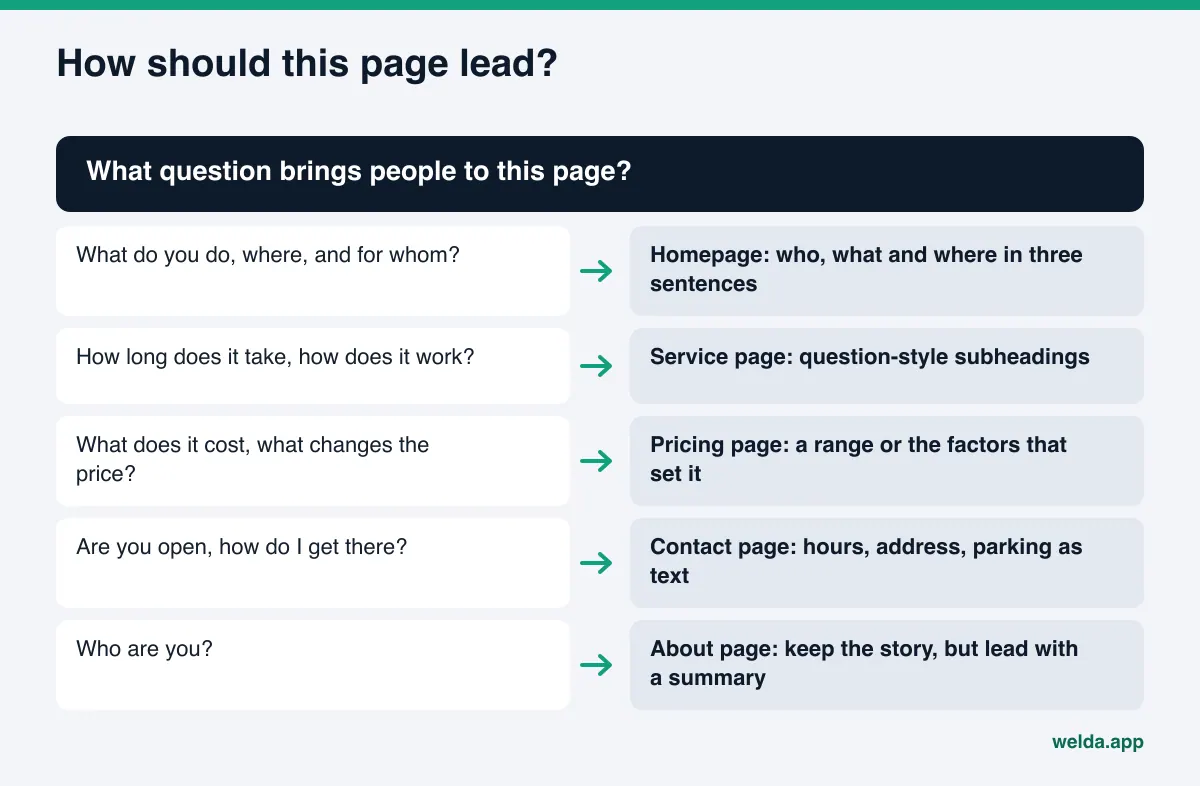
Homepage. Visitors and AI assistants want the same thing: what does this business do, where, and for whom? The H1 and the opening paragraph should answer all three. Promotions, slogans and image sliders can sit below.
Service pages. One section or one page per service works best. The first sentence says what the service is and who it is for. Then come subheadings for duration, method, preparation and aftercare.
Pricing page. If you can publish exact prices, do. If you cannot, explain plainly what drives the price. "Call for a quote" is not an answer. Some industries have rules about price advertising, so check before you publish.
Contact page. Address, phone, hours, parking and directions as text. "Free parking behind the building" is the answer to "Is there parking?"
About page. Storytelling belongs here. Still, let the first paragraph sum up the business in a sentence, and tell the story after.
FAQ. This is answer-first content in its purest form. Every question is a real customer question, every answer is clear in its first sentence. If the honest answer is "it depends," say what it depends on.
Common mistakes when writing answer-first content
The method looks simple, but the same mistakes keep coming up:
- Restating the question and delaying the answer. "Wondering how long an AC tune-up takes? You have come to the right place" repeats the question and answers nothing. Spend your first sentence on the answer.
- Keyword stuffing. Squeezing the city name and service name into every paragraph makes text harder to read and less trustworthy. State your service area once, clearly, in the right place.
- Stating maybes as facts. If you write "We always come the same day," it needs to be true every time. If it is not, write the condition. An assistant may repeat your sentence word for word, and a wrong promise looks wrong in the answer too.
- Superlatives and unsupported claims. "Best in town" and "guaranteed results" are not answers, and nobody can check them. The FTC's advertising guide for small businesses notes that advertising must be truthful and non-deceptive, and that advertisers need evidence for their claims before the ad runs. This is general information, not legal advice.
- Dumping everything into the FAQ. An FAQ helps, but it does not replace a service page. Core facts belong in the body of the relevant page as well.
- Writing it once and forgetting it. When hours, prices or staff change, the page must change too. A clearly written outdated fact is easier for an AI to repeat.
How Welda handles answer-first content
Welda is software that measures where a business shows up in AI answers and fills the gaps on the business's behalf. For answer-first content, two parts matter most: the ready-to-use text in the free site analysis, and the question tracking and to-do flow in the Welda dashboard.
The free analysis: which paragraph fails to answer, and what to write instead
The free site analysis reads your homepage plus a few inner pages such as services, pricing, about and contact. For this topic, it looks at what your page title and description say, whether your main heading tells people what you do, whether your services are spelled out, whether your address and phone number are present as text, and whether you have an FAQ section.
For each gap, it explains what it found, why it matters and how to fix it. For the homepage it also drafts replacement text: title, description, main heading, opening paragraph and FAQ. Read those drafts against the checklist in this guide: does the first sentence say what you do and where, and are the facts right? Edit where needed, then use them. A simulation shows how much each fix would move your score, so you can decide whether to rewrite the opening paragraph or the FAQ first.
The analysis also asks an AI assistant with web search five questions your customers might ask, and checks whether your business name appears in the answers. It is a one-time snapshot, but it tells you which question to start rewriting for.
The dashboard: question-by-question tracking and drafts on your to-do list
In the Welda dashboard, the questions your customers ask are put to ChatGPT, Gemini, Perplexity and Google AI three times each. The questions screen shows, for each one, whether you are named, on which engine and in what position. A question where you never come up usually means no paragraph on your site answers it clearly.
That is where Welda drafts the paragraph for you. It lands on your to-do list with the draft text right next to it. One rule matters here: Welda does not make up facts. If your Saturday hours, service area or pricing factors are not on your site, it leaves a blank and asks you in a "details we need from you" section. You fill it in once, and it flows into every draft that uses it.
On WordPress sites, Welda connects through a separate Editor user and an application password, with no code to install. Drafts open on your site as WordPress drafts and go live only when you approve them. On other platforms, Welda hands you a ready package and you or your web person paste it in. Either way, the content lives on your own site; Welda does not host it.
Before anything is published, a compliance check flags patterns such as price claims, guarantees, superiority claims and diagnostic suggestions. It is a warning layer, not legal advice, and it has not been reviewed by legal counsel. In healthcare, nothing is published automatically; every draft comes to you for approval.
Once the new paragraphs are live, you follow the same questions in later measurements. A before-and-after comparison and a one-page monthly report sum it up.
What stays with you: the accuracy of your facts, the final approval, placing text on non-WordPress platforms, and updating listings that are not connected.
Early access, plainly: The Welda dashboard is in early access and opening in stages, starting with businesses in Turkey. Regular measurement across all four engines is being added during early access, and the dashboard screens shown in our materials use representative data. What anyone can use today is the free site analysis, which works in English. Pricing is discussed in the early access conversation.
Limits: what answer-first content cannot do, and what Welda does not do
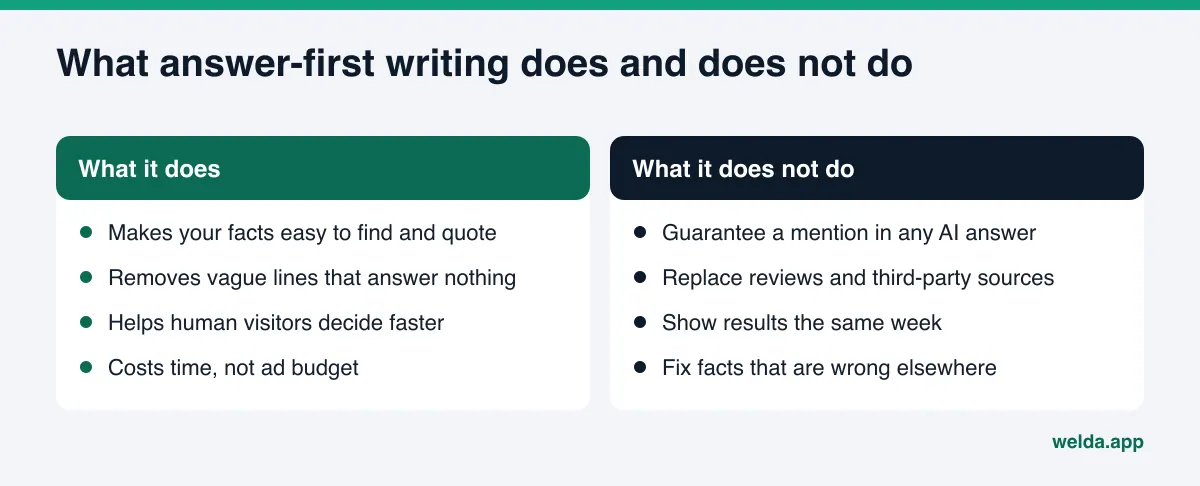
- No guarantees. Neither answer-first content nor Welda guarantees a mention in ChatGPT or any other engine. Welda does not promise rankings.
- It takes time. New or changed content usually takes weeks to show up in AI answers. Do not expect results the week you publish.
- Third-party sources are separate work. Assistants also read reviews, directories and news sites. Handling negative reviews, managing directory accounts and press outreach stay with you; Welda can draft text for them but does not run them. For the press side, see digital PR for AI visibility.
- No invented facts. Welda does not write hours, prices or credentials it does not know. It asks.
- No fake reviews. Welda drafts review replies; it never writes reviews.
- No sensitive content without approval. Sensitive content, especially in healthcare, does not go live without your sign-off.
Answer-first content checklist and decision table
Read each page against this list before you publish. Every "no" marks a section to rewrite.
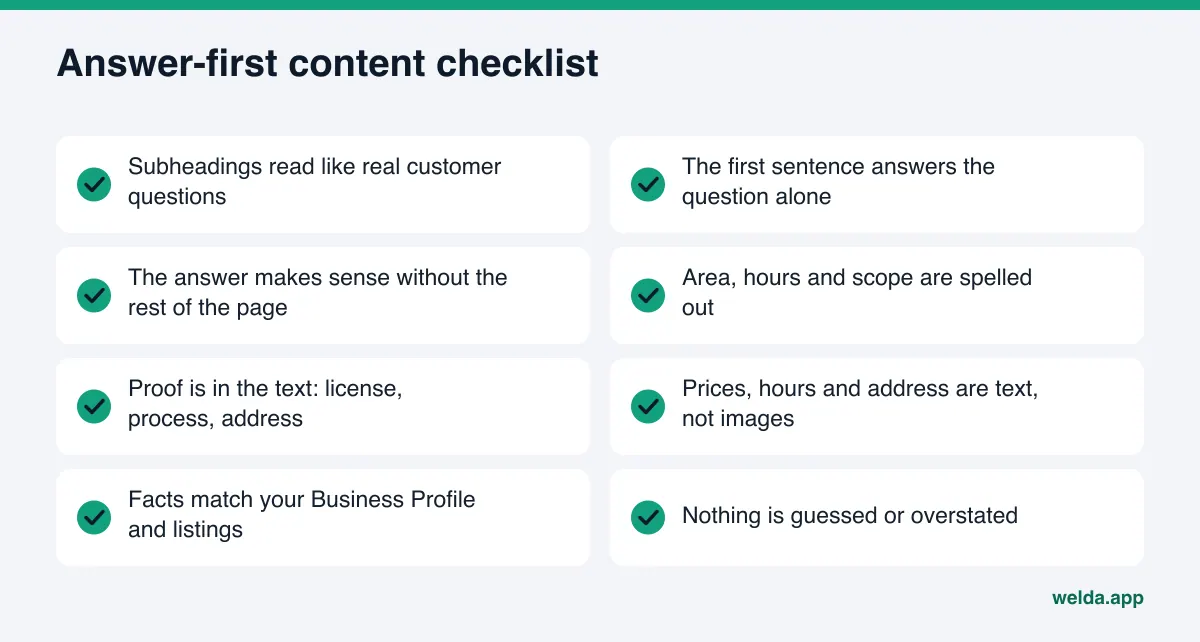
| Check | If yes | If no |
|---|---|---|
| Does the main heading say what you do and where? | Move on to the opening paragraph | Move the slogan down, rewrite the heading |
| Does the first sentence of the intro stand on its own? | Move on to the subheadings | Rewrite in the order: what, for whom, where |
| Do subheadings read like customer questions? | Check the first sentence under each | Turn your collected questions into headings |
| Are hours, address and prices in text? | Check consistency with your listings | Move the facts out of images and PDFs |
| Is there an FAQ section? | Check the first word of each answer | Start with your five most common questions |
| Is every absolute claim always true? | Ready to publish | Add the condition or remove the claim |
Frequently asked questions
Does answer-first content hurt traditional SEO?
No. Google says AI features need no special optimization and that clear, people-first content is the foundation. Putting the answer up front also makes pages easier to read in classic search results.
Should every paragraph start with a question?
No. The subheading is the question. The paragraph starts with the answer. Opening every paragraph with a question makes text feel forced and tiring.
Do I need to make my pages shorter?
No. Length is not the problem; a buried answer is. Detail, stories and examples can follow the answer.
Is an FAQ section enough on its own?
No. An FAQ helps, but core facts also need to be clear in the body of the relevant page. AI assistants read service and contact pages too.
Will Welda publish the text for me?
On WordPress, Welda opens the content as a draft and you approve it before it goes live. On other platforms, it gives you a ready package to place by hand. In healthcare, every draft needs your approval.
How soon will I see a change after rewriting?
Changes usually take weeks to show up in AI answers, and there is no guarantee. In the Welda dashboard you can follow the same questions over later measurements and compare before and after.
Next step: find the paragraphs that do not answer
The easiest way to start with answer-first content is to see how clearly your current homepage answers the basic questions. Run the free site analysis: it reads your homepage and a few inner pages, lists the gaps with reasons, and drafts a new main heading, opening paragraph and FAQ for you. It is free once per site, and the results link arrives by email and stays open for 14 days.