What makes service pages AI can quote? A quotable service page answers the customer's question in plain, self-contained sentences: what you do, for whom, in which area, how long it takes and what affects the price. The service name sits in the title, the definition sits in the first sentence, and scope, process and FAQs each get their own heading. Pages built this way give ChatGPT, Gemini, Perplexity and Google AI Overviews something they can cite. Nobody can guarantee a mention, but a business that never describes its services gives answer engines nothing to work with.
Why AI assistants skip most service pages
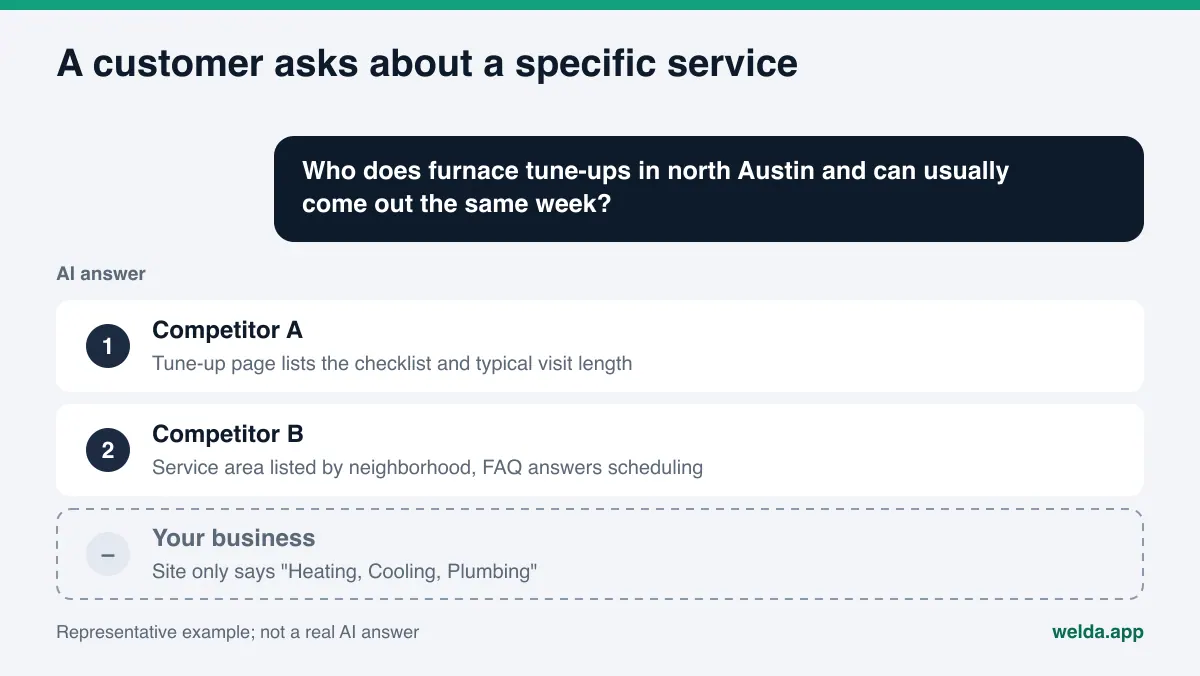
Customers no longer type "HVAC Austin" and scroll. They ask full questions: "Who does furnace tune-ups in north Austin and can come out this week?" or "Which roofer near me handles insurance claims for hail damage?" An answer engine responds with two or three names and a short reason for each. It might say one company "lists exactly what its tune-up includes" or another "serves Round Rock and Pflugerville." To write that reason, it needs a sentence on your site that says so.
Most small business service pages do not contain that sentence. Three patterns show up again and again:
- The keyword list. A page called "Services" with a row of icons: Heating, Cooling, Plumbing, Water Heaters. No scope, no area, no process.
- The brochure paragraph. "With decades of experience, our team delivers quality workmanship and unmatched customer service." True for everyone, so it says nothing about you.
- The locked-up facts. The price sheet is a JPG, the service area is a map image, and the warranty terms live in a PDF. The visible text of the page carries none of it.
In each case the assistant cannot pull a reliable statement like "this company does X for Y in Z." So it either leaves you out or takes its facts about you from somewhere else, such as your Yelp listing, an Angi profile or a directory page you never updated. The sentence that describes your business ends up being written by someone other than you.
Google is direct about this. Its guidance on AI features in Search says there are no additional requirements or special optimizations for appearing in AI Overviews or AI Mode. The usual fundamentals apply, including having important content available as text and keeping structured data consistent with the visible page. In other words, AEO (answer engine optimization, also called GEO or generative engine optimization) for a service business is not a hidden file or a secret tag. It is the copy on your service pages.
What service pages AI can quote need to answer
Before you rewrite anything, write down what customers actually ask about the service. Look at call notes, text threads, contact form submissions and the questions your techs get on site. For most service businesses the list falls into five groups:
- What exactly is it? The service name and what it covers at your company. A "tune-up" at one shop is a filter change; at another it includes a combustion and safety check.
- Who is it for, and where? Homes or commercial buildings, which cities, suburbs or neighborhoods. Without a written service area, the assistant cannot connect you to a "near me" question.
- How does it work, and how long does it take? Booking, the visit itself, what the customer should prepare, typical duration.
- What drives the price? You do not have to publish a number. Explaining what makes the job cost more or less is an honest answer to "how much will this cost?"
- What is not included? Saying what you do not do keeps you from being recommended for the wrong job.
When these five answers are on the page, an assistant can build its reason for naming you out of your own words. The free site analysis reads your home page and key inner pages the way Google and AI assistants do, and one of the things it checks is whether your services are described clearly enough to be understood.
The structure of a quotable service page
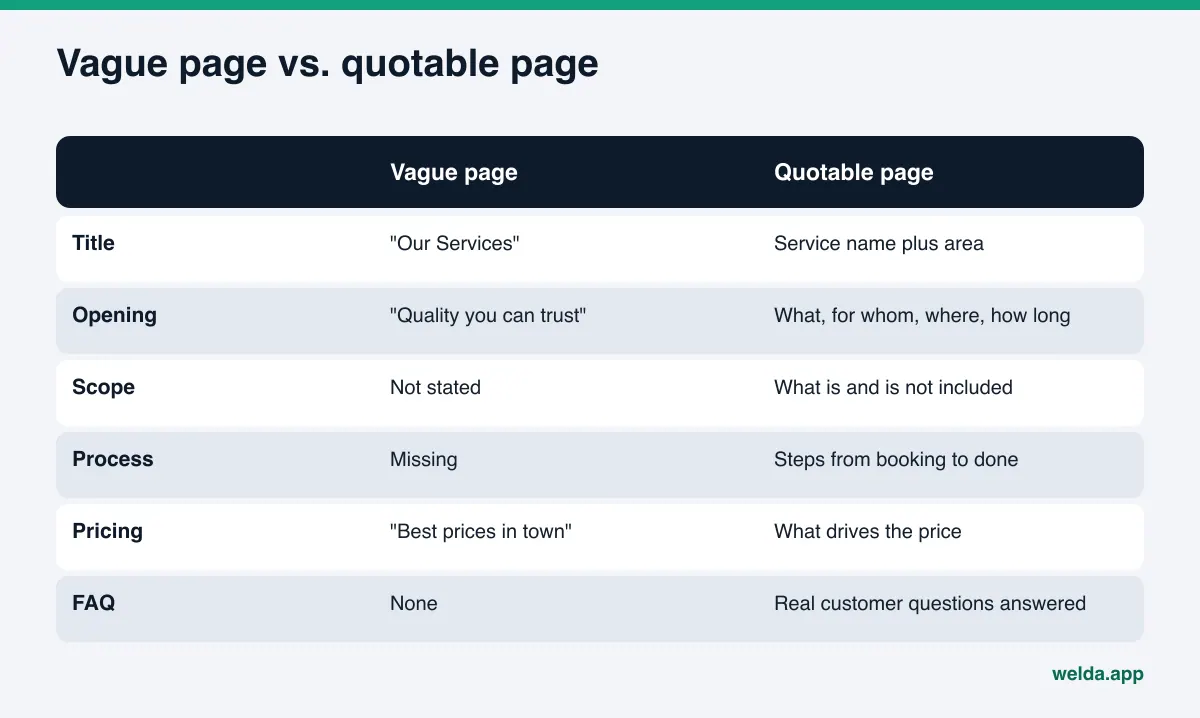
Answer engines lean on headings. When each heading matches a question a customer would ask, the paragraph beneath it can be lifted as the answer. The table below shows a recommended outline for an example HVAC company's furnace tune-up page. Treat it as a template and adapt the wording to your own trade.
| Section | What goes in it | Example line |
|---|---|---|
| Title tag | Service name and area | Furnace Tune-Ups in North Austin and Round Rock |
| Main heading | The phrase customers use | Furnace tune-up in north Austin |
| Opening paragraph | What, for whom, where, how long | We service gas furnaces in homes across north Austin, Round Rock and Pflugerville, usually in one visit of about an hour. |
| What the tune-up covers | Itemized scope | Filter check, burner cleaning, flame sensor, carbon monoxide test, thermostat calibration |
| What is not included | Separate or excluded work | Duct cleaning is a separate service. |
| How it works | Steps from booking to done | Book online or by phone, on-site inspection, tune-up, written summary |
| How pricing works | Price drivers | System age, accessibility and any parts that need replacing |
| FAQ | Real questions, short answers | How often should a furnace be tuned up? |
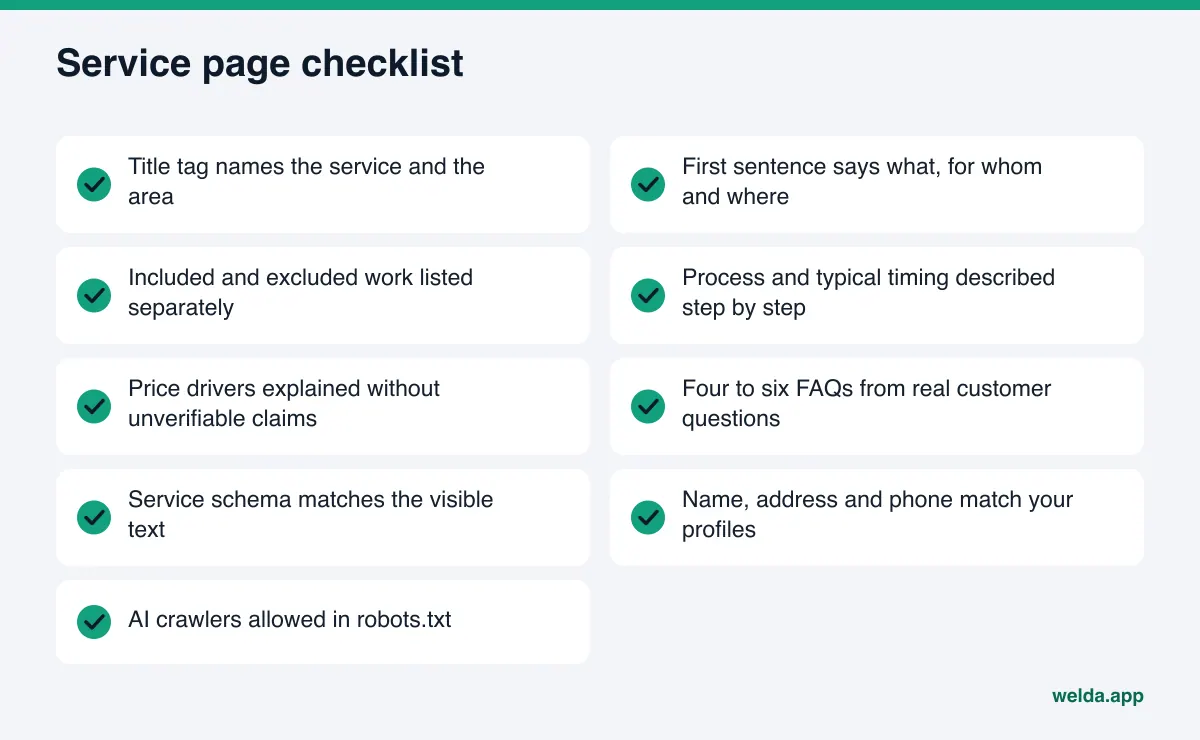
| Contact | Name, address, phone, hours | Written exactly as on your Google Business Profile |
Notice what the example lines have in common: each one makes sense on its own. An assistant may quote one paragraph, not the whole page. A paragraph that opens with "As mentioned above" or "We are experts in this field" means nothing out of context. "We service gas furnaces in homes across north Austin, Round Rock and Pflugerville" is a complete answer by itself.
A before-and-after rewrite
Here is the difference on a real-world scale. The business and neighborhoods below are an example, not a real company.
Before:
For over 20 years, our family-owned company has provided top-quality heating and cooling solutions to the greater Austin area. Our certified technicians are committed to your comfort and satisfaction. Call today for all your HVAC needs.
There is almost nothing an answer engine can use here. "Greater Austin" is vague, "top-quality" is unverifiable, and the paragraph never says what a tune-up includes or how fast you can come out. Every competitor could publish the same words.
After:
We tune up gas furnaces in single-family homes across north Austin, Round Rock and Pflugerville. Each visit covers a filter check, burner cleaning, flame sensor cleaning, a carbon monoxide test and thermostat calibration. Most appointments are available within the same week, and the visit typically takes about an hour. If a part needs replacing, we quote it in writing before starting work. Duct cleaning is not part of the tune-up and is booked separately.
The second version is not longer for its own sake. It is denser in facts. An assistant can now write "does furnace tune-ups in north Austin, lists exactly what the visit includes and how long it takes," which is the kind of reason that gets a business named. One rule matters more than any other: every fact in that paragraph must come from the business. Do not write a same-week promise you cannot keep because it reads well. Wrong facts do more damage than missing ones, and the FTC's advertising guide for small businesses is clear that claims must be truthful and backed by evidence.
How to rewrite a service page, step by step
Rewriting a page sounds like a project. Taken in order, one service page is a few hours of work.
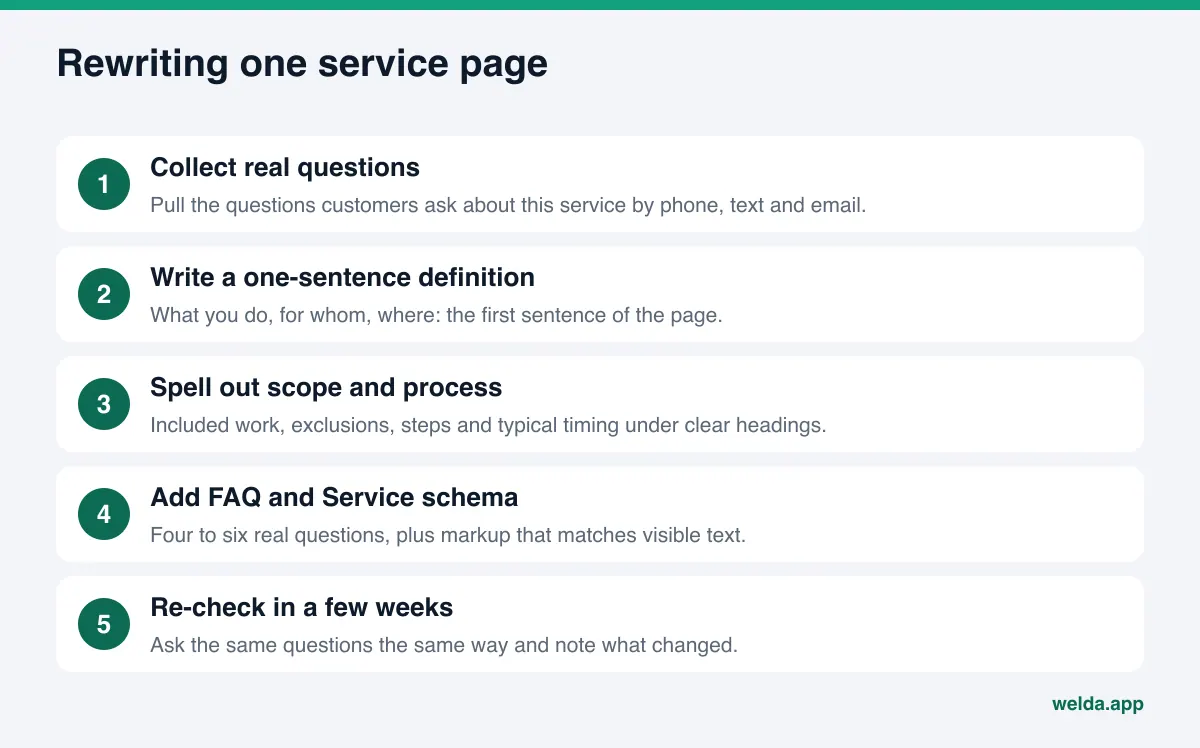
1. Collect real questions. Go through recent calls, texts and emails about this service. If the same question came in three times, the page does not answer it. These questions become your subheadings and your FAQ.
2. Write the one-sentence definition. The first sentence should follow a simple pattern: "We do [service] for [customer type] in [area], [how]." If you cannot write that sentence, the problem is not the copy. Agree internally on what the service is first.
3. Spell out scope and process. List what is included, what is not, the steps and the typical timing. If timing varies, give a range and say what it depends on.
4. Handle pricing honestly. If you do not publish prices, write what drives them and when the customer gets a quote. Skip "lowest prices in town" and similar claims you cannot back up.
5. Add an FAQ. Four to six real questions is plenty. Keep answers to two or three sentences, and put the service name in the question: "How long does a furnace tune-up take?" rather than "How long does it take?"
6. Add Service schema. The Service type on schema.org has fields for the service name, description, provider and area served. The rule is simple: whatever the markup says must also be visible on the page. Our guide to schema markup for AI search goes deeper.
7. Make sure AI crawlers can get in. A well-written page is useless if your robots.txt blocks AI search crawlers. Here is how to check robots.txt for AI crawlers.
8. Measure and keep it current. New copy usually takes weeks to show up in AI answers. Ask the same questions the same way a few weeks later. Keeping the page dated and current is part of the job; we explain why in content freshness for AI search.
Does every service need its own page?
Short answer: every service customers ask about by name needs its own answer, but not every answer needs its own URL. Two questions decide it. Do customers ask for this service by name? And does it have its own process, timing or pricing logic?
Take the example HVAC company again. "Furnace tune-up" and "furnace repair" are asked separately and work differently: one is a scheduled visit, the other is an urgent call. They deserve separate pages. "Furnace filter replacement" is usually asked as part of a tune-up, so a section on the tune-up page is enough. "Do you work Saturdays?" is not a service at all; it belongs in the FAQ.
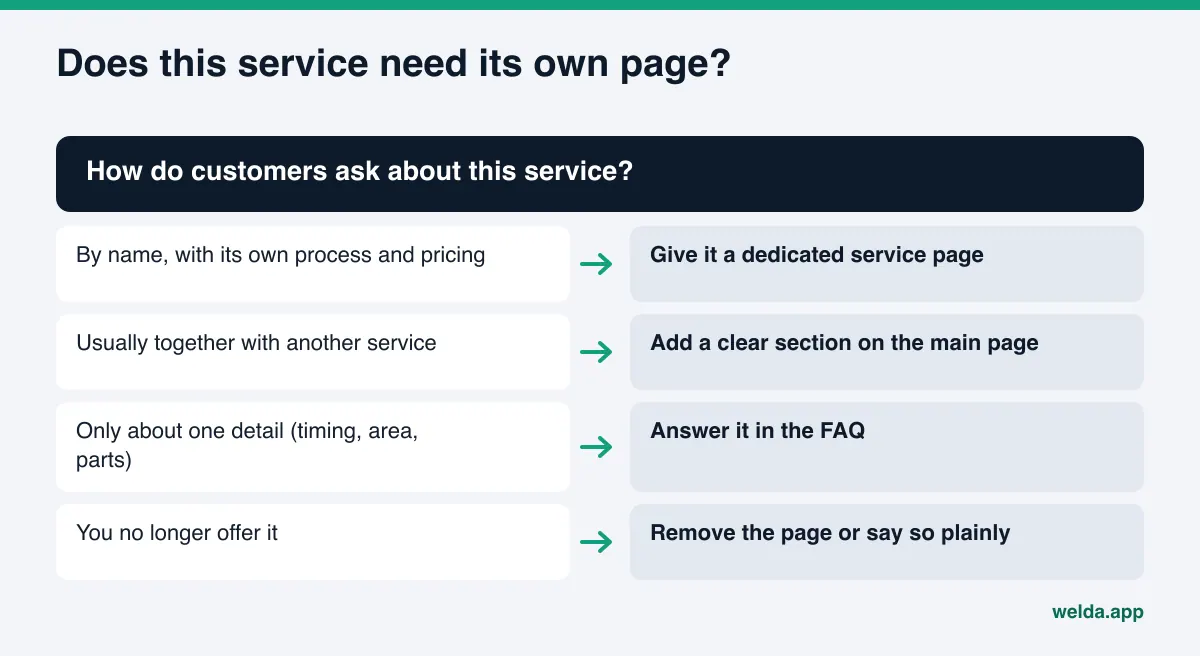
When you do create separate pages, each one needs its own opening sentence, scope and FAQ. Copying one page and swapping the service name gives answer engines two near-duplicates, not two services. The same principle applies if your site runs in more than one language; each version should be written for the questions asked in that language, as covered in our piece on multilingual AEO.
Keeping service pages consistent with your profiles
An answer engine does not judge a business from one page. It reads your site together with your Google Business Profile, Yelp, the BBB, Angi, Nextdoor recommendations and trade directories. When those sources disagree, the assistant decides which one to believe, and that decision does not always go your way.
After rewriting a service page, check three things:
- Service names. If the site says "furnace tune-up," list the same service under the same name on your Google Business Profile. "Heating maintenance" in one place and "furnace service" in another can read as two different offerings.
- Service area. The cities and neighborhoods on the page should match the service area on your profiles.
- Home page summary. Your home page should name your main services in a sentence or two and link to each page. The home page gives the overview, the service page gives the detail.
Reviews tie in as well. When a customer review mentions a furnace tune-up and your site has a clear tune-up page, the two sources support each other.
How Welda handles service pages
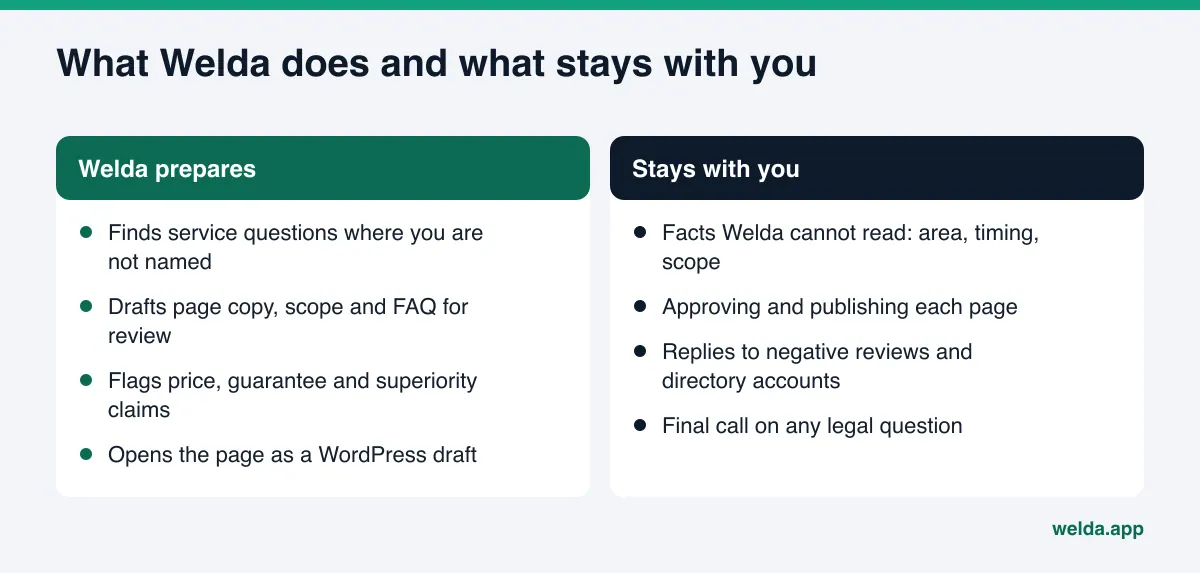
For this job, Welda does three things: it finds the service questions where you are not named, it fills missing facts without inventing them, and it drafts page copy that is ready to publish once you approve it.
Finding the gaps. In the Welda panel, the questions your customers would ask are put to ChatGPT, Gemini, Perplexity and Google AI three times each. For every question you see whether your name appears, in which engine and in what position, and which sources the answer relied on. For an HVAC company that might mean being named for furnace tune-ups but never for heat pump installation. If the heat pump answers lean on a directory listing and your own site has one line about heat pumps, the missing page is obvious.
Asking instead of guessing. Welda does not make up facts it cannot read on your site. If your service area, typical timing or scope is missing, it lands on the to-do list as information Welda needs from you. You enter it once and it flows into every draft. Fields left blank stay flagged in the preview, so a page with gaps does not go live by accident.
Drafting the page. Welda drafts the title, opening paragraph, scope, process and FAQ for the service page and puts it into preview. On WordPress sites, Welda connects through its own Editor user and an application password, with no plugin or code to install; the page opens as a draft and goes live when you approve it. On other platforms, Welda hands you a ready package and you apply it yourself. The content always lives on your own site. Before anything is published, a compliance check flags price, guarantee and superiority claims such as "lowest price guaranteed." It is a pattern check, not legal advice.
A note on availability. The Welda panel is in early access and is opening first to businesses in Turkey. Regular four-engine measurement is being added during early access, and sample panel screens use representative data. What anyone can use today is the free site analysis, which works in English: it reads your home page and pages such as services, pricing, about and contact, scores how clearly your services are described, suggests ready-to-use home page copy and gives you a fix package that includes business schema code.
What Welda does not do
- No ranking guarantee. Welda does not promise that a service page will be cited by ChatGPT or appear in Google AI Overviews. No one can. The work is making sure the facts are on your site in a form assistants can read.
- No invented facts. Service areas, timing and scope come from you.
- No publishing without approval. Drafts wait for your sign-off. In healthcare there is no automatic publishing at all; every piece goes to review.
- No fake reviews or testimonials. A "what our customers say" block is never filled with made-up quotes.
- Some work stays with you. Final replies to negative reviews, directory accounts and press outreach remain the business's job. Welda can draft text, but you own the accounts.
- No instant results. New pages usually take weeks to show up in AI answers, and timing varies by engine and question.
Where to start, and a service page checklist
A company with ten services cannot rewrite ten pages at once. Rank them by three things: share of revenue, questions where competitors are named and you are not, and services with no real page today. Start where those overlap. If they point in different directions, begin with the high-revenue service where you are missing from answers. Once the first page is done, you have a template and the rest go faster. Note the date each page goes live, so that when you re-ask the same questions you know what changed.
Three mistakes to avoid while working through the list:
- Keyword stuffing. Repeating "furnace tune-up Austin" in every paragraph makes the page harder to read and easier to ignore. The title, the opening and one subheading are enough.
- Markup that drifts from the text. If your schema lists a service area the page never mentions, that is an inconsistency. Write the copy first, then generate the markup from it.
- Stale pages. A page for a service you dropped can keep you recommended for work you no longer do. Our guide to updating old content for AI search walks through the cleanup. For a wider list, see the AEO checklist.
Frequently asked questions
Is a service page for AI different from a regular service page?
Mostly no. The difference is that it answers the customer's question in direct, self-contained sentences. A well-written service page works for people and for answer engines at the same time.
Do I have to publish prices?
No. Explaining what drives the price and when the customer gets a written quote is an honest answer. Avoid "lowest price" claims you cannot back up.
How long should a service page be?
Word count is not the goal. A page that answers the five core questions (what, for whom and where, how and how long, what drives price, what is excluded) is long enough. Filler does not help.
Is Service schema enough on its own?
No. Markup supports the visible text but does not replace it. Everything in the schema should also appear on the page.
How soon will a new service page show up in AI answers?
Usually within weeks rather than days, and it varies by engine and question. Re-ask the same questions a few weeks apart to see the effect.
Will Welda publish my service pages automatically?
No. On WordPress, pages open as drafts and go live only when you approve them. On other platforms, Welda provides the copy and code and you apply them.
Check your service pages for free
To see how your service pages read to AI assistants, run the free site analysis. It reads your home page and several inner pages, including services, and returns a score out of 100, what it found for each gap and how to fix it, suggested home page copy and a fix package with business schema code. It also asks a web-enabled AI assistant five questions your customers might ask and checks whether your business is named, as a one-time snapshot. It is free once per site; your results link arrives by email and stays open for 14 days.